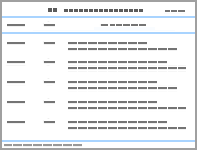
| Sample | Dominant species | Life form | Density | Height (cm) | Crown width (cm) | Importance value |
|---|---|---|---|---|---|---|
| S1 | Agropyron cristatum (L.) Gaertn. | Perennial herb | 160 | 18.09±4.53 | 17.5±3.54 | 0.24 |
| Phragmites australis (Cav.) Trin. ex Steud. | Perennial herb | 242 | 4.88±1.40 | 5.31±2.16 | 0.23 | |
| S2 | Cyperus rotundus L. | Annual herb | 430 | 6.67±3.06 | 3.00±0.58 | 0.38 |
| A. cristatum | Perennial herb | 76 | 102.5±37.89 | 4.50±0.71 | 0.36 | |
| S3 | Nitraria tangutorum Bobrov | Shrub | 1 | 120.00±55.13 | 150.00±39.24 | 0.32 |
| C. rotundus | Annual herb | 200 | 10.00±1.12 | 10.00±0.74 | 0.21 | |
| S4 | Tamarix chinensis Lour. | Shrub | 1 | 200.00±42.14 | 150.00±23.22 | 0.37 |
| P. australis | Perennial herb | 150 | 160.00±10.13 | 30.00±5.24 | 0.21 | |
| S5 | P. australis | Perennial herb | 120 | 60.00±5.79 | 40.00±22.56 | 0.26 |
| Calamagrostis epigeios (L.) Roth | Perennial herb | 100 | 150.00±26.28 | 30.00±9.86 | 0.31 | |
| S6 | Apocynum venetum L. | Semi-shrub | 49 | 73.13±15.26 | 42.67±7.53 | 0.66 |
| P. australis | Perennial herb | 21 | 25.93±10.94 | 16.93±12.30 | 0.26 | |
| S7 | T. chinensis | Shrub | 3 | 200.00±50.00 | 260.00±69.28 | 0.34 |
| A. venetum | Semi-shrub | 63 | 39.06±9.35 | 31.67±5.88 | 0.33 | |
| S8 | P. australis | Perennial herb | 370 | 113.33±29.55 | 45.33±13.60 | 1.00 |
| S9 | P. australis | Perennial herb | 1760 | 47.65±22.05 | 25.56±9.38 | 0.63 |
| T. chinensis | Shrub | 1 | 150.00±44.65 | 176.00±34.52 | 0.29 | |
| S10 | T. chinensis | Shrub | 3 | 200.00±64.38 | 350.00±77.84 | 0.40 |
| P. australis | Perennial herb | 35 | 35.00±14.23 | 30.00±10.24 | 0.35 | |
| S11 | P. australis | Perennial herb | 740 | 65.67±23.42 | 17.94±7.04 | 1.00 |
| S12 | P. australis | Perennial herb | 70 | 50.78±31.33 | 23.94±14.87 | 1.00 |
| S13 | P. australis | Perennial herb | 97 | 22.36±7.68 | 7.90±5.24 | 0.30 |
| T. chinensis | Shrub | 1 | 45.00±12.14 | 200.00±70.91 | 0.29 |