

Emotional Mediation of the Effect of Urban Park Audiovisual Elements on Leisure-Time Physical Activity
|
WANG Yueqi is a Ph.D. candidate in the School of Architecture and Planning, Shenyang Jianzhu University. Her research focuses on urban landscapes and human needs |
|
HU Zhenguo, Master, is an associate professor and deputy director of the Department of Urban Planning, the School of Architecture and Planning, Shenyang Jianzhu University. His research focuses on rural development and the creation of vibrant communities |
|
ZHU Ling, Ph.D. is a distinguished professor, doctoral supervisor, and the Department of Landscape Architecture in the School of Architecture, Tianjin University, and chief landscape architect at the Planning and Architecture Design Research Institute of Tianjin University. Her research focuses on urban landscape and urban design, as well as ecological landscape planning and design |
Received date: 2025-07-12
Revised date: 2026-01-16
Online published: 2026-03-13
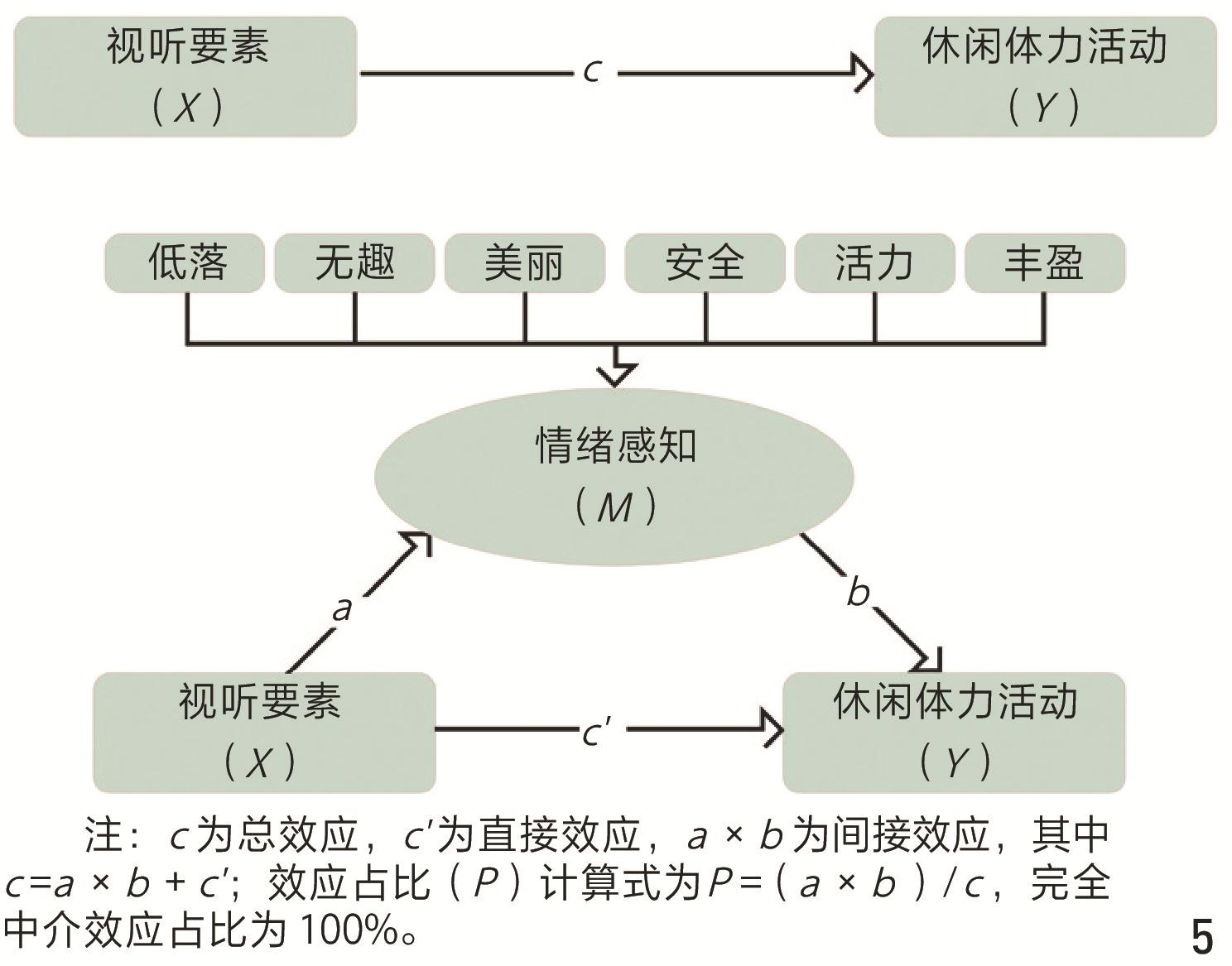
[Objective] As one of the basic well-beings and primary needs for the survival and development of mankind, health is closely influenced by a variety of multidimensional and complex influencing factors. Leisure-time physical activity (LTPA) is a physical activity of large flexibility in such factors as activity strength, duration, location selection and others, and together with the outstanding regulation effect on the physiological and psychological aspects, has seen a continuous and gradually expanded role in daily life. It is therefore regarded as the most promising type of changeable physical activities. Urban parks as a spatial store of comprehensive health resources have been rooted in green space system. They are combined with various service resources, providing a physical environment for LTPA. However, the majority of current research on LTPA predominantly concentrates on the direct relationship between the environment and behavior. Visual and auditory cues are typically presented in a parallel manner, lacking joint modeling at the same spatiotemporal location. Emotional perception, as a crucial psychological pivot through which environmental cues influence behavior, has not undergone systematic scrutiny. This has led to difficulties in the precise implementation of relevant design strategies. In the context of park settings, visual and auditory cues frequently co-occur at the same spatiotemporal point. They may influence an individual's subjective evaluations of safety, pleasure, and vitality through emotional regulation, thereby affecting their activity intensity and inclination to remain in the area. Consequently, there is an urgent need to conduct empirical research using the framework of "audio-visual environmental elements−emotional perception−leisure physical activities".
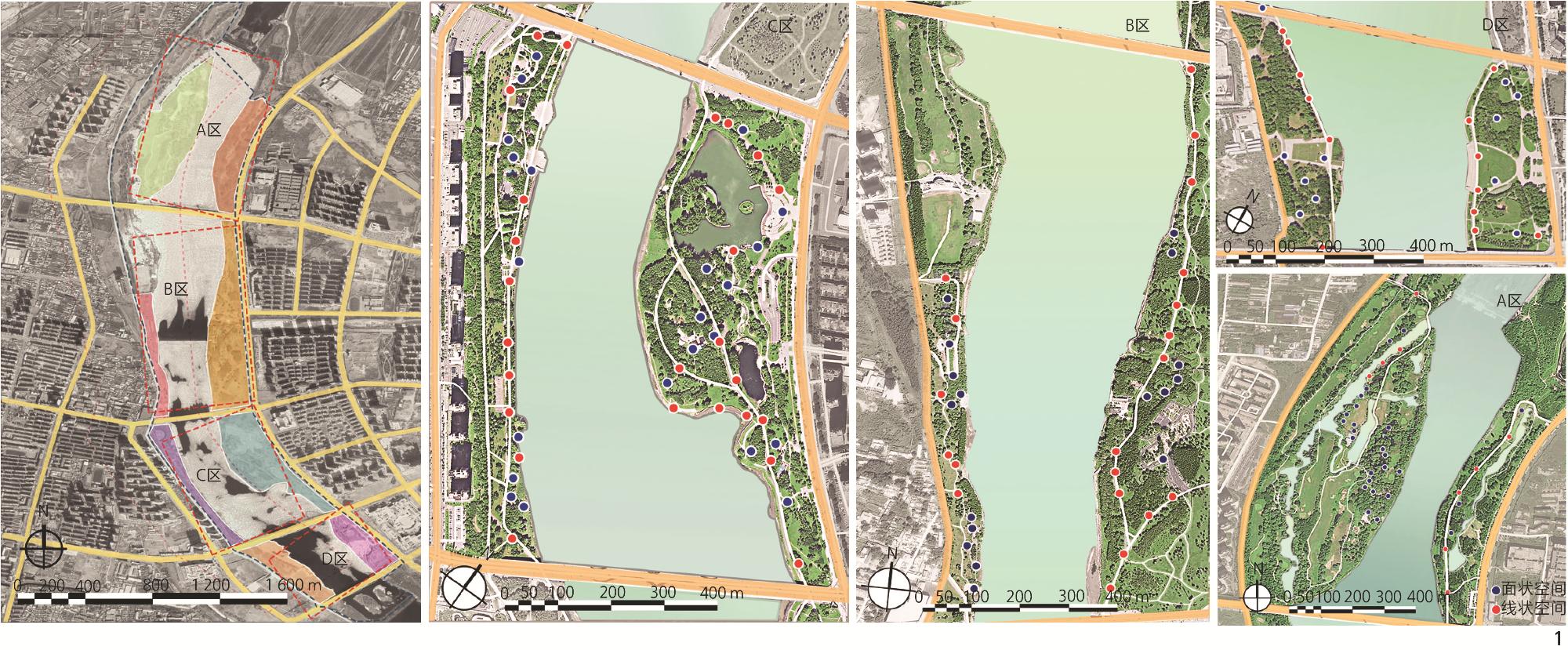
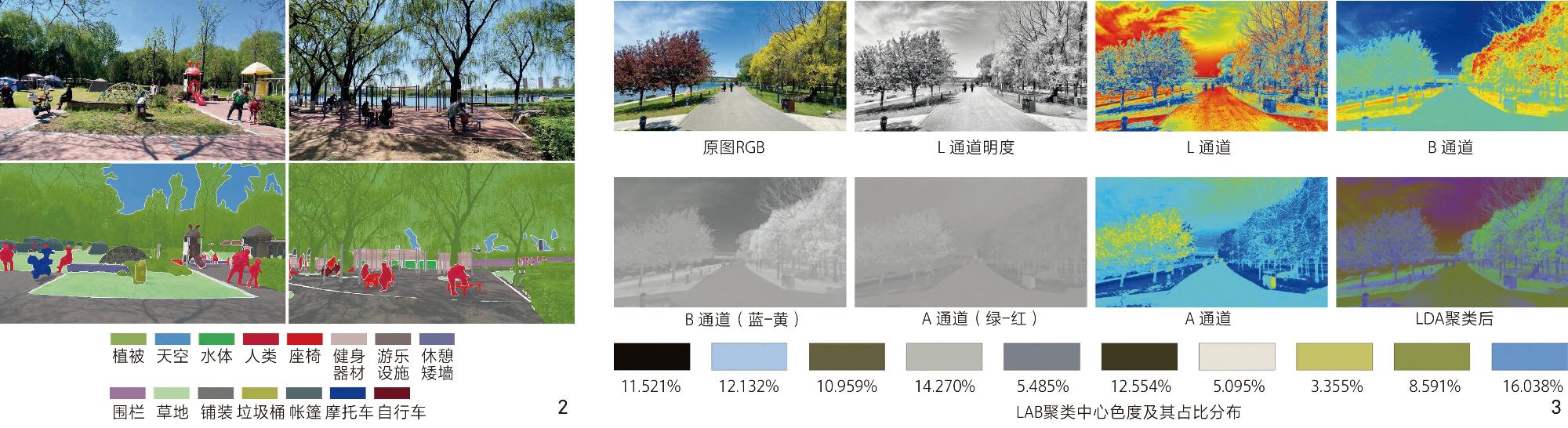
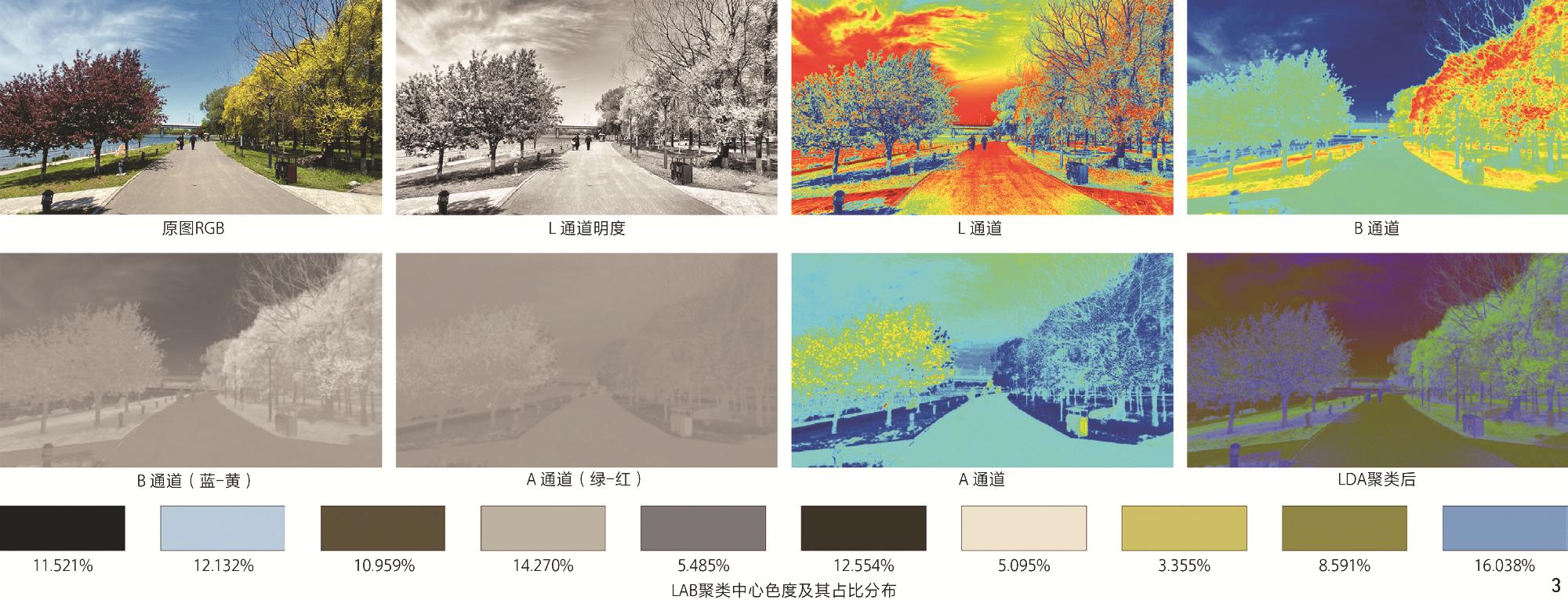
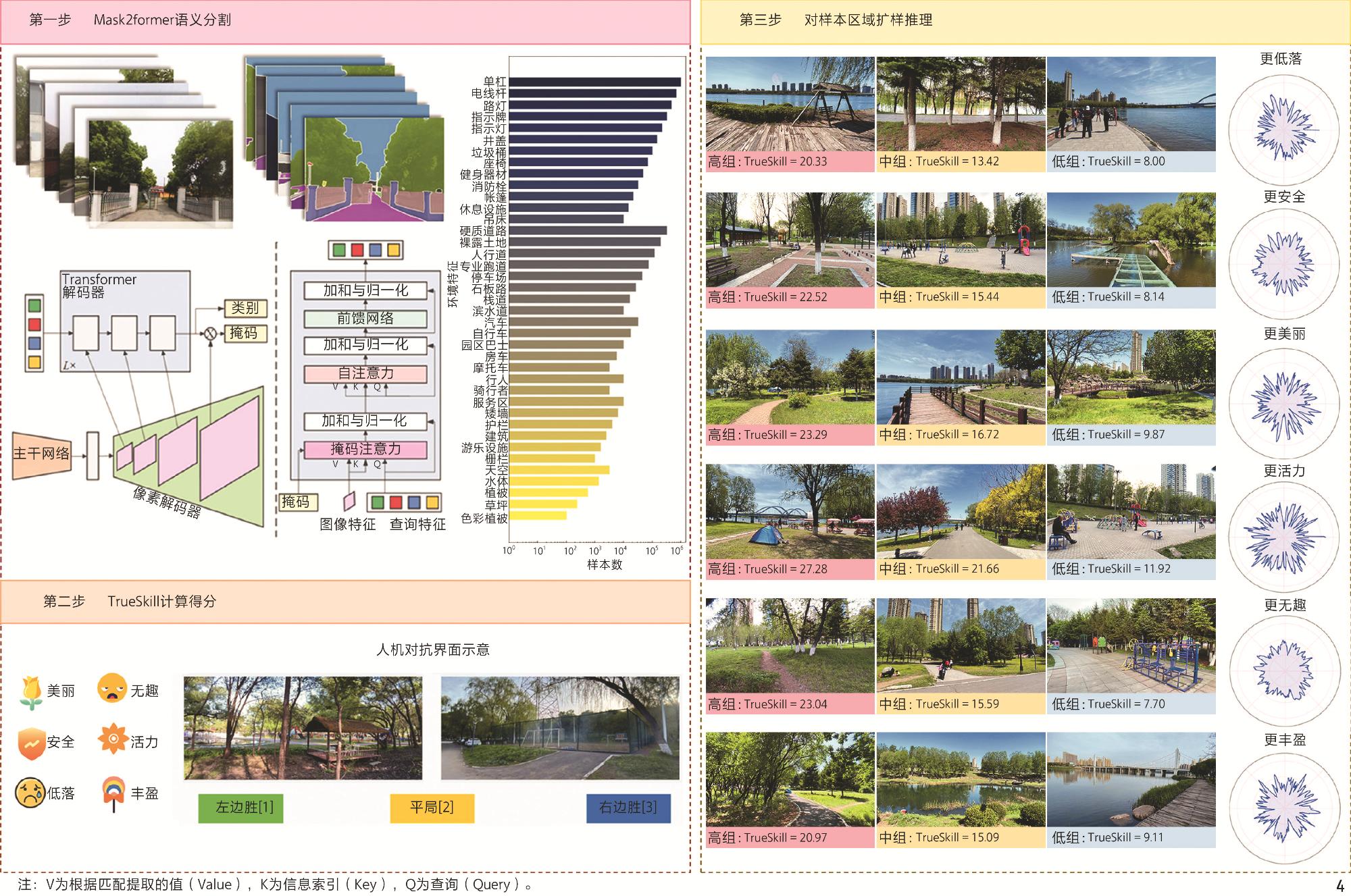
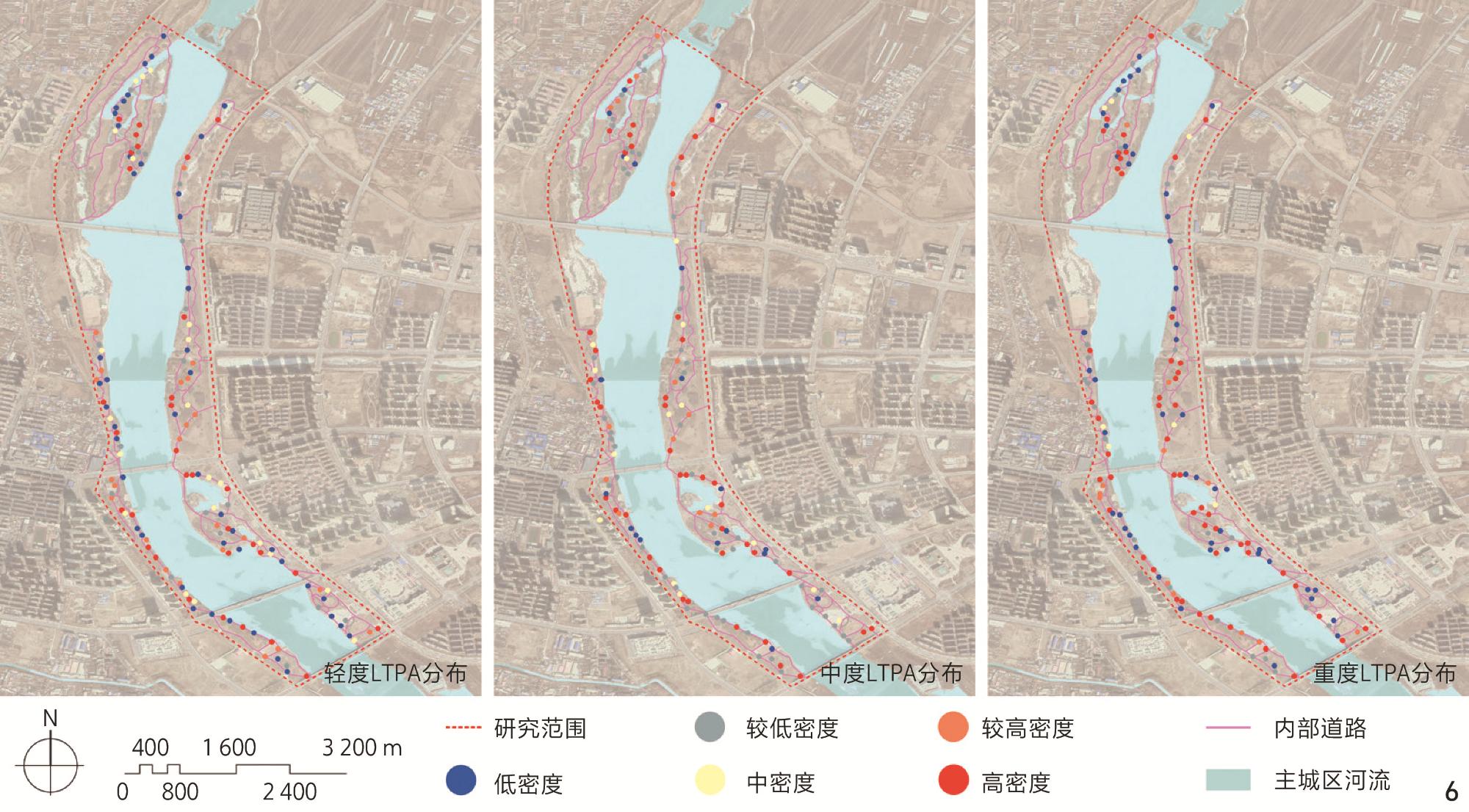
[Methods] In this paper, 144 landscape nodes in Taizi River Park, Liaoyang City, Liaoning Province were classified meticulously. In terms of visual object, the image acquisition method is conducted on a sunny day, and the circumferential three pictures are shot for each landscape node. ArcGIS 10.8 software was applied to match the image with GPS spatial data. The mask2Former semantic segmentation model was applied to the image data. According to Mapillary Vistas dataset, leisure-time physical activity related image vectors were embedded to build customized model according to the research purpose. The acquired image data were analyzed by this method. Color features (color saturation, color richness, and color harmony) of obtained image were analyzed using K-means algorithm. A “human-machine duel” score sheet was used for the emotional evaluation of the environment. For the acoustics, the environmental sound cues and the source category for the audio part were noted according to the ISO/TS
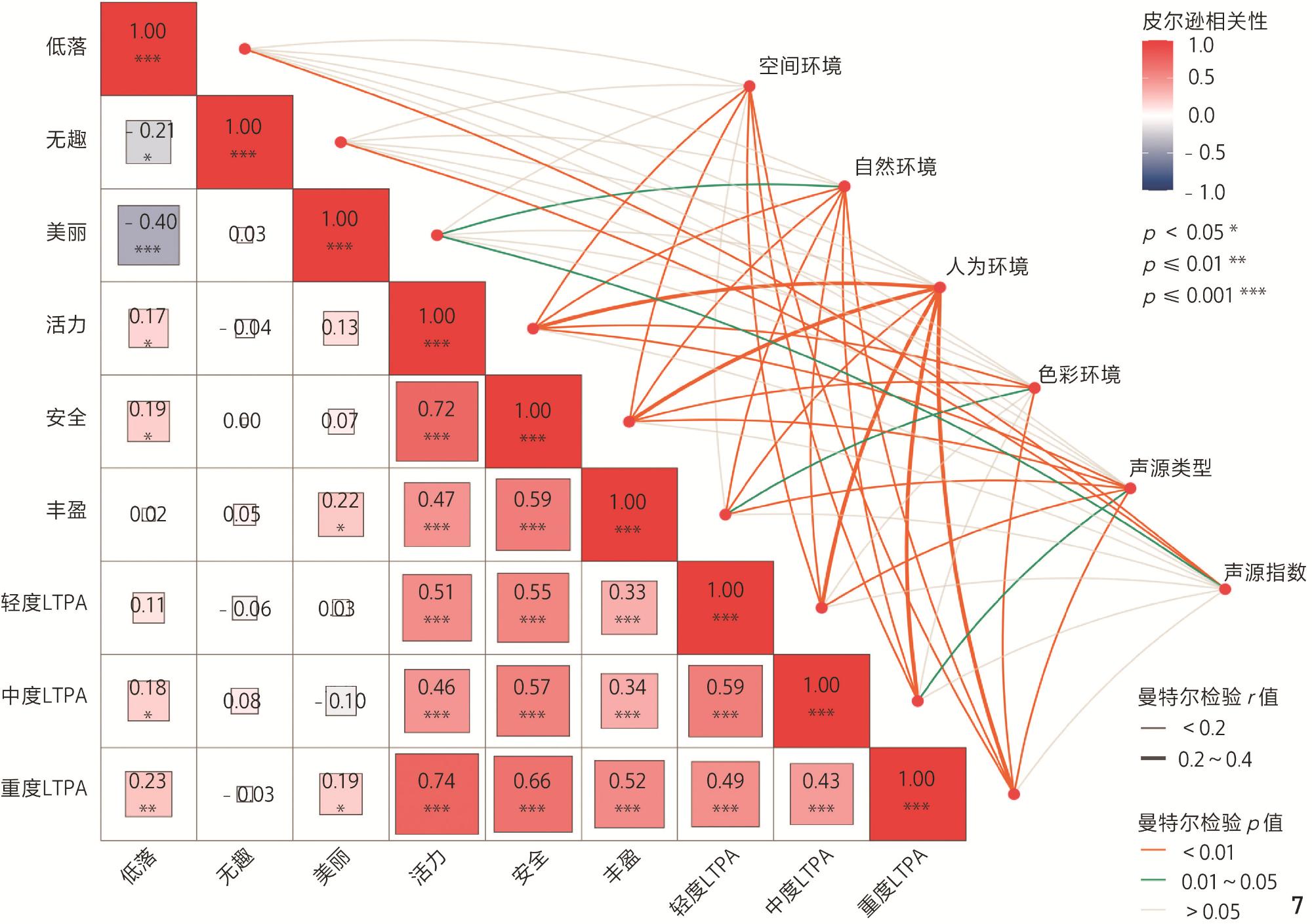
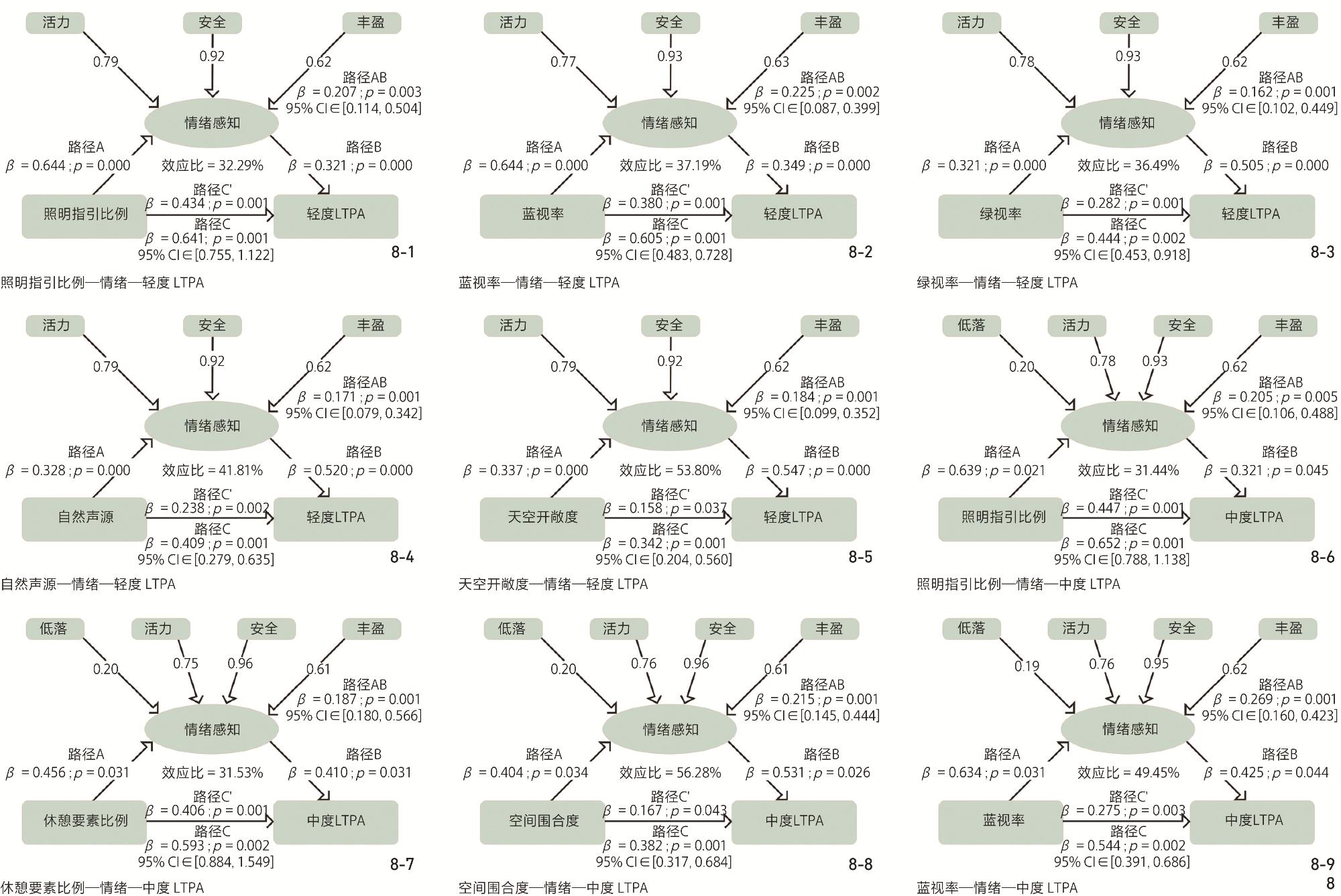
[Results] Through the analysis of the audio-visual environment, emotional evaluation, and behavioral observation data collected in the field, this study has yielded a series of crucial findings. Visual and auditory elements within urban parks, including the blue view ratio, sky openness, natural sounds, and light guidance, can significantly enhance visitors' positive emotional experiences (such as a sense of security, vitality, and fulfillment). This, in turn, further increases the likelihood of light-intensity and moderate-intensity LTPA. Emotional perception exerted a partial mediating effect along multiple pathways, providing quantitative evidence for the "environment−emotion−behavior" framework. Specifically, sky openness and natural sound sources influenced light LTPA through emotional perception, while spatial enclosure affected moderate LTPA. These results suggest that an open skyline and a favorable water-related environment are conducive to eliciting positive emotions and promoting gentle physical activities. Moreover, moderately enclosed green spaces significantly facilitate moderate activities by enhancing the sense of security. In contrast, no significant emotional mediation pathway was identified for high-intensity physical activities. This might be attributed to the fact that high-intensity activities are more goal-driven and performance-oriented. Environmental factors primarily act on such activities by directly influencing aspects such as safety and convenience, rather than indirectly through emotions.
[Conclusion] This research delved into the interrelationship of "environment−emotion−behavior" within the context of urban parks, quantitatively validating the pivotal mediating role of emotional perception in the process where the audiovisual environment influences LTPA. This has advanced the comprehension of the mechanisms through which environmental elements facilitate behaviors. On a practical level, the research findings offer significant implications for enhancing the health-promoting benefits of urban parks. Looking ahead, the analytical framework and optimization strategies established in this study can serve as a theoretical foundation and practical reference for related disciplines. They can also drive the research agenda of integrating emotional perception into environmental interventions to promote behavioral change, thereby providing a scientific underpinning for the creation of healthy cities and active spaces.
WANG Yueqi , HU Zhenguo , ZHU LING . Emotional Mediation of the Effect of Urban Park Audiovisual Elements on Leisure-Time Physical Activity[J]. Landscape Architecture, 2026 , 33(3) : 90 -101 . DOI: 10.3724/j.fjyl.LA20250363
表1 城市公园视觉、听觉环境要素描述性统计表[31-40]Tab. 1 Descriptive statistical table of visual and audio elements in urban parks[31-40] |
| 要素分类 | 序号 | 环境要素 | 定义/计算方式 | 量化方法 | |
| 注:a)色彩饱和度:将BGR格式图像转换为LAB颜色空间,利用其a、b通道分别表征红-绿与黄-蓝色度范围的特征;b)色彩丰富度:将图像转换至HSV空间并构建色相分量直方图,其分布跨度(最大值与最小值之差)可表征色相多样性水平;c)色彩和谐度:将图像经BGR空间转换至HSV色域(其色彩表征更贴合人眼感知机制),运用K均值聚类算法对像素进行聚类处理生成k个簇集并定位聚类中心。 | |||||
| 视觉 | 空间环境 | S1 | 天空开敞度 | 天空在图像中所占比例 | 语义分割 |
| S2 | 空间围合度 | 垂直要素(陆生植被、园内建筑、栏杆)在图像中所占比例 | |||
| 自然环境 | N1 | 绿视率 | 绿色植被(草坪、陆生植被、水生植被)在图像中所占比例 | ||
| N2 | 植被层次 | 单层型(草、灌、乔)=1;双层型(乔-草、乔-灌、灌-草)=2;三层型(乔-灌-草)=3 | 赋值统计 | ||
| N3 | 视觉主体植被健康程度[37] | 不健康=1(植被长势较差,叶色枯黄/异常,观赏价值低,树木树冠缺损≥40%);一般=2(植被长势一般,叶色普遍正常,有一定观赏价值,树木树冠缺损10%-40%);健康=3(枝叶丰盈,叶色正常,观赏价值较高,无明显病虫害和枯枝败叶树木树冠缺损<10%) | |||
| N4 | 花卉景观 | 无=1;有=2 | |||
| N5 | 土壤裸露度 | 较低=1;一般=2;较高=3 | |||
| N6 | 蓝视率 | 水体在图像中所占比例 | 语义分割 | ||
| N7 | 水体质量 | 无水体=0;干涸=1;浑浊=2;清澈=3 | 赋值统计 | ||
| N8 | 亲水体验 | 无相关=0;人工垂直型驳岸(护栏型)=1;亲水栈道=2;自然生态型驳岸=3 | |||
| 人为环境 | H1 | 城市背景比例 | 城市背景在图像中占比 | 语义分割 | |
| H2 | 休憩要素比例 | 园内座椅、长廊、遮阳空间占比 | |||
| H3 | 照明指引比例 | 路标、引导、记忆性装置、路灯空间占比 | |||
| H4 | 活动器材比例 | 可承载体力活动进行的器材占比 | |||
| H5 | 铺装比例 | 铺装在图像中所占比例 | |||
| H6 | 铺装材质 | 自然形成路径=1(铺装比例<3%);硬性路面(砖石、沥青、碎石)=2;木质=3;运动材质=4 | 赋值统计 | ||
| 色彩环境[38] | C1 | 色彩饱和度[39]a) | 主色RGB标准差与亮度均值的比值 | 色彩量化 | |
| C2 | 色彩丰富度b) | 主色数量与占比熵 | |||
| C3 | 色彩和谐度[40]c) | 色相环间距与互补色比例 | |||
| 听觉 | 声源类型 | V1 | 自然声源 | 语义差异尺度(1=完全听不到、2=较弱、3=可听但不主导、4=较强、5=完全占主导) | 赋值统计 |
| V2 | 人类声源 | ||||
| V3 | 机械声源 | ||||
| 声源指数 | L1 | 等效连续声级(equivalent continuous sound level, Leq) | 特定时间段内“稳定噪声”的声级值 | 测量统计 | |
| L2 | 声暴露级(a-weighted sound exposure level, Lae) | 单次噪声事件的总声能归一化1 s内的等效声级 | |||
| L3 | 声标准偏差(standard deviation of sound level, SD) | 声音波动频率强度 | |||
表4 视听要素与情绪感知的多元逐步回归分析Tab. 4 Multiple stepwise regression analysis of audio-visual elements and emotional perception |
| 情绪维度 | 模型参数 | 环境要素 | | t 值 | VIF |
| 注:**代表p≤0.01,*代表p<0.05,6个模型的残差分布均符合正态分布,且VIF值均小于5,表明模型不存在多重共线性且整体拟合效果显著。 | |||||
| 低落 | R 2=0.351 调整R 2=0.337 F=25.212 | 土地裸露度 | −0.302 | −4.232** | 1.096 |
| 等效连续声级 | −0.375 | −4.304** | 1.639 | ||
| 声暴露级 | 0.536 | 5.971** | 1.735 | ||
| 无趣 | R 2=0.258 调整R 2=0.247 F=24.476 | 等效连续声级 | 0.420 | 4.945** | 1.367 |
| 声标准偏差 | −0.576 | −6.795** | 1.367 | ||
| 美丽 | R 2=0.239 调整R 2=0.212 F=8.683 | 空间围合度 | −0.192 | −2.332* | 1.232 |
| 城市背景比例 | −0.236 | −2.979** | 1.135 | ||
| 花卉景观 | 0.274 | 3.426** | 1.157 | ||
| 自然声源 | 0.250 | 3.317** | 1.032 | ||
| 声暴露级 | −0.323 | −4.242** | 1.051 | ||
| 安全 | R 2=0.614 调整R 2=0.597 F=36.266 | 蓝视率 | 0.257 | 3.880** | 1.552 |
| 亲水体验 | 0.153 | 2.358* | 1.484 | ||
| 休憩要素比例 | 0.135 | 2.336* | 1.180 | ||
| 照明指引比例 | 0.267 | 4.293** | 1.370 | ||
| 活动器材比例 | 0.217 | 3.139** | 1.696 | ||
| 铺装材质 | 0.224 | 4.116** | 1.047 | ||
| 活力 | R 2=0.533 调整R 2=0.512 F=26.037 | 天空开敞度 | 0.129 | 2.082* | 1.132 |
| 植被健康度 | 0.256 | 3.947** | 1.233 | ||
| 土地裸露度 | −0.133 | −2.140* | 1.125 | ||
| 照明指引比例 | 0.262 | 3.797** | 1.395 | ||
| 活动器材比例 | 0.181 | 2.799** | 1.221 | ||
| 铺装材质 | 0.261 | 3.888** | 1.321 | ||
| 丰盈 | R 2=0.441 调整R 2=0.416 F=17.993 | 蓝视率 | 0.185 | 2.364* | 1.508 |
| 亲水体验 | 0.146 | 2.017* | 1.291 | ||
| 照明指引比例 | 0.161 | 2.148* | 1.383 | ||
| 活动器材比例 | 0.252 | 3.750** | 1.110 | ||
| 自然声源 | 0.165 | 2.276* | 1.285 | ||
| 人类声源 | 0.290 | 3.884** | 1.367 | ||
表5 视听要素与3种强度LTPA的多元逐步回归分析Tab. 5 Multiple stepwise regression analysis of audiovisual elements and three intensities of LTPA |
| 体力活动 | 模型参数 | 环境要素 | | t 值 | VIF |
| 注:**代表p≤0.01,*代表p<0.05,3个模型的残差分布均符合正态分布,且VIF值均小于5,表明模型不存在多重共线性且整体拟合效果显著。 | |||||
| 轻度LTPA | R 2=0.645 调整R 2=0.629 F=41.467 | 天空开敞度 | 0.130 | 2.357* | 1.177 |
| 绿视率 | 0.308 | 5.681** | 1.133 | ||
| 土地裸露度 | 0.144 | 2.686** | 1.108 | ||
| 蓝视率 | 0.216 | 3.369** | 1.579 | ||
| 照明指引比例 | 0.407 | 6.612** | 1.462 | ||
| 自然声源 | 0.186 | 3.343** | 1.196 | ||
| 中度LTPA | R 2=0.606 调整R 2=0.589 F=35.134 | 天空开敞度 | −0.135 | −2.287* | 1.217 |
| 空间围合度 | 0.157 | 2.314* | 1.599 | ||
| 蓝视率 | 0.147 | 2.458* | 1.242 | ||
| 休憩要素比例 | 0.223 | 3.722** | 1.249 | ||
| 照明指引比例 | 0.293 | 4.506** | 1.470 | ||
| 活动器材比例 | 0.366 | 5.445** | 1.574 | ||
| 重度LTPA | R 2=0.579 调整R 2=0.560 F=31.364 | 天空开敞度 | 0.224 | 3.817** | 1.118 |
| 植被健康度 | 0.137 | 2.127* | 1.350 | ||
| 土地裸露度 | −0.154 | −2.629** | 1.119 | ||
| 亲水体验 | 0.135 | 2.296* | 1.125 | ||
| 照明指引比例 | 0.252 | 3.885** | 1.366 | ||
| 铺装材质 | 0.393 | 6.410** | 1.219 | ||
1、构建城市公园同点位“双模态—情绪—行为”联合建模框架,融入Mask2Former、TrueSkill模型与现场声学实测,并以逐步回归及Bootstrap中介检验方法实现在节点尺度上环境对行为影响力的精准、可复制评估。
2、从内部空间视角揭示“环境—情绪—行为”机制模型,系统解析不同强度休闲体力活动的差异化响应特征及关键中介路径的效应占比。
3、形成可操作的场地优化策略谱系,为城市公园健康效益提升提供可落地的空间与声景优化策略。
| [1] |
健康中国行动推进委员会.健康中国行动(2019—2030 年)[EB/OL].(2019-07-15)[2024-05-01].https://www.gov.cn/xinwen/2019-07/15/content_5409694.htm.
The Healthy China Action Promotion Committee. Healthy China Initiative (2019−2030) [EB/OL]. (2019-07-15) [2024-05-01]. https://www.gov.cn/xinwen/2019-07/15/content_5409694.htm.
|
| [2] |
KIECOLT-GLASER J K, RENNA M E, SHROUT M R, et al. Stress Reactivity: What Pushes Us Higher, Faster, and Longer—and Why It Matters[J]. Current Directions in Psychological Science, 2020, 29(5): 492-498.
|
| [3] |
CASE L, SCHRAM B, JUNG J, et al. A Meta-Analysis of the Effect of Adapted Physical Activity Service-Learning Programs on College Student Attitudes Toward People with Disabilities[J]. Disability and Rehabilitation, 2021, 43(21): 2990-3002.
|
| [4] |
MAHINDRU A, PATIL P, AGRAWAL V. Role of Physical Activity on Mental Health and Well-Being: A Review[J]. Cureus, 2023, 15(1): e33475.
|
| [5] |
PEKMEZI D, JENNINGS E, MARCUS B H. Evaluating and Enhancing Self-Efficacy for Physical Activity[J]. ACSM’s Health & Fitness Journal, 2009, 13(2): 16-21.
|
| [6] |
EATHER N, WADE L, PANKOWIAK A, et al. The Impact of Sports Participation on Mental Health and Social Outcomes in Adults: A Systematic Review and the ‘Mental Health Through Sport’ Conceptual Model[J]. Systematic Reviews, 2023, 12(1): 102.
|
| [7] |
DEMPSEY P C, ROWLANDS A V, STRAIN T, et al. Physical Activity Volume, Intensity, and Incident Cardiovascular Disease[J]. European Heart Journal, 2022, 43(46): 4789-4800.
|
| [8] |
LUO H H, HUANG Y X, ZHANG Q L, et al. Impacts of Physical Activity and Particulate Air Pollution on the Onset, Progression and Mortality for the Comorbidity of Type 2 Diabetes and Mood Disorders[J]. Science of the Total Environment, 2023, 890:164315.
|
| [9] |
WANG Q Y, ZHOU W L. Roles and Molecular Mechanisms of Physical Exercise in Cancer Prevention and Treatment[J]. Journal of Sport and Health Science, 2021, 10(2): 201-210.
|
| [10] |
HALLAL P C, REIS R S, PARRA D C, et al. Association Between Perceived Environmental Attributes and Physical Activity Among Adults in Recife, Brazil[J]. Journal of Physical Activity & Health, 2010, 7(Suppl 2): S213-S222.
|
| [11] |
王鑫, 李雄. 基于网络大数据的北京森林公园社会服务价值评价研究[J]. 中国园林, 2017, 33(10): 14-18.
WANG X, LI X. Research on the Analysis of Social Services Value of Forest Park in Beijing Based on Network Big Data[J]. Chinese Landscape Architecture, 2017, 33(10): 14-18.
|
| [12] |
WANG X X, ZHOU Q F, ZHANG M J, et al. Exercise in the Park or Gym? The Physiological and Mental Responses of Obese People Walking in Different Settings at Different Speeds: A Parallel Group Randomized Trial[J]. Frontiers in Psychology, 2021, 12:728826.
|
| [13] |
JEKAUC D, BRAND R. Editorial: How Do Emotions and Feelings Regulate Physical Activity?[J]. Frontiers in Psychology, 2017, 8:1145.
|
| [14] |
YANG J X, ZHOU Q, LIU X Y, et al. Biased Perception Misguided by Affect: How Does Emotional Experience Lead to Incorrect Judgments About Environmental Quality?[J]. Global Environmental Change, 2018, 53:104-113.
|
| [15] |
宋扬, 吴丹蓉, 吕勤智. 乡村视觉识别系统设计(Ⅵ)在半山村景观环境中的应用设计[J]. 浙江工业大学学报(社会科学版), 2017, 16(3): 266-271.
SONG Y, WU D R, LV Q Z. A Study of the Application of Visual Identity System(Ⅵ) of Rural Areas in the Landscape Design of Banshancun Village[J]. Journal of Zhejiang University of Technology (Social Science), 2017, 16(3): 266-271.
|
| [16] |
COTTET M, PIÉGAY H, BORNETTE G. Does Human Perception of Wetland Aesthetics and Healthiness Relate to Ecological Functioning?[J]. Journal of Environmental Management, 2013, 128:1012-1022.
|
| [17] |
马冰倩, 徐程扬, 刘江, 等. 城镇森林视觉景观异质性对美学质量的影响[J]. 浙江农林大学学报, 2019, 36(2): 366-374.
MA B Q, XU C Y, LIU J, et al. Visual Heterogeneity and Visual Landscape Quality of Urban Forests as an Architectural Backdrop[J]. Journal of Zhejiang A&F University, 2019, 36(2): 366-374.
|
| [18] |
FOCHT B C. Brief Walks in Outdoor and Laboratory Environments: Effects on Affective Responses, Enjoyment, and Intentions to Walk for Exercise[J]. Research Quarterly for Exercise and Sport, 2009, 80(3): 611-620.
|
| [19] |
MCCORMACK G R, ROCK M, TOOHEY A M, et al. Characteristics of Urban Parks Associated with Park Use and Physical Activity: A Review of Qualitative Research[J]. Health & Place, 2010, 16(4): 712-726.
|
| [20] |
ALVARSSON J J, WIENS S, NILSSON M E. Stress Recovery During Exposure to Nature Sound and Environmental Noise[J]. International Journal of Environmental Research and Public Health, 2010, 7(3): 1036-1046.
|
| [21] |
ZHANG M, KANG J. Towards the Evaluation, Description, and Creation of Soundscapes in Urban Open Spaces[J]. Environment and Planning B: Planning and Design, 2007, 34(1): 68-86.
|
| [22] |
JENNINGS P, CAIN R. A Framework for Improving Urban Soundscapes[J]. Applied Acoustics, 2013, 74(2): 293-299.
|
| [23] |
LIU J, KANG J, BEHM H, et al. Effects of Landscape on Soundscape Perception: Soundwalks in City Parks[J]. Landscape and Urban Planning, 2014, 123:30-40.
|
| [24] |
GAN Y H, LUO T, BREITUNG W, et al. Multi-sensory Landscape Assessment: The Contribution of Acoustic Perception to Landscape Evaluation[J]. The Journal of the Acoustical Society of America, 2014, 136(6): 3200.
|
| [25] |
ZHAO J W, XU W Y, YE L. Effects of Auditory-Visual Combinations on Perceived Restorative Potential of Urban Green Space[J]. Applied Acoustics, 2018, 141:169-177.
|
| [26] |
JEON J Y, JO H I. Effects of Audio-Visual Interactions on Soundscape and Landscape Perception and Their Influence on Satisfaction with the Urban Environment[J]. Building and Environment, 2020, 169:106544.
|
| [27] |
JIN T F, LU J Y, SHAO Y H. Exploring the Impact of Visual and Aural Elements in Urban Parks on Human Behavior and Emotional Responses[J]. Land, 2024, 13(9): 1468.
|
| [28] |
FELISATTI A, FISCHER M H. Experimental Methods in Embodied Cognition: How Cognitive Psychologists Approach Embodiment[M]. London: Routledge, 2023.
|
| [29] |
KIM C, KIM J, THAPA B. Bidirectional Association Between Leisure Time Physical Activity and Well-Being: Longitudinal Evidence[J]. Journal of Leisure Research, 2020, 51(5): 559-580.
|
| [30] |
秦昕璐, 刘晖. 感知与表达: 从视知觉体验看景观空间营建[J]. 城市建筑, 2019, 16(28): 179-182,188.
QIN X L, LIU H. Perception and Expression: Construction of the Landscape Space from the View of Visual Perception Experience[J]. Urbanism and Architecture, 2019, 16(28): 179-182,188.
|
| [31] |
刘滨谊, 范榕. 景观空间视觉吸引要素及其机制研究[J]. 中国园林, 2013, 29(5): 5-10.
LIU B Y, FAN R. Research on Visual Attraction Elements and Mechanism of Landscape Space[J]. Chinese Landscape Architecture, 2013, 29(5): 5-10.
|
| [32] |
毕芳菲, 刘加平, 蔺宝钢. 基于景观视觉吸引的文旅空间建设策略研究: 以关中历史文化街区为例[J]. 中国园林, 2023, 39(2): 84-89.
BI F F, LIU J P, LIN B G. Research on the Construction Strategy of Cultural Tourism Space Based on Landscape Visual Attraction: A Case Study of Guanzhong Historical and Cultural Block[J]. Chinese Landscape Architecture, 2023, 39(2): 84-89.
|
| [33] |
范榕, 李卫正, 乌日汗. 基于无人机图像分割的环太湖绿道景观空间视觉吸引特性研究[J]. 中国园林, 2019, 35(5): 74-79.
FAN R, LI W Z, WU R H. Study on Spatial Visual Attraction of Landscape Space Around Taihu Lake Greenway Based on UAV Image Segmentation[J]. Chinese Landscape Architecture, 2019, 35(5): 74-79.
|
| [34] |
MA K W, MAK C M, WONG H M. Effects of Environmental Sound Quality on Soundscape Preference in a Public Urban Space[J]. Applied Acoustics, 2021, 171:107570.
|
| [35] |
DUNBAVIN P. ISO/TS 12913-2: 2018-Soundscape-Part 2: Data Collection and Reporting Requirements: What’s It All About[J]. Acoustics Bulletin, 2018, 43:55-57.
|
| [36] |
AXELSSON Ã, NILSSON M E, BERGLUND B. The Swedish Soundscape-Quality Protocol[J]. The Journal of the Acoustical Society of America, 2012, 131(4): 3476.
|
| [37] |
干靓, 唐艺源, 尹杰. 沿江型湿地公园景观环境特征对人群自然感知及感知复愈性的影响: 以上海后滩公园为例[J]. 中国园林, 2024, 40(1): 26-32.
GAN J, TANG Y Y, YIN J. Effects of Landscape and Environmental Characteristics of Riverine Wetland Park on People’s Perception of Nature and Perceived Restorativeness: Case Study of Shanghai Houtan Park[J]. Chinese Landscape Architecture, 2024, 40(1): 26-32.
|
| [38] |
ZHAI Y J, GONG R Y, HUO J Z, et al. Building Façade Color Distribution, Color Harmony and Diversity in Relation to Street Functions: Using Street View Images and Deep Learning[J]. ISPRS International Journal of Geo-Information, 2023, 12(6): 224.
|
| [39] |
PALUS H. Colorfulness of the Image: Definition, Computation, and Properties[C]// KOLACZ K, SOCHAKI J. Lightmetry and Light and Optics in Biomedicine 2004. Bellingham: SPIE-The International Society for Optical Engineering, 2006, 6158: 42-47.
|
| [40] |
KHALED A, ABDEL-KADER R F, YASEIN M S. A Hybrid Color Image Quantization Algorithm Based on K-Means and Harmony Search Algorithms[J]. Applied Artificial Intelligence, 2016, 30(4): 331-351.
|
| [41] |
CASPERSEN C J, POWELL K E, CHRISTENSON G M. Physical Activity, Exercise, and Physical Fitness: Definitions and Distinctions for Health-related Research[J]. Public Health Reports, 1985, 100(2): 126-131.
|
| [42] |
HERRMANN S D, WILLIS E A, AINSWORTH B E, et al. 2024 Adult Compendium of Physical Activities: A Third Update of the Energy Costs of Human Activities[J]. Journal of Sport and Health Science, 2024, 13(1): 6-12.
|
| [43] |
NEUHOLD G, OLLMANN T, BULÒ S R, et al. The Mapillary Vistas Dataset for Semantic Understanding of Street Scenes[C]//PELILLO M, IKEUCHI K. 2017 IEEE International Conference on Computer Vision. Venice: IEEE, 2017: 5000-5009.
|
| [44] |
CHENG B W, MISRA I, SCHWING A G, et al. Masked-Attention Mask Transformer for Universal Image Segmentation[C]//CHELLAPPA R, MATAS J, SHAH M. 2022 IEEE/CVF Conference on Computer Vision and Pattern Recognition. New Orleans: IEEE, 2022: 1280-1289.
|
| [45] |
YAO Y, LIANG Z T, YUAN Z H, et al. A Human-Machine Adversarial Scoring Framework for Urban Perception Assessment Using Street-View Images[J]. International Journal of Geographical Information Science, 2019, 33(12): 2363-2384.
|
| [46] |
DUBEY A, NAIK N, PARIKH D, et al. Deep Learning the City: Quantifying Urban Perception at a Global Scale[C]// LEIBE B, MATAS J, SEBE N, et al. Computer Vision − ECCV 2016. Cham: Springer, 2016: 196-212.
|
| [47] |
温忠麟, 叶宝娟. 中介效应分析: 方法和模型发展[J]. 心理科学进展, 2014, 22(5): 731-745.
WEN Z L, YE B J. Analyses of Mediating Effects: The Development of Methods and Models[J]. Advances in Psychological Science, 2014, 22(5): 731-745.
|
/
| 〈 |
|
〉 |