

The Indigenous Species Cosuccession Hypothesis and the Construction of Climate-Habitat Adaptability and Functional Diversity in Near-Natural Urban Forests
|
WANG Meng is a Ph.D. candidate in the School of Architecture, Xi’an University of Architecture and Technology, and a member of the XAUAT-UWA International Joint Lab on Urban Biodiversity and Design. Her research focuses on landscape architecture and human settlement ecology |
|
CHEN Jiao, Ph.D., is a lecturer in the Institute for Interdisciplinary Innovation Research, Xi’an University of Architecture and Technology, and a member of the XAUAT-UWA International Joint Lab on Urban Biodiversity and Design. Her research focuses on human settlements ecology |
|
HU Yuandong (Tujia), Ph.D., is an associate professor and doctoral supervisor in the College of Landscape Architecture, Northeast Forestry University, and serves as the associate director of the XAUAT-UWA International Joint Lab on Urban Biodiversity and Design. His research focuses on regional landscape planning and ecological restoration, urban biodiversity and urban ecosystem services |
|
DA Liangjun (Hui), Ph.D., is dean and professor, doctoral supervisor of the Institute of Ecological Science and Engineering for Arid and Semi-arid Regions, Interdisciplinary Innovation Research Academy, Xi’an University of Architecture and Technology, and the director of the XAUAT-UWA International Joint Lab on Urban Biodiversity and Design. His research focuses on urban vegetation ecology and human settlements ecology |
Received date: 2025-11-05
Revised date: 2026-01-08
Online published: 2026-03-13
[Objective] The Earth’s ecosystems are facing the twin challenges of climate change and rapidly accelerating biodiversity loss. Global warming has increased both the frequency and intensity of extreme weather events. At the same time, as the global population has surpassed eight billion, rapid urbanization has continued to replace large areas of natural habitat with artificial ecosystems, leading to a persistent decline in native urban biodiversity. Conventional approaches to urban greening have mainly focused on visual landscaping and aesthetic improvement. This aesthetic-driven paradigm, which reconstructs vegetation primarily for appearance, has led to highly homogenized urban plantings. Native species are commonly excluded from such practices. As a result, the constructed plant communities often fail to match local biogeographical conditions and are unable to initiate natural successional processes on their own. Consequently, they provide inadequate, low-quality habitat for indigenous fauna such as insects, birds, and small mammals.The frequent use of herbicides and pesticides, combined with intensive understory mowing, has further degraded many artificial green spaces into “green deserts,” where vegetation remains but essential animal life is largely absent. Long-term reliance on such high-input, high-intensity, and carbon-intensive maintenance practices conflicts with the goals of sustainable, low-carbon development. This highlights the need to establish an integrated theoretical and technical framework for urban near-natural forests, which should achieve low construction and maintenance costs while supporting high ecological resilience and strong carbon-sequestration capacity. This study aims to contribute scientific grounding and practical guidance for mitigating climate change and reversing biodiversity decline, and to offer a replicable and scalable approach rooted in contemporary Chinese ecological practices.
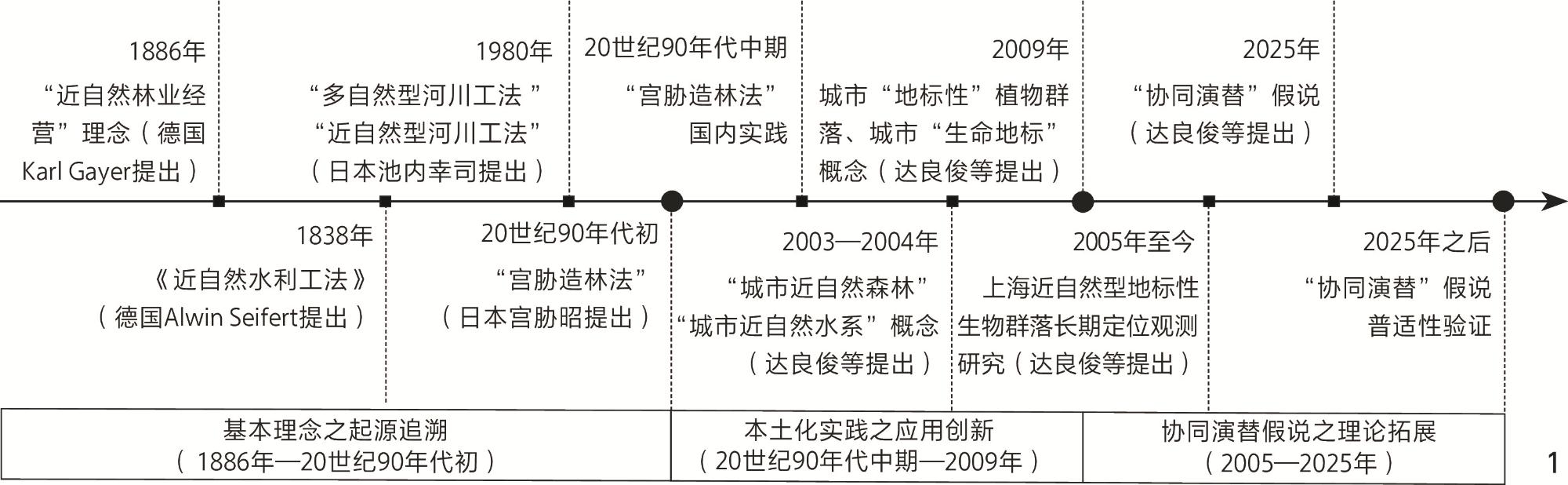
[Methods] The study began with a systematic review of the origins, development, and conceptual foundations of the “near-natural” philosophy in ecological science and restoration practice. Building on more than two decades of empirical research, long-term monitoring, and demonstration projects conducted by our interdisciplinary team, the cosuccession hypothesis was translated from extensive field observations into practical ecological application. Based on these foundations, we propose a coherent framework for developing urban near-natural forests. The framework is structured across five interrelated components: guiding philosophy, foundational principles, theoretical basis, methodological pathways, and technical system.The framework draws on the philosophies of mountains, waters, forests, farmland, lakes, grasslands and deserts as a community of life, a community of life for man and nature, and the three ecological perspectives. It highlights a transition from “pseudo-nature and false ecology” toward “near-nature and true ecology.” It focuses on the coordinated restoration and functional enhancement of the five main categories of urban ecological space, including green spaces, forests, wetlands, croplands and garden lands. The near-natural ecological restoration serves as the primary implementation pathway. The establishment of resilient, functionally rich, regionally characteristic landmark biological communities is identified as the long-term restoration objective. Together, these elements form a fully operational, climate-adaptive, and functionally diverse technical system for urban near-natural forests guided by the cosuccession hypothesis.
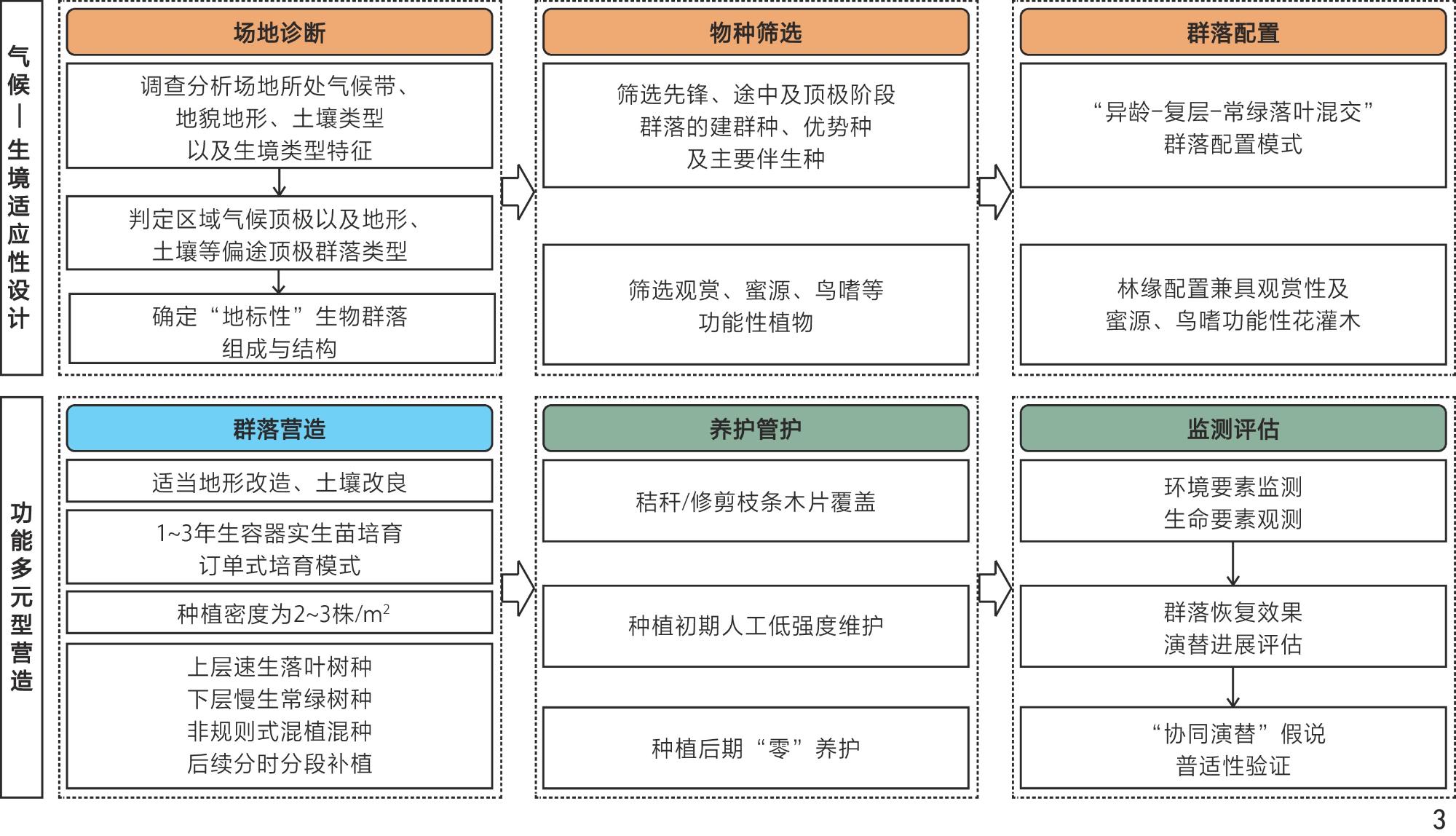
[Results] Long-term field observations show that urban near-natural forests, which are established by simulating the species composition and structural characteristics of zonal climax communities with native species as the primary components, can effectively support natural successional processes. Once succession begins, indigenous fauna such as insects, birds, and small mammals gradually colonize these restored habitats. Dynamic ecological interactions were commonly observed during this process, including population turnover among different biological groups. These findings indicate that native plant communities provide habitat conditions that support the return of indigenous animals. In turn, the ecological roles of these animals promote plant communities toward more complex and stable successional stages. Recognizing these symbiosis-coevolution dynamics broadens the traditional plant-centered understanding of succession. Importantly, this study systematically traces the evolutionary process of urban near-natural restoration, integrating over two decades of empirical research and localized application practices, and proposes the cosuccession hypothesis for native species. This hypothesis not only provides a theoretical foundation linking classical ecological succession with practical restoration goals but also emphasizes the coordinated co-development of flora and fauna in urban ecosystems, highlighting the functional interdependence of biological communities at multiple scales. Ecological restoration guided by this hypothesis integrates the natural processes of classical succession with the goal-oriented objectives of restoration practice. Two main technical pathways link theory to application: 1) climate-adaptive design, which operates at the ecosystem scale across different vegetation zones, addressing large-scale climatic and environmental gradients, and 2) habitat-adaptive design, which focuses on the local community scale to optimize species interactions and microhabitat conditions at specific urban sites.
[Conclusion] These pathways guide the establishment of diversified communities, including construction, stewardship and management, and monitoring and evaluation. A key innovation is the development of multifunctional “landmark” biological communities that simultaneously enhance climate-habitat adaptability, maintain high biodiversity, and provide ecosystem services including carbon sequestration, water retention, and aesthetic value. Furthermore, this research refines and expands the theoretical framework of urban near-natural forest restoration, offering a comprehensive paradigm in which climate-adaptive design operates at the ecosystem scale across vegetation zones, and habitat-adaptive design focuses on the local community scale, together supporting multifunctional, climate-resilient, and self-organizing urban ecosystems. The study provides both conceptual and technical innovations, bridging ecological theory and applied urban restoration, and establishes a China-specific approach that can inform global near-natural urban forest practices. By emphasizing functional diversity, resilience, and ecological authenticity, this work contributes a robust scientific and practical foundation for transforming conventional urban green spaces into sustainable, self-regulating and ecologically integrated urban ecosystems.
WANG Meng , CHEN Jiao , HU Yuandong , DA Liangjun . The Indigenous Species Cosuccession Hypothesis and the Construction of Climate-Habitat Adaptability and Functional Diversity in Near-Natural Urban Forests[J]. Landscape Architecture, 2026 , 33(3) : 23 -29 . DOI: 10.3724/j.fjyl.LA20250695
表1 西安近自然型地标性生物群落建议树种及配置方案Tab. 1 Recommended tree species and configuration scheme for near-natural landmark biological communities in Xi’an |
| 群落垂直结构 | 功能类型 | 推荐树种 |
| 注:◈表示树种观赏型为观花,○表示树种观赏型为观果,◎表示树种观赏型为观叶,*表示树种功能型为鸟嗜型,#表示树种功能型为蜜源型。 | ||
| 乔木层 | 顶极群落建群种 | 落叶阔叶乔木:栓皮栎(Quercus variabilis)◎*、辽东栎(Quercus liaotungensis)◎*、麻栎(Quercus acutissima)◎* |
| 先锋与途中群落建群种 | 落叶阔叶乔木:山杨(Populus davidiana)◎、小叶杨(Populus simonii)、毛白杨 (Populus tomentosa)、垂柳(Salix babylonica)#、旱柳(Salix matsudana)#、榆(Ulmus pumila)* | |
| 林冠层伴生种 | 常绿针叶乔木:白皮松(Pinus bungeana)、油松(Pinus tabuliformis)*等;落叶阔叶乔木:连香树(Cercidiphyllum japonicum)◎、杜仲(Eucommia ulmoides)#、槲栎 (Quercus aliena)◎*、槲树(Quercus dentata)◎*、白桦(Betula platyphylla)◎、鹅耳枥(Carpinus turczaninovii)◎、胡桃楸(Juglans mandshurica)、枫杨(Pterocarya stenoptera)○、榉树(Zelkova serrata)◎、杜梨(Pyrus betulifolia)◈○#、七叶树(Aesculus chinensis)◈○◎#、青榨槭(Acer davidii)◎#、秦岭槭(Acer tsinglingense)◎#、细裂槭(Acer pilosum var. stenolobum)◎#、楝(Melia azedarach)◈○#、山茱萸(Cornus officinalis)◈○#、刺楸(Kalopanax septemlobus)◈◎#、柿(Diospyros kaki)○◎*、水曲柳(Fraxinus mandshurica)◎、白蜡树(Fraxinus chinensis)◎等 | |
| 亚乔木层 | 林下层伴生种 | 常绿阔叶乔木:青冈(Quercus glauca)○*、冬青(Ilex chinensis)○*、乌冈栎(Quercus phillyraeoides)*、女贞(Ligustrum lucidum)◈○#等 |
| 灌木层 | 林下层伴生种 | 常绿阔叶灌木:柞木(Xylosma racemosum)、石楠(Photinia serratifolia)◈○◎#、海桐(Pittosporum tobira)○*#、小叶女贞(Ligustrum quihoui)◈#等 |
文中图表均由作者绘制。
1、系统追溯了城市生态系统近自然恢复的演进历程,结合本土化应用实践,提出基于本土生物“协同演替”假说。
2、形成了兼具气候-生境适应及生物多样性保护等功能多元的“地标性”生物群落构建技术体系,提供了可复制、可推广的实践样本与中国方案。
3、完善提升了城市近自然森林生态恢复理论框架体系,以期推动功能多元型城市生态系统空间构建范式的转型。
| [1] |
IPCC. Climate Change 2023: Synthesis Report. Contribution of Working Groups I, II and III to the Sixth Assessment Report of the Intergovernmental Panel on Climate Change[R]. Geneva: IPCC, 2023: 35-115.
|
| [2] |
TURNER C. Climate Change and Biodiversity[M]. London: ED-Tech Press, 2018.
|
| [3] |
TRISOS C H, MEROW C, PIGOT A L. The Projected Timing of Abrupt Ecological Disruption from Climate Change[J]. Nature, 2020, 580(7804): 496-501.
|
| [4] |
达良俊. 基于本土生物多样性恢复的近自然城市生命地标构建理念及其在上海的实践[J]. 中国园林, 2021, 37(5): 20-24.
DA L J. Urban Near-to-Nature Biocoenose Landmark Construction for the Restoration of Native Biodiversity: Concepts and Practices in Shanghai[J]. Chinese Landscape Architecture, 2021, 37(5): 20-24.
|
| [5] |
卢炜丽, 张洪江, 杜士才, 等. 重庆四面山地区几种不同配置模式水土保持林生物多样性研究[J]. 山地学报, 2009, 27(3): 319-325.
LU W L, ZHANG H J, DU S C, et al. Studies on Biodiversity in Five Different Deposition Model of Soil and Water Conservation Forest in Chongqing Simian Mountain[J]. Mountain Research, 2009, 27(3): 319-325.
|
| [6] |
张晓君, 管伟, 廖宝文, 等. 珠海人工红树林与天然红树林群落特征比较研究[J]. 生态科学, 2014, 33(2): 321-326.
ZHANG X J, GUAN W, LIAO B W, et al. Comparison on the Community Characteristics Between Artificial and Natural Mangroves in Zhuhai City[J]. Ecological Science, 2014, 33(2): 321-326.
|
| [7] |
SANCHEZ L C, RODRÍGUEZ E E, PIANI V A, et al. Assessing the Impact of Exotic Salicaceae Plantations on Amphibian Diversity of the Paraná River Delta[J]. Biodiversity and Conservation, 2025, 34(10): 3589-3608.
|
| [8] |
达良俊, 许东新. 上海城市 “近自然森林” 建设的尝试[J]. 中国城市林业, 2003, 1(2): 17-20.
DA L J, XU D X. An Attempt to Build a “Close-to-Nature Forest” in Shanghai[J]. Journal of Chinese Urban Forestry, 2003, 1(2): 17-20.
|
| [9] |
达良俊. 城市生态系统近自然型恢复的理论与实践[J]. 长江流域资源与环境, 2008, 17(2): 169.
DA L J. Theory and Practice of Near-Natural Restoration of Urban Ecosystem[J]. Resources and Environment in the Yangtze Basin, 2008, 17(2): 169.
|
| [10] |
GAYER K. Die Gemischte Wald: Seine Begründung und Pflege[M]. München: Verlag von J. F. Bergmann, 1886.
|
| [11] |
SEIFERT A. Naturnäherer Wasserbau[J]. Deutsche Wasserwirtschaft, 1938, 33(12): 361-366.
|
| [12] |
日本国土交通省 . 多自然川づくりの取り組 みに関する研究[EB/OL]. (2009)[2025-11- 09].https://www.mlit.go.jp/river/shinngikai_ blog/tashizen/dai01kai.
Ministry of Land, Infrastructure, Transport and Tourism (Japan). Study on Initiatives for Multi-natural River Construction[EB/OL]. (2009)[2025-11-09]. https://www.mlit.go.jp/river/shinngikai_blog/tashizen/dai01kai.
|
| [13] |
池内幸司, 金尾健司. 日本における河川環境の保全·復元の取り組みと今後の課題[J]. 応用生態工学, 2003, 5(2): 205-216.
IKEUCHI K, KANAO K. Initiatives and Future Challenges for River Environment Conservation and Restoration in Japan[J]. Ecology and Civil Engineering, 2003, 5(2): 205-216.
|
| [14] |
凌雯倩, 何萍, 王波. 日本多自然河川综合治理的发展历程与工作体系[J]. 国际城市规划, 2023, 38(1): 154-158.
LING W Q, HE P, WANG B. The Development Process and Working System of Japan’s Multi-natural River Management[J]. Urban Planning International, 2023, 38(1): 154-158.
|
| [15] |
王仁卿, 藤原一绘, 尤海梅. 森林植被恢复的理论和实践: 用乡土树种重建当地森林: 宫胁森林重建法介绍[J]. 植物生态学报, 2002, 26(S1): 133-139.
WANG R Q, TENG Y, YOU H M. Theory and Practices for Forest Vegetation Restoration: Native Forest With Native trees-Introduction of the Miyawaki’s Method for Reconstruction of “Environmental Protection Forest (Ecological Method to Reforestation)”[J]. Chinese Journal of Plant Ecology, 2002, 26(S1): 133-139.
|
| [16] |
达良俊, 杨永川, 陈鸣. 生态型绿化法在上海“近自然”群落建设中的应用[J]. 中国园林, 2004, 20(3): 38-40.
DA L J, YANG Y C, CHEN M. The Method of Ecological Greening and Its Application in the Construction of the Approaching Nature Plant Community in Shanghai[J]. Chinese Landscape Architecture, 2004, 20(3): 38-40.
|
| [17] |
陈伟峰, 达良俊, 陈克霞, 等. “宫胁生态造林法” 在上海外环环城绿带建设中的应用[J]. 中国城市林业, 2004, 2(5): 21-23.
CHEN W F, DA L J, CHEN K X, et al. Application of “Miyawaki’s Ecological Method to Reforestation” in the Construction of Outerringroad Greenbelt in Shanghai[J]. Journal of Chinese Urban Forestry, 2004, 2(5): 21-23.
|
| [18] |
MIYAWAKI A, GOLLEY F B. Forest Reconstruction as Ecological Engineering[J]. Ecological Engineering, 1993, 2(4): 333-345.
|
| [19] |
达良俊, 颜京松. 城市近自然型水系恢复与人工水景建设探讨[J]. 现代城市研究, 2005, 20(1): 8-15.
DA L J, YAN J S. The Method and Application of Approx-Natural Restoration in Urban Aquatic Ecosystem and Waterscape Constructions[J]. Modern Urban Research, 2005, 20(1): 8-15.
|
| [20] |
达良俊. 生态学视角下的城市更新: 基于本土生物多样性恢复的近自然型都市生命地标构建[J]. 世界科学, 2021 12 30-31.
DA L J. Urban Renewal from the Perspective of Ecology: Construction of Near-Natural Urban Life Landmarks Based on the Restoration of Native Biodiversity[J]. World Science, 2021 12 30-31.
|
| [21] |
张桂林, 柯高阳. 过度求新求美, 实则生态损毁: 城市绿化须防“生态形式主义”[J]. 半月谈, 2023 9 74-76.
ZHANG G L, KE G Y. Excessive Pursuit of Novelty and Beauty Leads to Ecological Damage: Urban Greening Must Guard Against “Ecological Formalism”[J]. Banyuetan, 2023 9 74-76.
|
| [22] |
达良俊, 宋坤.快速城市化下的生态环境危机与城市的自然回归[J].科学, 2023, 75(6): 1-5, 69.
DA L J, SONG K. Rapid Urbanization-Induced Eco-Environmental Crisis and Urban Natural Regeneration[J]. Science, 2023, 75(6): 1-5, 69.
|
| [23] |
达良俊, 李艳艳, 章君果, 等. 关于上海城市“地标性”植物群落建设的思考[J]. 城市问题, 2009 8 37-39.
DA L J, LI Y Y, ZHANG J G, et al. Consideration on the Construction of Urban “Land-Mark” Plant Community in Shanghai[J]. Urban Problems, 2009 8 37-39.
|
| [24] |
达良俊, 郭雪艳. 生态宜居与城市近自然森林: 基于生态哲学思想的城市生命地标建构[J]. 中国城市林业, 2017, 15(4): 1-5.
DA L J, GUO X Y. Ecological and Livable City and Near-Natural Forest: Urban Living Landmark Construction Based on Ecological Philosophy[J]. Journal of Chinese Urban Forestry, 2017, 15(4): 1-5.
|
| [25] |
EHRLICH P R, RAVEN P H. Butterflies and Plants: A Study in Coevolution[J]. Evolution, 1964, 18(4): 586-608.
|
| [26] |
张钧. 生物学进化[M]. 北京: 北京大学出版社, 1998.
ZHANG J. Biological Evolution[M]. Beijing: Peking University Press, 1998.
|
| [27] |
达良俊, 郭雪艳. 上海城市生态建设“四化”内涵的生态学释意[J]. 园林, 2019, 36(1): 8-13.
DA L J, GUO X Y. Ecological Interpretation on the Connotations of “Afforestation, Colorization, Preciousness, Efficiency” During Urban Ecological Construction in Shanghai[J]. Landscape Architecture Academic Journal, 2019, 36(1): 8-13.
|
| [28] |
国家发展改革委, 住房城乡建设部. 城市适应气候变化行动方案[EB/OL]. (2016-02-04)[2026-01-07]. https://www.cma.gov.cn/2011xwzx/2011xqxxw/2011xqxyw/201602/t20160217_304390.html.
National Development and Reform Commission, Ministry of Housing and Urban-Rural Development. Urban Climate Change Adaptation Action Plan[EB/OL]. (2016-02-04) [2026-01-07]. https://www.cma.gov.cn/2011xwzx/2011xqxxw/2011xqxyw/201602/t20160217_304390.html.
|
| [29] |
生态环境部, 国家发展和改革委员会, 科学技术部, 等. 国家适应气候变化战略2035[EB/OL]. (2022-05-10)[2026-01-07]. https://www.mee.gov.cn/xxgk2018/xxgk/xxgk03/202206/t20220613_985261.html.
Ministry of Ecology and Environment, National Development and Reform Commission, Ministry of Science and Technology, et al. National Climate Change Adaptation Strategy 2035[EB/OL]. (2022-05-10) [2026-01-07]. https://www.mee.gov.cn/xxgk2018/xxgk/xxgk03/202206/t20220613_985261.html.
|
| [30] |
ZHAO D S, WU S H. Responses of Vegetation Distribution to Climate Change in China[J]. Theoretical and Applied Climatology, 2014, 117(1): 15-28.
|
| [31] |
ZHANG X H, ZHANG B P, YAO Y H, et al. Dynamics and Climatic Drivers of Evergreen Vegetation in the Qinling-Daba Mountains of China[J]. Ecological Indicators, 2022, 136:108625.
|
| [32] |
马世骏, 王如松. 社会-经济-自然复合生态系统[J]. 生态学报, 1984, 4(1): 1-9.
MA S J, WANG R S. The Social-Economic-Natural Complex Ecosystem[J]. Acta Ecologica Sinica, 1984, 4(1): 1-9.
|
/
| 〈 |
|
〉 |