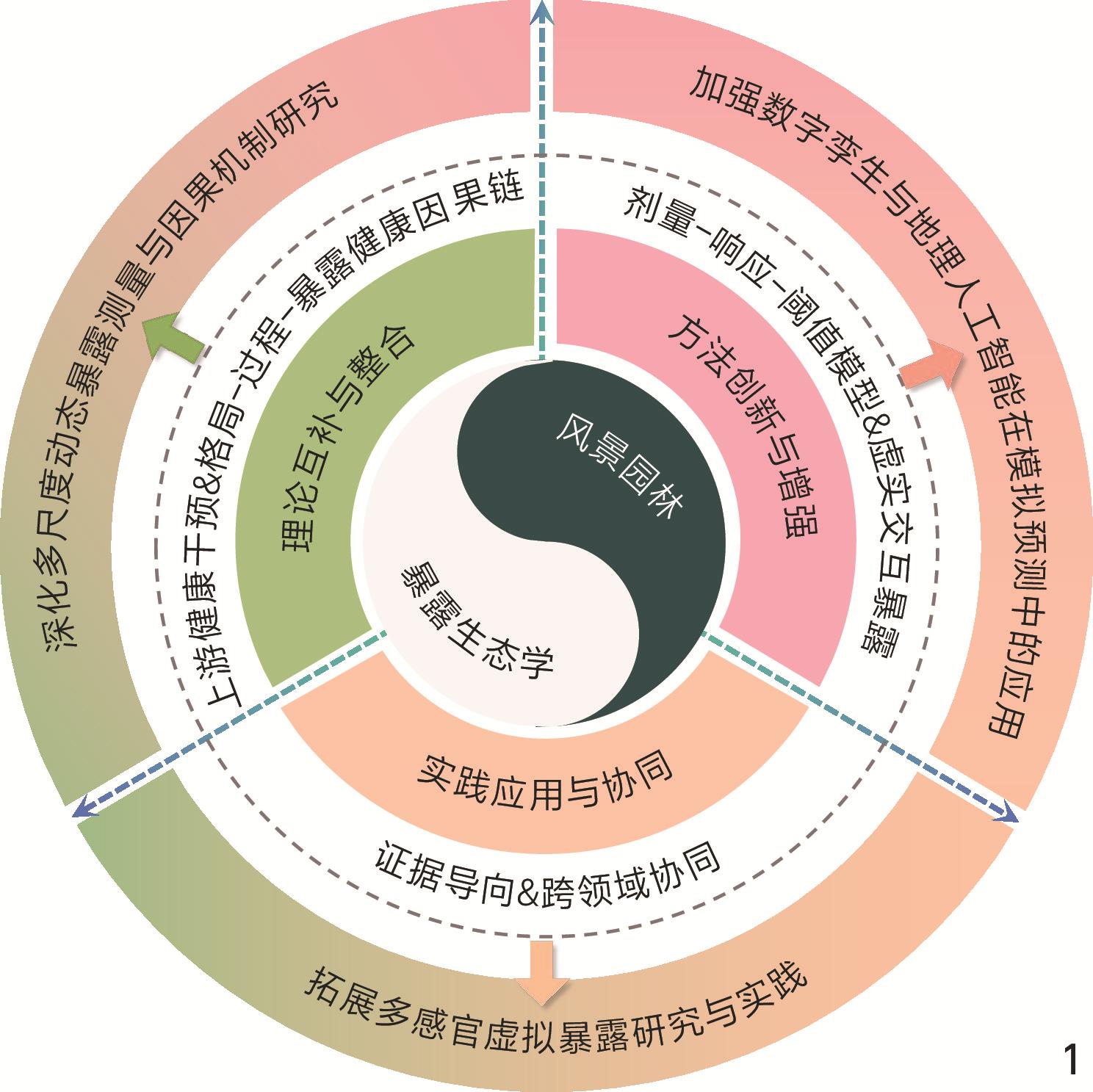


Exposure Ecology Empowers Landscape Architecture: Theoretical Complementarity and Integrative Innovation
|
MA Weiyuan is a Ph.D. candidate in the Department of Environmental Science and Engineering, Fudan University, and a member of Urban Ecology and Exposure Ecology Lab. Her research focuses on urban ecology and human health |
|
YANG Gaoyuan, Ph.D., is an associate professor in the School of Environmental and Geographical Sciences, Shanghai Normal University. Her research focuses on urban-rural landscape patterns and their ecological-social effects |
|
YU Zhaowu, Ph.D., is an associate professor in the Department of Environmental Science and Engineering, Fudan University. His research focuses on Urban Ecology, Exposure Ecology, nature-based solutions, environmental remote sensing, and climate change |
Received date: 2025-11-20
Online published: 2026-03-12
Copyright
Against the background of shrinking urban green space resources and diverse health needs of residents, traditional landscape architecture faces theoretical and methodological bottlenecks in quantifying health effects, exploring underlying mechaisms, conducting multi-scale analysis, and enabling dynamic prediction. This study examines how exposure ecology can supplement and enhance landscape architecture across three dimensions: theoretical core, methodological system, and practical path, so as to better serve public health-oriented urban planning.
This study combines literature review with inductive analysis. By systematically reviewing the core components of exposure ecology, including the “pattern−process−exposure−health” causal chain theoretical framework, the “dose−response−threshold” model, and virtual-real interactive simulation technology, it summarizes its innovative advantages over traditional landscape architecture in terms of health intervention concepts, quantitative assessment, and precise design. Building on this foundation, the study explores the inherent logic and feasible paths for the integration of the two disciplines by analyzing three dimensions: theoretical complementarity, methodological innovation, and practical synergy, and also looks forward to the key future development directions.
Systematic review and inductive analysis show that exposure ecology complements and integrates with landscape architecture in a comprehensive and profound way. 1) Complementary integration at the theoretical level. Guided by the core concept of “upstream health intervention”, exposure ecology shifts landscape architecture from providing passive ecological services to actively planning a “health-producing system”. By constructing a “subject –object –real –virtual” multidimensional framework, it expands the understanding of ecological exposure complexity, extending beyond physical design to include virtual nature experiences. 2) Enhanced innovation at the methodological level. The “dose–response–threshold” model enables accurate quantification of green space health benefits. Integrating real measurements with virtual modeling (GIS/remote sensing, multi-agent modeling, digital twins) creates a “virtual–real interactive exposure simulation” approach, advancing landscape architecture from static spatial analysis to dynamic process simulation. 3) Collaborative applications at the practical level. Exposure ecology promotes evidence-based landscape planning through techniques such as green space exposure equity assessment and behavioral trajectory analysis. This supports precise applications like greenway optimization and community service blind spot identification. The “physiological health benefit threshold” model offers a validated method for understanding green space’s upstream health impacts. By implementing a transformation path from research to policy, exposure ecology has strengthened cross-sectoral collaborative-governance with public health, environmental protection, and other departments in healthy city construction projects, improving the overall benefits of planning implementation.
Exposure ecology, through its innovative theoretical framework, quantitative methods and technical tools, effectively compensates for the lack of scientific rigor and precision in traditional landscape architecture when serving healthy urban planning. The deep integration of the two disciplines will show great potential and development space in the following three key research directions. 1) Deepening the research on multi-scale dynamic exposure measurement and causal mechanisms is the foundation for promoting the development of the discipline. In the future, we can explore the construction of a cross-temporal and multi-scale green space exposure measurement model; explore the physiological pathways and psychological processes of green space exposure affecting human health, and promote the research to deepen from correlation analysis to causal inference. 2) Strengthening the application of digital twin and geographic artificial intelligence technologies in simulation and prediction is key to improving planning efficiency. In the future, we can build a digital mirror in virtual space that evolves synchronously with the real urban green space system. This will enable planners to simulate the green space exposure scenarios and potential health outcomes of residents under different planning and design schemes, thereby facilitating project scheme comparison and optimization. 3) Expanding multi-sensory virtual exposure research and its synergistic optimization with physical space is an innovative pathway to address urban challenges. Virtual green space exposure will become an important natural exposure supplement in high-density urban areas. Future research should explore the health benefits of multi-sensory virtual nature experiences, determine the dose-response relationship and application threshold of virtual exposure, and compare the effects with those of real-world exposure. It should also develop research combining virtual and real exposure, exploring how to construct optimal ecological spatial patterns by coupling real and virtual dimensions. The deep integration of exposure ecology and landscape architecture will continue to deepen, jointly providing solid disciplinary support and practical impetus for optimizing urban green space planning, improving public health, and achieving sustainable urban development.
MA Weiyuan , YANG Gaoyuan , YU Zhaowu . Exposure Ecology Empowers Landscape Architecture: Theoretical Complementarity and Integrative Innovation[J]. Landscape Architecture, 2026 , 33(2) : 100 -104 . DOI: 10.3724/j.fjyl.LA20250723
1、理论互补与范式升维。暴露生态学引入“上游健康干预”核心理念,推动风景园林从被动的生态基础设施向能动的健康生产系统升维。
2、方法创新与精准量化。暴露生态学构建“格局-过程-暴露-健康”核心因果链条,引入“剂量-响应-阈值”模型与虚实交互模拟技术,有效弥补了传统景观设计缺乏科学量化的局限。
3、实践转型与决策支撑。暴露生态学驱动供需协同规划、公平性评估与精准健康干预,推动景观规划从“经验导向”到“证据导向”转型。
| [1] |
THEOBALD D M, KENNEDY C, CHEN B, et al. Earth Transformed: Detailed Mapping of Global Human Modification from 1990 to 2017[J]. Earth System Science Data, 2020, 12 (3): 1953-1972.
|
| [2] |
FANG C L, YU D L. Urban Agglomeration: An Evolving Concept of an Emerging Phenomenon[J]. Landscape and Urban Planning, 2017, 162: 126-136.
|
| [3] |
HAQ S M A. Urban Green Spaces and an Integrative Approach to Sustainable Environment[J]. Journal of Environmental Protection, 2011, 2 (5): 601-608.
|
| [4] |
TWOHIG-BENNETT C, JONES A. The Health Benefits of the Great Outdoors: A Systematic Review and Meta-analysis of Greenspace Exposure and Health Outcomes[J]. Environmental Research, 2018, 166: 628-637.
|
| [5] |
LIU H X, PANG Y J, JIAO M, et al. Greenspace Exposure and Its Dual Role as Mediator and Moderator in the Relationship Between Urban Density and Mental Health[J]. Landscape and Urban Planning, 2025, 264: 105497
|
| [6] |
杨锐. 风景园林学的机遇与挑战[J]. 中国园林, 2011, 27 (5): 18-19.
YANG R. Opportunities and Challenges of Chinese Landscape Architecture Discipline[J]. Chinese Landscape Architecture, 2011, 27 (5): 18-19.
|
| [7] |
朱丹, 李霞, 许哲平, 等. 开放科学视角下风景园林学科的发展和特征[J]. 应用与环境生物学报, 2024, 30 (2): 421-429.
ZHU D, LI X, XU Z P, et al. Development and Characteristics of Landscape Architecture from the Perspective of Open Science[J]. Chinese Journal of Applied & Environmental Biology, 2024, 30 (2): 421-429.
|
| [8] |
杜春兰, 郑曦. 一级学科背景下的中国风景园林教育发展回顾与展望[J]. 中国园林, 2021, 37 (1): 26-32.
DU C L, ZHENG X. Retrospect and Prospect of Landscape Architecture Education in China Under the Background of First-Level Discipline[J]. Chinese Landscape Architecture, 2021, 37 (1): 26-32.
|
| [9] |
成玉宁, 袁旸洋. 当代科学技术背景下的风景园林学[J]. 风景园林, 2015, 22 (7): 15-19.
CHENG Y N, YUAN Y Y. Landscape Architecture Under the Background of Contemporary Science and Technology[J]. Landscape Architecture, 2015, 22 (7): 15-19.
|
| [10] |
YU Z W, YANG G Y, LIN T, et al. Exposure Ecology Drives a Unified Understanding of the Nexus of (Urban) Natural Ecosystem, Ecological Exposure, and Health[J]. Ecosystem Health and Sustainability, 2024, 10: 165
|
| [11] |
余兆武, 马维源, 杨高原.暴露生态学: 景观生态学在健康维度的范式革新[J/OL].生态学报: 1-8(2025-08-06)[2025-12-31]. https://doi.org/10.20103/j.stxb.202507151851.
YU Z W, MA W Y, YANG G Y. Exposure Ecology: A Paradigm Shift in the Health Dimension of Landscape Ecology[J/OL]. Acta Ecologica Sinica: 1-8(2025-08-06)[2025-12-31]. https://doi.org/10.20103/j.stxb.202507151851.
|
| [12] |
科克伍德. 弹性景观: 未来风景园林实践的走向[J]. 中国园林, 2010, 26 (7): 10-14.
KIRKWOOD N G. Resilient Landscapes: Dimensions of Future Landscape Architectural Practices[J]. Chinese Landscape Architecture, 2010, 26 (7): 10-14.
|
| [13] |
李倞, 杨璐. 后疫情时代风景园林聚焦公共健康的热点议题探讨[J]. 风景园林, 2020, 27 (9): 10-16.
LI L, YANG L. Discussion on Hot Topics of Landscape Architecture Focusing on Public Health in the Post-epidemic Era[J]. Landscape Architecture, 2020, 27 (9): 10-16.
|
| [14] |
李树华, 姚亚男, 刘畅, 等. 绿地之于人体健康的功效与机理: 绿色医学的提案[J]. 中国园林, 2019, 35 (6): 5-11.
LI S H, YAO Y N, LIU C, et al. The Effect and Mechanism of Green Space on Human Physical and Mental Health: A Proposal of Green Medicine[J]. Chinese Landscape Architecture, 2019, 35 (6): 5-11.
|
| [15] |
YU Z W, YANG G Y, YANG B Y, et al. Transforming Urbanite Health with Upstream Knowledge[J]. Environment & Health, 2025, 3 (2): 111-113.
|
| [16] |
WHITE M P, ALCOCK I, GRELLIER J, et al. Spending at Least 120 Minutes a Week in Nature Is Associated with Good Health and Wellbeing[J]. Scientific Reports, 2019, 9: 7730
|
| [17] |
YU Z W, MA W Y, HU S Y, et al. A Simple but Actionable Metric for Assessing Inequity in Resident Greenspace Exposure[J]. Ecological Indicators, 2023, 153: 110423
|
| [18] |
YAO X H, YU Z W, MA W Y, et al. Quantifying Threshold Effects of Physiological Health Benefits in Greenspace Exposure[J]. Landscape and Urban Planning, 2024, 241: 104917
|
| [19] |
YU Z W, MA W Y, HU J Y, et al. Greening Dominates Greenspace Exposure Inequality in Chinese Cities[J]. npj Urban Sustainability, 2025, 5: 73
|
| [20] |
DE LA BARRERA F, REYES-PAECKE S, BANZHAF E. Indicators for Green Spaces in Contrasting Urban Settings[J]. Ecological Indicators, 2016, 62: 212-219.
|
| [21] |
LONG X J, CHEN Y J, ZHANG Y H, et al. Visualizing Green Space Accessibility for more than 4,000 Cities Across the Globe[J]. Environment and Planning B: Urban Analytics and City Science, 2022, 49 (5): 1578-1581.
|
| [22] |
LIU T, YU L, CHEN X, et al. Identifying Potential Urban Greenways by Considering Green Space Exposure Levels and Maximizing Recreational Flows: A Case Study in Beijing’s Built-Up Areas[J]. Land, 2024, 13 (11): 1793
|
| [23] |
JIN Y N, YU Z W, YANG G Y, et al. Quantifying Physiological Health Efficiency and Benefit Threshold of Greenspace Exposure in Typical Urban Landscapes[J]. Environmental Pollution, 2024, 362: 124726
|
| [24] |
常青, 王娅楠.城市绿地对人类健康的促进路径研究[M].北京: 科学出版社, 2024.
CHANG Q, WANG Y N. Research on the Promotion Path of Urban Green Spaces for Human Health[M]. Beijing: Science Press, 2024.
|
/
| 〈 |
|
〉 |