

Research on Poetic and Painterly Implications of Famous Mountain Scenic Areas and Generative Mechanisms Thereof: A Case Study of Hanyan − Mingyan Scenic Area in Tiantai, Zhejiang Province
|
YE Sen gained his doctoral degree in Beijing Forestry University. His research focuses on landscape planning and design, and history and theory of landscape architecture |
|
DONG Cong, Ph.D., is a professor in the School of Landscape Architecture, Beijing Forestry University. His research focuses on form of architecture and landscape, design theory and method of modern architecture, and design of ancient Chinese architecture |
|
LIU Xiaoming, Ph.D., is chief engineer of Beijing Binfenjiuzhou Eco-technology Co., Ltd. His research focuses on history and theory of landscape architecture, and landscape planning and design |
Received date: 2023-11-11
Revised date: 2024-06-16
Online published: 2025-12-17
Copyright
Exemplified by the private gardens in Jiangnan Region during Ming and Qing dynasties, traditional Chinese gardens are renowned for their intricate layouts, refined details, and profound implications. They are acclaimed as “three-dimensional paintings and silent poems”, exhibiting a significant affinity with poetry, literature, painting, and even musical arts. Landscape poetry and painting, in particular, have been highly abstracted, refined, and sublimated by scholars throughout the ages, based on their experiences of appreciating natural landscapes. These works transcend mere depictions of natural landscapes, incorporating scholars’ personal experiences, emotions, and aesthetics into reinterpretations. Various aspects of traditional private gardens in Jiangnan, encompassing rockery arrangements, water feature design, architectural layout, plant cultivation, couplets, plaques, and even home bonsai, can be perceived as continuations of this reinterpretation process in the realm of engineering. Consequently, poetry and painting arts serve as the spiritual bridge between natural landscapes and “urban forests”. While extensive research has explored the interconnection and intertextuality between poetry, painting, and urban gardens, investigations into the exploration and expression of poetic and artistic conceptions in natural landscapes, particularly in renowned mountain scenic areas, remain relatively scarce. Therefore, it is imperative to clarify the specific derivation process of the gardening technique of “emulation of nature” by identifying a well-known natural wonder among traditional famous mountain scenic areas that is adorned by scholars’ poems and paintings throughout history.
This research centers on the natural wonder of Hanyan − Mingyan Scenic Area. Rooted in landscape architecture, the research relies heavily on historical research and theories. The research is conducted through on-site surveying and mapping utilizing such methods as oblique photography, three-dimensional modeling, and field reconnaissance.
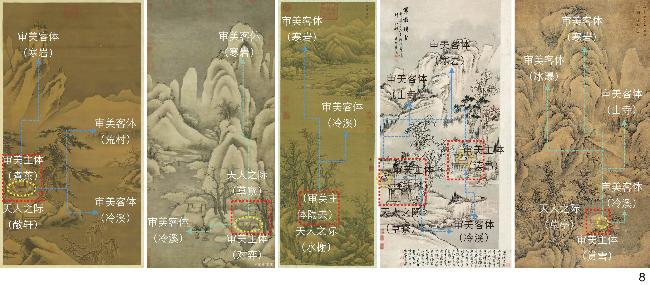
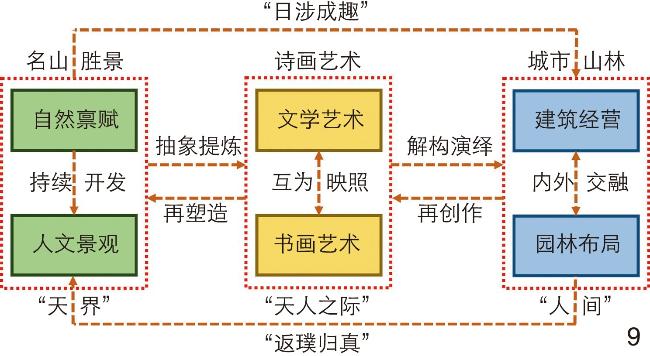
The inherent natural endowment of the “Ten-mile Iron Armor Dragon” (“Shilitiejialong”), where Hanyan − Mingyan Scenic Area is situated, attracts hermits and fosters the creation of Hanshan poetry and Mingyan paintings. Conversely, literary and artistic creations further invigorates and deepens the “anthropomorphic” aspect of local scenery, encompassing the so-called “naturalization of humans” and “humanization of nature”. These two aspects reinforce each other, ultimately achieving the apex state of “poetic and artistic nature”, which provides inexhaustible inspiration and nourishment for the creation of the “urban forest” among the bureaucratic class. The motif of “Snow on Cold Rock”, popular since Song Dynasty, along with the summaries of “poetic materials” and “painting materials” by scholars in Ming Dynasty, has elevated and refined the aesthetic cognition of landscapes to the realm of “harmony between heaven and man”. This has become an integral component of the aesthetic value of the renowned Tiantai Mountain Scenic Area. Relying on their superior natural endowments, traditional famous mountain scenic areas in China gradually evolve and improve with the progressive enhancement of their development and openness throughout the ages. In the process of deepening their epistemological understanding, the literati and scholar-bureaucrats of the time often engage in the “disembodied cognition” process, wherein aesthetic subjects cognize landscape objects through poetry, calligraphy, painting, and other creative expressions. Their diverse worldviews, life outlooks, and values as “social beings” give rise to diverse aspects of landscape aesthetics deconstruction and distinct expression styles. The aesthetic value of famous mountain scenic areas is derived from the commonalities extracted from all these deconstructions and expressions. Scholars apply the aesthetic experience garnered from appreciating the poetry and painting works of their predecessors or directly visiting the sites to the engineering practices of urban private garden construction. This transition represents a leap from “disembodied cognition” to “embodied cognition”. If captivating natural landscapes and artificial pavilions and temples constitute the “two facets of the same coin” in terms of the natural and humanistic attributes of famous mountain scenic areas, then the process of interpreting and deconstructing them through literary and artistic works may serve as a bridge and link that introduces them into the “human world”. The “re-cognition” and “re-interpretation” of landscape by the general public, based on literary and artistic works, continuously generate newer and deeper aesthetic understandings that can guide urban construction practices. Simultaneously, this may also enrich the cultural connotation of the original scenic areas from both material and spiritual dimensions, forming a complete positive feedback loop from beginning to end.
By analyzing the symbiotic relationship between humanities and natural landscapes, this research summarizes the interaction and positive feedback mechanism between the natural endowments of Hanyan − Mingyan Scenic Area and relevant literary and artistic creation. This approach is pivotal in elucidating the specific evolutionary process of the traditional gardening technique of “ emulation of nature”, and can offer insights into the rational development and utilization of the tourism resources of Hanyan − Mingyan Scenic Area. Furthermore, it can foster a novel integration of culture and tourism in “Poetic and Artistic Tiantai” and “Poetic and Artistic Zhejiang”, thereby promoting regional industrial upgrading.
Sen YE , Cong DONG , Xiaoming LIU . Research on Poetic and Painterly Implications of Famous Mountain Scenic Areas and Generative Mechanisms Thereof: A Case Study of Hanyan − Mingyan Scenic Area in Tiantai, Zhejiang Province[J]. Landscape Architecture, 2024 , 31(8) : 130 -138 . DOI: 10.3724/j.fjyl.202311110512
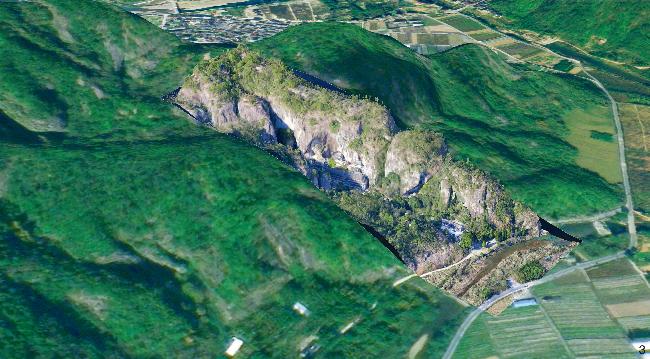
图3 明岩区域三维实景(方向从东南望向西北)Fig. 3 Three-dimensional real scene of Mingyan Scenic Area (viewing from southeast to northwest) |
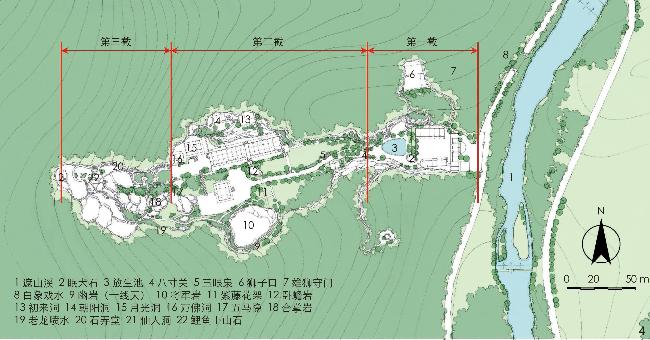
图4 明岩峡谷三段式空间序列示意Fig. 4 Schematic diagram of three-segment spatial sequence of Mingyan Canyon |
表1 明岩景区历朝名景一览Table 1 List of famous scenery in Mingyan Scenic Area |
| 景名 | 景点简介 |
| 注:a)齐召南在天台县城五关里的私宅名为“宝纶堂”(今已湮灭,原址现为城关镇第二小学),取“满腹经纶”意,齐召南《宝纶堂诗钞》《宝纶堂文钞》《宝纶堂集古录》等著作便是在此撰就。据周边乡民回忆,宝纶堂三进院落坐北向南,堂门东开,采用天台传统手工艺“一根藤”制作;入门为小天井,内为书房(正堂)及道地,后有二层平地楼,为主人起居之所;二进院落道地东侧开月洞门,过则为宅园(“息园”),园内北有桂花树一株,南有古槐一株,东侧照壁下有长方形鱼池一口,名为“桂花井”(今在城关二小操场国旗杆附近,为复建)。b)刘光禄即刘宪宠(1551— 1635),浙江宁波府慈溪县人,字仰之,万历二十年(1592年)及第壬辰科同进士第十五名(翁正春榜),授吉安推官,历任仪制司郎中,光宗朝改任太仆寺卿,不久告病还乡。后被魏忠贤指为东林,遭削夺,崇祯初年复官,著有《诗经会说》。传见《东林列传》卷十四“明·刘宪宠传”。据陈甲林《天台山游览志》,刘宪宠题碑至民国时期已残缺不全,惟“此衲面壁久矣,今始睹其面”几字尚可分辨。 | |
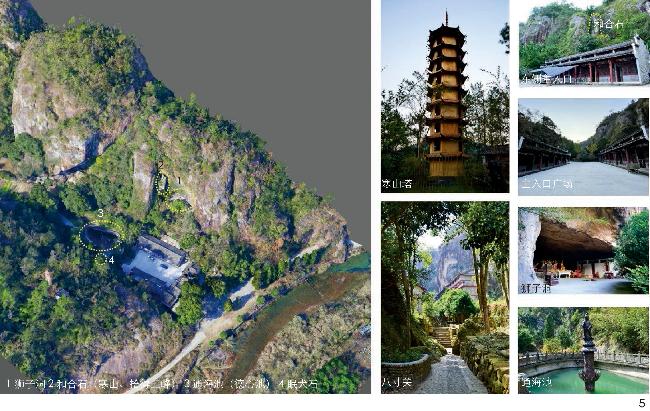
| 八寸关 | 两岩逼束为门,狭不盈尺。门东(关外)即通海池(今修葺为放生池,称“德心池”),旁有眠犬石,北有“石怪岩明”岩镌、小石梁,上对和合石(即寒、拾二峰,又称和尚岩) |
| 将军岩 | 亦称“石柱岩”“螳螂岩”,顶有藤蔓垂下,与其北侧卧蟾岩相连。清末民国时期藤蔓一度枯死而被斫除,今已恢复为紫藤花架 |
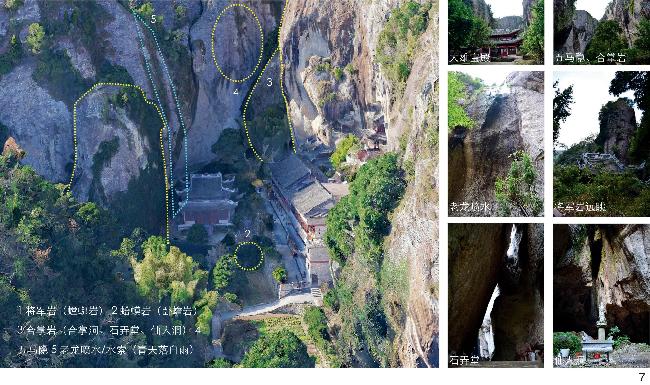
| 五马隐 | 亦称“影壁”,相传为“闾邱(胤)太守影”所在处[21],位于万佛洞斜上方。崖壁上因岩纹水痕和苔藓等自然之力作用,形成五匹马的痕迹,又被历朝文人雅士所引申、联想于诗文书画中,这正是“景面文心”的最佳体现 |
| 老龙喷水 | 在五马隐对面崖壁,其顶有泉下坠,水流不大,微风吹拂则四散开去,水雾若隐若现,形成“青天落白雨”奇景。其前即合掌岩,下为合掌洞,雨雾蒸发吸热,致使洞内温度降低,顿成清凉世界 |
| 合掌岩 | 实为自平地拔起的两座冲天巨岩。两岩形如佛掌,倒侧相倚,顶仅余一线,下为合掌洞。洞口有巨石堵门,南北岩壁凹入如回廊,可环通,沿途数十丈碎石遍地,故名“石弄堂”(今已砌筑台阶),清人陈向中有诗云“水落千寻练,岩通一线天”。崖间有“白狸捕鼠”天然岩画 |
| 仙人洞 | 在明岩西尽,洞前有一石笋斜插,如鲤鱼跳龙门之状,即鲤鱼上山石 |
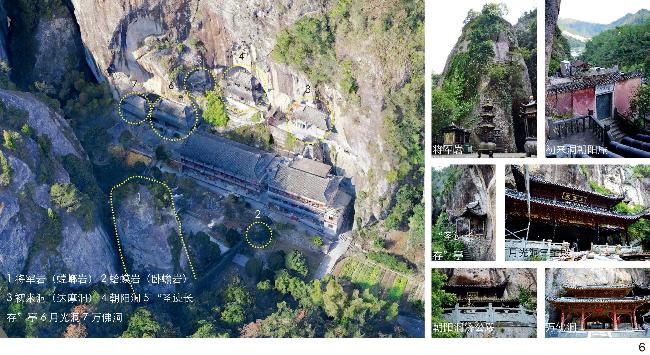
| 初来洞 | 位于明岩峡谷北侧崖壁,乃乡贤齐召南“宝纶诗社”a)旧址所在。洞口有明末句章行素居士刘光禄b)书短碑碣语,眉岩上有“狐狸斗鸡”纹样,内有“达摩祖师西来影”岩纹与齐召南书“高大”二字岩镌,故别名“达摩洞”“高大洞”,今朝阳庵建于此处 |
| 月光洞 | 眉岩上有“白马上西天”纹样,当是洞顶雨水顺流而下冲刷后的水渍形成。今三圣殿建于此处 |
| 朝阳洞 | 位于初来洞西侧,空间环境高爽向阳,得名“朝阳”,有齐召南书“日光”二字摩崖景观。洞内旧置草寮,今济公/寒山殿建于此处 |
| 狮子口 | 位于八寸关北侧崖壁,又名“老虎洞”,高6 m余,宽近20 m,洞内有二井名曰“日月井”(又称“仙人井”);洞外左上方为和合石,下临通海池,东与“象缩鼻”(白象戏水)相对,是为狮象二峰 |
图5 明岩峡谷第一截景观布局示意(方向从东南望向西北)Fig. 5 Schematic diagram of landscape pattern of the first segment of Mingyan Canyon (viewing from southeast to northwest) |
图6 明岩峡谷第二截景观布局示意(方向从东南望向西北)Fig. 6 Schematic diagram of landscape pattern of the second segment of Mingyan Canyon (viewing from southeast to northwest) |
| [1] |
孙筱祥. 生境·画境·意境: 文人写意山水园林的艺术境界及其表现手法[J]. 风景园林, 2013, 20(6): 26-33.
SUN X X. Life Conception, Picturesque Conception, Artistic Conception: On the Artistic Stages and Expressions of Literati’s Enjoyable Landscape Gardens[J]. Landscape Architecture, 2013, 20(6): 26-33.
|
| [2] |
孙筱祥. 中国山水画论中有关园林布局理论的探讨[J]. 风景园林, 2013, 20(6): 18-25.
SUN X X. A Study of the Theories of Chinese Landscape Planting Related to the Composition of Garden Design[J]. Landscape Architecture, 2013, 20(6): 18-25.
|
| [3] |
孟兆祯.园林与文化不解之缘[C]//《中国公园》编辑部.中国公园协会2002年论文集.北京: 《中国公园》编辑部, 2002: 4
MENG Z Z. The Inseparable Bond Between Garden and Culture [C]//Editorial Department ofChina Park. Proceedings of the 2002 China Park Association. Beijing: Editorial Department ofChina Park, 2002: 4.
|
| [4] |
孟兆祯.园衍[M].北京: 中国建筑工业出版社, 2015
MENG Z Z. Garden Deriving[M]. Beijing: China Architecture & Building Press, 2015.
|
| [5] |
宋爽, 陈奥星.当代审美语境下中国园林的山水思想传承与形式创新[J].城市建筑, 2023, 20(5): 147-150, 160
SONG S, CHEN A X. The Inheritance and Form Innovation of Landscape Thought in Chinese Gardens in the Contemporary Aesthetic Context[J]. Urbanism and Architecture, 2023, 20(5): 147-150, 160.
|
| [6] |
王思又, 高伟. 风景园林视野下的中国传统山水诗画时空观浅析[J]. 园林, 2022, 39(4): 88-93.
WANG S Y, GAO W. A Brief Analysis of Space-Time View of Traditional Chinese Landscape Poetry and Painting from the Perspective of Landscape Architecture[J]. Landscape Architecture Academic Journal, 2022, 39(4): 88-93.
|
| [7] |
张文正, 曹磊, 刘静蓉, 等. 诗画雅游: 明代南京徐氏东园平面复原考析[J]. 风景园林, 2022, 29(12): 113-119.
ZHANG W Z, CAO L, LIU J R, et al. Elegant Tour of Poetry and Painting: Research on Plan Restoration of Xu’s East Garden in Nanjing in Ming Dynasty[J]. Landscape Architecture, 2022, 29(12): 113-119.
|
| [8] |
杨箫凝.唐代王维辋川园林研究[D].西安: 西安建筑科技大学, 2016
YANG X N. The Research of Wang Wei’s Wangchuan Garden[D]. Xi’ an: Xi’ an University of Architecture and Technology, 2016.
|
| [9] |
王悦笛.唐宋诗歌与园林植物审美[D].北京: 中国社会科学院研究生院, 2021
WANG Y D. Poetry and Garden Plant Aesthetics in the Tang and Song Dynasties[D]. Beijing: Graduate School of Chinese Academy of Social Sciences, 2021.
|
| [10] |
李宇宏, 蒋佳俏. 移情与反哺: 竹在北宋诗、画、园林中的应用研究[J]. 园林, 2022, 39(4): 116-122.
LI Y H, JIANG J Q. Empathy and Feedback: The Cognition of Literati to Bamboo from Poems, Paintings and Gardens in the Northern Song Dynasty[J]. Landscape Architecture Academic Journal, 2022, 39(4): 116-122.
|
| [11] |
陈甜. 中国古典园林的诗、画、园耦合与互动: 以《红楼梦》大观园为例[J]. 现代园艺, 2022, 45(11): 116-118.
CHEN T. Coupling and Interaction of Poetry, Painting, and Garden in Chinese Classical Gardens: Taking the Grand View Garden inDream of Red Mansions as an Example[J]. Contemporary Horticulture, 2022, 45(11): 116-118.
|
| [12] |
刘文霜, 张彦艳. 中国传统文化在居住区景观设计中的应用研究[J]. 工业设计, 2023(2): 143-145.
LIU W S, ZHANG Y Y. A Study on The Application of Chinese Traditional Culture in The Landscape Design of Residential Areas[J]. Industrial Design, 2023(2): 143-145.
|
| [13] |
刘珂. 试论中国古典园林对现代景观的意义[J]. 城市建筑, 2022, 19(4): 166-168.
LIU K. Discussion on the Significance of Chinese Classical Gardens to Modern Landscape Architecture[J]. Urbanism and Architecture, 2022, 19(4): 166-168.
|
| [14] |
徐桐. 人类学栖居视角下传统山水名胜的自然文化混融价值再认知[J]. 风景园林, 2023, 30(12): 73-78.
XU T. Re-recognition of the Nature: Culture Integration Value of Traditional Landscape Places of Interest from the Perspective of Anthropological Dwelling[J]. Landscape Architecture, 2023, 30(12): 73-78.
|
| [15] |
毛华松, 汤思琦, 程语, 等. 中国古代镇山的地理想象及空间建构[J]. 风景园林, 2024, 31(1): 121-129.
MAO H S, TANG S Q, CHENG Y, et al. Geographical Imagination and Spatial Construction of Zhenshan in Ancient China[J]. Landscape Architecture, 2024, 31(1): 121-129.
|
| [16] |
李金路. 中国名山风景区的演化[J]. 风景园林, 2020, 27(4): 114-117.
LI J L. Evolution of Famous Mountain Resort in China[J]. Landscape Architecture, 2020, 27(4): 114-117.
|
| [17] |
周琦.寒山诗与史[M].合肥: 黄山书社, 1994
ZHOU Q. Poems and History of Han Shan[M]. Hefei: Huangshan Publishing House, 1994.
|
| [18] |
孙昌武.禅思与诗情[M].北京: 中华书局, 1997
SUN C W. Zen Meditation and Poetic Sentiment[M]. Beijing: Zhonghua Book Company, 1997.
|
| [19] |
王进珊. 谈寒山话拾得[J]. 中华文史论丛, 1984(1): 79-100.
WANG J S. Talking About Han Shan and Shi De[J]. Chinese History and Literary Theory, 1984(1): 79-100.
|
| [20] |
钟文. 关于寒山子的生平及其作品[J]. 汕头大学学报, 1985(2): 93-97.
ZHONG W. About Han Shanzi’s Life and Works[J]. Journal of Shantou University (Humanities & Social Sciences Edition), 1985(2): 93-97.
|
| [21] |
钱学烈.寒山子诗集校注[M].广州: 广东高等教育出版社, 1991.
QIAN X L. Annotated Poetry Collection of Han Shanzi[M]. Guangzhou: Guangdong Higher Education Press, 1991.
|
| [22] |
严振非. 寒山子身世考[J]. 东南文化, 1994(2): 212-218.
YAN Z F. Research on Han Shanzi’s Life Experience[J]. Southeast Culture, 1994(2): 212-218.
|
| [23] |
钱学烈. 寒山子年代的再考证[J]. 深圳大学学报(人文社会科学版), 1998(2): 101-107.
QIAN X L. A Fresh Textual Research on Han Shan’ s Lifetime[J]. Journal of Shenzhen University (Humanities & Social Sciences), 1998(2): 101-107.
|
| [24] |
何善蒙. 寒山子考证[J]. 文学遗产, 2007(2): 121-123.
HE S M. Textual Research on Han Shanzi[J]. Literary Heritage, 2007(2): 121-123.
|
| [25] |
任崇岳. 寒山、拾得身世杂考[J]. 中州学刊, 2016(6): 118-122.
REN C Y. Textual Research on the Stories of Hanshan and Shide[J]. Academic Journal of Zhongzhou, 2016(6): 118-122.
|
| [26] |
辛暨梅, 费勇. 寒山诗的寒岩意象与日本幽玄之美[J]. 南京师范大学文学院学报, 2015(2): 113-117.
XIN J M, FEI Y. The Image of Cold Rock in Han Shan’s Poems and the Japanese Aesthetics of Deep Mystery[J]. Journal of School of Chinese Language and Culture Nanjing Normal University, 2015(2): 113-117.
|
| [27] |
贺莉. 浅析寒山诗中的寒山意象[J]. 名作欣赏, 2015(18): 74-77.
HE L. Brief Analysis of the Image of Cold Mountain in Han Shan’s Poems[J]. Masterpieces Review, 2015(18): 74-77.
|
| [28] |
许尚枢.寒山子终隐天台山探因阐义[C]//苏州市寒山寺.第八届寒山寺文化论坛论文集(2014).上海: 上海三联书店, 2014: 9.
XU S S. Exploring the Reasons for Han Shanzi’s Final Hidden in Tiantai Mountain[C]//Suzhou City Hanshan Temple. Proceedings of the 8th Hanshan Temple Cultural Forum (2014). Shanghai: Shanghai SDX Joint Publishing Company, 2014: 9.
|
| [29] |
陈耆卿.嘉定赤城志[M].北京: 中国文史出版社, 2004.
CHEN Q Q. Jiading Chicheng Chronicle[M]. Beijing: China Literature and History Press, 2004.
|
| [30] |
许尚枢, 徐永恩.天台山游记选注[M].西安: 西安地图出版社, 2004.
XU S S, XU Y E. Annotations to the Travel Notes of Mount Tiantai[M]. Xi’an: Xi’an Cartographic Publishing House, 2004.
|
| [31] |
徐玮.天台山指南[M].上海: 商务印书馆, 1934.
XU W. Guide to Mount Tiantai[M]. Shanghai: The Commercial Press, 1934.
|
| [32] |
喻长霖.台州府志[M].台北: 成文出版社, 1970.
YU C L. Taizhou Prefecture Records[M]. Taipei: Cheng Wen Publishing Co., Ltd., 1970.
|
/
| 〈 |
|
〉 |