

Research on Renewal and Construction Strategies for Community Spaces Based on the Analysis of Children’s Outdoor Activity Characteristics
|
WANG Xia, Ph.D., is an associate professor and master supervisor in the College of Architecture and Environment, Sichuan University, and a member of Institute of Urbanization Strategy and Architecture, Sichuan University. Her research focuses on planning and design of urban public space, child-friendly city and community, and planning and design of urban outdoor children’s playground |
|
LI Keyue is a master student in the College of Architecture and Environment, Sichuan University. Her research focuses on planning and design of urban public space, and child-friendly design |
|
JIA Shiyi is a master student in the College of Architecture and Environment, Sichuan University. Her research focuses on planning and design of urban public space, community renewal, and child-friendly community |
|
XU Mengyi is a Ph.D. candidate in the School of Architecture and Planning, Hunan University, and a lecturer in the School of Architecture, Southwest Minzu University. Her research focuses on child-friendly cities and communities |
Received date: 2023-10-31
Revised date: 2024-06-12
Online published: 2025-12-17
Copyright
With the construction of child-friendly cities officially written into China’s “14th Five-Year Plan”, as an important part of the implementation of the child-friendly concept, how to create child-friendly spatial environments suitable for children’s activities in communities has become a question that needs to be answered urgently in community planning and construction. Therefore, this research aims to take three pilot child-friendly communities in Chengdu as examples, to explore the practice of community space construction, and to propose strategies for renewing and constructing a community space environment suitable for children’s outdoor activities.
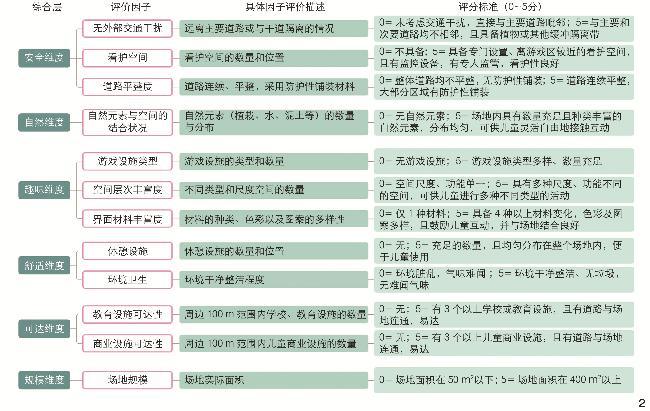
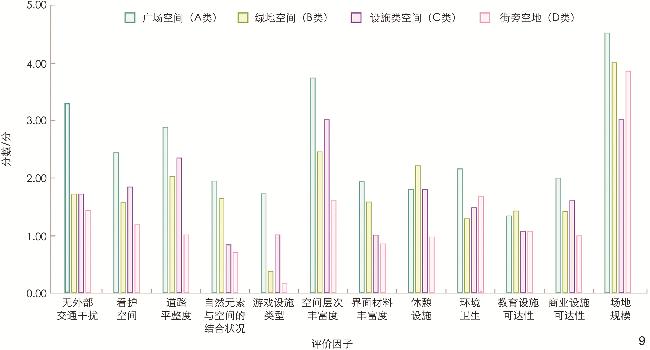
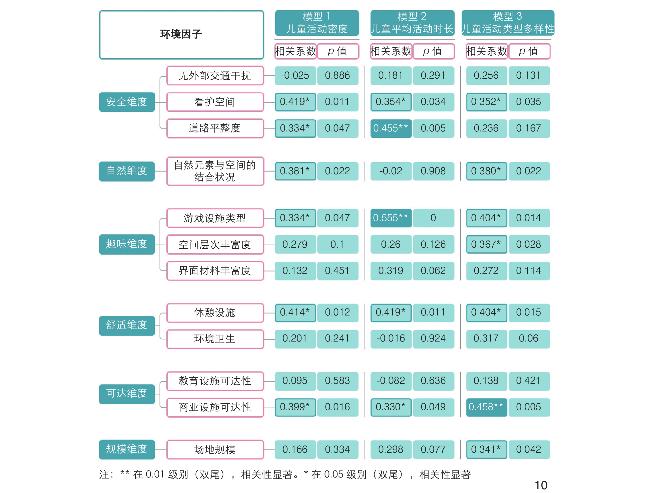
This research takes the four types of activity spaces of square, green space, facility space, and street space in the three pilot child-friendly communities in Chengdu as research objects. Methods such as the System for observing play and recreation in communities (SOPARC) and the kernel density estimation (KDE) are adopted to investigate the current status of community activity space, and the characteristics of the community space environment and children’s outdoor activities are collected. Based on relevant data and existing research, a total of twelve specific factors are used to quantify the characteristics of the community space environment from the six dimensions of safety, nature, fun, comfort, accessibility, and scale. Three indicators, namely density of children’s activities, average duration of children’s activities, and diversity index of children’s activity types, are used to analyze children’s activities quantitatively, and a correlation analysis model is established to explore the community space environment factors affecting children’s outdoor activities.
By analyzing the correlation between children’s outdoor activities and community space environment factors, it is found that multiple environmental factors have an impact on children’s activities, such as monitoring space, paving surfacing flatness, combination of natural elements and space, types of play facilities, spatial richness, rest facilities, accessibility of commercial facilities, and site scale. Among them, monitoring space, types of play facilities, rest facilities, and accessibility of commercial facilities are the key environmental indicators that affect the density, duration, and diversity of children’s outdoor activities, and significantly impact on children’s activities. In addition, paving surfacing flatness is also positively correlated with the density and duration of children’s activities, and the combination of natural elements and space has positively impact on the density of children’s activities and the diversity of activity types. Based on the quantitative analysis results of this research and considering the actual situation of community activity space construction, future key directions for creating community space environments that promote children’s outdoor activities can be summarized in four areas. 1) Reasonable planning and allocation of large-scale spaces with flat surfacing near children’s commercial areas. Both the accessibility of commercial facilities and site scale have a positive impact on children’s activities, with the former being a key environmental indicator affecting children’s activities, while the latter determining the number of activity facilities and space elements that the space can contain and accommodating a variety of key environmental factors that significantly affect children’s activities. So special attention needs to be paid to site scale in the construction of community space environment. Therefore, communities should prioritize the creation of large-scale, open, and flat-surfaced areas to provide ample opportunities for children’s play. 2) Addition of attractive and well-designed supporting facilities. Rest facilities and the types of play facilities are key environmental indicators that significantly impact children’s outdoor activities. Appropriate play facilities can be added according to different types of spaces. Meanwhile, rest facilities should also be designed with consideration of children’s psychological and behavioral habits, and they should be thoughtfully placed within activity space. 3) Creation of reasonable monitoring and rest spaces. There is a significant positive association between rest facilities and monitoring space with children’s activities. Community space for children’s activities should also take into account the needs of parents’ monitoring and resting needs while considering the needs of children’s activities. Ideally, monitoring and rest areas should be strategically placed around the activity site to offer a wider field of vision, making it easier to observe children’s outdoor activities. 4) Incorporation of novel, diverse, and interactive environmental elements. Spaces that excel in terms of the combination of natural elements and space and spatial richness are more appealing to children. Community planning should incorporate new, diverse, and interactive environmental elements to provide children with more opportunities for independent exploration and creativity, such as plants, sand, water, wood, and other natural elements.
These findings may provide a scientific foundation for designing community spaces that support children’s outdoor activities. Furthermore, the proposed renewal strategies, based on these analyses, can assist communities in creating a healthy and welcoming environment for children to thrive in.
Xia WANG , Keyue LI , Shiyi JIA , Mengyi XU . Research on Renewal and Construction Strategies for Community Spaces Based on the Analysis of Children’s Outdoor Activity Characteristics[J]. Landscape Architecture, 2024 , 31(8) : 86 -94 . DOI: 10.3724/j.fjyl.202310310488
表1 研究区域内社区广场、绿地、设施类活动空间基本特征Table 1 Basic characteristics of community square spaces, green spaces, and facility spaces in the research area |
| 空间类型 | 空间名称(代码) | 空间规模/m2 | 配套设施(数量) |
| 广场空间(A类):以较大硬质铺装为主要特征的开敞空间 | 玲珑珺广场(A1) | 200 | 沙池(1)、滑梯(2)、攀爬架(1)、 蹦床(1)、戏水池(1)、树屋(1) |
| 优博广场(A2) | 400 | 座椅(2)、树池座椅(6) | |
| 躬耕园广场(A3) | 500 | 篮球场(1)、乒乓球场(1)、 社区农场(1) | |
| 清波路转角广场(A4) | 50 | 大型树池座椅(1) | |
| 儿童友好广场(A5) | 150 | 舞台(1)、树池座椅(6)、乒乓球桌(2)、健身器材(1)、座椅(2) | |
| 工行门口小广场(A6) | 50 | 无 | |
| 地铁站口小广场(A7) | 50 | 无 | |
| 绿地空间(B类):以植物景观为主要特征,位于街道旁供人休憩游玩的绿地 | 智达二路转角绿地(B1) | 150 | 树池座椅(2)、廊架(1) |
| 成双大道中段绿地(B2) | 150 | 无 | |
| 金沙小学前绿地(B3) | 400 | 座椅(1) | |
| 清波路蜀鑫路交会处绿地(B4) | 50 | 树池座椅(1) | |
| 清百路转角绿地(B5) | 50 | 树池座椅(6) | |
| 火烧堰(B6) | 200 | 凉亭(1)、座椅(8) | |
| 梅园(B7) | 200 | 凉亭(1)、座椅(2)、树池座椅(4) | |
| 设施类空间(C类):配置休憩或游戏设施,可以支撑活动发生的节点空间 | 建行门口空间(C1) | 50 | 无 |
| 大润发门口空间(C2) | 50 | 树池座椅(4)、座椅(2) | |
| 社区党群中心门口空间(C3) | 50 | 座椅(1) | |
| 舞东风超市门口空间(C4) | 50 | 健身器材(1) | |
| 金福路街旁空间(C5) | 50 | 健身器材(1) | |
| 中铁双龙湾门口空间(C6) | 50 | 健身器材(1) | |
| 幼儿园旁游戏空间(C7) | 50 | 滑梯(1)、小木马(3)、座椅(2) | |
| 彩虹街拐角空间(C8) | 50 | 健身器材(1) |
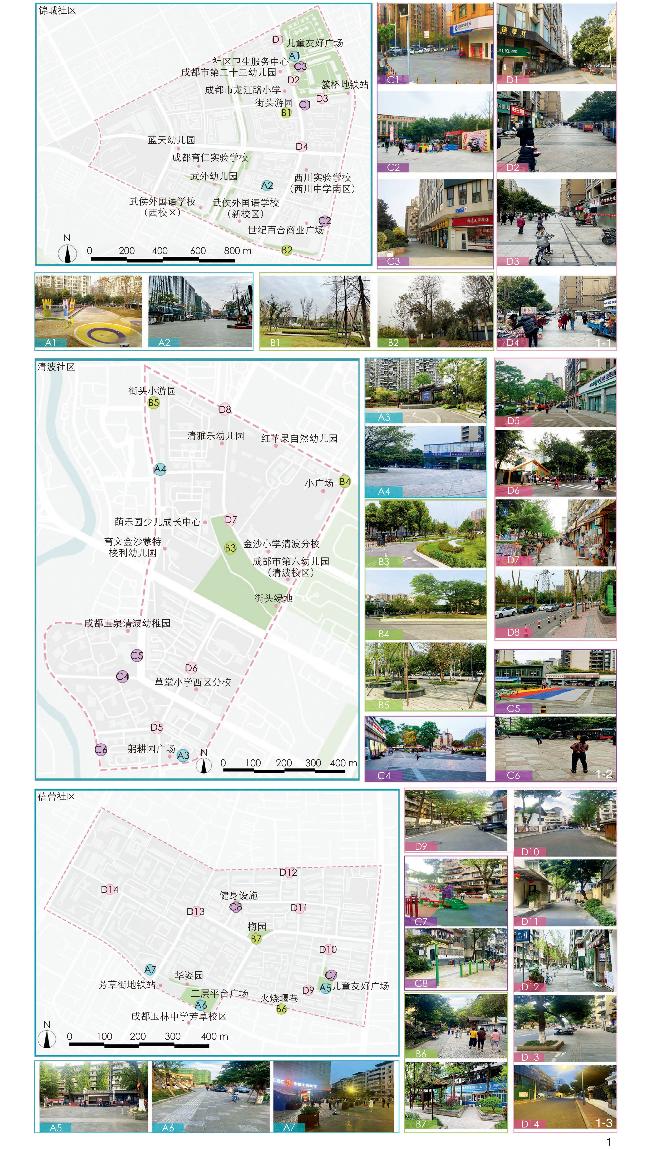
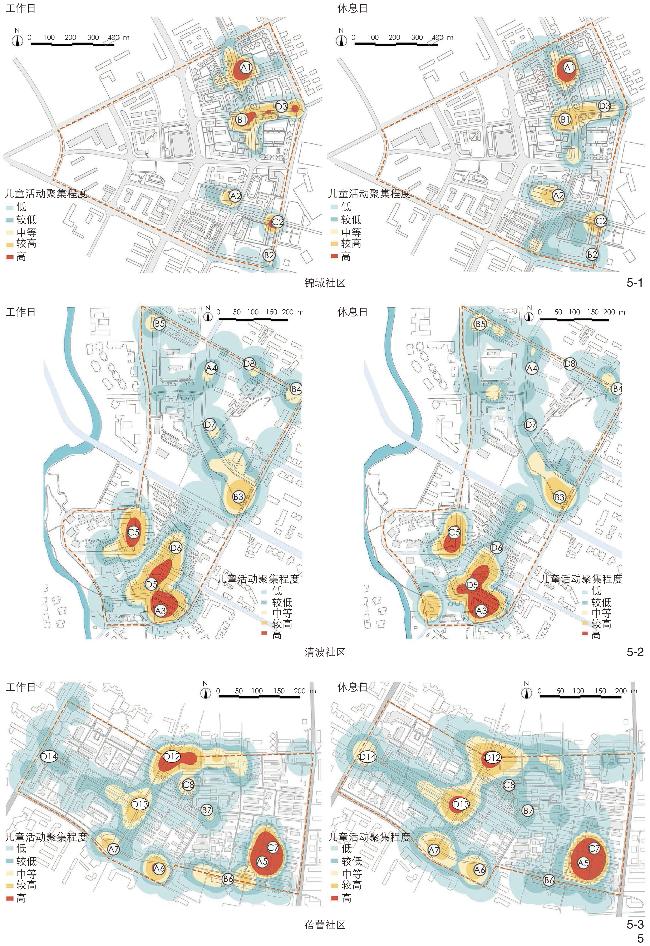
图1 3个社区的典型活动空间分布Fig. 1 Distribution of typical activity spaces in the three communities |
表2 研究区域内社区街旁空地活动空间基本特征Table 2 Basic characteristics of vacant street spaces within the community in the research area |
| 空间类型 | 空间名称(代码) | 空间规模/m2 | 街旁建成环境类别 | 街道的使用属性和 其他空间特征 |
| 街旁空地(D类):街道旁供人活动的空间 | 智达二路(D1) | 300 | 儿童商业 | 主要通学路段 |
| 龙江路小学街旁空地(D2) | 100 | 学校 | 主要通学路段 | |
| 金履三路(D3) | 200 | 儿童商业 | 普通路段 | |
| 中海锦城前街(D4) | 400 | 儿童商业 | 普通路段 | |
| 蜀清支路(D5) | 200 | 儿童商业 | 商业设施集中路段 | |
| 蜀清路(D6) | 300 | 住宅 | 主要通学路段 | |
| 清源二路(D7) | 300 | 学校、住宅 | 主要通学路段 | |
| 蜀江路(D8) | 200 | 住宅 | 普通路段 | |
| 蓓蕾西巷(D9) | 50 | 住宅、学校 | 主要通学路段,沿途有休憩设施 | |
| 蓓蕾北巷(D10) | 50 | 住宅、学校 | 主要通学路段,沿途有趣味性涂鸦、休憩设施 | |
| 彩虹街(D11) | 150 | 住宅 | 普通路段,沿途有座椅 | |
| 玉林西路(D12) | 300 | 儿童商业 | 社区主要干道 | |
| 芳草街(D13) | 300 | 儿童商业 | 社区主要干道 | |
| 芳草西一街(D14) | 150 | 住宅 | 主要通学路段 |
文中图表均由作者绘制或拍摄。
| [1] |
UNICEF. National Plan of Action for Children 2004[R]. Hague: Health, Welfare and Sport, 2004.
|
| [2] |
国务院.国务院关于印发中国妇女发展纲要和中国儿童发展纲要的通知[EB/OL].(2021-09-27)[2023-01-18].https://www.gov.cn/zhengce/content/2021-09/27/content_5639412.htm.
The State Council of the People’s Republic of China. A Notification from the State Council on the Issuance of the Outline for the China Women Development Programme and the Outline for the China Child Development Programme[EB/OL]. (2021-09-27) [2023-01-18].https://www.gov.cn/zhengce/content/2021-09/27/content_5639412.htm.
|
| [3] |
国家发展改革委, 住房和城乡建设部, 国务院妇儿工委办公室.城市儿童友好空间建设导则(试行)[EB/OL].(2022-12-02)[2023-01-18].https://www.mohurd.gov.cn/xinwen/gzdt/202211/20221130_769184.html.
National Development and Reform Commission, Ministry of Housing and Urban-Rural Development, Office of the Working Committee for Women and Children Under the State Council. The Guidelines for the Construction of Child-Friendly Spaces in Cities (Trial Implementation) [EB/OL]. (2022-12-02) [2023-01-18].https://www.mohurd.gov.cn/xinwen/gzdt/202211/20221130_769184.html.
|
| [4] |
联合国儿童基金会.儿童友好型城市规划手册[EB/OL].(2019-07)[2023-01-18].https://www.unicef.cn/reports/shaping-urbanization-children.
UNICEF. Shaping Urbanization for Children: A Handbook on Child-Responsive Urban Planning[EB/OL]. (2019-07) [2023-01-18].https://www.unicef.cn/reports/shaping-urbanization-children.
|
| [5] |
周惟彦.《儿童友好社区建设规范》操作手册[M].北京: 社会科学文献出版社, 2022.
ZHOU W Y. Handbook onSpecification for Child-Friendly Community Building[M]. Beijing: Social Sciences Academic Press, 2022.
|
| [6] |
惠英, 廖佳妹, 张雪诺, 等. 基于行为活动模式的儿童友好型街道设计研究[J]. 城市规划学刊, 2021(6): 92-99.
HUI Y, LIAO J M, ZHANG X N, et al. Child-Friendly Street Design Based on Behavioral Patterns[J]. Urban Planning Forum, 2021(6): 92-99.
|
| [7] |
陈天, 王佳煜, 石川淼. 儿童友好导向的生态社区公共空间设计策略研究: 以中新天津生态城为例[J]. 上海城市规划, 2020(3): 20-28.
CHEN T, WANG J Y, SHI C M. Public Space Optimization Design of Ecological Communities with Child-Friendly Orientation: A Case Study of Sino-Singapore Tianjin Eco-city[J]. Shanghai Urban Planning Review, 2020(3): 20-28.
|
| [8] |
王霞, 陈甜甜, 林广思. 自然元素在中国城市公园儿童游戏空间设计中的应用调查研究[J]. 国际城市规划, 2021, 36(1): 40-46.
WANG X, CHEN T T, LIN G S. Study on the Application of Natural Elements in Urban Parks’ Children’s Play Space in China[J]. Urban Planning International, 2021, 36(1): 40-46.
|
| [9] |
刘堃, 魏子珺. 成长视角下社区街道对儿童街道活动的支持研究[J]. 城市发展研究, 2019, 26(8): 16-24.
LIU K, WEI Z J. The Study of Neighborhood Streets on Supporting Children Street Activities from the Perspective of Children Growth[J]. Urban Development Studies, 2019, 26(8): 16-24.
|
| [10] |
周扬, 关经纯, 钱才云. 基于行为特征与心理需求的儿童友好型社区户外活动空间研究[J]. 中国园林, 2022, 38(7): 115-120.
ZHOU Y, GUAN J C, QIAN C Y. Study on Outdoor Activity Space of Child-Friendly Community Based on Behavioral Characteristics and Psychological Needs[J]. Chinese Landscape Architecture, 2022, 38(7): 115-120.
|
| [11] |
中国社区发展协会.儿童友好社区建设规范: T/ZSX3—2020[S/OL].(2020-01-13)[2024-06-11].http://www.shequxiehui.net.cn/w954/c5914.
China Community Development Association (CCDA). Specification for Child-friendly Community Building: T/ZSX3−2020[S/OL]. (2020-01-13) [2024-06-11].http://www.shequxiehui.net.cn/w954/c5914.
|
| [12] |
韩亚楠, 张希煜, 段雪晴, 等. 北京朝阳区双井街道: 基于儿童生活日志调研和空间观测的社区公共空间儿童友好性评估[J]. 北京规划建设, 2020(3): 43-48.
HAN Y N, ZHANG X Y, DUAN X Q, et al. Shuangjing Street, Chaoyang District, Beijing: Evaluation of Child-Friendliness of Community Public Space Based on Children’s Life Log Research and Spatial Observation[J]. Beijing Planning Review, 2020(3): 43-48.
|
| [13] |
孟雪, 李玲玲, 付本臣. 基于小学学龄儿童户外休闲活动实态调查的邻里建成环境优化设计研究[J]. 建筑学报, 2020(S2): 164-170.
MENG X, LI L L, FU B C. Study on the Optimization Design of Neighborhood Built Environment Based on an Investigation of Primary-School Age Children’s Outdoor Leisure Activities[J]. Architectural Journal, 2020(S2): 164-170.
|
| [14] |
罗雨雁, 王霞. 景观感知下的城市户外空间自然式儿童游戏场认知研究[J]. 风景园林, 2017, 24(3): 73-78.
LUO Y Y, WANG X. Research on Children Playground of Natural Style in Urban Outdoor Space Based on Landscape Perception[J]. Landscape Architecture, 2017, 24(3): 73-78.
|
| [15] |
徐欣, 胡静. 基于GPS数据城市公园游客时空行为研究: 以武汉东湖风景区为例[J]. 经济地理, 2020, 40(6): 224-232.
XU X, HU J. Study on Spatiotemporal Behavior of Urban Park Tourists Based on GPS Data: A Case Study of Wuhan East Lake Scenic Area[J]. Economic Geography, 2020, 40(6): 224-232.
|
| [16] |
DURANT R H, BARANOWSKI T, PUHL J, et al. Evaluation of the Childrens Activity Rating-Scale (CARS) in Young-Children[J]. Medicine and Science in Sports and Exercise, 1993, 25(12): 1415-1421.
|
| [17] |
DE SAINT-MAURICE P. Validation of the SOPLAY Direct Observation Tool with an Objective Accelerometry-Based Physical Activity Monitor[D]. Ames: Iowa State University, 2009.
|
| [18] |
MCKENZIE T L, COHEN D, SEHGAL A, et al. System for Observing Play and Recreation in Communities (SOPARC): Reliability and Feasibility Measures[J]. Journal of Physical Activity & Health, 2006, 3(1): 208-222.
|
| [19] |
REED J A, HOOKER S P. Where Are Youth Physically Active? A Descriptive Examination of 45 Parks in a Southeastern Community[J]. Childhood Obesity, 2012, 8(2): 124-131.
|
| [20] |
LINDBERG M, SCHIPPERIJN J. Active Use of Urban Park Facilities-Expectations Versus Reality[J]. Urban Forestry & Urban Greening, 2015, 14(4): 909-918.
|
| [21] |
邹诚, 玄锦, 王梓凌, 等. 基于SOPARC和KDE视角下的嵩口古镇游客游憩行为研究[J]. 山东林业科技, 2021, 51(2): 23-30.
ZOU C, XUAN J, WANG Z L, et al. Research on Tourists’ Recreational Behavior in Songkou Ancient Town Based on SOPARC and KDE[J]. Journal of Shandong Forestry Science and Technology, 2021, 51(2): 23-30.
|
| [22] |
曾忠平, 王雅丽, 彭浩轩. 基于SOPARC和KDE的游客游憩行为研究: 以武汉东湖绿道为例[J]. 中国园林, 2019, 35(12): 58-62.
ZENG Z P, WANG Y L, PENG H X. Research on Tourist Recreation Behavior Based on SOPARC and KDE: Taking Wuhan East Lake Greenway as an Example[J]. Chinese Landscape Architecture, 2019, 35(12): 58-62.
|
| [23] |
杨延基, 孙婷梅, 牛欣凯, 等. 基于SOPARC的夏季公园游憩行为研究: 以泌阳县双龙健康主题公园为例[J]. 西南大学学报(自然科学版), 2021, 43(9): 173-180.
YANG Y J, SUN T M, NIU X K, et al. An SOPARC-Based Study of Summer Park Recreation Behavior: Taking Shuanglong Health Theme Park in Biyang County as an Example[J]. Journal of Southwest University (Natural Science Edition), 2021, 43(9): 173-180.
|
| [24] |
徐梦一, 沈瑶, 廖堉珲, 等. 基于国外文献综述的社区环境儿童出行安全评价指标[J]. 景观设计学, 2020, 8(2): 10-25.
XU M Y, SHEN Y, LIAO Y H, et al. Evaluation Indicators of Children’s Mobility Safety in the Community Environment Based on English Literature Review[J]. Landscape Architecture Frontiers, 2020, 8(2): 10-25.
|
| [25] |
张玉荣.居住区儿童户外游憩场地安全性评价研究[D].上海: 上海交通大学, 2012.
ZHANG Y R, The Safety Evaluation Research of Children’s Play Ground in Residential Areas[D]. Shanghai: Shanghai Jiao Tong University, 2012.
|
| [26] |
毕波, 杨婷婷, 马春叶, 等. 儿童友好的街区中小学生放学空间与行为互动研究: 以万柳片区和大栅栏片区为例[J]. 风景园林, 2022, 29(2): 119-126.
BI B, YANG T T, MA C Y, et al. Exploring Interactions Between After-School Space and Behaviors of Primary and Secondary School Students for Creating Child-Friendly Spaces in Blocks: A Case Study of Wanliu and Dashilar Blocks of Beijing[J]. Landscape Architecture, 2022, 29(2): 119-126.
|
| [27] |
王霞, 胡心然, 乔雪. 基于游戏价值的中国城市公园儿童户外游戏空间评价研究[J]. 风景园林, 2022, 29(2): 78-83.
WANG X, HU X R, QIAO X. Research on Evaluation of Children’s Outdoor Play Space in Chinese Urban Parks Based on Play Values[J]. Landscape Architecture, 2022, 29(2): 78-83.
|
| [28] |
梁潇.居住区儿童户外游戏场地趣味性评价研究[D].上海: 上海交通大学, 2014.
LIANG X. Research of Post-occupancy Evaluation (POE) and Construction Strategies of the Interestingness of the Residential Children’s Playing Space Landscape[D]. Shanghai: Shanghai Jiao Tong University, 2014.
|
| [29] |
靳珂.儿童友好型城市街道步行空间评价体系及策略研究[D].福州: 福建农林大学, 2019.
JIN K. Research on Evaluation System and Strategy of Child-Friendly Urban Street Walking Space[D]. Fuzhou: Fujian Agriculture and Forestry University, 2019.
|
| [30] |
张渡也.儿童友好型社区公共空间设计研究: 以深圳市新田社区为例[D].深圳: 深圳大学, 2019.
ZHANG D Y. Research on the Design of Public Space in Child-Friendly Communities: Taking Shenzhen Xintian Community as an Example[D]. Shenzhen: Shenzhen University, 2019.
|
| [31] |
曾鹏, 蔡良娃. 儿童友好城市理念下安全街区与出行路径研究: 以荷兰为例[J]. 城市规划, 2018, 42(11): 103-110.
ZENG P, CAI L W. Safe Block and Children’s Travel Route (KINDLINT) Planning Under the Concept of Child-Friendly City: A Case Study of Holland[J]. City Planning Review, 2018, 42(11): 103-110.
|
| [32] |
魏琼, 李早, 胡文君. 小学生放学后停留行为与游憩空间的关联性研究[J]. 中国园林, 2017, 33(1): 100-105.
WEI Q, LI Z, HU W J. Research on the Relationship Between Recreational Space and Pupils’ Staying Behaviors After School[J]. Chinese Landscape Architecture, 2017, 33(1): 100-105.
|
| [33] |
朱亚斓, 张桂杰. 基于LBS大数据的城市儿童户外非正式公共活动空间体系构建[J]. 现代城市研究, 2019(1): 23-27.
ZHU Y L, ZHANG G J. Research on Informal Outdoor Public Space in Cities for Urban Children Based on the LBS Big Data[J]. Modern Urban Research, 2019(1): 23-27.
|
| [34] |
张岩松.基于儿童活动行为的住区开放空间环境研究: 以大连市为例[D].大连: 大连理工大学, 2021.
ZHANG Y S. Study on the Open Space Environment of Residential Area Based on Children’s Activity Behavior: Taking Dalian as an Example[D]. Dalian: Dalian University of Technology, 2021.
|
| [35] |
WOOLLEY H, LOWE A. Exploring the Relationship Between Design Approach and Play Value of Outdoor Play Spaces[J]. Landscape Research, 2013, 38(1): 53-74.
|
| [36] |
刘堃, 万心怡, 周佩玲. 儿童友好型社区公园对户外活动多样性的影响研究: 基于深圳市红荔社区自然实验[J]. 上海城市规划, 2022(6): 111-118.
LIU K, WAN X Y, ZHOU P L. The Effects of Child-Friendly Community Park on the Diversity of Outdoor Activities: A Natural Experiment in Hongli Community, Shenzhen[J]. Shanghai Urban Planning Review, 2022(6): 111-118.
|
| [37] |
BRUSSONI M, ISHIKAWA T, BRUNELLE S, et al. Landscapes for Play: Effects of an Intervention to Promote Nature-Based Risky Play in Early Childhood Centres[J]. Journal of Environmental Psychology, 2017, 54: 139-150.
|
/
| 〈 |
|
〉 |