

Action Mechanism of Folk Rituals in Alleviating Rural Hollowing: A Case Study of Qinban Village in Zhangzhou, Fujian
|
SU Wanyi is a master student in the College of Architecture and Landscape Architecture, Peking University, and a member of the River Basin Habitats Research Center. Her research focuses on riv- habitats locality and adaptation, and heritage conservation |
|
WANG Fang, Ph.D., is a professor in the College of Architecture and Landscape Architecture, Peking University, and director of the River Basin Habitats Research Center. Her research focuses on riv-habitats and their human-water adaptation domains |
|
HUANG Yuzi is a master student in the College of Architecture and Landscape Architecture, Peking University. His research focuses on design ecology |
|
XUE Pengcheng is a Ph.D. candidate in the College of Urban and Environment Sciences, Peking University, and a member of the River Basin Habitats Research Center. His research focuses on riv-habitats locality and adaptation |
Received date: 2024-05-12
Revised date: 2024-09-29
Online published: 2025-12-16
Copyright
In the context of rapid urban-rural factor flow, the large-scale migration of rural populations has led to issues such as labor shortage, hollowing of residential area, and industrial decline, which impede rural development and contribute to the problem of rural hollowing. Addressing the aforesaid issues has become a critical concern in the context of rural revitalization. As urbanization progresses and strategies like new urbanization and rural revitalization are implemented, China has seen a trend of population flow back from cities to rural areas. The return of labor equipped with knowledge, skills, and assets presents a new opportunity for rural socio-economic development. The main objective of this research is to explore how folk rituals, as a form of folk culture, drive population return and, based on this, discuss their role in mitigating rural hollowing.
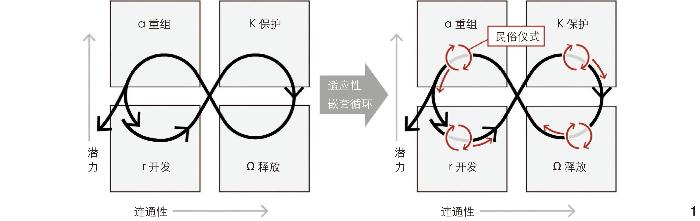
Participatory observation and semi-structured interview are employed to collect basic information on the activities, characteristics, and transmission mechanisms of folk rituals in Qinban Village. These methods are chosen to capture both the observable processes of the rituals and their in-depth connotations attributed by participants. “Adaptation” is a key concept for interpreting changes and developments in human-environment relationships. Holling’s theory of adaptive cycle extends the idea of adaptation to the research on complex systems. This theory explains the adaptive evolution of systems through four stages: Exploitation (r), Conservation (K), Release (Ω), and Reorganization (α), providing the theoretical foundation for this research. Previous research has built local adaptive cycles and applied them to study rural life cycles and dynamic development. This research constructs a nested adaptive cycle model for the village to explore how folk rituals, as a “micro-cycle”, interact with the village’s overall life cycle, thereby examining how the transmission of folk rituals helps mitigate rural hollowing.
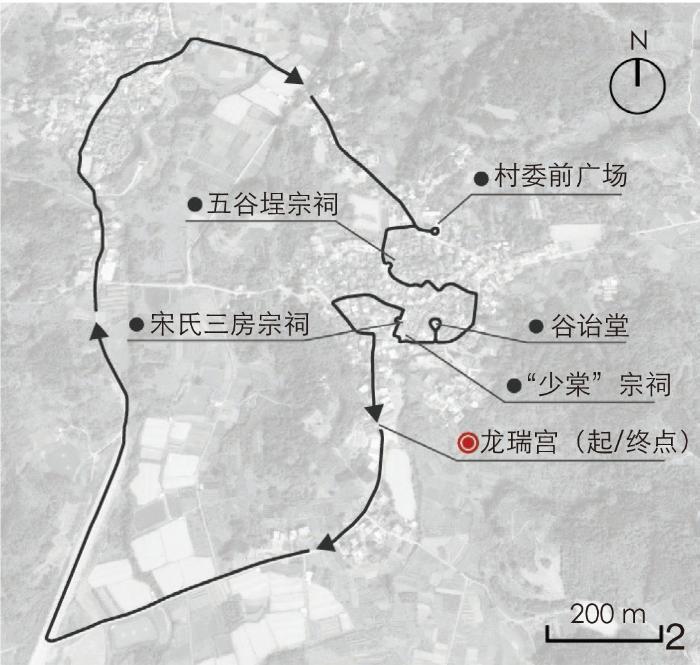
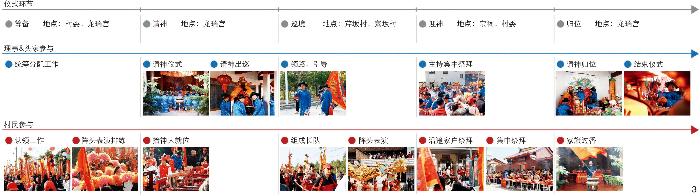
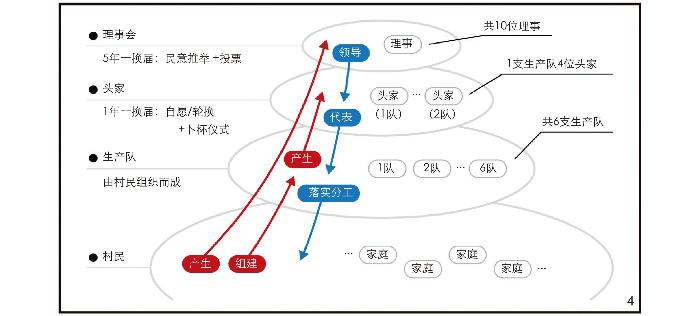
Folk rituals reflect social relationship and shape social space, serving as an important medium for fostering a sense of identity and belonging in rural communities. Based on adaptive cycle theory, the research finds that the ritual of “Xunjing” ritual (a parade ritual) is an annual “micro-cycle” that maintains rural vitality by nesting itself within the village’s overall life cycle, from birth to decline. In the context of rural population loss, the transmission of folk rituals helps mitigate the negative effects of rural hollowing in three key ways. 1) The annual folk ritual, through its historical evolution, has formed a multi-stakeholder collaborative framework that helps promote adaptive cycles. At the same time, the annual cyclic rhythm ensures that the folk ritual is renewed and continued within the structured framework. This provides strong support for the intergenerational transmission of folk rituals, rural memory, rural social networks, and villagers’ local identity, thereby enhancing the village’s adaptive evolutionary capacity. 2) The annual folk ritual provides an opportunity for villagers who have migrated to cities or other regions to return and participate in collective activities. The periodic return of the migrant population injects new social and economic resources into the village, helping maintain the village’s capacity for self-organization and self-adaptation. This cyclic interaction between urban and rural spaces ensures that the village does not completely lose its human capital, thereby helping alleviate the negative impacts of continued rural population migration. 3) The adaptive cycle of the village is characterized by a “dual-cycle” nesting: One cycle is the life course of the rural system from birth to decline, and the other is the temporal cycle formed by folk activities and seasonal festivals based on specific time patterns. Folk rituals, as time-cyclic cultural activities, play an active role in regulating the village’s broader life cycle. The adaptive cycle of the village includes the stages of Exploitation, Conservation, Release, and Reorganization. The annual cycle of folk rituals is nested within these stages, effectively reinforcing village resilience. Building a nested adaptive cycle model can help explore the role of cultural transmission in the village’s adaptive evolution from the perspective of dynamic cycles on different time scales.
The research reveals that the transmission of folk rituals supports local memory, cultural continuity, and social networks, and thus helps maintain village vitality. The cyclical nature of folk rituals not only promotes short-term social cohesion but also fosters long-term cultural continuity, positively contributing to the village’s adaptive capacity. Through the nested model of adaptive cycles, this research highlights the importance of cultural activities in mitigating the adverse effects of rural hollowing and provides a valuable framework for understanding how cultural practices support rural sustainability and resilience. However, the research also acknowledges certain limitations. Although folk rituals promote periodic reintegration of the migrant population with the village, this does not imply a permanent return of the population. Therefore, the issue of rural hollowing persists. Additionally, addressing rural hollowing requires a multi-dimensional discussion that goes beyond cultural factors, encompassing economic, social, and ecological aspects. The case of Qinban Village may not fully represent other rural areas. Future research should explore whether similar adaptive mechanisms exist in other cultural and geographical contexts and assess the potential for developing broader strategies to address rural hollowing based on these findings.
SU Wanyi , WANG Fang , HUANG Yuzi , XUE Pengcheng . Action Mechanism of Folk Rituals in Alleviating Rural Hollowing: A Case Study of Qinban Village in Zhangzhou, Fujian[J]. Landscape Architecture, 2024 , 31(12) : 27 -32 . DOI: 10.3724/j.fjyl.202405120260
表1 丰山镇14个行政村社庙更新与仪式时间基本情况Tab. 1 Overview of the temple renewal and ritual time of the 14 administrative villages in Fengshan Town |
| 村名 | 庙名 | 更新年月 | 巡境仪式日期 |
| 玉胜村 | 金鹊宫 | 2004年2月 | 每年农历三月初十 |
| 玉兰村 | 玉兰宫 | 2014年6月 | 每年农历一月十三 |
| 龙径村 | 龙径庵 | 2007年2月 | 每年农历三月十五 |
| 浦西村 | 威惠庙 | 2004年8月 | 每年农历二月十五 |
| 红岩村 | 武当宫 | 2012年12月 | 每年农历三月初三 |
| 后壁沟村 | 威惠庙 | 2008年12月 | 每年农历三月十四 |
| 内角村 | 威惠庙 | 2008年12月 | 每年农历三月十四 |
| 湖坪村 | 威惠庙 | 2008年12月 | 每年农历三月十四 |
| 碧溪村 | 碧云宫 | 2021年2月 | 每年农历一月十三 |
| 银塘村 | 毫光宫 | 2007年12月 | 每年农历十月二十六 |
| 银塘村 | 庆元宫 | 2023年12月 | 每年农历二月十五 |
| 银塘村 | 慈济宫 | 2022年10月 | 每年农历二月初六 |
| 下尾村 | 养正宫 | 2003年12月 | 每年农历一月二十二 |
| 康山村 | 代虚宫 | 2017年9月 | 每年农历一月十五 |
| 芹坂村 | 龙瑞宫 | 2001年9月 | 每年农历一月初五 |
| 寨坂村 | 鼎兴宫 | 2008年11月 | 每年农历一月十三 |
表2 受访者基本信息Tab. 2 Basic information of the respondents |
| 受访者编号 | 性别 | 年龄 | 当前常住所在地 | 身份 |
| V01 | 女 | 19 | 福州 | 学生 |
| V02 | 女 | 19 | 漳州 | 学生 |
| V03 | 男 | 19 | 泉州 | 学生 |
| V04 | 男 | 60 | 芹坂村 | 理事会会长 |
| V05 | 男 | 62 | 芹坂村 | 理事会成员 |
| V06 | 男 | 38 | 泉州 | 理事会成员 |
| E01 | 男 | 60 | 澳门 | 乡贤会成员 |
| E02 | 男 | 30 | 福州、丰山镇 | 乡贤会成员 |
| E03 | 男 | 48 | 福州 | 乡贤会秘书长 |
| G01 | 男 | 44 | 芹坂村 | 村长 |
| T01 | 女 | 约30 | 广东 | 游客 |
| T02 | 男 | 约30 | 福建 | 游客 |
| T03 | 男 | 20~30 | 漳州 | 戏团演员 |
| [1] |
LIU Y S, LI Y H. Revitalize the World’s Countryside[J]. Nature, 2017, 548 (7667): 275-277
|
| [2] |
ZHANG X X, BRANDT M, TONG X W, et al. A Large but Transient Carbon Sink from Urbanization and Rural Depopulation in China[J]. Nature Sustainability, 2022, 5 (4): 321-328
|
| [3] |
LI Y R, LIU Y S, LONG H L, et al. Community-Based Rural Residential Land Consolidation and Allocation Can Help to Revitalize Hollowed Villages in Traditional Agricultural Areas of China: Evidence from Dancheng County, Henan Province[J]. Land Use Policy, 2014, 39: 188-198
|
| [4] |
石亚灵, 张悦, 周政旭. 乡村空心化的社会网络演变特征及规划响应: 以四川省A村为例[J]. 城市规划, 2024, 48 (1): 102-114
SHI Y L, ZHANG Y, ZHOU Z X. Characteristics of Social Network Evolution in Hollowing Rural Areas and Planning Response: A Case Study of Hollowed Village A in Sichuan Province[J]. City Planning Review, 2024, 48 (1): 102-114.
|
| [5] |
郑殿元, 文琦, 王银, 等. 中国村域人口空心化分异机制及重构策略[J]. 经济地理, 2019, 39 (2): 161-168
ZHENG D Y, WEN Q, WANG Y, et al. Differentiation Mechanism and Reconstruction Strategy of Rural Population Hollowing in China[J]. Economic Geography, 2019, 39 (2): 161-168.
|
| [6] |
LU Y, ZHOU Y Q, LIU P L. Improving the Entrepreneurial Ability of Rural Migrant Workers Returning Home in China: Study Based on 5,675 Questionnaires[J]. Humanities and Social Sciences Communications, 2023, 10 (1): 1-10
|
| [7] |
WU B, ZHANG L Y, NOKE H, et al. How Does Reverse Entrepreneurship Facilitate Community Transformation in Rural China: Evidence from the Yellow Revier[J]. Journal of Rural Studies, 2024, 106: 103204.
|
| [8] |
李雨婷, 喻忠磊, 苗长虹, 等. 多维邻近性对流动人口回流意愿的影响: 基于中国流动人口动态监测数据的实证[J]. 地理科学进展, 2022, 41 (8): 1403-1415
LI Y T, YU Z L, MIAO C H, et al. Influence of Multi-proximities on Floating Population’s Return Intention: An Empirical Study Based on the China Migrant Population Dynamic Survey[J]. Progress in Geography, 2022, 41 (8): 1403-1415.
|
| [9] |
李志刚, 刘达, 林赛南. 中国城乡流动人口”回流”研究进展与述评[J]. 人文地理, 2020, 35 (1): 1-10
LI Z G, LIU D, LIN S N. A Literature Review of the Study on Return Floating Population in China[J]. Human Geography, 2020, 35 (1): 1-10.
|
| [10] |
张亨溢, 杨刚. 城乡公路建设对返乡创业增收的影响机理及其空间差异[J]. 经济地理, 2023, 43 (12): 103-112
ZHANG H Y, YANG G. Influencing Mechanism and Spatial Differences of Rural-Urban Road Construction on Returning Entrepreneurship and Increasing Income[J]. Economic Geography, 2023, 43 (12): 103-112.
|
| [11] |
LU Y H, QIAN J X. Rural Creativity for Community Revitalization in Bishan Village, China: The Nexus of Creative Practices, Cultural Revival, and Social Resilience[J]. Journal of Rural Studies, 2023, 97: 255-268
|
| [12] |
尹莎, 杨新军, 陈佳. 人地系统适应性研究进展: 概念、理论框架与方法[J]. 地理科学进展, 2021, 40 (2): 330-342
YIN S, YANG X J, CHEN J. Progress of Research on Adaptation of Human-Environment Systems: Concepts, Theoretical Frameworks, and Methods[J]. Progress in Geography, 2021, 40 (2): 330-342
|
| [13] |
HOLLING C S. Understanding the Complexity of Economic, Ecological, and Social Systems[J]. Ecosystems. 2001, 4: 390-405.
|
| [14] |
WANG F, XUE P C, SU W Y, et al. The Locality-Adaptation Theory of Traditional Villages[J]. Indoor and Built Environment, 2024, 33 (6): 979-984
|
| [15] |
XUE P C, ZHANG J Y, WANG F, et al. Adaptation of Chinese Traditional Villages from the Perspective of Locality Preservation[J/OL]. Indoor and Built Environment, 2024: 1420326X241277966(2024-08-27)[2019-05-12]. https://doi.org/10.1177/1420326X241277966.
|
| [16] |
魏艺. “韧性”视角下乡村社区生活空间适应性建构研究[J]. 城市发展研究, 2019, 26 (11): 50-57
WEI Y. Research on the Adaptive Construction of Rural Community Living Space from the Perspective of “Resilience”[J]. Urban Development Studies, 2019, 26 (11): 50-57
|
| [17] |
WANG F, XU H Y, HE P W, et al. Adaptive Changes in Traditional Settlements in the Loess Plateau of the Yellow River Basin over 500 Years[J]. River, 2023, 2 (2): 186-196
|
| [18] |
薛鹏程, 徐浩义, 汪芳, 等. “人口—生产—生态 ”演化视角下流域聚落的适应性发展规划路径: 以黄河流域黄土高原地区为例[J]. 规划师, 2022, 38 (11): 41-49
XUE P C, XU H Y, WANG F, et al. Adaptive Development Planning Paths of Settlements from the Perspective of “Population – Production – Ecology” Evolution: An Example of the Loess Plateau Region of the Yellow River Basin[J]. Planners, 2022, 38 (11): 41-49.
|
| [19] |
王云才, 申佳可. 乡村景观格局特征及演变中的多尺度空间过程探索: 以乌镇为例[J]. 风景园林, 2020, 27 (4): 62-68
WANG Y C, SHEN J K. Exploration of Multi-scale Spatial Process in the Characteristics and Evolution of Rural Landscape Pattern: A Case Study of Wuzhen[J]. Landscape Architecture, 2020, 27 (4): 62-68.
|
| [20] |
高凯, 何沁遥, 张宝文. 文化景观视角下的乡土聚落研究: 以云南垭口村为例[J]. 风景园林, 2020, 27 (3): 103-106
GAO K, HE Q Y, ZHANG B W. Vernacular Settlements from the Perspective of Cultural Landscape: A Case Study of Yakou Village in Yunnan Province[J]. Landscape Architecture, 2020, 27 (3): 103-106.
|
| [21] |
孙九霞, 许泳霞, 王学基. 旅游背景下传统仪式空间生产的三元互动实践[J]. 地理学报, 2020, 75 (8): 1742-1756
SUN J X, XU Y X, WANG X J. The Ternary Interactive Practice of the Production of Traditional Ritual Space in the Tourism Context[J]. Acta Geographica Sinica, 2020, 75 (8): 1742-1756
|
| [22] |
陈蔚, 梁蕤. 身份与边界: 藏彝走廊氐羌族群“纳-槃木系”聚居地“圣-俗”文化景观研究[J]. 风景园林, 2021, 28 (2): 109-115
CHEN W, LIANG R. Identity and Boundary: A Research on the “Holy-Secular” Cultural Landscape of “Na-Panmu” Settlements of Di-Qiang Ethnic Group in Tibetan-Yi Corridor[J]. Landscape Architecture, 2021, 28 (2): 109-115.
|
| [23] |
WANG C M. Assembling the Sacred Space in the Taiwanese Countryside: Endogenous Development Projects, Temple Festivals and Unruly Material Objects[J]. Journal of Rural Studies, 2017, 54: 28-38
|
| [24] |
周大鸣, 詹虚致. 祭祀圈与村落共同体: 以潮州所城为中心的研究[J]. 中国农业大学学报(社会科学版), 2013, 30 (4): 80-88
ZHOU D M, ZHAN X Z. Sacrifice Circle and Village Community: Research on Suocheng Village,Chaozhou City[J]. Journal of China Agricultural University(Social Sciences), 2013, 30 (4): 80-88.
|
| [25] |
YANG X T. Toujia: A Possibility of Village Autonomy in Southern Fujian?[M]//HOLL A F C. Traditions and Cultural Heritage: Genesis, Reproduction, and Preservation. Kolkata: B P International, 2023: 76-85.
|
| [26] |
LI Y R, FAN P C, LIU Y S. What Makes Better Village Development in Traditional Agricultural Areas of China? Evidence from Long-Term Observation of Typical Villages[J]. Habitat international, 2019, 83: 111-124
|
| [27] |
郭文. 传统村落神圣空间形态、当代价值及其研究范式再认识[J]. 人文地理, 2020, 35 (6): 1-8
GUO W. Recognition of Sacred Space Form, Contemporary Value and Research Paradigm of Traditional Villages[J]. Human Geography, 2020, 35 (6): 1-8.
|
/
| 〈 |
|
〉 |