

Exploring Urban Rewilding Opportunity Spaces Through Identification, Deconstruction and Conservation: A Case Study of the Direct Administration Zone of Tianfu New Area, Sichuan
|
JIN Xiaodong is a master student in the Faculty of Architecture and Urban Planning, Chongqing University. Her research focuses on urban rewilding and urban biodiversity |
|
FENG Li, Master, is director of the Second Institute of Landscape Architecture, Chengdu Park City Construction & Development Research Institute. Her research focuses on park city ecology, and landscape planning and design |
|
YOU Fengyi, Master, is an intermediate engineer in Pucao (Chongqing) Ecological Environment Technology Co., Ltd. Her research focuses on urban ecology and landscape design |
|
YUAN Jia, Ph.D. is an associate professor and doctoral supervisor in the Faculty of Architecture and Urban Planning, Chongqing University, a permanent research fellow in the Key Laboratory of New Technology for Construction of Cities in Mountain Area, Ministry of Education, and a research fellow in the Research Center for Ecological Restoration and Governance of Water Level Fluctuation Zone in the Three Gorges Reservoir Area. His research focuses on ecological landscape design, and ecological restoration and biodiversity conservation |
Received date: 2024-06-22
Revised date: 2024-09-18
Online published: 2025-12-16
Copyright
Urbanization has caused significant habitat loss, threatening biodiversity and socio-ecological sustainability. Urban rewilding is increasingly seen as key to restoring natural processes and fostering self-sustaining urban ecosystems by reducing human interference or applying moderate restoration techniques to guide urban areas toward a more natural, uncultivated state. Despite its benefits, substantial gaps remain in identifying suitable areas for rewilding, understanding their spatial characteristics, and developing effective conservation strategies.
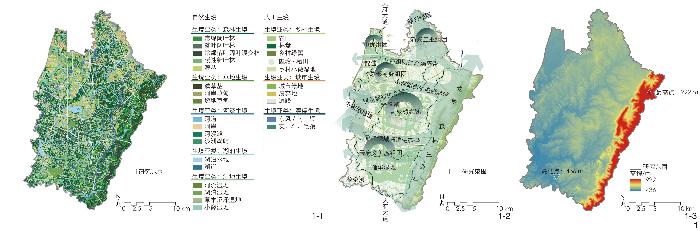
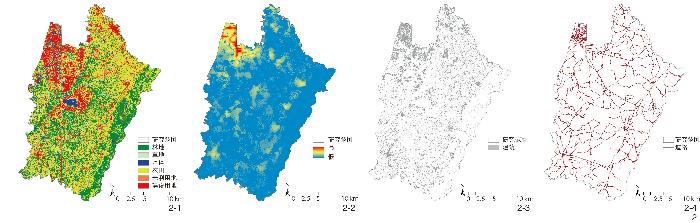
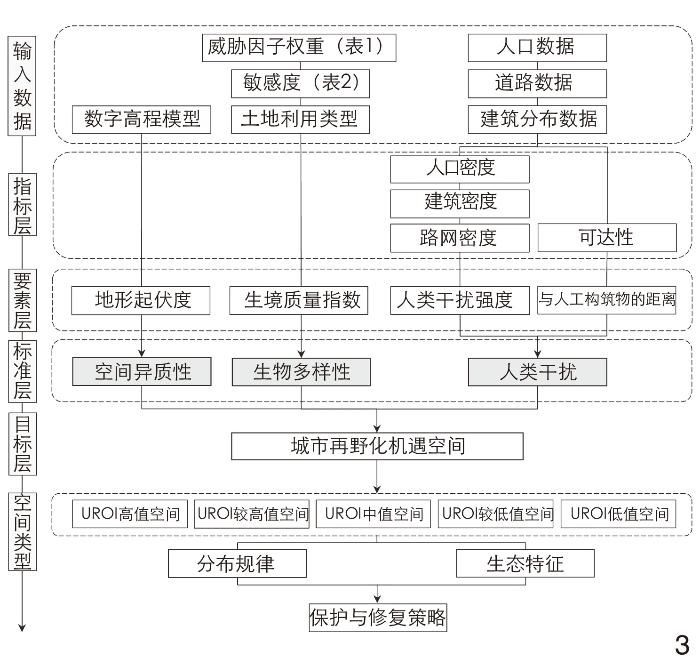
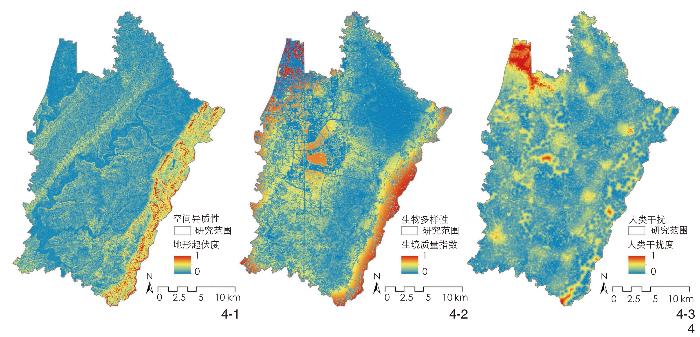
This research introduces the concept of urban rewilding opportunity spaces (UROS) to identify and assess areas suitable for urban rewilding. UROS refers to urban spaces that either already possess wild characteristics in need of protection or have the potential to develop new urban wildness. A comprehensive quantitative and spatial analysis framework is developed to identify UROS within the Direct Administration Zone of Tianfu New Area. This framework integrates multi-source data, including data on land use, topography, population density, buildings, and roads, and employs advanced quantitative methods such as neural network, InVEST model, inverse distance weighting interpolation, and the entropy weight method. These methods are used to extract key influencing factors — spatial heterogeneity, biodiversity, human interference, which are critical for urban rewilding processes. The urban rewilding opportunity index (UROI) is calculated by weighting and summing relevant indicators, and the spatial distribution of UROS is mapped using ArcGIS 10.8.
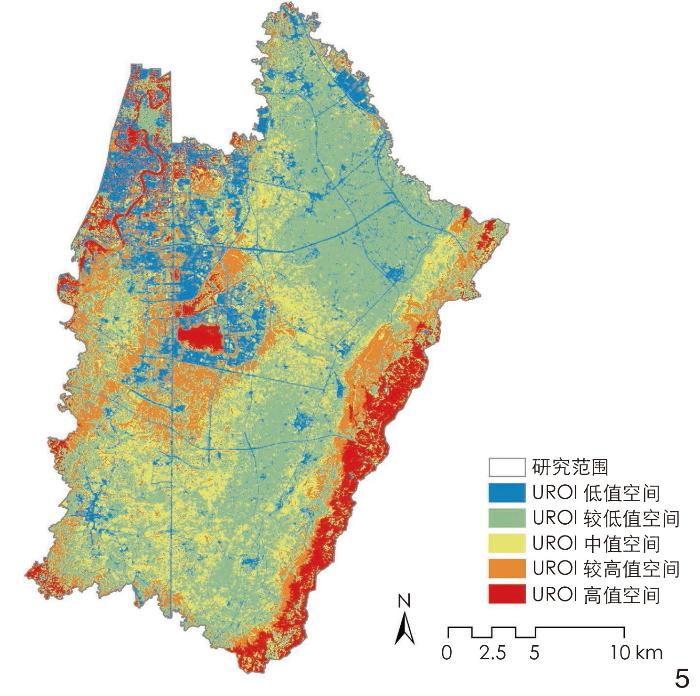
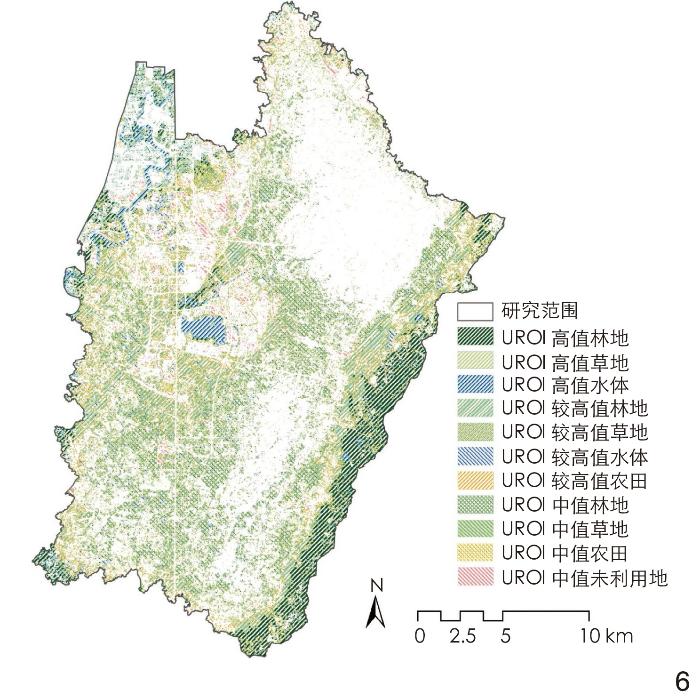
The UROI is classified into five categories using the natural breaks classification method: High (UROI≥0.628), relatively high (0.628>UROI≥0.451), moderate (0.451>UROI≥0.302), relatively low (0.302>UROI≥0.145), and low (UROI<0.145). Areas with UROI≥0.302 are designated as UROS. Areas with high UROI value cover an area of approximately 48.48 km², representing 8.68% of the research area, with 1,932 patches smaller than or equal to 900 m² in area, accounting for 56.26% of these high-value spaces. Areas with relatively high UROI value cover an area of 75.25 km², or 13.47% of the research area, with 5,549 patches under 900 m² in area, comprising 55.54% of this category. Areas with moderate UROI value cover an area of 101.71 km², with 10,986 patches under 900 m² in area, making up 56.67% of this category. The findings indicate that over half of the UROS within the research area are small patches with an area less than or equal to 900 m². Areas with high UROI value are primarily located in regions with minimal human interference, high spatial heterogeneity, and significant spontaneous vegetation, such as Longquan Mountain, the Luxi River corridor, and the ecologically restored Xinglong Lake wetland. Moderate-value UROS, covering a larger area, are typically found at the edges of areas with high or relatively high UROI value or within urban built-up areas, including grasslands, forestlands, wetlands, long-term unused or abandoned lands, and farmlands with semi-natural habitats, which are more susceptible to human impact.
This research establishes a quantitative framework to identify UROS and explores their distribution and ecological characteristics in Tianfu New Area. The findings underscore the need for systematic conservation of areas with high UROI value through the establishment of core protection zones, ecological buffer zones, and sustainable use zones. For areas with relatively high or moderate UROI value, enhancing habitat heterogeneity through targeted interventions is essential, while sustainable development should follow a “benign neglect” strategy to allow natural processes to dominate, thereby fostering biodiversity and ecosystem resilience. The research not only provides a scientific basis for identifying UROS but also offers theoretical support for further research on the dynamic balance and self-regulation mechanisms of urban ecosystems. Future research should delve deeper into the interactions between spatial heterogeneity, biodiversity, and human disturbance across various scales, and optimize the strategies for ecological design and management of urban rewilding processes to promote the sustainable development of urban ecosystems. Future research should examine the interactions between spatial heterogeneity, biodiversity, and human disturbance across scales, optimizing ecological design and management strategies for sustainable urban rewilding. Key focus areas include: 1) Simulation and prediction: Leverage 3S technologies, simulations, and field monitoring to model factors and processes affecting UROS. 2) Spontaneous plant dynamics: Monitor UROS evolution, focusing on spontaneous plant dynamics — key drivers of rewilding — at both population and community levels. 3) System dynamics modeling: Develop models to evaluate UROS responses to environmental pressures and management strategies, thereby uncovering mechanisms of wildness and biodiversity restoration.
JIN Xiaodong , FENG Li , YOU Fengyi , YUAN Jia . Exploring Urban Rewilding Opportunity Spaces Through Identification, Deconstruction and Conservation: A Case Study of the Direct Administration Zone of Tianfu New Area, Sichuan[J]. Landscape Architecture, 2024 , 31(11) : 22 -30 . DOI: 10.3724/j.fjyl.202406220337
表1 威胁因子的最大影响距离和权重Tab. 1 Maximum influence distance and weight of threat factors |
| 威胁因子 | 衰退方式 | 最大影响距离/km | 权重 |
| 农田 | 线型 | 0.4 | 0.6 |
| 建设用地 | 指数型 | 0.8 | 0.4 |
表2 不同土地利用类型的生境适宜度及对威胁因子的敏感度Tab. 2 Habitat suitability of different land use types and their sensitivity to threat factors |
| 土地利用类型 | 生境适宜度 | 敏感度 | |
| 农田 | 建设用地 | ||
| 农田 | 0.3 | 0.3 | 0.4 |
| 林地 | 1.0 | 0.7 | 0.4 |
| 草地 | 1.0 | 0.8 | 0.6 |
| 未利用地 | 0.6 | 0.6 | 0.5 |
| 建设用地 | 0 | 0 | 0 |
| 水体 | 0.9 | 0.5 | 0.4 |
表3 城市再野化机遇空间评价指标权重Tab. 3 Evaluation indicators and weights of UROS |
| 标准 | 要素 | 指标 | 权重 | 性质 |
| 注:“性质”表示各个指标与城市再野化机遇的相关关系,其中“+”代表正相关,“-”代表负相关。 | ||||
| 生物多样性 | 生境质量指数 | 生境质量 | 0.503 990 334 | + |
| 空间异质性 | 地形起伏度 | 地形起伏度 | 0.176 227 739 | + |
| 人类干扰 | 人类干扰强度 | 人口密度 | 0.077 587 255 | - |
| 建筑密度 | 0.057 635 544 | - | ||
| 路网密度 | 0.056 908 794 | - | ||
| 与人工构筑物的距离 | 可达性 | 0.127 650 334 | + | |
| [1] |
CHASE A F, CHASE D Z. Urbanism and Anthropogenic Landscapes[J]. Annual Review of Anthropology, 2016, 45 (1): 361-376
|
| [2] |
THEODOROU P. The Effects of Urbanisation on Ecological Interactions[J]. Current Opinion in Insect Science, 2022, 52: 100922.
|
| [3] |
SETO K C, GÜNERALP B, HUTYRA L R. Global Forecasts of Urban Expansion to 2030 and Direct Impacts on Biodiversity and Carbon Pools[J]. Proceedings of the National Academy of Sciences, 2012, 109 (40): 16083-16088
|
| [4] |
PETTORELLI N, SCHULTE TO BÜHNE H, CUNNINGHAM A A, et al. Rewilding Our Cities[R]. London: ZSL Report, 2022.
|
| [5] |
HWANG Y H. Rewilding Urban Landscapes: Attributes, Types, and Application as a Greening Policy[M]// DOUGLAS I, ANDERSON P M L, GOODE D, et al. The Routledge Handbook of Urban Ecology. London: Routledge, 2020: 762-772.
|
| [6] |
KOWARIK I. Urban Wilderness: Supply, Demand, and Access[J]. Urban Forestry & Urban Greening, 2018, 29: 336-347.
|
| [7] |
PERINO A, PEREIRA H M, NAVARRO L M, et al. Rewilding Complex Ecosystems[J]. Science, 2019, 364 (6438): eaav5570.
|
| [8] |
GELMI-CANDUSSO T A, HÄMÄLÄINEN A M. Seeds and the City: The Interdependence of Zoochory and Ecosystem Dynamics in Urban Environments[J]. Frontiers in Ecology and Evolution, 2019, 7: 41.
|
| [9] |
LEHMANN S. Growing Biodiverse Urban Futures: Renaturalization and Rewilding as Strategies to Strengthen Urban Resilience[J]. Sustainability, 2021, 13 (5): 2932.
|
| [10] |
曹越, 马丁, 杨锐. 城市野境: 城市区域中野性自然的保护与营造[J]. 风景园林, 2019, 26 (8): 20-24
CAO Y, MARTIN V G, YANG R. Urban Wildness: Protection and Creation of Wild Nature in Urban Areas[J]. Landscape Architecture, 2019, 26 (8): 20-24.
|
| [11] |
MYERS Z. Wildness and Wellbeing: Nature, Neuroscience, and Urban Design[M]. Singapore: Springer, 2019.
|
| [12] |
袁嘉. 城市荒野: 夹缝中的自然与机遇[J]. 景观设计学, 2021, 9 (1): 10-13
YUAN J. Urban Wilderness: Nature and the Potential in the Urban Cracks[J]. Landscape Architecture Frontiers, 2021, 9 (1): 10-13
|
| [13] |
JIN X, QIAN S, YUAN J. Identifying Urban Rewilding Opportunity Spaces in a Metropolis: Chongqing as an Example[J]. Ecological Indicators, 2024, 160: 111778.
|
| [14] |
科瓦里克. 与荒野共生: 城市绿地的发展前景[J]. 景观设计学, 2021, 9 (1): 92-103
KOWARIK I. Working with Wilderness: A Promising Direction for Urban Green Spaces[J]. Landscape Architecture Frontiers, 2021, 9 (1): 92-103
|
| [15] |
MCKINNEY M L, KOWARIK I, KENDAL D. The Contribution of Wild Urban Ecosystems to Liveable Cities[J]. Urban Forestry & Urban Greening, 2018, 29: 334-335.
|
| [16] |
TORRES A, FERNÁNDEZ N, SOPHUS Z E, et al. Measuring Rewilding Progress[J]. Philosophical Transactions B, 2018, 373 (1761): 1471-2970.
|
| [17] |
HWANG Y H, YUE Z E J, LING S K, et al. It’s Ok to Be Wilder: Preference for Natural Growth in Urban Green Spaces in a Tropical City[J]. Urban Forestry & Urban Greening, 2019, 38: 165-176.
|
| [18] |
THRELFALL C G, KENDAL D. The Distinct Ecological and Social Roles That Wild Spaces Play in Urban Ecosystems[J]. Urban Forestry & Urban Greening, 2018, 29: 348-356.
|
| [19] |
ESCOBAR H. Rewilding Rio[J]. Science, 2016, 353 (6295): 113-115
|
| [20] |
王向荣, 林箐, 李洋, 等. 江洋畈生态公园[J]. 城市环境设计, 2019 (1): 188-205
WANG X R, LIN Q, LI Y, et al. Jiangyangfan Ecological Park[J]. Urban Environment Design, 2019 (1): 188-205.
|
| [21] |
袁嘉, 游奉溢, 侯春丽, 等. 基于植被再野化的城市荒野生境重建: 以野花草甸为例[J]. 景观设计学, 2021, 9 (1): 26-39
YUAN J, YOU F Y, HOU C L, et al. Reconstruction of Urban Wilderness Habitats Based on Vegetation Rewilding: Taking Wildflower Meadows as an Example[J]. Landscape Architecture Frontiers, 2021, 9 (1): 26-39
|
| [22] |
CARVER S, TRICKER J, LANDRES P. Keeping It Wild: Mapping Wilderness Character in the United States[J]. Journal of Environmental Management, 2013, 131: 239-255.
|
| [23] |
MÜLLER A, BØCHER P K, SVENNING J C. Where Are the Wilder Parts of Anthropogenic Landscapes? A Mapping Case Study for Denmark[J]. Landscape and Urban Planning, 2015, 144: 90-102
|
| [24] |
MÜLLER A, BØCHER P K, FISCHER C, et al. ‘Wild’ in the City Context: Do Relative Wild Areas Offer Opportunities for Urban Biodiversity?[J]. Landscape and Urban Planning, 2018, 170: 256-265
|
| [25] |
RADFORD S L, SENN J, KIENAST F. Indicator-Based Assessment of Wilderness Quality in Mountain Landscapes[J]. Ecological Indicators, 2019, 97: 438-446
|
| [26] |
ZHANG Z, QIAN Z, ZHONG T, et al. Vectorized Rooftop Area Data for 90 Cities in China[J]. Scientific Data, 2022, 9 (1): 1-12
|
| [27] |
WIENS J A. The Emerging Role of Patchiness in Conservation Biology[M]//PICKETT S T A, OSTFELD R S, LIKENS M, et al. The Ecological Basis of Conservation. New York: Springer Science & Business Media, 1997: 93-107.
|
| [28] |
TILMAN D. Resource Competition and Community Structure[M]. Princeton: Princeton University Press, 1982.
|
| [29] |
CERVELLI E W, LUNDHOLM J T, DU X. Spontaneous Urban Vegetation and Habitat Heterogeneity in Xi’an, China[J]. Landscape and Urban Planning, 2013, 120: 25-33
|
| [30] |
CHONG K Y, TEO S, KURUKULASURIYA B, et al. Not All Green Is as Good: Different Effects of the Natural and Cultivated Components of Urban Vegetation on Bird and Butterfly Diversity[J]. Biological Conservation, 2014, 171: 299-309
|
| [31] |
HOU Y, LIU Y, ZENG H. Assessment of Urban Ecosystem Condition and Ecosystem Services in Shenzhen Based on the MAES Analysis Framework[J]. Ecological Indicators, 2023, 155: 110962.
|
| [32] |
WANG F, YUAN X, ZHOU L, et al. Detecting the Complex Relationships and Driving Mechanisms of Key Ecosystem Services in the Central Urban Area Chongqing Municipality, China[J]. Remote Sensing, 2021, 13 (21): 4248-4248
|
| [33] |
RILEY S J, DEGLORIA S D, ELLIOT R. Index That Quantifies Topographic Heterogeneity[J]. Intermountain Journal of Sciences, 1999, 5 (1-4): 23-27.
|
| [34] |
AZNAREZ C, SVENNING J C, TAVEIRA G, et al. Wildness and Habitat Quality Drive Spatial Patterns of Urban Biodiversity[J]. Landscape and Urban Planning, 2022, 228: 104570.
|
| [35] |
TERRADO M, SABATER S, CHAPLIN-KRAMER B, et al. Model Development for the Assessment of Terrestrial and Aquatic Habitat Quality in Conservation Planning[J]. Science of the Total Environment, 2016, 540: 63-70
|
| [36] |
SHARP R, TALLIS H T, RICKETTS T, et al. InVEST 3.8.0 Users Guide[EB/OL]. (2020)[2024-10-18]. https://naturalcapitalproject.stanford.edu/invest/.
|
| [37] |
SHANNON C E. A Mathematical Theory of Communication[J]. The Bell System Technical Journal, 1948, 27 (3): 379-423
|
| [38] |
张翔, 李金燕, 郭娇. 基于熵权-耦合协调度模型的水源地可持续发展能力评价[J]. 生态经济, 2020, 36 (9): 164-174
ZHANG X, LI J Y, GUO J. Evaluation of Sustainable Development Capacity of Water Sources Based on Entropy Weight and Coupling Coordination Degree[J]. Ecological Economy, 2020, 36 (9): 164-174.
|
| [39] |
IVANOV V Y, BRAS R L, VIVONI E R. Vegetation-Hydrology Dynamics in Complex Terrain of Semiarid Areas: 2. Energy-Water Controls of Vegetation Spatiotemporal Dynamics and Topographic Niches of Favorability[J]. Water Resources Research, 2008, 44 (3): W03430
|
| [40] |
DENNEY D A, JAMEEL M I, BEMMELS J B, et al. Small Spaces, Big Impacts: Contributions of Micro-Environmental Variation to Population Persistence Under Climate Change[J]. AoB Plants, 2020, 12 (2): 005
|
| [41] |
TEWS J, BROSE U, GRIMM V, et al. Animal Species Diversity Driven by Habitat Heterogeneity/Diversity: The Importance of Keystone Structures[J]. Journal of Biogeography, 2004, 31 (1): 79-92
|
| [42] |
傅声雷. 黄河流域生物多样性保护应考虑复杂的空间异质性[J]. 生物多样性, 2020, 28 (12): 1445-1446
FU S L. Biodiversity Conservation Along the Yellow River Should Emphasize the Complex Spatial Heterogeneity[J]. Biodiversity Science, 2020, 28 (12): 1445-1446
|
| [43] |
钱蕾西, 王晞月, 王向荣. 城市自然的再认知: 典型城市荒野空间的识别特征及应对策略[J]. 中国园林, 2022, 38 (8): 16-23
QIAN L X, WANG X Y, WANG X R. Recognition of Urban Nature: Identification Features and Coping Strategies of Typical Urban Wilderness Spaces[J]. Chinese Landscape Architecture, 2022, 38 (8): 16-23.
|
| [44] |
YUAN X, GUO Z, WANG S, et al. Drivers and Mechanisms of Spontaneous Plant Community Succession in Abandoned PbZn Mining Areas in Yunnan, China[J]. Science of the Total Environment, 2023, 904: 166871.
|
| [45] |
CHEESBROUGH A E, GARVIN T, NYKIFORUK C I. Everyday Wild: Urban Natural Areas, Health, and Well-Being[J]. Health & Place, 2019, 56: 43-52.
|
| [46] |
BONTHOUX S, VOISIN L, BOUCHÉ-PILLON S, et al. More Than Weeds: Spontaneous Vegetation in Streets as a Neglected Element of Urban Biodiversity[J]. Landscape and Urban Planning, 2019, 185: 163-172
|
| [47] |
ROBINSON S L, LUNDHOLM J T. Ecosystem Services Provided by Urban Spontaneous Vegetation[J]. Urban Ecosystems, 2012, 15 (3): 545-557
|
| [48] |
喻丁香, 熊壮, 罗垚, 等. 成都龙泉山城市森林公园野生维管植物多样性及区系特征[J]. 四川林业科技, 2023, 44 (2): 86-89
YU D X, XIONG Z, LUO Y, et al. Diversity and Floristic Characteristics of Wild Vascular Plants in Chengdu Longquan Mountain Urban Forest Park[J]. Journal of Sichuan Forestry Science and Technology, 2023, 44 (2): 86-89
|
| [49] |
ROCHA É G, BRIGATTI E, NIEBUHR B B, et al. Dispersal Movement Through Fragmented Landscapes: The Role of Stepping Stones and Perceptual Range[J]. Landscape Ecology. 2021, 36(11): 3249-3267.
|
| [50] |
MARTIN S, HULA V, KIPSON M, et al. Bringing Diversity Back to Agriculture: Smaller Fields and Non-crop Elements Enhance Biodiversity in Intensively Managed Arable Farmlands[J]. Ecological Indicators, 2018, 90: 65-73
|
| [51] |
WANG S, BROSE U, GRAVEL D. Intraguild Predation Enhances Biodiversity and Functioning in Complex Food Webs[J]. Ecology, 2019, 100 (3): e02616.
|
| [52] |
SOGA M, YAMAURA Y, KOIKE S, et al. Woodland Remnants as an Urban Wildlife Refuge: A Cross-Taxonomic Assessment[J]. Biodiversity and Conservation, 2014, 23 (3): 649-659
|
| [53] |
MANSUR A V, MCDONALD R I, GÜNERALP B, et al. Nature Futures for the Urban Century: Integrating Multiple Values into Urban Management[J]. Environmental Science and Policy, 2022, 131: 46-56
|
| [54] |
SOANES K, SIEVERS M, CHEE Y E, et al. Correcting Common Misconceptions to Inspire Conservation Action in Urban Environments[J]. Conservation Biology, 2019, 33 (2): 300-306
|
| [55] |
袁嘉, 杜春兰. 城市植物景观与关键种的协同共生设计框架: 以野花草甸与传粉昆虫为例[J]. 风景园林, 2020, 27 (4): 50-55
YUAN J, DU C L. Design Framework of Collaborative Symbiosis Between Urban Plant Landscape and Keystone Species: Taking Wildflower Meadows and Pollinators as a Case Study[J]. Landscape Architecture, 2020, 27 (4): 50-55.
|
| [56] |
袁嘉, 欧桦杰, 金晓东, 等. 城市荒野生态研究概述[J]. 生态学报, 2023, 43 (4): 1703-1713
YUAN J, OU H J, JIN X D, et al. An Overview of Urban Wildness Ecological Research[J]. Acta Ecologica Sinica, 2023, 43 (4): 1703-1713.
|
| [57] |
向羚丰, 袁嘉, 李祖慧, 等. 乡村生物多样性: 变化、维持机制及保护策略[J]. 风景园林, 2023, 30 (4): 10-17
XIANG L F, YUAN J, LI Z H, et al. Rural Biodiversity: Change, Maintenance Mechanism and Conservation Strategy[J]. Landscape Architecture, 2023, 30 (4): 10-17
|
| [58] |
STEPHEN V, JOHANNES K D. Benign Neglect Enhances Urban Habitat Heterogeneity: Responses of Vegetation and Carabid Beetles (Coleoptera: Carabidae) to the Cessation of Mowing of Park Lawns[J]. European Journal of Entomology, 2014, 111 (5): 703-714
|
/
| 〈 |
|
〉 |