

Research on Influence Mechanism of Park Green Space Characteristics on Physical Activity: A Case Study of Nanjing
|
MAO Yipei is a master student in the College of Horticulture, Nanjing Agricultural University. His research focuses on urban green space and public health, and landscape planning and design |
|
LI Ke is a master student in the College of Horticulture, Nanjing Agricultural University. Her research focuses on urban green space and public health, and landscape planning and design |
|
LI Yongjun, Ph.D., is a lecturer in the College of Horticulture, Nanjing Agricultural University. Her research focuses on landscape perception preferences, and landscape planning and design |
|
WEI Jiaxing, Ph.D., is a professor in and director of the Department of Landscape Architecture, College of Horticulture, Nanjing Agricultural University, and a member of the Key Laboratory of Landscape Agriculture, Ministry of Agriculture and Rural Development. His research focuses on green infrastructure, and urban green space and public health |
Received date: 2024-02-01
Revised date: 2024-10-07
Online published: 2025-12-16
Copyright
Due to the advancement of urbanization in China, a series of severe public health problems have ensued, and chronic diseases have become one of the major diseases that cause death among urban residents. Green space in urban parks has various functions, such as reducing air pollution, regulating temperature and humidity, and mitigating noise, which can provide residents with ideal and comfortable places for physical activity. However, previous research on promoting physical activity in urban parks primarily focuses on the correlation between park characteristics and physical activity behavior, typically concentrating on single-dimensional characteristic measurement. The research on direct correlation between park green space characteristics and physical activity ignores the complexity of the action pathways between them. Therefore, constructing a multi-dimensional assessment system of park green space characteristics and clarifying the action pathway between green space and physical activity have both theoretical value and practical support for urban green space planning and layout oriented at health behavior.
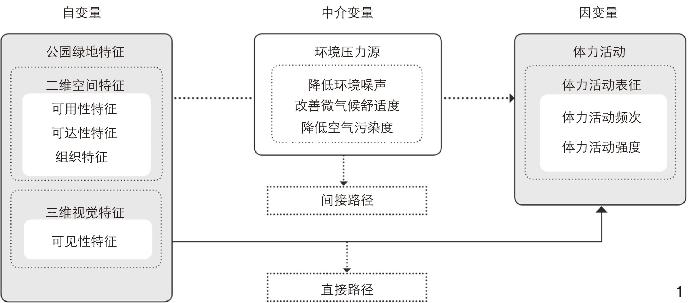
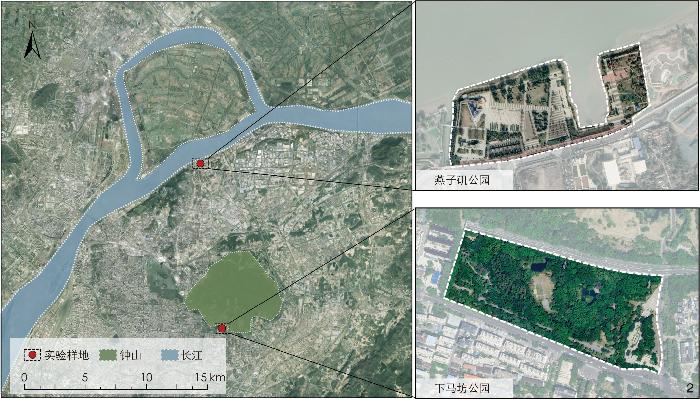
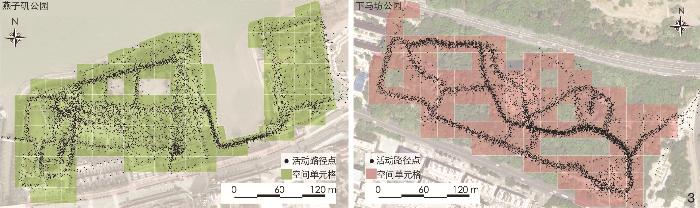
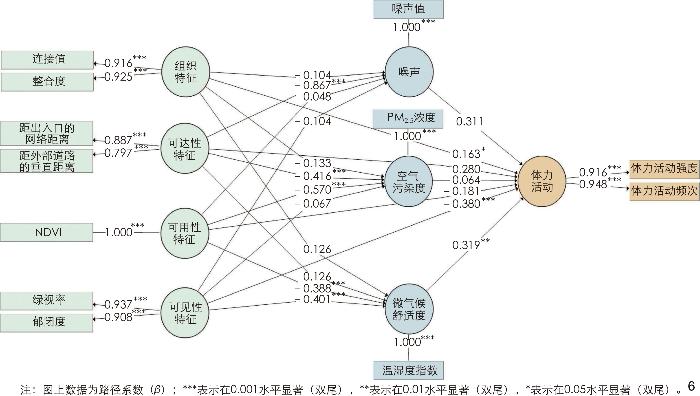
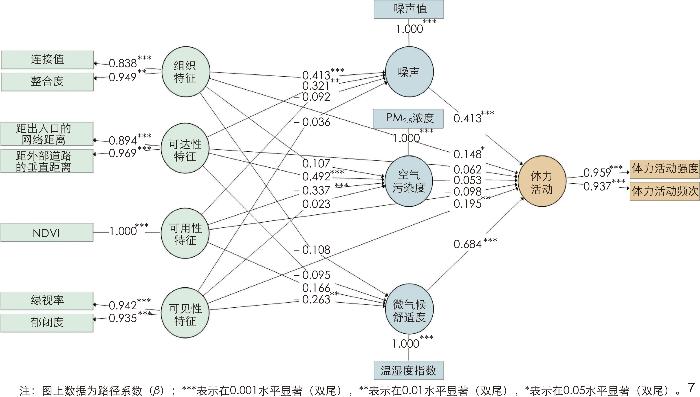
This research takes two sample plots in Nanjing with significant differences in greenness level indicators as research objects (Xiamafang Park and Yanziji Park), recruits 56 subjects to participate in a 2-hour free physical activity experiment, records the type and duration of the activity, measures the real-time data on park green space characteristics in the sample plots, and finally models and analyzes all the data from each spatial unit of the physical activity. Specifically, the park green space characteristic system is divided into two-dimensional spatial characteristics and three-dimensional visual characteristics. The two-dimensional spatial characteristics include usability characteristics (NDVI), organizational characteristics (connectivity value, and integration degree), and accessibility characteristics (distance from the network of entrances and exits, and vertical distance from external roads), and the three-dimensional visual characteristics are the visibility characteristics (green visibility, and canopy density). Secondly, the partial least squares structural equation modeling (PLS-SEM) is utilized to link the multidimensional park green space characteristics with physical activity representations and to clarify the potential influence pathways between park green space characteristics and physical activity, with park green space characteristics as the independent variable, physical activity characteristics as the dependent variable, and noise, temperature and humidity index, and air pollution as the mediator variables. Finally, based on the mechanism of “park green space – physical activity” under different levels of greenness, the research explores the methods and optimization approaches for promoting physical activity by urban park green space planning.
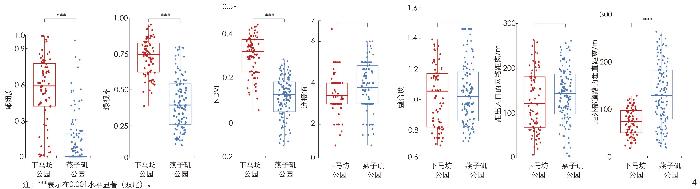
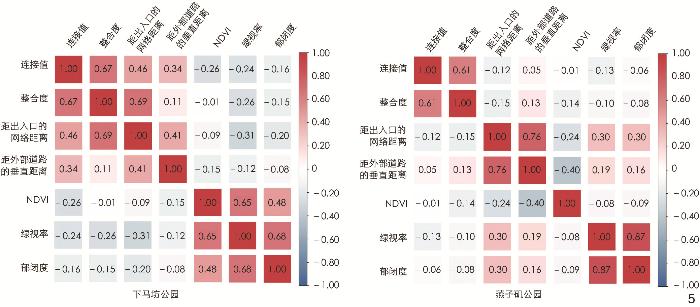
This research finds that the correlation between the multi-dimensional park green space characteristic indicators may be affected by the level of greenness of the green space, the two-dimensional indicators of usability characteristics (NDVI), and the three-dimensional indicators of visibility characteristics (green visibility, and canopy density) in the green space with high greenness show a significant positive correlation; in the green space with low greenness, the environmental organization characteristics and the accessibility characteristics positively affect noise perception and thus positively promote physical activity; the microclimate comfort is the most critical mediator variable in the green space affecting physical activity, which cannot be affected by the difference in the greenness of sample plots.
The findings of this research provide empirical evidence that park green space characteristics influence physical activity behavior through environmental stressors, and the differences and similarities in pathways between park green space characteristics and physical activity are analyzed in relation to different green spaces. First, an indicator system coupling two-dimensional spatial characteristics and three-dimensional visual characteristics is investigated to provide a more scientific and comprehensive method for assessing park green space characteristics. Second, the temperature and humidity index in the parallel mediation model is shown to be a more critical pathway, indicating that microclimate comfort greatly influences the physical activity representations of the active population. The guidance and shaping of green space need to fully consider the composite perception of the crowd on green visibility, canopy density, and microclimate, and the environmental optimization of green space should pay attention to the moderate principle in terms of green visibility. Third, there is a significant positive correlation between noise and the frequency of physical activity in urban green space, and noise feeds back to the attractive characteristics of green space. Fourth, the convergence of people may increase the frequency of staying and passing through a green space. Finally, the research results may provide ideas for subsequent investigation of the association mechanism between green space and physical activity in urban parks and provide strategies for health-oriented urban green space planning and design.
MAO Yipei , LI Ke , LI Yongjun , WEI Jiaxing . Research on Influence Mechanism of Park Green Space Characteristics on Physical Activity: A Case Study of Nanjing[J]. Landscape Architecture, 2024 , 31(11) : 103 -111 . DOI: 10.3724/j.fjyl.202402010079
表1 公园绿地特征、环境压力源及体力活动指标体系与数据来源Tab. 1 Park green space characteristics, environmental stressors and physical activity indicator system as well as relevant data sources |
| 指标类型 | 指标 | 指标要素 | 描述 | 数据来源 |
| 公园绿地 二维空间特征 | 可用性特征 | NDVI | 通过遥感影像中近红外光波段的反射率和红色波段反射率之间的差值与两者之和的比值 | ESA Sentinel-2卫星图 |
| 可达性特征 | 距出入口的网络距离 | 各采样点到最近出入口的网络距离,单位为m | ArcGIS软件OD成本矩阵和 近邻分析 | |
| 距外部道路的垂直距离 | 各采样点到最近外部道路的垂直距离,单位为m | |||
| 组织特征 | 连接值 | 与特定空间相邻接的空间数量,数值越高,可选择性越高 | Depthmap软件分析 | |
| 整合度 | 在特定空间拓扑距离范围内,空间联系的紧密程度,数值越高,可达性越高 | |||
| 公园绿地 三维视觉特征 | 可见性特征 | 绿视率 | 人眼视野范围内全景图中植被的像素占总像素的比例 | 拍摄全景图 |
| 郁闭度 | 鱼眼镜头拍摄的照片中绿色像素和总像素之比 | 拍摄顶界面视图 | ||
| 环境压力源 | 噪声 | 噪声值 | 噪声值是衡量噪声大小的指标,单位为dB | 仪器实测 |
| 空气污染度 | PM2.5浓度 | 直径小于或等于2.5 μm的尘埃或飘尘在某环境空气中的浓度 | ||
| 微气候舒适度 | 温湿度指数 | 温湿度指数是描述人体对环境温度和湿度综合感受的指数 | 结合仪器实测数据计算 | |
| 体力活动 | 体力活动频次 | 空间单元内路径点总量 | GPS模块 | |
| 体力活动强度 | 空间单元内活动代谢当量均值 | 问卷填写 | ||
表2 公园绿地特征指标与体力活动指标多元线性的回归分析结果Tab. 2 Results of multiple linear regression analysis of park green space characteristic indicators and physical activity indicators |
| 自变量 | 模型A1:Y1=体力活动频次 | 模型A2:Y2=体力活动强度 | 模型B1:Y3=体力活动频次 | 模型B2:Y4=体力活动强度 | |||||||||||
| 回归系数 (α) | p 值 | 标准差 (S.E.) | 回归系数 (α) | p 值 | 标准差 (S.E.) | 回归系数 (α) | p 值 | 标准差 (S.E.) | 回归系数 (α) | p 值 | 标准差 (S.E.) | ||||
| 注:X为自变量,Y为因变量;***表示在0.001水平显著(双尾),**表示在0.01水平显著(双尾),*表示在0.05水平时显著(双尾)。 | |||||||||||||||
| X1=连接值 | 0.051 | 0.574 | 5.919 | 0.213 | 0.121 | 0.063 | 0.294* | 0.010 | 5.078 | 0.196 | 0.105 | 0.041 | |||
| X2=整合度 | 0.094 | 0.404 | 34.386 | 0.063 | 0.709 | 0.365 | 0.054 | 0.651 | 31.096 | 0.077 | 0.546 | 0.253 | |||
| X3=距出入口的网络距离 | 0.073 | 0.431 | 0.084 | −0.236 | 0.092 | 0.001 | 0.287 | 0.051 | 0.126 | 0.410* | 0.009 | 0.001 | |||
| X4=距外部道路的垂直距离 | −0.038 | 0.601 | 0.153 | 0.228* | 0.037 | 0.002 | −0.128 | 0.388 | 0.120 | −0.236 | 0.136 | 0.001 | |||
| X5=绿视率 | −0.320** | 0.001 | 46.929 | −0.325* | 0.028 | 0.499 | −0.301* | 0.031 | 40.804 | −0.174 | 0.240 | 0.332 | |||
| X6=郁闭度 | −0.235** | 0.004 | 17.288 | −0.278* | 0.022 | 0.184 | 0.315* | 0.025 | 36.027 | 0.113 | 0.445 | 0.293 | |||
| X7=NDVI | −0.408*** | 0.000 | 57.570 | −0.092 | 0.459 | 0.612 | −0.129 | 0.196 | 58.195 | 0.009 | 0.929 | 0.473 | |||
表3 下马坊公园中介效应检验结果Tab. 3 Results of the mediating effect test for Xiamafang Park |
| 指标 | 路径 | 路径系数β | 标准差 | t 统计量 | p 值(Bootstrap n=5 000) | 95%置信区间 | ||
| 下限 | 上限 | |||||||
| 注:NO为噪声;MC为微气候舒适度;PM为空气污染度;AV为可用性特征;OR为组织特征;AC为可达性特征;VI为可见性特征;PA为体力活动。 | ||||||||
| 可用性特征 | 间接路径1 | AV→NO→PA | 0.015 | 0.022 | 0.664 | 0.507 | −0.021 | 0.069 |
| 间接路径2 | AV→MC→PA | −0.124 | 0.050 | 2.490 | 0.013 | −0.236 | −0.044 | |
| 间接路径3 | AV→PM→PA | −0.037 | 0.053 | 0.694 | 0.487 | −0.137 | 0.074 | |
| 直接路径1 | AV→PA | −0.181 | 0.106 | 1.703 | 0.089 | −0.405 | 0.012 | |
| 组织特征 | 间接路径4 | OR→NO→PA | −0.032 | 0.030 | 1.075 | 0.282 | −0.112 | 0.001 |
| 间接路径5 | OR→MC→PA | 0.040 | 0.030 | 1.319 | 0.187 | −0.003 | 0.114 | |
| 间接路径6 | OR→PM→PA | −0.009 | 0.015 | 0.583 | 0.560 | −0.041 | 0.020 | |
| 直接路径2 | OR→PA | 0.163 | 0.081 | 2.005 | 0.045 | 0.010 | 0.329 | |
| 可达性特征 | 间接路径7 | AC→NO→PA | −0.269 | 0.142 | 1.890 | 0.059 | −0.575 | −0.013 |
| 间接路径8 | AC→MC→PA | 0.040 | 0.031 | 1.305 | 0.192 | −0.012 | 0.111 | |
| 间接路径9 | AC→PM→PA | −0.027 | 0.040 | 0.662 | 0.508 | −0.112 | 0.050 | |
| 直接路径3 | AC→PA | 0.280 | 0.146 | 1.913 | 0.056 | 0.017 | 0.598 | |
| 可见性特征 | 间接路径10 | VI→NO→PA | −0.032 | 0.029 | 1.110 | 0.267 | −0.107 | 0.006 |
| 间接路径11 | VI→MC→PA | −0.128 | 0.045 | 2.863 | 0.004 | −0.222 | −0.049 | |
| 间接路径12 | VI→PM→PA | −0.004 | 0.012 | 0.374 | 0.708 | −0.034 | 0.014 | |
| 直接路径4 | VI→PA | −0.380 | 0.072 | 5.298 | 0.000 | −0.516 | −0.232 | |
表4 燕子矶公园中介效应检验结果Tab. 4 Results of the mediating effect test for Yanziji Park |
| 指标 | 路径 | 路径系数β | 标准差 | t 统计量 | p 值(Bootstrap n=5 000) | 95%置信区间 | ||
| 下限 | 上限 | |||||||
| 注:NO为噪声;MC为微气候舒适度;PM为空气污染度;AV为可用性特征;OR为组织特征;AC为可达性特征;VI为可见性特征;PA为体力活动。 | ||||||||
| 可用性特征 | 间接路径1 | AV→NO→PA | −0.038 | 0.043 | 0.885 | 0.376 | −0.137 | 0.038 |
| 间接路径2 | AV→MC→PA | 0.113 | 0.065 | 1.739 | 0.082 | −0.009 | 0.251 | |
| 间接路径3 | AV→PM→PA | −0.018 | 0.055 | 0.325 | 0.745 | −0.142 | 0.077 | |
| 直接路径1 | AV→PA | −0.098 | 0.082 | 1.193 | 0.233 | −0.252 | 0.068 | |
| 组织特征 | 间接路径4 | OR→NO→PA | 0.171 | 0.053 | 3.244 | 0.001 | 0.070 | 0.274 |
| 间接路径5 | OR→MC→PA | −0.074 | 0.073 | 1.017 | 0.309 | −0.218 | 0.066 | |
| 间接路径6 | OR→PM→PA | 0.006 | 0.021 | 0.273 | 0.785 | −0.026 | 0.058 | |
| 直接路径2 | OR→PA | 0.148 | 0.071 | 2.098 | 0.036 | 0.013 | 0.290 | |
| 可达性特征 | 间接路径7 | AC→NO→PA | 0.133 | 0.051 | 2.582 | 0.010 | 0.037 | 0.239 |
| 间接路径8 | AC→MC→PA | −0.065 | 0.083 | 0.784 | 0.433 | −0.234 | 0.090 | |
| 间接路径9 | AC→PM→PA | 0.026 | 0.075 | 0.347 | 0.729 | −0.117 | 0.182 | |
| 直接路径3 | AC→PA | 0.062 | 0.073 | 0.855 | 0.392 | −0.074 | 0.209 | |
| 可见性特征 | 间接路径10 | VI→NO→PA | −0.015 | 0.036 | 0.415 | 0.678 | −0.087 | 0.058 |
| 间接路径11 | VI→MC→PA | −0.180 | 0.066 | 2.728 | 0.006 | −0.312 | −0.053 | |
| 间接路径12 | VI→PM→PA | 0.001 | 0.011 | 0.110 | 0.912 | −0.017 | 0.032 | |
| 直接路径4 | VI→PA | 0.195 | 0.074 | 2.640 | 0.008 | 0.047 | 0.338 | |
文中图表均由作者绘制,其中
| [1] |
RAHAMAN M A, KALAM A, AL-MAMUN M. Unplanned Urbanization and Health Risks of Dhaka City in Bangladesh: Uncovering the Associations Between Urban Environment and Public Health[J]. Frontiers in Public Health, 2023, 11: 1269362.
|
| [2] |
中国居民营养与慢性病状况报告(2020年)[J].营养学报, 2020, 42(6): 521.
Report on Nutrition and Chronic Disease Status of Chinese Residents (2020)[J]. Journal of Nutrition, 2020,42(6): 521.
|
| [3] |
ALMEIDA D Q, PACIÊNCIA I, MOREIRA C, et al. Green and Blue Spaces and Lung Function in the Generation XXI Cohort: A Life-Course Approach[J]. European Respiratory Journal, 2022, 60 (6): 2103024.
|
| [4] |
TOSELLI S, BRAGONZONI L, GRIGOLETTO A, et al. Effect of a Park-Based Physical Activity Intervention on Psychological Wellbeing at the Time of COVID-19[J]. International Journal of Environmental Research and Public Health, 2022, 19 (10): 6028.
|
| [5] |
黄倩, 金荷仙. 基于社会生态模型的绿色空间对体力活动的影响机制研究进展及启示[J]. 中国园林, 2023, 39 (3): 93-98
HUANG Q, JIN H X. Research Progress and Lessons of Influence Mechanism of Green Space on Physical Activity Based on Social Ecology Model[J]. Chinese Landscape Architecture, 2023, 39 (3): 93-98.
|
| [6] |
侯韫婧, 赵晓龙, 战美伶, 等. 公共健康视角下东北老工业社区公园“体绿结合”空间优化研究: 以哈尔滨为例[J]. 风景园林, 2021, 28 (5): 92-98
HOU Y J, ZHAO X L, ZHAN M L, et al. Research on Space Optimization of “Combination of Physical Activity and Green Space” in Northeast Old Industrial Community Park from the Perspective of Public Health: Taking Harbin as a Case Study[J]. Landscape Architecture, 2021, 28 (5): 92-98.
|
| [7] |
孙佩锦, 陆伟. 城市绿色空间与居民体力活动和体重指数的关联性研究: 以大连市为例[J]. 南方建筑, 2019 (3): 34-39
SUN P J, LU W. The Correlation Between Urban Green Space and Residents’ Physical Activity and Health Outcome: A Case Study of Dalian[J]. South Architecture, 2019 (3): 34-39
|
| [8] |
郑凌予, 杨淑梅, 伍夏, 等. 基于空间感知的社区绿色暴露指数对活动行为影响研究[J]. 中国园林, 2023, 39 (1): 92-97
ZHENG L Y, YANG S M, WU X, et al. Study on the Impact of Community Green Exposure Index on Activity Behavior Based on Spatial Perception[J]. Chinese Landscape Architecture, 2023, 39 (1): 92-97.
|
| [9] |
ZHANG T, HUANG B, YAN Y Z, et al. Street-View and Traditional Greenness Metrics with Adults’ Sitting Time in High-Density Living in Hong Kong: Comparing Associations, Air Pollution and Noise Roles, and Population Heterogeneity[J]. Science of the Total Environment, 2023, 870: 161778.
|
| [10] |
FU E R, DENG X Y, WU Y H, et al. Exploring Restrictions to Use of Community Greenways for Physical Activity Through Structural Equation Modeling[J]. Frontiers in Public Health, 2023, 11: 1169728.
|
| [11] |
COHEN P, POTCHTER O, SCHNELL I. The Impact of an Urban Park on Air Pollution and Noise Levels in the Mediterranean City of Tel-Aviv, Israel[J]. Environmental Pollution, 2014, 195: 73-83
|
| [12] |
RUI L Y, BUCCOLIERI R, GAO Z, et al. Study of the Effect of Green Quantity and Structure on Thermal Comfort and Air Quality in an Urban-Like Residential District by ENVI-met Modelling[J]. Building Simulation, 2019, 12 (2): 183-194
|
| [13] |
DIENER A, MUDU P. How Can Vegetation Protect Us from Air Pollution? A Critical Review on Green Spaces’ Mitigation Abilities for Air-Borne Particles from a Public Health Perspective-with Implications for Urban Planning[J]. Science of the Total Environment, 2021, 796: 148605.
|
| [14] |
GOZALO G R, MORILLAS J, GONZÁLEZ D M. Perceptions and Use of Urban Green Spaces on the Basis of Size[J]. Urban Forestry & Urban Greening, 2019, 46: 126470
|
| [15] |
YUAN T T, HONG B, LI Y C, et al. The Right Activities at Right Spaces: Relationships Between Elderly Adults’ Physical Activities and Thermal Responses[J]. Buildings, 2023, 13 (3): 721.
|
| [16] |
GILES L V, KOEHLE M S, SAELENS B E, et al. When Physical Activity Meets the Physical Environment: Precision Health Insights from the Intersection[J]. Environmental Health and Preventive Medicine, 2021, 26 (1): 68.
|
| [17] |
SAKHVIDI M J Z, MEHRPARVAR A H, SAKHVIDI F Z, et al. Greenspace and Health, Wellbeing, Physical Activity, and Development in Children and Adolescents: An Overview of the Systematic Reviews[J]. Current Opinion in Environmental Science & Health, 2023, 32: 100445
|
| [18] |
ZHANG J G, LIU Y H, ZHOU S, et al. Do Various Dimensions of Exposure Metrics Affect Biopsychosocial Pathways Linking Green Spaces to Mental Health? A Cross-Sectional Study in Nanjing, China[J]. Landscape and Urban Planning, 2022, 226: 104494.
|
| [19] |
YU K X, ZHANG Q L, MENG X, et al. Association of Residential Greenness with Incident Chronic Obstructive Pulmonary Disease: A Prospective Cohort Study in the UK Biobank[J]. Environment International, 2023, 171: 107654.
|
| [20] |
ZHENG L Y, ZHAO Y X, DUAN R, et al. The Influence Path of Community Green Exposure Index on Activity Behavior Under Multi-dimensional Spatial Perception[J]. Frontiers in Public Health, 2023, 11: 1243838.
|
| [21] |
余洋, 王馨笛, 陆诗亮. 促进健康的城市景观: 绿色空间对体力活动的影响[J]. 中国园林, 2019, 35 (10): 67-71
YU Y, WANG X D, LU S L. Promoting Healthy Urban Landscape: The Impact of Green Space on Physical Activity[J]. Chinese Landscape Architecture, 2019, 35 (10): 67-71.
|
| [22] |
KÜHN S, SCHMALEN K, BEIJERS R, et al. Green Is Not the Same as Green: Differentiating Between the Association of Trees and Open Green Spaces with Children’s Brain Structure in the Netherlands[J]. Environment and Behavior, 2023, 55 (5): 311-334
|
| [23] |
成实, 王一婧, 程子倩. 基于倾斜摄影模型的滨江空间多维形态特征量化方法研究: 以南京滨江为例[J]. 中国园林, 2023, 39 (6): 20-25
CHENG S, WANG Y J, CHENG Z Q. Study on Quantitative Method of Three-Dimensional Spatial Features of Riverside Space Based on Oblique Photography Model: A Case Study of Nanjing Riverside[J]. Chinese Landscape Architecture, 2023, 39 (6): 20-25.
|
| [24] |
MARKEVYCH I, TIESLER C, FUERTES E, et al. Access to Urban Green Spaces and Behavioural Problems in Children: Results from the GINIplus and LISAplus Studies[J]. Environment International, 2014, 71: 29-35
|
| [25] |
FAUL F, ERDFELDER E, BUCHNER A, et al. Statistical Power Analyses Using G*Power 3.1: Tests for Correlation and Regression Analyses[J]. Behavior Research Methods, 2009, 41 (4): 1149-1160
|
| [26] |
翟宇佳. 基于空间句法理论的城市公园空间组织分析与设计管理应用: 凸边形地图分析方法初探[J]. 中国园林, 2016, 32 (3): 80-84
ZHAI Y J. Applying Space Syntax Theory in Measuring Urban Park Configurational Attributes and Implications in Design and Management: Based on Convex Map Analysis[J]. Chinese Landscape Architecture, 2016, 32 (3): 80-84.
|
| [27] |
成实, 张冠亭, 张潇涵, 等. 基于LiDAR点云的景观空间“绿视率”量化分析方法研究[J]. 中国园林, 2022, 38 (2): 12-19
CHENG S, ZHANG G T, ZHANG X H, et al. Research on the Quantitative Analysis Method of “Green Viewing Ratio” of Landscape Spatial Form Based on Three-Dimensional LiDAR Point Cloud[J]. Chinese Landscape Architecture, 2022, 38 (2): 12-19.
|
| [28] |
NAGATA S, NAKAYA T, HANIBUCHI T, et al. Objective Scoring of Streetscape Walkability Related to Leisure Walking: Statistical Modeling Approach with Semantic Segmentation of Google Street View Images[J]. Health & Place, 2020, 66: 102428
|
| [29] |
孔锋. 中国人居环境气候舒适度的多时相尺度评价及区域差异研究[J]. 干旱区资源与环境, 2020, 34 (3): 102-111
KONG F. Multi-temporal Scale Assessment of Climate Comfort of Habitat Environment and Spatial Differences in China[J]. Journal of Arid Land Resources and Environment, 2020, 34 (3): 102-111.
|
| [30] |
AINSWORTH B E, HASKELL W L, HERRMANN S D, et al. 2011 Compendium of Physical Activities: A Second Update of Codes and MET Values[J]. Medicine & Science in Sports & Exercise, 2011, 43 (8): 1575-1581.
|
| [31] |
LAMBERT K, LODGE C, PRENDERGAST L A, et al. Associations Between Early Life Exposure to Pollen and Adolescent Lung Function Are Modified by Residential Greenness[J]. European Respiratory Journal, 2018, 52: PA5018
|
| [32] |
NIU J Q, XIONG J P, QIN H Q, et al. Influence of Thermal Comfort of Green Spaces on Physical Activity: Empirical Study in an Urban Park in Chongqing, China[J]. Building and Environment, 2022, 219: 109168.
|
| [33] |
DZHAMBOV A M, DIMITROVA V, GERMANOVA N, et al. Joint Associations and Pathways from Greenspace, Traffic-Related Air Pollution, and Noise to Poor Self-Rated General Health: A Population-Based Study in Sofia, Bulgaria[J]. Environmental Research, 2023, 231 (1): 116087
|
| [34] |
JIANG B, CHANG C Y, SULLIVAN W C. A Dose of Nature: Tree Cover, Stress Reduction, and Gender Differences[J]. Landscape and Urban Planning, 2014, 132: 26-36
|
/
| 〈 |
|
〉 |