

Thermal Characteristics and Material Optimization of the Underlying Surface in the Central Plaza of Beijing Olympic Park
|
WANG Jiahui is a master student in the School of Landscape Architecture, Beijing Forestry University. His research focuses on landscape planning and design |
|
HU Yutian gained her Master degree in Beijing Forestry University. Her research focuses on landscape planning and design |
|
LI Danning gained her Master degree in Beijing Forestry University. Her research focuses on landscape planning and design |
|
LIU Dongyun, Ph.D., is a professor in the School of Landscape Architecture, Beijing Forestry University, and a principal designer in LAURSTUDIO. His research focuses on ecological planning, urban landscape planning and design, and sustainable environmental design |
Received date: 2023-09-25
Revised date: 2024-08-15
Online published: 2025-12-16
Copyright
[Objective] The large, continuous and hard urban underlying surface is an important cause of the deterioration of the near-surface thermal environment, and an increase in albedo can usually coolit. With global warming and rapid urbanization, urban heat island (UHI) has significantly impacted urban living comfort, air quality, and energy consumption. Mitigating urban high temperature and optimizing the urban thermal environment have become core issues in building low-carbon, green, and sustainable cities. Existing research indicates that the differences in thermal properties between hard underlying surfaces may affect the urban near-surface energy balance, significantly impacting surface temperature (ST). In recent years, scholars at home and abroad have conducted multi-indicator research on the thermal environment of different hard underlying surfaces, with a view to exploring their thermal environment effects, temperature, humidity and microclimate change characteristics, as well as thermal comfort in specific activity spaces. However, such research seldom combines actual measurements with numerical simulations for thermal environment optimization. This research aims to investigate the thermal environment characteristics and temperature interval ranges of six typical underlying surfaces in the central plaza of Beijing Olympic Park through actual measurements and numerical simulations using the ENVI-met model. The research also explores the specific impact of overall albedo changes on the thermal environment, and provides suggestions for the material selection and configuration of hard underlying surfaces in public spaces in Beijing.
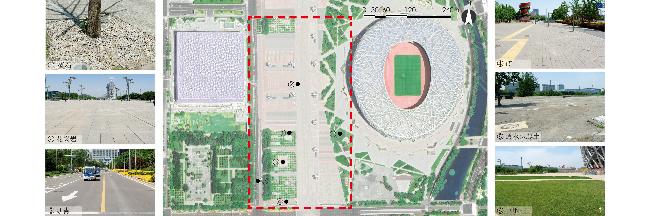
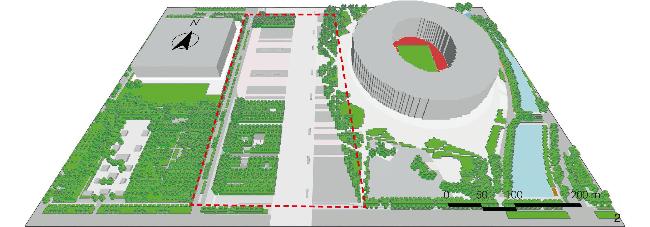
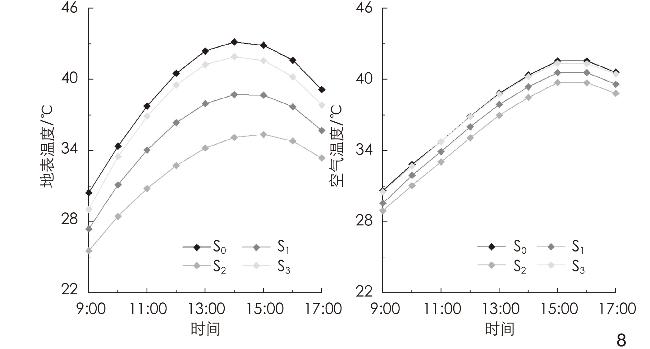
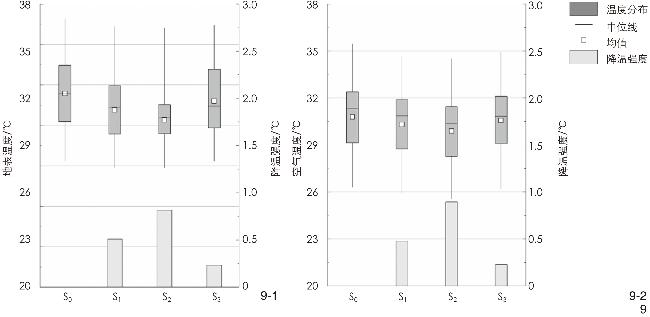
[Methods] In the central plaza of Beijing Olympic Park, the surface temperature of six typical underlying surfaces (asphalt, concrete, brick, granite, gravel, and grass) is measured to analyze the thermal environment characteristics and temperature interval range. The research also adopts the ENVI-met numerical simulation method to explore the specific impact of numerical changes in the overall albedo on the thermal environment. ENVI-met is a three-dimensional microclimate numerical simulation software based on computational fluid dynamics (CFD) principles. The model is built using actual measurement data for an 860 m × 580 m research area, with the core research area covering an area of 260 m × 500 m. Different albedo scenarios are simulated by applying high-reflectance coatings to the hard underlying surfaces, with the overall albedo being increased to 0.40, 0.60, and 0.80 in scenarios S1, S2, and S3, respectively. The simulation results are compared to the base scenario (S0) to analyze the cooling effect of increased albedo on surface and air temperatures.
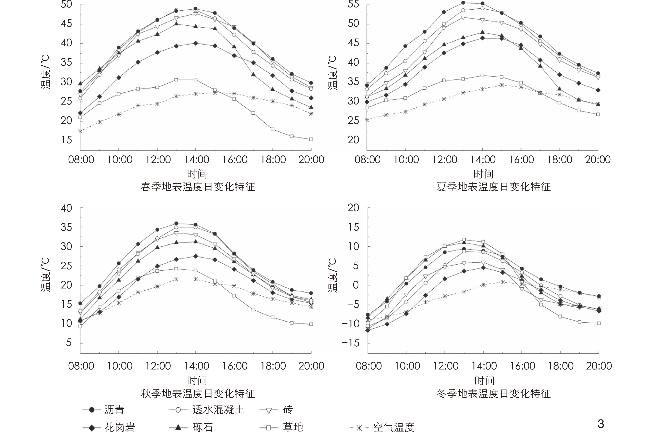
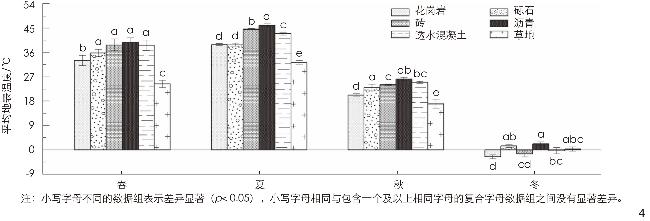
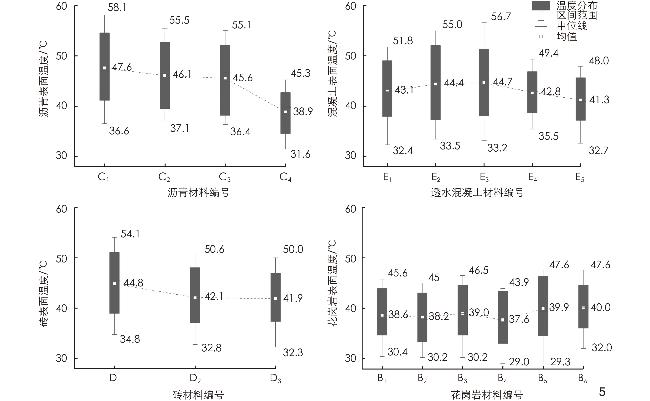
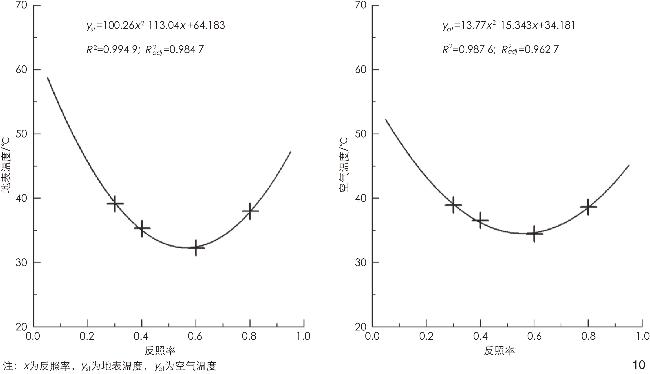
[Results] The measurement results show that different underlying surfaces produce different thermal effects due to variations in specific heat capacity and thermal conductivity. Seasonal variation patterns indicate that in spring, summer, and autumn, the surface temperatures of hard underlying surfaces (asphalt, concrete, brick, and granite) are significantly higher than the air temperature, indicating their role in heating the air. However, in winter, most hard surfaces’ temperatures drop below the air temperature after 16:00. One-way ANOVA results indicate that the average surface temperature of grass in spring, summer, and autumn is the lowest and significantly different from other underlying surfaces (p<0.01). In winter, the average surface temperature of grass is higher than all hard underlying surfaces except asphalt. Among hard surfaces, granite has the lowest annual average surface temperature, significantly lower than asphalt, concrete, and brick, while asphalt has the highest annual average surface temperature, significantly higher than concrete, granite, and brick. Overall, hotter hard surfaces like asphalt, concrete, and brick have a wider temperature range compared to cooler surfaces like granite. For similar types of surfaces, darker ones have a higher temperature range than lighter ones. In summer, dark surfaces with a lower daily average temperature may be hotter than light surfaces with a higher daily average temperature. The research also finds that increasing the overall albedo can effectively reduce surface and air temperatures. The maximum cooling intensity is observed at an albedo of approximately 0.56, with cooling effects increasing initially and then decreasing as albedo increases.
[Conclusion] This research reveals the thermal environment characteristics of common hard underlying surfaces in urban squares in Beijing, showing that asphalt surfaces are the hottest while granite surfaces are the coolest. Additionally, the surface temperature of grass in spring, summer, and autumn is significantly lower than that of hard surfaces. The research finds that among similar hard surfaces, lighter types have lower daily average temperatures and smaller temperature variations compared to darker types. Furthermore, light-colored surfaces with higher annual average temperatures may be cooler in summer than dark-colored surfaces with lower annual average temperatures, indicating that selecting light-colored materials can more effectively mitigate the urban heat island effect. ENVI-met simulation results show that increasing the overall albedo of urban surfaces can significantly reduce surface and air temperatures. The research area achieves the maximum cooling intensity at an albedo of around 0.56, with the optimal albedo range for cooling benefits being between 0.50 and 0.60. These insights may provide valuable guidance for the design and material selection of hard surfaces in public spaces, thus helping enhance urban thermal comfort and sustainability.
Jiahui WANG , Yutian HU , Danning LI , Dongyun LIU . Thermal Characteristics and Material Optimization of the Underlying Surface in the Central Plaza of Beijing Olympic Park[J]. Landscape Architecture, 2024 , 31(10) : 90 -97 . DOI: 10.3724/j.fjyl.202309250440
表1 S0模型计算结果准确性检验Tab. 1 Accuracy verification of the calculation results of S0 model |
| 下垫面类型 | 空气温度检验计算结果 | 地表温度检验计算结果 | |||||||
| R 2 | d | RMSE/℃ | MAE/℃ | R 2 | d | RMSE/℃ | MAE/℃ | ||
| 沥青 | 0.84 | 0.95 | 1.28 | 1.07 | 0.92 | 0.98 | 1.99 | 1.51 | |
| 透水混凝土 | 0.95 | 0.98 | 0.69 | 0.56 | 0.94 | 0.99 | 1.58 | 1.28 | |
| 砖 | 0.83 | 0.94 | 1.28 | 1.04 | 0.87 | 0.97 | 2.47 | 2.18 | |
| 花岗岩 | 0.94 | 0.98 | 0.64 | 0.48 | 0.93 | 0.98 | 1.51 | 1.17 | |
| 砾石 | 0.9 | 0.97 | 0.79 | 0.62 | 0.84 | 0.96 | 2.59 | 2.38 | |
| 草地 | 0.89 | 0.97 | 0.74 | 0.66 | 0.24 | 0.88 | 3.12 | 2.53 | |
图6 典型高温时段研究区域各模拟方案地表温度分布特征Fig. 6 Characteristics of surface temperature distribution in the research area of each simulation scheme during typical high temperature periods |
图9 白天时段各模拟方案地表温度与空气温度分布及降温强度Fig. 9 Distribution of surface temperature and air temperature and cooling intensity of each simulation scheme during the daytime |
文中图表均由作者绘制,其中
| [1] |
OKE T R. City Size and the Urban Heat Island[J]. Atmospheric Environment (1967), 1973, 7(8): 769-779.
|
| [2] |
彭少麟, 周凯, 叶有华, 等. 城市热岛效应研究进展[J]. 生态环境, 2005(4): 574-579.
PENG S L, ZHOU K, YE Y H, et al. Research Progress in Urban Heat Island[J]. Ecology and Environment, 2005(4): 574-579.
|
| [3] |
RAJAGOPALAN P, ANDAMON M M, PAOLINI R, Investigating Thermal Comfort and Energy Impact Through Microclimate Monitoring: A Citizen Science Approach[J]. Energy and Buildings, 2020, 229: 110526.
|
| [4] |
WANG Y Y, GUO Z, HAN J, The Relationship Between Urban Heat Island and Air Pollutants and Them with Influencing Factors in the Yangtze River Delta, China[J]. Ecological Indicators, 2021, 129: 107976.
|
| [5] |
KUMARI P, GARG V, KUMAR R, et al. Impact of Urban Heat Island Formation on Energy Consumption in Delhi[J]. Urban Climate, 2021, 36: 100763
|
| [6] |
谢苗苗, 王仰麟, 付梅臣. 城市地表温度热岛影响因素研究进展[J]. 地理科学进展, 2011, 30(1): 35-41.
XIE M M, WANG Y L, FU M C. An Overview and Perspective About Causative Factors of Surface Urban Heat Island Effects[J]. Progress in Geography, 2011, 30(1): 35-41.
|
| [7] |
FARAGALLAH R N, RAGHEB R A. Evaluation of Thermal Comfort and Urban Heat Island Through Cool Paving Materials Using ENVI-Met[J]. Ain Shams Engineering Journal, 2022, 13(3): 101609
|
| [8] |
杨雅君, 邹振东, 赵文利, 等. 6种城市下垫面热环境效应对比研究[J]. 北京大学学报(自然科学版), 2017, 53(5): 881-889.
YANG Y J, ZOU Z D, ZHAO W L, et al. Comparative Study on the Thermal Environment Effect of Six Urban Underlying Surfaces[J]. Acta Scientiarum Naturalium Universitatis Pekinensis, 2017, 53(5): 881-889.
|
| [9] |
彭历, 李彬, 王予芊. 北京城市街头绿地景观下垫面与小气候温湿度影响关系基础研究[J]. 华中建筑, 2017, 35(4): 38-43.
PENG L, LI B, WANG Y Q. Basic Research on the Impact of Beijing Urban Green Space Landscape of the Underlying Surface and Micro-climate Temperature & Humidity[J]. Huazhong Architecture, 2017, 35(4): 38-43.
|
| [10] |
DJEKIC J, DJUKIC A, VUKMIROVIC M, et al. Thermal Comfort of Pedestrian Spaces and the Influence of Pavement Materials on Warming Up During Summer[J]. Energy and Buildings, 2018, 159: 474-485.
|
| [11] |
覃福雨, 张滢, 梁明钊, 等. 桂林某高校校园常见下垫面夏季热环境效应的研究[J]. 节能, 2020, 39(5): 7-11.
QIN F Y, ZHANG Y, LIANG M Z, et al. Study on the Thermal Environmental Effects of Four Common Underlying Surfaces in a University Campus in Guilin in Summer[J]. Energy Conservation, 2020, 39(5): 7-11.
|
| [12] |
FALASCA S, CIANCIO V, SALATA F, et al. High Albedo Materials to Counteract Heat Waves in Cities: An Assessment of Meteorology, Buildings Energy Needs and Pedestrian Thermal Comfort[J]. Building and Environment, 2019, 163: 106242
|
| [13] |
SAILOR D J. Simulated Urban Climate Response to Modifications in Surface Albedo and Vegetative Cover[J]. Journal of Applied Meteorology, 1995, 34: 1694-1704.
|
| [14] |
SANTAMOURIS M, GAITANI N, SPANOU A, et al. Using Cool Paving Materials to Improve Microclimate of Urban Areas: Design Realization and Results of the Flisvos Project[J]. Building and Environment, 2012, 53: 128-136.
|
| [15] |
SANTAMOURIS M, DING L, FIORITO F, et al. Passive and Active Cooling for the Outdoor Built Environment: Analysis and Assessment of the Cooling Potential of Mitigation Technologies Using Performance Data from 220 Large Scale Projects[J]. Solar Energy, 2017, 154: 14-33.
|
| [16] |
QIAO Z, TIAN G J, ZHANG L X, et al. Influences of Urban Expansion on Urban Heat Island in Beijing During 1989−2010[J/OL]. Advances in Meteorology, 2014[2023-08-12]. https://doi.org/10.1155/2014/187169.
|
| [17] |
李膨利, 西迪基, 刘东云. 基于遥感技术的城市下垫面参数与热环境关系的研究: 以北京市朝阳区为例[J]. 风景园林, 2019, 26(5): 18-23.
LI P L, SIDDIQUI M A, LIU D Y. Research on the Relationship Between Urban Underlying Surface Parameters and Thermal Environment Based on Remote Sensing Technology: A Case Study of Chaoyang District of Beijing[J]. Landscape Architecture, 2019, 26(5): 18-23.
|
| [18] |
BRUSE M, FLEER H. Simulating Surface − Plant − Air Interactions Inside Urban Environments with a Three Dimensional Numerical Model[J]. Environmental Modelling & Software, 1998, 13: 373-384.
|
| [19] |
CHATZIDIMITRIOU A, YANNAS S. Microclimate Development in Open Urban Spaces: The Influence of Form and Materials[J]. Energy and Buildings, 2015, 108: 156-174.
|
| [20] |
HU L Q, LI Y Y, ZOU X L, et al. Temperature Characteristics of Porous Portland Cement Concrete During the Hot Summer Session[J/OL]. Advances in Materials Science and Engineering, 2017[2023-08-12]. https://doi.org/10.1155/2017/2058034
|
| [21] |
XU L, WANG J Y, XIAO F P, et al. Potential Strategies to Mitigate the Heat Island Impacts of Highway Pavement on Megacities with Considerations of Energy Uses[J]. Applied Energy, 2021, 281: 116077
|
| [22] |
TSOKA S, THEODOSIOU T, TSIKALOUDAKI K, et al. Modeling the Performance of Cool Pavements and the Effect of Their Aging on Outdoor Surface and Air Temperatures[J]. Sustainable Cities and Society, 2018, 42: 276-288.
|
| [23] |
HUANG G H, XIE W J, SUN H. Simulating 3D Urban Surface Temperature Distribution Using ENVI-met Model: Case Study on a Forest Park[C]//IEEE. 2015 IEEE International Geoscience and Remote Sensing Symposium (IGARSS). Milan: IEEE, 2015: 1642-1645.
|
| [24] |
CHEN Y H, WU J T, YU K, et al. Evaluating the Impact of the Building Density and Height on the Block Surface Temperature[J]. Building and Environment, 2020, 168: 106493
|
| [25] |
CARVALHO H D R, CHANG B X, MCINNES K J, et al. Energy Balance and Temperature Regime of Different Materials Used in Urban Landscaping[J]. Urban Climate, 2021, 37: 100854
|
| [26] |
刘霞, 王春林, 景元书, 等. 4种城市下垫面地表温度年变化特征及其模拟分析[J]. 热带气象学报, 2011, 27(3): 373-378.
LIU X, WANG C L, JING Y S, et al. Study on Annual Variation and Simulation of Temperature in Four Urban Underlying Surfaces[J]. Journal of Tropical Meteorology, 2011, 27(3): 373-378.
|
| [27] |
CARNIELO E, ZINZI M. Optical and Thermal Characterisation of Cool Asphalts to Mitigate Urban Temperatures and Building Cooling Demand[J]. Building and Environment, 2013, 60: 56-65.
|
| [28] |
GHAFFARIANHOSEINI A, BERARDI U, GHAFFARIANHOSEINI A. Thermal Performance Characteristics of Unshaded Courtyards in Hot and Humid Climates[J]. Building and Environment, 2015, 87: 154-168.
|
| [29] |
LOPEZ-CABEZA V P, ALZATE-GAVIRIA S, DIZ-MELLADO E, et al. Albedo Influence on the Microclimate and Thermal Comfort of Courtyards Under Mediterranean Hot Summer Climate Conditions[J]. Sustainable Cities and Society, 2022, 81: 103872
|
| [30] |
MOHAMMAD P, AGHLMAND S, FADAEI A, et al. Evaluating the Role of the Albedo of Material and Vegetation Scenarios Along the Urban Street Canyon for Improving Pedestrian Thermal Comfort Outdoors[J]. Urban Climate, 2021, 40: 100993
|
| [31] |
TALEGHANI M. The Impact of Increasing Urban Surface Albedo on Outdoor Summer Thermal Comfort Within a University Campus[J]. Urban Climate, 2018, 24: 175-184.
|
| [32] |
KYRIAKODIS G, SANTAMOURIS M. Using Reflective Pavements to Mitigate Urban Heat Island in Warm Climates: Results from a Large Scale Urban Mitigation Project[J]. Urban Climate, 2018, 24: 326-339.
|
| [33] |
ROSSO F, GOLASI L, CASTALDO V L, et al. On the Impact of Innovative Materials on Outdoor Thermal Comfort of Pedestrians in Historical Urban Canyons[J]. Renewable Energy, 2018, 118: 825-839.
|
/
| 〈 |
|
〉 |