

Generative Design of Plantscape Based on Generative Adversarial Network: A Case Study of the Generation of Flower Border Plan
|
FENG Lu, Ph.D., is an associate professor in the School of Art Design and Media, East China University of Science and Technology. Her research focuses on landscape planning and design |
|
YU Chenwen is a master student in the School of Art Design and Media, East China University of Science and Technology. Her research focuses on landscape planning and design |
|
SUN Yuting is a master student in the School of Art Design and Media, East China University of Science and Technology. Her research focuses on landscape planning and design |
|
ZHAO Jing, Ph.D., is a co-researcher in the Key Laboratory of Ecology and Energy Saving Study of Dense Habitat, Ministry of Education, a professor and doctoral supervisor in and vice dean of the School of Landscape Architecture, Beijing Forestry University, and a member of Beijing Laboratory of Urban and Rural Ecological Environment, and a deputy editor-in-chief of this journal. Her research focuses on design intelligence, history and theory of landscape architecture, and landscape planning and design |
Received date: 2024-04-08
Revised date: 2024-08-01
Online published: 2025-12-16
Copyright
[Objective] Plantscape design is an interdisciplinary field blending art and science. Designers often face multiple challenges in the practical application of plantscape design: 1) Difficulty in summarizing design principles; 2) barriers for beginners amidst a high demand for and shortage of designers; 3) low efficiency in revisions; 4) prevalent manual labor, presenting significant opportunities for automation. The design of flower borders, representing a significant aspect of plantscape design, is suitable for case studies. In this context, machine learning offers new technical support. For patterns that are difficult to summarize, machine learning can rapidly process large volumes of experiential data through probability density estimation, thus reducing reliance on designers' intuition while significantly enhancing design efficiency and reducing labor intensity. Previous research confirmed the effectiveness of generative adversarial network (GAN) in layout generation. Research on plantscape generation based on GAN endeavors to rapidly learn from a large dataset of plant combinations with inherent patterns to generate high-quality plant layout designs that meet real-world application needs, thus assisting designers in quickly producing plant layouts at the initial design stages. Further integration of image processing and evaluative feedback can generate plant arrangement schemes that are both standard and artistic. GAN can provide exploratory tools and methods for the landscape design field, promoting innovation and development in the generation of plant arrangement scheme.
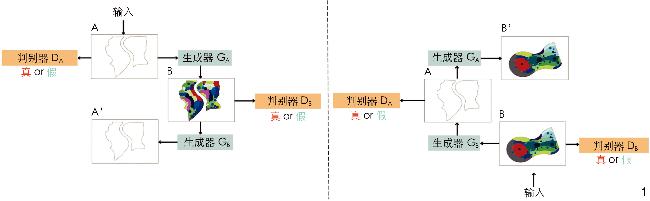
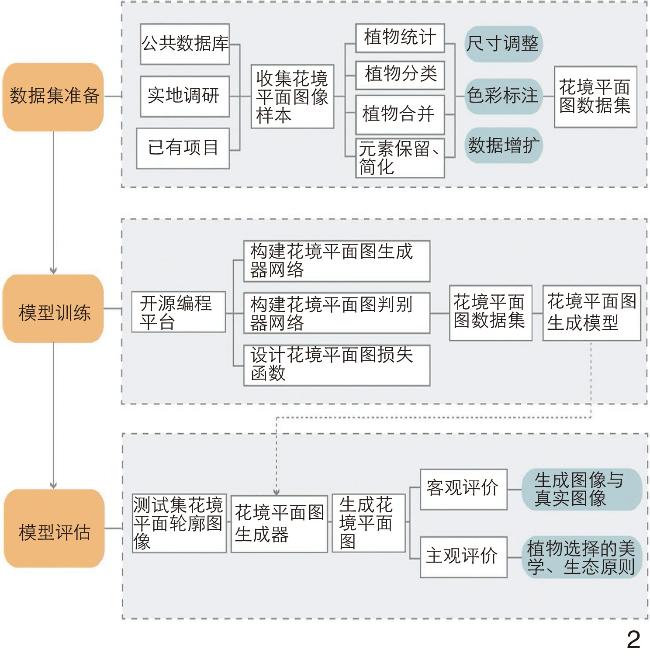
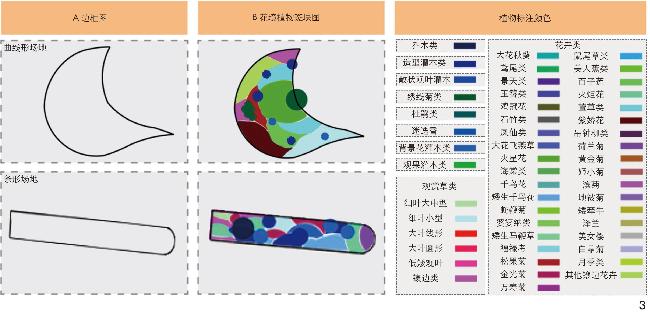
[Methods] The research proposes an experimental framework for a plantscape plan generation model based on GAN. The research design mainly includes three steps: Dataset preparation, model training, and model assessment. Initially, high-quality flower border plan images are collected from a single design firm, and these images are statistically categorized based on spatial structure types and design elements, thereby establishing principles for sample selection to ensure the professionalism and scientificity of the dataset adopted. Then, the selected flower border images undergo preprocessing, including plant classification, merging, image resizing, color tagging, and data augmentation. The cycle generative adversarial network (CycleGAN) algorithm is applied to build the flower border plantscape plan generation model on an open-source programming platform, undergoing multiple training rounds. Lastly, the research objectively analyzes and compares the spatial results of the generated flower border plans with actual design plans. In terms of subjective evaluations, expert scoring and other feedback methods are adopted to assess the generated plantscape images in terms of aesthetics and ecology.
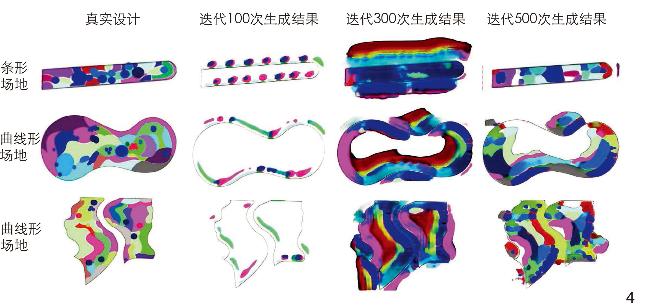
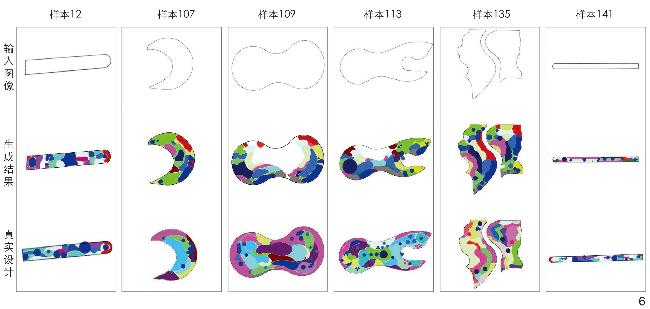
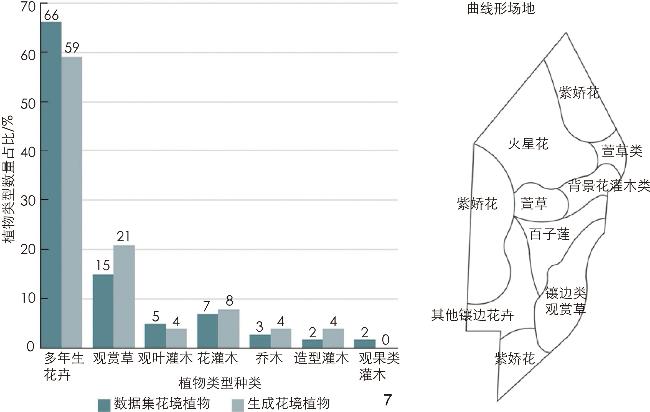
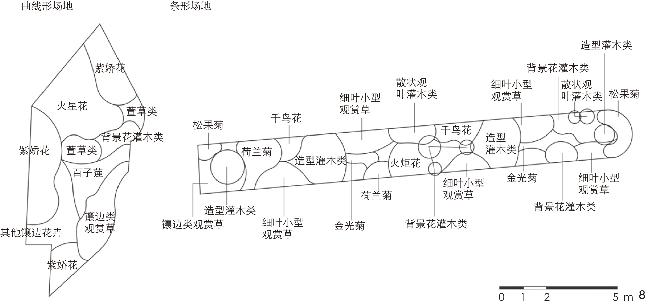
[Results] The objective evaluation reveals that: 1) The model most accurately identifies the contours of rectangular sites, requiring additional optimization for certain curved sites; 2) The model can accurately learn and reflect about half of the tagged types in the dataset, with most generated color blocks closely matching the pre-determined colors in the dataset, demonstrating high color accuracy; 3) The model needs to enhance the diversity of its outputs when handling similar sites. In terms of spatial structure generation, 1) the unit area of generated results conforms to the application and volume characteristics of plants typically used in flower borders; 2) The results can replicate plant combinations frequently used in the dateset; 3) The results can learn the spatial distribution patterns of plants, replicating the shapes of edge plants, internal plant patches, and sculptural shrubs; 4) The results can display vertical variation. In subjective evaluations, rectangular flower borders show certain advantages in aesthetics and ecology, particularly in low maintenance and sustainability, but there is room for improvement in seasonal variation and texture coordination. Curved flower borders are slightly inferior in aesthetics but perform reasonably well in ecological coordination, needing deeper optimization in plant diversity and aesthetics.
[Conclusion] CycleGAN exhibits unique advantages in plantscape design represented by flower borders. Although the number of training samples is not extensive, the CycleGAN model performs well in expressing image quality and spatial layout, and demonstrates accurate boundary recognition for rectangular sites and high precision in color reproduction. The generated plan images mimic the dataset well. The spatial layout of the generated plans showcases the spatial distribution characteristics and visual effects of various plants, reproducing some potential combination patterns. The generated flower border designs align with actual design samples in terms of color, seasonal change, layering, and harmony. Ecologically, the generated designs embody sustainability principles, emphasizing the convenience of sustainable maintenance and management. However, the application of CycleGAN also demonstrates certain limitations. First, the aesthetic and ecological quality of GAN-generated flower border designs highly depends on the quality and diversity of the training dataset. Secondly, CycleGAN models tend to produce generic designs, lacking diversity in similar sites. In view of this, future research may focus on improving model algorithms, enriching the training dataset, and investigating the potential of introducing conditional generative adversarial network (CGAN) .
Lu FENG , Chenwen YU , Yuting SUN , Jing ZHAO . Generative Design of Plantscape Based on Generative Adversarial Network: A Case Study of the Generation of Flower Border Plan[J]. Landscape Architecture, 2024 , 31(9) : 59 -68 . DOI: 10.3724/j.fjyl.202404080199
表1 生成花境评价指标Tab. 1 Evaluation indicators for generated flower borders |
| 评价方面 | 评价指标 | 评判标准 |
| 观赏性 | 竖向变化 | 垂直层面不同植物的丰富度 |
| 色彩搭配 | 不同颜色的花叶组合、色彩搭配的合理性 | |
| 季相变化 | 一年四季呈现不同的季相之美 | |
| 质感和谐性 | 植物质感、整体搭配之间的和谐性 | |
| 生态性 | 植物多样性 | 花境内植物生活型的多样性 |
| 低维护性 | 多年生植物及常绿植物的占比 | |
| 可持续性 | 花境的维持效果是否长续持久 | |
| 生态位和 谐性 | 植物生长生态位,种间竞争激烈程度 |
文中图表均由作者绘制。
| [1] |
王美仙, 刘燕. 花境及其在国外的研究应用[J]. 北方园艺, 2006(4): 135-136.
WANG M X, LIU Y. Flower Border and Its Research Application in Overseas Countries[J]. Northern Horticulture, 2006(4): 135-136.
|
| [2] |
LIU Y, FANG C, YANG Z, et al. Exploration on Machine Learning Layout Generation of Chinese Private Garden in Southern Yangtze[C]// YUAN P F, CHAI H, YAN C, et al. CDRF 2021: Proceedings of the 2021 DigitalFUTURES: The 3rd International Conference on Computational Design and Robotic Fabrication (CDRF 2021). Singapore: Springer, 2021.
|
| [3] |
ZHU J, PARK T, ISOLA P, et al. Unpaired Image-to- Image Translation Using Cycle-Consistent Adversarial Networks[C]// IEEE. Proceedings of the 2017 IEEE International Conference on Computer Vision (ICCV). Venice: IEEE, 2017: 2242-2251.
|
| [4] |
GOODFELLOW I, POUGET-ABADIE J, MIRZA M, et al. Generative Adversarial Nets[C]// NIPS. Advances in Neural Information Processing Systems. Massachusetts: MIT Press, 2014: 2672-2680.
|
| [5] |
XU T, ZHANG P, HUANG Q, et al. Attngan: Fine-Grained Text to Image Generation with Attentional Generative Adversarial Networks[C]// IEEE. Proceedings of the IEEE Conference on Computer Vision and Pattern Recognition. Honolulu: IEEE Computer Society, 2018: 1316-1324.
|
| [6] |
陈然, 赵晶. 基于样式生成对抗网络的风景园林方案生成及设计特征识别[J]. 风景园林, 2023, 30(7): 12-21.
CHEN R, ZHAO J. Generation and Design Feature Recognition of Landscape Architecture Scheme Based on Style-Based Generative Adversarial Network[J]. Landscape Architecture, 2023, 30(7): 12-21.
|
| [7] |
ZHENG H, AN K, WEI J, et al. Apartment Floor Plans Generation via Generative Adversarial Networks[C]// CAADRIA. Proceedings of the 25th International Conference on Computer Aided Architectural Design Research in Asia (CAADRIA) 2020. Hong Kong: CAADRIA, 2020: 601-610.
|
| [8] |
ZHANG L, ZHENG L, CHEN Y L, et al. CGAN-Assisted Renovation of the Styles and Features of Street Facades: A Case Study of the Wuyi Area in Fujian, China[J]. Sustainability, 2022, 14(24): 16575
|
| [9] |
YU Q, MALAEB J, MA W J. Architectural Facade Recognition and Generation Through Generative Adversarial Networks[C]. ACADIA. 2020 International Conference on Big Data & Artificial Intelligence & Software Engineering (Icbase 2020) Washington D.C.: IEEE Press, 2020: 310-316.
|
| [10] |
TIAN R. Suggestive Site Planning with Conditional GAN and Urban GIS Data[C]// YUAN P F, YAO J, YAN C, et al. CDRF 2020: The International Conference on Computational Design and Robotic Fabrication. Singapore: Springer, 2020: 103-113.
|
| [11] |
陈梦凡, 郑豪, 吴建. 基于生成对抗网络的复合功能体系计算性设计: 以职业技术学院校园平面生成为例[J]. 建筑学报, 2022(S1): 103-108.
CHEN M F, ZHEN H, WU J. Computational Design of Multi-functional System Based on Generative Adversarial Networks: Taking the Layout Generation of Vocational and Technical College as an Example[J]. Architectural Journal, 2022(S1): 103-108.
|
| [12] |
周怀宇, 刘海龙. 人工智能辅助设计: 基于深度学习的风景园林平面识别与渲染[J]. 中国园林, 2021, 37(1): 56-61.
ZHOU H Y, LIU H L. Artificial Intelligence Aided Design: Landscape Plan Recognition and Rendering Based on Deep Learning[J]. Chinese Landscape Architecture, 2021, 37(1): 56-61.
|
| [13] |
曲广滨, 薛博洋. 基于CGAN的居住区景观功能平面生成方法[J]. 低温建筑技术, 2022, 44(12): 5-9.
QU G B, XUE B Y. Generative Design Method of Landscape Functional Layout in Residential Areas Based on Conditional Generative Adversarial Nets[J]. Low Temperature Architecture Technology, 2022, 44(12): 5-9.
|
| [14] |
赵晶, 陈然, 郝慧超, 等. 机器学习技术在风景园林中的应用进展与展望[J]. 北京林业大学学报, 2021, 43(11): 137-156.
ZHAO J, CHEN R, HAO H C, et al. Application Progress and Prospect of Machine Learning Technology in Landscape Architecture[J]. Journal of Beijing Forestry University, 2021, 43(11): 137-156.
|
| [15] |
赵晶, 曹易. 风景园林研究中的人工智能方法综述[J]. 中国园林, 2020, 36(5): 82-87.
ZHAO J, CAO Y. Review of Artificial Intelligence Methods in Landscape Architecture[J]. Chinese Landscape Architecture, 2020, 36(5): 82-87.
|
| [16] |
陈兆倩, 王洪雁. 基于参数自动调整的生态景观空间结构优化设计[J]. 现代电子技术, 2020, 43(16): 159-161.
CHEN Z Q, WANG H Y. Design of Ecological Landscape Spatial Structure Optimization Based on Parameters Automatic Adjustment[J]. Modern Electronics Technique, 2020, 43(16): 159-161.
|
| [17] |
何庆港, 蔡海生, 张学玲, 等. 基于景观格局及元胞自动机-马尔科夫模型的县域生态风险评价: 以江西省婺源县为例的实证研究[J]. 林业经济, 2020, 42(8): 50-63.
HE Q G, CAI H S, ZHANG X L, et al. Assessment on Ecological Risk of Counties Based on Landscape Pattern and CA-Markov Model: Empirical Study on Wuyuan County in Jiangxi Province[J]. Forestry Economics, 2020, 42(8): 50-63.
|
| [18] |
陈冬洋, 陈彩虹, 常双双. 基于移动窗口法与ANN模型的澄迈林场森林景观研究[J]. 中南林业科技大学学报, 2015, 35(12): 95-101.
CHEN D Y, CHEN C H, CHANG S S. Forest Landscape Study for Chengmai Forest Farm, Hainan Province Based on Moving Window Method and ANN Model[J]. Journal of Central South University of Forestry & Technology, 2015, 35(12): 95-101.
|
| [19] |
王浩翼, 杨钧然, 吴子悦, 等. 机器学习视野下基于居民偏好的街道风格生成方法研究[J]. 新建筑, 2022(6): 19-24.
WANG H Y, YANG J R, WU Z Y, et al. Street Style Generation Method Based on Residents’ Preferences from the Perspective of Machine Learning[J]. New Architecture, 2022(6): 19-24.
|
| [20] |
李春娇, 贾培义, 董丽. 风景园林中植物景观规划设计的程序与方法[J]. 中国园林, 2014, 30(1): 93-99.
LI C J, JIA P Y, DONG L. Research on the Procedures and Methods of Planting Plan and Design[J]. Chinese Landscape Architecture, 2014, 30(1): 93-99.
|
| [21] |
李中亚. 人工智能技术在园林景观设计中的应用[J]. 现代园艺, 2020, 43(18): 74-75.
LI Z Y. Application of Artificial Intelligence Technology in Landscape Architecture Design[J]. Contemporary Horticulture, 2020, 43(18): 74-75.
|
| [22] |
LEITNER D, KLEPSCH S, KNIESS A, et al. The Algorithmic Beauty of Plant Roots: An L-System Model for Dynamic Root Growth Simulation[J]. Mathematical and Computer Modelling of Dynamical Systems, 2010, 16(6): 575-587.
|
| [23] |
郭湧. 论风景园林信息模型的概念内涵和技术应用体系[J]. 中国园林, 2020, 36(9): 17-22.
GUO Y. On the Concept and Technology Application System of Landscape Information Modeling[J]. Chinese Landscape Architecture, 2020, 36(9): 17-22.
|
| [24] |
祝薇雅, 李鹏波. 基于参数化设计方法的城市公园植物景观布局设计: 以天津市水西庄公园为例[J]. 中国园林, 2022, 38(5): 110-115.
ZHU W Y, LI P B. Plant Landscape Layout Design of Urban Park Based on the Parametric Design Method: A Case Study of Shuixizhuang Park in Tianjin[J]. Chinese Landscape Architecture, 2022, 38(5): 110-115.
|
| [25] |
林文君. 植物配置应用人工神经网络技术的可行性研究[D]. 广州: 华南理工大学, 2017.
LIN W J. Feasibility Study on Application of Artificial Neural Network in Plant Arrangement[D]. Guangzhou: South China University of Technology, 2017.
|
| [26] |
崔思贤, 张耀文, 贾婕, 等. 基于AI技术的花境设计应用分析[J]. 园林, 2023, 40(12): 106-112.
CUI S X, ZHANG Y W, JIA J, et al. Analysis of AI-Enabled Floral Design Applications[J]. Landscape Architecture Academic Journal, 2023, 40(12): 106-112.
|
| [27] |
王美仙, 刘燕. 花境设计[M]. 北京: 中国林业出版社, 2013.
WANG M X, LIU Y. Flower Border Design[M]. Beijing: China Forestry Publishing House, 2013.
|
| [28] |
董丽. 园林花卉应用设计[M]. 北京: 中国林业出版社, 2003.
DONG L. Landscape Flower Application Design[M]. Beijing: China Forestry Publishing House, 2003.
|
| [29] |
蔡军火, 黄太章, 魏绪英, 等. 花境设计与应用浅析[J]. 安徽农业科学, 2008(25): 10857-10858.
CAI J H, HUANG T Z, WEI X Y, et al. Preliminary Analysis on the Design and Application of Flower Border[J]. Journal of Anhui Agricultural Sciences, 2008(25): 10857-10858.
|
| [30] |
张扬, 许文超, 史洁婷, 等. 园林花境的设计要点与植物材料的选择[J]. 生态经济, 2015, 31(3): 191-195.
ZHANG Y, XU W C, SHI J T, et al. The Designing Approach and Selection of the Plants in Bloom Scenery[J]. Ecological Economy, 2015, 31(3): 191-195.
|
| [31] |
SUN C, ZHOU Y, HAN Y. Automatic Generation of Architecture Facade for Historical Urban Renovation Using Generative Adversarial Network[J]. Building and Environment, 2022, 212(15): 108781
|
| [32] |
刘德利, 王科奇. 基于pix2pix算法的建筑形态及其组合生成式设计研究[J]. 建筑科学, 2022, 38(10): 260-267.
LIU D L, WANG K Q. Research on the Generative Design of Architectural Form and Combination Based on Pix2Pix Algorithm[J]. Building Science, 2022, 38(10): 260-267.
|
| [33] |
MIRZA M, OSINDERO S. Conditional Generative Adversarial Nets[EB/OL]. (2014-11-06)[2024-04-08]. https://arxiv.org/abs/1411.1784.
|
/
| 〈 |
|
〉 |