

Research Progress of Computational Design in Planting Design
|
LI Jinnuo (Korean) is a master student in the School of Landscape Architecture, Beijing Forestry University. Her research focuses on landscape planning and ecological restoration |
|
MA Yueqi is a master student in the School of Landscape Architecture, Beijing Forestry University. Her research focuses on landscape planning and design |
|
YIN Hao, Ph.D., is a professor in the School of Landscape Architecture, Beijing Forestry University, and a member of the Beijing Laboratory of Urban and Rural Ecological Environment. His research focuses on urban and rural eco-habitat |
Received date: 2024-05-12
Revised date: 2024-07-15
Online published: 2025-12-16
Copyright
[Objective] Planting design is a non-linear process that must simultaneously consider the scientific configuration of plant communities and the artistic and practical aspects of spatial creation. The diverse requirements in this field make traditional planting design rely heavily on the experience accumulation of designers, resulting in a certain degree of subjectivity. Computational design organizes the elements of planting design through algorithms, potentially replacing human cognitive process with machine. This presents new opportunities for intelligent planting design. Therefore, this research aims to summarize the research progress of computational design in the context of planting design.
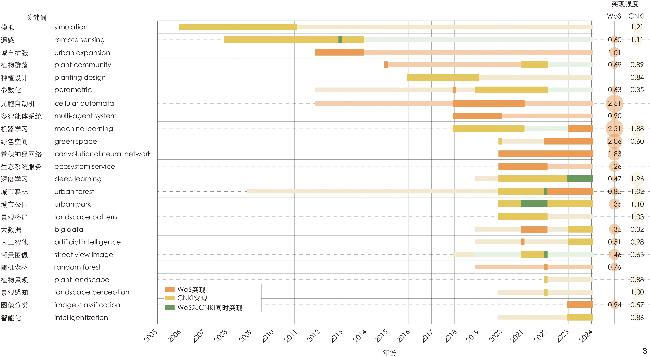
[Methods] This research utilizes Web of Science (WoS) and China National Knowledge Infrastructure (CNKI) as data sources, and employs both bibliometric analysis and narrative review methodologies to statistically analyze and synthesize the literature collected. 1) Bibliometric analysis: By virtue of COOC 14.9 and Citespace 6.3.R2, visual knowledge maps of 330 publications in the landscape architecture field are constructed with a focus on development stages and emergence timelines, based on which the trends and dynamics of computational design in landscape architecture are elucidated, with a specific emphasis on planting design. 2) Narrative review: Of the 330 publications, by reviewing their titles and abstracts, 24 ones relevant to planting and computational design are selected. These publications are then categorized and analyzed based on computational design techniques, research directions, and specific research objects within planting design.
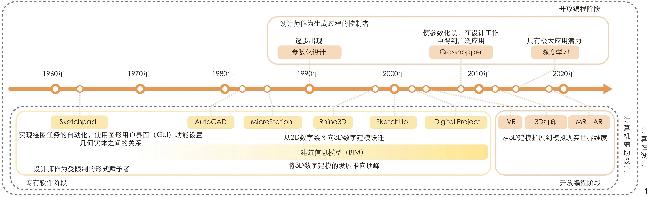
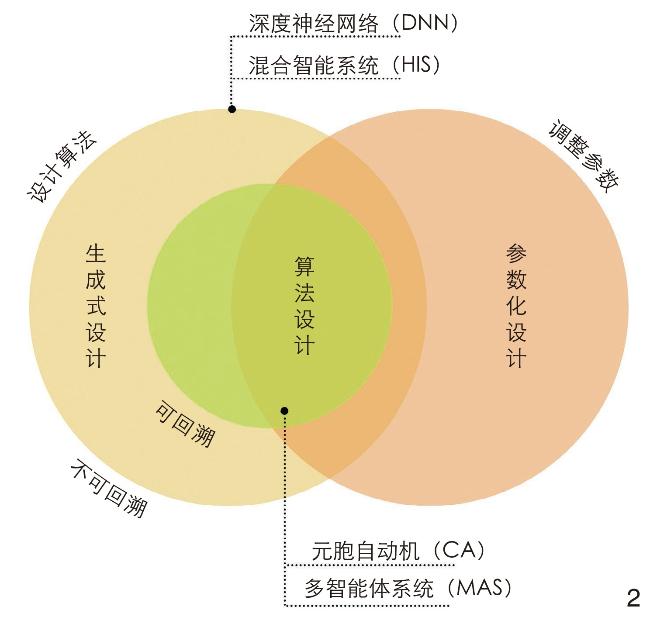
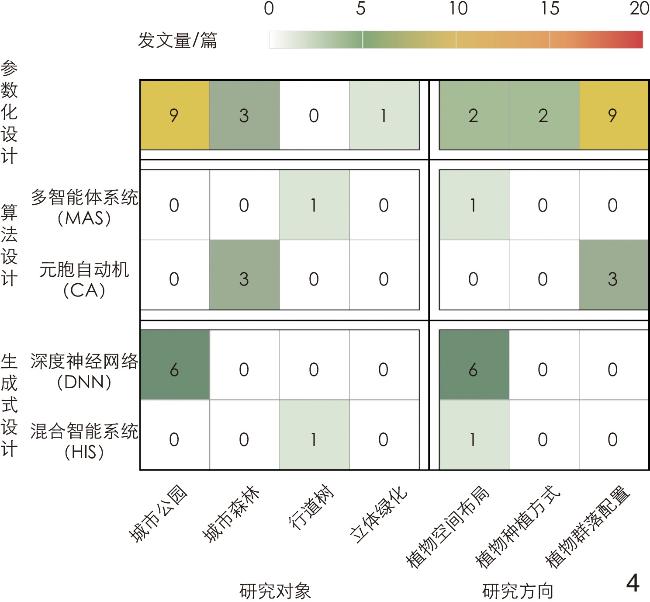
[Results] Between 2009 and 2023, the number of research on computational design in planting design has shown an overall upward trend. In terms of research objects, urban parks serve as the most significant research object with the largest number of publications, with recent trends extending to urban forests. Avenue trees and vertical greening also show significant potential. Regarding research directions, plant community configuration is a hot topic, followed by plant spatial layout. The research on planting direction still needs further enhancement. Computational design in planting design has progressed through three stages, namely parametric design, algorithmic design, and generative design. 1) Parametric design emphasizes the regulation of quantifiable parameters, aiming to deal with the complex qualitative characteristics of planting design on a one-to-one basis. It is the earliest and most widely used and mature design method in planting design, commonly applied in plant community configurations of urban parks. 2) Algorithmic design focuses on rule formulation, commonly using cellular automata (CA) and multi-agent system (MAS). CA simulates the “dynamic system” of natural communities and is adept at predicting competitive relationships within plant communities, which is widely used in natural plant community configurations in urban forests. MAS, suitable for interactions involving different goals and proprietary information, has significant implications for collaborative design among designers, the public, and the government, and has been applied to the spatial layout of avenue trees. 3) Generative design possesses strong rule-learning and implicit rule-capturing capabilities, with the potential for automated design generation. Algorithms like deep neural networks and hybrid intelligent systems are frequently used in planting design. Generative adversarial networks (GANs), such as Pix2Pix, CycleGAN, and StyleGAN, excel in style transfer, can generate images similar to input data, and are mainly used in plantscape layout in urban parks. For the aforesaid design methods, although the current focus is on their suitability for planting design, rapid development suggests they may become the primary technical approach for planting design in the future. By integrating multiple intelligent algorithms, hybrid intelligent systems can overcome the limitations of individual algorithms and combine the advantages of various techniques, which are currently applied in the integration of cellular automata and GANs.
[Conclusion] Computational design can effectively address the issues of ambiguity and high dimensionality in planting design, but still requires improvements. Presently, planting design lacks a data sharing platform, with various plant database resources dispersed across multiple platforms, leading to inconsistent data quality. Given the high demands of computational design for data quantity and quality, there is a need to promote the construction of planting design data sharing platforms and provide data evaluation channels to filter diverse and high-quality data. Moreover, planting design is highly related to human subjective aesthetics. Existing research primarily uses quantifiable spatial factors, lacking qualitative factors such as aesthetics and culture. Although generative design can mimic the design capabilities of designers, current generative results are unstable and lack detail. Future research needs to distinguish between quantitative and qualitative factors, with repetitive and quantifiable tasks handled by computational design, while qualitative factors judged by designers’ experience, thus forming a collaborative workflow between designer and computer. Additionally, most planting design research uses single techniques, failing to address the complexity of planting design practice comprehensively. Hybrid intelligent systems capable of integrating multiple intelligent methods, offer new ideas for planting design. Finally, computational design in planting design remains primarily at the experimental and research stages, necessitating further integration with practical application in the future.
Jinnuo LI , Yueqi MA , Hao YIN . Research Progress of Computational Design in Planting Design[J]. Landscape Architecture, 2024 , 31(9) : 51 -58 . DOI: 10.3724/j.fjyl.202405120259
| 研究类别 | 参数类别 | 参数选择 | 研究对象 | 发表年份 |
| 植物群落配置 | 植物群落结构 | 时间结构(花径大小变化、花期、花色和叶色变化等季 相变化数据)[15] | 城市公园 | 2020 |
| 空间结构(通透度、覆盖度、围合度、胸径与树高的比 值、空间面积、空间体积、密度、延伸度、复杂度)[16] | 2022 | |||
| 群落生境因子 | 风(风速)[21] | 城市森林 | 2009 | |
| 水分(地表径流)、光照(太阳辐射量、日照方向)、 地形(坡度)[17] | 城市公园 | 2015 | ||
| 光照(日照辐射)[18] | 2016 | |||
| 水分(湿度、降水量)、光照(太阳路径)、温度[19-20] | 2022、2023 | |||
| 群落配置理论 | 宫胁造林法的混合密植模式[22-23] | 城市森林 | 2021 | |
| 植物种植方式 | 规则式种植 | 孤植、列植、片植[24] | 城市公园 | 2020 |
| 自然式种植 | 仿自然的混合式种植[25] | 2021 | ||
| 植物空间布局 | 空间要素 | 植物种植点位、绿化面积、空间形式[26] | 立体绿化 | 2021 |
| 空间要素、 视听感知要素 | 空间形式(地形、水体、建筑和植物边界)、视听感知要素(游览路线、观赏点密度、观赏视距、噪声来源、噪声音量等)[27] | 城市公园 | 2022 |
| 算法类别 | 算法子类别 | 研究对象 | 输入数据类型 | 生成结果及问题 | 发表年份 |
| DNN | Pix2Pix | 城市公园 | 色块设计布局 | 区分出植被和其他空间要素,但出现了模式崩溃[43] | 2023 |
| 手绘黑白线条设计图 | 生成图像颜色不均匀,并出现显示崩溃[44] | 2024 | |||
| CycleGAN | 色块设计布局 | 能区分出草地及乔木,肌理较丰富,但植物细节不够[45] | 2021 | ||
| 色块设计布局 | 植物分布呈现自然和规则种植,但植物空间单一[43] | 2023 | |||
| 手绘黑白线条设计图 | 树木的表现较好,部分草坪有均匀的渐变效果,但一些植物组团和点状树出现模式 崩溃[44] | 2024 | |||
| StyleGAN | 色块设计布局 | 可以表现植物郁闭度,并能在林缘线外进行点状种植[42] | 2023 | ||
| HIS | CA、CycleGAN | 行道树 | CA模拟的森林菌根网络样本、城市卫星图像 | 生成了优先考虑绿化的城市行道树生态网络[49] | 2023 |
文中图表均由作者绘制。
| [1] |
SUN Q, CHEN Y, TAO W, et al. A GAN-Based Approach Toward Architectural Line Drawing Colorization Prototyping[J]. The Visual Computer, 2022, 38(4): 1283-1300.
|
| [2] |
WANG S, ZENG W, CHEN X, et al. ActFloor-GAN: Activity-Guided Adversarial Networks for Human-Centric Floorplan Design[J]. IEEE Transactions on Visualization and Computer Graphics, 2023, 29(3): 1610-1624.
|
| [3] |
袁潮, 郑豪. 生成式人工智能影响下的建筑设计新模式[J]. 建筑学报, 2023(10): 29-35.
YUAN C, ZHENG H. A New Architectural Design Methodology in the Age of Generative Artificial Intelligence[J]. Architectural Journal, 2023(10): 29-35.
|
| [4] |
CAETANO I, SANTOS L, LEITÃO A. Computational Design in Architecture: Defining Parametric, Generative, and Algorithmic Design[J]. Frontiers of Architectural Research, 2020, 9(2): 287-300.
|
| [5] |
CAETANO I, LEITÃO A. Architecture Meets Computation: An Overview of the Evolution of Computational Design Approaches in Architecture[J]. Architectural Science Review, 2020, 63(2): 165-174.
|
| [6] |
LIU Y, XU F. Analysis of Computer Aided Landscape Planning and Design Strategy[J]. Journal of Physics: Conference Series, 2021, 1992(2): 022100
|
| [7] |
FERNBERG P, CHAMBERLAIN B. Artificial Intelligence in Landscape Architecture: A Literature Review[J]. Landscape Journal, University of Wisconsin Press, 2023, 42(1): 13-35.
|
| [8] |
DONG S, WANG P, ABBAS K. A Survey on Deep Learning and Its Applications[J]. Computer Science Review, 2021, 40(2): 100379
|
| [9] |
HUNDE B R, WOLDEYOHANNES A D. Future Prospects of Computer-Aided Design (CAD): A Review from the Perspective of Artificial Intelligence (AI), Extended Reality, and 3D Printing[J]. Results in Engineering, 2022, 14(2): 100478
|
| [10] |
JABI W, SOE S, THEOBALD P, et al. Enhancing Parametric Design Through Non-manifold Topology[J]. Design Studies, 2017, 52(5): 96-114.
|
| [11] |
OXMAN R. Thinking Difference: Theories and Models of Parametric Design Thinking[J]. Design Studies, 2017, 52(5): 4-39.
|
| [12] |
JANG S, YOO S, KANG N. Generative Design by Reinforcement Learning: Enhancing the Diversity of Topology Optimization Designs[J]. Computer-Aided Design, 2022, 146(5): 103225
|
| [13] |
CHASZAR A, JOYCE S C. Generating Freedom: Questions of Flexibility in Digital Design and Architectural Computation[J]. International Journal of Architectural Computing, 2016, 14(2): 167-181.
|
| [14] |
BUKHARI F A. A Hierarchical Evolutionary Algorithmic Design (HEAD) System for Generating and Evolving Building Design Models[D]. Brisbane: Queensland University of Technology, 2011.
|
| [15] |
ALVEAR A. G. New Technologies + Algorithmic Plant Communities: Parametric / Agent-Based Workflows to Support Planting Design Documentation and Representation of Living Systems[J]. Journal of Digital Landscape Architecture, 2020, 5(1): 103-110.
|
| [16] |
王一婧, 成玉宁. 数字技术辅助下的风景园林空间精细化设计路径探索[J]. 中国园林, 2022, 38(S2): 93-98.
WANG Y J, CHENG Y N. Exploration of Refined Landscape Space Design Path Supported by Digital Technology[J]. Chinese Landscape Architecture, 2022, 38(S2): 93-98.
|
| [17] |
CHARALAMPIDIS E, TSALIKIDIS I. A Parametric Landscape Design Approach for Urban Green Infrastructure Development[C]// GOSPODINI A. Proceedings of the International Conference on Changing Cities II: Spatial, Design, Landscape & Socio-economic Dimensions. Thessaloniki: Meteorological Institute, Grafima Publications, 2015: 591-600.
|
| [18] |
魏合义. 基于日照需求的景观植物选择及智能决策方法[D]. 武汉: 武汉大学, 2016.
WEI H Y. An Intelligent Decision-Making Method for Landscape Plant Selection Based on Their Habits of Sunshine Requirements[D]. Wuhan: Wuhan University, 2016.
|
| [19] |
SĘDZICKI D, CUDZIK J, BONENBERG W, et al. Computer-Aided Automated Greenery Design: Towards a Green BIM[J]. Sustainability, 2022, 14(14): 8927
|
| [20] |
SĘDZICKI D, CUDZIK J, NYKA L. Computer-Aided Greenery Design-Prototype Green Structure Improving Human Health in Urban Ecosystem[J]. International Journal of Environmental Research and Public Health, 2023, 20(2): 1198
|
| [21] |
MOSAVI A. Parametric Modelling of Trees and Using Integrated CAD/CFD Tools: Application to Create a Planting Pattern for New Forests[C]// SCHINDLER D, BAUHUS J, MAYER H. Proceedings of the 2nd International Conference “Wind Effects on Trees”. Freiburg: Meteorological Institute, Albert-Ludwigs-University of Freiburg, 2009: 213-221.
|
| [22] |
钱小琴, 刘喆, 赵天祎, 等. 基于宫胁造林法的近自然城市森林数字化设计探索: 以河北省绿博园邢台林为例[J]. 景观设计学(中英文), 2021, 9(6): 60-76.
QIAN X Q, LIU Z, ZHAO T Y, et al. Digital Design Exploration of Nature-Approximating Urban Forest Basing on the Miyawaki Method: A Case Study of Xingtai Forest in a Hebei Green Expo Garden[J]. Landscape Architecture Frontiers, 2021, 9(6): 60-76.
|
| [23] |
钱小琴. 城市森林的近自然植物群落数字化设计方法研究[D]. 北京: 北京林业大学, 2021.
QIN X Q. Research on the Method of Digital Designing Nature-Approximating Plant Community in Urban Forest[D]. Beijing: Beijing Forestry University, 2021.
|
| [24] |
舒斌龙, 王忠杰, 王兆辰, 等. 风景园林信息模型(LIM)技术实践探究与应用实证[J]. 中国园林, 2020, 36(9): 23-28.
SHU B L, WANG Z J, WANG Z C, et al. Research on the Framework Construction of Landscape Information Modeling (LIM)[J]. Chinese Landscape Architecture, 2020, 36(9): 23-28.
|
| [25] |
NA S. Case Analysis and Applicability Review of Parametric Design in Landscape Architectural Design[J]. Journal of the Korean Institute of Landscape Architecture, 2021, 49(2): 1-16.
|
| [26] |
HOLLANDS J, KORJENIC A. Evaluation and Planning Decision on Facade Greening Made Easy-Integration in BIM and Implementation of an Automated Design Process[J]. Sustainability, 2021, 13(16): 9387
|
| [27] |
祝薇雅, 李鹏波. 基于参数化设计方法的城市公园植物景观布局设计: 以天津市水西庄公园为例[J]. 中国园林, 2022, 38(5): 110-115.
ZHU Y W, LI P B. Plant Landscape Layout Design of Urban Park Based on the Parametric Design Method: A Case Study of Shuixizhuang Park in Tianjin[J]. Chinese Landscape Architecture, 2022, 38(5): 110-115.
|
| [28] |
TAN X, DENG M, CHEN K, et al. A Spatial Hierarchical Learning Module Based Cellular Automata Model for Simulating Urban Expansion: Case Studies of Three Chinese Urban Areas[J]. GIScience & Remote Sensing, 2024, 61(1): 2290352
|
| [29] |
MOREIRA R M, LANA M, SIEBER S, et al. A Landscape Ecology Approach: Modeling Forest Fragmentation with Artificial Neural Networks and Cellular-Automata Markov-Chain for Improved Environmental Policy in the Southwestern Brazilian Amazon[J]. Land Degradation & Development, 2024, 35(2): 687-704.
|
| [30] |
WANG H, XUE H, YANG Y, et al. Multi-Scenario Simulation and Eco-Environmental Effects Analysis of Land Use/Cover Change in China by an Integrated Cellular Automata and Markov Model[J]. Land, 2024, 13(4): 520
|
| [31] |
KOMAROV A S, PALENOVA M M, SMIRNOVA O V. The Concept of Discrete Description of Plant Ontogenesis and Cellular Automata Models of Plant Populations[J]. Ecological Modelling, 2003, 170(2-3): 427-439.
|
| [32] |
FROLOV P V, ZUBKOVA E V, KOMAROV A S. A Cellular Automata Model for a Community Comprising Two Plant Species of Different Growth Forms[J]. Biology Bulletin, 2015, 42(4): 279-286.
|
| [33] |
刘喆, 郑曦. 近自然森林景观空间结构参数化设计研究[J]. 北京林业大学学报, 2023, 45(6): 100-107.
LIU Z, ZHENG X. Parametric Design of Close-to-Nature Forest Landscape Spatial Structure[J]. Journal of Beijing Forestry University, 2023, 45(6): 100-107.
|
| [34] |
BILURBINA M, ABELLAN S, CHRISTODOULOU M. Landscape Design Methodology: Pattern Formation Through the Use of Cellular Automata[J]. Journal of Digital Landscape Architecture, 2019, 4(1): 95-104.
|
| [35] |
WHITE M G, HAEUSLER M H, ZAVOLEAS Y. Simulation of Plant-Agent Interactions in a Landscape Information Model[J]. Journal of Digital Landscape Architecture, 2020, 5(1): 188-197.
|
| [36] |
REN Z, ANUMBA C J. Multi-agent Systems in Construction-State of the Art and Prospects[J]. Automation in Construction, 2004, 13(3): 421-434.
|
| [37] |
ALI A K, SONG H, LEE O J, et al. Multi-Agent-Based Urban Vegetation Design[J]. International Journal of Environmental Research and Public Health, 2020, 17(9): 3075
|
| [38] |
ABIODUN O I, JANTAN A, OMOLARA A E, et al. State-of-the-Art in Artificial Neural Network Applications: A Survey[J]. Heliyon, 2018, 4(11): e00938
|
| [39] |
张所任. 基于人工神经网络的园林植物配置研究[J]. 林业调查规划, 2022, 47(5): 196-200.
ZHANG S R. Carden Plant Configuration Based on Artificial Neural Network[J]. Forest Inventory and Planning, 2022, 47(5): 196-200.
|
| [40] |
林文君. 植物配置应用人工神经网络技术的可行性研究[D]. 广州: 华南理工大学, 2017.
LIN W J. Feasibility Study on Application of Artificial Neural Network in Plant Arrangement[D]. Guangzhou: South China University of Technology, 2017.
|
| [41] |
WANG Z W, SHE Q, WARD T E. Generative Adversarial Networks in Computer Vision: A Survey and Taxonomy[J]. ACM Computing Surveys (CSUR), 2021, 54(2): 1-38.
|
| [42] |
陈然, 赵晶. 基于样式生成对抗网络的风景园林方案生成及设计特征识别[J]. 风景园林, 2023, 30(7): 12-21.
CHEN R, ZHAO J. Generation and Design Feature Recognition of Landscape Architecture Scheme Based on Style-Based Generative Adversarial Network[J]. Landscape Architecture, 2023, 30(7): 12-21.
|
| [43] |
CHEN R, ZHAO J, YAO X, et al. Generative Design of Outdoor Green Spaces Based on Generative Adversarial Networks[J]. Buildings, 2023, 13(4): 1083
|
| [44] |
CHEN R, ZHAO J, YAO X, et al. Enhancing Urban Landscape Design: A GAN-Based Approach for Rapid Color Rendering of Park Sketches[J]. Land, 2024, 13(2): 254
|
| [45] |
周怀宇, 刘海龙. 人工智能辅助设计: 基于深度学习的风景园林平面识别与渲染[J]. 中国园林, 2021, 37(1): 56-61.
ZHOU H Y, LIU H L. Artificial Intelligence Aided Design: Landscape Plan Recognition and Rendering Based on Deep Learning[J]. Chinese Landscape Architecture, 2021, 37(1): 56-61.
|
| [46] |
ISOLA P, ZHU J Y, ZHOU T, et al. Image-to-Image Translation with Conditional Adversarial Networks[C]// Proceedings of the IEEE Conference on Computer Vision and Pattern Recognition. Honolulu: IEEE, 2017: 1125-1134.
|
| [47] |
梁俊杰, 韦舰晶, 蒋正锋. 生成对抗网络GAN综述[J]. 计算机科学与探索, 2020, 14(1): 1-17.
LIANG J J, WEI J J, JIANG Z F. Generative Adversarial Networks GAN Overview[J]. Journal of Frontiers of Computer Science and Technology, 2020, 14(1): 1-17.
|
| [48] |
KARRAS T, LAINE S, AILA T. A Style-Based Generator Architecture for Generative Adversarial Networks[J]. IEEE Transactions on Pattern Analysis and Machine Intelligence, 2021, 43(12): 4217-4228.
|
| [49] |
LE Y, HUANG S Y. Prediction of Urban Trees Planting Base on Guided Cellular Automata to Enhance the Connection of Green Infrastructure[J]. Land, 2023, 12(8): 1479
|
| [50] |
PlantNet: Home[EB/OL]. (2024-07-15) [2024-07-15]. https://plantnet.org/en/.
|
/
| 〈 |
|
〉 |