

Research on the Adaptability of Generative Algorithm in Generative Landscape Design
|
CHEN Ran is a co-researcher in the Key Laboratory of Ecology and Energy Saving Study of Dense Habitat, Ministry of Education, and a Ph.D. candidate in the School of Landscape Architecture, Beijing Forestry University. His research focuses on design intelligence and deep learning |
|
LUO Xiaomin gained her bachelor degree in Beijing Forestry University, and is master student in the School of Architecture, Tsinghua University. Her research focuses on design intelligence and deep learning and ecosystem service |
|
HE Yueheng is an undergraduate student in the School of Landscape Architecture, Beijing Forestry University. Her research focuses on design intelligence and deep learning |
|
ZHAO Jing, Ph.D., is a co-researcher in the Key Laboratory of Ecology and Energy Saving Study of Dense Habitat, Ministry of Education, a professor and doctoral supervisor in and vice dean of the School of Landscape Architecture, Beijing Forestry University, a member of Beijing Laboratory of Urban and Rural Ecological Environment, and a deputy editor-in-chief of this journal. Her research focuses on design intelligence, history and theory of landscape architecture, and landscape planning and design |
Received date: 2024-04-12
Revised date: 2024-08-12
Online published: 2025-12-16
Copyright
[Objective] In recent years, groundbreaking generative algorithms such as GPT-4 and Diffusion have propelled a new wave of technological revolution, significantly impacting various fields, including landscape architecture. This research reviews the integration of these advanced algorithms into landscape architecture, with a focus on their adaptability across different stages of design. These algorithms, known for their capability to generate texts and images, are poised to revolutionize design methodologies by offering innovative solutions that can transform traditional practices.
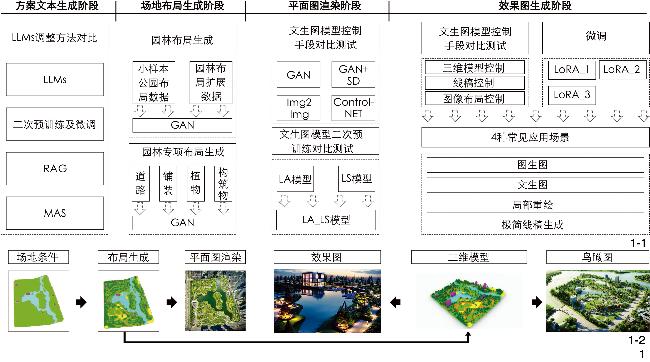
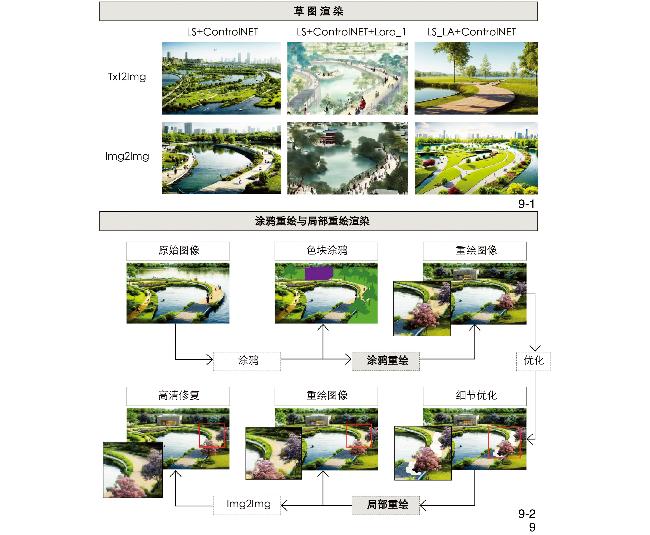
[Methods] The methodology of this research involves a systematic exploration of generative algorithms applied in a structured framework within the landscape architecture domain. The process is divided into four distinct stages: text generation, layout generation, master plan rendering, and effect visualization. Each stage tests different algorithms to evaluate their practicality and effectiveness and comprehensively assess their capabilities and limitations in real-world design scenarios.
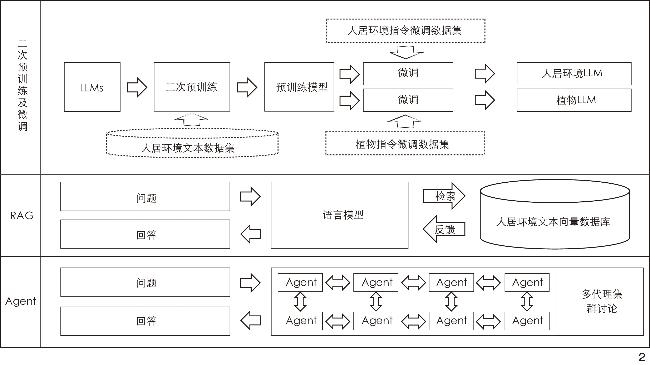
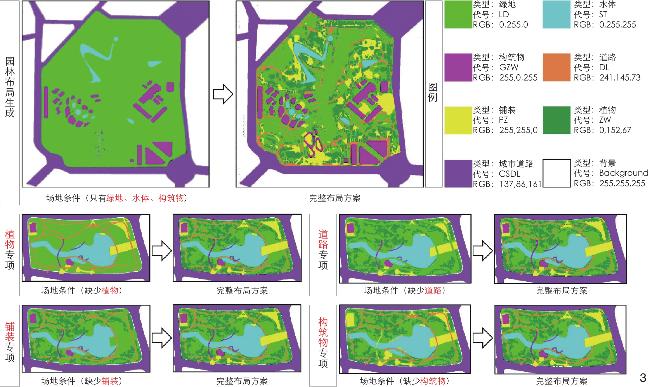
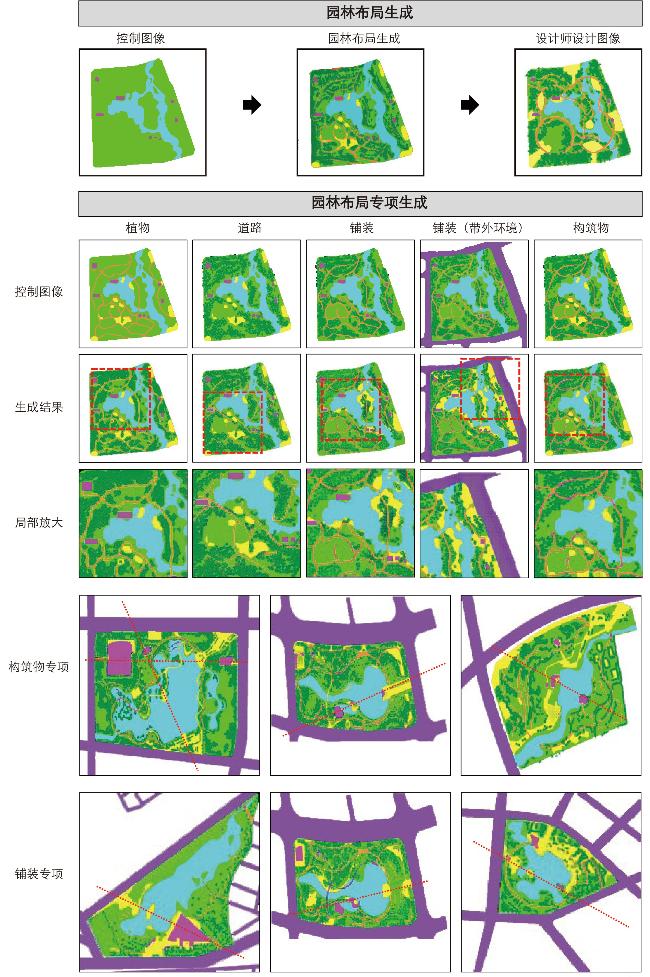
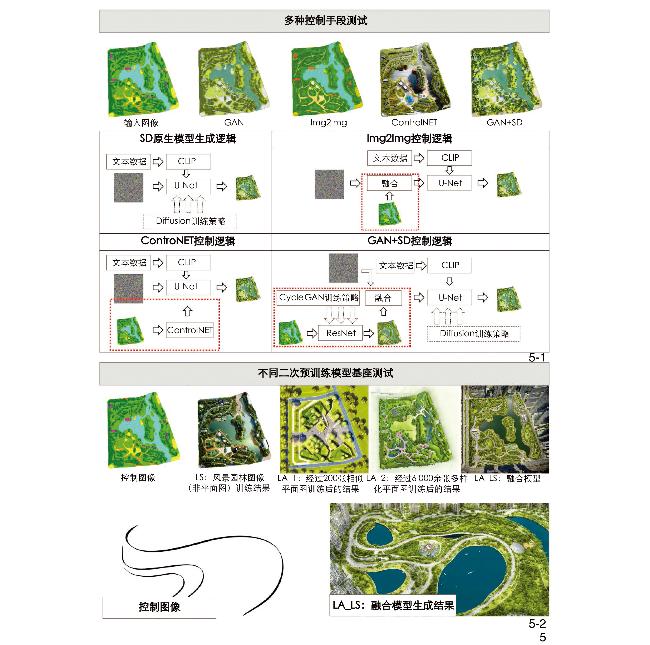
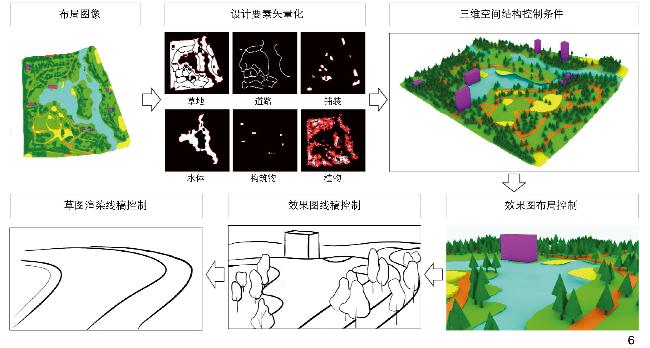
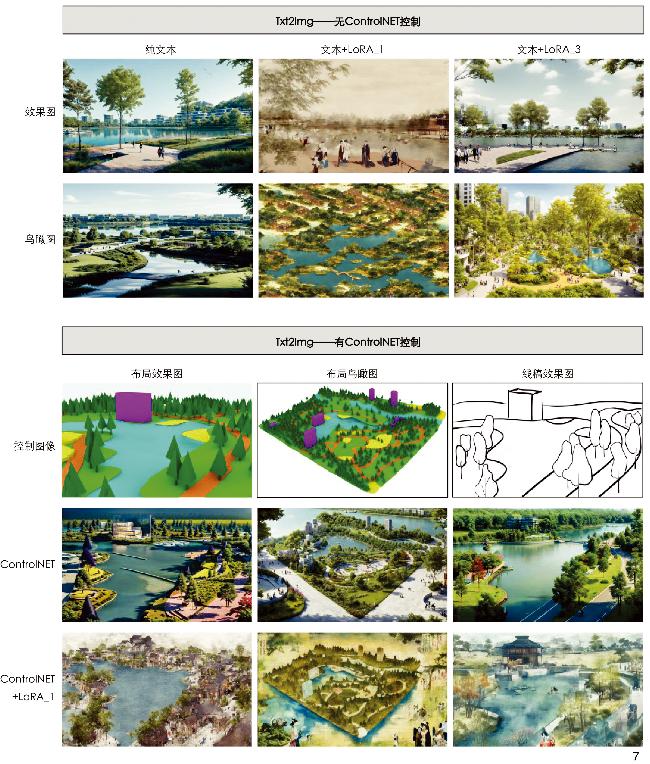
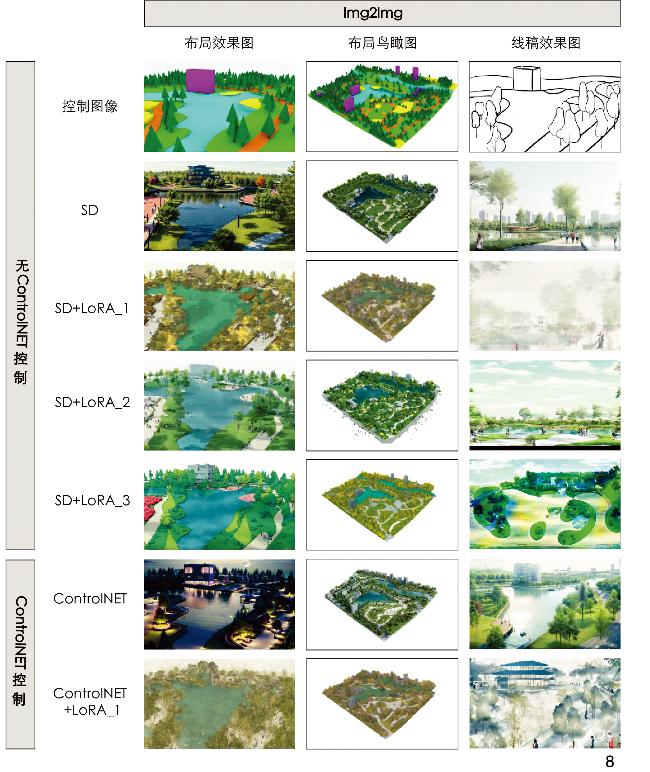
[Results] 1) Text generation: The initial stage of the design process involves generating descriptive texts based on input queries. Traditional LLMs like GPT-4 show robust capabilities in general text generation but often lack the nuanced understanding required for specialized fields such as landscape architecture. To address this, the research employs techniques such as fine-tuning and retrieval-augmented generation (RAG) to enhance the specificity and relevance of the outputs to landscape architecture. Despite these efforts, the adaptability of LLMs to generate contextually rich and technically accurate descriptions remains a significant challenge. The research suggests that integrating domain-specific knowledge bases and employing advanced tuning methods may improve the performance of LLMs in generating more relevant design descriptions.Layout generation. 2)Layout generation: The research explores the use of generative adversarial network (GAN), specifically CycleGAN and Pix2Pix, which can adapt source domain images to target domain layouts. These models excel in identifying and translating underlying design patterns without the need for direct supervision, which aligns well with creative design practices that value innovation over replication. The research highlights the potential of these algorithms to understand and reinterpret spatial data into feasible design layouts, showcasing their capability to innovate within the predefined norms of landscape architecture. 3)Master plan rendering: The master plan rendering stage is critical for producing detailed and accurate architectural drawings. The research tests the efficacy of large pre-trained models like Stable Diffusion and examines their integration with traditional GAN for enhanced precision. The findings indicate that while Stable Diffusion provides high-quality image outputs, its application in producing detailed technical drawings is limited. The research introduces a hybrid approach, combining the strengths of GAN for structural accuracy and the image quality of Stable Diffusion, to produce renderings that are both aesthetically pleasing and technically detailed. 4)Effect visualization: The final stage involves creating detailed three-dimensional visual effects from the two-dimensional plans. This stage tests the adaptability of algorithms to translate flat designs into vivid, multi-dimensional landscapes. Techniques such as ControlNet and specialized tuning methods like LoRA are used to fine-tune the visual outputs to meet specific aesthetic and functional requirements. The research delves into the challenges of maintaining the fidelity of the original design while enhancing the visual representation, which emphasizes the need for sophisticated control mechanisms to achieve high-quality visualizations.
[Conclusion] The research concludes that while generative algorithms hold significant promise for the field of landscape architecture, their success is contingent upon targeted adaptations and enhancements tailored to specific design tasks. The complexities of integrating these technologies into a coherent design process highlight the necessity for a multidisciplinary approach that leverages both technological innovations and traditional design principles. Future research should aim to develop an integrated system that combines various AI technologies, potentially transforming the landscape architecture field by streamlining and enhancing the design process. This integrated approach could pave the way for new methodologies that seamlessly merge theoretical and practical aspects of landscape design, thus fostering innovation and efficiency.
Ran CHEN , Xiaomin LUO , Yueheng HE , Jing ZHAO . Research on the Adaptability of Generative Algorithm in Generative Landscape Design[J]. Landscape Architecture, 2024 , 31(9) : 12 -23 . DOI: 10.3724/j.fjyl.202404120207
表1 风景园林设计方案生成 4个阶段对应的技术问题Tab. 1 Technical problems corresponding to each of the 4 stages involved in the generation of a landscape design scheme |
| 阶段 | 常见技术类型 | 技术问题 |
| 方案文本 生成 | LLMs基座模型 | 无专业领域知识 |
| 二次预训练及微调 | 成本及效率问题 | |
| RAG | 超出数据库的问题泛化能力问题 | |
| Agent | 控制、评价问题 | |
| 场地布局 生成 | GAN | 不可解释、不可控问题 |
| 数据量问题 | ||
| 平面图渲染 | GAN | 生成图像质量问题 |
| 大型文生图预 训练模型 | 语义识别能力问题 | |
| 效果图生成 | ControlNET 和SD模型结合 | 图像结构控制问题 |
| 二次预训练及微调 | 特定风格的表达问题 | |
| 三维模型生成 | 场地空间与平面图的对应问题 |
文中图表均由作者绘制。
| [1] |
ZHENG Y, LIN Y, ZHAO L, et al. Spatial Planning of Urban Communities via Deep Reinforcement Learning[J]. Nature Computational Science, 2023, 3(9): 748-762.
|
| [2] |
包瑞清. 基于机器学习的风景园林智能化分析应用研究[J]. 风景园林, 2019, 26(5): 29-34.
BAO R Q. Research on Application of Intelligent Analysis of Landscape Architecture Based on Machine Learning[J]. Landscape Architecture, 2019, 26(5): 29-34.
|
| [3] |
包瑞清. 计算机辅助风景园林规划设计策略探讨[J]. 北京林业大学学报(社会科学版), 2013, 12(1): 38-44.
BAO R Q. Discussion on Computer-aided Landscape Planning and Design Strategy[J]. Journal of Beijing Forestry University (Social Sciences Edition), 2013, 12(1): 38-44.
|
| [4] |
蔡凌豪. 风景园林数字化规划设计概念谱系与流程图解[J]. 风景园林, 2013(1): 48-57.
CAI L H. Concept Pedigrees and Process Diagram of Digital Planning and Design of Landscape Architecture[J]. Landscape Architecture, 2013(1): 48-57.
|
| [5] |
TOUVRON H, LAVRIL T, IZACARD G, et al. LLaMA: Open and Efficient Foundation Language Models[EB/OL]. (2023-02-27)[2024-04-15]. https://arxiv.org/abs/2302.13971.
|
| [6] |
BI K, XIE L, ZHANG H, et al. Accurate Medium-Range Global Weather Forecasting with 3D Neural Networks[J]. Nature, 2023, 619(7970): 533-538.
|
| [7] |
ZHANG Z, LYU L, MA X, et al. Fine-Mixing: Mitigating Backdoors in Fine-Tuned Language Models[C]// GOLDBERG Y, KOZAREVA Z, ZHANG Y. Findings of the Association for Computational Linguistics: EMNLP 2022. Abu Dhabi: Association for Computational Linguistics, 2022: 355-372.
|
| [8] |
LEWIS P, PEREZ E, PIKTUS A, et al. Retrieval-Augmented Generation for Knowledge-Intensive NLP Tasks[J]. Advances in Neural Information Processing Systems, 2020, 33: 9459-9474.
|
| [9] |
QIAN C, LIU W, LIU H, et al. ChatDev: Communicative Agents for Software Development[EB/OL]. (2020-01-18)[2024-03-24]. https://arxiv.org/abs/2307.07924
|
| [10] |
JOON S P, JOSEPH O, CARRIE J C, et al. Bernstein. Generative Agents: Interactive Simulacra of Human Behavior[C]// SEAN F, JEFF H, JÜRGEN S. UIST’23: Proceedings of the 36th Annual ACM Symposium on User Interface Software and Technology. New York: Association for Computing Machinery, 2023: 1-22.
|
| [11] |
HUANG W, ZHENG H. Architectural Drawings Recognition and Generation through Machine Learning[C]// ANZALONE P, SIGNORE M D, WIT A J. Proceedings of the 38th Annual Conference of the Association for Computer Aided Design in Architecture (ACADIA). Mexico City: ACADIA, 2018: 156-165.
|
| [12] |
PIZARRO P N, HITSCHFELD N, SIPIRAN I, et al. Automatic Floor Plan Analysis and Recognition[J]. Automation in Construction, 2022, 140: 104348
|
| [13] |
HU R, HUANG Z, TANG Y, et al. Graph2Plan: Learning Floorplan Generation from Layout Graphs[J]. ACM Transactions on Graphics, 2020, 39(4): 118: 1-118: 14.
|
| [14] |
LIU J, QIU Z, WANG L, et al. Intelligent Floor Plan Design of Modular High-Rise Residential Building Based on Graph-Constrained Generative Adversarial Networks[J]. Automation in Construction, 2024, 159: 105264
|
| [15] |
YE X, DU J, YE Y. Masterplangan: Facilitating the Smart Rendering of Urban Master Plans via Generative Adversarial Networks[J]. Environment and Planning B: Urban Analytics and City Science, 2022, 49(3): 794-814.
|
| [16] |
周怀宇, 刘海龙. 人工智能辅助设计: 基于深度学习的风景园林平面识别与渲染[J]. 中国园林, 2021, 37(1): 56-61.
ZHOU H Y, LIU H L. Artificial Intelligence-assisted Design: Landscape Plane Recognition and Rendering Based on Deep Learning[J]. Chinese Landscape Architecture, 2021, 37(1): 56-61.
|
| [17] |
CHEN R, ZHAO J, YAO X, et al. Enhancing Urban Landscape Design: A GAN-Based Approach for Rapid Color Rendering of Park Sketches[J]. Land, 2024, 13(2): 254
|
| [18] |
LIU Y, FANG C, YANG Z, et al. Exploration on Machine Learning Layout Generation of Chinese Private Garden in Southern Yangtze[C]// YUAN P F, CHAI H, YAN C, et al. Proceedings of the 2021 DigitalFUTURES. Singapore: Springer, 2022: 35-44.
|
| [19] |
陈然. 基于生成对抗网络的风景园林生成设计研究[D]. 北京: 北京林业大学, 2022.
CHEN R. Research on Landscape Architecture Generation Design Based on Generative Adversarial Networks[D]. Beijing: Beijing Forestry University, 2022.
|
| [20] |
WANG S, ZENG W, CHEN X, et al. ActFloor-GAN: Activity-Guided Adversarial Networks for Human-Centric Floorplan Design[J]. IEEE Transactions on Visualization & Computer Graphics, 2023, 29(3): 1610-1624.
|
| [21] |
LIU Y, HU K, DENG Q. Evolvable Case-Based Design: An Artificial Intelligence System for Urban Form Generation with Specific Indicators[EB/OL]. (2023-12-08)[2024-03-25]. https://journals.sagepub.com/doi/abs/10.1177/23998083231219364?journalCode=epbb.
|
| [22] |
CHEN R, ZHAO J, YAO X, et al. Generative Design of Outdoor Green Spaces Based on Generative Adversarial Networks[J]. Buildings, 2023, 13(4): 1083
|
| [23] |
RAMESH A, PAVLOV M, GOH G, et al. Zero-Shot Text-to-Image Generation[C]// MARINA M, TONG Z. International Conference on Machine Learning. Virtual: PMLR, 2021: 8821-8831.
|
| [24] |
杨柳. 基于深度学习的青年公寓户型自动生成研究[D]. 广州: 华南理工大学, 2019.
YANG L. Research on Automatic Generation of Youth Apartment Based on Deep Learning[D]. Guangzhou: South China University of Technology, 2020.
|
| [25] |
林文强. 基于深度学习的小学校园设计布局自动生成研究[D]. 广州: 华南理工大学, 2020.
LIN W Q. Research on Automatic Generation of Primary School Campus Design Layout Based on Deep Learning[D]. Guangzhou: South China University of Technology, 2021.
|
| [26] |
冯奕凯. 基于深度学习的住宅建筑平面布局生成设计[D]. 天津: 天津大学, 2020.
FENG Y. Generative Design of Residential Building Layout Based on Deep Learning[D]. Tianjin: Tianjin University, 2022.
|
| [27] |
陈然, 赵晶. 基于样式生成对抗网络的风景园林方案生成及设计特征识别[J]. 风景园林, 2023, 30(7): 12-21.
CHEN R, ZHAO J. Landscape Architecture Scheme Generation and Design Feature Recognition Based on Style Generation Adversarial Network[J]. Landscape Architecture, 2023, 30(7): 12-21.
|
| [28] |
LUO S, TAN Y, PATIL S, et al. LCM-LoRA: A Universal Stable-Diffusion Acceleration Module[EB/OL]. (2023-11-09)[2024-03-18]. https://arxiv.org/abs/2311.05556.
|
| [29] |
RUIZ N, LI Y, JAMPANI V, et al. Dreambooth: Fine Tuning Text-to-Image Diffusion Models for Subject-Driven Generation[C]// NICOLE F. Proceedings of the IEEE/CVF Conference on Computer Vision and Pattern Recognition. Vancouver: IEEE, 2023: 22500-22510.
|
| [30] |
MILDENHALL B, SRINIVASAN P P, TANCIK M, et al. Nerf: Representing Scenes as Neural Radiance Fields for View Synthesis[J]. Communications of the ACM, 2021, 65(1): 99-106.
|
| [31] |
HUANG C, ZHANG G, YAO J, et al. Accelerated Environmental Performance-Driven Urban Design with Generative Adversarial Network[J]. Building and Environment, 2022, 224: 109575
|
| [32] |
HUANG W, ZHENG H. Architectural Drawings Recognition and Generation through Machine Learning[C]// PHILLIP A, MARCELLA D S, ANDREW J W. Acadia 2018 Recalibration: On Imprecision and Infidelity Proceedings of the 38th Annual Conference of the Association for Computer Aided Design in Architecture. Mexico City: Acadia Publishing Company, 2018: 156-165.
|
| [33] |
LIU Y, FANG C, YANG Z, et al. Exploration on Machine Learning Layout Generation of Chinese Private Garden in Southern Yangtze[C]// PHILIP F. Y, HUA C, CHAO Y, et al. Proceedings of the 2021 DigitalFUTURES: The 3rd International Conference on Computational Design and Robotic Fabrication (CDRF 2021) 3. Singapore: Springer , 2022: 35-44
|
| [34] |
LIU Y, DENG, Q, LIANG L. SchGAN: Primary School Campus Layout Generation, Intelligent Assistant for Architectural Design[EB/OL]. (2020-01-18)[2024-03-21]. https://blog.csdn.net/shadowcz007/article/details/104035601.
|
| [35] |
LI Y, LI Z, ZHANG K, et al. Chatdoctor: A Medical Chat Model Fine-Tuned on a Large Language Model Meta-AI (llama) Using Medical Domain Knowledge[J]. Cureus, 2023, 15(6): e40895
|
| [36] |
DING S, CHEN X, FANG Y, et al. DesignGPT: Multi-Agent Collaboration in Design[C]// SUN L, TANG Y, CHAI C, et al. 2023 16th International Symposium on Computational Intelligence and Design (ISCID). Hangzhou: IEEE, 2023: 204-208.
|
| [37] |
HU E J, SHEN Y, WALLIS P, et al. LoRA: Low-Rank Adaptation of Large Language Models[EB/OL]. (2021-10-16)[2024-03-21]. https://arxiv.org/abs/2106.09685.
|
| [38] |
SANH V, WOLF T, RUSH A. Movement Pruning: Adaptive Sparsity by Fine-Tuning[J]. Advances in Neural Information Processing Systems, 2020, 33: 20378-20389.
|
| [39] |
LIU X, JI K, FU Y, et al. P-Tuning: Prompt Tuning Can Be Comparable to Fine-Tuning Across Scales and Tasks[C]// SMARANDA M, PRESLAV N, ALINE V. Proceedings of the 60th Annual Meeting of the Association for Computational Linguistics (Volume 2: Short Papers). Dublin: Association for Computational Linguistics, 2022.
|
| [40] |
ZHANG W, CAI M, ZHANG T, et al. Earthgpt: A Universal Multi-modal Large Language Model for Multi-sensor Image Comprehension in Remote Sensing Domain[J]. IEEE Transactions on Geoscience and Remote Sensing, 2024, 26: 1-20.
|
| [41] |
李磊, 卢漫, 刘宛钦, 等. BIM技术在城市园林景观竖向分析中的应用研究: 以南京市青龙绿带二期工程为例[J]. 建筑学报, 2021(S2): 18-21.
LI L, LU M, LIU W Q, et al. Application of BIM Technology in Vertical Analysis of Urban Landscape: A Case Study of Nanjing Qinglong Green Belt Phase II Project[J]. Architectural Journal, 2021(S2): 18-21.
|
| [42] |
王亮. 基于倾斜影像与点云数据的古建筑三维模型构建[J]. 城市勘测, 2024(1): 103-108.
WANG L. Three-Dimensional Model Construction of Ancient Buildings Based on Oblique Image and Point Cloud Data[J]. Urban Survey, 2024(1): 103-108.
|
/
| 〈 |
|
〉 |