

Review of Public Sentiment Experience Research for Urban Built Environment
|
TAN Lingqian is a master student in the School of Landscape Architecture, Beijing Forestry University. Her research focuses on landscape planning and design, and sentimental experience |
|
HAO Peiyao, Ph.D, is an associate professor and master supervisor in the School of Landscape Architecture, Beijing Forestry University, and a young editorial board member of this journal. Her research focuses on landscape ecology, and plantscape planning and design |
Received date: 2023-06-30
Online published: 2025-12-15
Copyright
[Objective] The objective of current urban construction in China is to enhance and optimize the quality of the built environment in order to improve the people’s sense of well-being and sense of gain, which has become a top priority for urban development. As the public is the principal constituent of the built environment, it is of utmost importance to have a clear comprehension of the public’s sentimental demand for the built environment in order to achieve high-quality urban development and promote the public’s sense of well-being. This research aims to, by gaining a deep understanding of the public’s sentimental needs, steers urban planning and construction towards creating a more habitable environment that better satisfies the people’s expectations.
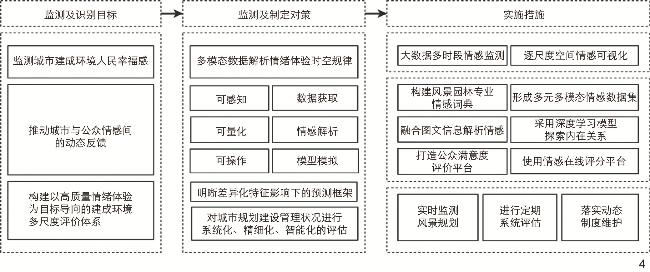
[Methods] The development of emotion research is first examined, including changes in emotion research theories and research methods. By virtue of the CiteSpace bibliometric analysis software, this research illustrates and scrutinizes the contemporary research development and salient aspects of public sentiment experience and built environment. By examining an extensive corpus of literature, the research extracts and elucidates the attributes of sentiment research from the three dimensions of data, content and method. To grasp the shifting dynamics of public sentiments more effectively, the research proposes a series of processes applicable to urban sentiment surveillance and discernment, thereby capturing the public’s sentiments in a more inclusive and systematic manner.
[Results] Sentiment classification theories can be broadly categorized into two main groups: basic emotion theory and emotion dimension theory. The theory of emotion, stemming from the accumulation of emotions, has evolved through the integration of landscape aesthetics, environmental psychology, and other significant theories in landscape gardening. Furthermore, in the context of multidisciplinary integration, the reciprocal exchange of research methods and theories across different disciplines has contributed to a more comprehensive perspective in the field of emotion research. With the advent of the 21st century, urbanization has ushered in both convenience and environmental degradation. It is crucial to recognize the dual impact of urbanization – the positive aspects of convenience and the negative consequences of environmental degradation. As cities evolve, the emphasis on creating sustainable and ecologically conscious urban spaces has become paramount. The shift towards garden cities and eco-friendly urban development reflects a collective recognition of the importance of preserving the environment amid rapid urban expansion. Despite these positive strides, there remains a notable gap in the design approach adopted for urban built environments. The prevailing focus on form and functionality, while essential, tends to sideline the emotional and psychological well-being of the urban residents. Furthermore, the spiritual connotations that an environment should embody are often neglected in the urban design discourse. The profound impact of surroundings on the human spirit and well-being is a crucial aspect that needs to be integrated into the design philosophy. Spaces should evoke a sense of belonging, cultural identity, and emotional resonance, thus contributing to a holistic urban experience. In light of these considerations, the call for emotional design becomes increasingly urgent. The research finds that the sources of data for sentiment research are primarily text-based, with relatively few direct analyses of image, speech or other forms of data. Furthermore, the research indicates that the current research mainly focuses on factors influencing positive sentiments, while paying less attention to negative sentiments. In terms of methodology, emotion recognition is a multimodal process, but there are significant variations in the quality and quantity of information available from different sources.
[Conclusion] The current research data on public sentiment research in urban built environment is characterized by a multitude of sources and types, however, the predominant data form is text data, and the direct analysis of such data forms as image and speech is relatively lacking. In the future, convolutional neural network (CNN) models can be employed to process information found on social media platforms, such as comments and photos, and delve into the hidden meanings of pictures, such as irony, humor, metaphor and exaggeration. Sentiment classification can be enhanced through machine learning, and the attention mechanism can be introduced to extract useful information in sentiment analysis, thus adding credibility to subsequent built environment evaluations. The classification of the influences of the research on built environment sentiment on various population groups and spatial elements in cities is yet to be improved and comprehensively organized. To achieve sustainable development and enhance people’s sense of well-being, it is important for researchers to focus on the relationship between positive sentiments and the built environment at multiple scales, and understand the sentiment influencing mechanisms and paths of various spatial structures, landscape elements, and design elements in future city planning. The application of the research on built environment sentiment is mainly limited by the content and type of research, with varying quality and quantity of information across different scales. It is suggested to utilize the synergy between multiple data forms, such as incorporating digital technology-assisted measurement methods to strengthen the practical application of virtual reality technology. This will provide richer methodological and technological support for the research on built environment evaluation, improving the reliability, validity, and generalizability of research findings. These recommendations will be beneficial for expanding the direction of landscape architecture research and promoting design innovation.
TAN Lingqian , HAO Peiyao . Review of Public Sentiment Experience Research for Urban Built Environment[J]. Landscape Architecture, 2024 , 31(3) : 106 -114 . DOI: 10.3724/j.fjyl.202306300295
表1 建成环境中情感研究的高频关键词聚类信息Tab. 1 Clustering information of high-frequency keywords involved in the research on built environment |
| 建成环境(built environment) | 情感识别( sentiment recognition) | 积极情绪(positive emotions) | ||||||||
|---|---|---|---|---|---|---|---|---|---|---|
| 关键词 | 频次 | 中心性 | 关键词 | 频次 | 中心性 | 关键词 | 频次 | 中心性 | ||
| 满意 | 42 | 0.07 | 模型 | 79 | 0.07 | 情感 | 122 | 0.08 | ||
| 健康 | 76 | 0.06 | 情感计算 | 7 | 0.06 | 影响 | 90 | 0.07 | ||
| 建成环境 | 65 | 0.04 | 感知 | 34 | 0.05 | 积极情绪 | 62 | 0.07 | ||
| 体力活动 | 28 | 0.03 | 脑 | 28 | 0.04 | 经验 | 46 | 0.05 | ||
| 利益 | 11 | 0.02 | 设计 | 28 | 0.03 | 环境 | 47 | 0.04 | ||
| 地理 | 26 | 0.02 | 质量 | 25 | 0.02 | 工作 | 22 | 0.02 | ||
| 社交媒体 | 14 | 0.02 | 虚拟现实 | 37 | 0.02 | 行为意向 | 3 | 0.01 | ||
| 加宽 | 12 | 0.01 | 情感识别 | 32 | 0.01 | 内在动机 | 2 | 0.01 | ||
| 身份 | 19 | 0.01 | 反应 | 29 | 0.01 | 自我决定论 | 3 | 0 | ||
| 生活质量 | 12 | 0.01 | 热舒适 | 14 | 0 | 工作满意度 | 2 | 0 | ||
文中图表均由作者绘制。
| [1] |
住房城乡建设部. 关于加强生态修复城市修补工作的指导意见[EB/OL]. (2017-03-06)[2024-01-04]. https://www.mohurd.gov.cn/gongkai/zhengce/zhengcefilelib/201703/20170309_230930.html.
Ministry of Housing and Urban-Rural Development. Guiding Opinions on Strengthening Ecological Restoration and Urban Repair[EB/OL]. (2017-03-06)[2024-01-04]. https://www.mohurd.gov.cn/gongkai/zhengce/zhengcefilelib/201703/20170309_230930.html.
|
| [2] |
国家发展和改革委员会. “十四五”新型城镇化实施方案[EB/OL]. (2022-07-28)[2024-01-04]. https://www.ndrc.gov.cn/fggz/fzzlgh/gjjzxgh/202207/t20220728_1332050.html.
National Development and Reform Commission. The 14th Five-Year Plan for New Urbanization[EB/OL]. (2022-07-28)[2024-01-04]. https://www.ndrc.gov.cn/fggz/fzzlgh/gjjzxgh/202207/t20220728_1332050.html.
|
| [3] |
北京市科学技术委员会, 中关村科技园区管理委员会. 北京市“十四五”时期智慧城市发展行动纲要[EB/OL]. (2021-03-23)[2024-01-04]. https://kw.beijing.gov.cn/art/2021/3/23/art_2388_14144.html.
Beijing Municipal Science and Technology Commission, Zhongguancun Science and Technology Park Management Committee. Beijing “14th Five-Year Plan” Period of Smart City Development Action Plan[EB/OL]. (2021-03-23)[2024-01-04]. https://kw.beijing.gov.cn/art/2021/3/23/art_2388_14144.html.
|
| [4] |
DIENER E, OISHI S, TAY L. Advances in Subjective Well-Being Research[J]. Nature Human Behaviour, 2018, 2 (4): 253-260.
|
| [5] |
DIENER E, SUH E M, LUCAS R E, et al. Subjective Well-Being: Three Decades of Progress[J]. Psychological Bulletin, 1999, 125 (2): 276-302.
|
| [6] |
DIENER E, EMMONS R A, LARSEN R J, et al. The Satisfaction with Life Scale[J]. Journal of Personality Assessment, 1985, 49 (1): 71-75.
|
| [7] |
KAHNEMAN D, DIENER E, SCHWARZ N. Well-Being: The Foundations of Hedonic Psychology[M]. New York: Russell Sage Foundation, 1999.
|
| [8] |
王梦如, 单祎婷. 基于周边居民需求的历史文化街区满意度评价: 以南京老门东为例[J]. 城市建筑, 2023, 20 (4): 131-133.
WANG M R, SHAN Y T. Satisfaction Evaluation of Historical and Cultural Blocks Based on the Needs of Surrounding Residents: A Case Study of Nanjing Laomendong[J]. Urbanism and Architecture, 2023, 20 (4): 131-133.
|
| [9] |
CHÁFER-PERICÁS C, ÁLVAREZ L, GANDIA-FERRERO M T, et al. Imaging Diagnosis and Emotion Recognition Relationship in Mild Cognitive Impairment[J]. Alzheimer’s & Dementia, 2023, 19 S16: e074577.
|
| [10] |
朱妙园, 华红莲, 杨慧, 等. 基于认知地图比较的乡村文化记忆主客感知维度研究: 以云南省丽江市玉湖村为例[J]. 旅游研究, 2023, 15 (2): 28-41.
ZHU M Y, HUA H L, YANG H, et al. Research on Subjective and Objective Perception Dimensions of Rural Cultural Memory Based on Cognitive Map Comparison: Taking Yuhu Village, Lijiang City, Yunnan Province as an Example[J]. Tourism Research, 2023, 15 (2): 28-41.
|
| [11] |
王颖洁, 朱久祺, 汪祖民, 等. 自然语言处理在文本情感分析领域应用综述[J]. 计算机应用, 2022, 42 (4): 1011-1020.
WANG Y J, ZHU J Q, WANG Z M, et al. Review of Applications of Natural Language Processing in Text Sentiment Analysis[J]. Computer Applications, 2022, 42 (4): 1011-1020.
|
| [12] |
潘家辉, 何志鹏, 李自娜, 等. 多模态情绪识别研究综述[J]. 智能系统学报, 2020, 15 (4): 633-645.
PAN J H, HE Z P, LI Z N, et al. A Review of Multimodal Emotion Recognition[J]. CAAI Transactions on Intelligent Systems, 2020, 15 (4): 633-645.
|
| [13] |
王婷, 杨文忠. 文本情感分析方法研究综述[J]. 计算机工程与应用, 2021, 57 (12): 11-24.
WANG T, YANG W Z. Computer Engineering and Applications[J]. Computer Engineering and Applications, 2021, 57 (12): 11-24.
|
| [14] |
怀松垚, 陈筝, 刘颂. 基于新数据、新技术的城市公共空间品质研究[J]. 城市建筑, 2018 (6): 12-20.
HUAI S Y, CHEN Z, LIU S. The Quality of Urban Public Space Based on New Data and New Technologies[J]. Urbanism and Architecture, 2018 (6): 12-20.
|
| [15] |
EKMAN P. Strong Evidence for Universals in Facial Expressions: A Reply to Russell’ Mistaken Critique[J]. Psychological Bulletin, 1994, 115 (2): 268-287.
|
| [16] |
乐国安, 董颖红. 情绪的基本结构: 争论、应用及其前瞻[J]. 南开学报(哲学社会科学版), 2013 (1): 140-150.
LE G A, DONG Y H. On the Categorical and Dimensional Approaches of the Theories of the Basic Structure of Emotions[J]. Nankai Journal (Philosophy, Literature and Social Science Edition), 2013 (1): 140-150.
|
| [17] |
丁汉青, 刘念. 情绪识别研究的学术场域: 基于CiteSpace的科学知识图谱分析[J]. 新闻大学, 2017 (2): 119-1322.
DING H Q, LIU N. Mapping the Academic Field of Emotion Recognition Studies: A Scientometric Analysis in CiteSpace[J]. Journalism Research, 2017 (2): 119-1322.
|
| [18] |
朱婧. 共鸣与合意: 情绪、情感在认知竞争中的作用[J]. 青年记者, 2023 22: 27-31.
ZHU J. Activation, Resonance and Consensus: The Role of Emotions and Emotions in Cognitive Competition[J]. Youth Journalist, 2023 22: 27-31.
|
| [19] |
Emotions as Motivations: An Evolutionary-Developmental Perspective[EB/OL]. (1978-01-01)[2024-01-03]. https://webofscience.clarivate.cn/wos/alldb/full-record/MEDLINE:399660.
|
| [20] |
孟昭兰. 体验是情绪的心理实体: 个体情绪发展的理论探讨[J]. 应用心理学, 2000 (2): 48-52.
MENG Z L. Experience: The Psychological Entity of Emotion: A Theoretical Perspective of lndividual Emotional Development[J]. Chinese Journal of Applied Psychology, 2000 (2): 48-52.
|
| [21] |
BARRETT L F. Solving the Emotion Paradox: Categorization and the Experience of Emotion[J]. Personality and Social Psychology Review, 2006, 10 (1): 20-46.
|
| [22] |
POWER M. The Structure of Emotion: An Empirical Comparison of Six Models[J]. Cognition & Emotion, 2006, 20 (5): 694-713.
|
| [23] |
JAMES W. The Principles of Psychology[J]. The American Journal of Psychology, 1891, 3 (4): 578.
|
| [24] |
EKMAN P. Are There Basic Emotions[J]. Psychological Review, 1992, 99 (3): 550-553.
|
| [25] |
DAMASIO A R. Descartes’ Error and the Future of Human Life[J]. Scientific American, 1994, 271 (4): 144.
|
| [26] |
EKMAN P. Basic Emotions[M]// DALGLEISH T, POWER M J. Handbook of Cognition and Emotion. West Sussex: Wiley, 1999: 45-60.
|
| [27] |
LAZARUS R S, LAZARUS B N. Passion and Reason. Making Sense of Our Emotions[EB/OL]. (1994)[2024-01-02]. https://www.scienceopen.com/document?vid=aebb6aaf-2c64-4faa-9753-25140f150010.
|
| [28] |
COWEN A S, KELTNER D. Self-Report Captures 27 Distinct Categories of Emotion Bridged by Continuous Gradients[J]. Proceedings of the National Academy of Sciences, 2017, 114 (38): E7900-E7909.
|
| [29] |
WUNDT W. Outlines of Psychology[EB/OL]. (2010-01-01)[2024-01-17]. https://www.free-ebooks.net/psychology-culture/Outlines-of-Psychology.
|
| [30] |
PLUTCHIK R. The Nature of Emotions[J]. American Scientist, 2001, 89 (4): 344.
|
| [31] |
AMIN M. Framework for a Comprehensive Description and Measurement of Emotional States[J]. Genetic Social and General Psychology Monographs, 1995, 121 (3): 339-361.
|
| [32] |
张敏, 张可. 多视角情感理论模型及其在信息行为领域应用拓展[J]. 情报学报, 2023, 42 (9): 1103-1113.
ZHANG M, ZHANG K. Multi-perspective Affective Theory Models and Their Applied Expansion in the Field of Information Behavior[J]. Journal of the China Society for Scientific and Technical Information, 2023, 42 (9): 1103-1113.
|
| [33] |
冯月华, 魏若岩, 朱晓庆. 融合背景上下文特征的视觉情感识别与预测方法[J/OL].计算机应用研究: 1-11 [2024-01-04].https://doi.org/10.19734/j.issn.1001-3695.2023.08.0388.
FENG Y H, WEI R Y, ZHU X Q. Visual Emotion Recognition and Prediction Based on Fusion of Background Contextual Features[J/OL].计算机应用研究: 1-11 [2024-01-04].https://doi.org/10.19734/j.issn.1001-3695.2023.08.0388.
|
| [34] |
蓝亦伦, 孟敏, 武继刚. 基于视觉语义联合嵌入和注意力机制的情感预测[J]. 计算机科学, 2020, 47 (11): 250-254.
LAN Y L, MENG M, WU J G. Emotion Prediction Based on Visual Semantic Joint Embedding and Attention Mechanism[J]. Computer Science, 2020, 47 (11): 250-254.
|
| [35] |
陈志敏, 黄鎔, 黄莹, 等. 街道空间宜步行性的精细化测度与导控: 基于虚拟现实与可穿戴生理传感器的循证分析[J]. 中国园林, 2022, 38 (1): 70-75.
CHEN Z M, HUANG R, HUANG Y, et al. The Measurements of Fine-Scale Street Walkability and Precise Design Control: An Evidence Based Approach Based on Virtual Reality and Wearable Bio-sensors[J]. Chinese Landscape Architecture, 2022, 38 (1): 70-75.
|
| [36] |
郭晓晖, 包志毅, 吴凡, 等. 街道可视因子对夏季午后城市街道峡谷微气候和热舒适度的影响研究[J]. 中国园林, 2021, 37 (9): 71-76.
GUO X H, BAO Z Y, WU F, et al. Influence of Street View Factors on Microclimate and Thermal Comfort of Urban Street Canyons in Summer Afternoon[J]. Chinese Landscape Architecture, 2021, 37 (9): 71-76.
|
| [37] |
郭昱, 崔哲, 史清江, 等. 适老建筑环境的情绪健康理论及研究方法综述[J]. 住宅科技, 2020, 40 (9): 35-43.
GUO Y, CUI Z, SHI Q J, et al. Overview of Emotional Health Theory and Research Methods of the Environment of the Elderly Suitable Building[J]. Housing Science, 2020, 40 (9): 35-43.
|
| [38] |
翁羽西, 朱玉洁, 董嘉莹, 等. 校园绿地声景观对情绪和注意力的影响: 以福建农林大学为例[J]. 中国园林, 2021, 37 (2): 88-93.
WENG Y X, ZHU Y J, DONG J Y, et al. Effects of Soundscape on Emotion and Attention on Campus Green Space: A Case Study of Fujian Agriculture and Forestry University[J]. Chinese Landscape Architecture, 2021, 37 (2): 88-93.
|
| [39] |
杜宏武, 李树华, 姜斌, 等. 健康城市与疗愈环境[J]. 南方建筑, 2022 (3): 1-8.
DU H W, LI S H, JIANG B, et al. Discourse on Healthy Cities and Healing Environments[J]. South Architecture, 2022 (3): 1-8.
|
| [40] |
张丽娟, 崔天舒, 井佩光, 等. 基于深度多模态特征融合的短视频分类[J]. 北京航空航天大学学报, 2021, 47 (3): 478-485.
ZHANG L J, CUI T S, JING P G, et al. Deep Multimodal Feature Fusion for Micro-Video Classification[J]. Journal of Beijing University of Aeronautics and Astronautics, 2021, 47 (3): 478-485.
|
| [41] |
刘畅, 李树华. 多学科视角下的恢复性自然环境研究综述[J]. 中国园林, 2020, 36 (1): 55-59.
LIU C, LI S H. Review of Restorative Natural Environment Under Multidisciplinary Perspectives[J]. Chinese Landscape Architecture, 2020, 36 (1): 55-59.
|
| [42] |
喻国明, 李莹, 李彪. 基于神经科学的传播学研究: 工具、路径与研究框架[J]. 国际新闻界, 2008 (7): 40-46.
YU G M, LI Y, LI B. Communication Studies Based on Neuroscienee: Method, Route and Frame[J]. Chinese Journal of Journalism & Communication, 2008 (7): 40-46.
|
| [43] |
罗跃嘉. 情绪与心境障碍的神经基础[J]. 军事医学, 2011, 35 (9): 641-645.
LUO Y J. Research Progress in Neural Correlates of Emotion and Mood Disorders[J]. Military Medical Sciences, 2011, 35 (9): 641-645.
|
| [44] |
陈筝, 徐蜀辰, 刘雨菡. 从认知行为学到环境神经学: 实景环境体验增强循证设计[J]. 城市建筑, 2017 28: 41-45.
CHEN Z, XU S C, LIU Y H. From Cognitive Behavior Science to Environmental Neuroscience: Evidence-Based Design for In-situ Environmental Experience Augmentation[J]. Urbanism and Architecture, 2017 28: 41-45.
|
| [45] |
JANG M H. Three-Dimensional Visualization of an Emotional Map with Geographical Information Systems: A Case Study of Historical and Cultural Heritage in the Yeongsan River Basin, Korea[J]. International Journal of Geographical Information Science, 2012, 26 (8): 1393-1413.
|
| [46] |
陈筝, 刘颂. 基于可穿戴传感器的实时环境情绪感受评价[J]. 中国园林, 2018, 34 (3): 12-17.
CHEN Z, LIU S. Real-Time Environmental Affective Experience Assessment via Wearable Sensors[J]. Chinese Landscape Architecture, 2018, 34 (3): 12-17.
|
| [47] |
谭少华, 孙雅文, 申纪泽. 城市公园环境对人群健康的影响研究: 基于感知与行为视角[J]. 城市建筑, 2018 24: 24-28.
TAN S H, SUN Y W, SHEN J Z. Research on the Impact of Urban Park Environment on Public Health: From the Perspectives of Psychological Perception and Behaviors[J]. Urbanism and Architecture, 2018 24: 24-28.
|
| [48] |
CHATTERJEE A, GUPTA U, CHINNAKOTLA M K, et al. Understanding Emotions in Text Using Deep Learning and Big Data[J]. Computers in Human Behavior, 2019, 93: 309-317.
|
| [49] |
龙瀛. (新)城市科学: 利用新数据、新方法和新技术研究“新”城市[J]. 景观设计学, 2019, 7 (2): 8-21.
LONG Y. (New) Urban Science: Studying “New” Cities with New Data, Methods, and Technologies[J]. Landscape Architecture Frontiers, 2019, 7 (2): 8-21.
|
| [50] |
CHANG V, LIU L, XU Q W, et al. An Improved Model for Sentiment Analysis on Luxury Hotel Review[J]. Expert Systems, 2023, 40 (2): e12580.
|
| [51] |
刘颖, 王哲, 房杰, 等. 基于图文融合的多模态舆情分析[J]. 计算机科学与探索, 2022, 16 (6): 1260-1278.
LIU Y, WANG Z, FANG J, et al. Multi-modal Public Opinion Analysis Based on Image and Text Fusion[J]. Journal of Frontiers of Computer Science and Technology, 2022, 16 (6): 1260-1278.
|
| [52] |
崔金栋, 李晨雨, 李菲菲. 大数据背景下主流融媒体热点发现机制研究[J]. 情报科学, 2021, 39 (12): 72-79.
CUI J D, LI C Y, LI F F. Hot Topics Discovery Mechanism of Mainstream Media Convergence in the Big Data Era[J]. Information Science, 2021, 39 (12): 72-79.
|
| [53] |
林怡, 曾宪宪, 陈神飞, 等. 基于多源生理反馈的城市景观照明对情绪影响的实验探索: 以上海南京东路步行街东段为例[J]. 照明工程学报, 2022, 33 (5): 129-143.
LIN Y, ZENG X X, CHEN S F, et al. Exploration of the Impact of Landscape Lighting on Emotion Based on Multi-source Physiological Data: Taking the East Section of East Nanjing Road Pedestrian Street in Shanghai as an Example[J]. China Illuminating Engineering Journal, 2022, 33 (5): 129-143.
|
| [54] |
李鑫, 王子尧, 吴丹子, 等. 基于生理反馈的城市滨河步道对青年人压力缓解的研究[J]. 中国园林, 2022, 38 (5): 86-91.
LI X, WANG Z Y, WU D Z, et al. Research on Pressure Relief of Young People by Urban Waterfront Trail Based on Physiological Feedback[J]. Chinese Landscape Architecture, 2022, 38 (5): 86-91.
|
| [55] |
ABRAMSON J H. Emotional Disorder, Status Inconsistency and Migration: A Health Questionnaire Survey in Jerusalem[J]. The Milbank Memorial Fund Quarterly, 1966, 44 (1): 23-48.
|
| [56] |
WATSON D, CLARK L A, TELLEGEN A. Development and Validation of Brief Measures of Positive and Negative Affect: The PANAS Scales[J]. Journal of Personality and Social Psychology, 1988, 54 (6): 1063-1070.
|
| [57] |
ZUNG M D W W K. A Rating Instrument for Anxiety Disorders[J]. Psychosomatics, 1971, 12 (6): 371-379.
|
| [58] |
PÁNEK J, GLASS M R, MAREK L. Evaluating a Gentrifying Neighborhood’s Changing Sense of Place Using Participatory Mapping[J]. Cities, 2020, 102: 102723.
|
| [59] |
曾岭, 郭丽霞, 岳慧蕾. 大数据视角下城市空间特色分析研究综述[J]. 中外建筑, 2023 12: 57-63.
ZENG L, GUO L X, YUE H L. A Review of Urban Spatial Characteristics from the Perspective of Big Data[J]. Chinese & Overseas Architecture, 2023 12: 57-63.
|
| [60] |
陈筝, 舒尔兹, 刘雨菡, 等. 基于生理反馈的建成环境体验评价与设计辅助[J]. 时代建筑, 2017 (5): 24-28.
CHEN Z, SHULZ S, LIU Y H, et al. Built Environment Experience Assessment and Design via Bio-feedback[J]. Time + Architecture, 2017 (5): 24-28.
|
| [61] |
SAYLAM B, İNCEL Ö D. Quantifying Digital Biomarkers for Well-Being: Stress, Anxiety, Positive and Negative Affect via Wearable Devices and Their Time-Based Predictions[J]. Sensors, 2023, 23 (21): 8987.
|
| [62] |
胡敏, 马頔翔, 张晶晶. 历史文化街区人居环境改善的导向研究: 基于居民感知的抽样调查问卷分析[J]. 世界建筑, 2022 12: 67-72.
HU M, MA D X, ZHANG J J. A Guided Research on the Improvement of Human Settlements in Historical and Cultural Districts: Analysis of Sample Questionnaires Based on Residents’ Perceptions[J]. World Architecture, 2022 12: 67-72.
|
| [63] |
林丹, 毛泳泳, 王宏俊, 等. 城市居住小区室外环境适老性调查分析: 以浙江丽水市白云街道为例[J]. 现代园艺, 2022, 45 (7): 51-53.
LIN D, MAO Y Y, WANG H J, et al. Investigation and Analysis of Outdoor Environment for the Elderly in Urban Residential Quarters: A Case Study of Baiyun Street, Lishui City, Zhejiang Province[J]. Contemporary Horticulture, 2022, 45 (7): 51-53.
|
| [64] |
李方正, 宗鹏歌. 基于多源大数据的城市公园游憩使用和规划应对研究进展[J]. 风景园林, 2021, 28 (1): 10-16.
LI F Z, ZONG P G. Research Progress of Urban Park Recreation Use and Planning Strategies Based on Multi-source Big Data[J]. Landscape Architecture, 2021, 28 (1): 10-16.
|
| [65] |
姜伟, 郝智辉, 王艳东, 等. 城市微博数据驱动的群体疫情情感响应时空特征: 以武汉市和石家庄市新冠疫情为例[J]. 地理与地理信息科学, 2022, 38 (1): 5-14.
JIANG W, HAO Z H, WANG Y D, et al. Spatio-temporal Characteristics of Groups’ Emotional Responses to Pandemic Driven by Urban Weibo Data: A Case Study of COVID-19 Pandemic in Wuhan and Shijiazhuang[J]. Geography and Geo-Information Science, 2022, 38 (1): 5-14.
|
| [66] |
许扬, 李君轶. 城市建成环境对游客情感体验及行为意向的影响: 以西安市为例[J]. 地域研究与开发, 2022, 41 (2): 107-112.
XU Y, LI J Y. Effects of Urban Built Environment on Tourists’ Emotional Experience and Behavioral Intention: A Case Study in Xi’an City[J]. Areal Research and Development, 2022, 41 (2): 107-112.
|
| [67] |
阳慧. 面向城市规划编制的大数据类型及应用研究[J]. 信息系统工程, 2019 (1): 120
YANG H. Research on the Types and Applications of Big Data for Urban Planning[J]. China CIO News, 2019 (1): 120.
|
| [68] |
姚心悦, 谢婷. 景区绿道骑行者行为特征及体验研究: 以千岛湖风景区为例[J]. 体育研究与教育, 2023, 38 (1): 47-55.
YAO X Y, XIE T. Research on the Behavioral Characteristics and Experience of Cyclists in Scenic Greenways: A Case Study of Qiandao Lake Scenic Spot[J]. Sports Research and Education, 2023, 38 (1): 47-55.
|
| [69] |
NAVARRETE-HERNANDEZ P, CHRISTOPHER ZEGRAS P. Mind the Perception Gap: The Impact of Bus Rapid Transit Infrastructure on Travelers’ Perceptions of Affective Subjective Well-Being[J]. Transportation Research Part A: Policy and Practice, 2023, 172: 103670.
|
| [70] |
陈倩, 刘文平. 大数据支持下城市绿地游憩研究进展[C]// 中国风景园林学会. 中国风景园林学会2018年会论文集. 北京: 中国建筑工业出版社, 2018: 60-64.
CHEN Q, LIU W P. Research Progress on Urban Green Space Recreation Under the Support of Large Data[C]// Chinese Society of Landscape Architecture. Proceedings of the 2018 Annual Meeting of Chinese Society of Landscape Architecture. Beijing: China Architecture & Building Press, 2018: 60-64.
|
| [71] |
单卓然, 安月辉, 袁满, 等. 基于微博大数据的城市居民情绪时空分布特征及影响因素研究: 以武汉市主城区为例[J]. 城市发展研究, 2022, 29 (8): 69-76.
SHAN Z R, AN Y H, YUAN M, et al. Study on Spatial and Temporal Distribution Characteristics and Influencing Factors of Urban Residents’ Sentiment Based on Weibo Data: A Case Study of the Main Urban Area of Wuhan[J]. Urban Development Studies, 2022, 29 (8): 69-76.
|
| [72] |
CHEN J, ZHAI S, SONG G, et al. Evaluation and Determinants of Satisfaction with the Urban-Rural Interface Area Liveability Toward “15-min City”: A Case Study in Henan Province, China[J]. Ecological Economics, 2023, 214: 107994.
|
| [73] |
NOSEIR D M A, KHALIFA M A, SERAG Y M, et al. Investigating the Influence of Land Use Mix and Built Environment Elements on Travel Time Perception and Subjective Wellbeing[J]. HBRC Journal, 2023, 19 (1): 563-587.
|
| [74] |
KAKLAUSKAS A, BARDAUSKIENE D, CERKAUSKIENE R, et al. Emotions Analysis in Public Spaces for Urban Planning[J]. Land Use Policy, 2021, 107: 105458.
|
| [75] |
KONG L, LIU Z, PAN X, et al. How Do Different Types and Landscape Attributes of Urban Parks Affect Visitors’ Positive Emotions[J]. Landscape and Urban Planning, 2022, 226: 104482.
|
| [76] |
XIAO X, GAO J, LU J, et al. Social Carrying Capacity and Emotion Dynamics in Urban National Parks During the COVID-19 Pandemic[J]. Journal of Outdoor Recreation and Tourism, 2023, 41: 100451.
|
| [77] |
丁颖, 闫成锐, 马晓丽, 等. 合肥市1491名社区老年人负性情绪调查分析[J]. 安徽预防医学杂志, 2018, 24 (5): 354-358.
DING Y, YAN C R, MA X L, et al. Investigation and Analysis of Negative Emotions in 1491 Elderly People in Hefei City[J]. Anhui Journal of Preventive Medicine, 2018, 24 (5): 354-358.
|
| [78] |
林佳昕, 李燕, 杜宏武. 广州高密度住区空中花园的恢复性效益研究[J]. 中国园林, 2023, 39 (7): 59-64.
LIN J X, LI Y, DU H W. Research on the Restorative Benefits of Sky Gardens in Guangzhou’ High-Density Residential Districts[J]. Chinese Landscape Architecture, 2023, 39 (7): 59-64.
|
| [79] |
杜喆, 蔺宝钢, 陈贞伊. 城市广场小型景观水体对人体健康的影响[J]. 中国城市林业, 2022, 20 (3): 54-60.
DU Z, LIN B G, CHEN Z Y. Impact of Urban Square Small-Scale Waters on Human Health[J]. Journal of Chinese Urban Forestry, 2022, 20 (3): 54-60.
|
| [80] |
段艺凡, 李树华. 植物群落景观的观赏形式对人体生理反应的影响[J]. 风景园林, 2022, 29 (3): 105-111.
DUAN Y F, LI S H. Effects of Viewing Forms of Plant Community Landscapes on Human Physiological Responses[J]. Landscape Architecture, 2022, 29 (3): 105-111.
|
| [81] |
王雪霏, 严欣, 周艺. 基于生理数据测量的景观情绪体验研究综述[J]. 城市建筑, 2023, 20 (9): 144-147.
WANG X F, YAN X, ZHOU Y. Review on Landscape Emotional Experience Based on Physiological Data Measurement[J]. Urbanism and Architecture, 2023, 20 (9): 144-147.
|
| [82] |
张琳, 刘苏燕, 贾虎, 等. 基于公共健康需求的城市社区公园景观设计[J]. 中国城市林业, 2020, 18 (6): 49-54.
ZHANG L, LIU S Y, JIA H, et al. Landscape Design of Urban Community Parks Based on the Public Health Needs[J]. Journal of Chinese Urban Forestry, 2020, 18 (6): 49-54.
|
| [83] |
赵卿, 张雪英, 陈桂军, 等. 基于模态注意力图卷积特征融合的EEG和fNIRS情感识别[J]. 浙江大学学报(工学版), 2023, 57 (10): 1987-1997.
ZHAO Q, ZHANG X Y, CHEN G J, et al. EEG and fNIRS Emotion Recognition Based on Modality Attention Graph Convolution Feature Fusion[J]. Journal of Zhejiang University (Engineering Science), 2023, 57 (10): 1987-1997.
|
| [84] |
谢丽星, 周明, 孙茂松. 基于层次结构的多策略中文微博情感分析和特征抽取[J]. 中文信息学报, 2012, 26 (1): 73-83.
XIE L X, ZHOU M, SUN M S. Hierarchical Structure Based Hybrid Approach to Sentiment Analysis of Chinese Micro Blog and Its Feature Extraction[J]. Journal of Chinese Information Processing, 2012, 26 (1): 73-83.
|
| [85] |
万琪, 杨祎. 中文情绪分析方法研究综述[J]. 现代计算机, 2017 (3): 3-5.
WAN Q, YANG Y. Research Overview of Chinese Emotion Analysis[J]. Modern Computer, 2017 (3): 3-5.
|
| [86] |
王文韬, 张士豹. 基于情感词典和SVM的微博网民情感分析[J]. 现代信息科技, 2021, 5 (24): 24-27.
WANG W T, ZHANG S B. Emotion Analysis of Micro-Blog Netizens Based on Emotion Dictionary and SVM[J]. Modern Information Technology, 2021, 5 (24): 24-27.
|
| [87] |
李纲, 张霁, 毛进, 等. 灾害事件下社交媒体图文相关性研究[J]. 情报学报, 2020, 39 (11): 1223-1231.
LI G, ZHANG J, MAO J, et al. Relevance Between Image and Text of Social Media Posts for Disasters[J]. Journal of the China Society for Scientific and Technical Information, 2020, 39 (11): 1223-1231.
|
| [88] |
孟祥瑞, 杨文忠, 王婷. 基于图文融合的情感分析研究综述[J]. 计算机应用, 2021, 41 (2): 307-317.
MENG X R, YANG W Z, WANG T. Survey of Sentiment Analysis Based on Image and Text Fusion[J]. Journal of Computer Applications, 2021, 41 (2): 307-317.
|
| [89] |
陈然, 赵晶, 郝慧超, 等. 基于多模态深度学习的审美认知规律大规模测度方法[J]. 装饰, 2021 (7): 106-111.
CHEN R, ZHAO J, HAO H C, et al. A Large-Scale Measurement Method of Esthetical Appreciation Laws Based on the Multimodal Machine Learning[J]. ZHUANGSHI, 2021 (7): 106-111.
|
| [90] |
何巍. 社交网络舆情多模态知识图谱构建框架研究[J]. 情报杂志, 2024, 43 (1): 160-166.
HE W. Research on the Construction Framework of Multi-modal Knowledge Graph for Social Network Public Opinion[J]. Journal of Intelligence, 2024, 43 (1): 160-166.
|
| [91] |
段锐, 邹统钎, 梁未哲. 大数据环境下的旅游目的地形象研究综述: 数据、方法和技术[J]. 旅游导刊, 2023, 7 (5): 66-93.
DUAN R, ZOU T Q, LIANG W Z. A Review of Tourism Destination Image in the Big Data Environment: Data, Tourism and Hospitality Prospects[J]. Travel Guide, 2023, 7 (5): 66-93.
|
| [92] |
CHANG P, OLAFSSON A S. The Scale Effects of Landscape Variables on Landscape Experiences: A Multi-scale Spatial Analysis of Social Media Data in an Urban Nature Park Context[J]. Landscape Ecology, 2022, 37 (5): 1271-1291.
|
| [93] |
王春东, 张卉, 莫秀良, 等. 微博情感分析综述[J]. 计算机工程与科学, 2022, 44 (1): 165-175.
WANG C D, ZHANG H, MO X L, et al. Review on Sentiment Analysis of Microblog[J]. Computer Engineering & Science, 2022, 44 (1): 165-175.
|
| [94] |
BLEI D M, NG A Y, JORDAN M I. Latent Dirichlet Allocation[J]. Journal of Machine Learning Research, 2003, 3 4-5: 993-1022.
|
| [95] |
丁锋, 孙晓. 基于注意力机制和BiLSTM-CRF的消极情绪意见目标抽取[J]. 计算机科学, 2022, 49 (2): 223-230.
DING F, SUN X. Negative-Emotion Opinion Target Extraction Based on Attention and BiLSTM-CR[J]. Computer Science, 2022, 49 (2): 223-230.
|
| [96] |
陈然, 赵晶. 基于样式生成对抗网络的风景园林方案生成及设计特征识别[J]. 风景园林, 2023, 30 (7): 12-21.
CHEN R, ZHAO J. Generation and Design Feature Recognition of Landscape Architecture Scheme Based on Style-Based Generative Adversarial Network[J]. Landscape Architecture, 2023, 30 (7): 12-21.
|
| [97] |
王旭阳, 王常瑞, 张金峰, 等. 基于跨模态交叉注意力网络的多模态情感分析方法[J/OL].广西师范大学学报(自然科学版): 1-9[2024-01-04]. https://doi.org/10.16088/j.issn.1001-6600.2023052701.
WANG X Y, WANG C R, ZHANG J F, et al. Multimodal Sentiment Analysis Based on Cross-Modal Cross-Attention Network[J/OL].广西师范大学学报(自然科学版): 1-9[2024-01-04]. https://doi.org/10.16088/j.issn.1001-6600.2023052701.
|
/
| 〈 |
|
〉 |