

Reflections on Professional Degree of Landscape Architecture and Landscape Architecture Body of Knowledge
|
CHENG Yuning, Ph.D., is a professor and doctoral supervisor, academic leader of the landscape architecture discipline of Southeast University, head of the Department of Landscape Architecture in the School of Architecture, Southeast University, a member of the landscape architecture discipline appraisal group of the State Council Academic Degree Committee, and an editorial board member of this journal. His research focuses on landscape planning and design, digital landscape and technology, landscape architecture design, and history and theory of landscape architecture |
|
FANG Yuhao is a Ph.D. candidate in the School of Architecture, Southeast University. His research focuses on theory, method and technology of digital landscape |
Received date: 2023-12-11
Online published: 2025-12-15
Copyright
[Objective] China’s landscape architecture education has entered a new development stage, and in the context of professional degree, the landscape architecture body of knowledge is in urgent need of combing and reflection. With the gradual deepening of China’s higher education reform, adjusting the first-level discipline of landscape architecture into a professional degree, which can be conferred at the doctoral and master’s levels. This adjustment marks that the landscape architecture discipline takes the lead in implementing professional degree training among many similar application-oriented disciplines, which aims not only to explore the new development direction of landscape architecture education, but also to guide the development of similar professions. Under the new situation, it is urgent to explore the cultivation mode of high-level talents in landscape architecture, and to build a knowledge system that conforms to the professional education of landscape architecture.
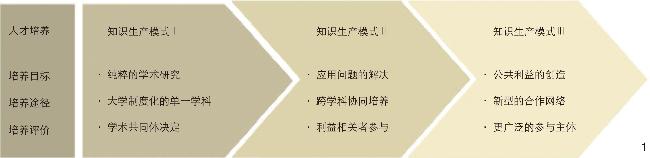
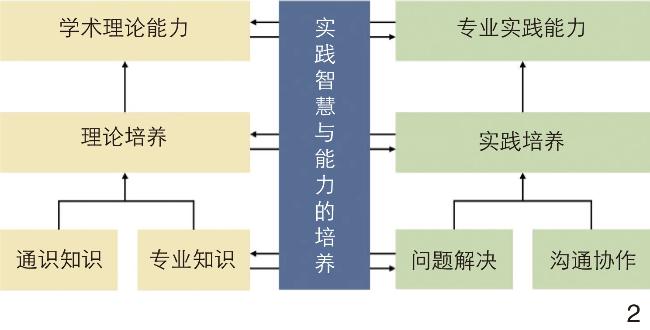
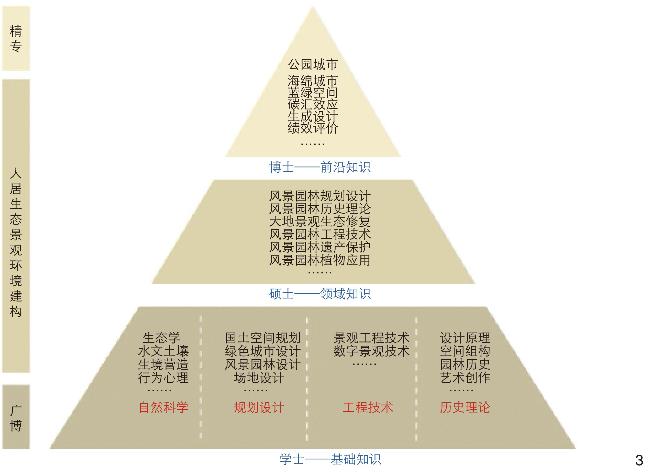
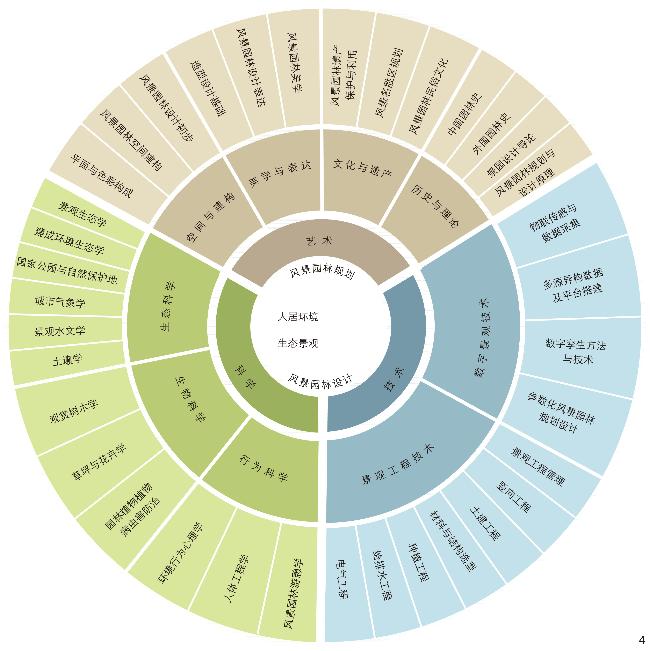
[Methods/process] Based on the professional degree education, this research analyzes the national policy, social demand and systematic cognition of landscape architecture degree, and constructs a professional landscape architecture body of knowledge from the four aspects of cultivation objective, knowledge type, knowledge level and knowledge structure. Firstly, from the perspective of cultivation objective. The core of the cultivation of professional talents in landscape architecture lies in the cultivation of practical intelligence, and the main type of professional knowledge will inevitably change from empirical knowledge to scientific knowledge and laws. Academic degree training focuses on scientific research ability, requiring the mastery of solid theoretical foundation and academic knowledge, while professional degree training of applied talents requires students not only to master solid theoretical knowledge, but also to have the ability of practical application and innovation and the ability to cope with complex practical problems. The knowledge production model proposed by M. Gibbons and others explains, to a certain extent, the transformation trend of global knowledge production model, namely from “I” to “II” or even to “III”, which reflects that with the development of society and technology, higher education becomes increasingly differentiated and mature. Secondly, from the perspective of knowledge type. The transformation of landscape architecture discipline means that the type of knowledge constituting the discipline’s knowledge system is no longer purely academic knowledge, making it necessary for modern landscape architecture to pay more attention to the production of practical knowledge, and to organically integrate the three types of knowledge of science, art and technology to cultivate professionals with the wisdom and ability of landscape architecture practice. Professional degree education is featured by relatively unique mode and distinctive knowledge composition. Thirdly, from the perspective of knowledge level. The professional degree of landscape architecture involves the three training levels of bachelor’s degree, master’s degree and doctoral degree that vary in cultivation objective, method and approach. Therefore, the landscape architecture body of knowledge that supports the cultivation of talents has a common composition axis extending from bachelor’s degree to master’s degree and doctoral degree, which is closely related to the cultivation of practical wisdom and ability. Fourthly, from the perspective of knowledge structure, it is supposed to explore the talent training and professional development of landscape architecture, focus on the professional ontology, clarify the knowledge structure, proactively adapt to the needs of high-quality development of human settlement environment and ecological landscape, properly dealing with the connection between landscape architecture and science & technology and culture & art, and optimize and reshape the knowledge structure of landscape architecture.
[Results/conclusion] Maintaining a relatively stable core knowledge structure and system is a sign of professional maturity, which together with the constantly enriched and perfected epitaxial knowledge constitutes the knowledge structure of landscape architecture, and it is beneficial for the landscape architecture specialty to properly deal with the stability and derivativeness of the knowledge structure of landscape architecture. Properly handling the “stability” and “derivativeness” of the knowledge structure of landscape architecture is conducive to the development and growth of the landscape architecture specialty. It is believed that landscape architecture, should explore a path of healthy development in accordance with the specific law of professional knowledge system: Firstly, cognize the professional attributes rationally, clarify the development direction, adhere to the professional ontology and development axis, and build up the kernel of the knowledge system; secondly, actively respond to the social development needs, strengthen the practical characteristics of the profession, and build up the core of the knowledge system; thirdly, actively respond to the needs of social development, strengthen the practice characteristics of the landscape architecture specialty, and enhance the vitality of the specialty while serving the society; fourthly, properly handle the mission and strategy of landscape architecture education, optimize the professional knowledge system and curriculum structure, and promote the formation of a self-improvement mechanism of landscape architecture; fifthly, the professional knowledge system is complete and systematic, with the part thereof responding to the social practice being resilient and diverse, so in order to promote the development of the landscape architecture specialty, it is necessary to properly deal with the relationship between specialization and integration.
CHENG Yuning , FANG Yuhao . Reflections on Professional Degree of Landscape Architecture and Landscape Architecture Body of Knowledge[J]. Landscape Architecture, 2024 , 31(3) : 12 -16 . DOI: 10.3724/j.fjyl.202312110553
文中图片均由作者绘制,其中
| [1] |
国务院学位委员会, 教育部. 国务院学位委员会 教育部关于印发《研究生教育学科专业目录(2022年)》《研究生教育学科专业目录管理办法》的通知[EB/OL]. (2022-09-13) [2024-01-07]. http://www.moe.gov.cn/srcsite/A22/moe_833/202209/t20220914_660828.html.
Academic Degrees Committee of the State Council, Ministry of Education. Announcement of the Academic Degrees Committee of the State Council and the Ministry of Education on the Issuance of the Catalogue of Disciplines and Majors in Graduate Education (2022) and the Measures for the Administration of the Catalogue of Disciplines and Majors in Graduate Education[EB/OL]. (2022-09-13) [2024-01-07]. http://www.moe.gov.cn/srcsite/A22/moe_833/202209/t20220914_660828.html.
|
| [2] |
国务院学位委员会, 教育部. 国务院学位委员会 教育部关于印发《专业学位研究生教育发展方案(2020—2025)》的通知[EB/OL].(2020-09-30) [2024-01-07]. http://www.moe.gov.cn/srcsite/A22/moe_826/202009/t20200930_492590.html.
Academic Degrees Committee of the State Council, Ministry of Education. Announcement of the Academic Degrees Committee of the State Council and the Ministry of Education on the Issuance of the Development Program for Professional Degree Graduate Education (2020−2025)[EB/OL].(2020-09-30) [2024-01-07]. http://www.moe.gov.cn/srcsite/A22/moe_826/202009/t20200930_492590.html.
|
| [3] |
黄瑶, 马永红, 王铭. 知识生产模式Ⅲ促进超学科快速发展的特征研究[J]. 清华大学教育研究, 2016, 37 (6): 37-45.
HUANG Y, MA Y H, WANG M. The Research on How Knowledge Production Mode III Promotes a Rapid Trans-disciplinary Development[J]. Tsinghua Journal of Education, 2016, 37 (6): 37-45.
|
| [4] |
GIBBONS M, LIMOGES C, NOWOTNY H, et al. The New Production of Knowledge the Dynamics of Science and Research in Contemporary Societies[M]. London: SAGE Publications, 1994.
|
| [5] |
CARAYANNIS E G, CAMPBELL D F J. Mode 3 Knowledge Production in Quadruple Helix Innovation Systems: 21st-Century Democracy, Innovation, and Entrepreneurship for Development[M]. New York: Springer, 2012.
|
| [6] |
刘宝存, 张金明. 知识生产模式转型视角下研究生培养模式变革研究[J]. 学位与研究生教育, 2023 (7): 73-81.
LIU B C, ZHANG J M. Research on Postgraduate Training Model Reforms Under the Transformation of Knowledge Production Model[J]. Academic Degrees & Graduate Education, 2023 (7): 73-81.
|
| [7] |
中华人民共和国国家质量监督检验检疫总局, 中国国家标准化管理委员会. 学科分类与代码: GB/T 13745-2009[S/OL].(2009-05-06)[2023-12-11]. https://openstd.samr.gov.cn/bzgk/gb/newGbInfo?hcno=4C13F521FD6ECB6E5EC026FCD779986E.
General Administration of Quality Supervision, Inspection and Quarantine of the People’s Republic of China, Standardization Administration of the People’s Republic of China. Academic Classification and Code: GB/T 13745-2009[S/OL].(2009-05-06)[2023-12-11]. https://openstd.samr.gov.cn/bzgk/gb/newGbInfo?hcno=4C13F521FD6ECB6E5EC026FCD779986E.
|
| [8] |
成玉宁. 现代景观设计理论与方法[M]. 南京: 东南大学出版社, 2010: 57-59.
CHENG Y N. Modern Landscape Design Theory and Methods[M]. Nanjing: Southeast University Press, 2010: 57-59.
|
| [9] |
拉卡托斯. 科学研究纲领方法论[M]. 上海: 上海译文出版社, 2005: 67
LAKATOS I. Methodology of Scientific Research Program[M]. Shanghai: Shanghai Translation Publishing House, 2005: 67
|
/
| 〈 |
|
〉 |