

Searching for the Lost Heritage: A Research Approach for Restoration of Perished Gardens Based on Multiple Evidence
|
LIU Shanshan, Ph.D., is an associate professor in the School of Architecture and Urban Planning, Beijing University of Civil Engineering and Architecture. Her research focuses on historical landscape, traditional gardens from women’s perspective, and modern gardens |
|
HUANG Xiao, Ph.D., is an associate professor in the School of Landscape Architecture, Beijing Forestry University, and a young editorial board member of this journal. His research focuses on history and theory of landscape architecture, and landscape paintings in ancient China |
Received date: 2023-07-29
Online published: 2025-12-15
Copyright
[Objective] The legacy of gardens holds a distinct place within Chinese culture, representing a vital facet of Chinese artistic heritage. In contrast to other forms of art such as painting and sculpture, the exploration of Chinese gardens faces a significant challenge due to the limited survival of early gardens predating Qing Dynasty. Consequently, the restoration of these gardens constitutes the foundational and central domain of Chinese garden historiography. This research introduces the concept of “perished garden” comprising two distinct types: Type Ⅰ perished gardens, where all tangible elements have perished, leaving behind only remnants, related drawings and texts, and other artifacts. Examples include the Shining Mountain Residence in Eastern Jin Dynasty (东晋始宁山居), the Wangchuan Villa in Tang Dynasty (唐代辋川别业), the Dule Garden in Song Dynasty (宋代独乐园), and the Zhi Garden in Ming Dynasty (明代止园). Type Ⅱ perished gardens encompass those in which some or all of the physical elements still exist but have undergone extensive reconstruction, resulting in partial obliteration of the original landscape during specific periods. Notably, some elements may persist, albeit with alterations in style, exemplified by the Humble Administrator’s Garden in Suzhou (苏州拙政园), the Jichang Garden in Wuxi (无锡寄畅园), and the Xiequ Garden in Beijing (北京谐趣园).
[Methods] This research outlines a comprehensive framework for restoration research focusing on perished gardens, and adopts a multifaceted approach rooted in various forms of evidence. Evidentiary sources can be categorized into physical evidence, documentary evidence, and verbal evidence, based on their forms. Additionally, evidence can be classified as direct or indirect, depending on its relevance to specific gardens. This taxonomy encompasses seven distinct categories of evidence: on-site physical evidence, site archaeology, poetic documents, pictorial representations, oral records, related physical artifacts, and gardening theories. While the first five directly pertain to the gardens under research and can independently contribute to their restoration, the latter two constitute indirect evidence, requiring integration with other sources to establish their evidentiary value. This sevenfold evidentiary approach possesses unique characteristics and methodologies, necessitating careful selection and application to construct a coherent chain of evidence supporting the restoration of perished gardens.
[Results] In the utilization of evidence, three crucial considerations emerge: Firstly, evaluate the availability and probative force of different forms of evidence to establish their respective importance in the restoration research; secondly, recognize potential corroborations or contradictions among evidence sources, identify key linkages between them, and leverage such linkages to reconstruct the historical appearance of gardens based on the formation of an evidence chain or network; thirdly, acknowledge the dynamic nature of evidence. When confronted with uncertainties or contradictions in the restoration process, researchers must broaden the scope and depth of available evidence to resolve these challenges. This shift represents a transition from reliance on a single weight of evidence to development of a multifaceted evidence base. New evidence may potentially revise or enhance existing research findings, offering the prospect of more robust support for prior results.
[Conclusion] The adoption of an approach based on multiple evidence to the restoration of perished gardens holds promise as a valuable reference for the research on historical gardens, which may contribute to a more comprehensive understanding of the evolution of classical Chinese gardens throughout history.
LIU Shanshan , HUANG Xiao . Searching for the Lost Heritage: A Research Approach for Restoration of Perished Gardens Based on Multiple Evidence[J]. Landscape Architecture, 2024 , 31(3) : 74 -80 . DOI: 10.3724/j.fjyl.202307290342
表1 湮废园林复原研究的7种证据Tab. 1 Seven types of evidence for research on restoration of perished gardens |
| 类型 | 描述 | 性质 | 关联 |
|---|---|---|---|
| 现场实存 | Ⅰ型湮废园林:园址、遗留地形、周边地形 | 实物证据 | 直接证据 |
| Ⅱ型湮废园林:植物、山石、建筑、水体 | |||
| 遗址考古 | Ⅰ型湮废园林:考古遗址 | ||
| Ⅱ型湮废园林:结合园林的复建、修缮甚至日常维护等局部考察遗址 | |||
| 诗文文献 | 园主(组织)撰写的园记和园诗 | 文献证据 | |
| 园主同时代人的游园诗文 | |||
| 方志收录的园林介绍和相关诗文 | |||
| 其他相关文献 | |||
| 绘画图像 | 可用于园林精确复原的界画 | ||
| 可用于园林意象复原的晚明及此前绘画 | |||
| 可用于介于精确与意象之间的园林复原的少数晚明绘画 | |||
| 口述证言 | 参与园林建造、发掘、维修、复原的工作人员口述证言 | 言辞证据 | |
| 园主后人口述证言 | |||
| 相关专家口述证言 | |||
| 相关实存 | 本体写仿或参照的对象 | 实物证据 | 间接证据 |
| 同流派造园家的其他作品 | |||
| 同时代的其他遗构 | |||
| 造园理论 | 园主、造园家的理论著作 | 文献证据 | |
| 与园主、造园家交游人士的理论著作 | |||
| 园主同时代的理论著作、后代相关研究 |
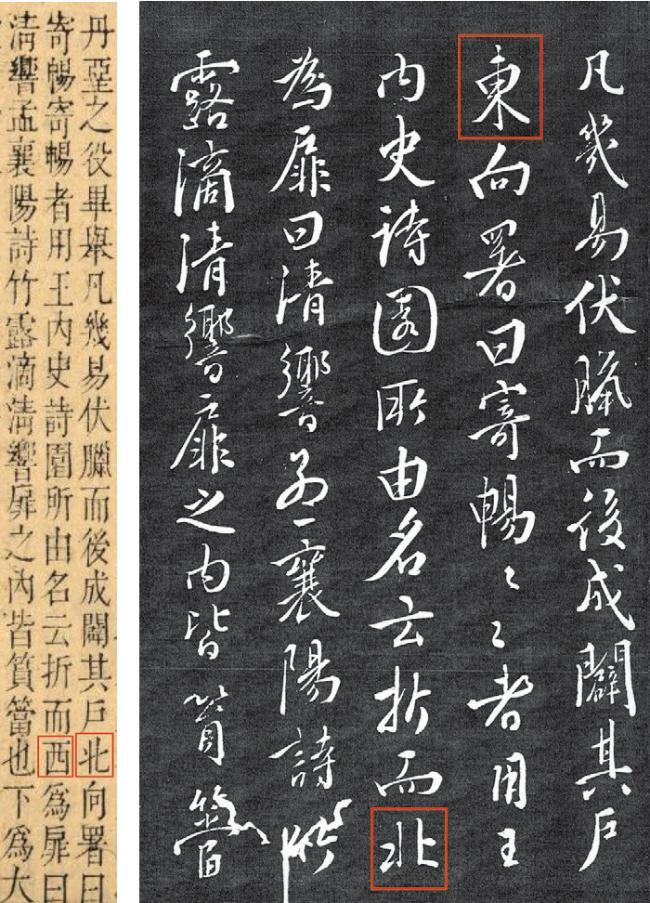
图4 乾隆时期《无锡县志》(4-1)与嘉庆时期《寄畅园法帖》(4-2)所收王穉登《寄畅园记》部分方位词比较[17]Fig. 4 A comparison of directional terms between Wang Zhideng’s Jichang Garden Record included in the Calligraphy of Jichang Garden during the Jiaqing period (4-2), and that included in the Wuxi County Annals during the Qianlong period (4-1)[17] |
| [1] |
周维权. 前言[M]//周维权.中国古典园林史. 北京: 清华大学出版社, 2008.
ZHOU W Q. Introduction[M]//ZHOU W Q. History of Chinese Classical Gardens. Beijing: Tsinghua University Press, 2008.
|
| [2] |
龙宗智. 法学与史学印证方法比较研究[J]. 四川大学学报(哲学社会科学版), 2020 (1): 111-118.
LONG Z Z. A Comparison Between Corroboration in History and Law[J]. Journal of Sichuan University (Philosophy and Social Sciences Edition), 2020 (1): 111-118.
|
| [3] |
王国维. 古史新证[M]. 北京: 北平来熏阁, 1935.
WANG G W. New Evidence of Ancient History[M]. Beijing: Laixunge, Beiping, 1935.
|
| [4] |
陈寅恪. 元白诗笺证稿[M]. 北京: 文学古籍刊行社, 1955.
CHEN Y K. Yuan Bai Shi Jian Zheng Manuscript[M]. Beijing: Literary Ancient Books Publishing House, 1955.
|
| [5] |
周斌斌. 三重证据法: 沈从文物质文化史研究方法论[J]. 安庆师范大学学报(社会科学版), 2023, 42 (1): 43-47.
ZHOU B B. Triple Evidence Method: Shen Congwen’s Methodology for Studying the History of Material Culture[J]. Journal of Anqing Normal University (Social Sciences Edition), 2023, 42 (1): 43-47.
|
| [6] |
叶舒宪. 文学人类学的中国化过程与四重证据法: 学术史的回顾及展望[J]. 社会科学战线, 2010, (6): 109-125.
YE S X. The Sinicization Process of Literary Anthropology and the Four Fold Evidence Method: A Review and Prospect of Academic History[J]. Social Science Front, 2010, (6): 109-125.
|
| [7] |
王欣, 胡坚强. 谢灵运山居考[J]. 中国园林, 2005, 21 (8): 73-77.
WANG X, HU J Q. A Study on the Restoration of Xie Lingyun’s Manor[J]. Chinese Landscape Architecture, 2005, 21 (8): 73-77.
|
| [8] |
陈铁民. 辋川别业遗址与王维辋川诗[J]. 中国典籍与文化, 1997 (4): 10-14.
CHEN T M. Wangchuan Bieye Site and Wang Wei’s Wangchuan Poetry[J]. Chinese Classics & Culture, 1997 (4): 10-14.
|
| [9] |
黄晓, 刘珊珊. 寄畅园的始建年代、沿革分期与重要议题[J]. 风景园林, 2018, 25 (11): 17-22.
HUANG X, LIU S S. Jichang Garden: lts Creation, Evolution Stages and Key Issues[J]. Landscape Architecture, 2018, 25 (11): 17-22.
|
| [10] |
夏楠, 林源. 广州秦汉南越国御苑遗址复原想象设计探析[J]. 中国园林, 2015, 31 (11): 94-98.
XIA N, LIN Y. Recovery Imagination Design of Nanyueguo Palace Ruins in Guangzhou[J]. Chinese Landscape Architecture, 2015, 31 (11): 94-98.
|
| [11] |
鲍沁星, 张敏霞. 南宋杭州恭圣仁烈杨皇后宅院园林遗址考[J]. 中国园林, 2011, 27 (11): 72-75.
BAO Q X, ZHANG M X. Study on the Remains of the Mansion of Empress Gongshengrenlie[J]. Chinese Landscape Architecture, 2011, 27 (11): 72-75.
|
| [12] |
张龙, 王奥怡, 赵迪. 颐和园绮望轩建筑群遗址复原研究[J]. 故宫博物院院刊, 2020 10: 83-95.
ZHANG L, WANG A Y, ZHAO D. Tracing the Former Splendor of the Summer Palace Qiwangxuan Complex[J]. Palace Museum Journal, 2020 10: 83-95.
|
| [13] |
李正. 古典名园今与昔: 无锡寄畅园的保护和修复(下)[J]. 国土绿化, 2010 (3): 20-23.
LI Z. The Present and Past of Classical Gardens: Protection and Restoration of Wuxi Jichang Garden (Part 2)[J]. Land Greening, 2010 (3): 20-23.
|
| [14] |
梁洁, 郑炘. 晚明寄畅园水池“锦汇漪”及其周边复原研究[J]. 中国园林, 2018, 34 (12): 135-139.
LIANG J, ZHENG X. An Estimation of Jichang Garden’s Pond and lts Surroundings in the Late Ming Period[J]. Chinese Landscape Architecture, 2018, 34 (12): 135-139.
|
| [15] |
曹汛. 赴台开授建筑考古学新课纪事[J]. 建筑师, 2003 (2): 110
CAO X. Chronicles of Teaching a New Course in Architectural Archaeology in Taiwan[J]. The Architect, 2003 (2): 110.
|
| [16] |
曹汛. 走进年代学[J]. 建筑师, 2004 (3): 94-102.
CAO X. Entering Chronology[J]. The Architect, 2004 (3): 94-102.
|
| [17] |
黄晓, 刘珊珊. 明代后期秦燿寄畅园历史沿革考[J]. 建筑史, 2012 (1): 112-135.
HUANG X, LIU S S. The Study of Chi Chang Yuan by Qin Yao: From Wanli to Chongzhen[J]. History of Architecture, 2012 (1): 112-135.
|
| [18] |
黄晓, 刘珊珊. 图像与园林: 学科交叉视角下的园林绘画研究[J]. 装饰, 2021 (2): 37-44.
HUANG X, LIU S S. Image and Garden: An Interdisciplinary Research on Garden Paintings[J]. ZHUANGSHI, 2021 (2): 37-44.
|
| [19] |
陆金霞. 基于界画《东园胜概图》的扬州乔氏东园复原设计研究[D]. 北京: 北方工业大学, 2014.
LU J X. The Recovering Design of the Eastern Garden in Yangzhou Based on the Drawing Dongyuanshenggaitu[D]. Beijing: North University of Technology, 2014.
|
| [20] |
鲁安东. 解析避居山水: 文徵明1533年《拙政园图册》空间研究[M]//丁沃沃, 胡恒.建筑文化研究(第2辑). 北京: 中央编译出版社, 2011: 269-324.
LU A D. Analysis of Avoiding Mountains and Waters: A Space Study of Wen Zhengming’s 1533 Humble Administrator’s Garden Atlas[M]//DING W W, HU H. Architectural Culture Research (Volume 2). Beijing: Central Compilation & Translation Press, 2011: 269-324.
|
| [21] |
贾珺. 明代北京勺园续考[J]. 中国园林, 2009, 25 (5): 76-79.
JIA J. A New Exploration of the Garden of Shaoyuan in Beijing in Ming Dynasty[J]. Chinese Landscape Architecture, 2009, 25 (5): 76-79.
|
| [22] |
王笑竹. 明代江南名园王世贞弇山园研究[D]. 北京: 清华大学, 2014.
WANG X Z. Wang Shizhen’s Yanshan Garden in Ming Dynasty[D]. Beijing: Tsinghua University, 2014.
|
| [23] |
黄晓, 刘珊珊. 止园梦寻: 再造纸上桃花源[M]. 上海: 同济大学出版社, 2022.
HUANG X, LIU S S. Rediscovering Zhi Garden: A Ming Dynasty Peach Blossom Spring[M]. Shanghai: Tongji University Press, 2022.
|
| [24] |
岳庆平. 关于口述史的五个问题[J]. 中国高校社会科学, 2013 (5): 81-93.
YUE Q P. Five Aspects of the Oral History[J]. Social Sciences in Chinese Higher Education, 2013 (5): 81-93.
|
| [25] |
段建强. 陈从周先生与豫园修复研究: 口述史方法的实践[J]. 南方建筑, 2011 (4): 28-32.
DUAN J Q. Chen Congzhou and the Preservation of Yuyuan Garden: The Practice of Oral History Research[J]. South Architecture, 2011 (4): 28-32.
|
| [26] |
曹汛. 计成研究: 为纪念计成诞生四百周年而作[J]. 建筑师, 1982 13: 10-12.
CAO X. Research on Ji Cheng: To Commemorate the 400th Anniversary of Ji Cheng’s Birth[J]. The Architect, 1982 13: 10-12.
|
| [27] |
魏向东. 明代《长物志》背后, 原来文震亨还有这样一位舅舅[EB/OL].(2020-11-20)[2022-06-10].https://www.thepaper.cn/newsDetail_forward_10004839.
WEI X D. Behind the Ming Dynasty’s Chronicles of Changwu, It Turns out that Wen Zhenheng also Had Such an Uncle[EB/OL].(2020-11-20)[2022-06-10].https://www.thepaper.cn/newsDetail_forward_10004839.
|
| [28] |
黄晓, 戈祎迎, 周宏俊. 明代园林建筑布局的奇正平衡: 以《园冶》与止园为例[J]. 新建筑, 2020 (1): 19-24.
HUANG X, GE Y Y, ZHOU H J. The Balance of Regulation and Novelty in the Chinese Garden in the 17th Century: A Study of Zhi Garden and Yuan Ye by Ji Cheng[J]. New Architecture, 2020 (1): 19-24.
|
| [29] |
张波. 建筑·规划·园林研究方法论[M]. 北京: 中国建筑工业出版社, 2023: 28.
ZHANG B. Research Methods in Architecture, Urban Planning and Landscape Architecture[M]. Beijing: China Architecture & Building Press, 2023: 28.
|
| [30] |
蔡作斌. 证据链完整性的标准及其审查判断[J]. 律师世界, 2003 (3): 11-13.
CAI Z B. Standards for the Integrity of Evidence Chains and Their Review Judgments[J]. Lawyer World, 2003 (3): 11-13.
|
| [31] |
黄晓, 朱云笛, 戈祎迎, 等. 望行游居: 明代周廷策与止园飞云峰[J]. 风景园林, 2019, 26 (3): 8-13.
HUANG X, ZHU Y D, GE Y Y, et al. Gaze, Walk, Wander and Dwell: 17th Century Landscape Architect Zhou Tingce and Feiyun Peak Rockeries in Zhiyuan Garden[J]. Landscape Architecture, 2019, 26 (3): 8-13.
|
/
| 〈 |
|
〉 |