

Supply-Demand Matching Evaluation and Coupling Coordination of Cultural Ecosystem Services in Urban Park Green Spaces
|
YU Yang, Ph.D., is a professor in the School of Architecture, Southwest Jiaotong University. His research focuses on theory of urban spatial planning and development, and planning of urban green infrastructure |
|
YANG Xian is a Ph.D. candidate in the School of Architecture, Southwest Jiaotong University. Her research focuses on theory of urban spatial development, and planning of urban green infrastructure |
|
LI Xiang is a master student in the School of Architecture, Southwest Jiaotong University. Her research focuses on valuation of urban ecosystem services |
|
QIAN Liyuan, Ph.D., is an associate professor in the School of Architecture, Southwest Jiaotong University. Her research focuses on ecosystem evolution, and valuation of urban ecosystem services |
|
ZHOU Sixiang, Master, is a deputy director of Infrastructure Planning and Campus Management Office, Southwest Jiaotong University. His research focuses on landscape heritage and traditional garden culture |
Received date: 2024-08-26
Revised date: 2024-12-29
Online published: 2025-12-12
Copyright
This research explores the spatial distribution characteristics, supply-demand matching patterns, relationships, and optimization strategies of cultural ecosystem services (CES) in urban park green spaces. These efforts aim to enhance the efficiency of ecosystem services, promote spatial equity, and provide new perspectives and methodologies for studying CES in urban park green spaces.
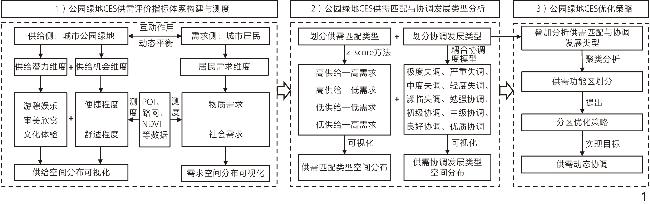
Using 222 park green spaces in the main urban area of Chengdu as research objects, the research divides the area into 500 m × 500 m grids for analysis. First, an evaluation indicator system and a supply-demand relationship model encompassing supply potential, supply opportunity, and resident demand dimensions are constructed to analyze the matching relationship and spatial distribution characteristics of CES. Second, the research applies a coupling coordination model to assess the coupling and coordination levels of CES supply and demand of urban park green spaces. Finally, based on the combined results of the supply-demand matching evaluation and the coupling coordination analysis, optimization strategies for CES in Chengdu’s park green spaces are proposed at the subarea level.
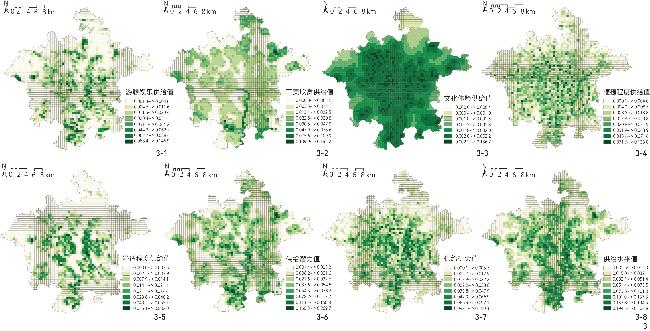
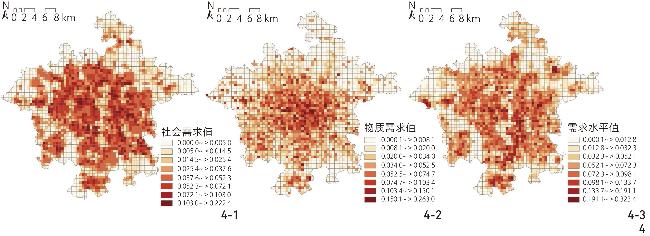
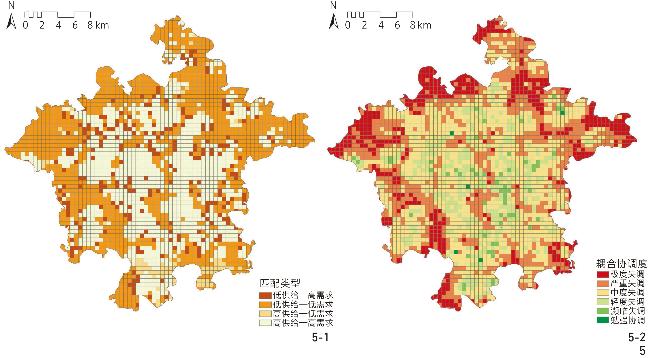
The comprehensive supply level of CES in Chengdu’s park green spaces exhibits a cluster distribution pattern that is “higher in the south, and lower in the north”, with high-value areas concentrated in the central and southwestern parts of the main urban area, and low-value areas mainly distributed in the northeastern part. Meanwhile, the comprehensive demand level for CES displays an aggregated cluster distribution pattern, where high-demand zones are located in the central and southern part of the main urban area with high population density, strong human activity, intensive urban development, and well-developed facilities, while low-demand zones are found in the less densely populated and developed northeastern part. The supply-demand matching patterns are predominantly high supply-high demand and low supply-low demand, reflecting a low-level equilibrium with significant supply gaps; zones characterized by high supply-high demand and high supply-low demand are mainly found in the central and southwestern parts of the main urban area, whereas whose with low supply and low demand are primarily located on the periphery of the main urban area. Additionally, the coupling coordination degree of supply and demand exhibits a decreasing trend from the city center to the periphery. Overall, the coupling coordination degree is suboptimal, with the zones featuring the highest coordination degree only reaching a barely coordinated level. Specifically, the barely coordinated zones are primarily concentrated in the central part of the main urban area. Overall, the spatial distribution of the supply-demand matching for CES of park green space in the main urban area of Chengdu exhibits a characteristic of being higher in the southwest and lower in the northeast. The distribution of mismatched zones is relatively scattered, and the coupling coordination is generally at a low level. The spatial differentiation of supply-demand coordination relationships is evident within the main urban area.
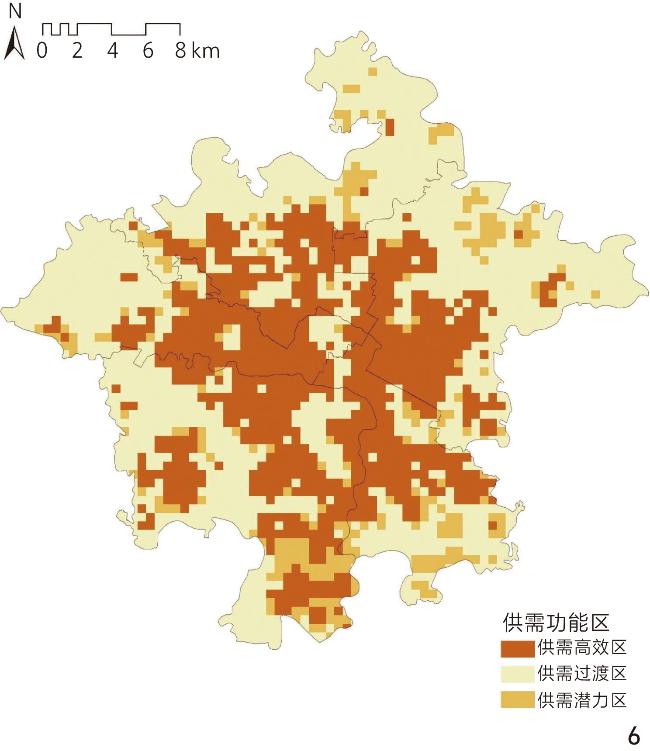
By overlaying the results of supply-demand matching types with coupling coordination levels, the research categorizes the service ranges of all park green spaces into three functional zones: efficient zones, transitional zones, potential zones, and proposes optimization strategies accordingly. Efficient zones, primarily located in the central and southern parts of Chengdu’s main urban area, are characterized by high supply and high demand with coupling coordination levels ranging from mild imbalance to barely coordinated. To enhance efficiency, it is recommended to construct a hierarchical and continuous green space network to improve connectivity and systematic integration, thus improving the supply efficiency to benefit surrounding under-supplied zones. Transitional zones, situated on the fringes of park green space service ranges, are dominated by low supply and high demand and low supply and low demand, with coupling coordination levels ranging from severe imbalance to moderate imbalance, for which the optimization strategies include increasing the supply of park green space through urban micro-renewal measures in densely populated areas and optimizing public service facilities in less developed peripheral areas to improve the efficiency of interaction with nearby parks. Potential zones, located mainly in the southern and northeastern parts of the main urban area, exhibit high supply-low demand characteristics with coupling coordination levels ranging from severe imbalance to moderate imbalance, for which the optimization strategies focus on expanding service coverage and enhancing supply spillover effects by developing these zones as ecological education hubs and improving accessibility through transportation infrastructure. These findings provide a basis for improving the efficiency of CES, advancing the planning and management of urban park green space, and ensuring environmental equity.
YU Yang , YANG Xian , LI Xiang , QIAN Liyuan , ZHOU Sixiang . Supply-Demand Matching Evaluation and Coupling Coordination of Cultural Ecosystem Services in Urban Park Green Spaces[J]. Landscape Architecture, 2025 , 32(3) : 90 -99 . DOI: 10.3724/j.fjyl.202408260483
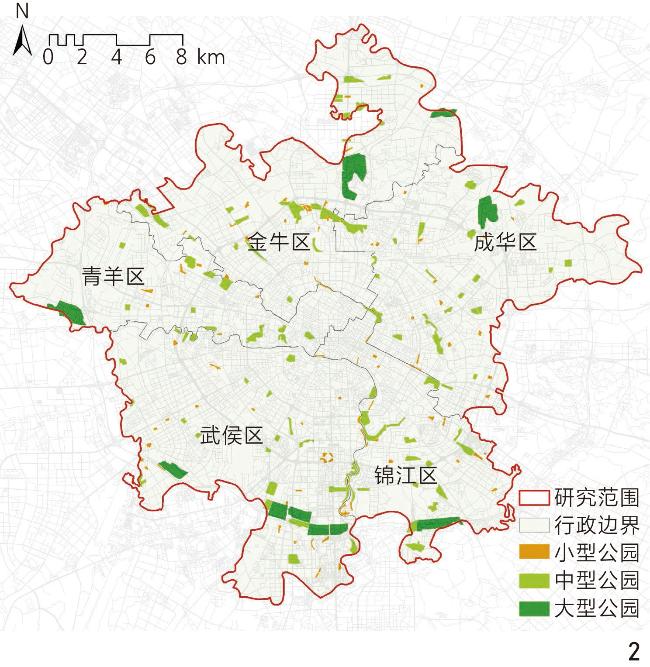
图2 成都市主城区城市公园绿地分布Fig. 2 Distribution of urban park green spaces in the main urban area of Chengdu |
表1 成都市主城区城市公园绿地分类统计Table 1 Classified statistics of urban park green spaces in the main urban area of Chengdu |
| 类型 | 公园面积/hm2 | 建设形式 | 数量/个 | 总面积/hm2 | 服务半径/m |
| 小型公园 | 1~5 | 社区公园、运动公园、科技公园等主题公园 | 100 | 270.56 | 500 |
| 中型公园 | >5~50 | 动物园、植物园、历史园等专类公园 | 111 | 1 558.17 | 1 000 |
| 大型公园 | >50 | 综合性公园 | 11 | 1 145.21 | 1 500 |
表2 城市公园绿地CES供给潜力评价指标体系Table 2 Evaluation indicator system for CES supply potential of urban park green spaces |
| 准则 | 指标 | 指标解释 | 计算方式 | 数据来源 | 指标性质 | 权重 |
| 注:POI数据均从高德开放平台(lbs.amap.com)获取。 | ||||||
| 游憩 | 公园绿地面积 | 反映公园绿地开敞空间大小 | 用ArcMap 10.8进行面积计算 | NDVI数据 | 正向 | 0.098 5 |
| 运动设施数量 | 反映运动设施服务水平 | 求和计算运动设施兴趣点(point of interest, POI)数量 | POI数据 | 正向 | 0.076 2 | |
| 娱乐设施数量 | 反映娱乐设施服务水平 | 求和计算娱乐设施POI数量 | POI数据 | 正向 | 0.078 5 | |
| 旅游景点设施数量 | 反映旅游景点设施服务水平 | 求和计算旅游景点设施POI数量 | POI数据 | 正向 | 0.100 2 | |
| 周边服务功能多样性 | 反映多种服务功能供给水平 | ${H}_{1}=-\displaystyle\sum\nolimits_{i}^{m}{P}_{i}{\text{ln} }{P}_{i}$, | POI数据 | 正向 | 0.029 0 | |
| 审美 | NDVI | 反映植被覆盖程度 | 以500 m×500 m网格为单位提取遥感影像中近红外波段与红光波段,计算二者差与和之比 | NDVI数据 | 正向 | 0.017 4 |
| 800 m内可获得水域面积 | 反映步行适宜距离内的水域面积 | 用ArcMap进行面积计算 | NDVI数据、 OpenStreetMap(OSM)路网数据 | 正向 | 0.151 8 | |
| 地表覆盖丰富度 | 反映地表覆盖多样性水平 | $H=-\displaystyle\sum\nolimits_{i}^{m}{P}_{i}{\text{ln}}{P}_{i}$, | GlobeLand 30全球地表 | 正向 | 0.026 1 | |
| 文化 | 文化设施数量 | 反映文化设施(如博物馆)服务水平 | 求和计算文化设施POI数量 | POI数据 | 正向 | 0.133 4 |
| 文化设施传播阻力 | 反映文化设施(如博物馆)传播度 | $\mathrm{C}={f}_{\min}\displaystyle\sum\nolimits_{j=n}^{i=m}({D}_{ij}\times {R}_{i})$, | POI数据、OSM路网 | 负向 | 0.002 2 | |
表3 文化设施传播阻力系数Table 3 Resistance coefficient for cultural facility dissemination |
| 阻力因子 | 类型分级 | 阻力系数 |
| 土地覆盖类型 | 水域 | 1 |
| 草地 | 3 | |
| 林地 | 5 | |
| 耕地 | 7 | |
| 建设用地 | 9 | |
| 道路类型 | 一级城市道路、公路 | 1 |
| 二级城市道路 | 3 | |
| 三级城市道路 | 5 | |
| 四级城市道路 | 7 | |
| 无道路 | 9 |
表4 城市公园绿地CES供给机会评价指标体系Table 4 Evaluation indicator system for CES supply opportunities of urban park green spaces |
| 准则 | 指标 | 指标解释 | 计算方式 | 数据来源 | 指标性质 | 权重 |
| 注:POI数据均从高德开放平台(lbs.amap.com)获取。 | ||||||
| 便捷 | 公交车站数量 | 反映交通联系强度 | 求和计算公交站POI数量 | POI数据 | 正向 | 0.033 3 |
| 地铁站数量 | 反映交通联系强度 | 求和计算地铁站POI数量 | POI数据 | 正向 | 0.111 3 | |
| 慢行交通密度 | 反映慢行交通适宜程度 | 用城市支路、人行道及自行车道的道路长度占网格面积比计算 | OSM路网数据 | 正向 | 0.023 2 | |
| 可达性 | 反映从网格中心点到达最邻近公园绿地的空间距离 | 用ArcGIS的near工具计算 | OSM路网数据 | 负向 | 0.001 5 | |
| 舒适 | 基础设施数量 | 反映基础设施服务水平 | 求和计算停车场、服务区、加油站等基础设施POI数量 | POI数据 | 正向 | 0.054 1 |
| 生活服务设施数量 | 反映生活服务设施服务水平 | 求和计算餐厅、售货点、卫生间等生活服务设施POI数量 | POI数据 | 正向 | 0.063 3 | |
表5 城市公园绿地CES需求评价指标体系Table 5 Evaluation indicator system for CES demand of urban park green spaces |
| 准则 | 指标 | 指标解释 | 计算方式 | 数据来源 | 指标性质 | 权重 |
| 注:POI数据均由高德开放平台(lbs.amap.com)获取。 | ||||||
| 社会需求 | 总人口数量 | 反映网格单元内总人口数量 | 求和计算人口数量 | 第七次成都市人口普查数据、POI数据 | 正向 | 0.064 0 |
| 老年人口数量 | 反映网格单元内60岁以上人口数量 | 求和计算老年人口数量 | 第七次成都市人口普查数据、POI数据 | 正向 | 0.066 9 | |
| 儿童人口数量 | 反映网格单元内0~14岁人口数量 | 求和计算儿童人口数量 | 第七次成都市人口普查数据、POI数据 | 正向 | 0.064 9 | |
| 人群活动强度 | 反映人类活动开发程度以及人群活动需求大小 | $ {\rm{HAILS}}=\dfrac{\displaystyle\sum\nolimits_{i=1}^{n}{({\rm{SL}}}_{i}\times {{\rm{CL}}}_{i})}{S}\times 1 00{\text{%}}$, | 地表覆盖数据 | 正向 | 0.039 3 | |
| 物质需求 | 容积率 | 反映网格单元内开发强度 | 求和计算网格单元内的容积率 | 中国建筑轮廓数据 | 正向 | 0.044 9 |
| 建筑密度 | 反映网格单元内建设强度 | 求和计算网格单元内的建筑密度 | 中国建筑轮廓数据 | 正向 | 0.039 3 | |
| 商业服务设施数量 | 反映居民经济活动强度 | 求和计算商业服务设施类POI数量 | POI数据 | 正向 | 0.079 1 | |
| 中小学教育设施数量 | 反映教育需求高的群体对公园绿地CES的需求 | 求和计算中学、小学教育设施POI数量 | POI数据 | 正向 | 0.140 9 | |
| 文化设施数量 | 反映居民进行文化活动时对公园绿地CES的需求 | 求和计算文化设施(包括博物馆、档案馆、展览馆等)POI数量 | POI数据 | 正向 | 0.168 6 | |
| 体育设施数量 | 反映居民进行体育活动时对公园绿地CES的需求 | 求和计算体育设施(包括综合体育馆、户外健身中心、游泳馆等)POI数量 | POI数据 | 正向 | 0.091 1 | |
| 娱乐设施数量 | 反映居民进行娱乐活动时对公园绿地CES的需求 | 求和计算娱乐设施(包括游乐场、度假区、农家乐等)POI数量 | POI数据 | 正向 | 0.093 9 | |
| 医疗设施数量 | 反映居民前往医院或进行治疗时对公园绿地CES的需求 | 求和计算医疗设施(包括综合医院、专科医院)POI数量 | POI数据 | 正向 | 0.107 1 | |
表6 供给—需求耦合协调度等级Table 6 Supply-demand coupling coherence levels |
| 协调程度类型 | 耦合协调度等级 | 耦合协调度($ D $) |
| 失调衰败类 | 极度失调 | $ \left[0.0,\right.0.1) $ |
| 严重失调 | $ \left[0.1,\right.0.2) $ | |
| 中度失调 | $ \left[0.2,\right.0.3) $ | |
| 轻度失调 | $ \left[0.3,\right.0.4) $ | |
| 过渡类 | 濒临失调 | $ \left[0.4,\right.0.5) $ |
| 勉强协调 | $ \left[0.5,\right.0.6) $ | |
| 协调发展类 | 初级协调 | $ \left[0.6,\right.0.7) $ |
| 中级协调 | $ \left[0.7,\right.0.8) $ | |
| 良好协调 | $ \left[0.8,\right.0.9) $ | |
| 优质协调 | $ \left[0.9,1.0\right] $ |
图6 成都市主城区公园绿地CES供需功能区分布Fig. 6 Distribution of functional zoning of CES supply and demand in urban park green spaces in the main urban area of Chengdu |
表7 成都市主城区公园绿地CES供需功能区概况Table 7 Overview of CES supply and demand functional zoning of park green spaces in the main urban area of Chengdu |
| 供需功能区 | 覆盖的公园 | 公园数 | 公园数量 |
| 供需高效区 | 小型公园 | 75 | 149 |
| 中型公园 | 73 | ||
| 大型公园 | 1 | ||
| 供需过渡区 | 小型公园 | 13 | 25 |
| 中型公园 | 12 | ||
| 大型公园 | 0 | ||
| 供需潜力区 | 小型公园 | 12 | 48 |
| 中型公园 | 26 | ||
| 大型公园 | 10 |
文中图表均由作者绘制。
| [1] |
吴隽宇, 朱榴奕. 生态系统环境–文化服务耦合视角下的珠江河口区生态功能分区[J]. 风景园林, 2023, 30(1): 85-93.
WU J Y, ZHU L Y. Ecological Function Regionalization in Pearl River Estuary Area from the Perspective of the Coupling of Environmental and Cultural Ecosystem Services[J]. Landscape Architecture, 2023, 30(1): 85-93.
|
| [2] |
MILLENNIUM ECOSYSTEM ASSESSMENT. Eco-systems and Human Well-Being: Volume 2 Scenarios[M]. Washington D.C.: Island Press, 2005.
|
| [3] |
郑曦. 城市公园作为绿色综合体的发展特征与构建策略研究[J]. 城市发展研究, 2013, 20(6): 25-29.
ZHENG X. Research on Urban Park Development Characteristics and Construction Strategies as Green Complex[J]. Urban Development Studies, 2013, 20(6): 25-29.
|
| [4] |
李梓杉, 干晓宇, 潘芳宏, 等. 公园绿地文化生态系统服务供需空间匹配研究: 以成都市主城区为例[J]. 中国园林, 2024, 40(8): 104-110.
LI Z S, GAN X Y, PAN F H, et al. Spatial Matching of Supply and Demand for Multiple Cultural Ecosystem Services in Park Green Spaces: A Case Study of the Main Urban Area of Chengdu[J]. Chinese Landscape Architecture, 2024, 40(8): 104-110.
|
| [5] |
彭婉婷, 刘文倩, 蔡文博, 等. 基于参与式制图的城市保护地生态系统文化服务价值评价: 以上海共青森林公园为例[J]. 应用生态学报, 2019, 30(2): 439-448.
PENG W T, LIU W Q, CAI W B, et al. Evaluation of Ecosystem Cultural Services of Urban Protected Areas Based on Public Participation GIS (PPGIS): A Case Study of Gongqing Forest Park in Shanghai, China[J]. Chinese Journal of Applied Ecology, 2019, 30(2): 439-448.
|
| [6] |
王新文, 高建洁. 西安主城区遗址公园文化服务绩效研究[J]. 中国园林, 2023, 39(3): 106-111.
WANG X W, GAO J J. Research on Cultural Service Performance of Heritage Park in Xi’an City[J]. Chinese Landscape Architecture, 2023, 39(3): 106-111.
|
| [7] |
骆畅, 王方民, 李高高, 等. 山地多中心城市公园绿地生态系统文化服务供需匹配特征[J]. 生态学报, 2024, 44(13): 5816-5827.
LUO C, WANG F M, LI G G, et al. Identifying Supply-Demand Spatial Matches of Cultural Ecosystem Services Provided by Urban Parks in Polycentric Mountainous Cities[J]. Acta Ecologica Sinica, 2024, 44(13): 5816-5827.
|
| [8] |
庄思冰, 龚建周, 陈康林, 等.粤港澳大湾区小型公园绿地生态系统文化服务的供需匹配特征[J].生态学报, 2023, 43(14): 5714-5725.
ZHUANG S B, GONG J Z, CHEN K L, et al. Supply and Demand Matching Characteristics of Cultural Ecosystem Services of Small Parks and Greenbelts in the Guangdong-HongKong-Macao Greater Bay Area[J], Acta Ecologica Sinica, 2023, 43(14): 5714-5725.
|
| [9] |
ZHU X, CHENG X, ZHANG B, et al. A User-Feedback Indicator Framework to Understand Cultural Ecosystem Services of Urban Green Space[J]. Ecological Indicators, 2023, 154: 110642.
|
| [10] |
KRELLENBERG K, ARTMANN M, STANLEY C, et al. What to Do in, and What to Expect from, Urban Green Spaces-Indicator-Based Approach to Assess Cultural Ecosystem Services[J]. Urban Forestry & Urban Greening, 2021, 59: 126986.
|
| [11] |
陈语娴, 戴代新. 城市公园绿地生态系统文化服务评估研究进展[J]. 中国城市林业, 2020, 18(6): 9-15.
CHEN Y X, DAI D X. Research Progress in Cultural Ecosystem Service Assessment of Urban Parks and Green Spaces[J]. Journal of Chinese Urban Forestry, 2020, 18(6): 9-15.
|
| [12] |
MAYER M, WOLTERING M. Assessing and Valuing the Recreational Ecosystem Services of Germany’s National Parks Using Travel Cost Models[J]. Ecosystem Services, 2018, 31: 371-386.
|
| [13] |
李想, 雷硕, 冯骥, 等. 北京市绿地生态系统文化服务功能价值评估[J]. 干旱区资源与环境, 2019, 33(6): 33-39.
LI X, LEI S, FENG J, et al. Assessing the Value of Cultural Ecosystem Services in Urban Green Space of Beijing[J]. Journal of Arid Land Resources and Environment, 2019, 33(6): 33-39.
|
| [14] |
戴代新, 陈语娴. 基于情感计算的城市历史公园更新改造文化服务感知评价: 以鲁迅公园更新改造为例[J]. 同济大学学报(社会科学版), 2022, 33(3): 81-90.
DAI D X, CHEN Y X. An Evaluation of the Perception of Cultural Services of Urban Historical Park Renovation Based on Sentiment Computing Method: A Case Study of Luxun Park[J]. Journal of Tongji University(Social Science Edition), 2022, 33(3): 81-90.
|
| [15] |
DONAHUE M L, KEELER B L, WOOD S A, et al. Using Social Media to Understand Drivers of Urban Park Visitation in the Twin Cities, MN[J]. Landscape and Urban Planning, 2018, 175: 1-10.
|
| [16] |
王敏, 王茜. 基于Q方法的城市公园生态服务使用者感知研究: 以上海黄兴公园为例[J]. 中国园林, 2016, 32(12): 97-102.
WANG M, WANG Q. Research on User Perception of Eco-service in Urban Parks by Using Q Method: A Case Study of Huangxing Park in Shanghai[J]. Chinese Landscape Architecture, 2016, 32(12): 97-102.
|
| [17] |
范颖, 吴歆怡, 周波, 等. 公园城市: 价值系统引领下的城市空间建构路径[J]. 规划师, 2020, 36(7): 40-45.
FAN Y, WU X Y, ZHOU B, et al. Park City: Values Oriented Urban Space Construction[J]. Planners, 2020, 36(7): 40-45.
|
| [18] |
彭楠淋, 王柯力, 张云路, 等.新时代公园城市理念特征与实现路径探索[J].城市发展研究, 2022, 29(5): 21-25.
PENG N L, WANG K L, ZHANG Y L, et al. A New Proposition of Urban Development in the Context of Ecological Civilization: Exploring the Path of Park City Construction in New Age[J]. Urban Development Studies. 2022, 29(5): 21-25.
|
| [19] |
鲁仕维, 黄亚平, 赵中飞. 成都市主城区空间形态与街区活力的关联性分析[J]. 地域研究与开发, 2021, 40(1): 73-77.
LU S W, HUANG Y P, ZHAO Z F. Relationships Between Urban Form and Neighborhood Vibrancy in Main Urban Area of Chengdu City[J]. Areal Research and Development, 2021, 40(1): 73-77.
|
| [20] |
成都市人民政府.成都市城市总体规划[EB/OL].(2018-03-06)[2024-01-25].https://wenku.baidu.com/view/6252d1b8185f312b3169a45177232f60ddcce7ed?aggId=undefined&fr=catalogMain_text_ernie_recall_v1%3Awk_recommend_main3&_wkts_=1735289575058.
The People’s Government of Chengdu. Chengdu Urban Master Plan[EB/OL]. (2018-03-06)[2024-01-25]. https://wenku.baidu.com/view/6252d1b8185f312b3169a45177232f60ddcce7ed?aggId=undefined&fr=catalogMain_text_ernie_recall_v1%3Awk_recommend_main3&_wkts_=1735289575058.
|
| [21] |
成都市公园城市建设管理局.《成都市公园城市绿地系统规划(2019—2035年)》送审稿公示[EB/OL].(2020-09-01)[2024-01-25].https://cdbpw.chengdu.gov.cn/cdslyj/c110447/2020-05/19/746b93c82f7b4fa39918bf9ad50d3e52/files/f6ecc4de27904dd1993ef9f22e2ca07d.pdf.
The Chengdu Park City Construction and Management Bureau. Public Announcement of the Draft for Review of the Chengdu Park City Green Space System Plan (2019− 2035)[EB/OL]. (2020-09-01)[2024-01-25]. https://cdbpw.chengdu.gov.cn/cdslyj/c110447/2020-05/19/746b93c82f7b4fa39918bf9ad50d3e52/files/f6ecc4de27904dd1993ef9f22e2ca07d.pdf.
|
| [22] |
成都市公园城市建设管理局.《成都市美丽宜居公园城市建设条例》[EB/OL].(2021-08-06)[2024-01-25].https://dbxq.chengdu.gov.cn/dbxq/c153403/2021-08/06/content_88562f1e05624ef6ab4ac59160e85374.shtml.
The Chengdu Park City Construction and Management Bureau. Regulations on the Construction of Beautiful and Livable Park City in Chengdu[EB/OL]. (2021-08-06) [2024-01-25]. https://dbxq.chengdu.gov.cn/dbxq/c153403/2021-08/06/content_88562f1e05624ef6ab4ac59160e85374.shtml.
|
| [23] |
刘炳熙, 田宇, 王蕾, 等. 基于网格尺度的公园绿地供需时空差异: 以哈尔滨主城区为例[J]. 风景园林, 2022, 29(10): 115-121.
LIU B X, TIAN Y, WANG L, et al. Spatio-Temporal Disparity Between Supply and Demand of Park Green Spaces Based on Grid Scale: A Case Study of the Main Urban Area of Harbin[J]. Landscape Architecture, 2022, 29(10): 115-121.
|
| [24] |
魏伟, 章阳, 洪梦谣, 等. 建成环境对户外空间健身活力的影响及其异质性: 以武汉市主城区为例[J]. 地理科学进展, 2024, 43(1): 93-109.
WEI W, ZHANG Y, HONG M Y, et al. Influence of the Built Environment on Outdoor Space Fitness Vitality and Its Heterogeneity: A Case Study of the Wuhan Urban Area[J]. Progress in Geography, 2024, 43(1): 93-109.
|
| [25] |
马琳, 刘浩, 彭建, 等. 生态系统服务供给和需求研究进展[J]. 地理学报, 2017, 72(7): 1277-1289.
MA L, LIU H, PENG J, et al. A Review of Ecosystem Services Supply and Demand[J]. Acta Geographica Sinica, 2017, 72(7): 1277-1289.
|
| [26] |
GOZALO G R, MORILLAS J M B, GONZÁLEZ D M. Perceptions and Use of Urban Green Spaces on the Basis of Size[J]. Urban Forestry & Urban Greening, 2019, 46: 126470.
|
| [27] |
李方正, 宗鹏歌. 基于多源大数据的城市公园游憩使用和规划应对研究进展[J]. 风景园林, 2021, 28(1): 10-16.
LI F Z, ZONG P G. Research Progress of Urban Park Recreation Use and Planning Strategies Based on Multi-source Big Data[J]. Landscape Architecture, 2021, 28(1): 10-16.
|
| [28] |
汪容基, 赵小敏, 赵丽红, 等. 基于MCR-InVEST模型的城郊耕地多功能评价及功能分区[J]. 农业工程学报, 2022, 38(20): 209-219.
WANG R J, ZHAO X M, ZHAO L H, et al. Multi-function Evaluation and Functional Zoning of Suburban Cultivated Land Using MCR-Invest Model[J]. Transactions of the Chinese Society of Agricultural Engineering, 2022, 38(20): 209-219.
|
| [29] |
官紫玲, 陈顺和. 乡土文化景观安全格局及遗产廊道构建研究: 以福建永泰为例[J]. 中国园林, 2020, 36(2): 96-100.
GUAN Z L, CHEN S H. Study on the Safety Pattern of Local Cultural Landscape and the Construction of Heritage Corridor: Taking in Yongtai, Fujian as an Example[J]. Chinese Landscape Architecture, 2020, 36(2): 96-100.
|
| [30] |
解晨, 周建妤, 姜群鸥, 等. 沿黄荒漠绿洲区生态廊道与生态节点识别及景观格局优化: 以磴口县为例[J]. 中国农业大学学报, 2024, 29(5): 135-148.
XIE C, ZHOU J Y, JIANG Q O, et al. Identification of Ecological Corridors and Ecological Nodes and Optimization of Landscape Pattern in Desert Oasis Area Along the Yellow River: Taking Dengkou County as an Example[J]. Journal of China Agricultural University, 2024, 29(5): 135-148.
|
| [31] |
李旭, 孙秀锋, 李悦, 等.山地型高密度城市生态系统文化服务供需空间关系的定量评估: 以重庆市为例[J/OL].武汉大学学报(理学版): 1-11(2024-08-11)[2024-12-27]. https://doi.org/10.14188/j.1671-8836.2023.0255.
LI X, SUN X F, LI Y, et al. Quantitative Assessment on Supply-Demand Space of Cultural Ecosystem Services of Mountainous High-Density City: A Case Study in Chongqing[J/OL]. Journal of Wuhan University (Natural Science Edition): 1-11 (2024-08-11) [2024-12-27]. https://doi.org/10.14188/j.1671-8836.2023.0255.
|
| [32] |
蒙小英, 边紫琳, 陈远方. 京广铁路北京中心城区段廊道绿地生态系统文化服务供应潜力与机会[J]. 风景园林, 2022, 29(10): 38-44.
MENG X Y, BIAN Z L, CHEN Y F. Culture Ecosystem Services Supply Potential and Opportunities of Beijing Guangzhou Railway Corridor Green Spaces in Beijing’s Central Urban Area[J]. Landscape Architecture, 2022, 29(10): 38-44.
|
| [33] |
刘韬, 杨德刚, 张豫芳, 等. 城市公园绿地可达性时空变化及影响因素: 以乌鲁木齐市为例[J]. 中国科学院大学学报, 2021, 38(3): 350-359.
LIU T, YANG D G, ZHANG Y F, et al. Spatial-Temporal Change and Influence Factors of Park Green Space Accessibility in Arid Area: Taking Urumqi as an Example[J]. Journal of University of Chinese Academy of Sciences, 2021, 38(3): 350-359.
|
| [34] |
周末, 王兰会. 公园绿地社会公平性变动及其驱动因素: 基于人口老龄化视角[J]. 中国园林, 2023, 39(2): 57-63.
ZHOU M, WANG L H. Change of Park Green Space Social Equity and Its Driving Forces: From the Perspective of Population Aging[J]. Chinese Landscape Architecture, 2023, 39(2): 57-63.
|
| [35] |
徐勇, 孙晓一, 汤青. 陆地表层人类活动强度: 概念、方法及应用[J]. 地理学报, 2015, 70(7): 1068-1079.
XU Y, SUN X Y, TANG Q. Human Activity Intensity of Land Surface: Concept, Method and Application in China[J]. Acta Geographica Sinica, 2015, 70(7): 1068-1079.
|
| [36] |
王春晓, 黄舒语, 邓孟婷, 等. 供需耦合协调视角下高密度城市公园绿地公平性研究: 以深圳龙华区为例[J]. 中国园林, 2023, 39(1): 79-84.
WANG C X, HUANG S Y, DENG M T, et al. Research on Equity of Park Green Spaces in High-Density Cities from the Perspective of Supply-Demand Coupling Coordination: A Case Study of Longhua District, Shenzhen[J]. Chinese Landscape Architecture, 2023, 39(1): 79-84.
|
| [37] |
黄云, 刘静, 郑博福, 等.基于服务流视角的长江经济带水供给服务供需匹配特征及驱动机制[J/OL].环境科学, 1-20(2024-08-20)[2024-12-27].https://doi.org/10.13227/j.hjkx.202406084.
HUANG Y, LIU J, ZHENG B F, et al. Characteristics and Driving Mechanisms of Matching Supply and Demand of Water Supply Services in the Yangtze River Economic Belt Based on the Perspective of Service Flow[J/OL]. Environmental Science, 1-20(2024-08-20)[2024-12-27]. https://doi.org/10.13227/j.hjkx.202406084.
|
| [38] |
王淑佳, 孔伟, 任亮, 等. 国内耦合协调度模型的误区及修正[J]. 自然资源学报, 2021, 36(3): 793-810.
WANG S J, KONG W, REN L, et al. Research on Misuses and Modification of Coupling Coordination Degree Model in China[J]. Journal of Natural Resources, 2021, 36(3): 793-810.
|
/
| 〈 |
|
〉 |