
Fuzhou Yunhu Original Territory: Site-Based Implantation Design

  • Z+T Studio
Expand

Online published: 2025-12-12

Copyright

Copyright © 2024 Landscape Architecture. All rights reserved.

Cite this article

Z+T Studio . Fuzhou Yunhu Original Territory: Site-Based Implantation Design[J]. Landscape Architecture, 2024 , 31(5) : 124 -130 . DOI: 10.3724/j.fjyl.202402270113

1 场地

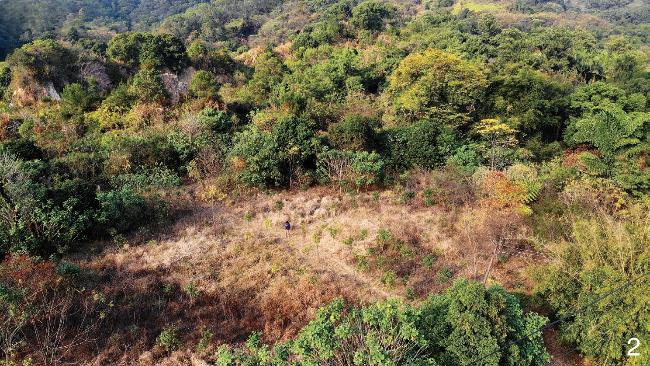
多数情况下,设计项目的基底条件都不太好:大部分处于待开发的状态,场地已经基本被铲平,特征消除,或者有些特征被转换成了不利的限制条件。有健康的小气候或者有闭环的生态系统的场地是极少的。福州登云生态城难得属于后者,尽管它处在城市扩张到自然的边界部分。现场基底条件可圈可点:有足够的高差,多样的地貌变化,丰富的原生植被,值得保留的树木、竹林、茅草。在现场踏勘后,设计师们讨论是否可以尝试依照场地特征确定空间骨架,尽量“轻碰触”原始的自然状态。
现场成团的麻楝、台湾相思和丛生竹林将场地随机划分,形成的半围合空间可用作将来的主要活动场地。场地的流线可从一部分疏林下笔直穿过。场地南侧有一个小山丘和成片杂树林,可作为登顶瞭望和林下停留空间,亦可作为场地的背景。

2 设计

2.1 设计理念

设计分为两部分:看不见的部分属于空间(space),看得见的部分属于“景物”(feature)。设计概念提出的“时间的永恒、生命的循环”通过6个装置(“基因链”“青玉蕨”“马蹄莲”“无穹顶”“贝壳丘”和登云桥)来体现,目的是促进人与自然的互动。尽管每个艺术装置的体量、虚实、功能、参与度在设计时都会被因地制宜地推敲,但是看得见的景物是可以被模仿的;而看不见的部分,比如空间、尺度、比例,是属于场地的、搬不到别的地方的,是相对的,是可以无限讨论而没有标准答案的。

2.2 设计手法

2.2.1 大小

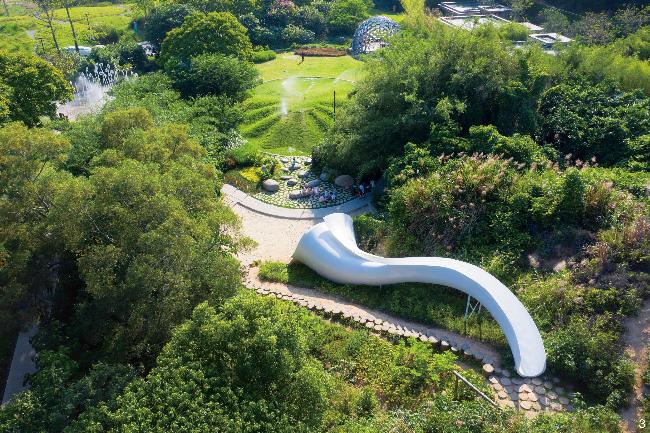
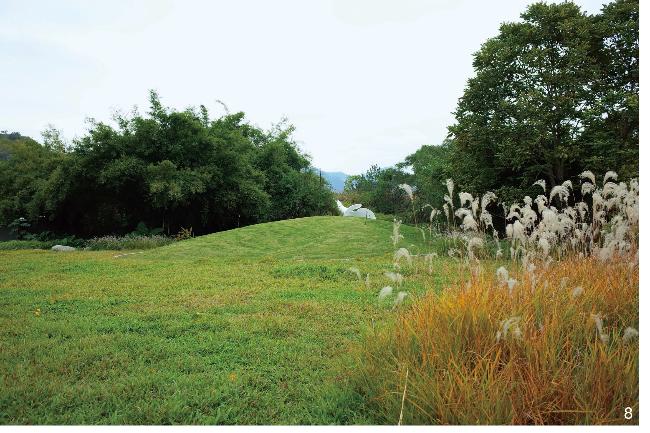
现状面积最大的场地(原生茅草地)反而给人的实际感觉是最小的。所以,设计“贝壳丘”的空间意义是赋予平坦的场地一个起伏变化,让它看起来不要太小。在设计草图中,“贝壳丘”占茅草地空间的比例比实际更大,所以严格意义上它不是“景物”。它起伏的弧度在实际人视效果中可以被感知。茅草在“贝壳丘”后面冒出尖尖,场地借助模糊的边界被放大、延展。
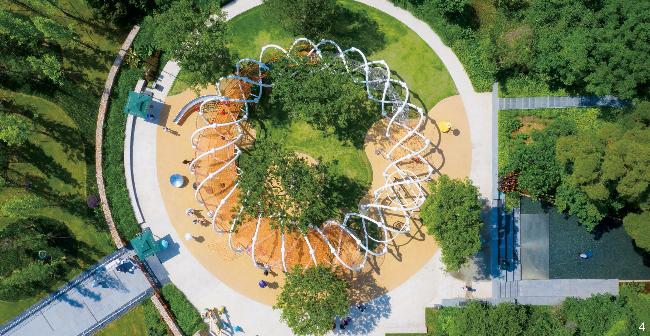
一般来说,作为入口的场地面积需要尽可能的大,但因受到基地现状限制,只能通过设计的手法,让入口场地看起来显得很大。在入口区域设计的象征“基因链”的综合童玩构架将空间进行了视觉上的纵向拉伸,让人忽视了场地水平方向的限制。
重塑场地大小,换言之就是重塑场地给人的感受,这是设计师在景观空间设计中经常会考虑的事情。起因往往是场地的某一个限制或不利条件,但重塑方法常常根据具体设计,不一而论。

2.2.2 穿插

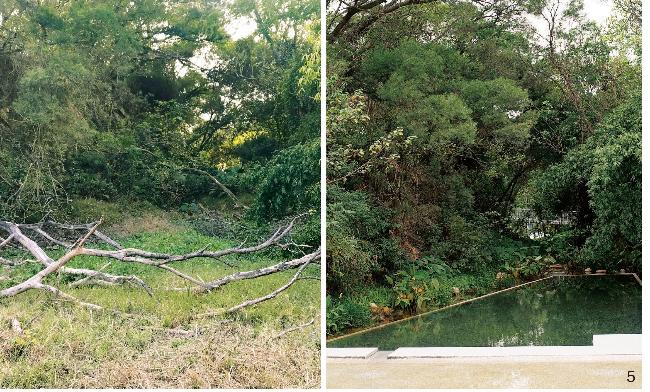
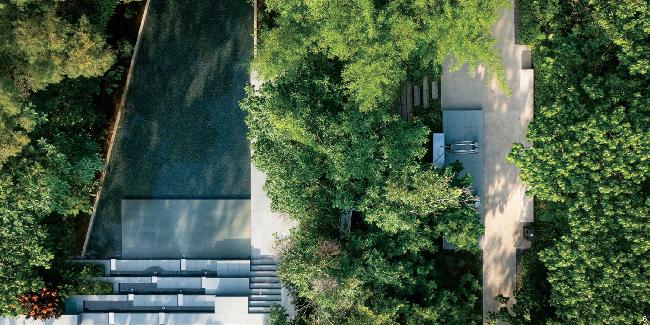
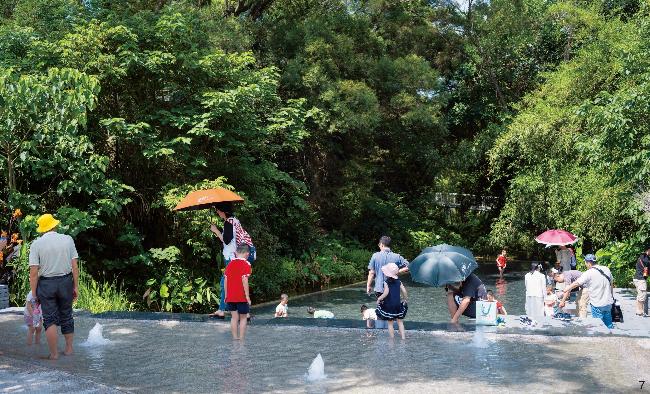
现场的2个小山头之间有唯一的天然汇水沟,设计保存现有枯木,以及水沟两侧郁郁葱葱的现状树林,并在中间置入了一个镜面水池——幽澜池。一系列关于水的活动随之展开:引水渠—浅水戏水空间—石台跌水—幽澜池,形成了空间上的穿插。建成后,整个戏水空间和周围杂乱的灌木融合在一起,林冠交叠,原来的汇水洼地被镜面水池与倒影的树冠定义成一个完整的、可以解读的空间。幽澜池是一个人工水池,边界需要像一根线一样硬挺而纤细,与沟旁的枯枝败叶形成了人工与自然、工整与凌乱、简与繁的对比。水池外面的水位随着季节涨落,镜面水池的边界在水满的时候成为一条线,在水落的时候成为人工水池的边。水池的形状使用“假透视”的设计手法,指向远处的空间,可见而不可达,形成视线上的穿插。
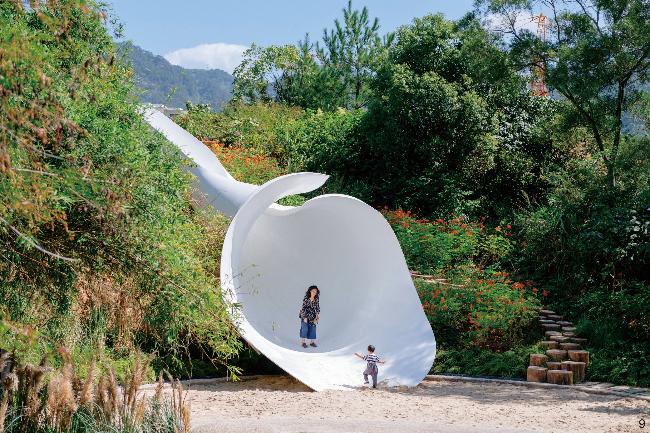
“马蹄莲”装置可以算作是滑梯(有人滑)、隧道(有人跑)、雕塑(有人打卡拍照),架设在现状的坡地上,引导山上的人来到场地中央的主要开敞空间。“贝壳丘”是“马蹄莲”和开敞空间的交汇点,形成空间上的穿插。穿插会把原来的空间边界打断,2种边界在此交汇,形成了设计上的矛盾点——2种边界元素是否有主次,是否介入新元素将其统一,是否同时模糊处理。尽管在设计阶段探索了各种可能性,但最后的建成效果仍然不尽如人意,而这正是设计中可以无限讨论的地方。

2.2.3 重叠

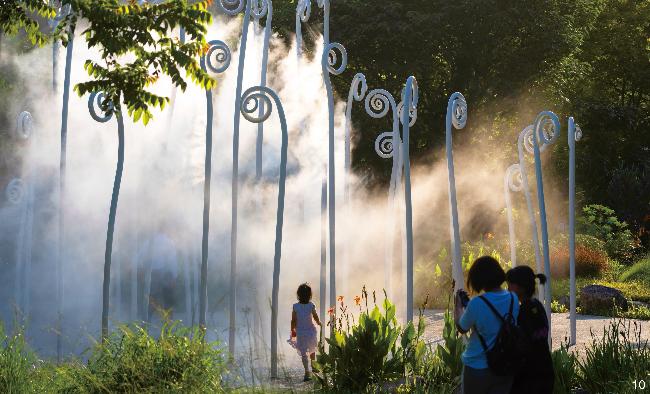
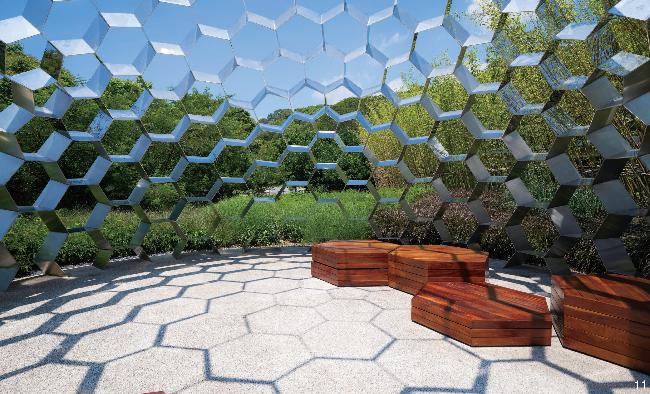
空间与空间之间会重叠,比如线性的“廊道”(corridor)和场所性的“空间”(space)以何种方式同时出现?并置?重叠?如果重叠,那么重叠的比例是怎样的?云湖自然探索乐园的几个空间重叠采用了基本的黄金比例。比如“青玉蕨”是一个小型的雾喷广场,它同时有穿行功能;“无穹顶”是一个类似带顶的亭,可以不受穿行功能的干扰,也可与“廊道”重叠,对此有多种设计上的可能,也会导致最后使用效果的不同。在二次深化设计时,内部功能因此而调整,也可能会导致整体结构不同。
因为场地现状有山地,空间上的重叠在本项目中体现得更加丰富,既包括行为上的重叠,也包括视线上的重叠。“对望”“隐约可见”“不同路线介入”都具有重叠关系。比如凹陷的水池部分与“马蹄莲”之间的小路径,为不同空间之间的介入、可达、渗透带来随机性。意外、惊喜、看似无序的各种可能性给小空间带来丰富多样的体验。

3 后续

设计上看不到的地方,最容易被修改或者忽视。无论是在设计师团队的设计过程中,还是施工队的实施过程中,会有各种因由去修改最初设计的大小、比例关系。大家往往不能通过可以看见的、有固定尺寸的“东西”,对多或少出来的几米或者大或小一点的尺度达成共识,导致最后建成的实际效果和最初的设计往往有很多不为人知的出入。
首先,所谓的“轻介入”在实际操作上是最难实现的。保护现场的植被、合理组织施工通道/施工界面等的精细化施工不仅对施工管理水平有很高的要求,还增加了施工成本。越粗暴的施工越容易实施,而保护现场的一棵树使其在施工后还成活,比起铲掉它或再买一棵麻烦很多,更不要提地这类被视为荒草的“没用的、不好看的”植物,因为它们是本土随处可见的,往往更容易被当作“需要被更新替换的东西”而被轻易碾压。
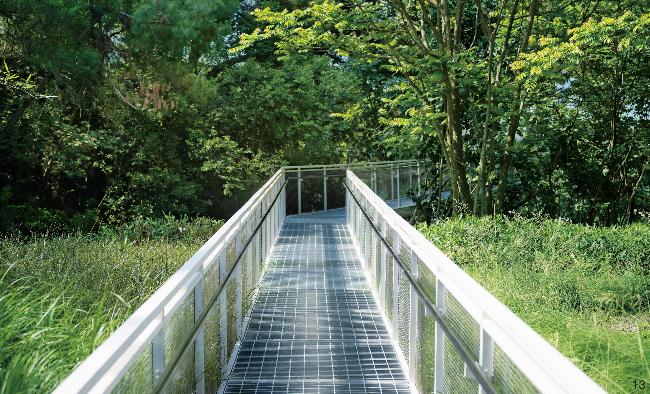
其次,“依现状而定”的设计还有一个操作上的难点,因为现状植被、地形复杂而很难被准确地测量,在图纸上也就很难一次到位精准地表达设计意图。而根据现场条件调整设计则需要设计师有很高的现场参与度,当这样的需求达到一定的量的时候,设计事务所的操作模式一般很难配合。登云桥就是一个例子,它需要穿林、跨路、探湖。由于设计之初勘察场地时,植被葱葱郁郁,在山顶观湖视野非常好,设计师希望利用空间的同时尽可能保留这片山头的野趣。施工方用GPS测绘了每一棵大树的根球位置,经过几轮方案调整,确定了A字形的架空廊桥形式。而在现场实际的放样过程中,却遇到了一棵偏冠树,根是正的,树干是斜的,刚好挡住廊桥路线。经过现场看、现场调,方案在施工阶段再次被改动。
这类保留场地原貌特征的设计非常考验设计师对设计“力度”的拿捏——很难平衡保留和介入的比例:做得过了当然不好,做不到位很容易让人产生“什么都没做”的错觉。而“做了就像没做一样”的景观也是一种境界,需要根据现场条件、人的需求、社会文化背景的不同做具体设计,在此无需累述。风景园林师的工作就像在自然系统和人类社会系统之间“左摇右摆”,掌握平衡。时代需求、文化背景决定了当下的设计判断和水平。
(编辑 / 刘昱霏)
项目地点:中国福州阳光城象屿
项目规模:约2万m2
设计时间:2019年11月—2020年4月
建成时间:2020年10月
客户名称:福州阳光城
景观团队:张东、唐子颖、张卿、杨玉鹏、陈逸帆、钱沁禾、周腾、楼思远、王琪
装置设计及施工:张唐艺术工作室
图片来源:图1257812-1©张唐景观;图346101112-213 ©河狸景观摄影;图9©福建登云房地产开发有限公司
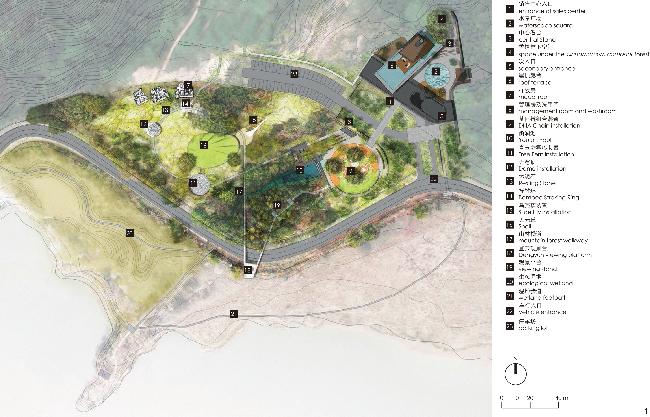
图1 总平面图

Fig. 1 Master plan

图2 现场植被

Fig. 2 Vegetation on site

图3 “贝壳丘”的实际空间尺度

Fig. 3 Actual spatial size of the “Shell”

图4 “基因链”的实际空间尺度

Fig. 4 Actual spatial size of the “DNA Chain”

图5 幽澜池与原环境的对比

Fig. 5 Contrast between the current Youlan Pool and the original environment

图6 俯瞰幽澜池

Fig. 6 Aerial view of Youlan Pool

图7 林下戏水空间

Fig. 7 Paddling space under the forest

图8 “马蹄莲”与“贝壳丘”的空间穿插

Fig. 8 Spatial interpenetration between the “Slide Lily” and the “Shell”

图9 现状坡地上的“马蹄莲”

Fig. 9 “Slide Lily” on the current slope

图10 “青玉蕨”的空间

Fig. 10 Space of the “Tree Fern”

图11 作为空间的“无穹顶”

Fig. 11 “Dome” serving as a gathering place

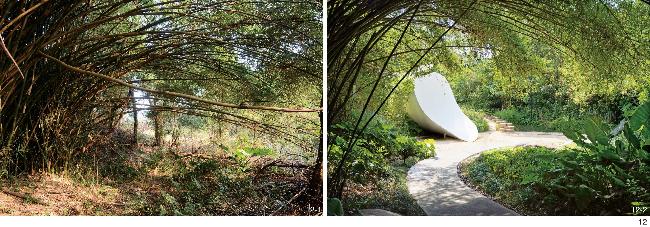
图12 “马蹄莲”与原场地对比

Fig. 12 Contrast between the current site of “Slide Lily” and the original site

图13 从现状树林中穿过的栈桥

Fig. 13 Boardwalk passing through the existing woods

1 Site

Most design projects are featured by poor conditions, with project site being largely undeveloped and site characteristics basically eliminated or converted into unfavorable constraints. It is uncommon to see sites with healthy microclimate or closed-loop ecosystem, while the site of Fuzhou Dengyun Eco-City is actually one of such sites, although it is also located in the boundary area between the city and natural environment. The aforesaid site has remarkable base conditions such as sufficient altitude difference, diverse geomorphic variations, abundant native vegetation, and preservable trees, bamboo groves and thatches. Upon field survey of the site, the designers discuss whether they may determine the spatial organization of the site according to the characteristics thereof, so as not to damage the original eco-system.
The site is randomly divided by clustered Chukrasia tabularis, Acacia confusa Merr. and bamboo groves, forming a semi-enclosed space that may serve as the main event venue in the future. The circulation of the site can run straight through a part of the open forest. On the south side of the site, there is a small hill and a scattered forest, which may be used as an overlook or shaded stay under the forest, and may also serve as the background of the site.

2 Design

2.1 Design Concept

The design method is divided into two parts, namely the visible part (“space”) and the invisible part (“feature”). The “eternity of time and cycle of life” advocated by the design concept is reflected through six art installations (“DNA Chain”, “Tree Fern”, “Slide Lily”, “Dome”, “Shell”, and Dengyun Overlook), with the aim of promoting the interaction between man and nature. The proportion, virtuality and reality, function and participation of each art installation will be considered according to specific site condition. The visible elements could be imitated, while the invisible elements, such as space, scale and proportion, belong to the site and cannot be moved elsewhere, which are typically relative and can be discussed without any standard answer.

2.2 Design Method

2.2.1 Size

Visually the largest area (the native thatch space) in the site is actually the smallest. Therefore, the spatial significance of the design of “Shell” is to make the flat site undulating to a certain extent, so that it may look not too small. In the design sketch, the “Shell” occupies a larger proportion of the thatch space, so strictly speaking, it is not a “feature”. Its undulating curvature is visible in the actual human-visual effect. Thatch tips stand out behind the “Shell”, enlarging and extending the site with the help of the blurred boundary.
Generally an entrance site should be large enough for access, which, however, may hardly be achieved due to the limitation of the current status of this project. A proper design strategy may be adopted to make the entrance site visually bigger. In the entrance area of the site, a playground with a structure resembling of the “DNA Chain” is designed to visually stretch the space vertically, which may help visually get rid of the horizontal constraints of the site.
Reshaping the size of a site is actually reshaping people’s visual perspectives, which is typical design method in landscape architecture. Such reshaping often originates from a certain limitation or disadvantage of the site, but the reshaping method adopted may vary according to the specific design.

2.2.2 Interpenetration

The natural valley between the two small hills on the site is designed to preserve the existing deadwood as well as the clustered lush trees on both sides, with a reflection pool named “Youlan Pool” being embedded. Based on this idea, a series of interactive water facilities are introduced Water channel − paddling pool − staggered water table terrace − Youlan Pool, forming a spatial interpenetration. Enclosed with original vegetation and valley terrain, the interactive water playground featured by the reflection pool is well defined by the surrounded tree canopies and their reflection. The Youlan Pool is an artificial pool, whose boundary is straight and thin. Interrupted with dead branches and leaves it shows a contrast between artificiality and naturalness, neatness and messiness, and simplicity and complexity. The water level outside the pool has seasonal change. The boundary shows a line when water is full, and becomes the edge when water level falls. The pool is also angled by the visual technique of “false perspective”, making the pool seemingly longer and pointing to the deep end of forest.
The “Slide Lily” installment may serve as a slide, a tunnel or a sculpture, which is erected on the current slope, and may lead people down from the hill to the main open space in the middle of the site. The “Shell” is located in the intersection area of the “Slide Lily” and the open space, and they create a spatial interpenetration together. The overlapping and mutual interruption of the two boundaries lead to the following contradiction in design: Whether the two boundary elements should be prioritized, whether new element should be inserted to unify them, or whether the two boundaries should be blurred simultaneously. The complete work is not perfect despite of the various optional studies, which brings design discussions in the future.

2.2.3 Overlapping

Spaces may overlap mutually. How should a linear “corridor” and a place-based “space” coexist? By way of juxtaposition or overlapping? If overlapping is adopted, what should be the proportion of overlapping? A basic golden ratio is used for the overlapping of several spaces in the Dengyun Original Territory. For example, the “Tree Fern” is a mist spraying installation on a small pavement with the pass-through function; the “Dome” is a dome roof pavilion, which may separate with the pass-through function, and may also be overlapped with a “corridor”. To this end, there are a number of possibilities in design, which may lead to different usage effects and thus entail the adjustment of internal functions. Such functional adjustment may in turn lead to the different structure design.
The exist terrain in the site enriches the spatial overlapping, involving both the behavioral and the visual overlapping. And “looking at each other”, “visibility as well” and “intervention of different routes” are all incorporated into the overlapping relations. For example, the small path between the pool valley and the “Slide Lily” brings randomness to the intervention, accessibility and penetration between spaces. Unexpectedness, surprise and seemingly random possibilities may bring various experiences to a small space.

3 Follow-Up

The invisible part in design is most likely to be modified or ignored. For the designer team in the process of design execution, or the construction team in the process of implementation, there will be various reasons to modify the size or proportional relationship of the initial design. People often fail to, through visible “things” with fixed size, reach a consensus on a quite minor discrepancy in distance, scale, etc., so there typically exist a lot of unknown inconsistencies between the final actual effect and the initial design.
First, it is difficult to achieve the so-called “light intervention” in practice. The details of protecting the vegetation on site and organizing the materials load and stack interface not only demands high for construction management, but also increases the construction cost. It is far more troublesome to protect a tree on site survive the construction process than to simply shovel it down and buy another one from the nursery. The “useless” plants such as weeds which are common in local and are often more easily crushed as “things that need to be renewed and replaced”.
Besides, it is not easy to achieve the design based on the current status in practice, as the current vegetation and terrain are too complicated to be accurately located, making it difficult to thoroughly and correctly express the design intention in drawings. Design adjustment based on site conditions entails designers to ensure high-level participation on site, that the operation mode of general design firms may hardly work. For example, the “Dengyun Overlook” needs to pass through the forest and the road towards the lake. During the early stage of the design, the field investigation shows that the vegetation was quite dense and the lake was well visible from the top of the mountain. The designers hoped to use the space while preserving the mountainous wildness as much as possible. Based on mapped root position of each tree, the design scheme was changed several times and eventually used an A-shape structure. However, in the process of installation, a lopsided tree with straight root while inclined trunk was encountered, just blocking the route of the bridge. The design was changed again at the construction stage.
For this kind of design aiming to preserve the original features of the site, it is very important and challenging to balance various design elements, such as the proportion of retention and intervention. Overdesign is not a solution, while insufficient design may create an illusion that “nothing has been done”. In fact, landscape design without trace is also a special design technique, and the determination of design technique should be based on specific site conditions, demands and socio-cultural backgrounds. For landscape architects nowadays, it is necessary to well balance the natural system and the social system, and their design judgment and level should be subject to the needs of the times and their respective cultural backgrounds.
(Editor / LIU Yufei)
Project Site: China Fuzhou YanGo · XMXYG Real Estate
Project Scale: About 20,000 m2
Design Time: From November 2019 to April 2020
Project Completion Time: October 2020
Customer Name: Fuzhou Yango Group Co., Ltd.
Landscape Team: Zhang Dong, Tang Ziying, Zhang Qing, Yang Yupeng, Chen Yifan, Qian Qinhe, Zhou Teng, Lou Siyuan, Wang Qi
Installation Design and Construction: Z+T Art Studio
Picture Source: Fig. 1, 2, 5, 7, 8 and 12-1 © Z+T Studio; Fig. 3, 4, 6, 10, 11, 12-2 and 13 © Holi Landscape Photography; Fig. 9 © Fujian Dengyun Real Estate Development Co., Ltd.
Outlines

/