

Regeneration Strategies for Traditional Old City Neighborhoods Inspired by Green Assessment Tools
|
LIANG Sisi, Ph.D., is vice dean of and an associate professor in the School of Architecture, Tsinghua University, a core member of the Key Laboratory of Eco-Planning & Green Building (Tsinghua University), Ministry of Education, and a core member of the Tsinghua University – Architectural Design and Research Institute Joint Research Center for Collaborative Innovation and Intelligence of Architecture. Her research focuses on sustainable urban regeneration, and site planning and design |
|
YUAN Congcong, Master, is a research assistant in the School of Architecture, Tsinghua University, and a core member of the Tsinghua University – Architectural Design and Research Institute Joint Research Center for Collaborative Innovation and Intelligence of Architecture. Her research focuses on landscape planning and design |
Received date: 2025-01-23
Revised date: 2025-09-04
Online published: 2025-12-10
Copyright
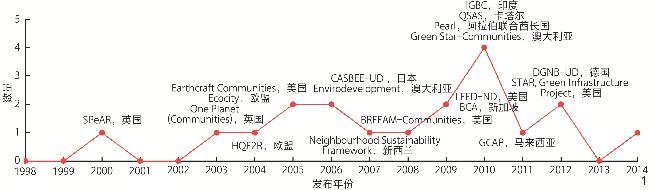
[Objective] Urban regeneration has become a critical component of sustainable urban development, especially as Chinese cities transform from large-scale expansion to stock-based optimization. Within this transformation, traditional old city neighborhoods represent the most challenging yet urgent targets for regeneration. These areas are characterized by high density, fragmented property rights, aging infrastructure, and the need to balance cultural heritage preservation with contemporary demands for livability, environmental performance, and low-carbon development. Green assessment systems at the neighborhood/community scale — such as BREEAM-Communities (UK), LEED-ND (US), CASBEE-UD (Japan), and DGNB-UD (Germany) — have matured over the past two decades, providing systematic frameworks that integrate environmental, social, and economic dimensions. However, the existing research primarily focuses on new development contexts, leaving a gap in strategies for traditional neighborhoods with unique spatial and governance constraints. This research therefore aims to explore how international green assessment tools can inform adaptive regeneration strategies for traditional old city neighborhoods in China. The research introduces a dual-dimensional “goal – process” framework that not only responds to global sustainability objectives but also addresses the full cycle of planning, construction, and management. Taking Beijing’s traditional neighborhoods as an example, the research seeks to demonstrate how generalized frameworks can be transformed into specialized tools that guide context-sensitive and operable regeneration strategies.
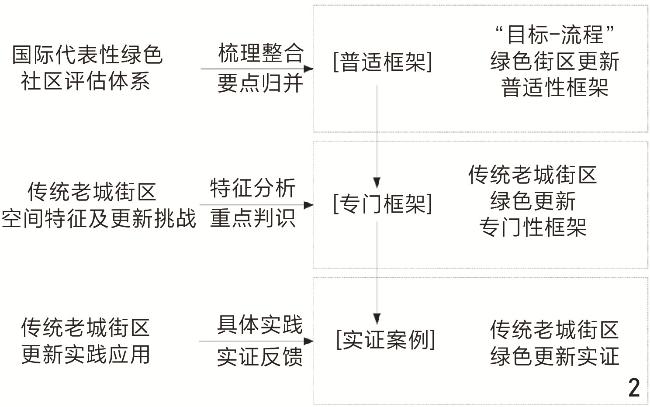
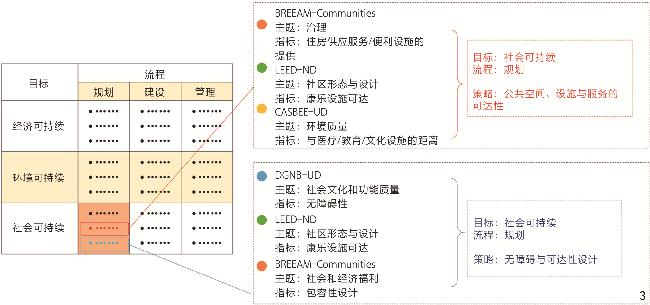
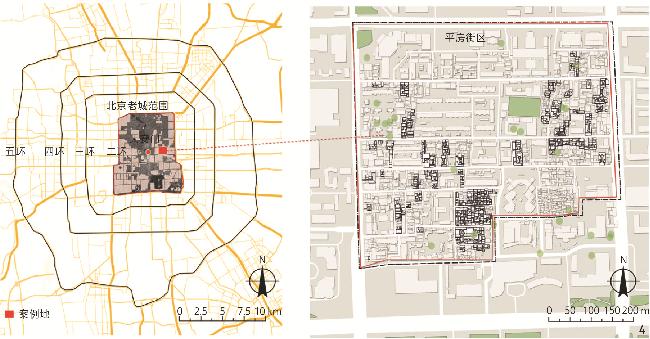
[Methods] The research adopts a multi-step research pathway. First, a systematic review of four representative international green neighborhood assessment systems is conducted to extract key indicators. These indicators are mapped and reorganized into a general “goal – process” framework: The goal dimension encompasses environmental, social, and economic sustainability (aligned with the United Nation’s “3E” principle), while the process dimension covers planning, construction, and management stages. Second, the framework is refined into a universal strategy system through indicator integration and reclassification, ensuring operability across diverse neighborhood regeneration contexts. Third, the framework is applied to Beijing’s traditional neighborhoods, where field surveys, spatial data analysis, and community/stakeholder interviews are carried out. The general framework is further adapted into a specialized regeneration framework by adjusting indicator priorities, identifying specific contradictions, and formulating targeted strategies. Furthermore, the research team integrates relevant data — including the environmental characteristics of neighborhood location, the constraint factors from higher-level planning, and the spatial characteristics of neighborhood courtyards — with textual data for overall analysis. This process helps identify the case’s characteristics as well as the key priorities and difficulties in the regeneration work. Then, based on the aforementioned specialized framework, the team leverages corresponding key strategies to conduct targeted regeneration and transformation.
[Results] The results highlight both theoretical contributions and practical applications. First, framework innovation: The general “goal – process” framework successfully bridges international assessment standards with China’s local regeneration contexts. Unlike static indicator systems, it emphasizes multi-objective sustainability and full-cycle governance, offering a flexible and operable strategy matrix. Second, case-based adaptation: Applied to Beijing’s old city neighborhoods, the framework clarifies regeneration priorities such as density optimization, functional mix, public space enhancement, and resilience building. Third, diagnostic insights: Empirical analysis reveals three distinctive pathways. 1) functional integration and energy efficiency — e.g., courtyard regeneration through mixed-use design and underground space development; 2) perceptual greening — introducing algorithms to measure and optimize residents’ visual perception of greenery, which guides the placement of vertical greening and green materials; 3) stakeholder negotiation — quantifying divergent demands (residential rights, commercial capacity, and public services) through text-mining and spatial modeling, which facilitates consensus building in previously stalled projects. Finally, performance verification: The framework proves effective in converting abstract sustainability goals into actionable regeneration measures. It not only identifies the contradictions between heritage preservation and livability improvement but also offers scalable strategies adaptable to various neighborhood conditions.
[Conclusion] This research demonstrates that integrating international green assessment tools into a general “goal – process” framework provides both conceptual clarity and practical operability for the regeneration of traditional old city neighborhoods. Unlike conventional evaluation systems that emphasize comprehensive but rigid indicators, the proposed approach is open, adaptive, and problem-oriented. By combining systematic indicator mapping with empirical case validation, the framework offers a pathway to balance universal sustainability goals with local specificities. Its contributions are threefold: 1) Advancing theoretical understanding of how assessment systems can be transformed into strategy-oriented frameworks for incremental regeneration; 2) providing a replicable methodological process — diagnosis, prioritization, and adaptation — that can be applied to other historic urban areas; and 3) supporting policy and design decisions with evidence-based, context-sensitive strategies. Overall, the research enriches the toolkit for sustainable neighborhood regeneration in China and offers international relevance by demonstrating how global frameworks can be localized to address the complexities of heritage-based urban regeneration. Looking forward, future research should further integrate carbon accounting, resilience modeling, and digital twin technologies to enhance dynamic evaluation. In doing so, the proposed framework has the potential not only to enrich the global discourse on sustainable urban regeneration but also to inform practical pathways for cities worldwide that face the dual challenge of heritage preservation and green transformation.
Sisi LIANG , Congcong YUAN . Regeneration Strategies for Traditional Old City Neighborhoods Inspired by Green Assessment Tools[J]. Landscape Architecture, 2025 , 32(10) : 99 -106 . DOI: 10.3724/j.fjyl.LA20250051
表1 基于“目标-流程”的绿色街区更新策略框架Tab. 1 Strategy framework for green neighborhoods regeneration based on the “goal-process” framework |
| 目标 | 规划 | 建设 | 管理 |
| 注:1代表该策略内容来源于CASBEE-UD;2代表该策略内容来源于LEED-ND;3代表该策略内容来源于DGNB;4代表该策略内容来源于BREEAM-Communities。 | |||
| 经济可持续 | 规划一致性与互补性1 选址与开发紧凑性1,2 土地多功能混合使用2,4 住房可负担性与多样性2 能源与智能基础设施能效与可持 续性3,4 | 容积率与空间效率优化1,4 棕地再利用与环境修复1,3 建筑、基础设施能效与能源表现2,4 | 需求与供应系统智能化1 资源再利用1,2,3 区块管理、可更新性与可扩展性1,2,3 绿色建筑认证、质量保证与环境监测2,3 生命周期成本与经济性、可持续性2,3 |
| 环境可持续 | 资源循环与生态可持续性1,2,4 栖息地与物种保护1,2 区域性与整体规划1,3 环境友好型建筑与设计1 农业用地与生态用地的保护2,3 湿地、栖息地与水体保护1,2,4 洪水与水资源风险评估2,4 提高生态价值的战略1,2,3,4 | 雨污处理与水循环系统设计1,2,3 绿色基础设施与自然资源利用1,2,4 环境污染与施工管理1,2,3,4 土地形态、改良与灾害防护1,2,3,4 热岛效应与小气候管理1,4 适应气候变化2,3,4 湿地、栖息地与水体恢复1,2,3,4 | 雨污管理优化与可持续水资源管理1,2,3,4 建筑绿化1 废弃物管理2,3 湿地、栖息地与水体管理1,2,3,4 环境污染控制1,2,3,4 |
| 社会可持续 | 灾难预防与疏散规划1 公共空间、设施与服务的可达 性1,2,3,4 城市景观与文化传承1,4 社区与邻里互动1,2,3,4 无障碍与可达性设计1,2,3,4 交通与绿色出行网络3,4 | 街区功能完善与交通安全1,4 历史资源保护与适应性再利用2,4 包容性与可持续设计1,4 | 犯罪预防与社区安全1,3 基础设施防灾与安全1,2,3,4 交通管理与碳排放控制2,4 食物、基础设施、材料与资源的可持续管理2,3,4 社区咨询、协商、管理与参与机制1,2,3,4 |
表2 传统老城街区专门性更新框架Tab. 2 Specialized regeneration framework for traditional neighborhoods in old city |
| 目标 | 规划 | 建设 | 管理 |
| 注:****为极其重要,***为重要,**为较重要,*为一般重要。 | |||
| 经济可 持续 | 规划一致性与互补性* 选址与开发紧凑性* 土地多功能混合使用**** 住房可负担性与多样性** 能源与智能基础设施能效与可持续性* | 容积率与空间效率优化*** 建筑、基础设施能效与能源表现**** | 需求与供应系统智能化* 资源再利用* 区块管理、可更新性与可扩展性*** 绿色建筑认证、质量保证与环境监测** 生命周期成本与经济性、可持续性* |
| 环境可 持续 | 资源循环与生态可持续性* 栖息地与物种保护* 区域性与整体规划** 环境友好型建筑与设计**** 洪水与水资源风险评估* 提高生态价值的战略* | 雨污处理与水循环系统设计** 绿色基础设施与自然资源利用*** 环境污染与施工管理** 土地形态、改良与灾害防护* 热岛效应与小气候管理* 适应气候变化* | 雨污管理优化与可持续水资源管理** 建筑绿化*** 废弃物管理* 环境污染控制* |
| 社会可 持续 | 灾难预防与疏散规划* 公共空间、设施与服务的可 达性**** 城市景观与文化传承* 社区与邻里互动*** 无障碍与可达性设计* 交通与绿色出行网络* | 街区功能完善与交通安全*** 历史资源保护与适应性再利用** 包容性与可持续设计**** | 犯罪预防与社区安全** 基础设施防灾与安全* 交通管理与碳排放控制* 社区咨询、协商、管理与参与机制*** |
| 专题学术主持人 Guest Editor of the Special | ||||
| 梁思思 LIANG Sisi | ||||
| 清华大学建筑学院副院长、副教授Vice dean of and associate professor in the School of Architecture, Tsinghua University | ||||
文中图表均由作者绘制,其中
| [1] |
ZHAO X X, CHEN J L, LI J Y, et al. Unraveling the Renewal Priority of Urban Heritage Communities via Macro-Micro Dimensional Assessment: A Case Study of Nanjing City, China[J]. Sustainable Cities and Society, 2025, 124: 106317.
|
| [2] |
REN J Q, ZHANG Y X. Multi-objective Optimization in the Renewal of Historic and Cultural Neighborhoods: Application to Shenyang’s Bagua Street Using an Improved NSGA-II Algorithm[J]. KSCE Journal of Civil Engineering, 2025, 29(10): 100214
|
| [3] |
王静, 刘艺蓉, 冯聃雅. 碳中和目标下中美英绿色生态城区评价标准能源指标的比较与启示[J]. 西部人居环境学刊, 2024, 39(3): 116-122.
WANG J, LIU Y R, FENG D Y. Comparison and Enlightenment of Energy Indicators of Green Eco-district Assessment Criteria from the Goal of Carbon Neutrality in China, the United States, and the United Kingdom[J]. Journal of Human Settlements in West China, 2024, 39(3): 116-122.
|
| [4] |
沈洁, 龙若愚, 陈静. 美国LEED-ND/SITES/LPS雨水管理评价标准对中国海绵城市绩效评价的启示[J]. 风景园林, 2019, 26(3): 81-86.
SHEN J, LONG R Y, CHEN J. The Enlightenment of American Stormwater Management Evaluation Criteria (LEED-ND, SITES, LPS) on Performance Assessment of Sponge Cities in China[J]. Landscape Architecture, 2019, 26(3): 81-86.
|
| [5] |
TAM V W Y, KARIMIPOUR H, LE K N, et al. Green Neighbourhood: Review on the International Assessment Systems[J]. Renewable and Sustainable Energy Reviews, 2018, 82: 689-699.
|
| [6] |
BLUM A, GRANT M, GROSSI A. The European HQE2R Sustainable Neighbourhood Assessment Toolkit: Case Studies Experience[M]//VREEKER R, DEAKIN M, CURWELL S. Sustainable Urban Development (Volume 3): The Toolkit for Assessment. London: Routledge, 2009: 177-191.
|
| [7] |
SHUANG H E, LUO J J, GAN X L, et al. LEED Certification System for Green Buildings in China: Examining Spatial Differences, Temporal Evolution, and Spatial Overflow[J]. Journal of Cleaner Production, 2024, 458: 142479.
|
| [8] |
SHARIFI A, MURAYAMA A. Neighborhood Sustainability Assessment in Action: Cross-Evaluation of Three Assessment Systems and Their Cases from the US, the UK, and Japan[J]. Building and Environment, 2014, 72: 243-258.
|
| [9] |
WONG D H, ZHANG C B, DI MAIO F, et al. Potential of BREEAM-C to Support Building Circularity Assessment: Insights from Case Study and Expert Interview[J]. Journal of Cleaner Production, 2024, 442: 140836.
|
| [10] |
ASAAD M, FAROUK HASSAN G, ELSHATER A, et al. Comparative Study of Green Neighbourhood Assessment Tools for Assessing Existing Urban Form in MENA Region[J]. Environmental Impact Assessment Review, 2024, 106: 107502.
|
| [11] |
杜海龙, 李迅, 李冰. 中外典型绿色生态城区评价标准系统化比较研究[J]. 城市发展研究, 2020, 27(11): 57-65.
DU H L, LI X, LI B. Systematic Comparative Study on Evaluation Standards of Typical Green Ecological Urban Districts[J]. Urban Development Studies, 2020, 27(11): 57-65.
|
| [12] |
FERREIRA A, PINHEIRO M D, DE BRITO J, et al. A Critical Analysis of LEED, BREEAM and DGNB as Sustainability Assessment Methods for Retail Buildings[J]. Journal of Building Engineering, 2023, 66: 105825.
|
| [13] |
WU J G. Urban Ecology and Sustainability: The State-of-the-Science and Future Directions[J]. Landscape and Urban Planning, 2014, 125: 209-221.
|
| [14] |
HAMDY A. Quality of Life: Quantitative Analysis in New Urbanism and LEED-ND Certified Neighbourhoods[J]. Proceedings of the Institution of Civil Engineers – Urban Design and Planning, 2024, 177(4): 195-231.
|
| [15] |
王振坡, 欧周月, 张安琪. 空间治理视角下我国城市社区规划实践创新研究[J]. 城市发展研究, 2024, 31(8): 104-110.
WANG Z P, OU Z Y, ZHANG A Q. Innovative Research on Urban Community Planning Practice in China from the Perspective of Spatial Governance[J]. Urban Development Studies, 2024, 31(8): 104-110.
|
| [16] |
PEDRO J, SILVA C, PINHEIRO M D. Integrating GIS Spatial Dimension into BREEAM Communities Sustainability Assessment to Support Urban Planning Policies, Lisbon Case Study[J]. Land Use Policy, 2019, 83: 424-434.
|
| [17] |
张佶, 钱秉玺. 寻找理想与现实的平衡: 基于美国LEED-ND评估体系与实践的思考[J]. 城市规划, 2017, 41(11): 102-110.
ZHANG J, QIAN B X. Seeking the Balance Between Ideality and Reality: Insights from LEED-ND and Its Practice[J]. City Planning Review, 2017, 41(11): 102-110.
|
| [18] |
易筱雅, 何依, 邓巍.基于社区生活圈的历史城区保护传承策略研究: 以荆州古城为例[J/OL].中国园林: 1-9.(2024-12-11)[2025-01-22]. https://kns.cnki.net/KCMS/detail/detail.aspx?filename=ZGYL20241210001&dbname=CJFD&dbcode=CJFQ.
YI X Y, HE Y, DENG W. Research on Protection and Inheritance Strategies for Historical City Districts Based on Community Life Circles: A Case Study of Jingzhou Ancient City[J/OL]. Chinese Landscape Architecture: 1-9. (2024-12-11)[2025-01-22]. https://kns.cnki.net/KCMS/detail/detail.aspx?filename=ZGYL20241210001&dbname=CJFD&dbcode=CJFQ.
|
| [19] |
王科, 刘亚男, 彭睿怡. 城市修补理念下北京西四片区开放空间更新策略探讨[J]. 北京规划建设, 2018(6): 136-139.
WANG K, LIU Y N, PENG R Y. Discussion on the Renewal Strategy of Open Space in Xisi Area, Beijing Under the Concept of Urban Repair[J]. Beijing Planning Review, 2018(6): 136-139.
|
| [20] |
崔怡冉. 城市更新背景下历史街区的保护与更新: 以北京幸福社区周边地区为例[J]. 城市建筑, 2022, 19(21): 171-174.
CUI Y R. Study on the Protection and Renewal of Historical Blocks Under the Background of Urban Renewal: A Case of the Area Surrounding Xingfu Village in Beijing[J]. Urbanism and Architecture, 2022, 19(21): 171-174.
|
| [21] |
陆晓明, 肖瑶, 李鸣宇. 历史文化街区的绿色可持续规划与活力复兴: 以武汉江汉路南片区更新为例[J]. 世界建筑, 2022(8): 51-56.
LU X M, XIAO Y, LI M Y. The Eco-Sustainable Planning and Revitalisation of Historic and Cultural Blocks: A Case Study of Jiang’an South District Renovation in Wuhan[J]. World Architecture, 2022(8): 51-56.
|
| [22] |
沈丽娜, 田玉娉, 杜雅星. 老旧小区韧性评价体系及韧性改造研究: 以西安老城东南片区为例[J]. 城市问题, 2021(8): 45-54.
SHEN L N, TIAN Y P, DU Y X. Resilience Reconstruction of Old Communities Based on Resilience Evaluation System[J]. Urban Problems, 2021(8): 45-54.
|
| [23] |
陈美伊, 胡宏. 城市街区碳代谢模式识别及适应性更新策略: 以福建省长汀县历史文化街区为例[J]. 城市规划, 2025, 49(2): 94-109.
CHEN M Y, HU H. Carbon Metabolism Pattern Identification and Adaptive Renewal Strategy in Urban Neighborhoods: A Case Study of Historic Conservation Areas in Changting County, Fujian Province[J]. City Planning Review, 2025, 49(2): 94-109.
|
/
| 〈 |
|
〉 |