

Pathway for County-Level Territorial Spatial Master Planning Oriented Toward Safety and Resilience Goals: A Case Study of Suning County, Hebei Province
|
REN Xiaotong is a Ph.D. candidate in the School of Architecture, Tianjin University. Her research focuses on urban – rural resilience, and rural planning |
|
ZENG Peng, Ph.D., is a professor in the School of Architecture, Tianjin University. His research focuses on land – sea coordination and urban – rural resilience, rural planning, and urban regeneration |
Received date: 2025-05-28
Revised date: 2025-08-16
Online published: 2025-12-10
Copyright
[Objective] Against the backdrop of intensifying global climate change, interlaced disaster risks, and ongoing urbanization, county-level units have gradually emerged as a key platform for new urbanization. They constitute fundamental spatial units for coordinating territorial spatial safety and development, as well as implementing disaster governance and emergency management. Oriented toward “safety and resilience” — a critical objective for urban – rural development in the new era — planning guidance has evolved across multiple dimensions and comprehensive chains, spanning systemic risk response, spatial pattern optimization, and resource allocation.
[Methods] Following the approach of “experience consolidation – framework construction – pathway exploration”, and using the planning case of Suning County, Hebei Province as a reference, this research summarizes the key priorities and challenges in county-level territorial spatial master planning under safety and resilience goals. The research outlines the conceptual framework and structure for plan formulation, and proposes integrated strategies for planning and implementation across three dimensions: disaster-resistant spatial optimization, disaster prevention resource allocation, and emergency response mechanisms.
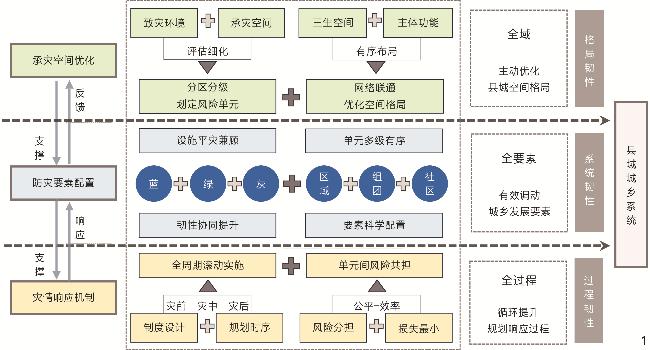
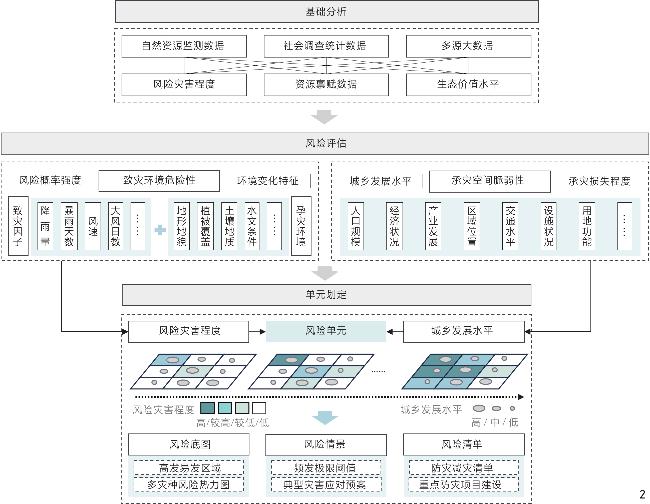
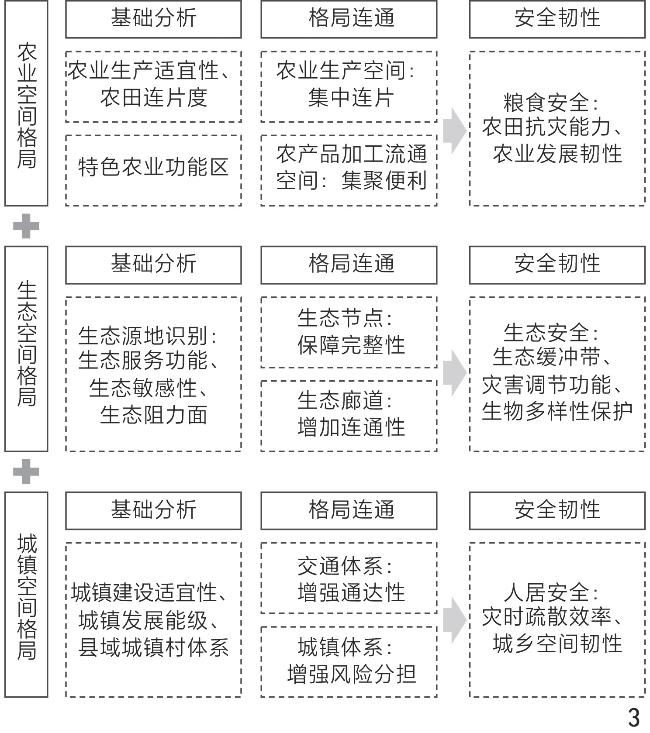
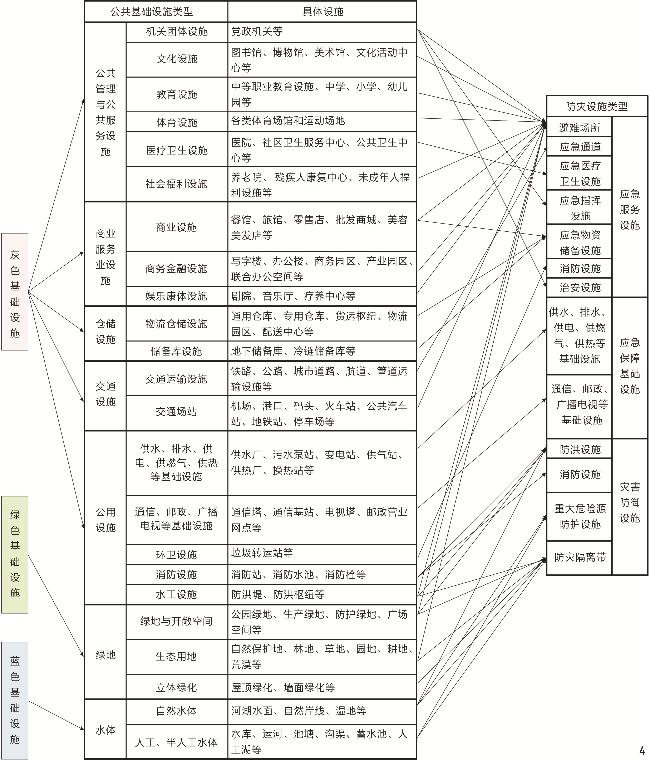
[Results] 1) The evolution of safety & resilience-oriented planning practice unfolds through three progressive phases: Initially, in the foundational stage, planning primarily takes the form of single-hazard-specific initiatives addressing physical damages caused by natural disasters such as earthquakes and floods, focusing on enhancing urban resistance to individual hazards through engineering fortification and localized interventions; subsequently, the developmental stage shifts toward integrated disaster prevention planning, broadening perspectives from natural hazards to diverse risks and formulating comprehensive strategies through a systemic resilience lens; ultimately, the integration phase systematically embeds safety-resilience spatial development into territorial spatial planning, transitioning toward all-hazard, whole-process, and long-term monitoring and governance. 2) Guided by safety – resilience principles, county-level planning serves as the pivotal tier bridging strategic vision and implementation within the territorial spatial planning system, tasked with both implementing higher-level development conservation strategies and land use regulations while guiding the formulation of lower-tier plans and execution of spatial governance. In disaster-bearing spatial configuration, county-level planning demonstrates transitional adaptability by translating macro spatial strategies into actionable resilience networks; regarding disaster prevention elements, it addresses infrastructure limitations and rural vulnerabilities through multifunctional infrastructure integration; and for disaster response, it prioritizes operational practicality by emphasizing long-term adaptive execution throughout dynamic implementation cycles. 3) The value-driven objective of safety and resilience prioritizes enhancing adaptive capacity and synergistic co-benefits within planning systems when confronting uncertain disruptions, advocating for a holistic “all-domain, all-element, whole-process” systemic response to disaster risks to collectively elevate the resilience threshold of urban – rural systems. Within territorial spatial master planning, this objective materializes through three integrated dimensions — pattern resilience, system resilience, and process resilience — which respectively govern three critical components: spatial optimization of disaster-bearing environments, allocation of disaster prevention elements, and implementation mechanisms for disaster response. By proactively refining county-level spatial patterns, strategically mobilizing urban – rural development resources, and iteratively upgrading disaster response protocols, this framework systematically strengthens the resilience capacity of territorial spaces. 4) County-level territorial spatial master planning integrates three core technical approaches: First, optimize disaster-bearing spatial configurations through zoned and tiered risk partitioning combined with resilient network connectivity, where precise identification of spatial risk heterogeneity enables refined zoning and tiered risk units to generate risk maps, scenarios, and inventories as spatial decision-making tools, while strengthening ecological corridors and emergency passages to actively adapt spatial patterns to comprehensive risk cognition; second, configure disaster prevention elements via dual-use systems with multi-tiered ordering, which maximizes self-organization, autonomous operation, and self-recovery capacities of complex urban – rural systems by functionally integrating and converting blue – green – gray infrastructure for everyday – emergency dual purposes, and deploying differentiated elements across region – cluster – community tiers to deeply couple development resources with safety demands; third, implement disaster response measures through adaptive implementation with risk pooling mechanisms, where planning execution bridges pre-disaster warnings, emergency responses, post-disaster recovery, and iterative learning via phased quantitative assessments to transform strategies into tangible resilience tasks, while cross-sectoral and interregional risk pooling allocates resources and liabilities to ensure continuous evolution of resilience capacities throughout the planning lifecycle.
[Conclusion] Guided by safety & resilience principles, county-level planning serves as the critical tier bridging strategic vision and operational implementation within the territorial spatial planning system. In disaster-bearing spatial configuration, it demonstrates transitional adaptability with the core objective of translating macro-level spatial strategies into actionable resilience networks; regarding disaster prevention elements, it emphasizes functional compatibility through multifunctional integration of infrastructure; and for disaster response implementation, it prioritizes operational practicality with a focus on long-term adaptive execution throughout dynamic cycles.
Xiaotong REN , Peng ZENG . Pathway for County-Level Territorial Spatial Master Planning Oriented Toward Safety and Resilience Goals: A Case Study of Suning County, Hebei Province[J]. Landscape Architecture, 2025 , 32(10) : 71 -79 . DOI: 10.3724/j.fjyl.LA20250314
表1 安全韧性导向的规划实践演进Tab. 1 Evolution of safety & resilience-focused planning practices |
| 风险类型 | 基础阶段:单灾种防灾减灾 具体规划及措施 | 发展阶段:综合防灾规划 具体措施 | 融合阶段:国土空间规划 具体措施 | |
| 自然 风险 | 1)地质风险:地震、火山喷发、滑坡、泥石流、地面塌陷、地裂缝等; 2)水文风险:洪水、风暴潮、海啸、冰凌等; 3)气象风险:台风、暴雨、暴雪、寒潮、热浪、干旱、沙尘暴等 | 各城市地质灾害防治规划中危险区工程避让、防洪规划中河道工程硬防护、气候适应性规划中预警信息发布等 | 72 h生命通道保障、河道疏浚、改造排水设施、饮用水源紧急净化、热浪/寒潮庇护所即时开放等 | 灾害风险评估与空间避让、洪涝韧性空间构建、气候适应性空间布局等 |
| 生态 风险 | 1)生物风险:传染病、蝗灾、鼠灾、生物入侵等; 2)生态风险:草原退化、湿地干涸等 | 《城市防疫专项规划编制导则》中疫情隔离控制、各城市生态环境保护规划中生态修复工程等 | 医疗秩序恢复、生态廊道建设、生态系统修复等 | 生物安全屏障建设、生态系统保护修复等 |
| 社会 风险 | 1)人为故意型风险:恐怖袭击、战争与武装冲突、人为破坏、网络攻击等; 2)人为失误型风险:操作失误导致的火灾、决策失误引发的资源危机等; 3)社会系统型风险:群体性抗议骚乱事件、经济危机、公共服务崩溃等 | 《公共安全专项规划》中人防设施布局、《城市消防专项规划》中消防站点规划布局等 | 人防设施布局、消防站点规划布局等 | 关键节点安全防护、安全分区与风险源管控、基础保障能力强化等 |
| 技术 风险 | 1)关键基础设施风险:能源泄漏、交通设施故障、通信系统中断、供水排水系统瘫痪等; 2)工业技术风险:化学品泄漏、核泄漏等; 3)新兴技术风险:人工智能伦理风险、物联网安全漏洞、区块链攻击等 | 各城市综合防灾生命线工程规划中“生命线”设施保障等 | “生命线”设施保障、危险化学品仓储布局等 | “生命线”系统韧性提升、高风险工业区空间隔离、数字基础设施安全布局等 |
| 复合 风险 | 1)自然-自然复合风险:台风-暴雨-洪水-滑坡连锁灾害等; 2)自然-技术复合风险:地震-化工厂管道破裂-有毒气体泄漏等; 3)自然-人为复合风险:极端干旱-农田绝收-人为冲突等; 4)技术-人为复合风险:网络攻击-金融系统瘫痪-挤兑潮等 | 灾害链阻断响应机制等 | 多灾种耦合风险模拟与空间响应、关键设施灾害链阻断设计、资源短缺风险的空间调控、系统性风险防控机制嵌入等 | |
表2 安全韧性导向的规划层级差异Tab. 2 Differential mechanisms in safety & resilience-oriented planning hierarchies |
| 规划层级 | 性质 | 核心定位 | 聚焦风险类型 | 重点内容 | 特征 | ||
| 承灾空间 | 防灾要素 | 灾情响应 | |||||
| 国家级 | 战略性 | 战略引导 | 跨区域重大风险 | 构建国家生态安全屏障、划定重大基础设施廊道 | 战略资源管控(能源基地/粮食主产区) | 跨省灾害联防联控机制、国家立法保障 | 顶层设计、跨省协同 |
| 省级 | 协调性 | 区域统筹 | 省内区域性风险 | 协调省域生态安全格局、布局省级防灾分区 | 统筹区域性生命线工程、配置省级应急储备体系 | 制定省级防灾标准、建立跨市应急联动平台 | 省内联动、分区管控 |
| 市级 | 实施性 | 实施管控 | 城市集中性风险 | 优化城市防灾空间结构、完善应急疏散通道网络 | 强化城市生命线工程韧性(供水/供电/交通) | 建立多部门协同应急平台、编制综合防灾专项规划 | 市内闭环、近郊协同 |
| 县级 | 实施行动 | 县域城乡风险,且更 突出乡村关联风险 | 承上启下构建县域防灾格局、联通生态-农业-城镇空间网络、分区分级划定风险单元 | 严守粮食/生态安全底线、拓展基础设施平急两用功能、差异化配置“蓝-绿-灰”设施 | 构建县域隐患数据库、近/中/远期防灾规划滚动实施、社区风险共担措施 | 城乡统筹、全域覆盖 | |
| 乡镇级 | 具体落实 | 小尺度、高频次风险 | 落实防灾空间管控(蓄滞洪区/防护隔离带) | 布置村级应急物资点、配置微型消防设施 | 制定村级应急预案、规划防灾避险路线 | 镇村联动、应急避险 | |
表3 防灾单元分层嵌入规划体系Tab. 3 Hierarchical integration of disaster prevention units into spatial planning systems |
| 空间层级 | 覆盖距离 /km | 服务人口 /万人 | 应急时间 /h | 重要防灾设施 | ||
| 防灾单元层级 | 县域层级 | 县城层级 | ||||
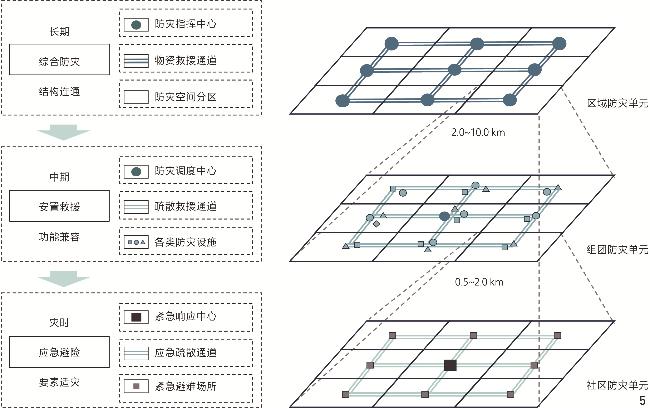
| 区域防灾单元 | 县域 | 中心城区 | [10.0,30.0] | [10.0,20.0] | [1.0,3.0] | 县级机关单位、中小学、大型场馆、综合医院、大型公园、防护绿地、消防队、警察局、物流仓储中心、机场、火车站、铁路、高速、国道、省道等 |
| 组团防灾单元 | 乡镇 | 街道 | [2.0,10.0) | [1.0,10.0) | [0.5,1.0) | 乡镇级机关单位/街道办、中小学、分区医院、消防分队、警察分局、广场、公交车站、快速路、主干路等 |
| 社区防灾单元 | 乡村群落 | 社区生活圈 | [0.5,2.0) | [0.2,1.0) | [0.1,0.5) | 村委会/居委会、小学、幼儿园、社区卫生服务中心、派出所、邻里公园、次干路、支路、乡道等 |
| [1] |
曾穗平, 王琦琦, 田健. 应对气候变化的韧性国土空间规划理论框架与规划响应研究[J]. 规划师, 2023, 39(2): 21-29.
ZENG S P, WANG Q Q, TIAN J. The Theoretical Framework and Planning Response of Resilient Territorial Space Planning in Response to Climate Change[J]. Planners, 2023, 39(2): 21-29.
|
| [2] |
施雅蓉, 庄子薛, 沈一, 等. 气候韧性视角下基于NSGA-Ⅲ的国土空间优化方法[J]. 风景园林, 2024, 31(6): 89-98.
SHI Y R, ZHUANG Z X, SHEN Y, et al. Territorial Spatial Optimization Method Based on NSGA-Ⅲ from the Perspective of Climate Resilience[J]. Landscape Architecture, 2024, 31(6): 89-98.
|
| [3] |
赵毅, 郑俊, 徐辰, 等. 县级国土空间总体规划编制关键问题[J]. 城市规划学刊, 2022(2): 54-61.
ZHAO Y, ZHENG J, XU C, et al. Key Issues in the Making of County-Level Territorial Spatial Master Plans[J]. Urban Planning Forum, 2022(2): 54-61.
|
| [4] |
曾鹏. 韧性城市与城市韧性发展机制[J]. 人民论坛·学术前沿, 2022 S1 35 45
ZENG P. Resilient Cities and Urban Resilience Development Mechanisms[J]. Frontiers, 2022 S1 35 45
|
| [5] |
诸嘉巍, 邓艳, 杨贺, 等. 安全韧性纳入国土空间详细规划的策略[J]. 规划师, 2024, 40(10): 9-15.
ZHU J W, DENG Y, YANG H, et al. Strategies for Integrating Security Resilience into Territorial Spatial Detailed Planning[J]. Planners, 2024, 40(10): 9-15.
|
| [6] |
刘婷婷, 戴慎志, 高晓昱. 市、县级国土空间综合防灾专项规划编制内容要点研究[J]. 城乡规划, 2024(1): 70-76.
LIU T T, DAI S Z, GAO X Y. Research on Main Contents and Key Points of Special Planning for Comprehensive Disaster Prevention of City and County-Level Territorial Space[J]. Urban & Rural Planning, 2024(1): 70-76.
|
| [7] |
MAO C, YUE A B, WANG Z Q, et al. Are Cities Genuinely Healthy? Diagnosis of Urban Development from the Perspective of Adaptive Capacity[J]. Sustainable Cities and Society, 2024, 108: 105494.
|
| [8] |
夏陈红, 王威, 马东辉, 等. 综合防灾规划中多灾种风险评估技术研究[J]. 上海城市规划, 2020(6): 105-111.
XIA C H, WANG W, MA D H, et al. Research on Multi-hazard Risk Assessment Technology in Comprehensive Disaster Prevention Planning[J]. Shanghai Urban Planning Review, 2020(6): 105-111.
|
| [9] |
潘鑫, 张尚武, 胡宁. 安全韧性理念融入国土空间规划的总体框架与实施策略[J]. 规划师, 2024, 40(10): 1-8.
PAN X, ZHANG S W, HU N. The Overall Framework and Implementation Strategy of Integrating Security Resilience Concept with Territorial Spatial Planning[J]. Planners, 2024, 40(10): 1-8.
|
| [10] |
戴慎志, 刘婷婷, 高晓昱, 等. 国土空间防灾减灾规划编制体系与实施机制[J]. 城市规划学刊, 2023(1): 48-53.
DAI S Z, LIU T T, GAO X Y, et al. Planning and Implementation Mechanism for Disaster Prevention and Mitigation in Territorial Spatial Planning[J]. Urban Planning Forum, 2023(1): 48-53.
|
| [11] |
夏陈红, 马东辉, 郭小东, 等. 适应性循环视角下的国土空间适灾韧性机理与规划响应研究[J]. 城市发展研究, 2024, 31(2): 44-52.
XIA C H, MA D H, GUO X D, et al. Research on Disaster Resilience Mechanism and Planning Response of Territorial Space from the Perspective of Adaptive Cycle[J]. Urban Development Studies, 2024, 31(2): 44-52.
|
| [12] |
吕悦风, 项铭涛, 王梦婧, 等. 从安全防灾到韧性建设: 国土空间治理背景下韧性规划的探索与展望[J]. 自然资源学报, 2021, 36(9): 2281-2293.
LYU Y F, XIANG M T, WANG M J, et al. From Disaster Prevention to Resilience Construction: Exploration and Prospect of Resilience Planning Under the Background of Territorial Governance[J]. Journal of Natural Resources, 2021, 36(9): 2281-2293.
|
| [13] |
陈智乾, 胡剑双, 王华伟. 韧性城市规划理念融入国土空间规划体系的思考[J]. 规划师, 2021, 37(1): 72-76.
CHEN Z Q, HU J S, WANG H W. Reflections on the Integration of the Concept of Resilient Urban Planning into the National Spatial Planning System[J]. Planners, 2021, 37(1): 72-76.
|
| [14] |
王威, 朱峻佚, 费智涛, 等. 国土空间韧性规划建设整体框架与发展路径研究[J]. 中国工程科学, 2023, 25(3): 209-218.
WANG W, ZHU J Y, FEI Z T, et al. Overall Framework and Development Path of National Land Space Resilience Planning and Construction[J]. Strategic Study of CAE, 2023, 25(3): 209-218.
|
| [15] |
石晓冬, 张晓昕, 冯雅薇, 等. 北京市韧性城市建设的系统路径与规划实践[J]. 城市学报, 2024(6): 24-29.
SHI X D, ZHANG X X, FENG Y W, et al. Systematic Path and Planning Practice of Resilient City Construction in Beijing[J]. Journal of Urban Sciences, 2024(6): 24-29.
|
| [16] |
廖启鹏, 韦桦, 胡守庚, 等. 国土空间韧性规划的演进逻辑与理论探索: 从应急响应到动态适应的路径创新[J]. 安全与环境工程, 2025, 32(3): 1-13.
LIAO Q P, WEI H, HU S G, et al. Evolution Logic and Theoretical Exploration of Territorial Spatial Resilience Planning: Path Innovation from Emergency Response to Dynamic Adaptation[J]. Safety and Environmental Engineering, 2025, 32(3): 1-13.
|
| [17] |
GENG Y W, LI X S, LI L, et al. Static-Dynamic Characteristics and Management Scheme of County Space Resilience Based on Geographical Natures: An Empirical Study of 95 Counties from Jiangsu Province, China[J]. Ecological Indicators, 2024, 166: 112285.
|
| [18] |
周燕, 徐莉, 刘梦瑶, 等. 多尺度嵌套的复合生态安全格局构建与管控路径: 以湖北省通城县为例[J]. 规划师, 2024, 40(10): 25-31.
ZHOU Y, XU L, LIU M Y, et al. Construction and Control Path of Multi-scale Nested Composite Ecological Security Pattern: A Case Study of Tongcheng County, Hubei Province[J]. Planners, 2024, 40(10): 25-31.
|
| [19] |
高雅, 雷振东, 刘苗苗. 面向生态脆弱区的县域国土空间规划技术体系框架[J].世界建筑, 2024, (10): 86-91
GAO Y, LEI Z D, LIU M M. Technological System Framework for County-Level Territorial Spatial Planning in Ecologically Fragile Areas[J]. World Architecture, 2024, (10): 86-91.
|
| [20] |
李燕, 张垒, 赵星烁. 基于韧性城市理论的“平急两用”公共基础设施国土空间规划应对策略研究[J]. 小城镇建设, 2025, 43(1): 92-98.
LI Y, ZHANG L, ZHAO X S. Research on the Coping Strategies of Land Spatial Planning of “Flat and Emergency” Public Infrastructure Based on the Theory of Resilient City[J]. Development of Small Cities & Towns, 2025, 43(1): 92-98.
|
| [21] |
薄茗洋, 戴代新, 廖晚迪. 基于生态防灾减灾的沿海城市规划韧性响应: 以上海市雨热灾害复合风险为例[J/OL].风景园林: 1-25(2025-06-24)[2025-08-04]. https://link.cnki.net/urlid/11.5366.s.20250624.1403.002.
BO M Y, DAI D X, LIAO W D. Resilient Response in Coastal Urban Planning Based on Ecosystem-Based Disaster Risk Reduction: A Case Study of Compound Rainstorm and Heatwave Extreme Risks in Shanghai[J/OL]. Landscape Architecture: 1-25. (2025-06-24) [2025-08-04]. https://link.cnki.net/urlid/11.5366.s.20250624.1403.002.
|
| [22] |
童彤, 鲍沁星. 基于生态系统的适应与减灾理论在国外城市气候规划中的实践研究[J]. 风景园林, 2022, 29(1): 102-107.
TONG T, BAO Q X. Practical Research on Adaptation and Disaster Reduction Theory Based on Ecosystem in Urban Climate Planning Abroad[J]. Landscape Architecture, 2022, 29(1): 102-107.
|
| [23] |
罗紫元, 曾坚. 基于InVEST模型的闽三角地区沿海脆弱性评估及响应策略[J]. 风景园林, 2021, 28(7): 10-16.
LUO Z Y, ZENG J. Coastal Vulnerability Assessment and Response Strategies of Fujian Delta Based on InVEST Model[J]. Landscape Architecture, 2021, 28(7): 10-16.
|
| [24] |
郝庆, 郑筱津, 付世华. 国土空间格局优化的总体思路与技术流程: 以市县级国土空间规划为例[J]. 经济地理, 2024, 44(1): 166-173.
HAO Q, ZHENG X J, FU S H. General Thought and Technical Process of the Territorial Space Pattern Optimization at the County Level[J]. Economic Geography, 2024, 44(1): 166-173.
|
| [25] |
王威, 朱峻佚, 郭小东, 等. “平急两用”公共基础设施体系及其机制建设[J].城市发展研究, 2024, 31(6): 54-61.
WANG W, ZHU J Y, GUO X D, et al. Research on the Construction of Public Infrastructure System and Its Mechanisms for “Dual Use”[J]. Urban Development Studies, 2024, 31(6): 54-61.
|
| [26] |
冉静, 蒋晓慧, 赫磊, 等. 城市平急两用公共基础设施的类型及空间体系与规划建设要点[J].城市规划学刊, 2024, (5): 98-105.
RAN J, JIANG X H, HE L, et al. Typology and Spatial System of Urban Dual-Use Public Infrastructure and the Key Points in Planning[J]. Urban Planning Forum, 2024, (5): 98-105.
|
| [27] |
冉静, 刘湘仪, 赫磊, 等. 基于社区生活圈的中心城区防灾分区划定研究: 以湖南省花垣县为例[J].规划师, 2024, 40(9): 98-106.
RAN J, LIU X Y, HE L, et al. Disaster Prevention Zoning Delineation in Central Urban Areas Based on Community Life Circles: A Case Study of Huayuan County, Hunan Province[J]. Planners, 2024, 40(9): 98-106.
|
/
| 〈 |
|
〉 |