

Resilience Measurement and Evolution Characteristics of Resource-Based Cities in Heilongjiang Province Based on Adaptive Cycle Framework from 2010 to 2019
|
TAN Zhuolin, Ph.D., is an assistant research fellow in the School of Architecture and Design, Harbin Institute of Technology. Her research focuses on urban resilience, and sustainable urban planning |
|
LU Ming, Ph.D., is a professor in the School of Architecture and Design, Harbin Institute of Technology. Her research focuses on sustainable development of urban and rural environment, and urban and rural social and humanistic revival and development |
|
DONG Wei, Ph.D., is a professor in the School of Architecture and Design, Harbin Institute of Technology. Her research focuses on community resilience and sustainable urban and rural regeneration |
|
DONG Yu, Ph.D., is an associate professor in the School of Architecture and Design, Harbin Institute of Technology. His research focuses on urban development with low environmental impact, and urban green infrastructure planning |
Received date: 2025-02-27
Revised date: 2025-08-20
Online published: 2025-12-10
Copyright
[Objective] Resource-based cities in Heilongjiang Province have encountered a series of challenges during their transformation, including resource depletion, industrial decline, environmental pollution, and population outflow. These issues stem from historical over-exploitation of resources, outdated processing methods, insufficient socioeconomic reforms, and the dominance of single-resource industrial structures. In the context of sustainable development transformation, these cities face intertwined complexities of historical legacies and emerging challenges. From the perspective of evolutionary resilience, urban resilience is defined as the capacity of the urban system to resist, transform, and adapt to risks. By adopting adaptive planning strategies and dynamic evolutionary approaches aligned with urban system development laws, cities can shift from “outcome-oriented” to “process-oriented” frameworks, offering novel pathways for sustainable transformation. However, leveraging resilience pathways to address developmental bottlenecks and deepen sustainability remains a critical research gap requiring further exploration.
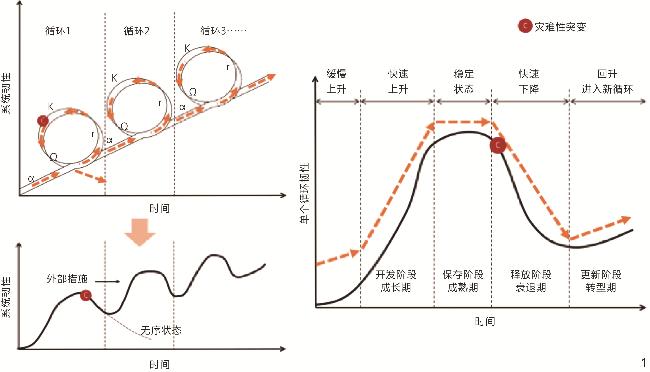
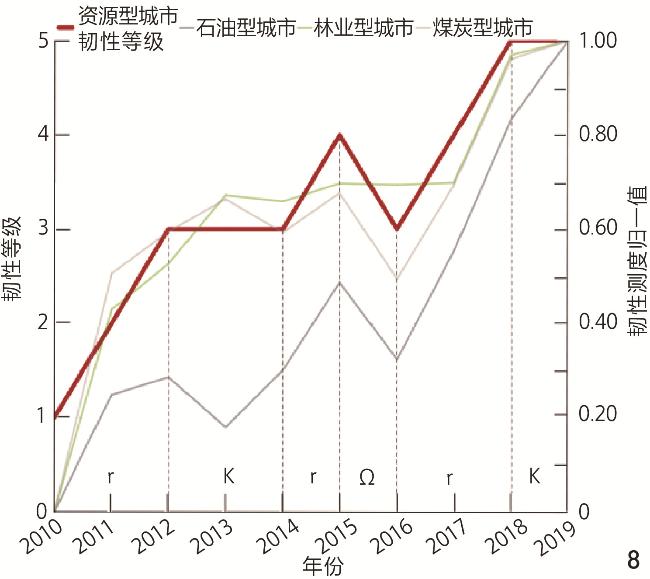
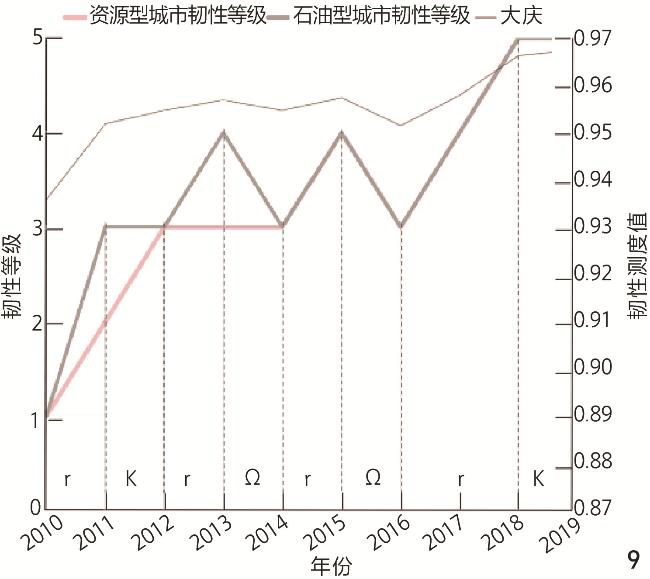
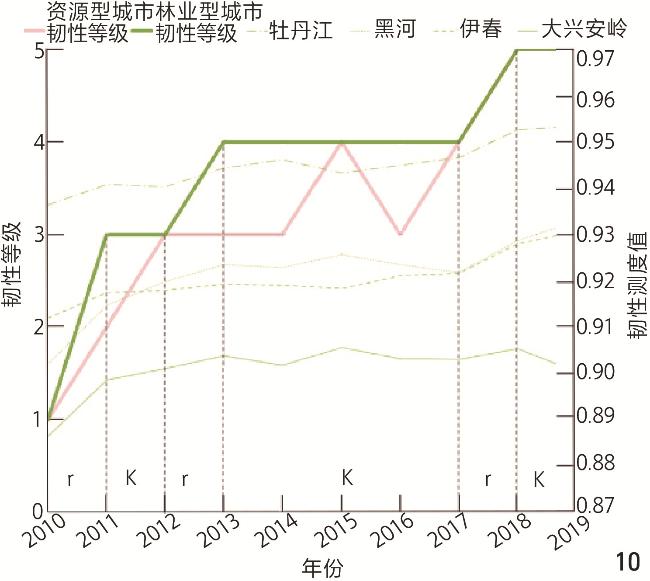
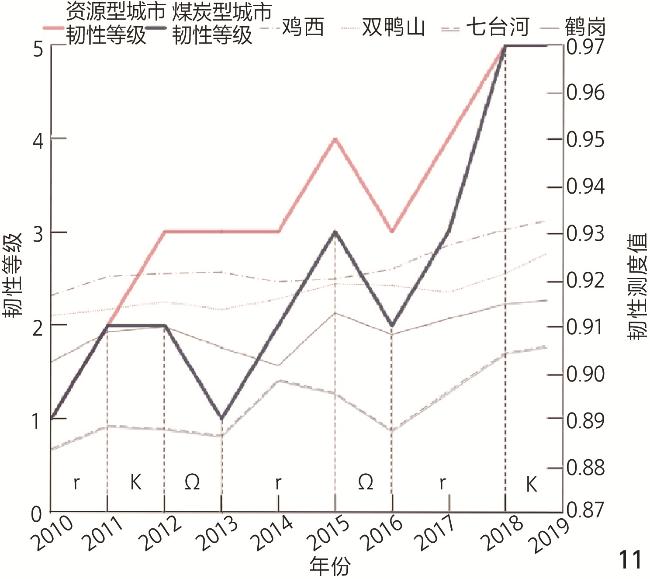
[Methods] This research measures the resilience of 9 resource-based cities in Heilongjiang Province (Daqing, Yichun, Mudanjiang, Heihe, Daxinganling, Hegang, Jixi, Shuangyashan, and Qitaihe cities) by integrating principal component analysis (PCA) and catastrophe progression method, while identifying dynamic evolution characteristics through the adaptive cycle framework. First, urban risk factors are summarized through field investigations and literature review, based on which a resilience evaluation index system is established, encompassing 4 dimensions, 12 primary indicators, 23 secondary indicators, and 59 tertiary indicators. Second, multi-source data (statistical yearbooks, spatial data, and government reports from 2010 to 2019 for nine cities) are collected, processed, and validated. Resilience values are quantified based on the integration of PCA and catastrophe progression method. Third, the adaptive cycle framework is applied to analyze resilience evolution patterns across three city types: petroleum-based, forestry-based, and coal-based types. The theoretical framework posits that resilience evolution follows a spiral process involving four phases: exploitation (r, rapid growth), conservation (K, stability), release (Ω, rapid decline), and reorganization (α, recovery). Notably, the release phase (Ω) serves as the critical juncture for cyclical transitions. Finally, tailored recommendations are proposed for each city type based on their unique evolutionary trajectories.
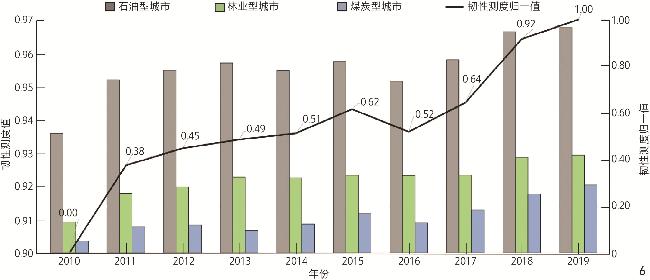
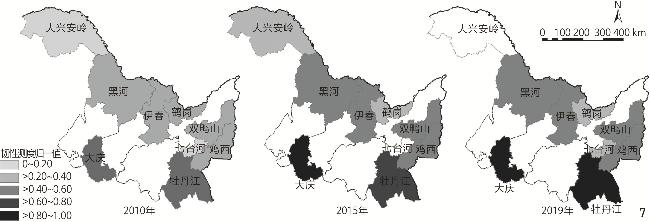
[Results] The findings reveal distinct hierarchical differentiation among various types of resource-based cities in Heilongjiang Province. 1) In terms of resilience measurement outcomes, overall resilience shows an upward trend with a temporary decline in 2016, attributed to external economic shocks. The spatial distribution of resilience exhibits a stepwise increase from north to south, reflecting geographic disparities in industrial structure and policy implementation. 2) In terms of resilience evolution characteristics, petroleum-based cities shows stepwise growth with fluctuations, influenced by global petroleum price volatility and domestic policy adjustments. Forestry-based cities show steady stepwise growth, driven by sustainable forestry practices and ecological compensation policies. Coal-based cities show significant volatility alongside upward trends, linked to cyclical coal market dynamics and green transition pressures. All cities have skipped the reorganization phase (α), transitioning directly from release phase (Ω) to exploitation phase (r), resulting in fragmented cycles dominated by national Five-Year Plans and policy interventions.
[Conclusion] The resilience evolution of resource-based cities in Heilongjiang Province has not undergone a complete four-phase adaptive cycle. Instead, these cities have transitioned directly from the release phase (Ω) to the exploitation phase (r), omitting the reorganization phase (α). Their evolutionary trajectory is heavily influenced by national Five-Year Plans and policy interventions, exhibiting three distinct characteristics: periodic discontinuity, policy dominance, and industrial heterogeneity. Therefore, this research proposes differentiated pathways for resilience enhancement based on these evolutionary characteristics: Petroleum-based cities should reduce inefficient redundant elements and enhance interconnectivity among components to facilitate a shift from a monolithic industrial structure toward economic diversification, thereby mitigating systemic collapse risks from structural homogeneity; forestry-based cities should rapidly accumulate diverse urban components (e.g., infrastructure, human capital, ecological assets) to increase systemic redundancy, strengthening endogenous drivers for resilience improvement; coal-based cities should leverage external shocks as transformative opportunities. It is supposed to, through comprehensive systemic repair and upgrading, vigorously develop new industrial and social elements to rebuild structural stability of the urban system. This research develops a tailored resilience quantification model based on the integration of PCA and catastrophe progression method and multi-year data, enriching methodological approaches for resilience research on China’s resource-based cities. The adaptive cycle framework reveals divergent evolution patterns across city types, emphasizing the need for differentiated strategies: Petroleum-based cities should prioritize market diversification, forestry-based cities should enhance ecological governance, and coal-based cities require accelerated green industrial transitions. These findings provide adaptable measurement references and quantitative tools to support sustainable development strategies for Heilongjiang Province, bridging gaps between theoretical frameworks and practical policymaking.
Zhuolin TAN , Ming LU , Wei DONG , Yu DONG . Resilience Measurement and Evolution Characteristics of Resource-Based Cities in Heilongjiang Province Based on Adaptive Cycle Framework from 2010 to 2019[J]. Landscape Architecture, 2025 , 32(10) : 61 -70 . DOI: 10.3724/j.fjyl.LA20250118
表1 黑龙江省资源型城市产业结构与经济的主要发展问题Tab. 1 Main industrial and economic development issues of resource-based cities in Heilongjiang Province |
| 分类 | 主要问题 | 具体表现 |
| 产业 结构 | 资源产业衰退明显 | 黑龙江省国有重点煤矿均濒临破产,资产负债率超80% |
| 第三产业发育不良 | 单一产业结构特征明显,如大庆市2011年第二产业占比高达82.2%,第三产业占比仅14.4% | |
| 对外流通环境不佳 | 资源型城市受全球资源市场低迷、资源商品翘尾以及新能源市场崛起等因素影响,主要资源产品市场萎缩,资源产业进一步衰退 | |
| 经济 | 公共财政赤字明显 | 政府财政赤字明显,2010年、2019年收支差额分别为−149.77亿元和−374.88亿元 |
| 居民收入水平较低 | 黑龙江省资源型城市2019年人均可支配收入29 278元,远低于全国平均水平42 359元 | |
| 经济下行态势明显 | 2010—2019年,石油型城市GDP增速由10.1%下降至3.54%,林业型城市平均GDP增速由18.5%下降至4.85%,煤炭型城市平均GDP增速由19.35%下降至5.12% |
表2 黑龙江省资源型城市社会及人口的主要发展问题Tab. 2 Main social and population development issues of resource-based cities in Heilongjiang Province |
| 分类 | 主要问题 | 具体表现 |
| 社会 | 城市管理职责不清 | “企业办社会”特征突出,国有企业改革后,城市管理体制权责问题一直未理顺 |
| 政府转型决策差异 | 当地政府在可持续发展政策限制下产生了决策和管理能力的差异 | |
| 人口 | 人口流失严重 | 2010—2019年9个资源型城市人口自然增长率平均值为−1.15% |
| 高层次人力供给不足 | 企业职工职业技能单一、高级技术型人才缺失、人才外流严重 | |
| 下岗职工保障不到位 | 存在拖欠国有企业职工养老、失业保险费等问题 | |
| 职工健康问题突出 | 矿业开采和森林采伐导致工人尘肺病、外伤甚至残疾等工伤和职业慢性病发生率高 |
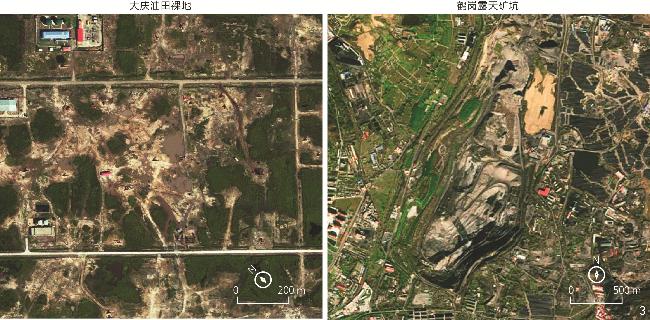
图3 2023年大庆油田裸地及鹤岗露天矿坑Fig. 3 Bare land in Daqing Oilfield and open-pit mines in Hegang in 2023 |
表3 黑龙江省资源型城市设施及环境与自然资源的主要发展问题Tab. 3 Main development issues with respect to facilities, environment, and natural resources of resource-based cities in Heilongjiang Province |
| 分类 | 主要问题 | 具体表现 |
| 城市 设施 | 交通设施分布不均衡 | 南部城市交通网络连通度较高,北部城市交通等级低,缺少快速交通 |
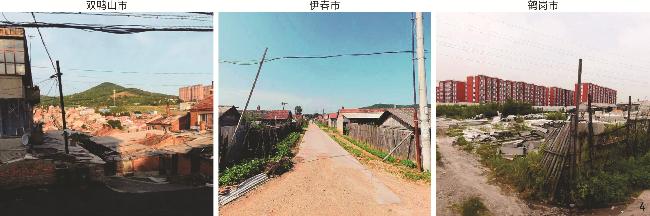
| 市政设施老旧破损 | 市政公用设施老旧破损程度严重,未得到及时维护和修缮,且棚户区问题突出 | |
| 公共服务设施不全面 | 林业型和煤炭型城市存在公共服务设施不全面问题,如鹤岗市2019年三甲医院数量仅为4个 | |
| 大型服务设施闲置 | 商场、运动馆和电影院等大型服务设施受经济下行而停业或关闭,产生大量闲置设施 | |
| 环境与自然 资源 | 城市绿地景观破碎化 | 石油开采产生大量点状裸地、煤炭开采产生大面积矿坑,割裂了城市景观连通性 |
| 环境污染尚未解决 | 石油和煤炭型城市废水、废气排放总量占全省50%以上 | |
| 矿产及森林资源枯竭 | 黑龙江省矿产资源已呈现明显枯竭趋势,森林资源出现可采林木资源枯竭迹象,如伊春市2010年森林蓄积量比1953年降低48.3百分点 | |
| 能源利用效率不高 | 东北地区冬季集体供暖多为传统能源,如煤和天然气等,增加了能源消耗 | |
| 生态环境退化凸显 | 油田开采区土地荒漠化程度高达95%,草地面积净减少约 | |
| 次生灾害频发 | 过度资源开采造成山体崩塌、地震等自然灾害,并形成滑坡、泥石流、地面塌陷等次生灾害 |
表4 黑龙江省资源型城市韧性测度指标体系Tab. 4 Resilience measurement indicator system for resource-based cities in Heilongjiang Province |
| 维度 | 一级指标 | 二级指标 | 三级指标 | 单位 | 方向i) | 维度 | 一级指标 | 二级指标 | 三级指标 | 单位 | 方向i) | |
| 注:a) 社会治安以刑事案件立案数表示;b) 公共安全以交通及火灾死亡人数表示;c) 资源型产业占比以林业及采矿业就业人数占总就业人数的比例表示;d) 国有和集体单位占比以国有和集体单位就业人数占总就业人数的比例表示;e) 金融机构存贷款差额=存款总额−贷款总额;f) 政府公共财政赤字率=(财政支出−财政收入)/GDP×100%;g) 主导资源禀赋同比变化=(当年资源产量−上年同期资源产量)/上年同期资源产量×100%,资源产量包含原油产量(万 t)、原煤产量(万 t)及活立木蓄积量(亿 m3);h) 综合能源消费量以2010—2019年用于工业生产的石油、煤炭产出能源折合成标准煤后进行汇总,不包含水电、核电、风电、太阳能电等清洁能源;i) +表示正向指标,−表示负向指标。 | ||||||||||||
| 社会韧性 | 制度 | 管理制度 | 社会治安a) | - | 基础设施韧性 | 生命线设施 | 工程性设施 | 供水管道长度 | km | + | ||
| 公共安全b) | - | 排水管道长度 | km | + | ||||||||
| 公共管理单位数量 | + | 天然气管道长度 | km | + | ||||||||
| 社会服务机构数量 | + | 照明设施数量 | + | |||||||||
| 政府决策 | 政府公开规范性文件数量 | + | 社会性设施 | 医院数量 | + | |||||||
| 政府公开信息数量 | + | 大型批发零售业数量 | + | |||||||||
| 人口 | 人口构成 | 自然增长率 | % | + | 大型住宿和餐饮业数量 | + | ||||||
| 年末总人口 | 万人 | + | 公共设施 | 公共服务设施 | 剧场和影院数量 | + | ||||||
| 人力资源 | 年末就业人数 | + | 运动场所数量 | + | ||||||||
| 研究与发展人员人数 | + | 小学数量 | + | |||||||||
| 社会保障 | 居民保障 | 居民基本医疗保险参保人数 | + | 中学数量 | + | |||||||
| 职工基本养老保险参保人数 | + | 交通设施 | 交通 | 公路线路长度 | km | + | ||||||
| 居民最低生活保障人数 | - | 每万人公共交通车辆拥有量 | + | |||||||||
| 万人失业率 | % | - | 人均城市道路面积 | m2 | + | |||||||
| 公共健康 | 卫生机构床位数量 | + | 通信 | 电信业务总量 | 亿元 | + | ||||||
| 执业医师数量 | + | 邮政业务总量 | 亿元 | + | ||||||||
| 经济韧性 | 产业结构 | 资源型产业 | 资源型产业占比c) | % | - | 环境与自然资源韧性 | 城市环境 | 城市绿地 | 建成区绿化覆盖率 | % | + | |
| 国有和集体单位占比d) | % | - | 绿地面积 | km2 | + | |||||||
| 产业构成 | 第一产业占比 | % | + | 废弃物 | 废水排放量 | 万 t | - | |||||
| 第二产业占比 | % | - | SO2排放量 | t | - | |||||||
| 第三产业占比 | % | + | 自然资源 | 自然资源 | 主导资源禀赋同比变化g) | % | + | |||||
| 经济资本 | 公共财政 | 金融机构存贷款差额e) | 亿元 | + | 禀赋 | 草地面积 | km2 | + | ||||
| 政府公共财政赤字率f) | % | - | 水域覆盖面积 | km2 | + | |||||||
| 居民收入 | 住户存款余额 | 万元 | + | 森林覆盖面积 | km2 | + | ||||||
| 居民人均可支配收入 | 元 | + | 能源消耗 | 综合能源消费量h) | 万 t | - | ||||||
| 经济发展 | 经济发展 | 人均GDP | 元 | + | 全社会用电量 | 万 kWh | - | |||||
| 地区GDP增长率 | % | + | 自然灾害 | 生态资源 | 湿地面积 | km2 | + | |||||
| 贸易流通 | 社会消费品零售总额 | 亿元 | + | 自然保护区数量 | + | |||||||
| 进出口总额 | 万美元 | + | 灾害风险 | 年降水量 | mm | - | ||||||
| 裸地面积 | km2 | - | ||||||||||
表5 本研究涉及的4种突变类型势函数及其分叉集方程Tab. 5 Potential functions and bifurcation set equations for the four catastrophe types |
| 突变类型 | 势函数 | 分叉集方程 | 归一化计算式 | 突变值计算式 |
| 注:$ x $为状态变量;$ a、b、c、d $为控制变量,需满足$ a > b > c > d $;$ {x}_{a}、{x}_{b}、{x}_{c}、{x}_{d} $分别表示控制变量$ a、b、c、d $的状态变量;$ {F}^\prime、{C}^\prime、{S}^\prime、B^\prime $分别表示通过折叠突变、尖点突变、燕尾突变、蝴蝶突变的突变值。 | ||||
| F | $ f\left(x\right)={x}^{3}+ax $ | $ a=-{3x}^{2} $ | $ {x}_{a}=\sqrt{a} $ | $ F^\prime=\sqrt{a} $ |
| C | $ f\left(x\right)={x}^{4}+{ax}^{2}+bx $ | $ a=-{6x}^{2} $,$ b=8{x}^{3} $ | $ {x}_{a}=\sqrt{a},x_b=\sqrt[3]{b} $ | $ C^\prime=(\sqrt{a}+\sqrt[]{b})/2 $ |
| S | $ f\left(x\right)={x}^{5}+{ax}^{3}+{bx}^{2}+cx $ | $ a=-{6x}^{2} $,$ b=8{x}^{3} $,$ c=-3x $ | $ {x}_{a}=\sqrt{a},{x}_{b}=\sqrt[]{b} $,$ {x}_{c}=\sqrt[]{c} $ | $ S^\prime=(\sqrt{a}+\sqrt[]{b}+\sqrt[]{c})/3 $ |
| B | $ f\left(x\right)={x}^{6}+{ax}^{4}+{bx}^{3}+{cx}^{2}+dx $ | $ a=-{10x}^{2} $,$ b=20{x}^{3} $,$ c=-15x $,$ d={4x}^{5} $ | $ {x}_{a}=\sqrt{a},{x}_{b}=\sqrt[]{b} $,$ {x}_{c}=\sqrt[]{c},{x}_{d}=\sqrt[]{d} $ | $ B^\prime=(\sqrt{a}+\sqrt[]{b}+\sqrt[]{c}+\sqrt[]{d})/4 $ |
表6 韧性测度等级划分Tab. 6 Classification of resilience measurement grades |
| 韧性等级 | 韧性程度 | 韧性测度值 | 韧性测度归一值 |
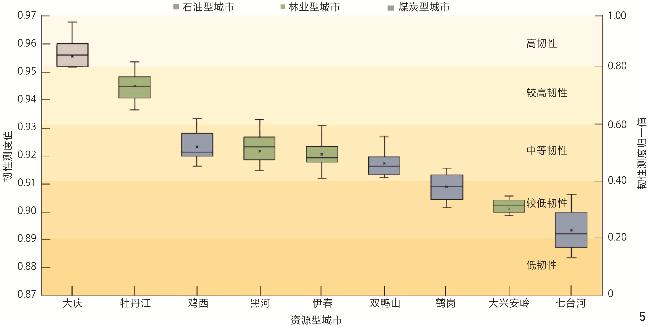
| 1 | 低韧性 | [0.884,0.899) | [0,0.20] |
| 2 | 较低韧性 | [0.899,0.912) | (0.20,0.40] |
| 3 | 中等韧性 | [0.912,0.933) | (0.40,0.60] |
| 4 | 较高韧性 | [0.933,0.952) | (0.60,0.80] |
| 5 | 高韧性 | [0.952,0.968 ] | (0.80,1.00] |
| [1] |
彭翀, 郭祖源, 彭仲仁. 国外社区韧性的理论与实践进展[J]. 国际城市规划, 2017, 32(4): 60-66.
PENG C, GUO Z Y, PENG Z R. Research Progress on the Theory and Practice of Foreign Community Resilience[J]. Urban Planning International, 2017, 32(4): 60-66.
|
| [2] |
刘佳燕, 沈毓颖. 面向风险治理的社区韧性研究[J]. 城市发展研究, 2017, 24(12): 83-91.
LIU J Y, SHEN Y Y. Research on Community Resilience Oriented to Risk Governance[J]. Urban Development Studies, 2017, 24(12): 83-91.
|
| [3] |
邵亦文, 徐江. 城市韧性: 基于国际文献综述的概念解析[J]. 国际城市规划, 2015, 30(2): 48-54.
SHAO Y W, XU J. Understanding Urban Resilience: A Conceptual Analysis Based on Integrated International Literature Review[J]. Urban Planning International, 2015, 30(2): 48-54.
|
| [4] |
汪辉, 徐蕴雪, 卢思琪, 等. 恢复力、弹性或韧性?: 社会-生态系统及其相关研究领域中“Resilience”一词翻译之辨析[J]. 国际城市规划, 2017, 32(4): 29-39.
WANG H, XU Y X, LU S Q, et al. A Comparative Study of Chinese Translation of Resilience Terminology in Socio-Ecological System and Its Related Research Fields[J]. Urban Planning International, 2017, 32(4): 29-39.
|
| [5] |
李彤玥. 韧性城市研究新进展[J]. 国际城市规划, 2017, 32(5): 15-25.
LI T Y. New Progress in Study on Resilient Cities[J]. Urban Planning International, 2017, 32(5): 15-25.
|
| [6] |
MEEROW S, NEWELL J P, STULTS M. Defining Urban Resilience: A Review[J]. Landscape and Urban Planning, 2016, 147: 38-49.
|
| [7] |
李彤玥. 基于弹性理念的城市总体规划研究初探[J]. 现代城市研究, 2017, 32(9): 8-17.
LI T Y. An Exploration of Comprehensive Planning Based on the Theory of Resilient Cities[J]. Modern Urban Research, 2017, 32(9): 8-17.
|
| [8] |
杨敏行, 黄波, 崔翀, 等. 基于韧性城市理论的灾害防治研究回顾与展望[J]. 城市规划学刊, 2016(1): 48-55.
YANG M X, HUANG B, CUI C, et al. Review and Prospect: Urban Disaster Resilience[J]. Urban Planning Forum, 2016(1): 48-55.
|
| [9] |
SHI Y J, ZHAI G F, XU L H, et al. Assessment Methods of Urban System Resilience: From the Perspective of Complex Adaptive System Theory[J]. Cities, 2021, 112: 103141.
|
| [10] |
HOLLING C S. Resilience and Stability of Ecological Systems[J]. Annual Review of Ecology and Systematics, 1973, 4: 1-23.
|
| [11] |
LI T, DONG Y X, LIU Z H. A Review of Social-Ecological System Resilience: Mechanism, Assessment and Management[J]. Science of The Total Environment, 2020, 723: 138113.
|
| [12] |
ZHANG L, HUANG Q X, HE C Y, et al. Assessing the Dynamics of Sustainability for Social-Ecological Systems Based on the Adaptive Cycle Framework: A Case Study in the Beijing – Tianjin – Hebei Urban Agglomeration[J]. Sustainable Cities and Society, 2021, 70: 102899.
|
| [13] |
夏陈红, 马东辉, 郭小东, 等. 适应性循环视角下的国土空间适灾韧性机理与规划响应研究[J]. 城市发展研究, 2024, 31(2): 44-52.
XIA C H, MA D H, GUO X D, et al. Research on Disaster Resilience Mechanism and Planning Response of Territorial Space from the Perspective of Adaptive Cycle[J]. Urban Development Studies, 2024, 31(2): 44-52.
|
| [14] |
LUO F H, LIU Y X, PENG J, et al. Assessing Urban Landscape Ecological Risk Through an Adaptive Cycle Framework[J]. Landscape and Urban Planning, 2018, 180: 125-134.
|
| [15] |
窦睿音.资源型城市循环经济发展路径研究基于机制、模式与评价角度[M].北京: 经济科学出版社, 2020.
DOU R Y. Research on the Development Path of Circular Economy in Resource-Based Cities[M]. Beijing: Economic Science Press, 2020.
|
| [16] |
毛蒋兴, 何邕健. 资源型城市生命周期模型研究[J]. 地理与地理信息科学, 2008, 24(1): 56-60.
MAO J X, HE Y J. Study on the Lifecycle Model of Resource-Intensive Cities[J]. Geography and Geo-Information Science, 2008, 24(1): 56-60.
|
| [17] |
YANG Y, FANG Y P, XU Y, et al. Assessment of Urban Resilience Based on the Transformation of Resource-Based Cities: A Case Study of Panzhihua, China[J]. Ecology and Society, 2021, 26(2): art20
|
| [18] |
余建辉, 李佳洺, 张文忠. 中国资源型城市识别与综合类型划分[J]. 地理学报, 2018, 73(4): 677-687.
YU J H, LI J M, ZHANG W Z. Identification and Classification of Resource-Based Cities in China[J]. Acta Geographica Sinica, 2018, 73(4): 677-687.
|
| [19] |
徐新良.中国人口空间分布公里网格数据集[DS/OL].资源环境科学数据注册与出版系统(2017-12-11)[2019-05-10]. https://www.resdc.cn/DOI/DOI.aspx?DOIID=32.
XU X L. China Population Spatial Distribution Kilometer Grid Dataset[DS/OL]. Resources and Environmental Sciences Data Registration and Publishing System (2017-12-11) [2019-05-10]. https://www.resdc.cn/DOI/DOI.aspx?DOIID=32.
|
| [20] |
张明斗, 冯晓青. 中国城市韧性度综合评价[J]. 城市问题, 2018(10): 27-36.
ZHANG M D, FENG X Q. Comprehensive Evaluation on Chinese Cities’ Resilience[J]. Urban Problems, 2018(10): 27-36.
|
| [21] |
The Rockefeller Foundation. City Resilience Framework[EB/OL]. (2014-06-01) [2022-12-10]. https://www.rockefellerfoundation.org/wp-content/uploads/100RC-City-Resilience-Framework.pdf.
|
| [22] |
BURTON C G. A Validation of Metrics for Community Resilience to Natural Hazards and Disasters Using the Recovery from Hurricane Katrina as a Case Study[J]. Annals of the Association of American Geographers, 2015, 105(1): 67-86.
|
| [23] |
ORENCIO P M, FUJII M. A Localized Disaster-Resilience Index to Assess Coastal Communities Based on an Analytic Hierarchy Process (AHP)[J]. International Journal of Disaster Risk Reduction, 2013, 3: 62-75.
|
| [24] |
LI Y, KAPPAS M, LI Y F. Exploring the Coastal Urban Resilience and Transformation of Coupled Human-Environment Systems[J]. Journal of Cleaner Production, 2018, 195: 1505-1511.
|
| [25] |
RENSCHLER C S, FRAZIER A E, ARENDT L A, et al. A Framework for Defining and Measuring Resilience at the Community Scale: The PEOPLES Resilience Framework[M]. Gaithersburg: NIST, 2010.
|
| [26] |
YANG J, HUANG X. The 30 m Annual Land Cover Dataset and Its Dynamics in China from 1990 to 2019[J]. Earth System Science Data, 2021, 13(8): 3907-3925.
|
| [27] |
张中浩, 聂甜甜, 高阳, 等. 长三角城市群生态安全评价与时空跃迁特征分析[J]. 地理科学, 2022, 42(11): 1923-1931.
ZHANG Z H, NIE T T, GAO Y, et al. Ecological Security Assessment and Spatio-Temporal Transition Characteristics in the Yangtze River Delta Urban Agglomeration[J]. Scientia Geographica Sinica, 2022, 42(11): 1923-1931.
|
/
| 〈 |
|
〉 |