

Scientific Greening, Landscape Colorization, and Spatial Verticalization: Exploration of the Action Framework and Construction Pathway for Garden City
|
LI Xiaoxi is a Ph.D. candidate in the School of Landscape Architecture, Beijing Forestry University. Her research focuses on landscape planning and design, and urban biodiversity |
|
LI Ting is a Ph.D. candidate in the School of Landscape Architecture, Beijing Forestry University. Her research focuses on landscape planning and design, and urban biodiversity |
|
ZHENG Xi, Ph.D., is dean of and a professor in the School of Landscape Architecture, Beijing Forestry University, and editor-in-chief of this journal. His research focuses on landscape planning and design |
Received date: 2025-07-30
Revised date: 2025-08-11
Online published: 2025-12-10
Copyright
[Objective] As cities enter the stage of stock optimization from expansion, improving urban quality and fostering harmonious coexistence between humans and nature have emerged as pressing priorities. Garden City construction, proposed by the capital, aims to systematically strengthen ecological resilience, improve public space quality, and raise residents’ satisfaction, forming a high-quality model integrating people, urban environment, industry, and green infrastructure. The “triple greening” approach — scientific greening, landscape colorization, and spatial verticalization — provides the technical foundation, driving urban transformation from gray to green spaces, two-dimensional to three-dimensional spaces, and closed to open spaces. Additionally, Garden City initiatives emphasize cross-departmental governance and multi-stakeholder collaboration. However, challenges remain, including limited public space resources with low utilization, unclear spatial ownership with fragmented responsibilities, and weak management and maintenance due to insufficient expertise and funding, all affecting construction quality. Therefore, developing an action framework and construction pathways grounded in the triple greening concept is vital to ensure effective implementation of Garden City projects.
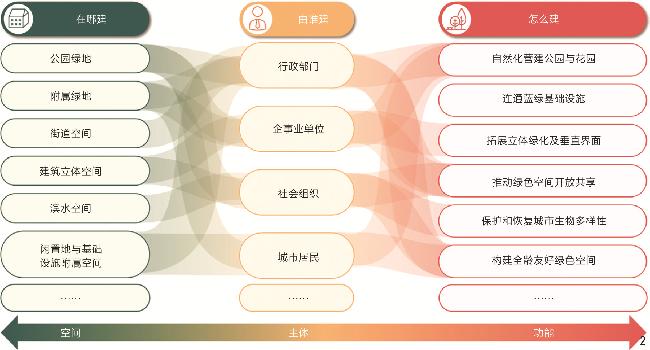
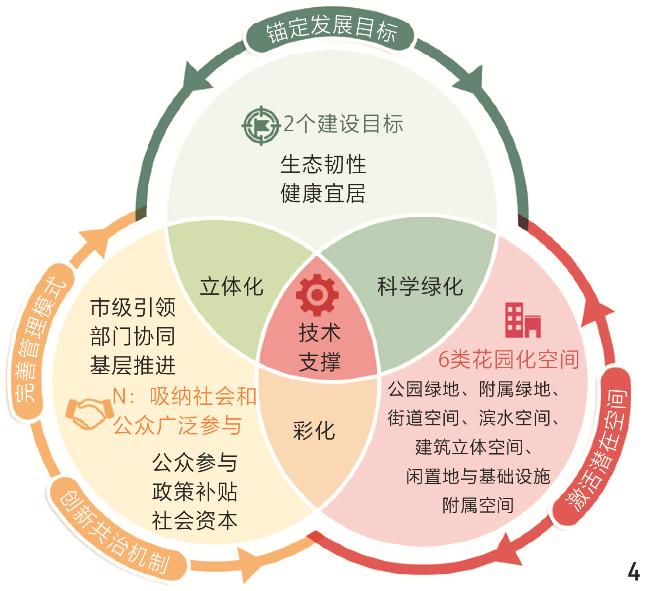
[Methods/process] This research employs a combined approach of policy review and empirical synthesis to systematically analyze national and Beijing municipal policies and practical experiences related to Garden City construction. Focusing on the core questions of “where to construct”, “who constructs” and “how to construct” garden spaces, the research develops an action framework based on the dimensions of space, actor, and function. The spatial dimension challenges the conventional perception of green space as limited to parks, expanding it to include parklands, gray infrastructure, and vertical building spaces as potential sites for garden development. The actor dimension clarifies the roles and collaborative relationships among government bodies, enterprises, communities, and the public across the full lifecycle of planning, construction, and maintenance, emphasizing multi-stakeholder participation. The functional dimension highlights the multifunctional roles of green spaces, including ecological regulation, aesthetic enhancement, public health promotion, and community governance, supported by corresponding technical strategies and institutional mechanisms. Based on this framework, and guided by the “triple greening” technical system, several pathways for Garden City construction are proposed from four dimensions: ecological foundation, city – garden integration, management models, and co-governance mechanisms.
[Results/conclusion] Four pathways for Garden City construction are proposed. 1) Establish a resilient ecological foundation. This pathway prioritizes optimizing ecosystem services and conserving biodiversity by integrating water bodies, green corridors, and urban forests into interconnected ecological networks. The use of native species, low-maintenance practices, and near-natural succession enables diverse urban spaces to support climate-resilient systems. 2) Promote city – garden integration and spatial openness. By enhancing greening quality, spatial verticalization, and colorized urban interfaces, this approach advances the ecological transformation of gray infrastructure. Mechanisms such as “de-fencing” and time-sharing access models enable shared green spaces and equitable access across communities. 3) Improve multi-level collaborative governance. A three-tier governance model, comprising municipal coordination, interdepartmental collaboration, and grassroots implementation, is established to ensure accountability across planning, construction, and maintenance. Digital tools and intelligent management systems are adopted to support full lifecycle governance of green infrastructure. 4) Innovate participatory co-construction mechanisms. A multi-actor engagement model is proposed involving government leadership, enterprise support, community co-building, and public participation. Through adoption programs, ecological education, and digital empowerment platforms, residents are encouraged to become active stewards in sustainable urban greening. The research demonstrates that advancing Garden City construction depends not merely on expanding green space quantitatively but on achieving a systematic transformation integrating shared understanding, coordinated spatial planning, and collaborative governance. Moving forward, Garden City development should be pursued as a comprehensive spatial quality enhancement strategy that extends beyond traditional green spaces to encompass streets, vertical interfaces, and gray infrastructure, embedding and functionally coupling green elements within the urban fabric. Moreover, the focus should shift from an exclusive emphasis on landscape aesthetics toward highlighting the multi-functional value of green spaces in enhancing ecological resilience, mitigating urban risks, and improving public welfare. Through sustained multi-actor collaboration and institutional innovation, Garden City can evolve from conceptual visions to high-quality, scalable realities. The proposed “space – actor – function” framework offers strong theoretical and practical guidance, demonstrating high local adaptability and replicability, and has the potential to significantly advance urban green transformation and contribute to ecological civilization under the new paradigm of sustainable urban development.
Xiaoxi LI , Ting LI , Xi ZHENG . Scientific Greening, Landscape Colorization, and Spatial Verticalization: Exploration of the Action Framework and Construction Pathway for Garden City[J]. Landscape Architecture, 2025 , 32(9) : 23 -29 . DOI: 10.3724/j.fjyl.LA20250458
表1 花园城市空间载体的类型、功能及适用技术Tab. 1 Types, functions, and applicable technologies of spatial carriers for Garden City |
| 空间载体类型 | 空间范畴 | 功能特征 | 建设与管理内容 | 适用绿化技术 |
| 公园绿地 | 包括综合公园、社区公园、专类公园、游园、郊野公园、森林公园、湿地公园等 | 是城市绿地系统的核心骨架,具备生态涵养、公共服务与景观功能 | 编制公园发展规划,审批设计方案;制定管理标准并监督服务质量;推进“无界公园”改造与绿地开放共享;组织资源调查与社区共建 | 科学绿化、彩化 |
| 附属绿地 | 包括居住区、企事业单位、学校、医院、商业区、办公区、产业园区等各类空间附属绿化 | 贴近居民日常生活,具备场所归属与日常使用特性 | 鼓励绿地对外开放,融入社区活动;推进公共服务设施营建;推动居民自主管养绿地与花园化改造;制定引导性绿化设计与养护标准 | 科学绿化、彩化、立体化 |
| 街道空间 | 包括街道公共空间、行道树、人行道、分车带、桥下空间等 | 是贯通绿道系统的结构性要素和改善街区微环境的重要载体 | 整合道路红线内外空间资源,统筹绿化断面设计;在高速/铁路两侧构建复层植物群落,推广绿荫车位;推行“街角微花园”“桥下口袋公园”等项目,实现“一桥一策”管理 | 科学绿化、彩化、立体化 |
| 建筑立体空间 | 包括屋顶、建筑立面、阳台、架空层等垂直与水平界面 | 是提升绿量、优化小气候与拓展绿化空间的重要载体 | 制定立体绿化技术导则与激励政策;推动绿屋顶、绿墙等系统化建设;提供财政补贴,鼓励企业与个人参与 | 科学绿化、彩化、立体化 |
| 滨水空间 | 包括河湖岸线、城市水渠与排涝通道等区域 | 是构建蓝绿通廊、提升生态系统服务的重要载体 | 实施生态护岸与岸线贯通工程;优化滨水绿道布局,融合生态修复与雨水管理功能;推动“亲水+亲绿”的复合型景观建设 | 科学绿化、彩化 |
| 闲置地与基础设施附属空间 | 包括城市中未被充分利用的边角地、闲置地、拆迁腾退地、废弃地,以及轨道交通、场站等基础设施的附属绿化空间 | 具备开发弹性大、权属多元等特点,是绿化增加与廊道连通的潜力空间 | 实施“见缝插绿”“边角花园”策略;鼓励结合临时性使用需求实施公共空间的一体化改造,打造低成本、可迁移、可持续的多样化绿地;整合景观营造与生态修复功能,促进空间的多元复合利用 | 科学绿化、彩化、立体化 |
| [1] |
人民日报评论员. 践行人民城市理念, 建设现代化人民城市[EB/OL]. (2025-07-16)[2025-07-28]. https://www.peopleapp.com/column/30049677041-500006378178.
People’s Daily commentator. Practicing People-Centered City Concept, Building Modern People’s City[EB/OL]. (2025-07-16)[2025-07-28]. https://www.peopleapp.com/column/30049677041-500006378178.
|
| [2] |
HOWARD E. To-Morrow: A Peaceful Path to Real Reform[M]. Cambridge, UK: Cambridge University Press, 2010.
|
| [3] |
傅凡, 李红, 赵彩君. 从山水城市到公园城市: 中国城市发展之路[J]. 中国园林, 2020, 36(4): 12-15.
FU F, LI H, ZHAO C J. From Shan-Shui City to Park City: The Way of City Development in China[J]. Chinese Landscape Architecture, 2020, 36(4): 12-15.
|
| [4] |
张桂莲, 仲启铖, 张浪. 面向碳中和的城市园林绿化碳汇能力建设研究[J]. 风景园林, 2022, 29(5): 12-16.
ZHANG G L, ZHONG Q C, ZHANG L. Research on Carbon Sink Capacity Construction via Urban Landscaping for Carbon Neutrality[J]. Landscape Architecture, 2022, 29(5): 12-16.
|
| [5] |
余敏江. “超前治理”: 城市管理的范式革命: 评《“花园城市”的“管”与“治”——新加坡城市管理的理念与实践》[J]. 理论与改革, 2017(4): 127-135.
YU M J. Advanced Governance: Urban Management Concept Formulated from Modern Science and Management Technology Platform: Comments on Management and Governance of the Garden City: Wisdom and Practice of Singapore’s Urban Management[J]. Theory and Reform, 2017(4): 127-135.
|
| [6] |
任斌斌, 商茹, 李芳, 等. 北京城市绿地近自然植物群落构建[J]. 生态学杂志, 2019, 38(10): 2911-2917.
REN B B, SHANG R, LI F, et al. Close-to-Nature Plant Community Construction in Urban Greenspace of Beijing[J]. Chinese Journal of Ecology, 2019, 38(10): 2911-2917.
|
| [7] |
丁水龙, 张璐, 陈海萍. 植物彩化在城市环境提升中的作用: 以杭州西湖风景名胜区G20峰会环境提升项目为例[J]. 中国园林, 2017, 33(2): 99-102.
DING S L, ZHANG L, CHEN H P. The Role of Plant Color in the Promotion of Urban Environment: Taking the Environment Improvement for the G20 Summit Hangzhou at the West Lake Scenic Area as the Example[J]. Chinese Landscape Architecture, 2017, 33(2): 99-102.
|
| [8] |
刘瑞雪, 李佳轩, 严仙友阳. 中国立体绿化政策发展与量化评价[J]. 中国城市林业, 2025, 23(1): 179-187.
LIU R X, LI J X, YAN X Y Y. Development and Quantitative Evaluation of China’s Three-Dimensional Greening Policies[J]. Journal of Chinese Urban Forestry, 2025, 23(1): 179-187.
|
| [9] |
中共北京市委生态文明建设委员会. 中共北京市委生态文明建设委员会关于印发《北京市关于科学绿化的实施方案》的通知[EB/OL]. (2022-04-01)[2025-07-28]. https://sthjj.beijing.gov.cn/bjhrb/index/xxgk69/zfxxgk43/fdzdgknr2/zcfb/szfgfxwj/325742110/index.html.
Beijing Municipal Committee for Ecological Civilization Construction. Notice on Issuing “Beijing Municipal Implementation Plan for Scientific Greening”[EB/OL]. (2022-04-01)[2025-07-28]. https://sthjj.beijing.gov.cn/bjhrb/index/xxgk69/zfxxgk43/fdzdgknr2/zcfb/szfgfxwj/325742110/index.html.
|
| [10] |
陈颖, 于淼, 马嘉, 等. 典型浅街峡谷布局及其植物配置模式春季花粉飞散特征模拟研究[J]. 生态学报, 2024, 44(1): 256-270.
CHEN Y, YU M, MA J, et al. Simulation Study on the Characteristics of Spring Pollen Scattering in Typical Shallow Street Canyon Layout and Plant Configuration Mode[J]. Acta Ecologica Sinica, 2024, 44(1): 256-270.
|
| [11] |
北京市园林绿化局(首都绿化委员会办公室). 北京城市绿化彩化三年行动计划(2024年—2026年)[EB/OL]. (2024-07-03)[2025-07-28]. https://yllhj.beijing.gov.cn/zwgk/ghxx/gh/202407/t20240711_3742922.shtml.
Beijing Municipal Administration Center of Parks and Greening (Capital Greening Committee Office). Three-Year Action Plan for Urban Greening and Colorization in Beijing (2024−2026)[EB/OL]. (2024-07-03)[2025-07-28]. https://yllhj.beijing.gov.cn/zwgk/ghxx/gh/202407/t20240711_3742922.shtml.
|
| [12] |
丰台园林. 丰台区“三师联动”助力花园城市建设取得实效[EB/OL]. (2025-06-20)[2025-07-28]. https://news.bjd.com.cn/2025/06/20/11205861.shtml.
Fengtai Landscaping. Fengtai District’s “Three-Expert Collaboration” Achieves Substantial Results in Garden City Construction[EB/OL]. (2025-06-20)[2025-07-28]. https://news.bjd.com.cn/2025/06/20/11205861.shtml.
|
| [13] |
DE SOUSA C A. Turning Brownfields into Green Space in the City of Toronto[J]. Landscape and Urban Planning, 2003, 62(4): 181-198.
|
| [14] |
刘悦来, 王奕辰, 崔灵楠. 公众参与城市微更新促进社区空间治理形成的策略研究: 以上海市东明路街道基层共生实践为例[J]. 中国园林, 2025, 41(4): 6-15.
LIU Y L, WANG Y C, CUI L N. Research on Strategies for Public Participation in Urban Micro-Regeneration to Promote the Formation of Community Space Governance: Taking the Grassroots Symbiosis Practice of Dongming Road Subdistrict in Shanghai as an Example[J]. Chinese Landscape Architecture, 2025, 41(4): 6-15.
|
| [15] |
BONTHOUX S, VOISIN L, BOUCHÉ-PILLON S, et al. More Than Weeds: Spontaneous Vegetation in Streets as a Neglected Element of Urban Biodiversity[J]. Landscape and Urban Planning, 2019, 185: 163-172.
|
| [16] |
侯晓蕾. 基于社区营造的城市公共空间微更新探讨[J]. 风景园林, 2019, 26(6): 8-12.
HOU X L. Exploration on Micro-Renewal of Urban Public Space Based on Community Building[J]. Landscape Architecture, 2019, 26(6): 8-12.
|
| [17] |
TAN K W. A Greenway Network for Singapore[J]. Landscape and Urban Planning, 2006, 76 1/2/3/4 45 66
|
| [18] |
SHANDAS V, HELLMAN D. Toward an Equitable Distribution of Urban Green Spaces for People and Landscapes: An Opportunity for Portland’s Green Grid[M]//NAKAMURA F, ed. Green Infrastructure and Climate Change Adaptation. Singapore: Springer Nature Singapore, 2022: 289-301.
|
| [19] |
LIM H S, LU X X. Sustainable Urban Stormwater Management in the Tropics: An Evaluation of Singapore’s ABC Waters Program[J]. Journal of Hydrology, 2016, 538: 842-862.
|
| [20] |
FRANK M, ZAUNBRECHER B S, HIMMEL S, et al. Bug City Life: Public Acceptance of Urban Insect-Friendly Meadows in Germany, Austria, and Switzerland[J]. Urban Forestry & Urban Greening, 2024, 99: 128426.
|
| [21] |
苏荣菲, 陈睿山, 郭晓娜. 城市社区更新中生物多样性的保护策略: 以上海市长宁区生境花园为例[J]. 生物多样性, 2023, 31(7): 194-207.
SU R F, CHEN R S, GUO X N. Conservation Strategies for Biodiversity in Urban Community Renewal: A Case Study of Habitat Garden in Changning District, Shanghai[J]. Biodiversity Science, 2023, 31(7): 194-207.
|
| [22] |
林良任, 陈莉娜, 福铭. 增进城市地区生物多样性: 以新加坡模式为例[J]. 风景园林, 2019, 26(8): 25-34.
LIM L Jim, CHAN L, HOCK BENG L A. Enhancing Biodiversity in Urban Areas: The Singapore Model[J]. Landscape Architecture, 2019, 26(8): 25-34.
|
| [23] |
张恒, 张艺川, 詹永杰, 等. 低碳城市建设背景下日本近20年屋顶绿化研究进展[J]. 广东园林, 2024, 46(5): 31-38.
ZHANG H, ZHANG Y C, ZHAN Y J, et al. Progress of Green Roofs Research in Japan in the Past 20 Years in the Context of Low Carbon City Construction[J]. Guangdong Landscape Architecture, 2024, 46(5): 31-38.
|
| [24] |
阎姝伊, 李晓溪, 李婷, 等. 开放共享背景下城市公园绿地建设举措与路径探索[J]. 风景园林, 2024, 31(2): 12-18.
YAN S Y, LI X X, LI T, et al. Exploration of Construction Measures and Paths for Urban Parks and Green Spaces Under the Background of Opening and Sharing[J]. Landscape Architecture, 2024, 31(2): 12-18.
|
| [25] |
上海市规划和自然资源局. 50余处单位附属绿地今年开放: 巧挖存量资源, 上海加快推动单位附属空间对外开放[EB/OL]. (2024-11-13)[2025-07-29]. https://ghzyj.sh.gov.cn/xh/20241118/88b6af4036aa4be894fc1a8ade178155.html.
Shanghai Municipal Planning and Natural Resources Bureau. More Than 50 Green Spaces Attached to Units to Be Opened This Year: Tapping into the Stock of Resources, Shanghai Accelerates the Opening Up of Spaces Attached to Units to the Outside World[EB/OL]. (2024-11-13)[2025-07-29]. https://ghzyj.sh.gov.cn/xh/20241118/88b6af4036aa4be894fc1a8ade178155.html.
|
| [26] |
WOLCH J R, BYRNE J, NEWELL J P. Urban Green Space, Public Health, and Environmental Justice: The Challenge of Making Cities ‘Just Green Enough’[J]. Landscape and Urban Planning, 2014, 125: 234-244.
|
| [27] |
常玮, 温佳浩, 郑开雄. 英国伦敦城市树木数字化及其对中国的启示[J]. 中国园林, 2023, 39(5): 80-85.
CHANG W, WEN J H, ZHENG K X. Digitalization of Urban Trees in London, UK and Its Enlightenment to China[J]. Chinese Landscape Architecture, 2023, 39(5): 80-85.
|
| [28] |
胡建兵, 李鑫欣. “百园百师工作营”为绿隔公园补短板[J]. 绿化与生活, 2023(10): 26
HU J B, LI X X. “Hundred Parks, Hundred Instructors” Workshop Program: Addressing Shortcomings in Green Buffer Parks[J]. Greening and Life, 2023(10): 26
|
/
| 〈 |
|
〉 |