

Operational Modes and Technical Points for Empowering Urban Park Green Spaces by Digital Technology
|
ZHANG Yang, Ph.D., is an associate professor in the School of Design, Shanghai Jiao Tong University. His research focuses on intelligent landscape, digital landscape scenario construction, landscape planning and design, and data-driven design |
|
LI Changlin, Master, is chief executive officer of Beijing DreamDeck Intelligent Technology Co., Ltd. His research focuses on intelligent landscape |
|
ZHANG Ninglu, Master, is an intelligent landscape architect in Beijing DreamDeck Intelligent Technology Co., Ltd. Her research focuses on intelligent landscape |
|
WU Fei, Master, is a solution engineer in China Unicom (Beijing) Industrial Internet Co., Ltd. Her research focuses on intelligent cultural tourism, and intelligent landscape |
Received date: 2024-12-31
Revised date: 2025-04-30
Online published: 2025-12-10
Copyright
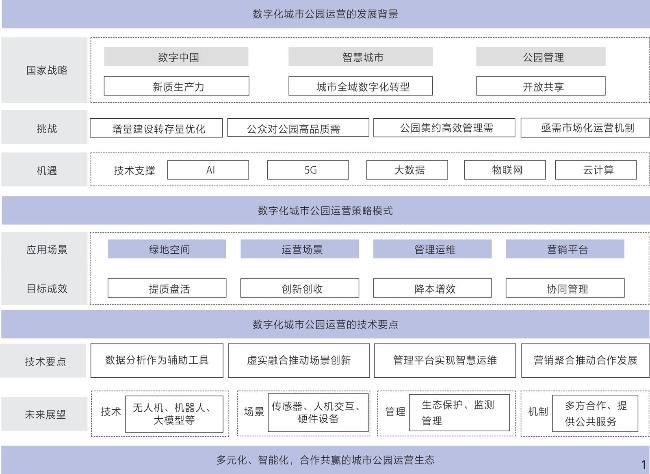
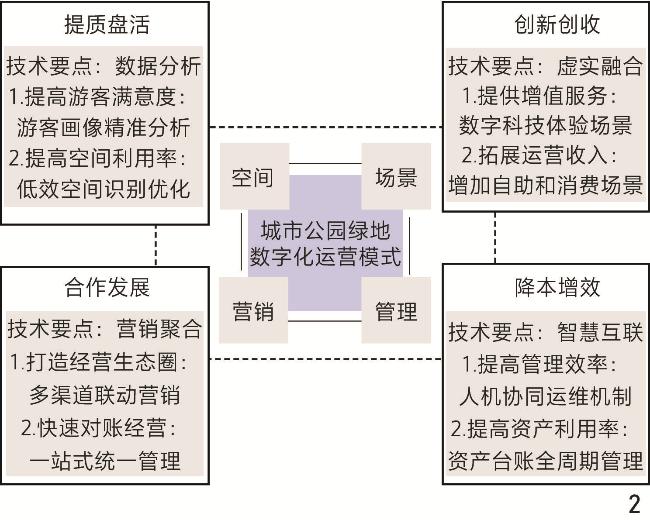
[Objective] As an important urban public open space, park green spaces bear multiple social functions such as ecology, recreation, and culture. Park services are evolving from being low-frequency and periodic to high-frequency and all-day, giving rise to the urgent need of the public for high-quality and diversified services. However, as a public welfare product, parks have long relied on government financial investment for operation and maintenance, and this traditional operation and maintenance mode exposes deep-seated contradictions of insufficient sustainability under the dual constraints of the downward economic pressure and the rising maintenance costs. This leads to an increasingly prominent contradiction between public demand and operation management. Therefore, against the backdrop of China’s encouragement of the open sharing of urban park green spaces, it is particularly important in the current economic situation to consider how to make better use of digital technologies such as artificial intelligence (AI), Internet of Things (IoT), and big data (BD) to empower the operation of park green spaces, further revitalize the advantageous resources of parks, promote the transformation of parks from “extensive management” to “precise services”, and enhance the “self-sustaining” function of parks through operation. Thus, this research focuses on the operational mode and implementation path of empowering the operation of urban park green spaces by digital technology, with the aim of providing scientific guidance for the future operation practice of park green spaces. [Methods/process] Space, scenario, management, and marketing are the four core elements of the operation of park green spaces. Space, as the physical carrier of operation, provides a place for people’s activities in parks; scenario focuses on the feelings and experiences of tourists in parks and is related to tourists’ satisfaction with parks; management covers the cost input of various resources in the operation process and plays a key role in the economic benefits of park operation; marketing involves the online and offline business operation logic of parks and directly affects the commercial revenue and market influence of parks. [Results/conclusion] Therefore, this research focuses on the above four aspects and divides the operational mode for empowerment by digital technology into the improvement and revitalization of green space, the creation of innovative consumption scenarios, the reduction of operation and maintenance costs and improvement of efficiency, and the improvement of unified revenue and expenditure in marketing. 1) Data-driven improvement and revitalization of space. Through the data-driven mode, accurately identify the inefficiently utilized space and potential demand gaps, and thus formulate targeted transformation strategies to achieve the coordinated improvement of tourists’ needs and space utilization efficiency. 2) Innovative experience in operation scenarios. Digital technology can help reconstruct the logic of scenario experience and consumption mode and. through immersive experience value addition and service efficiency enhancement, activate the integration of the functions and commercial value of park green spaces. 3) Cost reduction and efficiency improvement in operation and maintenance management. Through digital technologies such as AI, Large Language Model, and Big Data, improve the unmanned and automated level of the whole process of environmental event response, resource ledger management, and personnel scheduling to achieve cost reduction and efficiency improvement in park operation. 4) “Online + offline” coordinated management in marketing and operation. Based on data-driven construction of an “online + offline” integrated marketing management mode, through precise reach, business format linkage, and integration of digital platforms, achieve the optimization of tourists’ experience and the improvement of the commercial closed-loop efficiency, ultimately reducing costs and increasing revenue. Based on the above, four specific technical points for implementing the operational mode in reality are proposed as follows. 1) Multi-source data as an auxiliary tool for constructing accurate tourist portraits and optimizing space. Use data to complete the identification of tourists’ needs, diagnosis of inefficient spaces, and optimization and revitalization. 2) Integration of virtuality and reality to promote innovative operation scenarios. Digital technology can realize the immersive experience of integrating virtual and real scenarios, improve the cultural, ecological, and artistic values of parks, make the commercial operation lightweight by means of self-service and upgrading of consumption conversion efficiency, and thus construct a sustainable closed loop of revenue. 3) Construction of a management platform to achieve intelligent operation and maintenance. Through the construction of IoT foundation, data middle platform, and AI-driven platform intelligent agent, achieve intelligent operation and maintenance of parks. 4) Aggregation of traffic and integration of data to enhance operation efficiency. Vertically integrate consumption scenarios in depth, connect court services, equipment rental, and healthy catering support with the sports consumption chain, and connect outdoor science education, natural practice classes, and theme derivatives development with the parent – child consumption chain; besides, horizontally expand cross-domain cooperation, jointly build a ticket intercommunication and point conversion system with surrounding scenic spots and commercial entities, and activate the regional consumption synergy effect.
Yang ZHANG , Changlin LI , Ninglu ZHANG , Fei WU . Operational Modes and Technical Points for Empowering Urban Park Green Spaces by Digital Technology[J]. Landscape Architecture, 2025 , 32(6) : 29 -35 . DOI: 10.3724/j.fjyl.LA20240175
表1 体验型场景汇总Tab. 1 Summary of experiential scenarios |
| 场景类型 | 核心技术与设施 | 特色 | 关键效果/运营目标 | 案例 |
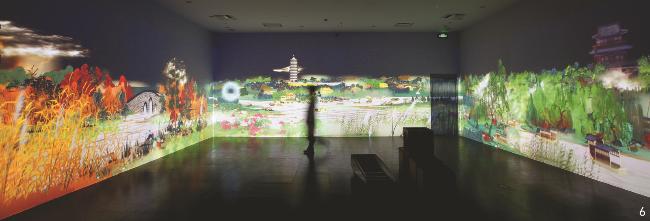
| 历史文化沉浸体验 | 虚实融合技术、互动投影、全息投影 | 与历史人物三维影像对话、历史场景互动还原 | 增强对公园文化内涵的理解和记忆,实现文旅融合 | 圆明园数字化复原工程,北京通州大运河景区, 山西运城永乐宫,苏州拙政园、沧浪亭 |
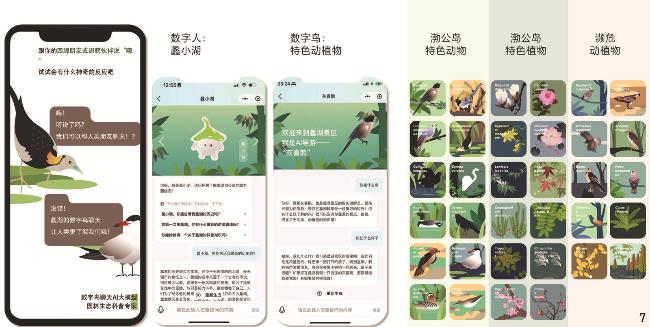
| 生态科普互动体验 | AR体验设施、科普积分 体系、声音感应装置、 智能体 | 自然知识科普互动;人机交互仿生装置、虚拟生态博物馆、积分兑换 文创奖励 | 实现科普教育与消费流量双向赋能[6] | 新加坡星耀樟宜“Jewel-rassic Quest”AR应用、新加坡滨海湾花园、无锡蠡湖渤公岛生态公园 |
| 艺术创意展示体验 | 光影艺术装置、裸眼3D、参数化共创界面 | 游客参与参数化艺术共创、沉浸式夜游IP(灯光节/光影秀) | 打造城市形象,贡献城市热度话题,拉动夜间经济[7] | 上海油罐艺术中心投影秀、上海西岸梦中心船坞《时光回廊》水帘投影秀 |
图6 历史文化沉浸体验场景——北京通州大运河森林公园互动投影沉浸式展厅Fig. 6 Historical and cultural immersive experience scenario — an immersive exhibition hall featuring interactive projection in Beijing Tongzhou Grand Canal Forest Park |
表2 自助型和消费型场景汇总Tab. 2 Summary of self-service-type and consumption-type scenarios |
| 场景类型 | 核心技术与设施 | 特色亮点 | 关键效果/运营目标 |
| 自助型场景 | 自助导览;自动售货、 无人售货、线上售卖平台 | 智能导览导航、推送特色优惠活动;无人售卖线上监控、线下推广 | 实时引流;拓展售卖渠道, 增加游览绑定黏性 |
| 消费型场景 | 线上预订系统、数字化 场地管理平台 | 场地线上预约定制(如主题活动包场)、数字化分时租赁(如设备/空间) | 提高场地利用率, 规范场地收入 |
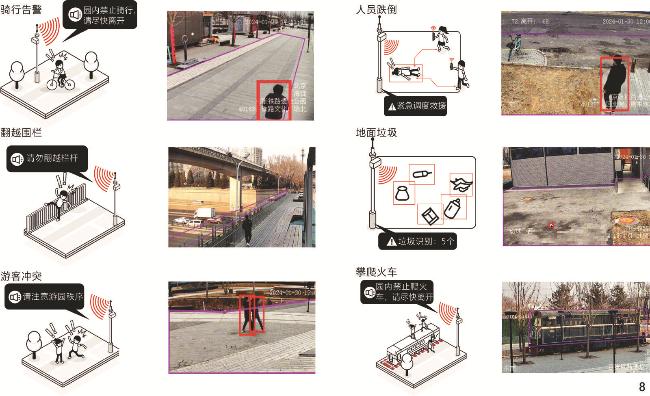
表3 北京京张铁路遗址公园智慧管理功能Tab. 3 Intelligent management function of Beijing Jingzhang Railway Heritage Park |
| 智慧管理 功能 | 安全 哨兵 | 保洁 哨兵 | 客流 哨兵 | 广播 哨兵 | 照明 哨兵 | 分期 功能 |
| 注:·代表功能对应的管理哨兵。 | ||||||
| 人行道骑车警告 | · | · | 已实现功能 | |||
| 攀爬火车 | · | · | ||||
| 翻越栏杆 | · | · | ||||
| 人员聚集 | · | · | · | |||
| 人流量统计 | · | · | ||||
| 人员冲突 | · | |||||
| 垃圾识别 | · | · | ||||
| 智能照明 | · | |||||
| 车辆随意停放 | · | 待实现功能 | ||||
| 宠物识别 | · | · | · | |||
| 噪声检测 | · | |||||
| [1] |
阎姝伊, 李晓溪, 李婷, 等. 开放共享背景下城市公园绿地建设举措与路径探索[J]. 风景园林, 2024, 31(2): 12-18.
YAN S Y, LI X X, LI T, et al. Exploration of Construction Measures and Paths for Urban Parks and Green Spaces Under the Background of Opening and Sharing[J]. Landscape Architecture, 2024, 31(2): 12-18.
|
| [2] |
梁佳宁, 李文竹, 李伟健, 等. 数字技术驱动的城市景观应用场景与实践路径[J]. 风景园林, 2023, 30(7): 29-35.
LIANG J N, LI W Z, LI W J, et al. Application Scenario and Practice Path of Urban Landscape Driven by Digital Technology[J]. Landscape Architecture, 2023, 30(7): 29-35.
|
| [3] |
成实, 张潇涵, 成玉宁. 数字景观技术在中国风景园林领域的运用前瞻[J]. 风景园林, 2021, 28(1): 46-52.
CHENG S, ZHANG X H, CHENG Y N. Prospect of the Application of Digital Landscape Technology in the Field of Landscape Architecture in China[J]. Landscape Architecture, 2021, 28(1): 46-52.
|
| [4] |
王忠杰, 吴岩, 景泽宇.公园化城, 场景营城: “公园城市”建设模式的新思考[J].中国园林, 2021, 37(S1): 7-11.
WANG Z J, WU Y, JING Z Y. Park-Oriented Urbanization, Scenario-Based City Building: New Perspectives on the Construction Model of "Park City"[J]. Chinese Landscape Architecture, 2021, 37(S1): 7-11.
|
| [5] |
张恩嘉, 龙瀛. 面向未来的数据增强设计: 信息通信技术影响下的设计应对[J]. 上海城市规划, 2022(3): 1-7.
ZHANG E J, LONG Y. Data Augmented Design for the Future Urban Space: Design Responses Influenced by Information and Communication Technology[J]. Shanghai Urban Planning Review, 2022(3): 1-7.
|
| [6] |
甲板智慧.无锡蠡湖渤公岛数字景观科普系统[EB/OL].(2024-06-06)[2024-12-30]. https://mp.weixin.qq.com/s/uuuvRfiWoGkJLz-8mu0APw.
DreamDeck. Digital Landscape Science System of Bogong Island in Wuxi[EB/OL]. (2024-06-06)[2024-12-30]. https://mp.weixin.qq.com/s/uuuvRfiWoGkJLz-8mu0APw.
|
| [7] |
姚丽敏, 陈文卿, 肖乐鑫.光影不熄, 徐汇夜幕下的艺术交响曲仍将延续[EB/OL].(2024-10-21)[2024-12-30]. https://www.shanghai.gov.cn/nw15343/20241021/db1d38b30fd34c48b9afb30bd3b7ea73.html.
YAO L M, CHEN W Q, XIAO L X. The Art Symphony of Xuhui Night will Continue Without the Light and Shadow[EB/OL]. (2024-10-21)[2024-12-30]. https://www.shanghai.gov.cn/nw15343/20241021/db1d38b30fd34c48b9afb30bd3b7ea73.html.
|
| [8] |
师卫华, 季珏, 张琰, 等. 城市园林绿化智慧化管理体系及平台建设初探[J]. 中国园林, 2019, 35(8): 134-138.
SHI W H, JI J, ZHANG Y, et al. Discussion on the Intelligent Management System and Platform Construction of Urban Landscaping[J]. Chinese Landscape Architecture, 2019, 35(8): 134-138.
|
| [9] |
张洋, 夏舫, 李长霖. 智慧公园建设框架构建研究: 以北京海淀公园智慧化改造为例[J]. 风景园林, 2020, 27(5): 78-87.
ZHANG Y, XIA F, LI C L. Research on the Construction Framework of Smart Park: A Case Study of Intelligent Renovation of Beijing Haidian Park[J]. Landscape Architecture, 2020, 27(5): 78-87.
|
| [10] |
郭湧. 论风景园林信息模型的概念内涵和技术应用体系[J]. 中国园林, 2020, 36(9): 17-22.
GUO Y. On the Concept and Technology Application System of Landscape Information Modeling[J]. Chinese Landscape Architecture, 2020, 36(9): 17-22.
|
| [11] |
蕾奥规划.深圳城市公园的388种玩法, 公园宇宙1.0版来啦[EB/OL].(2023-09-14)[2024-12-22]. https://mp.weixin.qq.com/s/DhKq3pE8s-FwOPkHnXdU6Q.
Rior Planning. The 388 Ways of Playing in Shenzhen City Park, The Park Universe Version 1.0 is Coming[EB/OL]. (2023-09-14)[2024-12-22]. https://mp.weixin.qq.com/s/DhKq3pE8s-FwOPkHnXdU6Q.
|
| [12] |
张洋, 李长霖, 吴菲. 数字化技术驱动下的交互景观实践与未来趋势[J]. 风景园林, 2021, 28(4): 99-104.
ZHANG Y, LI C L, WU F. Interactive Landscape Practice and Future Trends Driven by Digital Technology[J]. Landscape Architecture, 2021, 28(4): 99-104.
|
/
| 〈 |
|
〉 |