

Interpretation of Cultural Landscape Layering and Assessment of Heritage Value of Urban Historical Parks: A Case Study of Xiamen Zhongshan Park
|
LI Xufang is a Ph.D. candidate in the College of Architecture and Urban Planning (CAUP), Tongji University. Her research focuses on history and theory of landscape architecture and heritage protection |
|
ZHOU Xiangpin, Ph.D., is an associate professor in the College of Architecture and Urban Planning (CAUP), Tongji University. His research focuses on history and theory of landscape architecture and heritage protection, and culture landscape |
|
WENG Feifan is a Ph.D. candidate in the College of Landscape Architecture and Art, Fujian Agriculture and Forestry University. His research focuses on rural landscape heritage protection |
Received date: 2024-11-15
Revised date: 2025-05-05
Online published: 2025-12-10
Copyright
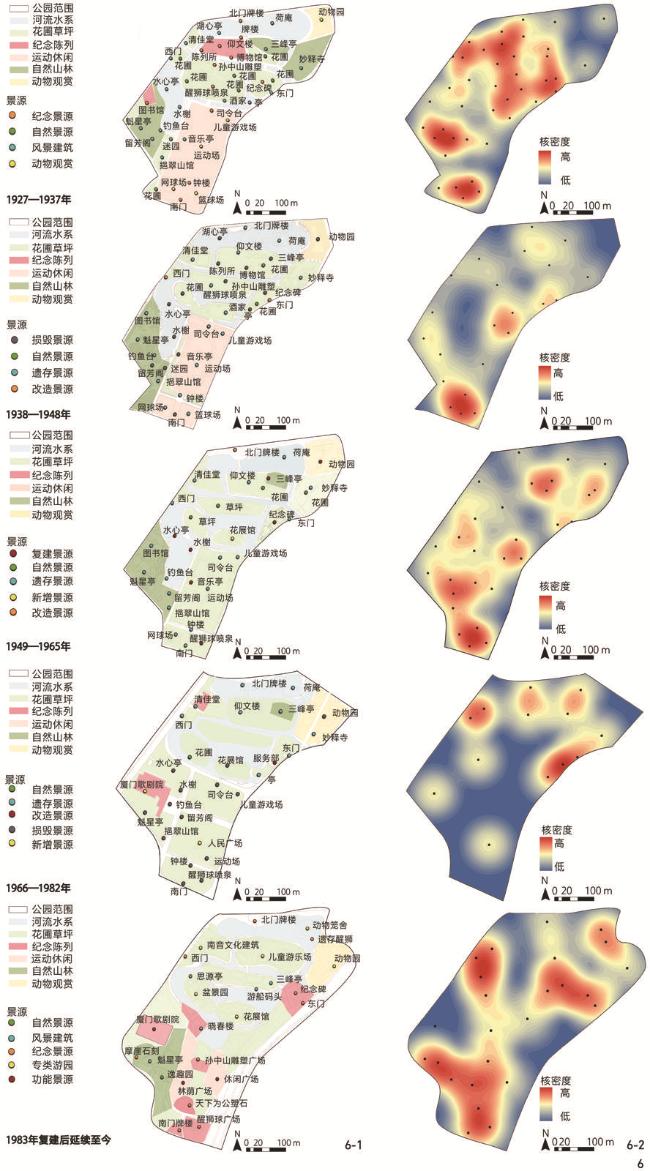
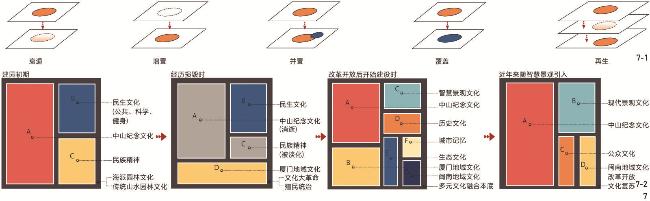
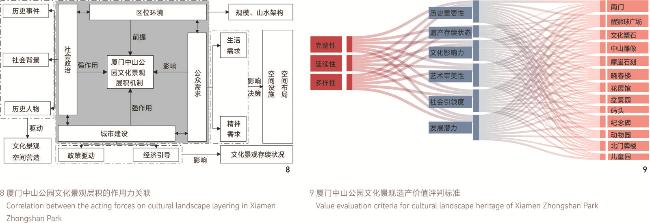
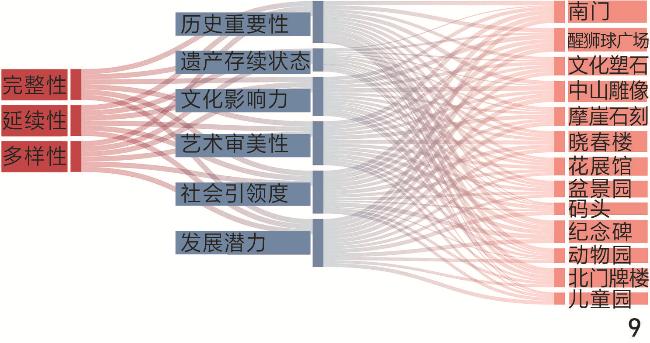
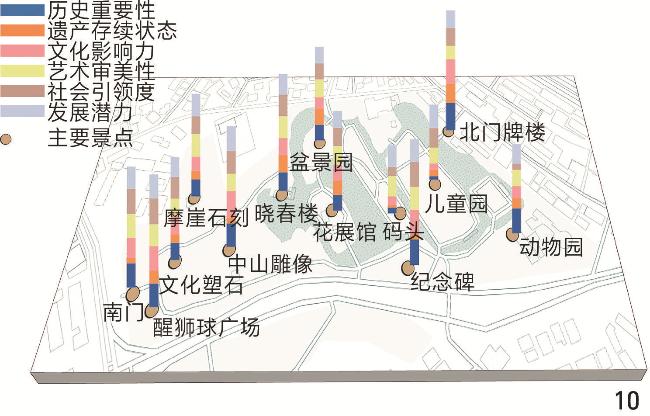
[Objective] Expanding the coverage of territorial spatial planning to the whole territory and all elements provides an opportunity for the protection and development of historical heritage. The evolution of the cultural landscape of urban historical parks, an urban cultural heritage and an important territorial space, is a medium for the transformation, continuation and reconstruction of the modern city. Under the value orientation of the heritage protection system, strengthening the spatial connection and temporal order among heritage resources can cope with the dilemma of spatial homogenization and fragmentation of the cultural landscape. [Methods] This research takes Xiamen Zhongshan Park (the “Park”) as an example for the interpretation and value assessment of the historical layering process. It constructs a cultural landscape heritage layering model of Xiamen Zhongshan Park by combining ancient literature and the spatial interpretation of ancient maps, and employing the historic urban landscape (HUL) method. By systematically analyzing the characters of the cultural landscape, the distribution patterns of the kernel density of cultural landscape, the layering pattern, and the dynamic superposition of cultural connotations in different periods, the research analyzes the dynamics of the layering evolution of the Park’s cultural landscape. Through expert scoring, the historical importance and cultural influence, artistic aesthetics, social leadership, development potential, and heritage survival status of the cultural landscape heritage of Xiamen Zhongshan Park are assessed, and the value attributes (mainly ontological and reuse values) of such cultural landscape heritage are interpreted by constructing an assessment system. [Results] This research shows that the layering evolution of cultural landscape in Xiamen Zhongshan Park went through five periods. The initial construction in the germination period formed a preliminary cultural landscape layering space of memorial, natural and landscape scenery sources, as well as special gardens, with cultural scenery sources distributed in a concentrated pattern across the northern, central, and southern areas of the Park. During the destruction period, the development of Xiamen Zhongshan Park stagnated due to the strong force of political power. During the recovery period, the purpose of park construction was to restore the original appearance and maintain the original functions on the basis of adding public facilities of commemorative significance, in an attempt to enhance the Park’s landscape and educational nature. During the recession period, with only some natural and landscape scenery sources remaining, showing a layering state of accumulation in the north and disappearance in the south. During the revival period, the memorial scenery sources, scenic buildings, and special gardens showed a uniform distribution of layering. The spatial functions of cultural landscapes are diversified, forming a multi-integrated cultural landscape layering state. By combing the characters of cultural landscape and the kernel density of cultural landscape distribution in different periods of the Park, the cultural landscape information of multiple periods is superimposed to generate a layering slicing map and a cultural connotation evolution map of the map. According to the results of the layering interpretation, five layering modes of recession, augmentation, juxtaposition, coverage, and regeneration of Xiamen Zhongshan Park are refined, and multiple layering modes are superimposed on each other in the continuous and dynamic evolution of the Park from the modern era to the present day. By retracing the evolution of the Park’s cultural landscape, the driving factors affecting the layering evolution of the Park’s cultural landscape are extracted. The location environment determines the Park’s landscape architecture, forming the initial state of the cultural landscape layering, the public’s demand influences the creation of space in the Park with the change of the times and thus affects the layering evolution, and the urban construction and social politics play a strong role in the layering of cultural landscape through relevant historical, economic, and political elements. In addition, the historical importance, cultural influence, artistic aesthetics, social leadership, and development potential of the Park’s scenic spots are significantly higher than their heritage survival status, which is related to the transformation of the elements in the cultural landscape layering model of Xiamen Zhongshan Park. In view of this, it is necessary to link the natural and cultural heritage resources in the Park, establish a systematic framework for interpreting the value of heritage, and revitalize the styles and features of historical landscapes. [Conclusion] This research examines Xiamen Zhongshan Park as a living cultural landscape heritage, and explores the processes, patterns, and mechanisms of cultural landscape heritage superposition across different periods from a dynamic evolutionary perspective. By taking a holistic view of the Park’s heritage value and evolution, this research aims to establish an assessment system for assessing the values and identifying its defining characteristics of the Park’s cultural landscape heritage. The findings seek to inform strategies for the scientific management, comprehensive protection, and sustainable development of urban historical parks. Xiamen Zhongshan Park is not only a historical cultural artifact but also a symbol of urban heritage and modern identity. Analyzing the mechanisms of cultural landscape characterization and value assessment from the perspective of temporal accumulation offers a comprehensive approach to preserving value continuity and supporting the organic renewal of this historic park, bridging territorial spatial planning with heritage preservation.
Xufang LI , Xiangpin ZHOU , Feifan WENG . Interpretation of Cultural Landscape Layering and Assessment of Heritage Value of Urban Historical Parks: A Case Study of Xiamen Zhongshan Park[J]. Landscape Architecture, 2025 , 32(6) : 132 -141 . DOI: 10.3724/j.fjyl.LA20240043
① 城市历史景观/历史性城市景观(historic urban landscape, HUL),2011年在联合国教科文组织(UNESCO)的《关于城市历史景观的建议书》中作为名词概念被提出,而后演化为动词用于研究历史景观遗产的层积性。
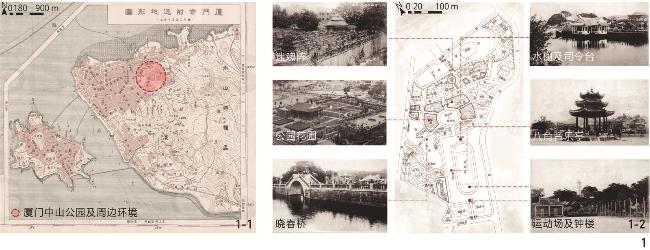
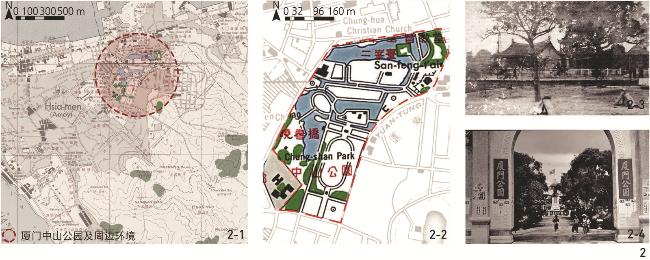
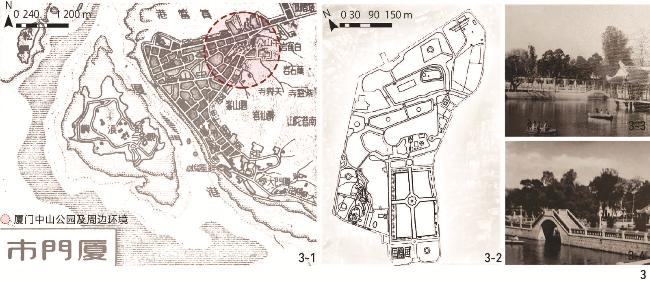
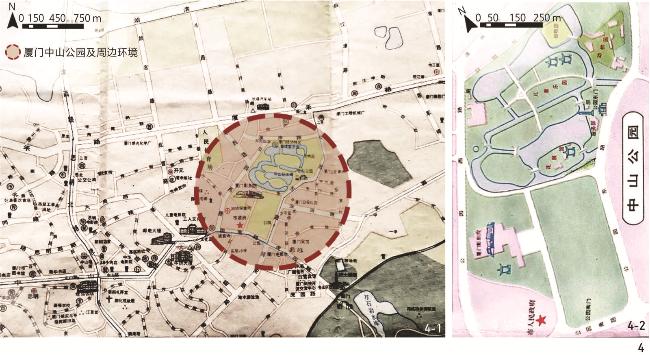
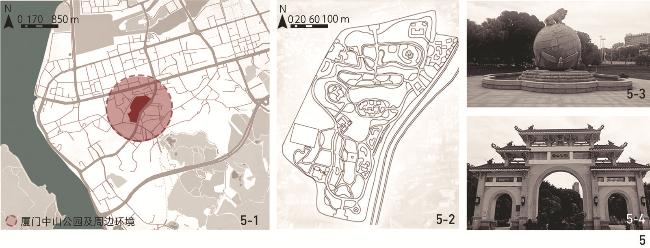
文中图片均由作者拍摄、绘制,其中图1-1、2-1、2-2、3-1底图来自睿恩古地图网站,图1-2平面图来自参考文献[36],图1-2中的景点照片以及图2-3、2-4由公众号客鹭社负责人提供,林鸿东收藏,图3-2底图来自参考文献[40],图3-3、3-4引自参考文献[41],图4-1、4-2为福建省图书馆收藏的20世纪80年代厦门旅游地图,图5-1底图来自规划云网站(2024年),图5-2底图来自高德地图(2024年)。由于历史地图的特殊性,文中
| [1] |
新华社.习近平: 高举中国特色社会主义伟大旗帜 为全面建设社会主义现代化国家而团结奋斗: 在中国共产党第二十次全国代表大会上的报告[EB/OL].(2022-10-25)[2023-11-10]. https://www.gov.cn/xinwen/2022-10/25/content_5721685.htm.
Xinhua News Agency. Hold High the Great Banner of Socialism with Chinese Characteristics and Unite and Strive for the Comprehensive Construction of a Modern Socialist Country: Report at the 20th National Congress of the Communist Party of China[EB/OL]. (2022-10-25)[2023-11-10]. https://www.gov.cn/xinwen/2022-10/25/content_5721685.htm.
|
| [2] |
ICOMOS-IFLA. Document on Historic Urban Public Parks[R]. Delhi: ICOMOS-IFLA, 2017.
|
| [3] |
ICOMOS. The Florence Charter[R]. Florence: ICOMOS, 1982.
|
| [4] |
UNESCO. Recommendation on the Historic Urban Landscape[R]. Paris: UNESCO, 2011
|
| [5] |
GINZARLY M, TELLER J. The Historic Urban Landscape Approach to Urban Management: A Systematic Review[J]. International Journal of Heritage Studies, 2019, 25(10): 999-1019.
|
| [6] |
裴昱, 杨锐, 党安荣. 基于城市历史景观方法的榆林古城历史层积过程解译与价值评估[J]. 城市发展研究, 2022, 29(7): 128-136.
PEI Y, YANG R, DANG A R. Historic Layering Process Interpretation and Value Assessment of the Ancient City of Yulin Based on Historic Urban Landscape Approach[J]. Urban Development Studies, 2022, 29(7): 128-136.
|
| [7] |
李旭芳, 周向频, 吴怡婧, 等. 文化景观视角下的历史公园风貌演化研究进展及趋势[J]. 园林, 2024, 41(3): 69-77.
LI X F, ZHOU X P, WU Y J, et al. Progress and Trends of Research on Style and Feature Evolution of Historical Parks from the Perspective of Cultural Landscape[J]. Landscape Architecture Academic Journal, 2024, 41(3): 69-77.
|
| [8] |
ATHANASIADOU E. Historic Gardens and Parks Worldwide and in Greece: Principles of Acknowledgement, Conservation, Restoration and Management[J]. Heritage, 2019, 2(4): 2678-2690.
|
| [9] |
BAZAC T, MARIN S, OLTEANU C, et al. Sustainable Management Decisions for Urban Historical Parks: A Case Study Based on Online Referential Values of Carol I Park in Bucharest, Romania[J]. Sustainability, 2023, 15(19): 14456
|
| [10] |
HÜTTL R F, DAVID K, SCHNEIDER B U. Historic Gardens and Climate Change: Insights, Desiderata and Recommendations[M]. Berlin: De Gruyter Akademie Forschung, 2019.
|
| [11] |
ESICHAIKUL R, CHANSAWANG R. Community Participation in Heritage Tourism Management of Sukhothai Historical Park[J]. International Journal of Tourism Cities, 2022, 8(4): 897-911.
|
| [12] |
KIM E J. The Historical Landscape: Evoking the Past in a Landscape for the Future in the Cheonggyecheon Reconstruction in South Korea[J]. Humanities, 2020, 9(3): 113
|
| [13] |
ŞENGÜR Ş, NURLU E. Historic Landscape Characterization in Protected Areas; A Case Study Kazdagı National Park[J]. Journal of Agricultural Sciences, 2021, 27(1): 106-113.
|
| [14] |
EMGE D, KLEESPIES M W, WENZEL V. Measuring Attitudes Towards Historic Gardens: Development and Validation of the Garden Heritage Scale[J]. Humanities and Social Sciences Communications, 2024, 11: 911
|
| [15] |
CEKULE M, BALTMANE I. The Evaluation of the Attractiveness of the Urban Historic Parks[C]//19th International Multidisciplinary Scientific GeoConference SGEM 2019. Bulgaria: STEF92 Technology, 2019: 1013-1020.
|
| [16] |
BAYRAMOVA V, KRYUKOVSKIY A, KUPRIIANOVA A, et al. Modern Problems of Historical Parks Recreational Potential Comprehensive Assessment[J]. IOP Conference Series: Earth and Environmental Science, 2021, 876(1): 012011
|
| [17] |
张志恩. 鲁迅公园的历史沿革与历史评价[J]. 中国园林, 1996, 12(4): 22-24.
ZHANG Z E. History and Historical Evaluation of Luxun Park[J]. Chinese Landscape Architecture, 1996, 12(4): 22-24.
|
| [18] |
陈枫, 周向频. 西风东渐和政治异化下的宁波近代园林勃兴与转型[J]. 中国园林, 2013, 29(10): 110-116.
CHEN F, ZHOU X P. The Boom and Transition of Modern Garden in Ningbo Under the Condition of Political Ideology Heterization and Western Culture Influence[J]. Chinese Landscape Architecture, 2013, 29(10): 110-116.
|
| [19] |
周向频. 20世纪遗产视角下的中国近现代城市公园保护与发展[J]. 中国园林, 2013, 29(12): 67-70.
ZHOU X P. Study on the Conservation and Development of Chinese Modern Urban Gardens From the Perspective of 20th Century Heritage[J]. Chinese Landscape Architecture, 2013, 29(12): 67-70.
|
| [20] |
刘珊珊, 黄晓. 由私及公: 社会文化视角下的无锡近代园林转型[J]. 风景园林, 2020, 27(2): 20-25.
LIU S S, HUANG X. From Private to Public: A Socio-Cultural Study on the Transformation of Modern Gardens in Wuxi[J]. Landscape Architecture, 2020, 27(2): 20-25.
|
| [21] |
戴代新, 陈语娴, 戴开宇, 等. 城市历史公园计算机三维可视化研究: 上海复兴公园1926年至1935年历史场景复原[J]. 建筑遗产, 2019(3): 105-113.
DAI D X, CHEN Y X, DAI K Y, et al. Three-Dimensional Visualisation of Historic Urban Parks: Scene Restoration of Shanghai’s Fuxing Park From 1926 to 1935[J]. Heritage Architecture, 2019(3): 105-113.
|
| [22] |
肖竞, 吴国玉, 吕妍, 等. 公共文化视角下城市历史公园遗产价值的多尺度识别与统筹保护[J]. 风景园林, 2023, 30(8): 111-118.
XIAO J, WU G Y, LYU Y, et al. Multi-scale Identification and Coordinate Preservation of Heritage Values of Historic Urban Public Parks from the Perspective of Public Culture[J]. Landscape Architecture, 2023, 30(8): 111-118.
|
| [23] |
周向频, 陈路平. 基于遗产价值评估的历史公园更新策略[J]. 风景园林, 2021, 28(6): 50-55.
ZHOU X P, CHEN L P. Historical Park Renewal Strategies Based on Heritage Value Assessment[J]. Landscape Architecture, 2021, 28(6): 50-55.
|
| [24] |
雷泽鑫, 罗俊杰, 冯雅茹, 等. 基于网络点评数据的天津北宁公园文化感知分析[J]. 风景园林, 2023, 30(S2): 99-105.
LEI Z X, LUO J J, FENG Y R, et al. Analysis of Cultural Perception of Beining Park in Tianjin Based on Online Review Data[J]. Landscape Architecture, 2023, 30(S2): 99-105.
|
| [25] |
张志远, 王玏. 基于不同人群话语分析的城市历史景观层积机制研究: 以襄阳为例[J]. 中国园林, 2022, 38(7): 121-126.
ZHANG Z Y, WANG L. The Layering Mechanism of Historic Urban Landscape Based on Discourse Analysis of Different Populations: A Case Study of Xiangyang[J]. Chinese Landscape Architecture, 2022, 38(7): 121-126.
|
| [26] |
LI X F, ZHOU X P, WENG F F, et al. Evolution of Cultural Landscape Heritage Layers and Value Assessment in Urban Countryside Historic Districts: The Case of Jiufeng Sheshan, Shanghai, China[J]. Heritage Science, 2024, 12: 96
|
| [27] |
李和平, 付鹏. 城镇历史景观的层积规律解译及保护方法研究: 以重庆龙兴古镇为例[J]. 中国园林, 2020, 36(4): 49-54.
LI H P, FU P. The Interpretation and Preservation Strategies of the Layering Laws of Historic Urban Landscape[J]. Chinese Landscape Architecture, 2020, 36(4): 49-54.
|
| [28] |
UNESCO. Operational Guidelines for the Implementation of the World Heritage Convention[R]. Paris: UNESCO, 1996.
|
| [29] |
DREIJA K. Historic Gardens and Parks: Challenges of Development in the Context of Relevant Regulations, Definitions and Terminology[J]. Mokslas − Lietuvos Ateitis/Science − Future of Lithuania, 2012, 4(2): 167-175.
|
| [30] |
潘莹, 张倩, 施瑛. 梅州松口古镇历史景观的“锚固-层积” 解译[J]. 南方建筑, 2023(12): 87-95.
PAN Y, ZHANG Q, SHI Y. Analysis of “Anchoring – Layering” in the Historic Landscape of Songkou Ancient Town, Meizhou, China[J]. South Architecture, 2023(12): 87-95.
|
| [31] |
SAUER C O. The Morphology of Landscape[M]. Berkeley: University of California Press, 1925.
|
| [32] |
肖竞, 马春叶, 曹珂. 公共文化视角下城市历史公园景观演变、层积分析与遗产价值识别: 以重庆市沙坪公园为例[J]. 当代建筑, 2021(11): 39-42.
XIAO J, MA C Y, CAO K. Landscape Evolution and Layering Analysis and Heritage Value Identifying of Historic Urban Public Parks Under the Civic Cultural Perspective: A Case Study of Shaping Park in Chongqing[J]. Contemporary Architecture, 2021(11): 39-42.
|
| [33] |
朱钧珍.中国近代园林史: 上篇[M].北京: 中国建筑工业出版社, 2012.
ZHU J Z. History of Modern Gardens in China: Part I[M]. Beijing: China Architecture & Building Press, 2012.
|
| [34] |
王艳婷, 彭长歆. 中山纪念与市政改良: 岭南近代中山公园的创建[J]. 中国园林, 2024, 40(1): 138-144.
WANG Y T, PENG C X. The Commemoration of Sun Yat-Sen and Municipal Improvement: The Creation of Zhongshan Parks in Modern Lingnan Area[J]. Chinese Landscape Architecture, 2024, 40(1): 138-144.
|
| [35] |
TANG L N, ZHAO Y, YIN K, et al. Xiamen[J]. Cities, 2013, 31: 615-624.
|
| [36] |
漳厦海军警备司令部. 厦门中山公园计划书[M].厦门: 漳厦海军警备司令部, 1927
Zhangxia Naval Police Command. Xiamen Zhongshan Park Plan[M]. Xiamen: Zhangxia Naval Police Command, 1927.
|
| [37] |
LI X F, ZHOU X P, WENG F F, et al. Acculturation and translation: Modern Architectural Heritage of Zhongshan Park in Xiamen from Typological Perspective[J]. Frontiers of Architectural Research, 2024, 13(3): 613-624.
|
| [38] |
王凯来.亚洲视域下中山公园的景观价值感知与影响机制研究[D].天津: 天津大学, 2019.
WANG K L. Studies on Landscape Value Perceptions and Influencing Mechanism of Sun Yat-Sen Parks in Asia[D]. Tianjin: Tianjin University, 2019.
|
| [39] |
李向群.见证: 1938厦门日寇入侵厦门前后报刊史料汇编[M].厦门: 厦门大学出版社, 2015.
LI X Q. Witness: A Compilation of Historical Materials of Newspapers Before and After the Japanese Invasion of Xiamen in 1938[M]. Xiamen: Xiamen University Press, 2015.
|
| [40] |
王婧.城市历史公园与文化景观保护: 厦门近代中山公园研究[D].厦门: 华侨大学, 2013.
WANG J. The Protection of Urban Historic Park and Cultural Landscape: The Study of Xiamen Early Modern Zhongshan Park[D]. Xiamen: Huaqiao University, 2013.
|
| [41] |
肆意凡尘.老照片: 20世纪50—60年代福建厦门[EB/OL].(2024-11-18)[2025-01-23]. https://mp.weixin.qq.com/s/ehKM0MpGWymRnZHfX91awg.
Si yi fan chen. Old Photos: Xiamen, Fujian in the 1950s and 1960s[EB/OL]. (2024-11-18)[2025-01-23]. https://mp.weixin.qq.com/s/ehKM0MpGWymRnZHfX91awg.
|
| [42] |
林建载, 林涛.走近厦门中山公园[M].厦门: 厦门大学出版社, 2013.
LIN J Z, LIN T. Approaching Zhongshan Park in Xiamen[M]. Xiamen: Xiamen University Press, 2013.
|
| [43] |
ZHAO W K, ZHOU B. Out of the Dilemma: Industrial Heritage Value Evaluation and Renewal Suitability Research in Chengdu, China[J]. Journal of Urban Planning and Development, 2022, 148(2): 04022004
|
/
| 〈 |
|
〉 |