

Simulation and Resilience Evolution of the Composite System of Historical Legacy Mines (Mine Areas) in Sanmenxia Section of the Yellow River Basin
|
HUANG Yuming, Ph.D., is a lecturer in the School of Management Science and Engineering, Henan University of Economics and Law, and a postdoctoral researcher in the Postdoctoral Research Station on Geography, Henan University. Her research focuses on resource environment and economy, and mine ecological restoration |
|
ZHAI Hongtao, is an engineer in The Fourth Geological Exploration Institute of Henan Province Co., Ltd. His research focuses on hydrogeology, engineering ecology and environmental ecology, and ecological environment restoration |
|
RAO Zhenxing, Master, is a senior engineer in The Fourth Geological Exploration Institute of Henan Province Co., Ltd. His research focuses on hydrogeology, engineering ecology and environmental ecology, and ecological environment restoration |
|
ZHANG Yang, Ph.D., is a professor and doctoral supervisor in the School of Agriculture and Rural Development, Henan University of Economics and Law. His research focuses on land resource management, and ecological economy |
Received date: 2024-11-27
Revised date: 2025-07-05
Online published: 2025-12-09
Copyright
The implementation of the strategy for ecological conservation and high-quality development in the Yellow River Basin signifies a new phase of “systematic governance” in China’s ecological civilization efforts. Concurrently, numerous historical legacy issues make mine restoration an urgent priority. Building resilience, as the primary approach to addressing ecological risks and fostering inclusive growth, serves as an effective means to assess and resolve the complex challenges associated with the restoration of historical legacy mines (mine areas). This research aims to bridge this gap by investigating the relationship between ecological restoration strategies and system resilience under both acute and chronic disturbance, thereby enhancing decision-making for ecological restoration in key areas of the Yellow River Basin and to promote harmonious coexistence between humans and the Earth.
This research uses system dynamics modelling to establish casual relationships between historical mine restoration and the individual subsystems of society, economy, and ecology. By analyzing sample data from Sanmenxia City from 2015 to 2022, including survey and statistical data, the research quantitatively evaluates the impact of three restoration modes — ecological reconstruction, assisted regeneration, and natural recovery — on the resilience of ecological, economic, and social subsystems. Based on relevant research and policy regulations, two scenarios — acute shock and chronic shock — are developed to identify optimal strategies for enhancing resilience in each subsystem. In addition, a policy intervention strategy — balanced synergistic development — is analyzed to assess its impact on subsystem resilience.
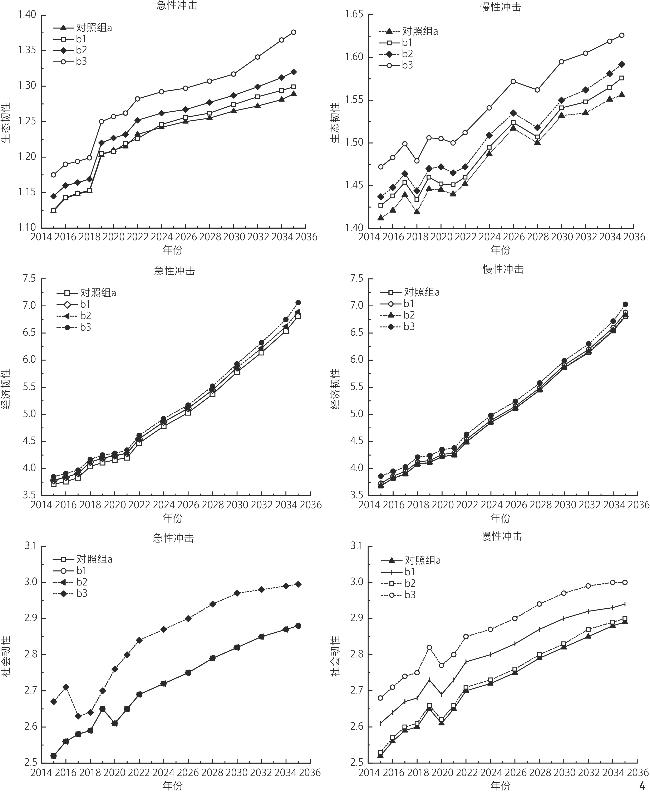
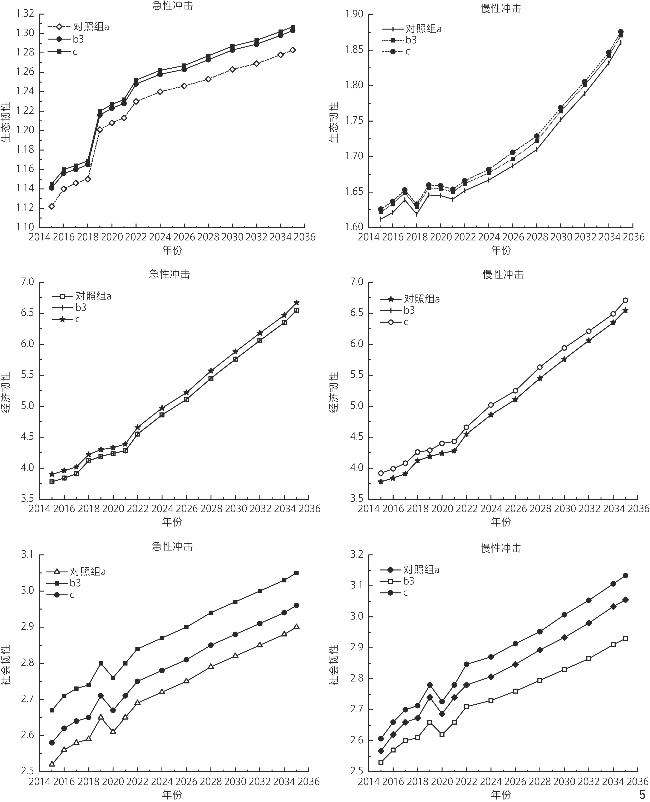
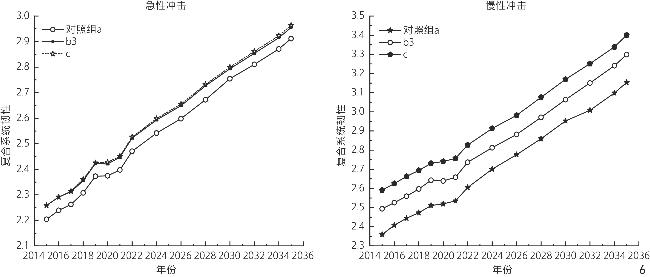
1) Restoration mode efficacy: Under acute and chronic disturbances, ecological reconstruction has the most significant positive impact on the resilience of all three subsystems (ecological, economic, and social subsystems), followed by assisted regeneration, while natural recovery has the weakest impact. It is believed that the greater the intensity of intervention, the greater the positive impact on system resilience. 2) Policy intervention outcomes: Under chronic shock conditions, the strategy ranking from strongest to weakest ecological response capacity is balanced coordination > ecological reconstruction > no intervention. Under acute shock conditions, ecological resilience levels gradually decrease across the three strategies of ecological reconstruction, balanced coordination, and no intervention. The balanced coordination strategy demonstrates strong effects in enhancing resilience across all subsystems and is more likely to achieve a collaborative enhancement effect in composite system resilience. 3) Temporal and scenario-specific optimization: In 2023, the Sanmenxia composite system barely achieved a coordinated state, highlighting the necessity of strengthening the coupling of the three subsystems to effectively implement the ecological restoration strategy for historical legacy mines (mine areas) and enhance the resilience of the composite system. The simulation results reveal that prior to 2027, the resilience of the composite system under the balanced coordination strategy is slightly higher than that of the ecological reconstruction model. However, starting from 2027, the ecological reconstruction model begins to outperform the balanced coordination strategy and maintains this advantage until 2035. This also underscores that ecological restoration should be based on the coordinated unity of the composite system, prioritizing economic development while also balancing ecological and social benefits, so as to achieve sustainable use of resources and promote sustainable development.
This research provides a critical theoretical and practical link between ecological restoration of historical legacy mines (mine areas) and the resilience of the “ecological – economic – social” composite system. Key contributions include: A framework for quantifying resilience responses to restoration strategies, addressing a gap in existing resilience theory. Empirical validation confirms that ecological restoration is the most effective restoration mode for enhancing multi-dimensional resilience, particularly in highly disturbed contexts. Policy recommendations: Advocate selecting restoration strategies based on specific contexts — balancing development with restoration to achieve gradual system adaptation or intensive reconstruction to meet urgent restoration needs. These findings provide actionable guidance for policymakers to align restoration objectives with broader socio-ecological resilience goals, ultimately promoting sustainable post-mining regional development.
HUANG Yuming , ZHAI Hongtao , RAO Zhenxing , ZHANG Yang . Simulation and Resilience Evolution of the Composite System of Historical Legacy Mines (Mine Areas) in Sanmenxia Section of the Yellow River Basin[J]. Landscape Architecture, 2025 , 32(8) : 128 -135 . DOI: 10.3724/j.fjyl.LA20240080
表1 各子系统韧性指标Table 1 Indicators for the resilience of subsystems |
| 一级指标 | 二级指标 | 三级指标 | 单位 |
| 生态子系统韧性 | 生态 | 废弃物综合处理能力 | m2/hm2 |
| 矿山生态修复投资占比 | % | ||
| 企业技术水平 | |||
| 植被覆盖率 | % | ||
| 生态 | 污水排放量 | t | |
| 关闭矿坑口数 | 个 | ||
| 地面塌陷等地灾事件数量 | 个 | ||
| 固体废弃物排放量 | 万m3 | ||
| 经济子系统韧性 | 经济 | 城镇化率 | % |
| 矿山环保产业投资占比 | % | ||
| 经济 | 环境保护事务支出决算数 | 亿元 | |
| 高新技术企业总产值占比 | % | ||
| 金融机构参与数 | 个 | ||
| 社会子系统韧性 | 社会文化丰富度 | 人均GDP | 万元 |
| 非物质文化遗产保护单位数 | 个 | ||
| 文化娱乐从业人数 | 万人 | ||
| 社会福祉水平 | 人均可支配收入 | 万元 | |
| 人均绿地面积 | km2 |
表2 情景-策略仿真设定Table 2 Scenario-strategy simulation setting |
| 模式/策略 | 预期结果 | 直接驱动因素 | 间接驱动因素 | 情景仿真参数设定 | ||
| 急性冲击:区域结构脆性上升50%;环境扰动提高10% | 慢性冲击:区域结构脆性上升5%;环境扰动提高10% | |||||
| 注:急性冲击与慢性冲击下,不同修复模式的方法措施均以2020年为参考。 | ||||||
| 无干预(a) | 各指标水平保持不变 | |||||
| 生态修复模式 | 自然恢复 | 生态稳定性提升、生态脆弱性降低 | 植被覆盖率、废弃物综合处理能力、技术水平、矿山污染总量、地灾事件数量、关闭坑口数 | 时间序列a)、GDP增量、人均绿地面积 | 矿山生态修复投资占比不变;矿山污染总量降低10%(污水排放量、固体废弃物排放量) | 矿山生态修复投资占比不变;废弃物综合处理能力提升10% |
| 辅助再生 | 矿山生态修复投资占比提升10%;生态抵抗力提升10%(植被覆盖率) | 矿山生态修复固定投资提升10%;生态适应力提升10%(企业技术水平、废弃物综合处理能力) | ||||
| 生态重建 | 矿山生态修复投资占比提高20%;生态抵抗力提升15%(植被覆盖率) | 矿山生态修复投资占比提高20%;生态适应力提升15%(企业技术水平、废弃物综合处理能力) | ||||
| 均衡协同发展 | 生态、经济、社会系统韧性均提升 | 在生态修复模式直接驱动因素的基础上增加:人均可支配收入、人均绿地面积、人均GDP、非物质文化遗产保护单位数 | 矿山生态修复投资占比、生态抵抗力指标、经济稳健性指标增长10%;社会福祉水平提升10%(人均绿地面积、人均可支配收入) | 矿山生态修复投资占比、生态适应力指标、经济重建性指标增长10%;社会文化丰富度提升10%(人均GDP、非物质文化遗产保护单位数) | ||
| [1] |
于昊辰, 吕晓, 杨俊, 等. 面向中国式现代化的国土空间治理: 从理论逻辑到实现路径[J]. 中国土地科学, 2024, 38(1): 9-19.
YU H C, LYU X, YANG J, et al. Territorial Space Governance Towards Chinese Path to Modernization: From Theoretical Logic to Implementation Solutions[J]. China Land Science, 2024, 38(1): 9-19.
|
| [2] |
胡振琪, 赵艳玲. 矿山生态修复面临的主要问题及解决策略[J]. 中国煤炭, 2021, 47(9): 2-7.
HU Z Q, ZHAO Y L. Main Problems in Ecological Restoration of Mines and Their Solutions[J]. China Coal, 2021, 47(9): 2-7.
|
| [3] |
程可欣, 王志芳, 唐瑜聪. 国土空间尺度下生态修复空间优先级与策略探究: 以矿山用地为例[J]. 风景园林, 2021, 28(12): 10-15.
CHENG K X, WANG Z F, TANG Y C. Spatial Priority and Strategy of Ecological Restoration Under the Territorial Spatial Scale: A Case Study of Mine Land[J]. Landscape Architecture, 2021, 28(12): 10-15.
|
| [4] |
范余敏, 李向阳, 李梦, 等. 黄河中游三门峡市矿山生态环境承载力分区研究[J]. 自然资源情报, 2022(1): 30-36,29.
FAN Y M, LI X Y, LI M, et al. Study on the Mine Ecological Environment Capacity of Different Zones in Sanmenxia[J]. Natural Resources Information, 2022(1): 30-36,29.
|
| [5] |
邓楚雄, 刘唱唱, 李忠武. 生态修复背景下流域国土空间韧性研究思路[J]. 中国土地科学, 2022, 36(5): 11-20.
DENG C X, LIU C C, LI Z W. Research Path on the Resilience of Watershed Territorial Space Under the Background of Ecological Restoration[J]. China Land Science, 2022, 36(5): 11-20.
|
| [6] |
鲁庆奥, 孙小平, 顾峰雪, 等. 生态学中韧性的概念范畴及表征方法[J]. 陆地生态系统与保护学报, 2023, 3(4): 66-73.
LU Q A, SUN X P, GU F X, et al. Concept and Representation of Resilience in Ecology[J]. Terrestrial Ecosystem and Conservation, 2023, 3(4): 66-73.
|
| [7] |
汪辉, 徐蕴雪, 卢思琪, 等. 恢复力、弹性或韧性?: 社会-生态系统及其相关研究领域中“Resilience”一词翻译之辨析[J]. 国际城市规划, 2017, 32(4): 29-39.
WANG H, XU Y X, LU S Q, et al. A Comparative Study of Chinese Translation of Resilience Terminology in Socio-Ecological System and Its Related Research Fields[J]. Urban Planning International, 2017, 32(4): 29-39.
|
| [8] |
GAO F F, ZHOU J S, JIANG H D, et al. Assessing the True Value of Ecological Restoration in Mining Areas: An Input-Output Approach Based on Ecosystem Service Valuation[J]. Ecological Indicators, 2024, 166: 112591.
|
| [9] |
杨新国, 刘春虹, 王磊, 等. 荒漠草原生态恢复与重建: 人工植被推动下水分介导的系统响应、生态阈值与互馈作用[J]. 生态学报, 2023, 43(1): 95-104.
YANG X G, LIU C H, WANG L, et al. Study on Ecological Restoration and Reconstruction of Desert Steppe: A Review[J]. Acta Ecologica Sinica, 2023, 43(1): 95-104.
|
| [10] |
HOLLING C S. Resilience and Stability of Ecological Systems[J]. Annual Review of Ecology and Systematics, 1973, 4: 1-23.
|
| [11] |
FOLKE C. Resilience: The Emergence of a Perspective for Social-Ecological Systems Analyses[J]. Global Environmental Change, 2006, 16(3): 253-267.
|
| [12] |
MEEROW S, NEWELL J P, STULTS M. Defining Urban Resilience: A Review[J]. Landscape and Urban Planning, 2016, 147: 38-49.
|
| [13] |
于贵瑞, 张雪梅, 赵东升, 等. 区域资源环境承载力科学概念及其生态学基础的讨论[J]. 应用生态学报, 2022, 33(3): 577-590.
YU G R, ZHANG X M, ZHAO D S, et al. Discussion on the Scientific Concepts of Regional Resources and Environmental Carrying Capacity and Its Ecological Basis[J]. Chinese Journal of Applied Ecology, 2022, 33(3): 577-590.
|
| [14] |
CONRADI T, HENRIKSEN M V J, SVENNING J C. Global Change, Novel Ecosystems and the Ecological Restoration of Post-industrial Areas: The Case of a Former Brown Coal Mine in Søby, Denmark[J]. Applied Vegetation Science, 2021, 24(3): e12605.
|
| [15] |
崔晓萌. 基于生态脆弱性评价的生态修复关键区域识别与修复研究[D]. 徐州: 中国矿业大学, 2023.
CUI X M. Identification and Restoration of Key Ecological Restoration Areas Based on Ecological Vulnerability Assessment[D]. Xuzhou: China University of Mining and Technology, 2023.
|
| [16] |
雷少刚, 卞正富, 杨永均. 论引导型矿山生态修复[J]. 煤炭学报, 2022, 47(2): 915-921.
LEI S G, BIAN Z F, YANG Y J. Discussion on the Guided Restoration for Mine Ecosystem[J]. Journal of China Coal Society, 2022, 47(2): 915-921.
|
| [17] |
宋小青. 韧性国土空间导向的全域土地综合整治理论与实践路径[J]. 现代城市研究, 2021, 36(3): 11-16.
SONG X Q. Theoretical Framework and Practical Route of Comprehensive Land Consolidation Towards Resilient Territorial Space[J]. Modern Urban Research, 2021, 36(3): 11-16.
|
| [18] |
甄博珺. 露天矿排土场不同复垦模式生态修复效果研究[D]. 阜新: 辽宁工程技术大学, 2022.
ZHEN B J. Study on Ecological Restoration Effect of Different Reclamation Modes in Open-Pit Mine Dump[D]. Fuxin: Liaoning Technical University, 2022.
|
| [19] |
杨选梅. 国土空间韧性: 概念框架及实施路径[J]. 城市规划学刊, 2021(3): 112-118.
YANG X M. Territorial Space Resilience: A Conceptual Framework and Its Implementation Path[J]. Urban Planning Forum, 2021(3): 112-118.
|
| [20] |
SALAS J, YEPES V. Urban Vulnerability Assessment: Advances from the Strategic Planning Outlook[J]. Journal of Cleaner Production, 2018, 179: 544-558.
|
| [21] |
仇保兴. 基于复杂适应系统理论的韧性城市设计方法及原则[J]. 城市发展研究, 2018, 25(10): 1-3.
QIU B X. Methods and Principles of Designing Resilient City Based on Complex Adaptive System Theory[J]. Urban Development Studies, 2018, 25(10): 1-3.
|
| [22] |
乔晗, 徐君如, 张硕. 基于系统动力学的社群电商价值创造影响效应研究[J]. 系统工程理论与实践, 2023, 43(9): 2615-2631.
QIAO H, XU J R, ZHANG S. Research on the Impact of Community E-Commerce Value Creation Based on System Dynamics[J]. Systems Engineering-Theory & Practice, 2023, 43(9): 2615-2631.
|
| [23] |
马超, 赵康, 冯印成, 等. 我国历史遗留矿山环境污染综合整治技术与路径探索[J]. 环境工程学报, 2024, 18(11): 3102-3113.
MA C, ZHAO K, FENG Y C, et al. Exploration of Comprehensive Remediation Technologies and Paths for Environmental Pollution from Historical Legacy Mines in China[J]. Chinese Journal of Environmental Engineering, 2024, 18(11): 3102-3113.
|
| [24] |
卞正富, 于昊辰, 韩晓彤. 碳中和目标背景下矿山生态修复的路径选择[J]. 煤炭学报, 2022, 47(1): 449-459.
BIAN Z F, YU H C, HAN X T. Solutions to Mine Ecological Restoration Under the Context of Carbon[J]. Journal of China Coal Society, 2022, 47(1): 449-459.
|
| [25] |
常媛媛. 黄土高原露天煤矿区排土场土壤-植被系统恢复力及其权衡研究[D]. 徐州: 中国矿业大学, 2023.
CHANG Y Y. Study on the Resilience and Tradeoff of Soil-Vegetation System in Open-Pit Coal Mine Area on Loess Plateau[D]. Xuzhou: China University of Mining and Technology, 2023.
|
| [26] |
国家统计局, 生态环境部. 2023年中国环境统计年鉴[M]. 北京: 中国统计出版社, 2023.
National Bureau of Statistics of China, Ministry of Ecology and Environment. China Environment Statistical Yearbook 2023[M]. Beijing: China Statistics Press, 2023.
|
| [27] |
三门峡市统计局, 国家统计局三门峡调查队. 2022三门峡统计年鉴[M]. 北京: 中国统计出版社, 2023.
Sanmenxia Municipal, Bureau of Statistics. Sanmenxia Statistical Yearbook 2022[M]. Beijing: China Statistics Press, 2023.
|
| [28] |
ZHANG J X, QIAO J Y, ZHUO J C, et al. Research on Safety Resilience Evaluation of Hydrogen Station Based on System Dynamics Modeling[J]. International Journal of Hydrogen Energy, 2024, 80: 542-553.
|
| [29] |
刘家霖. 多源数据视角下生态修复与气候变化对渤海湾北岸典型盐碱化地生态系统韧性影响研究[J]. 园林, 2024, 41(10): 131-136.
LIU J L. Investigating the Effects of Ecological Restoration and Climate Change on the Ecological Resilience of Saline-Alkali Soils in the Northern Bohai Sea: A Multi-source Data Perspective on a Typical Coastal Site[J]. Landscape Architecture Academic Journal, 2024, 41(10): 131-136.
|
| [30] |
张进德, 郗富瑞. 我国废弃矿山生态修复研究[J]. 生态学报, 2020, 40(21): 7921-7930.
ZHANG J D, XI F R. Study on Ecological Restoration of Abandoned Mines in China[J]. Acta Ecologica Sinica, 2020, 40(21): 7921-7930.
|
| [31] |
METZGER J P, ESLER K, KRUG C, et al. Best Practice for the Use of Scenarios for Restoration Planning[J]. Current Opinion in Environmental Sustainability, 2017, 29: 14-25.
|
| [32] |
刘宏磊. 矿山环境修复治理和开发利用模式的理论与实践研究[D]. 北京: 中国矿业大学(北京), 2020.
LIU H L. Research on the Theory and Practice of the Restoration and Utilization Model for the Mine Environment[D]. Beijing: China University of Mining and Technology-Beijing, 2020.
|
/
| 〈 |
|
〉 |