

A Multi-perspective Exploration of the Restorative Effects and Multidimensional Analysis of the Restorative Characteristics of Waterscapes
|
LIU Yuxi (Hui) is a Ph.D. candidate in the School of Architecture, Tsinghua University. Her research focuses on perception and restorative effects of waterscapes |
|
LIU Hailong, Ph.D., is an associate professor, special research fellow and doctoral supervisor in the School of Architecture, Tsinghua University. His research focuses on landscape hydrology, regional landscape planning, and conservation of natural and cultural heritage |
Received date: 2025-01-09
Revised date: 2025-07-01
Online published: 2025-12-09
Copyright
Waterscapes are essential elements of both natural and urban environments, contributing significantly to physical and mental well-being through their restorative effects. Although research in this field has advanced over the past two decades — driven by the evolution of urban landscapes and methodological innovations — it remains fragmented. A comprehensive framework integrating multiple research perspectives on the restorative effects of waterscapes has yet to be established. Furthermore, the relationships between research perspectives, methodologies, and specific restorative characteristics of waterscapes remain underexplored. These gaps have limited the development of a multidimensional understanding of the restorative effects of waterscapes.
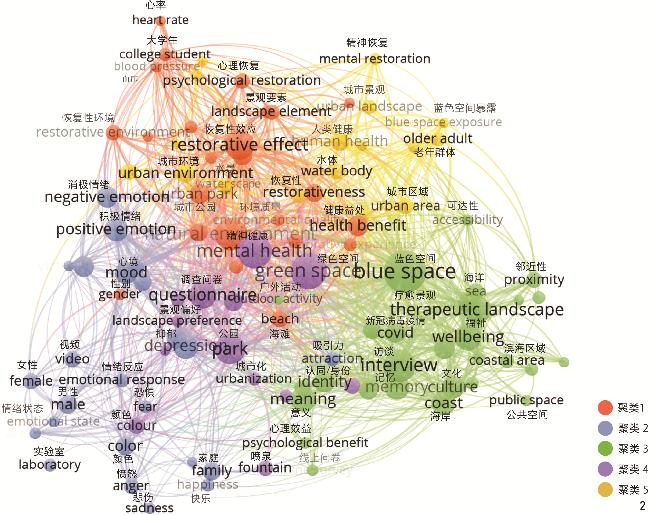
This research employs a literature review and bibliometric analysis to comprehensively assess domestic and international research published from January 1, 1980 to December 31, 2024. A total of 331 English articles and 144 Chinese articles are collected. Upon review of titles and abstracts, 160 articles are selected for in-depth reading and citation analysis, with 78 articles being finally included for discussion. Based on this dataset, a VOSviewer-based keyword co-occurrence analysis is conducted to explore the connections among research perspectives, research objects, and restorative characteristics, with the results obtained informing the construction of a structured analytical framework for this review.
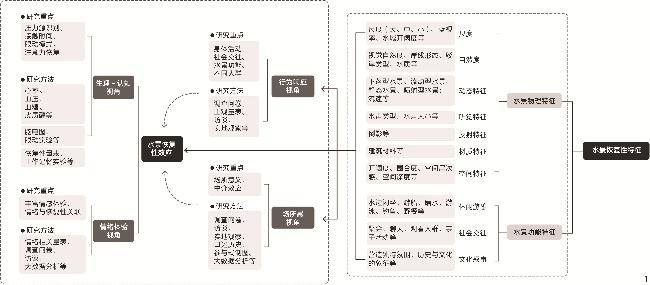
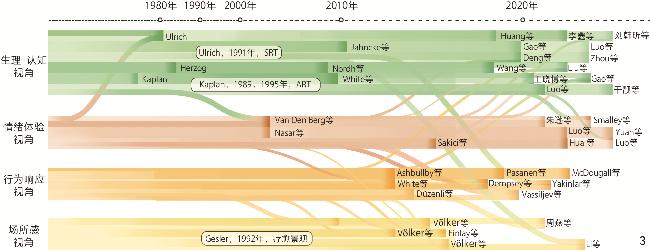
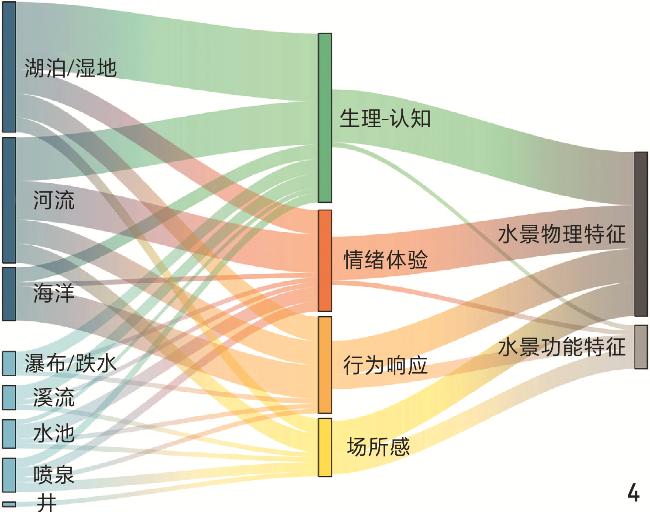
This research identifies four major research perspectives: physiology – cognition, emotional experience, behavioral response, and sense of place. The physiology – cognition perspective, grounded in stress reduction theory (SRT) and attention restoration theory (ART), often combines physiological indicators with psychometric scales. Physiological data enable dynamic tracking of stress and add a temporal dimension to analysis, while restorative scales help link waterscape characteristics to the four ART dimensions: being away, extent, fascination, and compatibility. The emotional experience perspective delves into the broad range of affective responses triggered by waterscapes, often focusing on themes like awe, nostalgia, and memory. The behavioral response and sense of place perspectives examine the functional and symbolic roles of waterscapes. Behavioral research links restorative outcomes with physical activity, social interaction, space utilization, and demographic differences, while sense of place research emphasizes spatial meaning and place attachment. Though these two perspectives may not directly reflect restorative outcomes, they are integral to understanding the restorative effects of waterscapes, yet remain underexplored. The research on the restorative effects of waterscapes focuses not only on understanding individuals’ restorative experiences, but also on identifying the specific characteristics of waterscapes that contribute to restoration. Based on core literature, this research explores how four research perspectives engage with different waterscape types and restorative characteristics. Regarding waterscape types, with the exception of the sense of place perspective, existing research primarily focuses on large-scale natural or semi-natural waterscapes, with limited attention to small-scale elements such as artificial cascades, waterfalls, streams, and fountains. At the level of specific restorative characteristics, physical characteristics have been widely studied, particularly in terms of scale and naturalness. Their measurability supports quantitative analysis of their association with restorative outcomes. Compared to scale and naturalness, multisensory and spatial characteristics receive less attention. Most research focuses on audiovisual stimuli, with limited exploration of tactile and olfactory dimensions. Moreover, links between audiovisual characteristics and restoration remain inconclusive. Spatial characteristics are typically assessed through metrics such as water body width, depth-to-height ratios, and perception-based evaluations, but both the range of indicators and their quantification methods remain limited. Factors like layering and landscape depth may also contribute to restorative perceptions but lack empirical study. The functional characteristics of waterscapes are closely tied to individual perception and contextual experience, thus exhibiting greater subjectivity. Landscape research tends to prioritize quantifiable recreational and social functions of waterscapes, while experiential dimensions such as interactivity and cultural meaning are often overlooked. Activities such as water play and swimming, and waterscapes' symbolic associations with history or identity, can elicit emotional resonance and foster restorative experiences. These effects vary across populations, and their mechanisms deserve further investigation through both quantitative and qualitative methods.
In general, existing research is moving beyond a “static observation” paradigm by embracing a more holistic understanding of restorative place experience. Future research should emphasize the integrated perception of both intrinsic and extrinsic waterscape characteristics, the continuous experience of three-dimensional space, and multi-sensory interactions with water environments. Greater integration of the four research perspectives, along with the application of mixed research methods, is needed to establish a more comprehensive framework for exploring restorative waterscapes.
LIU Yuxi , LIU Hailong . A Multi-perspective Exploration of the Restorative Effects and Multidimensional Analysis of the Restorative Characteristics of Waterscapes[J]. Landscape Architecture, 2025 , 32(8) : 102 -110 . DOI: 10.3724/j.fjyl.LA20250020
文中图片均由作者绘制。
| [1] |
史舒琳. 城市水景康养功效与机制研究[J]. 西北大学学报(自然科学版), 2020, 50(6): 881-886.
SHI S L. A Review of Well-Being Benefits and Mechanism of Urban Waterscapes[J]. Journal of Northwest University (Natural Science Edition), 2020, 50(6): 881-886.
|
| [2] |
FOLEY R, KISTEMANN T. Blue Space Geographies: Enabling Health in Place[J]. Health & Place, 2015, 35: 157-165.
|
| [3] |
GESLER W M. Therapeutic Landscapes: Medical Issues in Light of the New Cultural Geography[J]. Social Science & Medicine, 1992, 34(7): 735-746.
|
| [4] |
沈世伟, BENJAMIN T. 欧洲海滨旅游的演进历程及其启示[J]. 北京第二外国语学院学报, 2014, 36(11): 37-43.
SHEN S W, BENJAMIN T. The Evolution of Seaside Tourism in Europe and Some Reflections on the Case in China[J]. Journal of Beijing International Studies University, 2014, 36(11): 37-43.
|
| [5] |
ZHANG X D, ZHANG Y X, ZHAI J, et al. Waterscapes for Promoting Mental Health in the General Population[J]. International Journal of Environmental Research and Public Health, 2021, 18(22): 11792.
|
| [6] |
VÖLKER S, KISTEMANN T. Developing the Urban Blue: Comparative Health Responses to Blue and Green Urban Open Spaces in Germany[J]. Health & Place, 2015, 35: 196-205.
|
| [7] |
KAPLAN S. The Restorative Benefits of Nature: Toward an Integrative Framework[J]. Journal of Environmental Psychology, 1995, 15(3): 169-182.
|
| [8] |
KAPLAN R. Down by the Riverside: Informational Factors in Waterscape Preference[EB/OL]. [2025-01-10]. http://deepblue.lib.umich.edu/handle/2027.42/148446
|
| [9] |
VAN DEN BERG A E, KOOLE S L, VAN DER WULP N Y. Environmental Preference and Restoration: (How) Are They Related[J]. Journal of Environmental Psychology, 2003, 23(2): 135-146.
|
| [10] |
ULRICH R S, SIMONS R F, LOSITO B D, et al. Stress Recovery During Exposure to Natural and Urban Environments[J]. Journal of Environmental Psychology, 1991, 11(3): 201-230.
|
| [11] |
ULRICH R S. Natural Versus Urban Scenes: Some Psychophysiological Effects[J]. Environment and Behavior, 1981, 13(5): 523-556.
|
| [12] |
HERZOG T R. A Cognitive Analysis of Preference for Waterscapes[J]. Journal of Environmental Psychology, 1985, 5(3): 225-241.
|
| [13] |
LUO S X, XIE J, WANG H X, et al. Natural Dose of Blue Restoration: A Field Experiment on Mental Restoration of Urban Blue Spaces[J]. Land, 2023, 12(10): 1834.
|
| [14] |
LUO S X, XIE J, FURUYA K. Assessing the Preference and Restorative Potential of Urban Park Blue Space[J]. Land, 2021, 10(11): 1233.
|
| [15] |
SAKICI C. Assessing Landscape Perceptions of Urban Waterscapes[J]. The Anthropologist, 2015, 21(1/2): 182-196.
|
| [16] |
WHITE M, SMITH A, HUMPHRYES K, et al. Blue Space: The Importance of Water for Preference, Affect, and Restorativeness Ratings of Natural and Built Scenes[J]. Journal of Environmental Psychology, 2010, 30(4): 482-493.
|
| [17] |
李鑫, 王子尧, 吴丹子, 等. 基于生理反馈的城市滨河步道对青年人压力缓解的研究[J]. 中国园林, 2022, 38(5): 86-91.
LI X, WANG Z Y, WU D Z, et al. Research on Pressure Relief of Young People by Urban Waterfront Trail Based on Physiological Feedback[J]. Chinese Landscape Architecture, 2022, 38(5): 86-91.
|
| [18] |
LI X, ZHANG X, JIA T. Humanization of Nature: Testing the Influences of Urban Park Characteristics and Psychological Factors on Collegers’ Perceived Restoration[J]. Urban Forestry & Urban Greening, 2023, 79: 127806.
|
| [19] |
GAO H T, LIU F F, KANG J, et al. The Relationship Between the Perceptual Experience of a Waterfront-Built Environment and Audio-Visual Indicators[J]. Applied Acoustics, 2023, 212: 109550.
|
| [20] |
SMALLEY A J, WHITE M P, SANDIFORD R, et al. Soundscapes, Music, and Memories: Exploring the Factors that Influence Emotional Responses to Virtual Nature Content[J]. Journal of Environmental Psychology, 2023, 89: 102060.
|
| [21] |
FOLEY R. Performing Health in Place: The Holy Well as a Therapeutic Assemblage[J]. Health & Place, 2011, 17(2): 470-479.
|
| [22] |
ZHANG X D, LIN E S, TAN P Y, et al. Beyond Just Green: Explaining and Predicting Restorative Potential of Urban Landscapes Using Panorama-Based Metrics[J]. Landscape and Urban Planning, 2024, 247: 105044.
|
| [23] |
WHITE M P, ALCOCK I, WHEELER B W, et al. Coastal Proximity, Health and Well-Being: Results from a Longitudinal Panel Survey[J]. Health & Place, 2013, 23: 97-103.
|
| [24] |
朱逊, 张冉, 赵晓龙. 影响公众情绪偏好的城市蓝色空间特征识别研究: 以松花江流域为例[J]. 中国园林, 2021, 37(8): 50-55.
ZHU X, ZHANG R, ZHAO X L. Blue Space Characteristics Recognition Based on Public Emotion: A Case Study of Songhua River Basin[J]. Chinese Landscape Architecture, 2021, 37(8): 50-55.
|
| [25] |
MCDOUGALL C W, HANLEY N, QUILLIAM R S, et al. Blue Space Exposure, Health and Well-Being: Does Freshwater Type Matter[J]. Landscape and Urban Planning, 2022, 224: 104446.
|
| [26] |
ASHBULLBY K J, PAHL S, WEBLEY P, et al. The Beach as a Setting for Families’ Health Promotion: A Qualitative Study with Parents and Children Living in Coastal Regions in Southwest England[J]. Health & Place, 2013, 23: 138-147.
|
| [27] |
HUANG S C L, CHIANG N C, KUO N F, et al. An Exploratory Approach for Using EEG to Examine Person-Environment Interaction[J]. Landscape Research, 2019, 44(6): 702-715.
|
| [28] |
FINLAY J, FRANKE T, MCKAY H, et al. Therapeutic Landscapes and Wellbeing in Later Life: Impacts of Blue and Green Spaces for Older Adults[J]. Health & Place, 2015, 34: 97-106.
|
| [29] |
VÖLKER S, KISTEMANN T. “I’m Always Entirely Happy When I’m Here!” Urban Blue Enhancing Human Health and Well-Being in Cologne and Düsseldorf, Germany[J]. Social Science & Medicine, 2013, 78: 113-124.
|
| [30] |
刘群阅, 尤达, 朱里莹, 等. 游憩者场所依恋与恢复性知觉关系研究: 以福州城市公园为例[J]. 资源科学, 2017, 39(7): 1303-1313.
LIU Q Y, YOU D, ZHU L Y, et al. The Relationship Between Place Attachment and Restorative Perception of Tourists Visiting Fuzhou Urban Parks[J]. Resources Science, 2017, 39(7): 1303-1313.
|
| [31] |
ULRICH R S. Aesthetic and Affective Response to Natural Environment[M/OL]//ALTMAN I, WOHLWILL J F. Behavior and the Natural Environment. Boston: Springer, 1983: 85-125[2025-06-30]. https://doi.org/10.1007/978-1-4613-3539-9_4
|
| [32] |
ARNBERGER A, EDER R, ALLEX B, et al. Health-Related Effects of Short Stays at Mountain Meadows, a River and an Urban Site: Results from a Field Experiment[J]. International Journal of Environmental Research and Public Health, 2018, 15(12): 2647.
|
| [33] |
DENG L, LI X, LUO H, et al. Empirical Study of Landscape Types, Landscape Elements and Landscape Components of the Urban Park Promoting Physiological and Psychological Restoration[J]. Urban Forestry & Urban Greening, 2020, 48: 126488.
|
| [34] |
李同予, 薛滨夏, 杨秀贤, 等. 基于无线生理传感器与虚拟现实技术的复愈性环境注意力恢复作用研究[J]. 中国园林, 2020, 36(12): 62-67.
LI T Y, XUE B X, YANG X X, et al. Research on Attention Recovery in Restorative Environment Based on Wireless Physiological Sensor and Virtual Reality Technology[J]. Chinese Landscape Architecture, 2020, 36(12): 62-67.
|
| [35] |
HARTIG T, KORPELA K, EVANS G W, et al. A Measure of Restorative Quality in Environments[J]. Scandinavian Housing and Planning Research, 1997, 14(4): 175-194.
|
| [36] |
LUO L, YU P, JIANG B. Differentiating Mental Health Promotion Effects of Various Bluespaces: An Electroencephalography Study[J]. Journal of Environmental Psychology, 2023, 88: 102010.
|
| [37] |
GAO Y, ZHANG T, ZHANG W K, et al. Research on Visual Behavior Characteristics and Cognitive Evaluation of Different Types of Forest Landscape Spaces[J]. Urban Forestry & Urban Greening, 2020, 54: 126788.
|
| [38] |
ZHOU X C, CEN Q Y, QIU H F. Effects of Urban Waterfront Park Landscape Elements on Visual Behavior and Public Preference: Evidence from Eye-Tracking Experiments[J]. Urban Forestry & Urban Greening, 2023, 82: 127889.
|
| [39] |
LAUMANN K, GÄRLING T, STORMARK K M. Rating Scale Measures of Restorative Components of Environments[J]. Journal of Environmental Psychology, 2001, 21(1): 31-44.
|
| [40] |
HAN K T. A Reliable and Valid Self-Rating Measure of the Restorative Quality of Natural Environments[J]. Landscape and Urban Planning, 2003, 64(4): 209-232.
|
| [41] |
WANG X B, JIN Y, SONG Y. Effects of Pictures with Waterscapes of Varied Visual Perception of Naturalness on Individual Cognition[J]. Landscape Architecture Frontiers, 2021, 9(5): 32-45.
|
| [42] |
WANG R H, ZHAO J W, MEITNER M J, et al. Characteristics of Urban Green Spaces in Relation to Aesthetic Preference and Stress Recovery[J]. Urban Forestry & Urban Greening, 2019, 41: 6-13.
|
| [43] |
王茜, 张延龙, 赵仁林, 等. 四种校园绿地景观对大学生生理和心理指标的影响研究[J]. 中国园林, 2020, 36(9): 92-97.
WANG X, ZHANG Y L, ZHAO R L, et al. Study on the Effects of Four Campus Green Landscapes on College Students’ Physiological and Psychological Indicators[J]. Chinese Landscape Architecture, 2020, 36(9): 92-97.
|
| [44] |
HARTIG T, KAISER F G, BOWLER P A. Further Development of a Measure of Perceived Environmental Restorativeness[J]. Institute of Housing Research, 1997: 23.
|
| [45] |
LI H S, BROWNING M H E M, RIGOLON A, et al. Beyond “Bluespace” and “Greenspace”: A Narrative Review of Possible Health Benefits from Exposure to Other Natural Landscapes[J]. Science of The Total Environment, 2023, 856: 159292.
|
| [46] |
RUSSELL J A. A Circumplex Model of Affect[J]. Journal of Personality and Social Psychology, 1980, 39(6): 1161-1178.
|
| [47] |
MCNAIR D M, DROPPLEMAN L F, LORR M. Edits Manual for the Profile of Mood States: POMS[M]. San Diego: Educational and Industrial Testing Service, 1992.
|
| [48] |
WATSON D, CLARK L A, TELLEGEN A. Development and Validation of Brief Measures of Positive and Negative Affect: The PANAS Scales[J]. Journal of Personality and Social Psychology, 1988, 54(6): 1063-1070.
|
| [49] |
YUAN S, BROWNING M H E M, MCANIRLIN O, et al. A Virtual Reality Investigation of Factors Influencing Landscape Preferences: Natural Elements, Emotions, and Media Creation[J]. Landscape and Urban Planning, 2023, 230: 104616.
|
| [50] |
LUO J J, ZHAO T H, CAO L, et al. Water View Imagery: Perception and Evaluation of Urban Waterscapes Worldwide[J]. Ecological Indicators, 2022, 145: 109615.
|
| [51] |
HUAI S Y, VAN DE VOORDE T. Which Environmental Features Contribute to Positive and Negative Perceptions of Urban Parks A Cross-Cultural Comparison Using Online Reviews and Natural Language Processing Methods[J]. Landscape and Urban Planning, 2022, 218: 104307.
|
| [52] |
LUO J J, ZHAO T H, CAO L, et al. Semantic Riverscapes: Perception and Evaluation of Linear Landscapes from Oblique Imagery Using Computer Vision[J]. Landscape and Urban Planning, 2022, 228: 104569.
|
| [53] |
NASAR J, LIN Y H. Evaluative Responses to Five Kinds of Water Features[J]. Landscape Research, 2003, 28(4): 441-450.
|
| [54] |
DEMPSEY S, DEVINE M T, GILLESPIE T, et al. Coastal Blue Space and Depression in Older Adults[J]. Health & Place, 2018, 54: 110-117.
|
| [55] |
DÜZENLİ T, MUMCU S, YILMAZ S, et al. Water Reflections on the Social Dimension of Place: Different Waterscapes and Related Activity Patterns[J]. Journal of Crystal Growth, 2014, 83(4): 528-542.
|
| [56] |
刘韩昕, 马宁. 滨水空间旷奥感知与恢复性效应交互路径探寻: 基于桂林山水城市的实证研究[J]. 南方建筑, 2024(4): 106-114.
LIU H X, MA N. Exploration of Interactive Pathways of “Kuang-Ao” Perceptions and Restorative Effects in the Waterfront Space: An Empirical Study Based on the Guilin Shan-Shui City[J]. South Architecture, 2024(4): 106-114.
|
| [57] |
岳亚飞, 杨东峰, 徐丹. 城市蓝绿空间对老年心理健康影响机制的探究与检验[J]. 风景园林, 2022, 29(12): 71-77.
YUE Y F, YANG D F, XU D. Exploration and Examination of the Influence Mechanism of Urban Blue-Green Space on the Elderly’s Mental Health[J]. Landscape Architecture, 2022, 29(12): 71-77.
|
| [58] |
MISHRA H S, BELL S, VASSILJEV P, et al. The Development of a Tool for Assessing the Environmental Qualities of Urban Blue Spaces[J]. Urban Forestry & Urban Greening, 2020, 49: 126575.
|
| [59] |
周燕, 刘梦瑶, 杨柳琪, 等. 小微蓝绿空间特征对居民不同类型社会交往的影响: 以武汉市东湖绿道为例[J]. 园林, 2022, 39(10): 87-94.
ZHOU Y, LIU M Y, YANG L Q, et al. The Influence Mechanism of Tiny Blue-Green Space’s Characteristics on Different Types of Social Interaction of Residents: A Case Study of Wuhan East Lake Greenway[J]. Landscape Architecture Academic Journal, 2022, 39(10): 87-94.
|
| [60] |
VÖLKER S, MATROS J, CLAßEN T. Determining Urban Open Spaces for Health-Related Appropriations: A Qualitative Analysis on the Significance of Blue Space[J]. Environmental Earth Sciences, 2016, 75(13): 1067.
|
| [61] |
VASSILJEV P, BELL S, BALICKA J, et al. Urban Blue Acupuncture: An Experiment on Preferences for Design Options Using Virtual Models[J]. Sustainability, 2020, 12(24): 10656.
|
| [62] |
KORPELA K, HARTIG T. Restorative Qualities of Favorite Places[J]. Journal of Environmental Psychology, 1996, 16(3): 221-233.
|
| [63] |
COLEMAN T, KEARNS R. The Role of Bluespaces in Experiencing Place, Aging and Wellbeing: Insights from Waiheke Island, New Zealand[J]. Health & Place, 2015, 35: 206-217.
|
| [64] |
朱竑, 刘博. 地方感、地方依恋与地方认同等概念的辨析及研究启示[J]. 华南师范大学学报(自然科学版), 2011(1): 1-8.
ZHU H, LIU B. Concepts Analysis and Research Implications: Sense of Place, Place Attachment and Place Identity[J]. Journal of South China Normal University (Natural Science Edition), 2011(1): 1-8.
|
| [65] |
林广思, 吴安格, 蔡珂依. 场所依恋研究: 概念、进展和趋势[J]. 中国园林, 2019, 37(5): 5-8.
LIN G S, WU A G, CAI K Y. Research on Place Attachment: Concept, Progress and Trend[J]. Chinese Landscape Architecture, 2019, 37(5): 5-8.
|
| [66] |
李佳冉, 钟乐, 秦仁强. 场所依恋理论在风景园林领域研究前沿及中国动态分析: 2011—2021国内外相关研究文献综述[J]. 中国园林, 2022, 38(S2): 140-144.
LI J R, ZHONG L, QIN R Q. The Research Frontier of Place Attachment Theory in Landscape Architecture and China’s Dynamic Analysis: A Review of Relevant Research Literature at Home and Abroad from 2011 to 2021[J]. Chinese Landscape Architecture, 2022, 38(S2): 140-144.
|
| [67] |
JAHANI A, SAFFARIHA M. Aesthetic Preference and Mental Restoration Prediction in Urban Parks: An Application of Environmental Modeling Approach[J]. Urban Forestry & Urban Greening, 2020, 54: 126775.
|
| [68] |
LI X, LI L, WANG X R, et al. Visual Quality Evaluation Model of an Urban River Landscape Based on Random Forest[J]. Ecological Indicators, 2021, 133: 108381.
|
| [69] |
LI J Y, HUANG Z L, ZHENG D L, et al. Effect of Landscape Elements on Public Psychology in Urban Park Waterfront Green Space: A Quantitative Study by Semantic Segmentation[J]. Forests, 2023, 14(2): 244.
|
| [70] |
ZHANG H X, NIJHUIS S, NEWTON C. Advanced Digital Methods for Analysing and Optimising Accessibility and Visibility of Water for Designing Sustainable Healthy Urban Environments[J]. Sustainable Cities and Society, 2023, 98: 104804.
|
| [71] |
LIU F F, LIU P Y, KANG J, et al. Relationships Between Landscape Characteristics and the Restorative Quality of Soundscapes in Urban Blue Spaces[J]. Applied Acoustics, 2022, 189: 108600.
|
| [72] |
EWING R, HANDY S, BROWNSON R C, et al. Identifying and Measuring Urban Design Qualities Related to Walkability[J]. Journal of Physical Activity & Health, 2006, 3(s1): S223-S240.
|
| [73] |
BOZKURT M, WOOLLEY H. Let’s Splash: Children’s Active and Passive Water Play in Constructed and Natural Water Features in Urban Green Spaces in Sheffield[J]. Urban Forestry & Urban Greening, 2020, 52: 126696.
|
| [74] |
VÖLKER S, HEILER A, POLLMANN T, et al. Do Perceived Walking Distance to and Use of Urban Blue Spaces Affect Self-Reported Physical and Mental Health[J]. Urban Forestry & Urban Greening, 2018, 29: 1-9.
|
| [75] |
XIE Q, LEE C, LU Z P, et al. Interactions with Artificial Water Features: A Scoping Review of Health-Related Outcomes[J]. Landscape and Urban Planning, 2021, 215: 104191.
|
| [76] |
YAKıNLAR N, AKPıNAR A. How Perceived Sensory Dimensions of Urban Green Spaces Are Associated with Adults’ Perceived Restoration, Stress, and Mental Health[J]. Urban Forestry & Urban Greening, 2022, 72: 127572.
|
| [77] |
ZHAO J W, XU W Y, YE L. Effects of Auditory-Visual Combinations on Perceived Restorative Potential of Urban Green Space[J]. Applied Acoustics, 2018, 141: 169-177.
|
| [78] |
WANG R H, JIANG W X, LU T S. Landscape Characteristics of University Campus in Relation to Aesthetic Quality and Recreational Preference[J]. Urban Forestry & Urban Greening, 2021, 66: 127389.
|
| [79] |
NGIAM R W J, LIM W L, COLLINS C M. A Balancing Act in Urban Social-Ecology: Human Appreciation, Ponds and Dragonflies[J]. Urban Ecosystems, 2017, 20(4): 743-758.
|
| [80] |
KORPELA K M, YLÉN M, TYRVÄINEN L, et al. Determinants of Restorative Experiences in Everyday Favorite Places[J]. Health & Place, 2008, 14(4): 636-652.
|
| [81] |
CHAU C K, LEUNG T M, CHUNG W K, et al. Effect of Perceived Dominance and Pleasantness on the Total Noise Annoyance Responses Evoked by Augmenting Road Traffic Noise with Birdsong/Stream Sound[J]. Applied Acoustics, 2023, 213: 109650.
|
| [82] |
干靓, 唐艺源, 尹杰. 沿江型湿地公园景观环境特征对人群自然感知及感知复愈性的影响: 以上海后滩公园为例[J]. 中国园林, 2024, 40(1): 26-32.
GAN J, TANG Y Y, YIN J. Effects of Landscape and Environmental Characteristics of Riverine Wetland Park on People’s Perception of Nature and Perceived Restorativeness: Case Study of Shanghai Houtan Park[J]. Chinese Landscape Architecture, 2024, 40(1): 26-32.
|
| [83] |
罗召鑫, 马蕙, 舒珊. 城市滨水空间恢复性评价的视听影响因素研究[J]. 南方建筑, 2021(1): 76-82.
LUO Z X, MA H, SHU S. A Social Survey on the Visual and Auditory Factors Influencing Restorative Perceptions of Urban Waterfront Spaces[J]. South Architecture, 2021(1): 76-82.
|
| [84] |
KARMANOV D, HAMEL R. Assessing the Restorative Potential of Contemporary Urban Environment(s): Beyond the Nature Versus Urban Dichotomy[J]. Landscape and Urban Planning, 2008, 86(2): 115-125.
|
| [85] |
GIBSON J J. The Ecological Approach to Visual Perception: Classic Edition[M]. London: Psychology Press, 1979.
|
| [86] |
FOLEY R. Swimming in Ireland: Immersions in Therapeutic Blue Space[J]. Health & Place, 2015, 35: 218-225.
|
| [87] |
GUO L, GONG X Q, LI Y N, et al. Multisensory Health and Well-Being of Chinese Classical Gardens: Insights from Humble Administrator’s Garden[J]. Land, 2025, 14(2): 317.
|
/
| 〈 |
|
〉 |