

Habitat Optimization Design and Effectiveness Assessment of Urban Lake Islands for Waterbird Diversity Conservation
|
WU Yedan is a master student in the School of Architecture and Urban Planning, Chongqing University. Her research focuses on ecological restoration of urban lakes and biodiversity conservation |
|
YUAN Jia, Ph.D., is an associate professor and doctoral supervisor in the School of Architecture and Urban Planning, Chongqing University, a fixed research fellow in the Key Laboratory of New Technology for Construction of Cities in Mountain Area(Chongqing University), Ministry of Education. His research focuses on ecological landscape design, and ecological restoration and biodiversity conservation |
|
TANG Ting is a Ph.D. candidate in the School of Architecture and Urban Planning, Chongqing University. Her research focuses on earthscape and ecological restoration |
|
YUAN Xingzhong, Ph.D., is a full professor in the School of Architecture and Urban Planning, Chongqing University, serves as the executive director of the China Wetland Conservation Association. His research focuses on ecosystem design, wetland ecology |
Received date: 2025-04-04
Revised date: 2025-07-03
Online published: 2025-12-09
Copyright
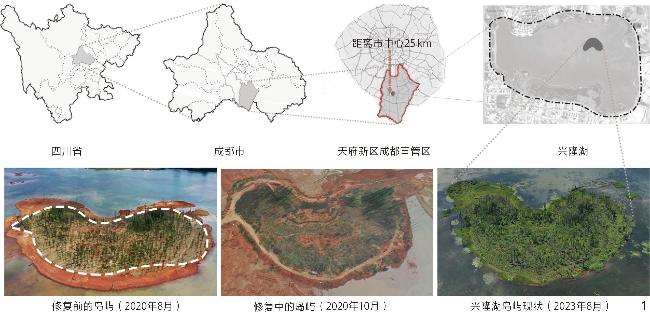
In lake ecosystems, islands, as isolated terrestrial areas and stepping-stone habitats, are scarce yet high-quality habitats for birds, especially waterbirds, providing them with suitable environments for resting, breeding, and foraging. The construction and habitat optimization of lake islands are effective means to promote the conservation of waterbirds and enhance wetland biodiversity. Currently, research on urban lake islands remains limited, particularly regarding the relationships among spatial configuration, habitat characteristics, and bird diversity. This research aims to assess the effectiveness and ecological impact of the habitat optimization design of the island in Xinglong Lake, explore the relationship between bird diversity and island habitat structure, and provide a scientific basis and replicable design framework for improving habitat quality on artificial islands in urban lake ecosystems.
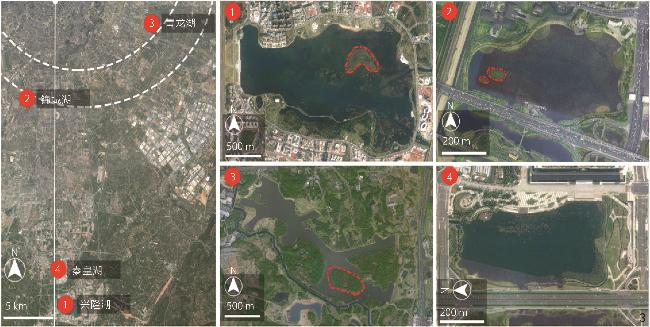
Concentrating on three key island spatial categories: Island interior, island shoreline, surrounding waters, this research selects waterbirds as indicator taxa, and takes Xinglong Lake’s island in Tianfu New Area, Sichuan as the main research object. Field survey is conducted to document species composition, abundance, spatial distribution patterns, and habitat conditions of bird communities. To assess the ecological outcomes of habitat optimization, comparative analyses are performed using three control sites within the Chengdu metropolitan area: Jincheng Lake’s island and Qinglong Lake’s island (both exhibiting similar natural setting, while differing in morphology and lacking ecological restoration), as well as Qinhuang Lake (containing no constructed islands). Habitat classification and mapping are carried out through GIS-based spatial analysis and habitat unit delineation, following standardized protocols from the urban habitats biodiversity assessment (UHBA) standard and the urban habitat categories (UHCs) classification system. Island habitats are systematically categorized, visualized, and quantified to investigate the relationship between habitat structure and bird community attributes. This approach enables the identification of key habitat variables influencing bird diversity and the underlying ecological mechanisms driving relevant habitat patterns.
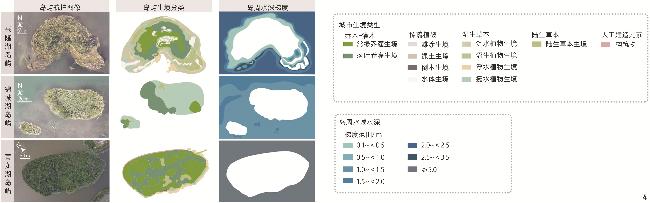
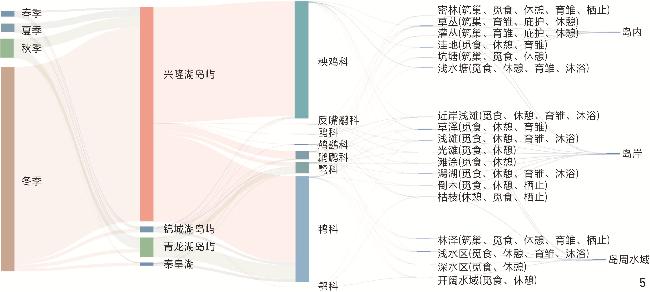
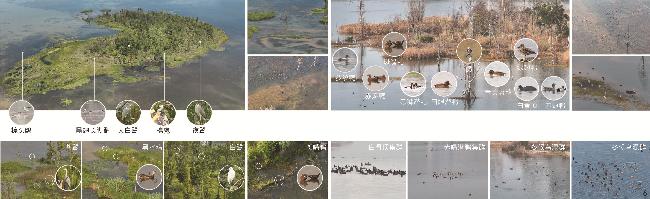
According to the UHCs system, a total of 12 habitat types are identified across all research sites. The restored Xinglong Lake’s island exhibits the highest habitat diversity, comprising 11 distinct types, compared to 8 and 4 types recorded on Qinglong Lake’s island and Jincheng Lake’s island, respectively. The restored island also displays more complex habitat structures and element assemblages, forming a nested spatial mosaic of habitat types across vertical and horizontal gradients — from the island’s interior to its shoreline and adjacent waters. By constructing diverse composite habitat structures such as dense forests, sparse forests – grasslands, sparse forests – meadows, forests – ponds, micro-wetland, island shoreline grasses, grasslands, fallen logs, dead branches, bare soil, and island surrounding waters forests – swamps along waters surrounding the island, grasses – swamps, shrubs – grass swamps, shallows, and deep pools – shallows, Xinglong Lake has formed a composite pattern of alternating habitat types, providing key support for different bird community types. The contagion index, dispersion index and aggregation index further verify the highly mosaic habitat pattern and high habitat heterogeneity of Xinglong Lake’s island. The habitat diversity index (DIVh = 2.043) of Xinglong Lake’s island is significantly higher than that of Jincheng Lake’s island (DIVh = 0.883) and Qinglong Lake’s island (DIVh = 1.188). A total of 26 bird species (14,510 birds in total, Dmg = 2.61) are recorded on Xinglong Lake’s island, where many birds are attracted, including the Aythya baeri (a critically endangered [CR] bird species identified by IUCN and listed as a national first-class protected bird in the “National Key Protected Wildlife List”), significantly more than the control group’s 13 species (1,984 birds in total). The ecological restoration strategy for Xinglong Lake’s island based on the key spatial categories of “island interior – island shoreline – surrounding waters” can effectively optimize the island’s spatial configuration, and enhance its habitat diversity and heterogeneity, while providing essential functional habitats for waterbirds’ nesting, breeding and foraging. Waterbird diversity on the restored island is significantly higher than that observed at the control sites, demonstrating notable ecological restoration benefits. Pearson correlation analysis shows that waterbird diversity has no significant correlation with lake area or general lake-scale indicators, indicating minimal interference from lake size. Island area, water depth gradient around the island, and the types, forms and structures of island habitats are core variables affecting waterbird diversity. These findings highlight the importance of habitat spatial heterogeneity and effective niche construction as primary mechanisms driving the enhancement of waterbird diversity in urban lakes.
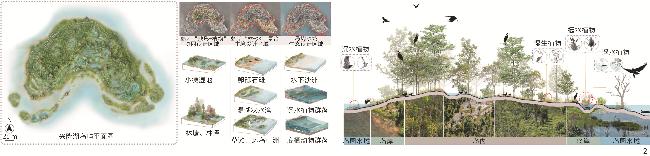
The ecological restoration strategies implemented on Xinglong Lake’s island have provided crucial functional habitats for waterbirds that can support nesting, breeding, and foraging activities, thus being able to effectively enhance the bird diversity of urban lakes. Habitat optimization strategies for urban lake islands, designed based on “topography – vegetation” coordination, “forest – water” composite habitats, and “underwater topography reshaping with food web construction”, have significantly enriched island habitat heterogeneity and improved spatial configuration. Research on the internal mechanisms of “habitat structure – habitat configuration – bird diversity” provides a scientific basis for the design and optimization of waterbird habitats on artificial islands in urban lakes. The aforesaid findings may offer scientific guidance and establish a replicable and promotable innovative technical paradigm for ecological restoration and biodiversity conservation of urban lakes.
WU Yedan , YUAN Jia , TANG Ting , YUAN Xingzhong . Habitat Optimization Design and Effectiveness Assessment of Urban Lake Islands for Waterbird Diversity Conservation[J]. Landscape Architecture, 2025 , 32(8) : 49 -57 . DOI: 10.3724/j.fjyl.LA20250226
图3 实验组与对照组地理位置及遥感影像Fig. 3 Geographic locations and remote sensing images of the experimental and control groups |
| 研究区域 | 区域性质 | 湖泊 | 建成 | 水域面 | 平均水 | 地表水 | 沉水植物 | 岛屿面 | 岛屿周 | 能否 | |
| 实验组 | 兴隆湖 | 城市新区 | 人工湖 | 2019年 | 300 | 2.5 | Ⅱ类 | 75.3 | 50 507 | 1 410 | 否 |
| 对照组 | 锦城湖 | 城市建成区 | 人工湖 | 2013年 | 21.6 | 3.0 | Ⅱ类 | 94.8 | 2 380 | 250 | 否 |
| 青龙湖 | 生态保育区 | 人工湖 | 2008年 | 94.9 | 2.5 | Ⅲ类 | 28.2 | 50 100 | 1 390 | 否 | |
| 秦皇湖 | 商务活动中心 | 人工湖 | 2017年 | 19.8 | 2.5 | Ⅱ类 | 64.8 | ||||
表2 不同岛屿生境类型统计Table 2 Statistics on different island habitat types |
| 生境类别 | 生境 | 岛内陆域 | 岛岸 | 岛周水域 | ||||||||
| 岛1 | 岛2 | 岛3 | 岛1 | 岛2 | 岛3 | 岛1 | 岛2 | 岛3 | ||||
| 注:岛1、岛2、岛3分别代表兴隆湖岛屿、锦城湖岛屿和青龙湖岛屿。 | ||||||||||||
| 乔木-灌木 | 常绿 | √ | √ | √ | √ | |||||||
| 落叶 | √ | √ | √ | √ | ||||||||
| 陆生草本 | 陆生 | √ | √ | √ | √ | √ | ||||||
| 湿生草本 | 沉水 | √ | √ | √ | ||||||||
| 沼生 | √ | √ | √ | √ | ||||||||
| 浮水 | √ | √ | √ | |||||||||
| 挺水 | √ | √ | √ | √ | ||||||||
| 稀疏植被 | 滩涂 | √ | √ | |||||||||
| 裸土 | √ | √ | √ | |||||||||
| 倒木 | √ | √ | ||||||||||
| 水体 | √ | √ | √ | |||||||||
| 人工建造 | 构筑物 | √ | ||||||||||
表3 岛屿生境格局指数Table 3 Island habitat pattern index |
| 研究区域 | PR | LSI | CONTAG | SPLIT | AI | DIVh | SHEI |
| 兴隆湖 | 11 | 10.191 | 56.543 | 12.246 | 99.509 | 2.043 | 0.852 |
| 锦城湖 | 4 | 2.606 | 67.135 | 2.499 | 99.614 | 0.883 | 0.634 |
| 青龙湖 | 8 | 6.000 | 70.132 | 5.635 | 99.231 | 1.188 | 0.571 |
表4 研究区域水鸟种类、数量及留居型Table 4 Waterbird species, quantity and residency type in the research area |
| 目 | 科 | 学名 | 居留型 | 实验组 | 对照组 | |||
| 兴隆湖 | 锦城湖 | 青龙湖 | 秦皇湖 | |||||
| 注:a为国家Ⅰ级重点保护鸟类,并被世界自然保护联盟评为极危[CR];b为国家Ⅱ级重点保护鸟类,并观察到棉凫的孵卵及育雏行为;c为兴隆湖新记录种。 | ||||||||
| 鹤形目 | 秧鸡科 | 白骨顶(Fulica atra) | W | 7 680 | 54 | 14 | 40 | |
| 黑水鸡(Gallinula chloropus) | R | 138 | 35 | 1 | 1 | |||
| 鸻形目(Charadriiformes) | 反嘴鹬科 | 黑翅长脚鹬(Himantopus himantopus) | P | 4 | 0 | 0 | 0 | |
| 鸥科 | 棕头鸥(Chroicocephalus brunnicephalus) | W | 2 | 0 | 0 | 0 | ||
| 红嘴鸥(C. ridibundus) | W | 1 | 0 | 0 | 0 | |||
| 鲣鸟目 | 鸬鹚科 | 普通鸬鹚(Phalacrocorax carbo) | W | 18 | 3 | 0 | 0 | |
| 䴙䴘目 | 䴙䴘科 | 小䴙䴘(Tachybaptus ruficollis) | R | 522 | 33 | 7 | 8 | |
| 鹈形目 | 鹭科 | 苍鹭(Ardea cinerea) | R | 200 | 14 | 223 | 0 | |
| 大白鹭(A. alba) | P | 2 | 0 | 0 | 0 | |||
| 中白鹭(A. intermedia) | S | 6 | 0 | 0 | 0 | |||
| 白鹭(Egretta garzetta) | R | 65 | 21 | 89 | 0 | |||
| 夜鹭(Nycticorax nycticorax) | S | 10 | 59 | 61 | 0 | |||
| 雁形目 | 鸭科 | 斑嘴鸭(Anas zonorhyncha) | S | 395 | 0 | 334 | 2 | |
| 绿翅鸭(A. crecca) | W | 14 | 0 | 0 | 0 | |||
| 绿头鸭(A. platyrhynchos) | W | 314 | 53 | 512 | 2 | |||
| 白眼潜鸭(Aythya nyroca) | P | 172 | 17 | 100 | 61 | |||
| 凤头潜鸭(A. fuligula) | W | 6 | 3 | 0 | 11 | |||
| 红头潜鸭(A. ferina) | W | 870 | 108 | 0 | 117 | |||
| 青头潜鸭a(A. baeri) | W | 7 | 0 | 0 | 0 | |||
| 赤膀鸭(Mareca strepera) | W | 1 873 | 0 | 0 | 0 | |||
| 赤颈鸭(M. penelope) | W | | 0 | 0 | 0 | |||
| 罗纹鸭(M. falcata) | W | 433 | 0 | 0 | 0 | |||
| 赤嘴潜鸭(Netta rufina) | W | 67 | 0 | 0 | 0 | |||
| 棉凫b(Nettapus coromandelianus) | S | 13 | 1 | 0 | 0 | |||
| 赤麻鸭(Tadorna ferruginea) | W | 2 | 0 | 0 | 0 | |||
| 鹰形目 | 鹗科 | 鹗bc(Pandion haliaetus) | R | 1 | 0 | 0 | 0 | |
表5 研究区域鸟类群落特征Table 5 Bird community characteristics in the research area |
| 研究区域 | 鸟类物种丰富度 | 鸟类多度 | 鸟类密度 | Pielou均匀度指数 | 鸟类丰富度指数 | 鸟类多样性指数 | |
| 实验组 | 兴隆湖岛屿 | 26 | 14 510 | 48.37 | 0.51 | 2.61 | 0.68 |
| 对照组 | 锦城湖岛屿 | 11 | 398 | 18.48 | 0.84 | 1.67 | 0.85 |
| 青龙湖岛屿 | 9 | 1 341 | 45.57 | 0.73 | 1.28 | 0.75 | |
| 秦皇湖 | 8 | 242 | 12.22 | 0.65 | 1.11 | 0.67 | |
表6 鸟类群落特征与岛屿生境特征的相关性系数Table 6 Correlation coefficient between bird community characteristics and island habitat characteristics |
| 岛屿生境特征 | 鸟类群落特征 | ||
| 物种丰富度 | 多度 | 丰富度指数 | |
| 注:**在0.01级别(双尾)相关性显著;*在0.05 级别(双尾)相关性显著。 | |||
| 湖泊水域面积/m2 | 0.503 | 0.503 | 0.177 |
| 岛屿面积/m2 | 0.918** | 0.739** | 0.798** |
| 岛周水深梯度 | 0.821** | 0.717** | 0.563 |
| 沉水植物覆盖率/% | 0.415 | 0.237 | 0.621* |
| PR | 0.754** | 0.404 | 0.507* |
| LSI | 0.742** | 0.445 | 0.448 |
| CONTAG | -0.207 | -0.261 | -0.040 |
| SPLIT | 0.795** | 0.463 | 0.542* |
| AI | -0.191 | -0.031 | -0.026 |
| DIVh | 0.794** | 0.471 | 0.545* |
| SHEI | 0.212 | 0.262 | 0.050 |
所有图表及照片均由作者绘制或拍摄,其中
| [1] |
MITSCH W J, GOSSELINK J G. Wetlands[M]. 4th ed. New Jersey: Wiley, 2007.
|
| [2] |
GREGORY R D, NOBLE D, FIELD R, et al. Using Birds as Indicators of Biodiversity[J]. Ornis Hungarica, 2003, 12: 11-24.
|
| [3] |
王强, 吕宪国. 鸟类在湿地生态系统监测与评价中的应用[J]. 湿地科学, 2007, 5(3): 274-281.
WANG Q, LYU X G. Application of Water Bird to Monitor and Evaluate Wetland Ecosystem[J]. Wetland Science, 2007, 5(3): 274-281.
|
| [4] |
任璐, 袁嘉, 伍叶丹, 等. 基于鸟类生境需求的城市湖岸带设计与修复评估: 以梁平双桂湖为例[J]. 中国城市林业, 2024, 22(1): 43-52.
REN L, YUAN J, WU Y D, et al. Design and Restoration Assessment of Urban Lakeshore Based on Bird Habitat Requirements: A Case Study of Shuanggui Lake in Liangping[J]. Journal of Chinese Urban Forestry, 2024, 22(1): 43-52.
|
| [5] |
邬建国. 岛屿生物地理学理论: 模型与应用[J]. 生态学杂志, 1989, 8(6): 34-39.
WU J G. The Theory of Island Biogeography: Model and Application[J]. Chinese Journal of Ecology, 1989, 8(6): 34-39.
|
| [6] |
张征恺, 黄甘霖. 中国城市鸟类学研究进展[J]. 生态学报, 2018, 38(10): 3357-3367.
ZHANG Z K, HUANG G L. Urban Ornithological Research in China: A Review[J]. Acta Ecologica Sinica, 2018, 38(10): 3357-3367.
|
| [7] |
GALBRAITH M, COOPER H. Tiritiri Matangi: An Overview of 25 Years of Ecological Restoration[J]. New Zealand Journal of Ecology, 2013, 37(3): 258-260.
|
| [8] |
BALING M, WINKEL D, RIXON M, et al. A Review of Reptile Research and Conservation Management on Tiritiri Matangi Island, New Zealand[J]. New Zealand Journal of Ecology, 2013, 37(3): 272-281.
|
| [9] |
施翔, 阮秀, 李世禧, 等. 海岛及海滨特色生境生态修复研究综述[J]. 地理科学研究, 2022(6): 648-654.
SHI X, RUAN X, LI S X, et al. Review of Ecological Restoration Studies on Island and Seashore Characteristic Habitats[J]. Geographical Science Research, 2022(6): 648-654.
|
| [10] |
张韫, 廖宝文. 我国红树林湿地生态修复技术研究现状分析[J]. 中国科学基金, 2022, 36(3): 412-419.
ZHANG Y, LIAO B W. The Research Status of Ecological Restoration Technology of Mangrove Wetlands in China[J]. Bulletin of National Natural Science Foundation of China, 2022, 36(3): 412-419.
|
| [11] |
林鹏, 张宜辉, 杨志伟. 厦门海岸红树林的保护与生态恢复[J]. 厦门大学学报(自然科学版), 2005, 44(S1): 1-6.
LIN P, ZHANG Y H, YANG Z W. Protection and Restoration of Mangroves Along the Coast of Xiamen[J]. Journal of Xiamen University (Natural Science), 2005, 44(S1): 1-6.
|
| [12] |
韩维栋, 高秀梅, 卢昌义, 等. 中国红树林生态系统生态价值评估[J]. 生态科学, 2000, 19(1): 40-46.
HAN W D, GAO X M, LU C Y, et al. The Ecological Values of Mangrove Ecosystems in China[J]. Ecologic Science, 2000, 19(1): 40-46.
|
| [13] |
CHAPMAN M G, UNDERWOOD A J. The Need for a Practical Scientific Protocol to Measure Successful Restoration[J]. Wetlands Australia, 2010, 19(1): 28.
|
| [14] |
BRINSON M M, MALVÁREZ A I. Temperate Freshwater Wetlands: Types, Status, and Threats[J]. Environmental Conservation, 2002, 29(2): 115-133.
|
| [15] |
郭恒松, 齐玉杰, 范存祥, 等. 广州海珠湖湖心岛生态修复工程植物与鸟类多样性变化研究[J]. 江西农业学报, 2023, 35(2): 162-167.
GUO H S, QI Y J, FAN C X, et al. Study on Diversity of Plants and Birds in Ecological Restoration Project of Haizhu Lake Central Island in Guangzhou[J]. Acta Agriculturae Jiangxi, 2023, 35(2): 162-167.
|
| [16] |
陈俊豪, 陈勇, 李朝晖. 南京江心洲鸟类群落特征研究[J]. 南京晓庄学院学报, 2008, 24(6): 50-54.
CHEN J H, CHEN Y, LI Z H. A Study on the Avian Community in Jiangxinzhou Alluvium of Nanjing[J]. Journal of Nanjing Xiaozhuang University, 2008, 24(6): 50-54.
|
| [17] |
熊星, 唐晓岚, 包文渊, 等. 城市江河洲岛绿色基础设施建构策略: 以南京江心洲为例[J]. 林业科技开发, 2015(5): 146-151.
XIONG X, TANG X L, BAO W Y, et al. Construction Strategy of Green Infrastructure in Urban Rivers Island: A Case Study of Nanjing Jiang Xinzhou[J]. China Forestry Science and Technology, 2015(5): 146-151.
|
| [18] |
袁嘉, 袁兴中. 湿地生态系统修复设计与实践研究[M]. 北京: 科学出版社, 2022.
YUAN J, YUAN X Z. Study on Design and Practice of Wetland Ecosystem Restoration[M]. Beijing: Science Press, 2022.
|
| [19] |
游屹, 陆柯, 王旭. 成都锦城湖水环境综合整治工程涉水工程设计[J]. 城市道桥与防洪, 2014(5): 138-142.
YOU Y, LU K, WANG X. Design of Water Involving Engineering of Chengdu Jincheng Lake Water Environment Comprehensive Improvement Project[J]. Urban Roads Bridges & Flood Control, 2014(5): 138-142.
|
| [20] |
张颖, 朱建宁. 融入风景园林因子的生境单元制图法及在公园鸟类微生境研究中的应用[J]. 风景园林, 2021, 28(2): 96-102.
ZHANG Y, ZHU J N. Biotope Mapping with Landscape Architecture Elements and Its Application in the Research of Park Avian Microhabitats[J]. Landscape Architecture, 2021, 28(2): 96-102.
|
| [21] |
BUNCE R G H, METZGER M J, JONGMAN R H G, et al. A Standardized Procedure for Surveillance and Monitoring European Habitats and Provision of Spatial Data[J]. Landscape Ecology, 2008, 23(1): 11-25.
|
| [22] |
FARINHA-MARQUES P, FERNANDES C, GUILHERME F, et al. Morphology and Biodiversity in the Urban Green Spaces of the City of Porto. Book II-Habitat Mapping and Characterization[M]. Porto: Research Centre in Biodiversity and Genetic Resources, 2015.
|
| [23] |
陈文波, 肖笃宁, 李秀珍. 景观指数分类、应用及构建研究[J]. 应用生态学报, 2002, 13(1): 121-125.
CHEN W B, XIAO D N, LI X Z. Classification, Application, and Creation of Landscape Indices[J]. Chinese Journal of Applied Ecology, 2002, 13(1): 121-125.
|
| [24] |
郑光美. 中国鸟类分类与分布名录[M].4版. 北京: 科学出版社, 2023.
ZHENG G M. A Checklist on the Classification and Distribution of the Birds of China[M]. 4th ed. Beijing: Science Press, 2023.
|
| [25] |
WEIGELT P, KREFT H. Quantifying Island Isolation-Insights from Global Patterns of Insular Plant Species Richness[J]. Ecography, 2013, 36(4): 417-429.
|
| [26] |
何小芳, 吴法清, 周巧红, 等. 武汉沉湖湿地水鸟群落特征及其与富营养化关系研究[J]. 长江流域资源与环境, 2015, 24(9): 1499-1506.
HE X F, WU F Q, ZHOU Q H, et al. Research on Water Birds Community Feature and Its Relationship with the Eutrophication in Chenhu Wetland[J]. Resources and Environment in the Yangtze Basin, 2015, 24(9): 1499-1506.
|
| [27] |
CHENG C Y, MA Z J. Conservation Interventions Are Required to Improve Bird Breeding Performance in Artificial Wetlands[J]. Biological Conservation, 2023, 278: 109872.
|
| [28] |
THOMSEN M S, ALTIERI A H, ANGELINI C, et al. Heterogeneity Within and Among Co-occurring Foundation Species Increases Biodiversity[J]. Nature Communications, 2022, 13: 581.
|
/
| 〈 |
|
〉 |