

Intelligent Environmental Health Risk Assessment System for the Elderly in Cold Regions Based on Artificial Intelligence Integrated Development Environment
|
ZHANG Tianheng is a Ph.D. candidate in the School of Architecture and Urban Planning, Shenyang Jianzhu University. His research focuses on healthy building, and healthy city |
|
FU Yao, Ph.D., is a professor in the School of Architecture and Urban Planning, Shenyang Jianzhu University. Her research focuses on healthy building, healthy city, and elderly-oriented design |
|
GAO Jian is a master student in the School of Architecture and Urban Planning, Shenyang Jianzhu University. His research focuses on healthy building, and healthy city |
|
XUE Huanran is a Ph.D. candidate in the School of Architecture and Urban Planning, Shenyang Jianzhu University. Her research focuses on healthy building, and healthy city |
Received date: 2025-01-27
Revised date: 2025-05-07
Online published: 2025-12-09
Copyright
This research aims to develop a comprehensive environmental health risk prediction system for elderly populations in cold regions based on a Bayesian probability framework. The system is designed to quantitatively evaluate the effects of different outdoor environmental exposures on physiological and psychological indicators of elderly individuals, thereby providing evidence-based decision support for elderly health management and elderly-oriented environmental design. The research addresses the unique challenges faced by the elderly in cold regions, where prolonged low temperatures significantly impact cardiovascular health and outdoor activity patterns, creating special health management challenges for this vulnerable population. By incorporating individual difference parameters and environmental characteristic metrics into a predictive framework, the research seeks to bridge the gap between theoretical knowledge and practical applications in elderly-oriented landscape design.
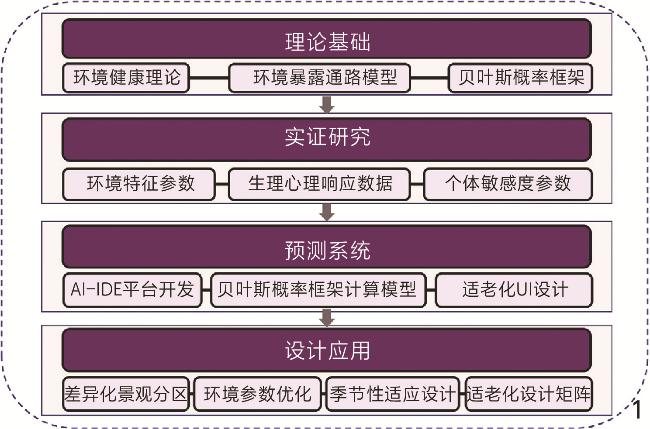
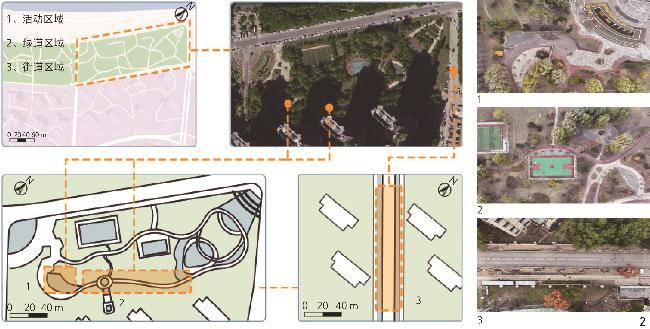
The research employs a multi-stage methodological approach combining field experimentation, mathematical modeling, and application development. Health indicators of elderly subjects (n = 345, aged 60 − 70) are collected in three distinct outdoor environments (activity area, greenway area, and street area) in a community in Shenyang, China. Data collection was conducted during November − December of 2023 and 2024, with outdoor temperatures ranging from 4°C to 8°C. Environmental parameters are standardized through a two-tier framework quantifying spatial openness (δopen) and green coverage (δgreen) relative to reference standards. Individual sensitivity parameters are established incorporating gender differences, with sensitivity coefficients (η) and regulatory factors (γ) calculated based on physiological responses. A systematic testing is conducted following a standardized protocol consisting of preparation, environmental exposure, and recovery assessment phases. Physiological indicators include systolic blood pressure (SBP), diastolic blood pressure (DBP), and pulse pressure (PP), which are measured using an Omron HEM-7136 electronic sphygmomanometer. Psychological variables are assessed using validated Chinese versions of the Profile of Mood States (POMS) and Restoration Outcome Scale (ROS) with Cronbach’s α coefficients of 0.86 and 0.82 respectively. Based on the collected data, a Bayesian probability model is constructed that transforms traditional Bayesian components into environment-specific parameters: Prior probabilities become baseline blood pressure values, likelihood functions become environmental adjustment effects, and posterior distributions become predictive blood pressure values with confidence intervals. The Artificial Intelligence-Integrated Development Environment (AI-IDE) platform is utilized to transform the theoretical framework into a practical application. The development process employs an iterative evolution approach, converting the Bayesian probability framework into executable code through natural language processing capabilities of the AI-IDE platform. Based on parameter sensitivity analysis results of the prediction system, design optimization strategies for elderly-oriented outdoor environments in cold regions are proposed.
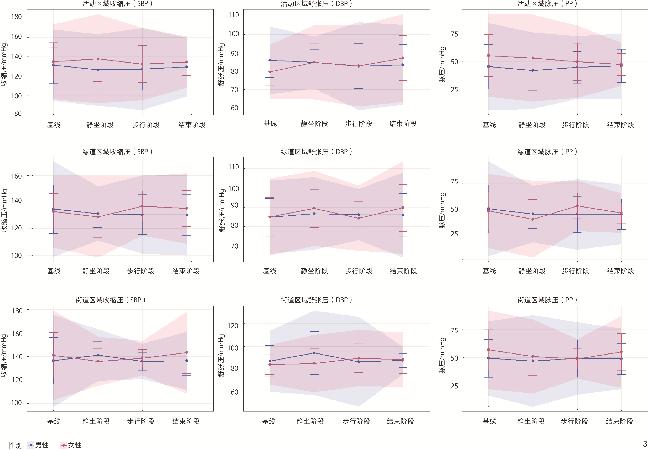
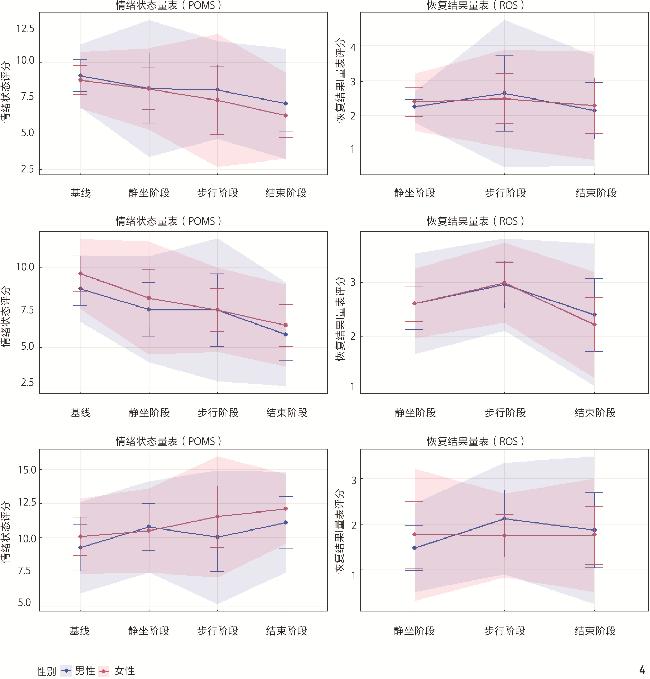
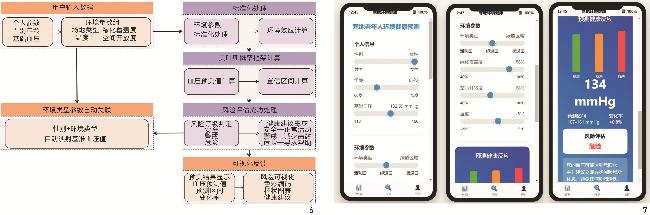
The research identifies significant gender-based differences in environmental sensitivity, with elderly females demonstrating markedly higher sensitivity coefficients compared to males (0.85±0.04 vs. 0.72±0.05) and greater regulatory factors (1.24±0.07 vs. 0.86±0.05). These differences are manifested in physiological responses, with female subjects exhibiting larger blood pressure fluctuations during environmental transitions (8.76±2.31 mmHg vs. 5.24±1.87 mmHg). Among the three outdoor environments, the greenway area produces the most positive health effects, characterized by a mean decrease in systolic blood pressure of 2.7±1.8 mmHg from baseline and improvements in psychological indicators (POMS scores decrease by 2.6±0.9, while ROS scores increase by 0.53±0.12). Conversely, the street area induces negative effects, with SBP increasing by 7.8±2.4 mmHg on average and negative mood indicators rising. The activity area demonstrates intermediate effects with non-significant SBP changes (±1.5 mmHg) and slight mood improvements. The prediction model demonstrates excellent performance metrics across validation testing. The system performs best in predicting responses in the activity area (SBP mean root error: 4.8 mmHg; accuracy rate: 91.2%), with slightly higher error rates in street area, where the accuracy rate is still maintained above 88.5%. Five-fold cross-validation confirms model stability with a CV coefficient of 0.092. Overall model fit achieves an R² value of 0.87, with prediction interval coverage reaching 93.8%, demonstrating strong explanatory power and reliability. Key health indicators (SBP, POMS, and ROS) all show significant linear relationships between predicted and actual values. The mobile terminal implementation features age-appropriate design elements including large-sized touch control elements (30px × 30px with a minimum spacing of 12mm), high contrast visual feedback, 18px font size, and a three-tiered risk visualization framework using color-coding (green − orange − red) to enhance information accessibility for elderly users.
The prediction system based on the Bayesian probability framework successfully achieves accurate assessment of environmental health risks for elderly individuals in cold regions. The adoption of individual difference parameterization methods, combined with a multi-level cascade prediction framework system design, significantly enhances the prediction accuracy of health risk probability. The system effectively addresses the common challenges of small-sample health research by leveraging Bayesian approaches to handle uncertainty in parameter distributions, providing robust predictions despite limited training data. The application of AI-IDE platform notably accelerates the transformation process from research findings to practical applications, establishing a seamless bridge between academic knowledge and implementable tools. This approach substantially lowers technical barriers for cross-disciplinary applications by converting research requirements and model logic into structured code through natural language processing. The system provides quantitative indicators and scientific foundations for optimizing elderly-oriented landscape environments in cold regions, including optimal spatial openness range (0.65 − 0.80), recommended green coverage threshold (0.82 − 0.88), and gender-specific environmental transition zone designs. These evidence-based design parameters offer practical guidance for creating outdoor environments that enhance physiological and psychological well-being of elderly populations in cold regions, ultimately supporting healthy aging in place.
ZHANG Tianheng , FU Yao , GAO Jian , XUE Huanran . Intelligent Environmental Health Risk Assessment System for the Elderly in Cold Regions Based on Artificial Intelligence Integrated Development Environment[J]. Landscape Architecture, 2025 , 32(7) : 123 -131 . DOI: 10.3724/j.fjyl.LA20250057
表2 标准化试验流程与时长Table 2 Process and duration of standardized testing |
| 阶段 | 环境区域 | 持续时长 | 活动内容 |
| 准备阶段 | 基线测量区 | 10 min | 知情同意书签署、基础信息登记、基准生理测量、心理量表填写 |
| 环境暴露阶段 | 活动区域 | 15 min | 静坐休息暴露 |
| 15 min | 以3~4 km/h的速度进行慢速步行活动 | ||
| 5 min | 静坐休息,禁止社交互动 | ||
| 绿道区域 | 15 min | 静坐休息暴露 | |
| 15 min | 以3~4 km/h的速度进行慢速步行活动 | ||
| 5 min | 静坐休息,禁止社交互动 | ||
| 街道区域 | 15 min | 静坐休息暴露 | |
| 15 min | 以3~4 km/h的速度进行慢速步行活动 | ||
| 5 min | 静坐恢复 | ||
| 恢复评估阶段 | 基线测量区 | 10 min | 最终生理指标测量、心理量表填写、问卷填写 |
表3 不同环境类型的空间特征参数统计结果Table 3 Statistical results of spatial characteristic parameters for different types of environments |
| 环境类型 | 空间开敞度( ${\delta } _{ \mathrm{open}} $ ) | 绿化覆盖度( ${\delta } _{ \mathrm{green}} $ ) |
| 注:数据以平均值±标准差表示。 | ||
| 活动区域 | 0.73±0.05 | 0.82±0.04 |
| 绿道区域 | 0.68±0.06 | 0.88±0.05 |
| 街道区域 | 0.85±0.04 | 0.65±0.06 |
表4 不同性别老年人群体的环境敏感度与调节因子特征(n=345)Table 4 Characteristics of environmental sensitivity and regulatory factors in elderly people of different genders (n=345) |
| 性别 | 样本量 | 敏感度系数($\eta $) | 调节因子(${\text{γ}} $) | 血压变化幅度/mmHg | 恢复率/% |
| 男性 | 165 | 0.72±0.05 | 0.86±0.05 | 5.24±1.87 | 35.7±3.2 |
| 女性 | 180 | 0.85±0.04 | 1.24±0.07 | 8.76±2.31 | 42.3±3.8 |
表5 环境过渡期的生理指标响应特征Table 5 Response characteristics of physiological indicators during the environmental transition period |
| 环境类型 | 性别 | 基准血压/mmHg | SBP最大变化值/mmHg | 恢复时间/min | 调节系数 |
| 活动区域至 | 男性 | 131.02±18.81 | 3.82±1.24 | 8.46±2.31 | 0.82±0.06 |
| 女性 | 134.88±19.79 | 5.67±1.86 | 7.23±1.98 | 1.18±0.08 | |
| 绿道区域至 | 男性 | 134.66±18.24 | 5.24±1.87 | 9.82±2.76 | 0.86±0.05 |
| 女性 | 132.69±13.73 | 8.76±2.31 | 8.54±2.42 | 1.24±0.07 |
表6 个体特征参数与生理指标的相关性分析(Pearson相关系数)Table 6 Analysis of the correlation between individual characteristic parameters and physiological indicators (Pearson correlation coefficient) |
| 参数 | 敏感度系数($\eta $) | 调节因子(${\text{γ} } $) | SBP最大变化值 | 恢复率 |
| 注:**表示在0.01水平上显著相关(双尾);数据源自试验样本统计分析。 | ||||
| 敏感度系数 | 1.000 | 0.682** | 0.754** | 0.623** |
| 调节因子 | 0.682** | 1.000 | 0.628** | 0.815** |
| 收缩压变化 | −0.754** | 0.628** | 1.000 | 0.542** |
| 恢复率 | −0.623** | 0.815** | 0.542** | 1.000 |
表7 从基础贝叶斯计算式到环境健康预测计算式的转换解释Table 7 Explanation of the transition from the basic Bayesian formula to environmental health prediction formula |
| 转换要素 | 基础贝叶斯计算式 | 环境健康预测计算式 | 转换原因 |
| 目标变量 | 预测参数集合(${\text{θ}} $) | 血压值(BP) | 将抽象参数具体化为可测量的健康指标 |
| 条件变量 | 实验观测数据(D) | 环境参数(E) | 将一般观测数据具体化为环境特征参数 |
| 先验知识 | 先验概率(P(${\text{θ}} $)) | 血压基准值(${{\text{μ}} _{BP}} $) | 将先验概率转换为无环境干预时的血压期望值 |
| 似然函数 | 似然函数(${P} ({D}{|} {{\text{θ}}} ) $) | 环境调节效应(${\beta _E} $) | 将似然函数转换为环境参数对血压的影响系数 |
| 不确定性表达 | 整个后验分布 | 方差参数(${{\text{σ}} ^2} $) | 将分布不确定性具体化为个体差异导致的血压波动 |
| 计算方式 | 概率计算 | ${{\text{μ}} _{BP}} $与${\beta _E} $求和 | 从概率推断转换为确定性参数计算 |
| 个体差异处理 | 通过分布表达 | 通过$\eta $(敏感度系数)调整 | 引入个体敏感度参数处理性别等个体特征差异 |
| 预测输出 | 后验概率分布 | 预测值与置信区间:BPpred±1.96${\text{σ}} $ | 从概率分布转换为具体的预测值和风险区间 |
表8 风险等级判定标准Table 8 Criteria for determining risk levels |
| 风险等级 | 血压范围/mmHg | 风险解读 | 建议措施 |
| 正常 | <140 | 健康范围 | 正常活动 |
| 警戒 | 140~<160 | 轻度风险 | 减少暴露时间,监测血压 |
| 高风险 | ≥160 | 显著风险 | 避免长时间暴露,建议转移到更适宜环境 |
表9 不同环境类型下的生理指标预测性Table 9 Predictability of physiological indicators under different environmental types |
| 环境类型 | SBP预测均值方根误差/mmHg | 样本区间/mmHg | 变化率预测准确度/% |
| 活动区域 | 4.8 | 132.5~138.2 | 91.2 |
| 绿道区域 | 5.1 | 130.8~136.9 | 89.7 |
| 街道区域 | 5.6 | 135.4~142.3 | 88.5 |
表10 优化策略矩阵Table 10 Optimization strategy matrix |
| 优化方向 | 个体特异性需求 | 最优设计参数 | 预期健康效应 |
| 过渡区 | 老年女性:渐变过渡,易疲劳; | 渐变长度:老年女性需更长过渡区休息; | 降低血压波动 |
| 绿化覆盖 | 老年女性偏好:更注重绿化; | 最优覆盖度(0.82~0.88);街道区域最低覆盖度需维持在[0.60,0.65] | 收缩压显著改善,在绿道环境中平均降低2.7±1.8 mmHg;负面情绪指数平均降低2.6±0.9 |
| 空间开 | 老年女性偏好开敞度(0.65~0.75); | 综合最优空间开敞度(0.65~0.80);街道区域最优开敞度需维持在[0.80,0.85] | 降低血压波动,在街道环境中减少收缩压波动幅度7.8±2.4 mmHg |
| 季节适 | 老年女性需求:对冬季环境保护设施有更高需求,偏好全面防寒措施; | 常绿植物比例建议从28%提升至40% | 提升老年人的恢复体验,恢复导向量表(ROS)评分提高0.53±0.12;负面情绪指数平均降低2.6±0.9 |
| [1] |
LIU L H, QU H Y, MA Y M, et al. Restorative Benefits of Urban Green Space: Physiological, Psychological Restoration and Eye Movement Analysis[J]. Journal of Environmental Management, 2022, 301: 113930.
|
| [2] |
王子琳, 李志刚, 程晗蓓. 社区网格尺度下城市密度对居民绿地暴露水平的影响: 以特大城市武汉市为例[J]. 经济地理, 2022, 42(12): 82-91.
WANG Z L, LI Z G, CHENG H B. The Impact of Urban Density on Residents’ Green Space Exposure in Megacities at the Community Grid Scale: Evidence from Wuhan[J]. Economic Geography, 2022, 42(12): 82-91.
|
| [3] |
王小月, 杨东峰. 建成环境如何影响老年人绿地使用频率: 基于可达性和吸引力双重视角[J]. 中国园林, 2020, 36(11): 62-66
WANG X Y, YANG D F. How the Built Environment Affect the Frequency of Green Space Used by the Elderly: Based on the Dual Perspective of Accessibility and Attractiveness[J]. Chinese Landscape Architecture, 2020, 36(11): 62-66.
|
| [4] |
郎蕾洁, 成实. 全球视野下老年友好型绿地研究热点及关键方法探析与启示[J]. 风景园林, 2024, 31(6): 73-81.
LANG L J, CHENG S. Exploration of and Inspiration from Research Hotspots and Key Methods of Age-Friendly Green Spaces from a Global Perspective[J]. Landscape Architecture, 2024, 31(6): 73-81.
|
| [5] |
CHEN K L, ZHANG T Z, LIU F Y, et al. How Does Urban Green Space Impact Residents’ Mental Health: A Literature Review of Mediators[J]. International Journal of Environmental Research and Public Health, 2021, 18(22): 11746.
|
| [6] |
ZHOU W S, WANG W J, ZHOU F F, et al. The Effects of Greenness Exposure on Hypertension Incidence Among Chinese Oldest-Old: A Prospective Cohort Study[J]. Environmental Health, 2022, 21(1): 66.
|
| [7] |
叶佳明. 绿地空间和NO2暴露与中国老年人高血压的关联分析[D]. 长春: 吉林大学, 2023.
YE J M. Correlation Analysis of Green Space and NO2 Exposure with Hypertension in the Elderly in China[D]. Changchun: Jilin University, 2023.
|
| [8] |
陈玉洁, 袁媛, 周钰荃, 等. 蓝绿空间暴露对老年人健康的邻里影响: 以广州市为例[J]. 地理科学, 2020, 40(10): 1679-1687.
CHEN Y J, YUAN Y, ZHOU Y Q, et al. The Neighborhood Effect of Exposure to Green and Blue Space on the Elderly’s Health: A Case Study of Guangzhou, China[J]. Scientia Geographica Sinica, 2020, 40(10): 1679-1687.
|
| [9] |
岳亚飞, 杨东峰, 徐丹. 城市蓝绿空间对老年心理健康影响机制的探究与检验[J]. 风景园林, 2022, 29(12): 71-77.
YUE Y F, YANG D F, XU D. Exploration and Examination of the Influence Mechanism of Urban Blue-Green Space on the Elderly’s Mental Health[J]. Landscape Architecture, 2022, 29(12): 71-77.
|
| [10] |
LI G, MEI J H, YOU J, et al. Sociodemographic Characteristics Associated with Adolescent Depression in Urban and Rural Areas of Hubei Province: A Cross-Sectional Analysis[J]. BMC Psychiatry, 2019, 19(1): 386.
|
| [11] |
SINGH A. Machine Learning Approaches for Mental Health Diagnosis[J]. International Journal of Health Sciences, 2022, 6(S1): 10758-10764.
|
| [12] |
MAGNANI J W, NING H Y, WILKINS J T, et al. Educational Attainment and Lifetime Risk of Cardiovascular Disease[J]. JAMA Cardiology, 2024, 9(1): 45-54.
|
| [13] |
QIAO M, GUO J, WANG R, et al. Research Progress on Population Aging and Chronic Diseases[J]. MEDS Public Health and Preventive Medicine, 2023, 1(3): 28-35.
|
| [14] |
肖惠敏, 邝惠容. SF-12量表评价中国老年人生存质量的信度和效度分析[J]. 中国老年学杂志, 2014, 34(4): 1018-1020.
XIAO H M, KUANG H R. Reliability and Validity of the SF-12 Scale in Assessing Quality of Life Among Chinese Older Adults[J]. Chinese Journal of Gerontology, 2014, 34(4): 1018-1020.
|
| [15] |
KABISCH N, KRAEMER R, MASZTALERZ O, et al. Impact of Summer Heat on Urban Park Visitation, Perceived Health and Ecosystem Service Appreciation[J]. Urban Forestry & Urban Greening, 2021, 60: 127058.
|
| [16] |
BURTSCHER M, GATTERER H, BURTSCHER J, et al. Extreme Terrestrial Environments: Life in Thermal Stress and Hypoxia. a Narrative Review[J]. Frontiers in Physiology, 2018, 9: 572.
|
| [17] |
CAMPBELL T S, LAVOIE K L, BACON S L, et al. Asthma Self-Efficacy, High Frequency Heart Rate Variability, and Airflow Obstruction During Negative Affect in Daily Life[J]. International Journal of Psychophysiology, 2006, 62(1): 109-114.
|
| [18] |
WHELTON P K, CAREY R M, ARONOW W S, et al. 2017 ACC/AHA/AAPA/ABC/ACPM/AGS/APhA/ASH/ASPC/NMA/PCNA Guideline for the Prevention, Detection, Evaluation, and Management of High Blood Pressure in Adults: A Report of the American College of Cardiology/American Heart Association Task Force on Clinical Practice Guidelines[J]. Journal of the American College of Cardiology, 2018, 71(19): e127-e248.
|
| [19] |
KRAEMER R, KABISCH N. Parks in Context: Advancing Citywide Spatial Quality Assessments of Urban Green Spaces Using Fine-Scaled Indicators[J]. Ecology and Society, 2021, 26(2): art45.
|
| [20] |
ULRICH R S, SIMONS R F, LOSITO B D, et al. Stress Recovery During Exposure to Natural and Urban Environments[J]. Journal of Environmental Psychology, 1991, 11(3): 201-230.
|
| [21] |
BRATMAN G N, ANDERSON C B, BERMAN M G, et al. Nature and Mental Health: An Ecosystem Service Perspective[J]. Science Advances, 2019, 5(7): eaax0903.
|
| [22] |
MARKEVYCH I, SCHOIERER J, HARTIG T, et al. Exploring Pathways Linking Greenspace to Health: Theoretical and Methodological Guidance[J]. Environmental Research, 2017, 158: 301-317.
|
| [23] |
中华人民共和国住房和城乡建设部. 城市居住区规划设计标准: GB 50180—2018[S]. 北京: 建筑工业出版社, 2018.
Ministry of Housing and Urban-Rural Development of the People’s Republic of China. Standard for Urban Residential Area Planning and Design: GB 50180−2018[S]. Beijing: China Architecture & Building Press, 2018.
|
| [24] |
WANG Y, WANG R Z. Research on Satisfaction of Habitat Natural Environment[J]. IOP Conference Series: Earth and Environmental Science, 2019, 300(3): 032032.
|
| [25] |
YAN L, JIA W X, ZHAO S Q. The Cooling Effect of Urban Green Spaces in Metacities: A Case Study of Beijing, China’s Capital[J]. Remote Sensing, 2021, 13(22): 4601.
|
| [26] |
DE BELL S, GRAHAM H, JARVIS S, et al. The Importance of Nature in Mediating Social and Psychological Benefits Associated with Visits to Freshwater Blue Space[J]. Landscape and Urban Planning, 2017, 167: 118-127.
|
| [27] |
周帮兴. 统计学正态分布规律在生化检验中的应用[J]. 中国卫生产业, 2014, 11(12): 2
ZHOU B X. Application of Normal Distribution Law of Statistics in Biochemical Examination[J]. China Health Industry, 2014, 11(12): 2.
|
| [28] |
ROSSO A L, SANDERS J L, ARNOLD A M, et al. Multisystem Physiologic Impairments and Changes in Gait Speed of Older Adults[J]. The Journals of Gerontology Series A, Biological Sciences and Medical Sciences, 2015, 70(3): 319-324.
|
| [29] |
隋辉, 王文. 《中国高血压基层管理指南》(2014年修订版)要点解读[J]. 临床荟萃, 2015, 30(7): 4
SUI H, WANG W. Commentary on Chinese Guidelines for the Management of Hypertension in the Community (2014 Revised Edition)[J]. Clinical Focus, 2015, 30(7): 4.
|
/
| 〈 |
|
〉 |