

Impact of Subjective and Objective Green Space Characteristics on Mental Health Benefits: An Explainable Machine Learning Approach
|
LI Ke is a master student in the College of Horticulture, Nanjing Agricultural University. Her research focuses on urban green space and public health, and landscape planning and design |
|
MAO Yipei is a master student in the College of Horticulture, Nanjing Agricultural University. His research focuses on urban green space and public health, and landscape planning and design |
|
LI Yongjun, Ph.D., is a lecturer in the College of Horticulture, Nanjing Agricultural University. Her research focuses on landscape perception preference, and urban green space and public health |
Received date: 2025-02-15
Revised date: 2025-05-09
Online published: 2025-12-09
Copyright
Against the backdrop of high-density urban development, residents’ mental health problems have become increasingly severe. Access to urban green spaces is widely regarded as an important approach to improving residents’ mental health. Exploring the impact of green space characteristics on mental health benefits can provide a theoretical basis for urban green space planning and design from the perspective of healthy city. This research aims to clarify the internal relationships between objective and subjective green space characteristics and different mental health benefits (emotional restoration, cognitive enhancement, and stress relief) through explainable machine learning models.
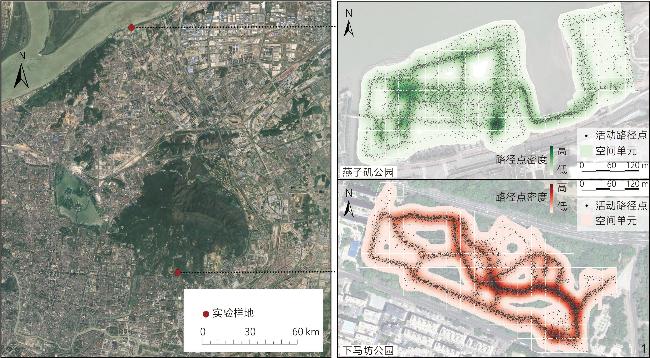
A mental health perception restoration experiment was carried out in two green spaces (Yanziji Park and Xiamafang Park) in Nanjing, with 56 participants engaged in two-hour free activities in the green spaces. During this period, GPS trajectories, data on objective green space characteristics, data on perception assessment of subjective green space characteristics, and data on self-assessment of mental health benefits were collected. Objective green space characteristics include the Normalized Difference Vegetation Index (NDVI), green view index, canopy density, actual noise dB (A), and spatial attractiveness, which are measured by remote sensing, semantic segmentation, and acoustic instruments. Subjective green space characteristics, such as perceived greenness, perceived noise, and perceived attractiveness, are evaluated by means of a 5-point Likert scale questionnaire. Mental health benefits are divided into the three types of emotional restoration, cognitive enhancement, and stress relief, and are assessed using the Restorative Outcomes Scale (ROS). To analyze and clarify the relationships between objective and subjective green space characteristics and different types of mental health benefits, the research adopts the Light Gradient Boosting Machine (LightGBM) model, combined with SHapley Additive exPlanations (SHAP) to measure and explain the importance of green space characteristics for mental health benefits. Based on the SHAP values, the non-linear relationships between them are further clarified.
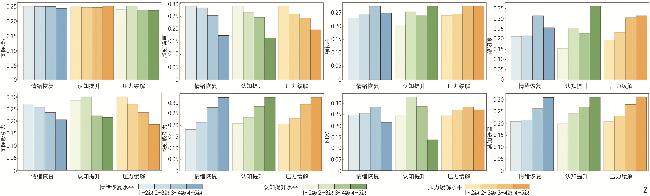
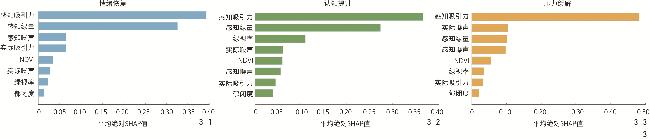
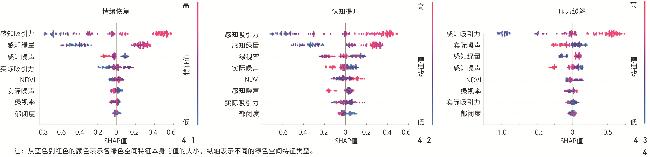
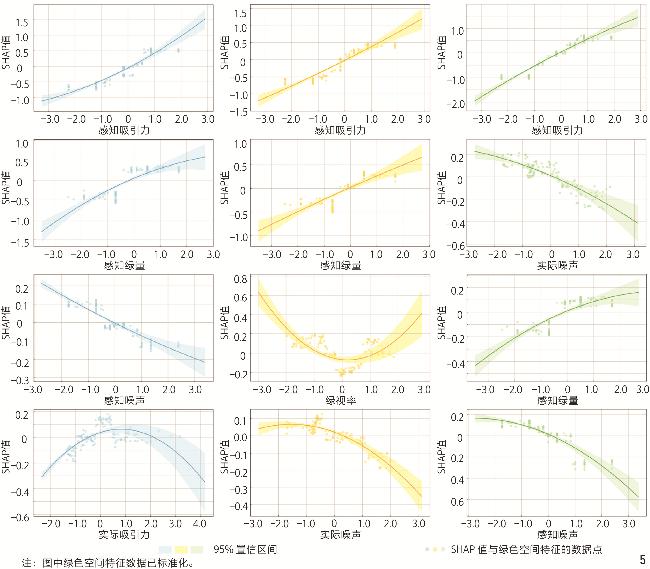
Through the analysis of 3 types of mental health benefits and 5 models, the LightGBM model outperforms other algorithms (such as Random Forest and XGBoost) in terms of prediction accuracy (R 2: 0.523 – 0.642), with its robustness in capturing complex feature interactions being verified. The SHAP value analysis shows that subjective green space characteristics have a stronger relative impact on mental health outcomes than objective indicators. Specifically, perceived attractiveness is the most important contributing factor, followed by perceived greenness and perceived noise. Notably, the positive impact of perceived greenness on mental health is greater than that of objective indicators such as green visibility and NDVI. In addition, in terms of noise, excessive actual noise could inhibit cognitive enhancement and stress relief. However, moderate perceived noise could promote emotional restoration and stress relief. For example, when the actual noise exceeds 53.88 decibels in the cognitive enhancement model and 52.73 decibels in the stress relief model, negative effects would occur. While in the emotional restoration model, when the perceived noise is within a certain range (less than 2.58 points), it is beneficial for emotional restoration.
The results of this research provide empirical evidence for the internal relationship between urban green spaces and residents’ mental health. Firstly, this research constructs an indicator system covering both objective and subjective characteristics. By combining field measurements, questionnaire surveys, and advanced machine learning algorithms, the research explores the impact of green space characteristics on emotional restoration, cognitive enhancement, and stress relief. Secondly, subjective green space characteristics play a prominent role in influencing mental health benefits. The combined influence of perceived attractiveness and perceived greenness is the most significant. The results of non-linear regression show that actual noise has an inhibitory effect on cognitive enhancement and stress relief, while moderate perceived noise can promote emotional restoration and stress relief. Finally, this research provides a direction for further exploring the in-depth association mechanism between green spaces and mental health, and also offers data support for urban green space planning and design aimed at promoting residents’ mental health.
LI Ke , MAO Yipei , LI Yongjun . Impact of Subjective and Objective Green Space Characteristics on Mental Health Benefits: An Explainable Machine Learning Approach[J]. Landscape Architecture, 2025 , 32(7) : 56 -64 . DOI: 10.3724/j.fjyl.LA20250095
表1 受试者基本情况表Table 1 Basic information of subjects |
| 受试者组别 | 男 | 女 | 年龄/岁 | 身高/m | 体重/kg | BMI |
| 注:性别括号内数值表示该性别所占比例;年龄、身高、体重及BMI数据表示为均值(标准差)。 | ||||||
| 下马坊(n=25) | 12(48%) | 13(52%) | 18.80(0.96) | 1.69(0.08) | 62.28(12.86) | 21.65(3.81) |
| 燕子矶(n=31) | 16(52%) | 15(48%) | 19.65(0.84) | 1.70(0.07) | 64.18(13.25) | 22.26(4.70) |
表2 绿色空间特征指标测度Table 2 Measurement of green space characteristic indicators |
| 指标类型 | 指标 | 描述 | 数据来源 |
| 客观绿色 | NDVI | 样地各30 m×30 m空间单元的NDVI均值评估高空视角的植被覆盖度 | Sentinel-2卫星图 |
| 绿视率 | DeepLabv3模型对人眼高度1.5 m全景图语义分割后的植被面积占比 | 全景图实拍 | |
| 郁闭度 | 35 mm焦段的鱼眼镜头拍摄的顶视图中的绿色像素数量占比 | 顶视图实拍 | |
| 实际噪声 | 各采样点持续1 min的等效连续A声级均值,单位为dB (A) | HS-5633B声级计实测 | |
| 实际吸引力 | 各空间单元中两步路App活动路径点数量 | 两步路App | |
| 主观绿色 | 感知绿量 | 受试者对各空间单元绿量大小的感知评估,1~5分 | 问卷调查 |
| 感知噪声 | 受试者对各空间单元噪声程度的感知评估,1~5分 | 问卷调查 | |
| 感知吸引力 | 受试者对各空间单元活动意愿的感知评估,1~5分 | 问卷调查 |
表3 5种预测模型间准确性对比Table 3 Comparison of accuracy among five forecasting models |
| 模型 | 情绪恢复 | 认知提升 | 压力缓解 | |||||||||||
| MSE | MAPE | RMSE | R 2 | MSE | MAPE | RMSE | R 2 | MSE | MAPE | RMSE | R 2 | |||
| RF | 0.482 | 1.210 | 0.694 | 0.514 | 0.568 | 2.184 | 0.754 | 0.428 | 0.569 | 1.705 | 0.754 | 0.426 | ||
| SVR | 0.548 | 1.139 | 0.740 | 0.448 | 0.640 | 1.897 | 0.800 | 0.354 | 0.598 | 1.516 | 0.773 | 0.398 | ||
| 线性回归 | 0.597 | 1.338 | 0.773 | 0.398 | 0.727 | 2.286 | 0.853 | 0.268 | 0.573 | 1.589 | 0.757 | 0.423 | ||
| XGBoost | 0.544 | 1.213 | 0.737 | 0.452 | 0.645 | 2.169 | 0.803 | 0.350 | 0.690 | 1.913 | 0.831 | 0.304 | ||
| LightGBM | 0.332 | 0.206 | 0.576 | 0.642 | 0.315 | 0.216 | 0.561 | 0.601 | 0.448 | 0.236 | 0.669 | 0.523 | ||
表4 3类心理健康效益差异性分析Table 4 Variability analysis of three types of mental health benefits |
| 对比组 | 平均值差值 | 标准误 | p 值 | 95%置信区间 | |
| 下限 | 上限 | ||||
| 情绪恢复—认知提升 | 0.211 6 | 0.096 6 | 0.029 0 | 0.021 7 | 0.401 4 |
| 情绪恢复—压力缓解 | 0.064 4 | 0.096 6 | 0.505 6 | −0.125 5 | 0.254 2 |
| 认知提升—压力缓解 | −0.147 2 | 0.096 6 | 0.128 4 | −0.337 0 | 0.042 7 |
文中图表均由作者绘制,其中
| [1] |
刘航, 马烨清, 朱争鸣. 健康视角下城市密度与绿地空间暴露关系的脉络及展望[J]. 生态学报, 2024, 44(24): 11096-11108.
LIU H, MA Y Q, ZHU Z M. The Relationship and Prospects Between Urban Density and Green Space Exposure from a Health Perspective[J]. Acta Ecologica Sinica, 2024, 44(24): 11096-11108.
|
| [2] |
CARDINALI M, BEENACKERS M A, FLEURY-BAHI G, et al. Examining Green Space Characteristics for Social Cohesion and Mental Health Outcomes: A Sensitivity Analysis in Four European Cities[J]. Urban Forestry & Urban Greening, 2024, 93: 128230.
|
| [3] |
XU J X, MA J, TAO S. Examining the Nonlinear Relationship Between Neighborhood Environment and Residents' Health[J]. Cities, 2024, 152: 105213.
|
| [4] |
FANG Z, LIN Y, CHEN C Y, et al. Mental Health in China: Exploring the Impacts of Built Environment, Work Environment, and Subjective Perception[J]. Frontiers in Psychology, 2024, 15: 1352609.
|
| [5] |
DZHAMBOV A M, HARTIG T, TILOV B, et al. Residential Greenspace Is Associated with Mental Health via Intertwined Capacity-Building and Capacity-Restoring Pathways[J]. Environmental Research, 2019, 178: 108708.
|
| [6] |
YAN Q Y, SUN Y X. Mapping Perceived Sentiments in University Campuses with Varied Landscape Metrics and Climatic Conditions[J]. Frontiers in Psychology, 2024, 15: 1467966.
|
| [7] |
RIEVES E S, FREIS S M, FRIEDMAN N P, et al. Is Greenspace in the Eye of the Beholder? Exploring Perceived and Objective Greenspace Exposure Effects on Mental Health[J]. Journal of Environmental Psychology, 2024, 100: 102468.
|
| [8] |
TACZANOWSKA K, TANSIL D, WILFER J, et al. The Impact of Age on People’s Use and Perception of Urban Green Spaces and Their Effect on Personal Health and Wellbeing During the COVID-19 Pandemic: A Case Study of the Metropolitan Area of Vienna, Austria[J]. Cities, 2024, 147: 104798.
|
| [9] |
LI K, MAO Y P, LI Y J, et al. Exploring the Pathways of Urban Green Space Exposure on Respiratory Health: An Empirical Study in Nanjing, China[J]. Urban Forestry & Urban Greening, 2024, 101: 128536.
|
| [10] |
BAI Y H, WANG R Y, YANG L C, et al. The Impacts of Visible Green Spaces on the Mental Well-Being of University Students[J]. Applied Spatial Analysis and Policy, 2024, 17(3): 1105-1127.
|
| [11] |
XU W Z, XU S Q, SHI R X, et al. Exploring the Impact of University Green Spaces on Students' Perceived Restoration and Emotional States Through Audio-Visual Perception[J]. Ecological Informatics, 2024, 82: 102766.
|
| [12] |
MOLLAESMAEILI M, HAKIMIAN P, LAK A. Perceived Urban Green Spaces and Youth Mental Health in the Post-COVID-19 Era[J]. Frontiers in Public Health, 2024, 12: 1265682.
|
| [13] |
陈崇贤, 刘欣宜, 邱添, 等. 夜跑友好视角下城市街道环境视觉感知评价[J]. 风景园林, 2024, 31(4): 36-43.
CHEN C X, LIU X Y, QIU T, et al. Evaluation on Visual Perception of Urban Street Environment from the Perspective of Being Friendly to Nighttime Running[J]. Landscape Architecture, 2024, 31(4): 36-43.
|
| [14] |
MA R, ZHANG M. Pathways Mediating Neighborhood Green Spaces on Emotions of Populations with Different Mental Health in Nanjing, China[J]. Applied Geography, 2024, 173: 103457.
|
| [15] |
HA J, KIM H J, WITH K A. Urban Green Space Alone is not Enough: A Landscape Analysis Linking the Spatial Distribution of Urban Green Space to Mental Health in the City of Chicago[J]. Landscape and Urban Planning, 2022, 218: 104309.
|
| [16] |
REID C E, RIEVES E S, CARLSON K. Perceptions of Green Space Usage, Abundance, and Quality of Green Space Were Associated with Better Mental Health During the COVID-19 Pandemic Among Residents of Denver[J]. PLoS One, 2022, 17(3): e0263779.
|
| [17] |
PENG Z M, ZHANG R Y, DONG Y, et al. A Study on the Relationship Between Campus Environment and College Students’ Emotional Perception: A Case Study of Yuelu Mountain National University Science and Technology City[J]. Buildings, 2024, 14(9): 2849.
|
| [18] |
SUN D, ZHOU F J, LIN J J, et al. A Study on Landscape Feature and Emotional Perception Evaluation of Waterfront Greenway[J]. Environmental Research Communications, 2024, 6(9): 095023.
|
| [19] |
崔雪, 金荷仙, 曾程程. 校园绿地听嗅交互感知对大学生压力恢复的影响研究[J]. 中国园林, 2023, 39(2): 26-31.
CUI X, JIN H X, ZENG C C. A Study on the Influence of Campus Green Space Auditory and Olfactory Interactive Perception on Stress Recovery of College Students[J]. Chinese Landscape Architecture, 2023, 39(2): 26-31.
|
| [20] |
DELGADO-SERRANO M M, MELICHOVÁ K, MAC FADDEN I, et al. Perception of Green Spaces' Role in Enhancing Mental Health and Mental Well-Being in Small and Medium-Sized Cities[J]. Land Use Policy, 2024, 139: 107087.
|
| [21] |
SONG L Y, LIU D, KWAN M P, et al. Machine-Based Understanding of Noise Perception in Urban Environments Using Mobility-Based Sensing Data[J]. Computers, Environment and Urban Systems, 2024, 114: 102204.
|
| [22] |
吝涛, 曾志伟, 姚霞, 等. 城市绿地暴露与人群健康效应研究[J]. 生态学报, 2023, 43(23): 10013-10021.
LIN T, ZENG Z W, YAO X, et al. Study on Urban Green Space Exposure and Population Health Effect[J]. Acta Ecologica Sinica, 2023, 43(23): 10013-10021.
|
| [23] |
QU S R, MA R C. Exploring Multi-Sensory Approaches for Psychological Well-Being in Urban Green Spaces: Evidence from Edinburgh’s Diverse Urban Environments[J]. Land, 2024, 13(9): 1536.
|
| [24] |
刘泽润, 刘超. 可持续建成环境研究的机器学习应用进展与展望[J]. 风景园林, 2023, 30(7): 51-59.
LIU Z R, LIU C. Application of Machine Learning in the Research on Sustainable Built Environment: Progress and Prospect[J]. Landscape Architecture, 2023, 30(7): 51-59.
|
| [25] |
韩会然, 许岭怡, 杨成凤. 多尺度建成环境对老年人心理健康的影响: 基于极端梯度提升模型的合肥实证[J]. 地理研究, 2024, 43(6): 1502-1521.
HAN H R, XU L Y, YANG C F. The Impact of Multi-Scale Built Environment on the Mental Health of Older Adults: An Empirical Study of Hefei Based on Extreme Gradient Boosting Model[J]. Geographical Research, 2024, 43(6): 1502-1521.
|
| [26] |
Secretariat of the Convention on Biological Diversity. Global Biodiversity Outlook 5: Summary for Policy Makers[R/OL]. (2020-08-18)[2025-02-15]. https://www.cbd.int/gbo5.
|
| [27] |
中国科学院心理研究所. 心理健康蓝皮书: 中国国民心理健康发展报告(2023—2024)[M]. 北京: 社会科学文献出版社, 2025.
Institute of Psychology, Chinese Academy of Sciences. Mental Health Blue Book: Report on the Development of National Mental Health in China (2023−2024)[M]. Beijing: Social Sciences Academic Press, 2025.
|
| [28] |
TEEUWEN R, MILIAS V, BOZZON A, et al. How Well Do NDVI and OpenStreetMap Data Capture People’s Visual Perceptions of Urban Greenspace?[J]. Landscape and Urban Planning, 2024, 245: 105009.
|
| [29] |
AIKOH T, HOMMA R, ABE Y. Comparing Conventional Manual Measurement of the Green View Index with Modern Automatic Methods Using Google Street View and Semantic Segmentation[J]. Urban Forestry & Urban Greening, 2023, 80: 127845.
|
| [30] |
SALIM M, SARAVANAN S. Evaluation of Noise Exposure Levels of Pedestrians in Suburban Chennai, India[J]. Journal of Environmental Engineering and Landscape Management, 2024, 32(3): 211-221.
|
| [31] |
GRACE M, DICKIE J, BROWN C, et al. Using Solicited Research Diaries to Assess the Restorative Potential of Exposure to Inland Blue Space Across Time[J]. Landscape and Urban Planning, 2024, 241: 104904.
|
| [32] |
WU Y J, ZHOU W, ZHANG H M, et al. Relationships Between Green Space Perceptions, Green Space Use, and the Multidimensional Health of Older People: A Case Study of Fuzhou, China[J]. Buildings, 2024, 14(6): 1544.
|
| [33] |
刘喆, 潘瑞琦, 李昊冉, 等. 基于植被群落特征的大型公共绿地环境效益制图方法[J]. 风景园林, 2022, 29(10): 67-73.
LIU Z, PAN R Q, LI H R, et al. Mapping Method for Environmental Benefits of Large-Scale Public Green Space Based on Characteristics of Vegetation Community[J]. Landscape Architecture, 2022, 29(10): 67-73.
|
| [34] |
JIANG B, XU W, JI W, et al. Impacts of Nature and Built Acoustic-Visual Environments on Human’s Multidimensional Mood States: A Cross-continent Experiment[J]. Journal of Environmental Psychology, 2021, 77: 101659.
|
| [35] |
LIS A, ZALEWSKA K, GRABOWSKI M. The Ability to Choose How to Interact with Other People in the Park Space and Its Role in Terms of Perceived Safety and Preference[J]. Journal of Environmental Psychology, 2024, 99: 102429.
|
| [36] |
杜新存, 李方正. 绿色暴露作为促进健康服务的评估指标与机制研究综述[J]. 风景园林, 2022, 29(10): 26-31.
DU X C, LI F Z. A Review of Research on Green Exposure as an Assessment Indicator and Mechanism for Health Services Promotion[J]. Landscape Architecture, 2022, 29(10): 26-31.
|
| [37] |
MARKEVYCH I, SCHOIERER J, HARTIG T, et al. Exploring Pathways Linking Greenspace to Health: Theoretical and Methodological Guidance[J]. Environmental Research, 2017, 158: 301-317.
|
| [38] |
MUELLER W, MILNER J, LOH M, et al. Exposure to Urban Greenspace and Pathways to Respiratory Health: An Exploratory Systematic Review[J]. Science of the Total Environment, 2022, 829: 154447.
|
| [39] |
李倞, 杨璐. 后疫情时代风景园林聚焦公共健康的热点议题探讨[J]. 风景园林, 2020, 27(9): 10-16.
LI L, YANG L. Discussion on Hot Topics of Landscape Architecture Focusing on Public Health in the Post-Epidemic Era[J]. Landscape Architecture, 2020, 27(9): 10-16.
|
| [40] |
嵇雨桐, 胡坤宁, 李雄, 等. 从布局到功能: “口袋公园簇” 协同设计模式[J]. 风景园林, 2024, 31(2): 95-101.
JI Y T, HU K N, LI X, et al. From Layout to Function: Synergistic Design Pattern of “Pocket Park Bundle”[J]. Landscape Architecture, 2024, 31(2): 95-101.
|
/
| 〈 |
|
〉 |