

Research Progress and Prospect of Green Infrastructure with Public Health Promotion Function
|
LI Tongyu, Ph.D., is an associate professor in the School of Architecture and Design, Harbin Institute of Technology, a member of the Key Laboratory of Cold Region Urban and Rural Human Settlement Environment Science and Technology, Ministry of Industry and Information Technology, and a Horticultural Therapist-Registered (HTR). Her research focuses on healing landscape and healthy campus |
|
LIXU Junyi is a Ph.D. candidate in the School of Architecture and Design, Harbin Institute of Technology, and a member of the Key Laboratory of Cold Region Urban and Rural Human Settlement Environment Science and Technology, Ministry of Industry and Information Technology. His research focuses on healthy human settlement environment and natural healing system, and big data analysis and spatial analysis methods for healthy cities |
|
XUE Binxia, Ph.D., is an associate professor in the School of Architecture and Design, Harbin Institute of Technology, a member of the Key Laboratory of Cold Region Urban and Rural Human Settlement Environment Science and Technology, Ministry of Industry and Information Technology, and a Horticultural Therapist-Registered (HTR). His research focuses on healthy human settlement environment and natural healing system |
|
(USA) SONG Yan, Ph.D., is a professor in the School of Architecture & Urban Planning, Shenzhen University, and a lifetime professor in the Department of Urban and Regional Planning, University of North Carolina at Chapel Hill. Her research focuses on healthy cities, environmental governance policies, correlation between urban development form and urban diseases, smart cities and smart health technologies, and spatial analysis methods |
Received date: 2025-02-24
Revised date: 2025-05-14
Online published: 2025-12-09
Copyright
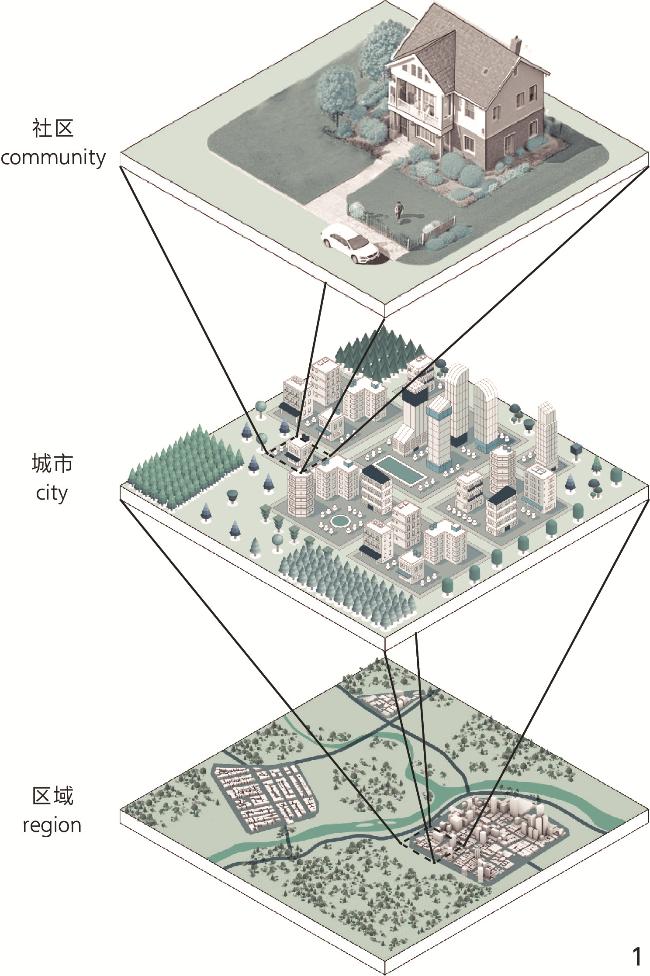
This research aims to explore and elucidate pathways through which green infrastructure (GI) promotes public health by constructing an integrative framework that integrates various GI types with their roles in enhancing physiological, psychological, and social well-being. Recognizing the importance of GI in urban planning to integrate natural and built environments for improving citizens’ daily life, this research addresses challenges such as fragmented classification systems, limited analysis of action pathways, and ambiguity in scale adaptation. The main objectives are to systematically classify GI types, track the development of related research, and describe the positive and negative mechanisms by which GI affects public health.
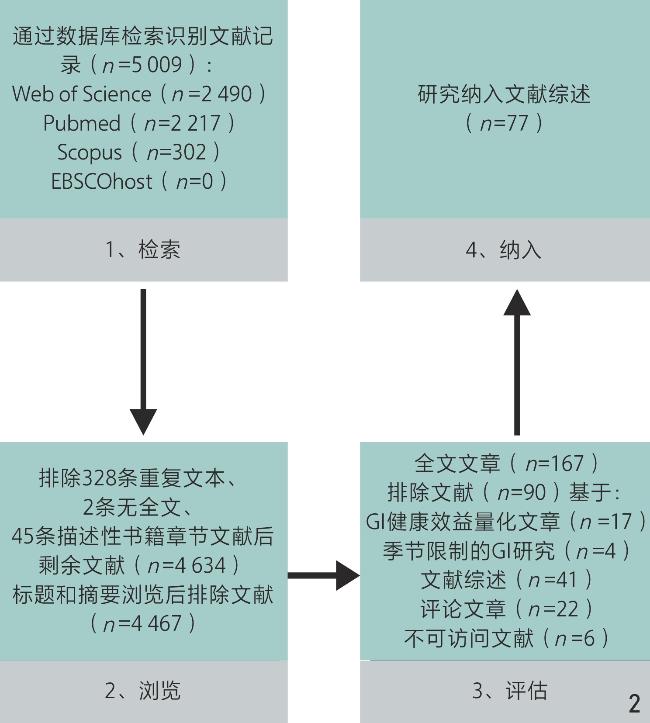
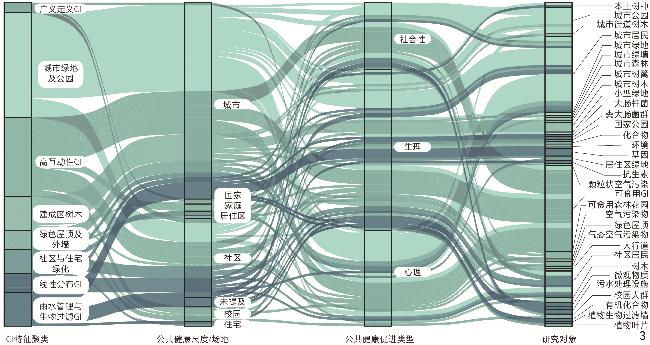
A systematic review approach modelled on the PRISMA guidelines is used to collect and analyze literature from multiple disciplines including medicine, environmental sciences, and architecture. Comprehensive search is conducted in databases such as Web of Science, PubMed, Scopus, and EBSCOhost using a broad range of search terms related to GI and public health without time restrictions. After rigorous screening based on predefined inclusion and exclusion criteria, 77 relevant research articles are selected for detailed analysis. Data extraction focused on various dimensions, including specific GI types, action pathways, health outcomes, public health dimensions (physiological, psychological and social dimensions), spatial scales, and research subjects. To manage the multidimensionality of GI research, cluster analysis is performed using a Word2Vec model combined with a K-means algorithm to integrate different GI forms into a coherent classification system.
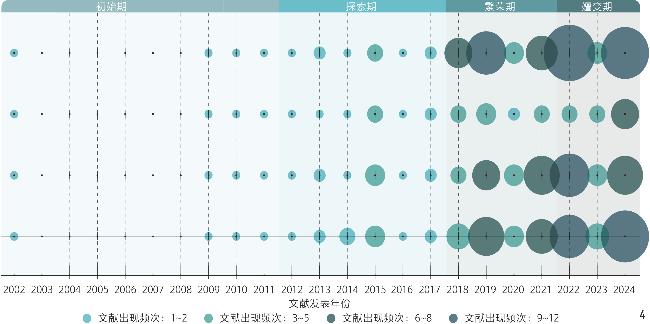
The results show that GI can be clearly divided into different categories, such as urban green spaces and parks, high-interaction spaces, trees in built-up areas, water management and biofiltration systems, community and residential greening, green roofs and facades, linear green networks, and broader macro-GI strategies. The historical development of GI research can be divided into four stages: Initial stage (2002 – 2011), during which the research focus was on thermal comfort and air quality improvement; exploration stage (2012 – 2017), during which the research scope was expanded to include disease prevention and social cohesion; prosperity stage (2018 – 2021), during which multidimensional health outcomes were integrated; and transformation stage (2022 – 2024), during which advanced technologies such as GIS, remote sensing, and machine learning were utilized. In addition, the research identifies positive pathways for GI to promote physical activity, regulate microclimate, enhance aesthetic and biodiversity benefits, and improve water quality. However, it also acknowledges potential negative effects, such as serving as habitats for disease vectors and releasing allergens that may exacerbate respiratory diseases.
This research systematically outlines the multifaceted role of GI in public health, highlighting the need for a standardized GI health service framework that integrates various GI types with specific health outcomes and spatial scales. Such a framework could significantly enhance urban planning and policy-making by optimizing GI interventions to provide the most significant public health benefits. The findings advocate further interdisciplinary collaboration and integration of advanced data analytics to deepen our understanding of GI health pathways. Future research should focus on quantifying these benefits and developing practical evaluations to provide targeted interventions, ultimately leading to more effective public health strategies in urban settings.
LI Tongyu , LIXU Junyi , XUE Binxia , (USA) SONG Yan . Research Progress and Prospect of Green Infrastructure with Public Health Promotion Function[J]. Landscape Architecture, 2025 , 32(7) : 12 -20 . DOI: 10.3724/j.fjyl.LA20250109
表1 GI 特征聚类频次Table 1 GI feature clustering frequency |
| GI特征聚类 | 频次 |
| 注:此分类中,频数与关键词共现次数关联,而不与研究数量关联。 | |
| 城市绿地及公园 | 44 |
| 高互动性GI | 33 |
| 建成区树木 | 14 |
| 雨水管理与生物过滤GI | 14 |
| 社区与住宅绿化 | 10 |
| 绿色屋顶及外墙 | 8 |
| 线性分布GI | 8 |
| 广义定义GI | 4 |
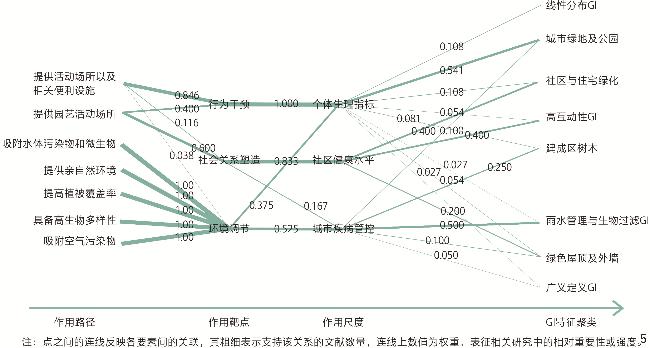
表2 正向路径解析Table 2 Analysis of positive pathways |
| 作用路径 | 健康结果 | 涉及GI类型 | 尺度/场地 | 文献频数 |
| 提供活动场所以及相关便利设施 | 1)促进体育锻炼和社交互动,延长寿命; | 校园绿色屋顶;小型绿地;城市绿色空间;社区绿地;街头绿地;居住区绿地;城市公园;城市绿地;城市绿道;河滨公园;社区花园;社区绿道 | 城市;社区;场地 | 25 |
| 提供场所与人员服务 | 1)通过主动参与促进生理与心理恢复,改善增强社区凝聚力; | 可食用城市森林;可食用森林花园;植物园;学校菜园;地方菜园;社区菜园;家庭菜园;可食用绿墙 | 社区 | 3 |
| 增加植被覆盖率,提供树荫遮蔽,通过蒸散调节湿度温度,进而调节气候 | 有效调节了地表和空气温度,提高公众热舒适性,缓解高温,减少了相关疾病发病率和死亡率 | 城市可渗透地面;城市树木;城市公园 | 城市 | 8 |
| 植物叶片捕获气态和颗粒状空气污染物,植物吸附气态空气污染物并在微生物的协同作用下将其降解 | 1)改善空气质量,降低空气污染物含量; | 城市树木;绿色屏障;绿墙;树篱 | 城市 | 6 |
| 通过水生植物、根际微生物、抗菌滤料和土壤过滤和吸收有机化合物、抗生素、生活污水、细菌 | 1)改善雨水物理化学性质,降低大肠杆菌含量; | 生物滞留池;人工湿地;雨水生物过滤器;垂直潜流湿地;生物滤池 | 城市;场地 | 7 |
| 拥有更多的植物种类与鸟类,具有较高的植物、鸟类和蝴蝶种类丰富度 | 被城市居民感知从而促进心理健康,场地拥有更多的疗愈优势,进一步降低了抑郁、压力和焦虑的强度 | 城市绿地 | 城市 | 2 |
| 提供以自然元素为主的视觉景观,利用自然元素创造视觉和听觉体验,利用植物种植与周围建筑塑造围合感 | 1)对城市环境要素(风光声等)的隔离,提供远离尘嚣的氛围; | 城市绿地;城市森林;城市公园;社区花园;家庭花园;城市绿色外墙;绿色立面 | 城市;社区 | 6 |
| 具有高质量环境品质,具有良好的美学特征、维护水平和清洁度,对社区居民具有高度的可达性和访问便利性 | 1)改善了低收入社区居民难以获得和高收入社区同等医疗保障而产生的健康不平等现象,降低疾病风险; | 城市绿地;城市公园 | 社区 | 3 |
| 植物中包含了许多生物活性的化合物,提供了丰富的可用于制药的化合物储备 | 便于生产具有预防心血管疾病和癌症等退行性疾病作用的药物 | 国家公园 | 国家 | 1 |
| 树木吸引了更多的居民,增加了社区中人的密度 | 减少犯罪,减轻攻击性行为 | 社区树木 | 社区 | 1 |
表3 反向路径解析Table 3 Analysis of negative pathways |
| 作用路径 | 健康结果 | 涉及GI类型 | 尺度/场地 | 文献频数 |
| 为病毒和细菌的媒介(蜱虫和蚊子)提供栖息地 | 1)增加人群暴露于蜱传疾病的风险; | 城市绿地; | 城市 | 2 |
| 植物散发易导致过敏的气味,在授粉期散播花粉 | 1)导致易过敏人群过敏性疾病的发生; | 城市绿地; | 城市; | 3 |
| 树木叶片在空气流动受限的街道环境中富集了更多的空气污染物 | 叶片枯萎掉落后其中的污染物可能会进入城市生态系统循环(如水循环)威胁公共健康安全 | 城市绿地 | 城市 | 1 |
| 专题学术主持人 Guest Editors of the Special | ||||
| 魏家星 WEI Jiaxing | 陈崇贤 CHEN Chongxian | |||
| 南京农业大学园艺学院教授Professor in the the College of Horticulture, Nanjing Agricultural University | 华南农业大学林学与风景园林学院副教授Associate Professor in the College of Forestry and Landscape Architecture, South China Agricultural University | |||
文中图表均由作者绘制。其中,
| [1] |
HUNOLD C. Green Infrastructure and Urban Wildlife: Toward a Politics of Sight[J]. Humanimalia, 2019, 11(1): 89-108.
|
| [2] |
TZOULAS K, KORPELA K, VENN S, et al. Promoting Ecosystem and Human Health in Urban Areas Using Green Infrastructure: A Literature Review[J]. Landscape and Urban Planning, 2007, 81(3): 167-178.
|
| [3] |
KARJALAINEN E, SARJALA T, RAITIO H. Promoting Human Health Through Forests: Overview and Major Challenges[J]. Environmental Health and Preventive Medicine, 2010, 15(1): 1-8.
|
| [4] |
CANZONIERI C. M.E. Benedict and E.T. McMahon, Green Infrastructure: Linking Landscapes and Communities[J]. Landscape Ecology, 2007, 22(5): 797-798.
|
| [5] |
European Environment Agency. Green Infrastructure (GI): Enhancing Europe’s Natural Capital[EB/OL]. (2014-02-21) [2024-12-14]. https://www.eea.europa.eu/policy-documents/green-infrastructure-gi-2014-enhancing.
|
| [6] |
U.S. Environmental Protection Agency. About Green Infrastructure[EB/OL]. (2025-02-13)[2024-12-15]. https://www.epa.gov/green-infrastructure/about-green-infrastructure.
|
| [7] |
BARTON H, GRANT M. A Health Map for the Local Human Habitat[J]. The Journal of the Royal Society for the Promotion of Health, 2006, 126(6): 252-253.
|
| [8] |
VÖLKER S, KISTEMANN T. The Impact of Blue Space on Human Health and Well-Being − Salutogenetic Health Effects of Inland Surface waters: A Review[J]. International Journal of Hygiene and Environmental Health, 2011, 214(6): 449-460.
|
| [9] |
TWENGE J M, JOINER T E, ROGERS M L, et al. Increases in Depressive Symptoms, Suicide-Related Outcomes, and Suicide Rates Among U.S. Adolescents After 2010 and Links to Increased New Media Screen Time[J]. Clinical Psychological Science, 2018, 6(1): 3-17.
|
| [10] |
HUXLEY R R, ANSARY-MOGHADDAM A, CLIFTON P, et al. The Impact of Dietary and Lifestyle Risk Factors on Risk of Colorectal Cancer: A Quantitative Overview of the Epidemiological Evidence[J]. International Journal of Cancer, 2009, 125(1): 171-180.
|
| [11] |
COLLABORATORS G R F. Global, Regional, and National Comparative Risk Assessment of 79 Behavioural, Environmental and Occupational, and Metabolic Risks or Clusters of Risks in 188 Countries, 1990−2013: A Systematic Analysis for the Global Burden of Disease Study 2013[J]. British Dental Journal, 2015, 219(7): 329.
|
| [12] |
LEE I M, SHIROMA E J, LOBELO F, et al. Effect of Physical Inactivity on Major Non-Communicable Diseases Worldwide: An Analysis of Burden of Disease and Life Expectancy[J]. The Lancet, 2012, 380(9838): 219-229.
|
| [13] |
薛滨夏, 李同予, 姜博. 自然疗愈体系的当代发展及公共健康服务潜力[J]. 风景园林, 2024, 31(5): 23-38.
XUE B X, LI T Y, JIANG B. Contemporary Development of the Nature-Based Intervention System and Its Potential for Public Health Services[J]. Landscape Architecture, 2024, 31(5): 23-38.
|
| [14] |
HUGHES S. A Meta-Analysis of Urban Climate Change Adaptation Planning in the U.S[J]. Urban Climate, 2015, 14: 17-29.
|
| [15] |
PATZ J A, CAMPBELL-LENDRUM D, HOLLOWAY T, et al. Impact of Regional Climate Change on Human Health[J]. Nature, 2005, 438(7066): 310-317.
|
| [16] |
KLEIN ROSENTHAL J, KINNEY P L, METZGER K B. Intra-Urban Vulnerability to Heat-Related Mortality in New York City, 1997−2006[J]. Health & Place, 2014, 30: 45-60.
|
| [17] |
SETO K C, GÜNERALP B, HUTYRA L R. Global Forecasts of Urban Expansion to 2030 and Direct Impacts on Biodiversity and Carbon Pools[J]. Proceedings of the National Academy of Sciences of the United States of America, 2012, 109(40): 16083-16088.
|
| [18] |
MAAS J, VERHEIJ R A, GROENEWEGEN P P, et al. Green Space, Urbanity, and Health: How Strong Is the Relation?[J]. Journal of Epidemiology and Community Health, 2006, 60(7): 587-592.
|
| [19] |
MITCHELL R, POPHAM F. Effect of Exposure to Natural Environment on Health Inequalities: An Observational Population Study[J]. The Lancet, 2008, 372(9650): 1655-1660.
|
| [20] |
VAN DEN BERG M, WENDEL-VOS W, VAN POPPEL M, et al. Health Benefits of Green Spaces in the Living environment: A Systematic Review of Epidemiological Studies[J]. Urban Forestry & Urban Greening, 2015, 14(4): 806-816.
|
| [21] |
WINSLOW C E. The Untilled Fields of Public Health[J]. Science, 1920, 51(1306): 23-33.
|
| [22] |
MOLD A, CLARK P, MILLWARD G, et al. Placing the Public in Public Health in Post-War Britain, 1948−2012[M]. Cham: Springer International Publishing, 2019: 7-32.
|
| [23] |
马明, 蔡镇钰. 健康视角下城市绿色开放空间研究: 健康效用及设计应对[J]. 中国园林, 2016, 32(11): 66-70.
MA M, CAI Z Y. Research on Health and Urban Green Open Space: Health Benefits and Design Strategy[J]. Chinese Landscape Architecture, 2016, 32(11): 66-70.
|
| [24] |
王兰, 廖舒文, 赵晓菁. 健康城市规划路径与要素辨析[J]. 国际城市规划, 2016, 31(4): 4-9.
WANG L, LIAO S W, ZHAO X J. Exploration of Approaches and Factors of Healthy City Planning[J]. Urban Planning International, 2016, 31(4): 4-9.
|
| [25] |
ZHANG J G, YU Z W, ZHAO B. Impact Mechanism of Urban Green Spaces in Promoting Public Health: Theoretical Framework and Inspiration for Practical Experiences[J]. Landscape Architecture Frontiers, 2020, 8(4): 104.
|
| [26] |
姚亚男, 李树华. 基于公共健康的城市绿色空间相关研究现状[J]. 中国园林, 2018, 34(1): 118-124.
YAO Y N, LI S H. Review on Research of Urban Green Space Based on Public Health[J]. Chinese Landscape Architecture, 2018, 34(1): 118-124.
|
| [27] |
PAGE M J, MCKENZIE J E, BOSSUYT P M, et al. The PRISMA 2020 Statement: An Updated Guideline for Reporting Systematic Reviews[J]. International Journal of Surgery, 2021, 88: 105906.
|
| [28] |
PENNINGTON J, SOCHER R, MANNING C. Glove: Global Vectors for Word Representation[C]// Proceedings of the 2014 Conference on Empirical Methods in Natural Language Processing. Stroudsburg: ACL, 2014: 1532-1543.
|
| [29] |
BHOLOWALIA P, KUMAR A. EBK-Means: A Clustering Technique Based on Elbow Method and K-Means in WSN[J]. International Journal of Computer Applications, 2014, 105(9): 17-24.
|
| [30] |
TAKANO T, NAKAMURA K, WATANABE M. Urban Residential Environments and Senior Citizens’ Longevity in Megacity Areas: The Importance of Walkable Green Spaces[J]. Journal of Epidemiology and Community Health, 2002, 56(12): 913-918.
|
| [31] |
GRAHN P, STIGSDOTTER U K. The Relation Between Perceived Sensory Dimensions of Urban Green Space and Stress Restoration[J]. Landscape and Urban Planning, 2010, 94(3/4): 264-275.
|
| [32] |
HATHAWAY J M, HUNT W F, GRAVES A K, et al. Exploring Fecal Indicator Bacteria in a Constructed Stormwater Wetland[J]. Water Science and Technology, 2011, 63(11): 2707-2712.
|
| [33] |
BUFFOLI M, REBECCHI A, GOLA M, et al. A Calculation Model for Improving Outdoor Air Quality in Urban Contexts and Evaluating the Benefits to the Population’s Health Status[C]// MONDINI G, FATTINNANZI E, OPPIO A, et al. 2016 SIEV Conference. Rome: Springer, 2018: 453-467.
|
| [34] |
VANOS J K, WARLAND J S, GILLESPIE T J, et al. Human Energy Budget Modeling in Urban Parks in Toronto and Applications to Emergency Heat Stress Preparedness[J]. Journal of Applied Meteorology and Climatology, 2012, 51(9): 1639-1653.
|
| [35] |
IRVINE K N, WARBER S L, DEVINE-WRIGHT P, et al. Understanding Urban Green Space as a Health Resource: A Qualitative Comparison of Visit Motivation and Derived Effects Among Park Users in Sheffield, UK[J]. International Journal of Environmental Research and Public Health, 2013, 10(1): 417-442.
|
| [36] |
CARRUS G, DADVAND P, SANESI G. The Role and Value of Urban Forests and Green Infrastructure in Promoting Human Health and Wellbeing[M]//PEARLMUTTER D, CALFAPIETRA C, SAMSON R, et al. The Urban Forest. Cham: Springer International Publishing, 2017: 217-230.
|
| [37] |
ZHANG Y, VAN DIJK T, TANG J J, et al. Green Space Attachment and Health: A Comparative Study in Two Urban Neighborhoods[J]. International Journal of Environmental Research and Public Health, 2015, 12(11): 14342-14363.
|
| [38] |
WANG R Y, BROWNING M H E M, KEE F, et al. Exploring Mechanistic Pathways Linking Urban Green and Blue Space to Mental Wellbeing Before and After Urban Regeneration of a Greenway: Evidence from the Connswater Community Greenway, Belfast, UK[J]. Landscape and Urban Planning, 2023, 235: 104739.
|
| [39] |
WILLIAMS K J H, LEE K E, SARGENT L, et al. Appraising the Psychological Benefits of Green Roofs for City Residents and Workers[J]. Urban Forestry & Urban Greening, 2019, 44: 126399.
|
| [40] |
ELSADEK M, LIU B Y, LIAN Z F. Green Façades: Their Contribution to Stress Recovery and Well-Being in High-Density Cities[J]. Urban Forestry & Urban Greening, 2019, 46: 126446.
|
| [41] |
COCCOLO S, PEARLMUTTER D, KAEMPF J, et al. Thermal Comfort Maps to Estimate the Impact of Urban Greening on the Outdoor Human Comfort[J]. Urban Forestry & Urban Greening, 2018, 35: 91-105.
|
| [42] |
CAPOTORTI G, ALÓS ORTÍ M M, COPIZ R, et al. Biodiversity and Ecosystem Services in Urban Green Infrastructure Planning: A Case Study from the Metropolitan Area of Rome (Italy)[J]. Urban Forestry & Urban Greening, 2019, 37: 87-96.
|
| [43] |
LAI Y, KONTOKOSTA C E. The Impact of Urban Street Tree Species on Air Quality and Respiratory Illness: A Spatial Analysis of Large-Scale, High-Resolution Urban Data[J]. Health & Place, 2019, 56: 80-87.
|
| [44] |
KABISCH N, KRAEMER R, BRENCK M E, et al. A Methodological Framework for the Assessment of Regulating and Recreational Ecosystem Services in Urban Parks Under Heat and Drought Conditions[J]. Ecosystems and People, 2021, 17(1): 464-475.
|
| [45] |
BYDAŁEK F, MYSZOGRAJ S. Safe Surface Concept in Vertical Flow Constructed Wetland Design to Mitigate Infection Hazard[J]. Journal of Environmental Science and Health, Part A, 2019, 54(3): 246-255.
|
| [46] |
PETTIT T, TORPY F R, SURAWSKI N C, et al. Effective Reduction of Roadside Air Pollution with Botanical Biofiltration[J]. Journal of Hazardous Materials, 2021, 414: 125566.
|
| [47] |
TENDAIS I, RIBEIRO A I. Urban Green Spaces And Mental Health During The Lockdown Caused By Covid-19[J]. Finisterra, 2020, 55(115): 4.
|
| [48] |
VENTER Z S, HASSANI A, STANGE E, et al. Reassessing the Role of Urban Green Space in Air Pollution Control[J]. Proceedings of the National Academy of Sciences of the United States of America, 2024, 121(6): e2306200121.
|
| [49] |
XIA Q F, QIN G Y, LIU Q, et al. Green Space Exposure and Chinese Residents’ Physical Activity Participation: Empirical Evidence from a Health Geography Perspective[J]. Frontiers in Public Health, 2024, 12: 1430706.
|
| [50] |
FOURNET F, SIMARD F, FONTENILLE D. Green Cities and Vector-Borne Diseases: Emerging Concerns and Opportunities[J]. European Communicable Disease Bulletin, 2024, 29(10): 2300548.
|
| [51] |
JANZÉN T, CHOUDHURY F, HAMMER M, et al. Ticks: Public Health Risks in Urban Green Spaces[J]. BMC Public Health, 2024, 24(1): 1031.
|
| [52] |
HASSETT E, DIUK-WASSER M, HARRINGTON L, et al. Integrating Tick Density and Park Visitor Behaviors to Assess the Risk of Tick Exposure in Urban Parks on Staten Island, New York[J]. BMC Public Health, 2022, 22(1): 1602.
|
| [53] |
AERTS R, STAS M, VANLESSEN N, et al. Residential Green Space and Seasonal Distress in a Cohort of Tree Pollen Allergy Patients[J]. International Journal of Hygiene and Environmental Health, 2020, 223(1): 71-79.
|
| [54] |
AERTS R, BRUFFAERTS N, SOMERS B, et al. Tree Pollen Allergy Risks and Changes Across Scenarios in Urban Green Spaces in Brussels, Belgium[J]. Landscape and Urban Planning, 2021, 207: 104001.
|
| [55] |
ZUBERBIER T, STEVANOVIC K, ANSOTEGUI I J, et al. Green Roof Gardens: Selecting Allergy-Friendly Vegetation: A Global Allergy and Asthma Excellence Network (GA²LEN) Position Paper[J]. The Journal of Allergy and Clinical Immunology: In Practice, 2024, 12(2): 347-354.
|
| [56] |
KAPLAN S. The Restorative Benefits of Nature: Toward an Integrative Framework[J]. Journal of Environmental Psychology, 1995, 15(3): 169-182.
|
| [57] |
ULRICH R S, SIMONS R F, LOSITO B D, et al. Stress Recovery During Exposure to Natural and Urban Environments[J]. Journal of Environment Psychology, 1991, 11(3): 201-230.
|
/
| 〈 |
|
〉 |