

Evaluation of Urban Composite Carbon Sink Value: A Case Study of Shenyang
|
SHI Tiemao, Ph.D., is a professor and doctoral supervisor in the School of Architecture and Urban Planning, Shenyang Jianzhu University. His research focuses on ecological planning, low-carbon planning, and healthy city |
|
WANG Di is a Ph.D. candidate in the School of Architecture and Urban Planning, Shenyang Jianzhu University. His research focuses on ecological planning, and carbon sinks in urban ecosystems |
|
TANG Yu, Ph.D., is a professor in the School of Architecture and Urban Planning, Shenyang Architecture University. Her research focuses on ecological planning, carbon sinks in urban ecosystems, and green architecture |
|
LI Peiying, Ph.D., is a lecturer in the School of Architecture and Urban Planning, Shenyang Architecture University. Her research focuses on ecological planning, and carbon sinks in urban ecosystems |
Received date: 2024-04-18
Revised date: 2024-11-15
Online published: 2025-12-07
Copyright
[Objective] In view of the urgent necessity to achieve the carbon peaking and carbon neutrality goals and establish an effective ecological compensation system, it is of crucial significance to evaluate the carbon sink value. With the increasing concerns about climate change and the pursuit of sustainable development, accurately evaluating the carbon sink value becomes essential for understanding the role of different ecosystems in carbon cycling. However, it is highly remarkable that in the current research on ecological compensation of carbon sink, the urban carbon sink value has been frequently overlooked, which is rather concerning given the rapid expansion of urban areas and their growing impact on the environment. Therefore, this research endeavors to address this issue by proposing a method for calculating the composite carbon sink value of urban areas, which is based on the distinct characteristics of urban ecosystems, with the ultimate aim of comprehensively uncovering the true composite carbon sink value of cities.
[Methods] On the basis of the analysis of carbon sink elements in urban spaces, a carbon storage estimation model for vegetation, soil and buildings is established by combining remote sensing imagery with plot data. This model is used to calculate the natural and artificial carbon storage within the Shenyang Fourth Ring area from 2003 to 2023. The afforestation cost method, carbon tax method, and carbon trading method are adopted to evaluate the composite carbon sink value of the research area. Using different methods, the research analyzes the spatiotemporal variations of the composite carbon sink value as well as the changing contributions of various carbon sink elements. Additionally, the research conducts preliminary discussions on the relationships between different carbon pricing calculation methods, changes in carbon sink value, and urban development, and compares the carbon sink values of urban spaces with those of other ecosystems.
[Results] The results indicate that from 2003 to 2023, within the Shenyang Fourth Ring area, the composite carbon sink value calculated by the afforestation cost method ranges from RMB 599 million to RMB 2.5 billion, while that calculated by the carbon tax method ranges from RMB 646 million to 864 million, and that calculated by the carbon trading method ranges from 623 million to RMB 833 million. There are significant differences in the evaluations of carbon sink value among different methods, suggesting that there is still room for increasing the carbon trading price and carbon tax price in China according to related research. Over the period from 2003 to 2023, the urban composite carbon sink value kept increasing. The vegetation carbon sink value and soil carbon sink value presented a fluctuating trend, while the building carbon sink value had been consistently rising. The proportion of carbon sink value contributed by vegetation and soil decreased from 43.61% and 46.15% in 2003 to 34.70% and 36.62% respectively, whereas the proportion contributed by buildings increased from 10.24% to 28.70%.
[Conclusion] The important contribution of urban space to carbon sinks in terrestrial ecosystems should not be ignored. Although the total composite carbon sink value of urban areas is slightly inferior to that of other terrestrial ecosystems such as forests, it has a certain advantage in average annual growth. This implies that urban areas, despite their different characteristics compared to natural ecosystems, still play a meaningful role in carbon sink. The evaluation of urban composite carbon sink value can reveal the situation of urban spatial carbon assets, clarify the values of various carbon sinks in urban areas, and provide support for further exploring the impacts of the conflict between natural and artificial spaces and urban environmental changes on carbon sink value. It also provides new theories and methods for enhancing urban composite carbon sink efficiency and serves as a reference for land use decision-making and planning for comprehensive benefits. The impact of various human activities on urban composite carbon sink value is complex, and identifying the key impact factors should be the focus of future research. This is because human activities such as urban construction, transportation, and industrial production can have both positive and negative impacts on carbon sink. Understanding these impacts and identifying the key impact factors will enable more effective management of urban carbon sink. Regarding the choice of different methods, the afforestation cost method is relatively unsuitable for evaluating urban carbon sink value. Meanwhile, the carbon tax method and the carbon trading method also have limitations in the application process. In the future, when regulating the carbon trading price and formulating the carbon tax rate, reference should be made to the afforestation cost of carbon sinks to make it more adaptable to the evaluation of urban composite carbon sink value. This will ensure that the methods used for evaluating urban carbon sink value are more accurate and reflective of the actual situation, thereby facilitating better decision-making in the context of urban carbon management.
Tiemao SHI , Di WANG , Yu TANG , Peiying LI . Evaluation of Urban Composite Carbon Sink Value: A Case Study of Shenyang[J]. Landscape Architecture, 2025 , 32(1) : 57 -66 . DOI: 10.3724/j.fjyl.202404180219
表1 3种方法计算碳汇价格汇总Tab. 1 Summary of various methods for calculating carbon sink price |
| 年份 | 碳汇价格 | ||
| 造林成本法 | 碳税法 | 碳交易法 | |
| 注:地均碳汇价值为单位土地面积某类型碳汇要素的碳汇价值,即该类型碳汇价值除以控规单元的面积。 | |||
| 2003 | 33.41 | 36 | 34.7 |
| 2008 | 54.89 | ||
| 2013 | 85.95 | ||
| 2018 | 81.57 | ||
| 2023 | 104.12 | ||
表2 研究区碳汇价值评价结果Tab. 2 Accounting results of carbon sink value in the research area |
| 评价方法 | 年份 | 自然碳汇 | 人工碳汇 | 城市复合碳汇 | |||||||
| VCV/ 亿元 | 地均VCV/ 元·hm-2 | SCV/ 亿元 | 地均SCV/ 元·hm-2 | BCV/ 亿元 | 地均BCV/ 元·hm-2 | UCV/ 亿元 | 地均UCV/ 元·hm-2 | ||||
| 造林成本法 | 2003 | 2.61 | 2 116.99 | 2.77 | 2 240.16 | 0.61 | 497.22 | 5.99 | 4 854.37 | ||
| 2008 | 4.86 | 3 937.98 | 4.69 | 3 799.44 | 1.67 | 1 350.32 | 11.22 | 9 087.74 | |||
| 2013 | 6.85 | 5 549.12 | 7.36 | 5 963.36 | 3.93 | 3 185.77 | 18.15 | 14 698.25 | |||
| 2018 | 7.37 | 5 971.55 | 6.40 | 5 184.35 | 4.82 | 3 906.55 | 18.60 | 15 062.45 | |||
| 2023 | 8.67 | 7 182.99 | 9.15 | 7 103.06 | 7.17 | 6 663.08 | 25.00 | 20 949.13 | |||
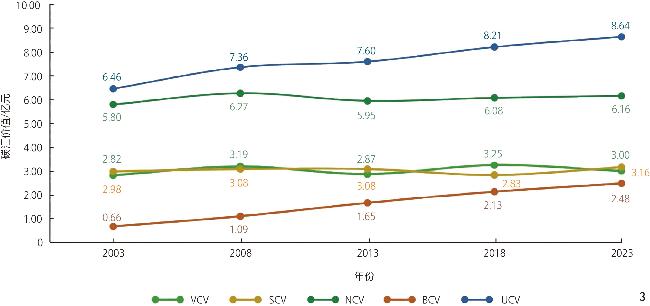
| 碳税法 | 2003 | 2.82 | 2 281.11 | 2.98 | 2 413.82 | 0.66 | 5 35.76 | 6.46 | 5 230.69 | ||
| 2008 | 3.19 | 2 582.75 | 3.08 | 2 491.89 | 1.09 | 885.62 | 7.36 | 5 960.26 | |||
| 2013 | 2.87 | 2 324.24 | 3.08 | 2 497.74 | 1.65 | 1 334.35 | 7.60 | 6 156.33 | |||
| 2018 | 3.25 | 2 635.48 | 2.83 | 2 288.05 | 2.13 | 1 724.11 | 8.21 | 6 647.64 | |||
| 2023 | 3.00 | 2 483.55 | 3.16 | 2 455.92 | 2.48 | 2 303.79 | 8.64 | 7 243.27 | |||
| 碳交易法 | 2003 | 2.72 | 2 198.73 | 2.87 | 2 326.66 | 0.64 | 516.41 | 6.23 | 5 041.80 | ||
| 2008 | 3.07 | 2 489.49 | 2.97 | 2 401.91 | 1.05 | 853.64 | 7.09 | 5 745.04 | |||
| 2013 | 2.77 | 2 240.31 | 2.97 | 2 407.55 | 1.59 | 1 286.17 | 7.33 | 5 934.03 | |||
| 2018 | 3.14 | 2 540.31 | 2.72 | 2 205.43 | 2.05 | 1 661.85 | 7.91 | 6 407.59 | |||
| 2023 | 2.89 | 2 393.87 | 3.05 | 2 367.23 | 2.39 | 2 220.60 | 8.33 | 6 981.70 | |||
图3 研究区不同要素碳汇价值变化情况Fig. 3 Changes in the carbon sink value of different elements in the research area |
表3 研究区碳汇价值占比变化情况Tab. 3 Changes in the proportion of carbon sink value in the research area |
| 年份 | VCV占比/% | SCV占比/% | BCV占比/% |
| 2003 | 43.61 | 46.15 | 10.24 |
| 2008 | 43.33 | 41.81 | 14.86 |
| 2013 | 37.75 | 40.58 | 21.67 |
| 2018 | 39.65 | 34.41 | 25.94 |
| 2023 | 34.70 | 36.62 | 28.68 |
| [1] |
仇保兴. 城市如何实现碳达峰碳中和[J]. 城乡建设, 2021 19): 8-15
QIU B X. How Can Cities Achieve Carbon Peak and Carbon Neutrality[J]. Urban and Rural Development, 2021 19): 8-15.
|
| [2] |
石铁矛, 王迪, 汤煜, 等. 城市生态系统碳汇固碳能力计算方法与影响因素研究进展[J]. 应用生态学报, 2023, 34(2): 555-565
SHI T M, WANG D, TANG Y, et al. Research Progress on Calculation Method and Impact Factors of Carbon Sequestration Capacity in Urban Eco-systems[J]. Chinese Journal of Applied Ecology, 2023, 34(2): 555-565.
|
| [3] |
王敏, 石乔莎. 城市绿色碳汇效能影响因素及优化研究[J]. 中国城市林业, 2015, 13(4): 1-5
WANG M, SHI Q S. A Study of Influencing Factors to Urban Green Carbon Sequestration and Its Efficiency Optimization[J]. Journal of Chinese Urban Forestry, 2015, 13(4): 1-5
|
| [4] |
CHEN J, GAO M, CHENG S, et al. County-Level CO2 Emissions and Sequestration in China During 1997—2017[J]. Scientific Data, 2020, 7(1): 391
|
| [5] |
UENO A, KAWAI K J, KOBAYASHI K, et al. Evaluation of Visual Methods for CO2 Uptake by Demolished Concrete: Research Activities by JSCE Subcommittee 219[J]. Construction and Building Materials, 2014, 67 393-398
|
| [6] |
郗凤明, 石铁矛, 王娇月, 等. 水泥材料碳汇研究综述[J]. 气候变化研究进展, 2015, 11(4): 288-296
XI F M, SHI T M, WANG J Y, et al. Review of Cement Materials Carbon Sink[J]. Climate Change Research, 2015, 11(4): 288-296.
|
| [7] |
刘丽丽, 王娇月, 邴龙飞, 等. 我国钢渣碳汇的量化分析[J]. 应用生态学报, 2018, 29(10): 3385-3390
LIU L L, WANG J Y, BING L F, et al. Analysis of Carbon Sink of Steel Slag in China[J]. Chinese Journal of Applied Ecology, 2018, 29(10): 3385-3390.
|
| [8] |
MCPHERSON E G, XIAO Q F, AGUARON E. A New Approach to Quantify and Map Carbon Stored, Sequestered and Emissions Avoided by Urban Forests[J]. Landscape and Urban Planning, 2013, 120 70-84
|
| [9] |
靳利飞, 周海东, 刘芮琳. 适应碳达峰、碳中和目标的生态保护补偿机制研究: 基于碳汇价值视角[J]. 中国科学院院刊, 2022, 37(11): 1623-1634
JIN L F, ZHOU H D, LIU R L. Research on Ecological Protection Compensation Mechanism Based on Carbon Sink Value[J]. Bulletin of Chinese Academy of Sciences, 2022, 37(11): 1623-1634.
|
| [10] |
夏敏, 王行, 刘振亚, 等. 四川若尔盖高原3种湿地生态系统的碳储量及碳汇价值[J]. 福建农林大学学报(自然科学版), 2020, 49(3): 392-398
XIA M, WANG H, LIU Z Y, et al. Carbon Stock and Its Value for 3 Types of Wetland Ecosystems on Zoige Plateau, Sichuan Province[J]. Journal of Fujian Agriculture and Forestry University (Natural Science Edition), 2020, 49(3): 392-398.
|
| [11] |
于海群. 华北地区平原造林工程碳汇能力及碳汇价值研究: 以北京市东郊森林公园为例[J]. 生态经济, 2022, 38(2): 110-115
YU H Q. Carbon Accounting for Afforestation Project in the Plain Area of Beijing: A Case Study of Eastern Suburb Forest Park, Beijing[J]. Ecological Economy, 2022, 38(2): 110-115.
|
| [12] |
王智晨, 张颖. 京津冀地区碳汇价值嵌入的森林资产核算与负债表编制[J]. 资源开发与市场, 2023, 39(7): 769-777
WANG Z C, ZHANG Y. Accounting and Balance Sheet Preparation for Forest Assets Embedded in the Value of Carbon Sinks in the Beijing-Tianjin-Hebei Region[J]. Resource Development & Market, 2023, 39(7): 769-777
|
| [13] |
GREN I M, CARLSSON M. Economic Value of Carbon Sequestration in Forests Under Multiple Sources of Uncertainty[J]. Journal of Forest Economics, 2013, 19(2): 174-189
|
| [14] |
DAMNYAG L, TYYNELÄ T, APPIAH M, et al. Economic Cost of Deforestation in Semi-deciduous Forests: A Case of Two Forest Districts in Ghana[J]. Ecological Economics, 2011, 70(12): 2503-2510
|
| [15] |
CARR E W, SHIRAZI Y, PARSONS G R, et al. Modeling the Economic Value of Blue Carbon in Delaware Estuary Wetlands: Historic Estimates and Future Projections[J]. Journal of Environmental Management, 2018, 206 40-50.
|
| [16] |
YOO J, KIM J, KIM J, et al. Soil Carbon Storage and Its Economic Values of Inland Wetlands in Korea[J]. Ecological Engineering, 2022, 182 106731
|
| [17] |
HAO Y, TIAN C S. A Hybrid Framework for Carbon Trading Price Forecasting: The Role of Multiple Influence Factor[J]. Journal of Cleaner Production, 2020, 262 120378
|
| [18] |
张文明. 建立健全体现碳汇价值的生态保护补偿机制初探[J]. 中国经贸导刊, 2023 1): 57-58
ZHANG W M. A Preliminary Study on the Establishment of a Sound Ecological Protection Compensation Mechanism That Reflects the Value of Carbon Sinks[J]. China Economic & Trade Herald, 2023 1): 57-58.
|
| [19] |
林枫, 王丽芳, 文琦. 黄土高原土壤有机碳固存对植被恢复的动态响应及其碳汇价值[J]. 水土保持研究, 2021, 28(3): 53-58
LIN F, WANG L F, WEN Q. Dynamic Responses of Sequestration of Soil Organic Carbon to Vegetation Restoration and the Values of Carbon Sink in the Loess Plateau[J]. Research of Soil and Water Conservation, 2021, 28(3): 53-58.
|
| [20] |
李淑娟, 丁佳琦, 隋玉正. 碳汇交易视角下中国滨海湿地蓝色碳汇价值实现机制及路径研究[J]. 海洋环境科学, 2023, 42(1): 55-63
LI S J, DING J Q, SUI Y Z. Mechanism and Path of the Value Realization of Blue Carbon Sink of Coastal Wetlands in China from Perspective of Carbon Sink Trading[J]. Marine Environmental Science, 2023, 42(1): 55-63.
|
| [21] |
田晶晶, 解旭东. 碳中和、碳达峰导向下的碳汇价值评估: 以天津市蓝绿基础设施为例[J]. 城市建筑, 2022, 19(4): 6-9
TIAN J J, XIE X D. Evaluation on the Carbon Sequestration Value Under the Guidance of Carbon Dioxide Emissions Peaking and Neutraling: A Case of the Urban Green and Blue Infrastructure in Tianjin[J]. Urbanism and Architecture, 2022, 19(4): 6-9.
|
| [22] |
王晓迪, 冯丽, 马晓燕. 碳汇价值核算下森林城市建设策略: 以北京市海淀区为例[J]. 北京农学院学报, 2022, 37(2): 95-99
WANG X D, FENG L, MA X Y. Forest City Construction Strategy Based on Value Accounting of Forest Carbon Sequestration: A Case Study of Haidian District of Beijing[J]. Journal of Beijing University of Agriculture, 2022, 37(2): 95-99.
|
| [23] |
XI F M, DAVIS S J, CIAIS P, et al. Substantial Global Carbon Uptake by Cement Carbonation[J]. Nature Geoscience, 2016, 9(12): 880-883
|
| [24] |
MA M J, GUO R, BING L F, et al. Quantitative Analysis of CO2 Uptake by Alkaline Solid Wastes in China[J]. Journal of Cleaner Production, 2022, 363 132454
|
| [25] |
马铭婧, 郗凤明, 尹岩, 等. 碳中和视角下秸秆处置方式对碳源汇的贡献[J]. 应用生态学报, 2022, 33(5): 1331-1339
MA M J, XI F M, YIN Y, et al. Contribution of Straw Disposal to Carbon Source and Sink Under the Framework of Carbon Neutrality[J]. Chinese Journal of Applied Ecology, 2022, 33(5): 1331-1339.
|
| [26] |
白冬锐, 张涛, 陈坦, 等. 苏州古城区域河道碳氮磷类污染物的分布特征[J]. 环境科学, 2021, 42(3): 1403-1415
BAI D R, ZHANG T, CHEN T, et al. Distribution Characteristics of Carbon, Nitrogen, and Phosphorus Bearing Pollutants in the Ancient Town Rivers of Suzhou[J]. Environmental Science, 2021, 42(3): 1403-1415.
|
| [27] |
曾攀儒, 张福平, 冯起, 等. 祁连山地区不同植被生态系统固碳价值量估算及时空演变分析[J]. 冰川冻土, 2019, 41(6): 1348-1358
ZENG P R, ZHANG F P, FENG Q, et al. Estimation of the Carbon Sequestration Value and Spatial and Temporal Evolution of Different Vegetation Ecosystems in Qilian Mountains[J]. Journal of Glaciology and Geocryology, 2019, 41(6): 1348-1358.
|
| [28] |
徐婷婷, 郭嘉, 李庆卫, 等. 农林业净碳汇价值测算方法[J]. 乡村科技, 2021, 12(9): 107-108
XU T T, GUO J, LI Q W, et al. Method for Calculating the Net Carbon Sink Value of Agriculture and Forestry Industry[J]. Rural Science and Technology, 2021, 12(9): 107-108
|
| [29] |
汤煜, 石铁矛, 卜英杰, 等. 城市绿地碳储量估算及空间分布特征[J]. 生态学杂志, 2020, 39(4): 1387-1398
TANG Y, SHI T M, BU Y J, et al. Estimation and Spatial Distribution of Carbon Storage in Urban Greenspace[J]. Chinese Journal of Ecology, 2020, 39(4): 1387-1398.
|
| [30] |
王紫君, 申广荣, 朱赟, 等. 上海城市森林叶生物量遥感监测[J]. 生态学杂志, 2016, 35(5): 1308-1315
WANG Z J, SHEN G R, ZHU Y, et al. Remote-Sensing Monitoring of Urban Forest Leaf Biomass in Shanghai[J]. Chinese Journal of Ecology, 2016, 35(5): 1308-1315.
|
| [31] |
殷炜达, 苏俊伊, 许卓亚, 等. 基于遥感技术的城市绿地碳储量估算应用[J]. 风景园林, 2022, 29(5): 24-30
YIN W D, SU J Y, XU Z Y, et al. Estimation and Application of Urban Green Space Carbon Storage Based on Remote Sensing Technology[J]. Landscape Architecture, 2022, 29(5): 24-30.
|
| [32] |
李军吉, 费佳宁, 周婷, 等. 利用高光谱数据估算城市植被碳储量[J]. 测绘通报, 2023 4): 106-110
LI J J, FEI J N, ZHOU T, et al. Estimation of Urban Vegetation Carbon Storage Using Hyperspectral Data[J]. Bulletin of Surveying and Mapping, 2023 4): 106-110.
|
| [33] |
夏子书, 白一茹, 包维斌, 等. 基于多光谱和地理加权回归模型的石嘴山城市土壤有机碳空间分布研究[J]. 干旱区地理, 2020, 43(5): 1348-1357
XIA Z S, BAI Y R, BAO W B, et al. Spatial Distribution of Soil Organic Carbon in Shizuishan Based on Multispectral and Geographically Weighted Regression Model[J]. Arid Land Geography, 2020, 43(5): 1348-1357.
|
| [34] |
汤煜, 石铁矛, 卜英杰, 等. 城市化进程中沈阳城市绿地土壤有机碳储量空间分布研究[J]. 中国园林, 2019, 35(12): 68-73
TANG Y, SHI T M, BU Y J, et al. Spatial Distribution of Soil Organic Carbon Stocks in Urban Green Space with Urbanization in Shenyang, China[J]. Chinese Landscape Architecture, 2019, 35(12): 68-73.
|
| [35] |
郑曼迪, 熊黑钢, 乔娟峰, 等. 基于综合光谱指数的不同程度人类干扰下土壤有机质含量预测[J]. 江苏农业学报, 2018, 34(5): 1048-1056
ZHENG M D, XIONG H G, QIAO J F, et al. Prediction of soil Organic Matter Content Based on Comprehensive Spectral Index at Different Levels of Human Disturbance[J]. Jiangsu Journal of Agricultural Sciences, 2018, 34(5): 1048-1056
|
| [36] |
和紫微. 呼伦贝尔草原林草交错区土壤碳储量遥感估算[D]. 北京: 北京林业大学, 2020.
HE Z W. Estimation of the Remote Sensing on Soil Carbon Storage of the Ecotone of Forest and Grassland in Hulunbuir Steppe[D]. Beijing: Beijing Forestry University, 2020.
|
| [37] |
阴世超.建筑全生命周期碳排放核算分析[D].哈尔滨: 哈尔滨工业大学, 2012: .
YIN S C. Study of Life-Cycle Carbon Emission in Buildings[D]. Harbin: Harbin Institute of Technology, 2012.
|
| [38] |
石铁矛, 王梓通, 李沛颖. 基于水泥碳汇的建筑碳汇研究进展[J]. 沈阳建筑大学学报(自然科学版), 2017, 33(1): 1-9
SHI T M, WANG Z T, LI P Y. Research Progress of Building Carbon Sinks Based on Cement Carbon Sinks[J]. Journal of Shenyang Jianzhu University: Natural Science, 2017, 33(1): 1-9.
|
| [39] |
LI P Y, SHI T M, BING L F, et al. Calculation Method and Model of Carbon Sequestration by Urban Buildings: An Example from Shenyang[J]. Journal of Cleaner Production, 2021, 317 128450
|
| [40] |
任云卯, 温志勇, 王敏男, 等. 北京市森林碳汇能力评价[J]. 北京林业大学学报, 2023, 45(12): 108-119
REN Y M, WEN Z Y, WANG M N, et al. Evaluation of Forest Carbon Sequestration Capacity in Beijing[J]. Journal of Beijing Forestry University, 2023, 45(12): 108-119
|
| [41] |
陈周光, 龙飞, 祁慧博. 浙江省森林碳汇潜力及经济价值研究[J]. 黑龙江八一农垦大学学报, 2022, 34(4): 126-133
CHEN Z G, LONG F, QI H B. Study on Forest Carbon Sink Potential and Economic Value in Zhejiang Province[J]. Journal of Heilongjiang August First Land Reclamation University, 2022, 34(4): 126-133
|
| [42] |
刘梅娟, 钱怡霖, 郑根水. 基于造林成本法的森林碳汇成本影响因素研究[J]. 财会月刊, 2020 9): 79-84
LIU M J, QIAN Y L, ZHENG G S. Research on the Influencing Factors of Forest Carbon Sequestration Cost Based on Afforestation Cost Method[J]. Finance and Accounting Monthly, 2020 9): 79-84.
|
| [43] |
许文. 以排放为依据的碳税制度国际经验与借鉴[J]. 国际税收, 2021 12): 14-20
XU W. International Experience and Enlightenment of Carbon Tax System Based on Emissions[J]. International Taxation in China, 2021 12): 14-20.
|
| [44] |
ICAP. Emissions Trading Worldwide: Status Report 2023[R]. Berlin: International Carbon Action Partnership, 2023.
|
| [45] |
董灵波, 蔺雪莹, 张一帆, 等. 兼顾碳汇和木材生产的长白落叶松人工林最优轮伐期[J]. 林业科学, 2022, 58(5): 18-30
DONG L B, LIN X Y, ZHANG Y F, et al. Optimal Rotation of Larix olgensis Plantation in Considering Carbon Sequestration and Timber Production[J]. Scientia Silvae Sinicae, 2022, 58(5): 18-30
|
| [46] |
任红剑. 荒山工程造林成本核算构成: 以山东省宁阳县为例[J]. 林业建设, 2022 3): 70-74
REN H J. Composition of Engineering Afforestation Cost Accounting in Barren Mountain: Taking Ningyang County of Shandong Province as an Example[J]. Forestry Construction, 2022 3): 70-74.
|
| [47] |
吕雁琴, 达振华, 杨洋, 等. “双碳”背景下碳税设计及对碳排放和宏观经济的影响[J]. 生态经济, 2023, 39(6): 25-31
LYU Y Q, DA Z H, YANG Y, et al. Design of Carbon Tax and Its Impact on Carbon Emissions and Macroeconomics Under the Background of “Dual Carbon” Goal[J]. Ecological Economy, 2023, 39(6): 25-31.
|
| [48] |
范允奇. 我国碳税效应, 最优税率和配置机制研究[D]. 北京: 首都经济贸易大学, 2012.
FAN Y Q. Research on Tax Effects, Optimal Tax Ratesand Related Mechanisms of Carbon Taxation in China[D]. Beijing: Capital University of Economics and Business, 2012.
|
| [49] |
杨颖. 我国开征碳税的理论基础与碳税制度设计研究[J]. 宏观经济研究, 2017 10): 54-61
YANG Y. Research on the Theoretical Basis of Levying Carbon Tax and the Design of Carbon Tax System in China[J]. Scientific Management Research, 2017 10): 54-61.
|
| [50] |
蒙平珠, 王文棣, 吴玉泽. “双碳”背景下甘肃省森林碳汇经济价值估算研究[J]. 生产力研究, 2023 6): 55-59
MENG P Z, WANG W D, WU Y Z. Research on Estimation of the Economic Value of Forest Carbon Sink in Gansu Province Under the Background of “Double Carbon”[J]. Productivity Research, 2023 6): 55-59
|
| [51] |
陆敏健, 虞依娜, 邹碧山, 等. “双碳”目标下广东省西江林场森林碳汇价值评价[J]. 北京林业大学学报(社会科学版), 2022, 21(4): 66-71
LU M J, YU Y N, ZOU B S, et al. Value Assessment of Forest Carbon Sequestration of Xijiang Forest Farm in Guangdong Province Under the Goal of “Double Carbon” Strategy[J]. Journal of Beijing Forestry University (Social Sciences), 2022, 21(4): 66-71.
|
| [52] |
于鲁冀, 张亚慧, 樊雷, 等. 河南省森林固碳量与碳汇价值评估[J]. 郑州大学学报(工学版), 2024, 45(3): 7-13
YU L J, ZHANG Y H, FAN L, et al. Evaluation of Carbon Sequestration and Carbon Sink Value of Forests in Henan Province[J]. Journal of Zhengzhou University: Engineering Science, 2024, 45(3): 7-13.
|
| [53] |
康晓明, 崔丽娟, 赵欣胜, 等. 辽宁双台河口芦苇湿地固碳价值评价研究[J]. 湿地科学与管理, 2016, 12(2): 15-18
KANG X M, CUI L J, ZHAO X S, et al. Valuation of Carbon Sequestration of a Reed (Phragmites australis) Wetland in Liaoning Shuangtai Estuary[J]. Wetland Science & Management, 2016, 12(2): 15-18
|
/
| 〈 |
|
〉 |