

Influencing Mechanisms of Ecosystem Services on Net Carbon Sink Efficiency and Spatial Differentiation Thereof: A Case Study of the Shanghai Metropolitan Area
|
SONG Haoyang is a Ph.D. candidate in the College of Architecture and Urban Planning (CAUP), Tongji University. Her research focuses on landscape planning and design |
|
WANG Min, PH.D., is deputy Party secretary of and an associate professor and doctoral supervisor in the College of Architecture and Urban Planning (CAUP), Tongji University, director and co-founder of Eco-SMART LAB attached to Key Laboratory of Ecology and Energy Saving Study of Dense Habitat, Ministry of Education, a member of the Technology Innovation Center for Land Spatial Eco-restoration in Metropolitan Area, MNR, and a member of the Shanghai Engineering Research Center of Landscaping on Challenging Urban Sites. Her research focuses on ecosystem services for blue and green spaces, urban green space and ecological planning and design, and resilient landscape and urban sustainability |
Received date: 2024-07-16
Revised date: 2024-11-12
Online published: 2025-12-07
Copyright
[Objective] Ecosystem services are the link between ecosystems and social systems. While effectively coordinating regional ecological, social and economic needs and promoting carbon sequestration and emission reduction, ecosystem services can be transmitted to surrounding areas to boost regional ecological space optimization. Under the guidance of the carbon peaking and carbon neutrality goals, clarifying the positive impact of ecosystem services on net carbon sink efficiency in metropolitan areas and the spillover effect of ecosystem services can effectively contribute to regional ecosystem service enhancement, and realize efficient carbon sequestration and reduction in ecological space.
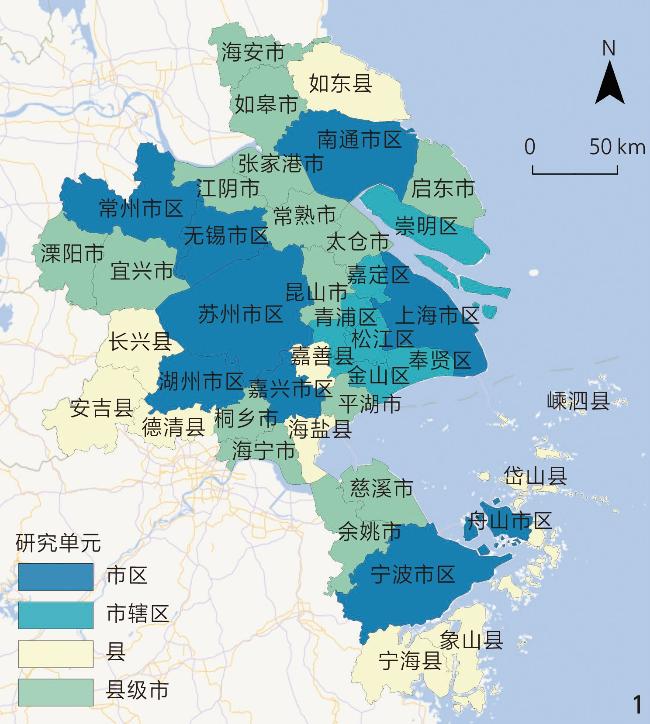
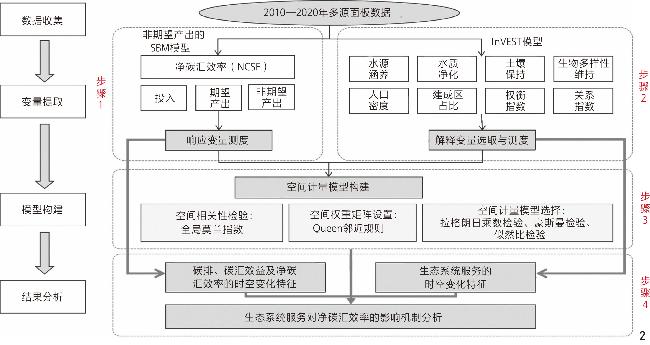
[Methods] Supported by multi-source panel data spanning the period from 2010 to 2020, this research takes the Shanghai Metropolitan Area as the research object and divides the research area into 40 research units. Based on the multiple benefits of ecosystem services in synergistically promoting urban sink enhancement and emission reduction, this research constructs a net carbon sink efficiency indicator system. Then, utilizing the undesirable slacks-based measurement (SBM) model, the research evaluates the net carbon sink efficiency of each unit during the period from 2010 to 2020, and further explores the distributional characteristics and spatial-temporal changes of carbon sinks, carbon emissions, and net carbon sink efficiency from the geospatial perspective. In combination with the guiding content of spatial synergistic planning for the Shanghai Metropolitan Area, four important ecosystem services, namely water retention, water purification, soil retention and biodiversity maintenance, are quantitatively characterized with the InVEST model. Subsequently, based on the spatial decomposition effects (direct, indirect and total effects) obtained with spatial econometric model, the influencing mechanisms of ecosystem services and their interrelationship on the net carbon sink efficiency of 40 research units are analyzed. In addition, the spatial spillover effects of ecosystem services are innovatively revealed according to ecosystem service flow conduction mechanisms.
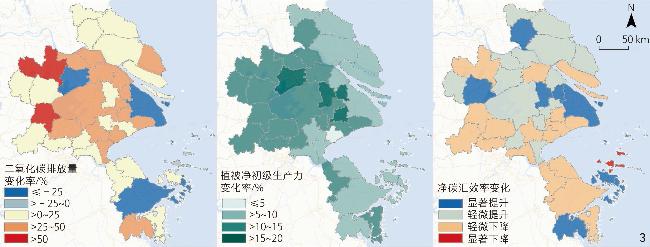
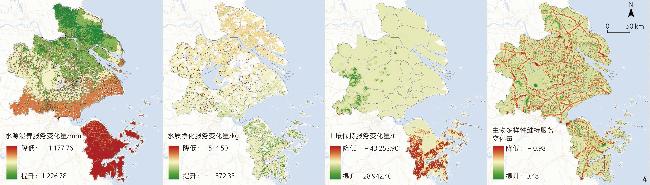
[Results] Research results are summarized as follows. 1) During the 11 years from the 2010 to 2020, the growth of carbon dioxide emissions in the Shanghai Metropolitan Area gradually slowed down, while the net primary productivity of vegetation continued to increase, and the areas with high carbon emissions and high carbon sinks were partially overlapped; in addition, the net carbon sink efficiency of some core nodes, such as Shanghai City, maintained a steady improvement, effectively driving neighboring cities to reduce carbon emissions and increase carbon sinks; meanwhile, the areas with improved net carbon sink efficiency have some similar characteristics and can be divided into 2 types: areas with high production value, high carbon emissions, and high carbon sinks, and those with medium-high production value, low carbon emissions, and medium-high carbon sinks. 2) The four ecosystem services have significant spatial heterogeneity and relatively stable changes over the 11-year period, with the high values mainly distributed in the southwestern part of the area with high vegetation cover and the area around the Taihu Lake with concentrated water resources, while the low values mainly distributed in the concentrated urban construction areas and near the regional traffic arteries, and the total amount of the four ecosystem services has shown fluctuating characteristics. 3) Regarding the spatial decomposition effects of ecosystem services on net carbon sink efficiency, there are differences in the coefficients, directions and significance of the spatial effects of different ecosystem services. For the ecosystem service trade-off index and relationship index, the direct effects are significantly positive, while indirect effects significantly negative.
[Conclusion] The research clarifies that water-related ecosystem services such as water retention and water purification services can significantly affect carbon reduction and sink enhancement in the Shanghai Metropolitan Area, and attention should be paid to water network system and its coupling effects with green and grey spaces, so as to further stimulate the ecological vitality of Jiangnan water vein. As there are differences in the spillover effects of different ecosystem services, it is necessary to differentiate the optimization and enhancement strategies for each type of ecological space and its ecosystem services according to local conditions, and the conservation of important ecological spaces in the metropolitan area should be continuously strengthened, followed by joint protection and control of ecological red lines in neighboring areas, so as to promote territorial spatial carbon reduction and sink enhancement activities, thus contributing to the steady improvement of the net carbon sink efficiency of the Shanghai Metropolitan Area in general. The research clearly demonstrates the positive effects of enhancing water-related ecosystem services and conserving important ecological spaces on regional carbon sinks and reduction, and effectively reveals an effective path for synergistic carbon reduction in the region, which may provide certain reference for improving territorial spatial management.
Haoyang SONG , Min WANG . Influencing Mechanisms of Ecosystem Services on Net Carbon Sink Efficiency and Spatial Differentiation Thereof: A Case Study of the Shanghai Metropolitan Area[J]. Landscape Architecture, 2025 , 32(1) : 49 -56 . DOI: 10.3724/j.fjyl.202407160389
表1 净碳汇效率指标体系Tab. 1 Net carbon sink efficiency indicator system |
| 类型 | 要素名称 | 表征指标 | 单位 |
| 投入 | 劳动力 | 从业人员数量 | 万人 |
| 资本 | 固定资金投资金额 | 亿元 | |
| 能源 | 全年用电量 | 亿kW·h | |
| 期望产出 | 经济效益 | 年度GDP | 亿元 |
| 碳汇效益 | 植被NPP | 万t | |
| 非期望产出 | 碳排放 | 二氧化碳排放量 | 万t |
| 变量类型 | 变量名 | 计算式 | 式注 |
| 响应变量 | 净碳汇效率 | 式(1) | |
| 解释变量 | 人口密度 | 研究单元的户籍总人口与总面积之比 | |
| 建成区占比 | 研究单元的建成区总面积与总面积之比 | ||
| 水源涵养 | | ||
| 水质净化 | | ||
| 土壤保持 | | ||
| 生物多样性维持 | | ||
| 权衡指数 | | ||
| 关系指数 | | ||
表3 各变量空间分解效应计算结果Tab. 3 Results of spatial decomposition effects for each variable |
| 变量 | 直接效应 | 间接效应 | 总效应 | |||||
| 系数 | T值 | 系数 | T值 | 系数 | T值 | |||
| 注:***、**、*分别表示在1%、5%和10%水平显著。 | ||||||||
| 人口密度 | 11.080*** | −2.190 | 5.157 | −3.564 | 16.240*** | −2.954 | ||
| 建成区占比 | −1.976** | −0.902 | 1.402 | −1.560 | −0.574 | −1.310 | ||
| 水源涵养 | 0.232 | −0.232 | 0.337 | −0.300 | 0.569*** | −0.217 | ||
| 水质净化 | −0.665*** | −0.170 | 0.271 | −0.268 | −0.394* | −0.237 | ||
| 土壤保持 | −0.103** | − | 0.168** | − | − | |||
| 生物多样性维持 | −0.108** | − | 0.152* | −0.080 | − | |||
| 权衡指数 | 3.289** | −1.386 | −4.420** | −2.177 | −1.131 | −2.464 | ||
| 关系指数 | 2.570** | −1.075 | −3.540** | −1.708 | 0.03 | −1.921 | ||
文中图表均由作者绘制,其中
| [1] |
傅伯杰, 张立伟. 土地利用变化与生态系统服务: 概念, 方法与进展[J]. 地理科学进展, 2014, 33(4): 441-446
FU B J, ZHANG L W. Land-Use Change and Ecosystem Services: Concepts, Methods and Progress[J]. Progress in Geography, 2014, 33(4): 441-446
|
| [2] |
COSTANZA R, D’ARGE R, DE GROOT R, et al. The Value of the World’s Ecosystem Services and Natural Capital[J]. Ecological Economics, 1998, 25(1): 3-15.
|
| [3] |
王云才, 刘玲. 远程耦合: 绿色基础设施绩效评价的空间生态智慧[J]. 中国园林, 2023, 39(10): 51-55
WANG Y C, LIU L. Telecoupling Spatial Ecological Wisdom for Performance Evaluation of Green Infrastructure[J]. Chinese Landscape Architecture, 2023, 39(10): 51-55.
|
| [4] |
朱俊俊, 高周冰, 王君櫹, 等. 南京都市圈生态系统服务时空变化及权衡协同关系[J]. 水土保持研究, 2023, 30(3): 383-394
ZHU J J, GAO Z B, WANG J X, et al. Spatio-Temporal Changes and Trade-Off/Synergy Relationship of Ecosystem Services in Nanjing Metropolitan Area[J]. Research of Soil and Water Conservation, 2023, 30(3): 383-394.
|
| [5] |
王敏, 郭广钰. 上海大都市圈城镇化与生态环境耦合协调关系: 基于2011—2020年面板数据的实证分析[J]. 北京林业大学学报, 2024, 46(7): 101-111
WANG M, GUO G Y. Coupling and Coordination Relationship Between Urbanization and Eco-environment in Shanghai Metropolitan Area: Empirical Analysis Based on Panel Data From 2011 to 2020[J]. Journal of Beijing Forestry University, 2024, 46(7): 101-111
|
| [6] |
LIN B Q, GE J M. Valued Forest Carbon Sinks: How Much Emissions Abatement Costs Could Be Reduced in China[J]. Journal of Cleaner Production, 2019, 224 455-464
|
| [7] |
GAO P, YUE S J, CHEN H T. Carbon Emission Efficiency of China’s Industry Sectors: From the Perspective of Embodied Carbon Emissions[J]. Journal of Cleaner Production, 2021, 283 124655
|
| [8] |
涂海洋, 加帕尔, 于涛, 等. 中国陆地生态系统净初级生产力时空变化特征及影响因素[J]. 生态学报, 2023, 43(3): 1219-1233
TU H Y, JIAPAER G L, YU T, et al. Analysis of Spatio-Temporal Variation Characteristics and Influencing Factors of Net Primary Productivity in Terrestrial Ecosystems of China[J]. Acta Ecologica Sinica, 2023, 43(3): 1219-1233.
|
| [9] |
WANG C, TANG C J, FU B J, et al. Determining Critical Thresholds of Ecological Restoration Based on Ecosystem Service Index: A Case Study in the Pingjiang Catchment in Southern China[J]. Journal of Environmental Management, 2022, 303 114220
|
| [10] |
李成, 赵洁, 庄智程, 等. 长三角城市群生态系统服务权衡强度时空演变及影响因素[J]. 生态学报, 2022, 42(14): 5708-5720
LI C, ZHAO J, ZHUANG Z C, et al. Spatio-Temporal Dynamics and Influencing Factors of Ecosystem Service Trade-Offs in the Yangtze River Delta Urban Agglomeration[J]. Acta Ecologica Sinica, 2022, 42(14): 5708-5720.
|
| [11] |
刘颂, 张浩鹏, 裴新生, 等. 长时间序列生态系统服务权衡与协同驱动因素: 以芜湖市生态系统服务功能极重要区为例[J]. 生态学报, 2024, 44(5): 1780-1790
LIU S, ZHANG H P, PEI X S, et al. Drivers of Ecosystem Service Trade-Off and Synergy in Long-Term Sequence: A Case Study of the Extremely Important Ecosystem Service Function Area in Wuhu City[J]. Acta Ecologica Sinica, 2024, 44(5): 1780-1790.
|
| [12] |
QUAN Y, HUTJES R W A, BIEMANS H, et al. Patterns and Drivers of Carbon Stock Change in Ecological Restoration Regions: A Case Study of Upper Yangtze River Basin, China[J]. Journal of Environmental Management, 2023, 348 119376
|
| [13] |
王敏, 宋昊洋. 影响碳中和的城市绿地空间特征与精细化管控实施框架[J]. 风景园林, 2022, 29(5): 17-23
WANG M, SONG H Y. Spatial Characteristics and Implementation Framework for Fine Control of Urban Green Space Affecting Carbon Neutrality[J]. Landscape Architecture, 2022, 29(5): 17-23.
|
| [14] |
ZHANG A X, DENG R R. Spatial-Temporal Evolution and Influencing Factors of Net Carbon Sink Efficiency in Chinese Cities Under the Background of Carbon Neutrality[J]. Journal of Cleaner Production, 2022, 365 132547
|
| [15] |
CHU X, JIN Y, WANG X, et al. The Evolution of the Spatial-Temporal Differences of Municipal Solid Waste Carbon Emission Efficiency in China[J]. Energies, 2022, 15(11): 3987
|
| [16] |
权天舒, 张晖, 许玉韫.长三角城市群碳排放效率的空间关联网络及其影响因素[J/OL].南京林业大学学报(自然科学版): 1-13(2024-05-08)[2024-07-16]. http://kns.cnki.net/kcms/detail/32.1161.S.20240508.1506.002.htm.
QUAN T S, ZHANG H, XU Y Y. The Spatial Correlation Network and Influencing Factors of Carbon Emission Efficiency in the Yangtze River Delta Urban Agglomeration[J/OL]. Journal of Nanjing Forestry University (Natural Sciences Edition): 1-13 (2024-05-08)[2024-07-16]. http://kns.cnki.net/kcms/detail/32.1161.S.20240508.1506.002.htm.
|
| [17] |
任悦宁, 张建勋, 董宏杰, 等. 中国省域净碳汇效率时空演变及影响因素研究[J]. 生态经济, 2024, 40(4): 36-45
REN Y N, ZHANG J X, DONG H J, et al. Spatio-Temporal Evolution and Influencing Factors of China’s Provincial Net Carbon Sink Efficiency[J]. Ecological Economy, 2024, 40(4): 36-45.
|
| [18] |
TONE K. Dealing with Undesirable Outputs in DEA: A Slacks-Based Measure (SBM) Approach: I-2003-0005[R/OL]. (2023-12-03)[2024-07-16]. https://www.researchgate.net/publication/360933959_The_Evolution_of_the_Spatial-Temporal_Differences_of_Municipal_Solid_Waste_Carbon_Emission_Efficiency_in_China.
|
| [19] |
朱红波, 高乙嘉. 我国西南地区城市土地利用效率的时空格局研究: 基于非期望产出超效率SBM模型的分析[J]. 城市问题, 2022 9): 95-103
ZHU H B, GAO Y J. Spatial and Temporal Pattern of Urban Land Use Efficiency in Southwest China: Based on Undesired Output Super-Efficiency SBM Model[J]. Urban Problems, 2022 9): 95-103.
|
| [20] |
YAN F P, SHANGGUAN W, ZHANG J, et al. Depth-to-Bedrock Map of China at a Spatial Resolution of 100 Meters[J]. Scientific Data, 2020, 7(1): 2
|
| [21] |
颜文涛, 陈卉, 万山霖, 等. 省级次区域国土生态空间格局构建与管控政策: 以川西北生态示范区为例[J]. 上海城市规划, 2021, 3(3): 8-17
YAN W T, CHEN H, WAN S L, et al. The Construction and Control Policy of the Ecological Spatial Pattern of the Provincial Sub-regions: A Case Study of Northwestern Sichuan[J]. Shanghai Urban Planning Review, 2021, 3(3): 8-17
|
| [22] |
申佳可, 彭震伟, 王云才. 基于生态系统服务空间流的洪涝调节服务需求制图与生态空间优先级识别[J]. 中国园林, 2022, 38(2): 20-25
SHEN J K, PENG Z W, WANG Y C. Mapping of Flood Regulation Service Demand and Identifying of Priority Settings of Ecological Spaces in Rapidly Urbanized Area Based on Ecosystem Service Spatial Flow[J]. Chinese Landscape Architecture, 2022, 38(2): 20-25.
|
| [23] |
嵇娟, 陈军飞, 丁童慧, 等. 长三角城市群城市洪涝韧性与生态系统服务的耦合协调关系[J]. 生态学报, 2024, 44(7): 2772-2785
JI J, CHEN J F, DING T H, et al. Coupling Coordination Between Urban Flood Resilience and Ecosystem Services in the Yangtze River Delta Urban Agglomerations[J]. Acta Ecologica Sinica, 2024, 44(7): 2772-2785.
|
| [24] |
温婉琴, 王强, 陈田田. 整合生态系统服务与驱动因素阈值效应的生态安全分区研究: 以西南地区为例[J]. 生态学报, 2024, 44(8): 3142-3156
WEN W Q, WANG Q, CHEN T T. Integrating the Threshold Effects of Driving Forces on Ecosystem Service into the Ecological Security Zoning: A Case Study in the Southwest China[J]. Acta Ecologica Sinica, 2024, 44(8): 3142-3156.
|
| [25] |
LIU L L, ZHANG H B, GAO Y, et al. Hotspot Identification and Interaction Analyses of the Provisioning of Multiple Ecosystem Services: Case Study of Shaanxi Province, China[J]. Ecological Indicators, 2019, 107 105566
|
| [26] |
王守坤. 空间计量模型中权重矩阵的类型与选择[J]. 经济数学, 2013, 30(3): 57-63
WANG S K. Several Types of Weights Matrix and Their Extended Logic[J]. Journal of Quantitative Economics, 2013, 30(3): 57-63
|
| [27] |
SONG M, WU J, SONG M R, et al. Spatio-Temporal Regularity and Spillover Effects of Carbon Emission Intensity in China's Bohai Economic Rim[J]. Science of the Total Environment, 2020, 740 140184
|
| [28] |
肖华斌, 郭妍馨, 王玥, 等. 从效用评估到过程测度: 生态系统服务流研究进展[J]. 风景园林, 2022, 29(10): 32-37
XIAO H B, GUO Y X, WANG Y, et al. From Utility Assessment to Process Measurement: Progress in Research on Ecosystem Services Flow[J]. Landscape Architecture, 2022, 29(10): 32-37.
|
| [29] |
王敏, 宋昊洋. 耦合功能分区的上海崇明岛生态安全格局构建[J]. 园林, 2022, 39(3): 78-86
WANG M, SONG H Y. Construction of Ecological Security Pattern of Chongming Island in Shanghai Coupling with Functional Zoning[J]. Landscape Architecture Academic Journal, 2022, 39(3): 78-86
|
/
| 〈 |
|
〉 |