

Visual Environment Factors Influencing Staying Behaviors During Cycling on Countryside Greenways
|
WEN Ting is a master student in the Institute of Landscape Architecture, College of Agriculture and Biotechnology, Zhejiang University. Her research focuses on landscape planning and design |
|
ZHANG Yun, Ph.D., is an associate professor in the Institute of Landscape Architecture, College of Agriculture and Biotechnology, Zhejiang University. Her research focuses on landscape planning and design |
|
DU Ming, Ph.D., is an associate professor in the Faculty of Civil Engineering and Architecture, Zhejiang Sci-Tech University. His research focuses on landscape heritage conservation and historic place regeneration |
Received date: 2024-05-20
Revised date: 2024-12-23
Online published: 2025-12-07
Copyright
[Objective] Countryside greenways represent an organic extension of urban green slow-moving traffic systems into suburban areas, addressing urban residents' demands for closer contact with nature and fostering the development of an integrated urban-rural belt. Cycling, as a slow-moving activity that combines outdoor recreation and leisure tourism, constitutes one of the primary modes of activity on countryside greenways. Compared to urban greenways, cycling on countryside greenways is characterized by faster speeds, longer distances, and longer durations, causing cyclists to pay closer attention to the amenities, scenery, and safety aspects of the staying spaces when selecting a site and determining the duration of their sojourn. Since visual perception accounts for 80%-90% of the information humans receive from their environment, it exerts a profound influence on human behavior and environmental experiences. Riders on countryside greenways are often attracted to the distinctive visual environments and tend to make spontaneous stops, which could increase safety risks. Furthermore, existing regulatory frameworks have not sufficiently addressed the safety concerns of cycling on countryside greenways, resulting in insufficient attention to this issue. Therefore, investigating the characteristics of staying behaviors and the influencing factors of the visual environment on countryside greenway cycling holds practical significance and expands upon existing greenway research. The planning and design of staying points in conjunction with the visual environment not only help improve the safety and user-friendliness of greenway cycling but also leverage scenic resources to entice cyclists to linger longer, thereby enhancing the usage intensity of the countryside greenway and further promoting the development of the rural tourism economy.
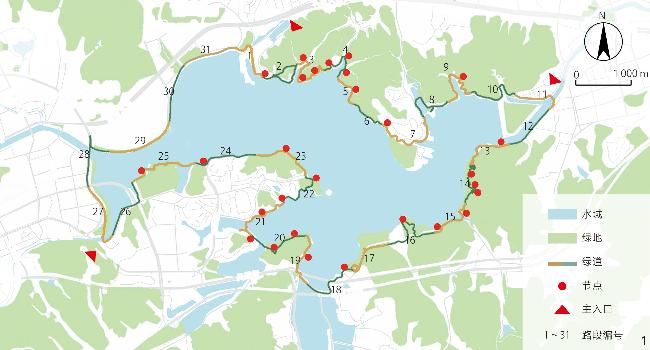
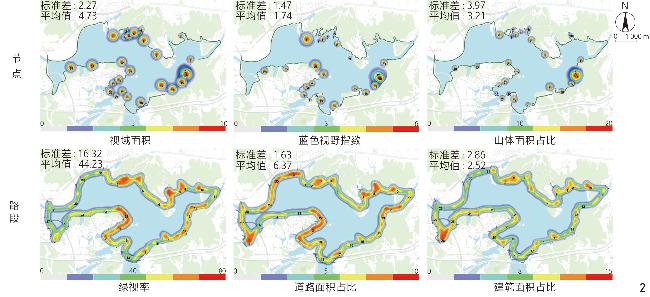
[Methods] This research focuses on the Qingshan Lake Greenway in Hangzhou. This greenway, spanning across urban built-up areas, rural settlements, and natural scenic zones, showcases a unique combination of lakeside and mountainous landscapes, making it a representative example of countryside greenways. Through field research and analysis of cycling trajectory data, local staying spaces are categorized into nodes and road sections. Four key indicators — number of stays, duration of stays, frequency of stays, and staying rate — are established to provide a comprehensive understanding of user engagement and interaction with the greenway environment. This approach allows for a more nuanced analysis of how cyclists utilize and experience the greenway spaces. Additionally, visual environmental features are analyzed through image semantic segmentation and ArcGIS, with a view to exploring their impact on staying behaviors during cycling. Correlation and multiple regression analyses are employed to determine the intensity of the visual environment’s influence on staying behaviors.
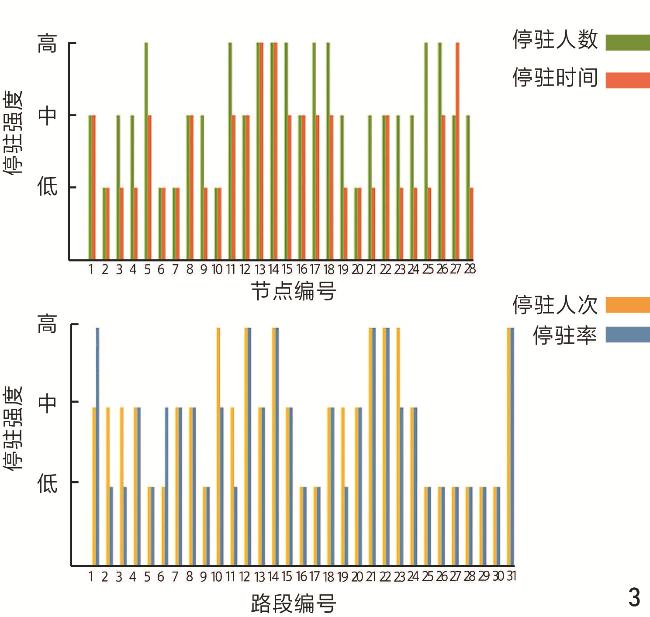
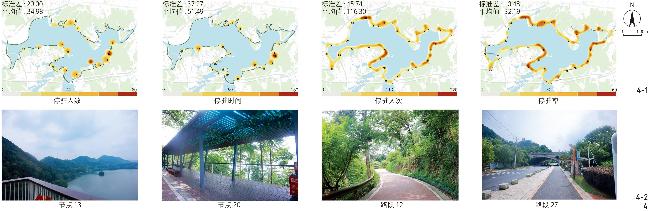
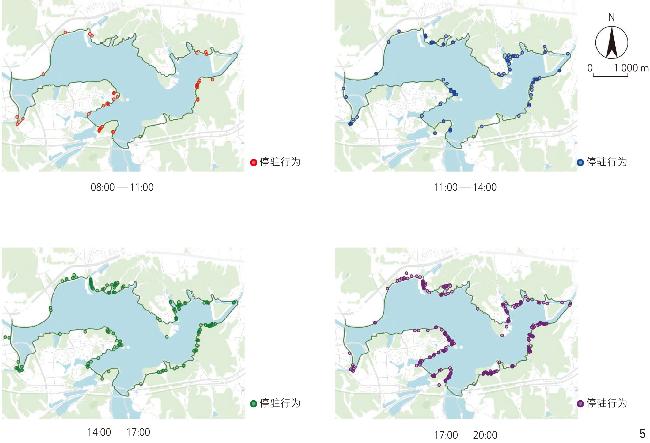
[Results] The findings reveal that cyclists tend to stay longer at nodes compared to road sections. However, the overall staying time remains brief, averaging less than one minute. This indicates low utilization rates of greenway stations and viewing platforms. Conversely, the frequency of spontaneous stays on road sections is higher, suggesting that cyclists are more inclined to make impromptu stays during their rides. Given the prevalence of cycling accidents on countryside greenways, these spontaneous stays may pose significant safety risks. Moreover, the visual environment’s influence varies between nodes and road sections; staying behaviors at nodes are primarily affected by the visual field area, while those on road sections are influenced by green visibility, with higher greenery levels promoting impromptu short stays.
[Conclusion] This research endeavors to develop spatial strategies for enhancing the staying behaviors of cyclists on countryside greenways, with a view to improving the usage intensity of greenway nodes and ensuring the safety of road segment traversal. Particular emphasis is placed on the optimization of staying spaces situated in poor visual environments, because the visibility of prominent landscape features, such as water bodies and mountain vistas, has been found to exert a significant influence on cyclists' propensity to linger. At the node level, strategies should focus on broadening the visual field and prolonging the duration of stays. This can be achieved through strategic optimization of plant layouts and reduction of physical obstructions, which collectively serve to enhance the perceivability of the surrounding natural scenery. In contrast, the spatial design of road segment staying spaces must prioritize safety considerations, especially in areas constrained by adjacent mountains or cliffs. By expanding the width of select road sections and introducing cantilevered structures or recessed micro-terraces along them, the creation of small yet safe “pocket” staying spaces can provide cyclists with suitable rest areas without compromising the overall flow of traffic. This, in turn, contributes to a more vibrant and active greenway network.The systematic integration of the spatio-temporal distribution patterns of cyclists' staying behaviors with the influencing factors of the visual environment laid the foundation for this research, which not only informs the enhancement of greenway station usage intensity and cycling safety, but also provides a robust methodological framework for the optimization of small and micro staying point placement along road segments. Looking ahead, further investigations incorporating other greenway usage characteristics, such as cycling distances and incident-prone locations, could shed additional light on the construction of cyclist-friendly countryside greenway environments that cater to the diverse needs and behavioral patterns of users.
Ting WEN , Yun ZHANG , Ming DU . Visual Environment Factors Influencing Staying Behaviors During Cycling on Countryside Greenways[J]. Landscape Architecture, 2025 , 32(2) : 95 -101 . DOI: 10.3724/j.fjyl.202405200276
表1 郊野绿道视觉环境要素指标体系计算方法Tab. 1 Computational methods for visual envrionment indicators of countryside greenways |
| 计算工具 | 要素指标 | 计算方法 |
| ArcGIS | 视域面积 | 视域分析工具计算观察点的视域面积 |
| 图像语义分割 | 蓝色视野指数 | 静态图像分割得到水域占观测图像的像素面积比值 |
| 山体面积占比 | 静态图像分割得到山体占观测图像的像素面积比值 | |
| 绿视率 | 静态图像分割得到绿植占观测图像的像素面积比值 | |
| 道路面积占比 | 静态图像分割得到道路占观测图像的像素面积比值 | |
| 建筑面积占比 | 静态图像分割得到建筑占观测图像的像素面积比值 |
表2 视觉环境要素与停驻行为相关性Tab. 2 Correlation of visual environment elements and staying behaviors |
| 空间类型 | 指标因子 | 停驻人数 | 停驻时间 | 停驻人次 | 停驻率 |
| 注:**在0.01级别(双尾),相关性显著;*在0.05级别(双尾)相关性显著。 | |||||
| 节点 | 视域面积 | 0.778** | 0.797** | ||
| 蓝色视野指数 | 0.753** | 0.739** | |||
| 山体面积占比 | 0.658** | 0.764** | |||
| 路段 | 绿视率 | 0.686** | 0.652** | ||
| 道路面积占比 | 0.302* | 0.219* | |||
| 建筑面积占比 | -0.469** | -0.469** | |||
表3 影响停驻行为的视觉环境显著因子Tab. 3 Salience visual environment factors of staying behavior |
| 空间类型 | 因变量 | D-W值 | 调整后的R2 | 模型系数 | 标准化系数Beta | t检验 |
| 注:**在0.01级别(双尾),相关性显著;*在0.05级别(双尾),相关性显著。 | ||||||
| 节点 | 停驻人数 | 1.771 | 0.662 | 常量 | 1.022 | |
| 视域面积 | 0.440** | 2.604 | ||||
| 蓝色视野指数 | 0.357** | 2.131 | ||||
| 山体面积占比 | 0.133* | 0.832 | ||||
| 停驻时间 | 2.071 | 0.728 | 常量 | -0.087 | ||
| 视域面积 | 0.412** | 2.717 | ||||
| 蓝色视野指数 | 0.225* | 1.494 | ||||
| 山体面积占比 | 0.345** | 2.409 | ||||
| 路段 | 停驻人次 | 1.633 | 0.598 | 常量 | -0.144 | |
| 绿视率 | 0.570** | 4.557 | ||||
| 道路面积占比 | 0.344** | 2.935 | ||||
| 建筑面积占比 | -0.304** | -2.407 | ||||
| 停驻率 | 1.668 | 0.501 | 常量 | 1.318 | ||
| 绿视率 | 0.537** | 3.847 | ||||
| 道路面积占比 | 0.261** | 2.001 | ||||
| 建筑面积占比 | -0.305** | -2.167 | ||||
文中图表均由作者绘制或拍摄,其中
| [1] |
邢忠, 袁川乔, 顾媛媛, 等. 融合生态服务与游憩功能的城郊绿色基础设施用地系统规划研究: 以眉山市岷东新区非集中建设区为例[J]. 西部人居环境学刊, 2019, 34(1): 45-54
XING Z, YUAN C Q, GU Y Y, et al. Planning Research for Suburban GI Land-Use System on the Perspective of Introducing Recreation Pursuit into Ecological Service Function: A Case Study of Mindong Non-development Land Planning, Meishan City[J]. Journal of Human Settlements in West China, 2019, 34(1): 45-54.
|
| [2] |
桂玥, 张云. 景观体验视角下社区绿道步行场景研究: 以杭州为例[J]. 华中建筑, 2024, 42(12): 125-129
GUI Y, ZHANG Y. Exploring Walking Scenes of Community Greenways Through Landscape Experiences: Evidence from Hangzhou[J]. Huazhong Architecture, 2024, 42(12): 125-129.
|
| [3] |
熊璨, 唐慧超, 徐斌, 等. 郊野绿道的使用特征与满意度[J]. 浙江农林大学学报, 2019, 36(1): 154-161
XIONG C, TANG H C, XU B, et al. Using Characteristics and Satisfaction of Country Greenway[J]. Journal of Zhejiang A&F University, 2019, 36(1): 154-161
|
| [4] |
中华人民共和国住房和城乡建设部.绿道规划设计导则[EB/OL].(2022-04-11)[2025-01-07]. http://www.weboos.cn:8083/assets/basicStandard/std_1354266.pdf.
Ministry of Housing and Urban-Rural Development of the People’s Republic of China. Guidelines for Greenway Planning and Design[EB/OL]. (2022-04-11)[2025-01-07]. http://www.weboos.cn:8083/assets/basicStandard/std_1354266.pdf.
|
| [5] |
LI F F, IYER A, KOCH C, et al. What Do We Perceive in a Glance of a Real-World Scene?[J]. Journal of Vision, 2007, 7(1): 10
|
| [6] |
LEE J G, LEE H S, JEONG D Y, et al. The Relationship Between User Perception and Preference of Greenway Trail Characteristics in Urban Areas[J]. Sustainability, 2019, 11(16): 4438
|
| [7] |
王芳, 陈金华, 汪秀芳. 绿道休闲旅游安全管理对策研究[J]. 北京第二外国语学院学报, 2015, 37(7): 70-77
WANG F, CHEN J H, WANG X F. The Study on Safety Management Countermeasure of Greenway Leisure and Tourism[J]. Journal of Beijing International Studies University, 2015, 37(7): 70-77.
|
| [8] |
范榕, 李卫正, 王亚炜, 等. 城市绿道景观视觉空间吸引模式研究: 以玄武湖为例[J]. 生态经济, 2018, 34(5): 231-236
FAN R, LI W Z, WANG Y W, et al. Research on Landscape Visual Space Attraction Mode of Urban Greenway: Taking Xuanwu Lake as an Example[J]. Ecological Economy, 2018, 34(5): 231-236.
|
| [9] |
范榕, 徐灏文. 基于生态多样性的太湖绿道景观空间视觉质量研究[J]. 西部人居环境学刊, 2019, 34(3): 19-25
FAN R, XU H W. Study on Visual Quality of Taihu Greenway Landscape Space Based on Ecological Diversity[J]. Journal of Human Settlements in West China, 2019, 34(3): 19-25.
|
| [10] |
李佳敏, 余艳薇, 李婷婷, 等. 基于骑行视觉感知的绿道景观意象评价: 以武汉东湖绿道二期为例[J]. 华中建筑, 2020, 38(9): 87-93
LI J M, YU Y W, LI T T, et al. Evaluation of Greenway Landscape Image Based on Cycling Visual Perception: A Case Study of Wuhan East Lake Green Road Phase II[J]. Huazhong Architecture, 2020, 38(9): 87-93.
|
| [11] |
赵彦, 卫丽亚, 李海红. 山体绿道景观空间复合视觉感受设计引导探索: 泉州市山体绿道示范段为例[J]. 中国园林, 2021, 37(S2): 6-10
ZHAO Y, WEI L Y, LI H H. Exploration on the Design Guidance of Compounding Visual Perception of Landscape Space in the Mountain Greenway Demonstration Section of Quanzhou[J]. Chinese Landscape Architecture, 2021, 37(S2): 6-10.
|
| [12] |
何初航, 徐斌, 张亚平, 等. 基于视觉分析的绿道景观评价: 以浙江青山湖绿道为例[J]. 西南师范大学学报(自然科学版), 2022, 47(5): 80-90
HE C H, XU B, ZHANG Y P, et al. Landscape Evaluation of Greenway Based on Visual Analysis: A Case Study of the Qingshan Lake Greenway in Zhejiang Province[J]. Journal of Southwest China Normal University (Natural Science Edition), 2022, 47(5): 80-90.
|
| [13] |
李鑫, 吴丹子, 李倞, 等. 基于深度学习的城市滨河绿道景观视觉感知评价研究[J]. 北京林业大学学报, 2021, 43(12): 93-104
LI X, WU D Z, LI L, et al. Research on Visual Perception Evaluation of Urban Riverside Greenway Landscape Based on Deep Learning[J]. Journal of Beijing Forestry University, 2021, 43(12): 93-104
|
| [14] |
GUO S Y, ZHOU Y, YU J N, et al. Effects of the Combination of Audio and Visual Factors on Mental Restoration in a Large-Scale Urban Greenway: Perspectives from Wuhan, China[J]. Land, 2022, 11(11): 2017
|
| [15] |
贺慧, 林小武, 余艳薇. 基于SD法的绿道骑行环境感知评价研究: 以武汉市东湖绿道一期为例[J]. 新建筑, 2019 4): 33-37
HE H, LIN X W, YU Y W. Research on Greenway Riding Environment Perception Evaluation Based on Semantic Differential Method: The Case of the First Phase of East Lake Greenway in Wuhan[J]. New Architecture, 2019 4): 33-37
|
| [16] |
贾敬涵, 王子尧, 李倞. 基于多源大数据与深度学习的道路视觉特征与骑行流量相关性研究[J]. 中国园林, 2023, 39(4): 84-90
JIA J H, WANG Z Y, LI L. Research on the Correlation Between Road Visual Features and Cycling Traffic Based on Multi-source Big Data and Deep Learning[J]. Chinese Landscape Architecture, 2023, 39(4): 84-90.
|
| [17] |
张章, 徐高峰, 李文越, 等. 历史街道微观建成环境对游客步行停驻行为的影响: 以北京五道营胡同为例[J]. 建筑学报, 2019 3): 96-102
ZHANG Z, XU G F, LI W Y, et al. The Impact of the Micro-scale Built Environment of Historic Street on Visitor’s Walking Behaviors: A Case Study on Wudaoying Hutong in Beijing[J]. Architectural Journal, 2019 3): 96-102.
|
| [18] |
任熙元, 王灿, 王德, 等. 消费者行为视角下的大宁商业综合体空间绩效评价[J]. 规划师, 2018, 34(2): 101-107
REN X Y, WANG C, WANG D, et al. Space Performance Evaluation of Daning Commercial Complex Based on Consumers’ Behavior[J]. Planners, 2018, 34(2): 101-107
|
| [19] |
刘敏楠, 汪松陵, 丁绍刚, 等. “驻点”游人日时空分布对旅游舒适度的影响: 以网师园为例[J]. 中国园林, 2019, 35(9): 129-134
LIU M N, WANG S L, DING S G, et al. Impact of Spatial and Temporal Distribution of Tourists at “Stationary Point” on Tourism Comfort Degree: Taking the Master of Nets Garden as an Example[J]. Chinese Landscape Architecture, 2019, 35(9): 129-134.
|
| [20] |
齐君, 罗咏菊, 肖圮欣. 基于环境可供性的骑行风景道规划设计研究: 以昆明滇池骑行线路为例[J]. 中国园林, 2021, 37(2): 66-70
QI J, LUO Y J, XIAO Q X. Planning and Design of Scenic Bikeway Based on Environmental Affordances: A Case Study of Kunming Dianchi Lake Cycling Route[J]. Chinese Landscape Architecture, 2021, 37(2): 66-70.
|
| [21] |
叶怡霖.骑行热, 带火自行车新消费[N].浙江日报, 2023-09-12(008).
YE Y L. Cycling Fever, New Consumption of Hot Bicycles[N]. Zhejiang Daily, 2023-09-12(008).
|
| [22] |
杭州市人民政府.关于公开征求《杭州市绿地系统规划(修编)》(2021—2035)[EB/OL].(2021-12-07)[2025-01-07]. https://www.hangzhou.gov.cn/art/2021/12/7/art_1229063429_3977627.html.
Hangzhou Municipal People’s Government. Notice on Public Solicitation of Opinions for the “Hangzhou Green Space System Plan (Revision)”(2021−2035)[EB/OL]. (2021-12-07)[2025-01-07]. https://www.hangzhou.gov.cn/art/2021/12/7/art_1229063429_3977627.html.
|
| [23] |
朱战强, 黄存忠, 柳林, 等. “绿道—邻里”视角下建成环境对城市绿道使用的影响: 以广州为例[J]. 热带地理, 2019, 39(2): 247-253
ZHU Z Q, HUANG C Z, LIU L, et al. Influence of Built Environment on Urban Greenway Use from the Perspective of Greenway–Neighborhood Relationships: A Case Study of Guangzhou, China[J]. Tropical Geography, 2019, 39(2): 247-253.
|
| [24] |
庞文欣, 刘纪平, 王勇, 等. 手机信令聚类的个体常驻区域识别[J]. 测绘科学, 2022, 47(11): 177-184
PANG W X, LIU J P, WANG Y, et al. Character Recognition of Individual Resident Area Based on Mobile Phone Signaling Data Mining[J]. Science of Surveying and Mapping, 2022, 47(11): 177-184.
|
| [25] |
董雯, 朱逊, 赵晓龙. 社区绿道建成环境特征与体力活动强度关联性研究: 以深圳市为例[J]. 风景园林, 2021, 28(12): 93-99
DONG W, ZHU X, ZHAO X L. Research on Correlation Between Built Environment Characteristics of Community Greenway and Intensity of Physical Activities: A Case Study of Shenzhen[J]. Landscape Architecture, 2021, 28(12): 93-99.
|
/
| 〈 |
|
〉 |