

Influence of Exposure to Different Green Rooftop Spaces on Stress Restoration of College Students
|
ZHUO Zhixiong is a Ph.D. candidate in the School of Architecture, Huaqiao University. His research focuses on healthy landscape, and urban thermal environment |
|
DONG Liang, Ph.D., is a professor and dotoral supervisor in the School of Architecture, Huaqiao University. His research focuses on sustainable landscape design, and smart city design |
Received date: 2024-03-10
Revised date: 2024-12-09
Online published: 2025-12-06
Copyright
[Objective] Along with the continuous progress of urbanization, the number of people living in cities is increasing. Although urbanization can offer people many conveniences, a large number of people also face different degrees of health risks in their daily lives, such as the increasing spread of various diseases, the growing prominence of psychological problems and the increasing health risks in cities. With aggravated social competition, college students are prone to physical and psychological health problems when facing academic tasks. Therefore, students are in urgent need of healing pathways to relieve their physical and psychological stress. The healing function of the natural environment is becoming more and more prominent. Exposure to the natural environment can reduce the stimulation of stressors from daily life and alleviate people’s psychological and physiological stress. Urban green spaces, which are mainly natural environments, have been explored for their health restoration benefits, and in recent years green rooftops have also been noted for their potential to promote physical and psychological health. As a new form of urban green space, green rooftops have certain ecological service values, such as the reduction of building energy consumption, the management of stormwater and the mitigation of heat island effect. Although green rooftops have limited space, their natural elements provide people with opportunities to engage with nature and gain restorative experience, making them important places to promote healthy and sustainable human settlement environments. Therefore, this research explores the influence of exposure to green rooftop space on the physical and psychological restoration of college students from both physiological and psychological perspectives through a field experiment.
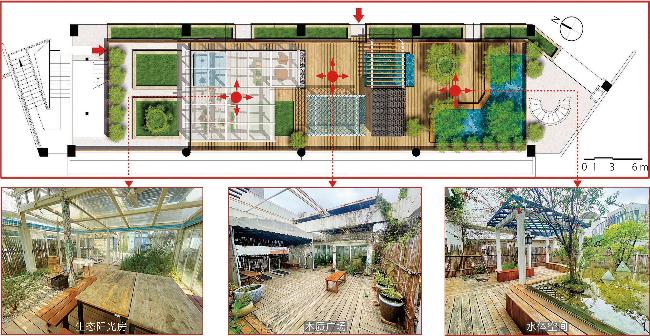
[Methods] In order to determine the restorative effects of green rooftops on physical and psychological health, three types of green rooftop spaces (water space, wooden plaza, and ecological sunroom) and a control group (non-green rooftop space) in the Experimental Building of Architecture Discipline of Huaqiao University are selected to explore the restorative potentials of green rooftop space. Field measurements are conducted during the daytime on a sunny and windless day, with no significant difference between the physical environments of different green rooftop spaces. 35 college student volunteers participate in the experiment, all of whom are daily users of green rooftop space. The volunteers are in good health without any adverse symptoms, who are asked to eat a healthy diet and get enough sleep before the experiment. The research adopts a within-subjects design to quantitatively analyze the influence of exposure to green rooftop space on the physiological and psychological health indicators of college students by using biofeedback (blood pressure and heart rate variability) and psychological state (brief profile of mood states) measures. The research uses SPSS 26.0 software to process all data.
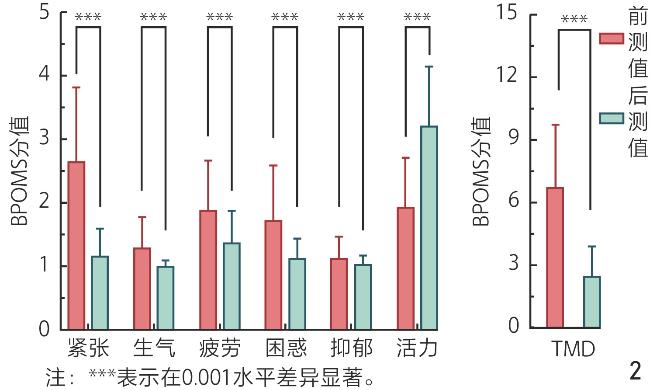
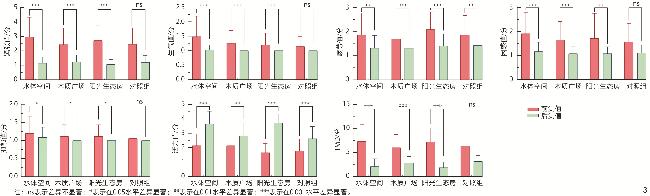
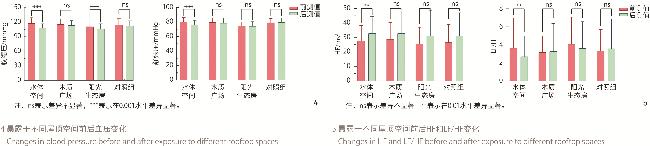
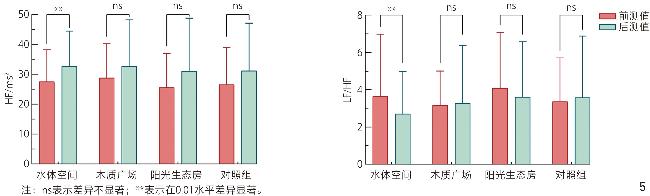
[Results] 1) Compared to non-green rooftop space, both psychological and physiological indicators show positive improvement in green rooftop space. Specifically, the values of tension, anger, fatigue, confusion, depression and TMD in the emotional factors decrease significantly, while the values of vitality increase significantly after exposure to green rooftop spaces. TMD decreases significantly in green rooftop space compared to non-green rooftop space, suggesting that exposure to green rooftop space can suppress negative emotions, promote positive emotions, and provide pleasant sensory stimulation for college students. Positive changes in physiological indicators further explain that green rooftop space has health restoration effects. Compared with the changes in physiological indicators, the changes in psychological indicators are more significant. 2) The three green rooftop spaces have different degrees of health restoration benefits, and the mood factor TMD reveals that the water space performs best in stress restoration, followed by the seco-sunroom and the wooden plaza. Positive changes in all physiological indicators also occur in the water space, with only a significant decrease in systolic blood pressure in the ecological sunroom, and no significant changes in all physiological indicators in the wooden plaza. Overall, in terms of health restoration benefits, the three green rooftop spaces rank in the order of water space, ecological sunroom and wooden plaza from high to low. 3) There exist significant correlations between the values of changes in some psychological and physiological indicators, among which the physiological indicators diastolic blood pressure and LF/HF are significantly correlated with the values of fatigue and depression in the mood factor, respectively.
[Conclusion] Through scientific field measurements of the influence of green rooftop space on stress restoration of college students, the research finds that green rooftop space has a supportive role in the restoration of physical and psychological health of college students. The restorative benefits of different green rooftop spaces differ significantly, with more naturalized green rooftop spaces showing better stress restoration benefits. The results of the research may help improve people’s awareness of the restorative value of green rooftop space, further support the argument that green rooftop space promotes physical and psychological health, and provide a theoretical basis for the design of green rooftop space based on the healthy concept.
Key words: green rooftop; nature exposure; college student; psychology; physiology; restoration
Zhixiong ZHUO , Liang DONG . Influence of Exposure to Different Green Rooftop Spaces on Stress Restoration of College Students[J]. Landscape Architecture, 2025 , 32(2) : 79 -85 . DOI: 10.3724/j.fjyl.202403100145
表1 压力应激后各项指标方差分析Tab. 1 Analysis of variance of indicators after stress exposure |
| 指标 | 水体空间 | 木质广场 | 生态阳光房 | 对照组 | 自由度 | 均方 | F | p |
| 紧张值 | 2.97 | 2.43 | 2.71 | 2.46 | 2 | 2.257 | 1.656 | 0.179 |
| 生气值 | 1.49 | 1.26 | 1.20 | 1.14 | 2 | 0.790 | 3.227 | 0.250 |
| 疲劳值 | 1.86 | 1.69 | 2.09 | 1.86 | 2 | 0.943 | 1.511 | 0.214 |
| 困惑值 | 1.91 | 1.66 | 1.71 | 1.57 | 2 | 0.743 | 0.968 | 0.410 |
| 抑郁值 | 1.20 | 1.11 | 1.11 | 1.06 | 2 | 0.121 | 0.997 | 0.397 |
| 活力值 | 2.14 | 2.14 | 1.66 | 1.77 | 2 | 2.219 | 3.838 | 0.110 |
| TMD | 7.29 | 6.00 | 7.17 | 6.31 | 2 | 14.045 | 1.538 | 0.207 |
| 收缩压 | 117.46 | 115.34 | 110.69 | 114.17 | 2 | 280.962 | 1.954 | 0.124 |
| 舒张压 | 80.09 | 79.49 | 78.49 | 79.00 | 2 | 229.000 | 6.480 | 0.560 |
| HF | 27.54 | 28.82 | 25.52 | 26.56 | 2 | 69.247 | 0.516 | 0.672 |
| LF/HF | 3.64 | 3.17 | 4.08 | 3.36 | 2 | 5.508 | 0.759 | 0.519 |
表2 暴露于绿色屋顶空间前后血压变化Tab. 2 Changes in blood pressure before and after exposure to green rooftop space |
| 血压 | 前测值/mmHg | 后测值/mmHg | 前后差异/mmHg | Cohen’s d | t | p |
| 注:*表示在0.05水平(双侧)显著相关;**表示在0.01水平(双侧)显著相关。 | ||||||
| 收缩压 | 114.41 ± 12.16 | 109.69 ± 10.64 | 4.73 ± 6.91 | 0.68 | 8.10 | 0.000*** |
| 舒张压 | 78.26 ± 6.29 | 77.06 ± 6.73 | 1.20 ± 5.99 | 0.20 | 2.37 | 0.019* |
表3 生理指标与BPOMS量表得分相关性Tab. 3 Correlation between physiological indicators and BPOMS scores |
| 情绪因子 | 收缩压 | 舒张压 | HF | LF/HF | |||||||
| r | p | r | p | r | p | r | p | ||||
| 注:*表示在0.05 水平(双侧)显著相关。 | |||||||||||
| TMD | 0.054 | 0.583 | -0.164 | 0.094 | -0.040 | 0.965 | -0.021 | 0.831 | |||
| 紧张值 | 0.076 | 0.443 | -0.124 | 0.208 | -0.005 | 0.957 | -0.024 | 0.804 | |||
| 生气值 | 0.076 | 0.439 | -0.042 | 0.674 | 0.020 | 0.842 | −0.014 | 0.888 | |||
| 疲劳值 | 0.079 | 0.424 | 0.224* | 0.022 | 0.064 | 0.514 | 0.043 | 0.664 | |||
| 困惑值 | 0.189 | 0.054 | -0.127 | 0.195 | -0.004 | 0.968 | -0.023 | 0.817 | |||
| 抑郁值 | -0.014 | 0.884 | -0.100 | 0.312 | 0.169 | 0.084 | 0.193* | 0.048 | |||
| 活力值 | -0.019 | 0.851 | 0.003 | 0.976 | -0.005 | 0.959 | −0.042 | 0.674 | |||
文中所有图表均由作者绘制。
| [1] |
REZAEI M, EMMANUEL N, KIM J, et al. Analyzing the Impact of Green Roof Functions on the Citizens' Mental Health in Metropolitan Cities[J]. Iranian Journal of Public Health, 2021, 50(5): 900-907.
|
| [2] |
LYU K, DE DEAR R, BRAMBILLA A, et al. Restorative Benefits of Semi-outdoor Environments at the Workplace: Does the Thermal Realm Matter?[J]. Building and Environment, 2022, 222 109355
|
| [3] |
SHELDON E, SIMMONDS-BUCKLEY M, BONE C, et al. Prevalence and Risk Factors for Mental Health Problems in University Undergraduate Students: A Systematic Review with Meta-analysis[J]. Journal of Affective Disorders, 2021, 287 282-292
|
| [4] |
NUTSFORD D, PEARSON A L, KINGHAM S, et al. Residential Exposure to Visible Blue Space (but Not Green Space) Associated with Lower Psychological Distress in a Capital City[J]. Health & Place, 2016, 39 70-78.
|
| [5] |
刘群阅, 吴瑜, 肖以恒, 等. 城市公园恢复性评价心理模型研究: 基于环境偏好及场所依恋理论视角[J]. 中国园林, 2019, 35(6): 39-44
LIU Q Y, WU Y, XIAO Y H, et al. The Inherent Psychological Mechanism of Perceived Restoration of Urban Parks: An Perspective from Environmental Preference and Place Attachment Theory[J]. Chinese Landscape Architecture, 2019, 35(6): 39-44.
|
| [6] |
RATHMANN J, BECK C, FLUTURA S, et al. Towards Quantifying Forest Recreation: Exploring Outdoor Thermal Physiology and Human Well-Being Along Exemplary Pathways in a Central European Urban Forest (Augsburg, SE-Germany)[J]. Urban Forestry & Urban Greening, 2020, 49 126622
|
| [7] |
KO W H, SCHIAVON S, ZHANG H, et al. The Impact of a View from a Window on Thermal Comfort, Emotion, and Cognitive Performance[J]. Building and Environment, 2020, 175 106779
|
| [8] |
ZHOU B, WANG L, HUANG S S, et al. Impact of Perceived Environmental Restorativeness on Tourists’ Pro-environmental Behavior: Examining the Mediation of Place Attachment and the Moderation of Ecocentrism[J]. Journal of Hospitality and Tourism Management, 2023, 56 398-409.
|
| [9] |
ULRICH R S, SIMONS R F, LOSITO B D, et al. Stress Recovery During Exposure to Natural and Urban Environments[J]. Journal of Environmental Psychology, 1991, 11(3): 201-230
|
| [10] |
KAPLAN S. The Restorative Benefits of Nature: Toward an Integrative Framework[J]. Journal of Environmental Psychology, 1995, 15(3): 169-182
|
| [11] |
HARTIG T, MITCHELL R, DE VRIES S, et al. Nature and Health[J]. Annual Review of Public Health, 2014, 35 207-228
|
| [12] |
STAATS H, KIEVIET A, HARTIG T. Where to Recover from Attentional Fatigue: An Expectancy-Value Analysis of Environmental Preference[J]. Journal of Environmental Psychology, 2003, 23(2): 147-157
|
| [13] |
HUANG Q Y, YANG M Y, JANE H A, et al. Trees, Grass, or Concrete? The Effects of Different Types of Environments on Stress Reduction[J]. Landscape and Urban Planning, 2020, 193 103654
|
| [14] |
YIN J, RAMANPONG J, CHANG J, et al. Effects of Blue Space Exposure in Urban and Natural Environments on Psychological and Physiological Responses: A Within-subject Experiment[J]. Urban Forestry & Urban Greening, 2023, 87 128066
|
| [15] |
王茜, 张延龙, 赵仁林, 等. 四种校园绿地景观对大学生生理和心理指标的影响研究[J]. 中国园林, 2020, 36(9): 92-97
WANG X, ZHANG Y L, ZHAO R L, et al. Study on the Effects of Four Campus Green Landscapes on College Students' Physiological and Psychological Indicators[J]. Chinese Landscape Architecture, 2020, 36(9): 92-97.
|
| [16] |
谭少华, 孙雅文, 申纪泽. 城市公园环境对人群健康的影响研究: 基于感知与行为视角[J]. 城市建筑, 2018 24): 24-28
TAN S H, SUN Y W, SHEN J Z. Research on the Impact of Urban Park Environment on Public Health: From the Perspectives of Psychological Perception and Behaviors[J]. Urbanism and Architecture, 2018 24): 24-28
|
| [17] |
WU Y, LIU J, QUEVEDO J M D, et al. Critical Factors Influencing Visitor Emotions: Analysis of “Restorativeness” in Urban Park Visits in Fuzhou, China[J]. Frontiers in Public Health, 2023, 11 1286518
|
| [18] |
SONG S, XIAO Y, TU R, et al. Effects of Thermal Perception on Restorative Benefits by Green Space Exposure: A Pilot Study in Hot-Humid China[J]. Urban Climate, 2024, 53 101767
|
| [19] |
ZHANG T Y, LIU J H, LI H Y. Restorative Effects of Multi-sensory Perception in Urban Green Space: A Case Study of Urban Park in Guangzhou, China[J]. International Journal of Environmental Research and Public Health, 2019, 16(24): 4943
|
| [20] |
LEE K E, WILLIAMS K J H, SARGENT L D, et al. 40-Second Green Roof Views Sustain Attention: The Role of Micro-breaks in Attention Restoration[J]. Journal of Environmental Psychology, 2015, 42 182-189
|
| [21] |
LEE K, WYLIE B, WILLIAMS N S G, et al. “It's a Little Soap Opera of Its Own”: Fascinating Green Roofs offer Complexity, Movement, Sensory Engagement, and Vast Vistas[J]. Landscape and Urban Planning, 2024, 242 104925
|
| [22] |
XIE G, LUNDHOLM J T, SCOTT MACIVOR J. Phylogenetic Diversity and Plant Trait Composition Predict Multiple Ecosystem Functions in Green Roofs[J]. Science of The Total Environment, 2018, 628-629 1017-1026.
|
| [23] |
MESIMÄKI M, HAURU K, LEHVÄVIRTA S. Do Small Green Roofs Have the Possibility to Offer Recreational and Experiential Benefits in a Dense Urban Area? A Case Study in Helsinki, Finland[J]. Urban Forestry & Urban Greening, 2019, 40 114-124.
|
| [24] |
LEE K E, WILLIAMS K J H, SARGENT L D, et al. Living Roof Preference Is Influenced by Plant Characteristics and Diversity[J]. Landscape and Urban Planning, 2014, 122 152-159
|
| [25] |
LEE J, KANG M J, LEE S, et al. Effects of Vegetation Structure on Psychological Restoration in an Urban Rooftop Space[J]. International Journal of Environmental Research and Public Health, 2022, 20(1): 260
|
| [26] |
WILLIAMS K J H, LEE K E, SARGENT L, et al. Appraising the Psychological Benefits of Green Roofs for City Residents and Workers[J]. Urban Forestry & Urban Greening, 2019, 44: 126399.
|
| [27] |
迟松, 林文娟. 简明心境量表(BPOMS)的初步修订[J]. 中国心理卫生杂志, 2003, 17(11): 768-770
CHI S, LIN W J. The Preliminary Revision of Brief Profile of Mood States (BPOMS) Chinese Edition[J]. Chinese Mental Health Journal, 2003, 17(11): 768-770
|
| [28] |
XIONG X, JIN H X, HU W H, et al. Benefits of Jasminum polyanthum's Natural Aromas on Human Emotions and Moods[J]. Urban Forestry & Urban Greening, 2023, 86 128010
|
| [29] |
LUO W, CHEN C, LI H, et al. How Do Residential Open Spaces Influence the Older Adults’ Emotions: A Field Experiment Using Wearable Sensors[J]. Landscape and Urban Planning, 2024, 251 105152
|
| [30] |
YIN J, YUAN J, ARFAEI N, et al. Effects of Biophilic Indoor Environment on Stress and Anxiety Recovery: A Between-Subjects Experiment in Virtual Reality[J]. Environment International, 2020, 136 105427
|
| [31] |
ELSADEK M, ZHANG D S, LIU B. High-Rise Window Views: Evaluating the Physiological and Psychological Impacts of Green, Blue, and Built Environments[J]. Building and Environment, 2024, 262 111798
|
| [32] |
SHAFFER F, GINSBERG J P. An Overview of Heart Rate Variability Metrics and Norms[J]. Frontiers in Public Health, 2017, 5 00258
|
| [33] |
YIN J, ZHU S, MACNAUGHTON P, et al. Physiological and Cognitive Performance of Exposure to Biophilic Indoor Environment[J]. Building and Environment, 2018, 132 255-262.
|
| [34] |
AINSWORTH B E, HASKELL W L, HERRMANN S D, et al. 2011 Compendium of Physical Activities: A Second Update of Codes and Met Values[J]. Medicine and Science in Sports and Exercise, 2011, 43(8): 1575-1581
|
| [35] |
TARVAINEN M P, NISKANEN J P, LIPPONEN J A, et al. Kubios HRV – Heart Rate Variability Analysis Software[J]. Computer Methods and Programs in Biomedicine, 2014, 113(1): 210-220.
|
| [36] |
YOON E, LIM Y. A Study on the Connection Between Nature and Architectural Space in Le Corbusier's Venice Hospital Project[J]. Architectural Research, 2020, 22(4): 113-122.
|
| [37] |
VÖLKER S, KISTEMANN T. Developing the Urban Blue: Comparative Health Responses to Blue and Green Urban Open Spaces in Germany[J]. Health & Place, 2015, 35 196-205.
|
| [38] |
GRACE M J, DICKIE J, BARTIE P J, et al. Health and Wellbeing (Dis)Benefits of Accessing Inland Blue Spaces over the Course of the COVID-19 Pandemic[J]. Landscape and Urban Planning, 2024, 252: 105178.
|
| [39] |
GIBSON J J. The Ecological Approach to Visual Perception[M]. Hillsdale: Lawrence Erlbaum Associates, 1986.
|
| [40] |
KELLERT S R, WILSON E O. The Biophilia Hypothesis[M]. Washington, D. C.: Island Press, 1993.
|
| [41] |
何琪潇, 谭少华, 刘诗芳.城市公园空间庇护感与人群身心健康恢复绩效的关联性研究[J]. 中国园林, 2022, 38(3): 66-71.
HE Q X, TAN S H, LIU S F. Study on the Correlation Between the Sense of Refuge in Urban Parks and the Effect of Mental Recovery in Population[J]. Chinese Landscape Architecture, 2022, 38(3): 66-71.
|
| [42] |
SUN K, LI Z, ZHENG S, et al. Quantifying Environmental Characteristics on Psychophysiological Restorative Benefits of Campus Window Views[J]. Building and Environment, 2024, 262: 111822.
|
| [43] |
HUNG S, CHANG C. Designing for Harmony in Urban Green Space: Linking the Concepts of Biophilic Design, Environmental Qi, Restorative Environment, and Landscape Preference[J]. Journal of Environmental Psychology, 2024, 96: 102294.
|
| [44] |
WANG Z, CHENG H, LI Z, et al. Can Green Space Exposure Enhance the Health of Rural Migrants in Wuhan, China? An Exploration of the Multidimensional Roles of Place Attachment[J]. Urban Forestry & Urban Greening, 2024, 93: 128228.
|
| [45] |
ULRICH R S. Aesthetic and Affective Response to Natural Environment[M]//ALTMAN I, WOHLWILL J F. Behavior and the Natural Environment. Boston: Springer, 1983: 85-125.
|
| [46] |
ALVARSSON J J, WIENS S, NILSSON M E. Stress Recovery During Exposure to Nature Sound and Environmental Noise[J]. International Journal of Environmental Research and Public Health, 2010, 7(3): 1036-1046
|
/
| 〈 |
|
〉 |