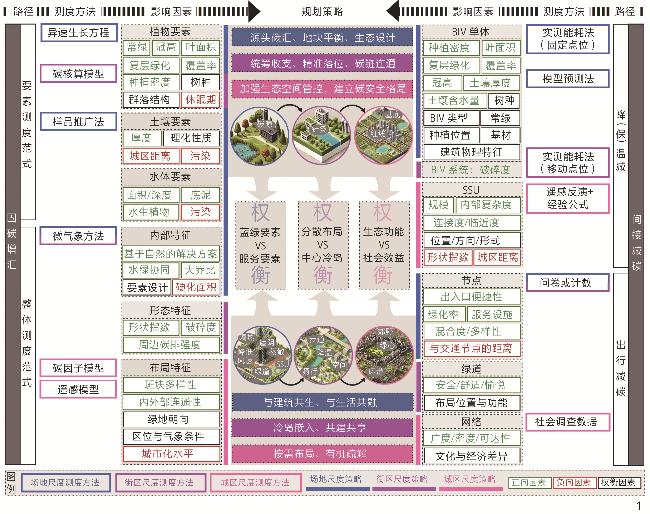


城市蓝绿基础设施多尺度增汇减碳能效测度研究进展和规划策略
|
刘颂/女/博士/同济大学建筑与城市规划学院教授、博士生导师/高密度人居环境生态与节能教育部重点实验室数字景观模拟分实验室负责人/研究方向为城乡绿地系统规划、景观规划技术方法 |
|
白钊成/男/同济大学建筑与城市规划学院在读博士研究生/研究方向为数字景观 |
|
柳迪子/男/同济大学建筑与城市规划学院在读博士研究生/研究方向为城乡绿地系统规划 |
|
沈培宇/女/同济大学建筑与城市规划学院在读博士研究生/研究方向为城乡绿地系统规划 |
Copy editor: 刘昱霏
收稿日期: 2024-03-28
修回日期: 2024-11-18
网络出版日期: 2025-12-07
基金资助
国家自然科学基金面上项目“基于生态系统服务权衡与协同的市级生态空间多目标优化研究”(52178050)
版权
Research Progress in and Planning Strategies for Multi-scale Measurement of the Efficiency of Urban Blue-Green Infrastructure in Carbon Sink Enhancement and Emission Reduction
|
LIU Song, Ph.D., is a professor and doctoral supervisor in the College of Architecture and Urban Planning (CAUP), Tongji University, person in charge of DLA sub-lab of the Key Laboratory of Ecology and Energy Saving Study of Dense Habitat, Ministry of Education. Her research focuses on urban and rural green space system planning, and techniques and methods for landscape planning.liusong5@tongji.edu.cn |
|
BAI Zhaocheng is a Ph.D. candidate in the College of Architecture and Urban Planning (CAUP), Tongji University. His research focuses on digital landscape |
|
LIU Dizi is a Ph.D. candidate in the College of Architecture and Urban Planning (CAUP), Tongji University. His research focuses on urban and rural green space system planning |
|
SHEN Peiyu is a Ph.D. candidate in the College of Architecture and Urban Planning (CAUP), Tongji University. Her research focuses on urban and rural green space system planning |
Received date: 2024-03-28
Revised date: 2024-11-18
Online published: 2025-12-07
Copyright
【目的】城市是最大的碳源,城市蓝绿基础设施(urban blue-green infrastructure, UBGI)作为城市重要的生态空间,系统梳理当前UBGI增汇减碳研究的进展和不足,提出规划策略和重点论题,对实现“碳中和”目标具有关键意义。【方法】通过文献归纳与演绎,梳理多尺度UBGI增汇减碳能效的测度方法,解析对应尺度下的影响因素,依据“测度方法—影响因素—规划策略”的逻辑框架,构建多尺度UBGI增汇减碳规划策略。【结果】UBGI增汇减碳的测度方法和影响因素具有尺度差异性,因此面向场地、社区、城区3个空间尺度,从固碳增汇、降(保)温减碳、出行减碳3个方面构建了UBGI增汇减碳规划策略,并基于当前研究不足和规划需求,提出了面向增汇减碳的UBGI规划研究的五大重点论题:如何构建尺度合一的UBGI增汇减碳测度方法、如何测度独立场所UBGI (separate-sited UBGI, SSU)降(保)温减碳能效、如何实现融合碳汇测度与减碳测度的UBGI全生命周期评估、如何权衡UBGI增汇减碳与其他功能以获得综合效益最优的布局、如何布局UBGI以实现低碳正义。【结论】策略框架的碳汇路径要求“源头碳汇—精准落位—格局管控”,减碳路径要求“共生共融—共建共享—有机疏解”,权衡这2条路径在3个空间尺度上的策略,能为UBGI建设和管理提供理论支持和实践指导。五大重点论题能够为UBGI建设和未来研究提供指引。
刘颂 , 白钊成 , 柳迪子 , 沈培宇 . 城市蓝绿基础设施多尺度增汇减碳能效测度研究进展和规划策略[J]. 风景园林, 2025 , 32(1) : 14 -22 . DOI: 10.3724/j.fjyl.202403280180
[Objective] The world is still in a phase of rapid industrialization and urbanization. Excessive carbon emissions has become the primary root cause of various urban or even global environmental problems, further impacting human physiological and psychological health. Cities are the largest sources of carbon emissions and are crucial regions for achieving carbon neutrality goals. Urban blue-green infrastructure (UBGI), comprising natural, semi-natural, or artificial green and blue spaces within cities, is considered as the most important carbon sink space in urban areas and has increasingly attracted widespread attention from researchers. However, there are still many unresolved issues regarding the effectiveness of UBGI in carbon sink enhancement and emission reduction: 1) How is the energy efficiency of carbon sink enhancement and emission reduction measured, and what factors influence it? 2) What are the mechanisms and pathways through which UBGI enhances carbon sink and reduces carbon emission? 3) How can UBGI be regulated to better enhance its effectiveness in carbon sink enhancement and emission reduction? 4) What are the limitations and potential directions for future research? This research aims to address these issues and propose scientifically sound planning strategies for UBGI construction to achieve urban carbon neutrality goals.
[Methods] Through literature synthesis and deduction, this research organizes and analyzes the multi-scale measurement methods for UBGI’s efficiency in carbon sink enhancement and emission reduction, identifies corresponding influencing factors at each scale, and constructs multi-scale planning strategies for UBGI based on the logical framework of “measurement methods–influencing factors – planning strategies”.
[Results] The research proposes UBGI planning strategies across three spatial scales (site, community and urban area), covering three key aspects: Carbon sequestration and sink enhancement, carbon reduction based on temperature reduction (or preservation), and travel-related carbon reduction. Based on current research gaps and planning needs, five major research topics are further identified. This research provides a detailed analysis of the measurement methods and influencing factors of UBGI’s efficiency in carbon sink enhancement and emission reduction from three perspectives: Carbon sequestration and sink enhancement, carbon reduction based on temperature reduction (or preservation), and travel-related carbon reduction. The research finds significant differences in the measurement methods for UBGI’s efficiency in carbon sink enhancement and emission reduction efficiency across different scales. Contradictory results may occur at different scales, and large-scale research often lacks characterization of internal features, leading to unclear mechanisms of influencing factors and obstructing practical planning. Based on the interpretation of UBGI’s mechanisms for carbon sink enhancement and emission reduction at different scales, this research formulates UBGI planning strategies across three spatial scales (site, community, and urban area). These strategies include: 1) At the site scale, for carbon sequestration and sink enhancement – carbon sink at the source, land balance, and ecological design; for emission reduction – symbiosis with buildings and integration into daily life. 2) At the community scale, for carbon sequestration – overall balance of revenue and expenditure, precise positioning, and proper interconnection of the carbon chain; for emission reduction – incorporation of cool islands and co-construction. 3) At the urban area scale, for carbon sequestration – enhancement of ecological space management and establishment of a carbon-safe pattern; for emission reduction – demand-based layout and organic dispersion. Finally, the research proposes five major research topics for the planning of UBGI’s carbon sink enhancement and emission reduction: How to construct unified measurement methods for UBGI’s efficiency in carbon sink enhancement and emission reduction across scales? How to measure UBGI’s efficiency in carbon reduction based on temperature reduction (or preservation) at the site scale? How to integrate the pathways of carbon sink enhancement and emission reduction for a life cycle assessment of UBGI? How to balance UBGI’s carbon sink enhancement and emission reduction with other functions to achieve the optimal layout for comprehensive benefits? How to achieve urban “carbon justice” through UBGI?
[Conclusion] The carbon sink pathway of the strategy framework requires “carbon sink at the source – precise positioning – safe pattern”, and the emission reduction pathway requires “symbiotic integration – co-construction and sharing – organic dispersion”. The key trade-offs between these two pathways at three spatial scales may provide theoretical support and practical guidance for UBGI construction and management. The five major research topics mentioned above may offer valuable assistance for UBGI construction and future research.
表1 UBGI的碳汇能效测度方法和影响因素[6-9, 11-14, 17-22, 27, 29-31, 33-39]Tab. 1 Measurement methods and influencing factors of UBGI’s carbon sink efficiency[6-9, 11-14, 17-22, 27, 29-31, 33-39] |
| 测度方式 | 应用尺度 | 测度方法 | 碳汇能效影响因素 | ||
| 正向因素 | 负向因素 | 权衡因素 | |||
| 基于要素的UBGI 碳汇能效测度 | 场地尺度 | 样品推广法[9, 11] | 土壤要素:厚度、含水量、有机质含量等[29, 31]; 水体要素:水体面积、水质、深度、底泥厚度、 水生物多样性等[35-36] | 土壤要素:污染程度等[30]; 水体要素:渠化、富营养化等[36] | 土壤水体理化性质[29, 34] |
| 异速生长方程[12] | 植物高度、冠幅、叶面积、栽植密度等[27] | 植物休眠期时长等[27, 34] | 植物种类、配置方式[7] | ||
| 社区、城区尺度 | 基于LiDAR测量的 异速生长方程[14] | ||||
| 碳核算模型[8, 13] | 植物数量、覆盖率等[8] | 树龄等[8] | 气候条件等[33] | ||
| 基于整体的UBGI 碳汇能效测度 | 场地尺度 | 微气象方法[17-18] | 内部要素:大乔木比例[34]; 外部环境:周边碳排强度[36] | 距离城市中心的距离[37] | 水面占比、设计形式[35] |
| 社区尺度 | 布局特征:多层次性和分散度[39] | UBI和UGI的距离[35] | 局部微气候[37] | ||
| 城区尺度 | 碳因子模型[6, 19-20] | 形态特征:斑块多样性、形态复杂度等[37-38]; 布局特征:UBGI连通性和聚集型[22] | 布局特征:蓝绿要素的距离等[35] | 外部环境:布局位置、气候条件等[22, 39] | |
| 遥感模型[21-22] | |||||
表2 UBGI减碳能效测度研究和影响因素[27, 42-44, 49, 51-69]Tab. 2 Measurement and influencing factors of UBGI’s carbon reduction efficiency[27, 42-44, 49, 51-69] |
| 测度对象 | 测度方法 | 减碳能效影响因素 | |||
| 正向因素 | 负向因素 | 权衡因素 | |||
| 以降(保)温为中介 的减碳能效测度 | 场地尺度BIV及社区 尺度BIV系统 | 实地测温、实测能耗[42] | 植物要素:种植密度、叶面积、冠高[49, 59-60]; 土壤要素:厚度、含水量[61]; 布局特征:BIV层次性等[65] | 不透水表面面积等[61] | BIV的类型、植物选择、种植方式、 和建筑相对位置等[44, 51-52] |
| 模型预测温度和能耗[27] | |||||
| 城区尺度的SSU | 遥感反演、经验估计[43] | 形态特征:面积、河流曲折度、内部斑块复 杂度[43, 62-63]; 布局形式:UBGI系统连接度、水绿斑块临近 度等[64-65] | 形态复杂度等[63] | 布局位置、布局形式[49, 63] | |
| 模型预测温度、经验估计[27] | |||||
| 以促进体力出行为为中 介的减碳能效测度 | 场地尺度 | 现场调查记录体力出行 人数变化[53-54] | 便捷性、绿化覆盖率、基础设施、土地利用 多样性和混合度[63, 66-68] | 绿道距城市中心的距离[58] | 使用者感知特征[69] |
| 社区尺度 | 安全性、舒适度、愉悦感[53, 55-57, 69] | ||||
| 城区尺度 | 基于交通统计数据进行 回归分析或横向对比[55-56] | UBGI网络的广度、密度、可达性[58, 67] | |||
文中图表均由作者绘制。
| [1] |
叶玉瑶, 张虹鸥, 许学强, 等. 面向低碳交通的城市空间结构: 理论、模式与案例[J]. 城市规划学刊, 2012 5): 37-43
YE Y Y, ZHANG H O, XU X Q, et al. The Urban Spatial Structure Towards Low-Carbon Transportation: Theory, Model and Case Study[J]. Urban Planning Forum, 2012 5): 37-43.
|
| [2] |
XU H H, CHEN H. Impact of Urban Morphology on the Spatial and Temporal Distribution of PM2.5 Concentration: A Numerical Simulation with WRF/CMAQ Model in Wuhan, China[J]. Journal of Environmental Management, 2021, 290 112427
|
| [3] |
李迅. “双碳”战略下的城市发展路径思考[J]. 城市发展研究, 2022, 29(8): 1-11
LI X. Thinking on the Urban Development Path Under Carbon Emission Peak and Carbon Neutrality Strategic Goal[J]. Urban Development Studies, 2022, 29(8): 1-11.
|
| [4] |
冷红, 赵妍, 袁青. 城市形态调控减碳路径与策略[J]. 城市规划学刊, 2023 1): 54-61
LENG H, ZHAO Y, YUAN Q. The Path Toward Carbon Reduction Through Urban Form Control[J]. Urban Planning Forum, 2023 1): 54-61.
|
| [5] |
DAI X, WANG L C, TAO M H, et al. Assessing the Ecological Balance Between Supply and Demand of Blue-Green Infrastructure[J]. Journal of Environmental Management, 2021, 288 112454
|
| [6] |
荆贝贝, 杜安. 上海城市绿色空间碳汇评估及提升策略[J]. 中国国土资源经济, 2022, 35(4): 64-72
JING B B, DU A. Evaluation and Promotion Strategy of Carbon Sink of Urban Green Space in Shanghai[J]. Natural Resource Economics of China, 2022, 35(4): 64-72.
|
| [7] |
王敏, 石乔莎. 城市绿色碳汇效能影响因素及优化研究[J]. 中国城市林业, 2015, 13(4): 1-5
WANG M, SHI Q S. A Study of Influencing Factors to Urban Green Carbon Sequestration and Its Efficiency Optimization[J]. Journal of Chinese Urban Forestry, 2015, 13(4): 1-5.
|
| [8] |
ZHAO D, CAI J, XU Y M, et al. Carbon Sinks in Urban Public Green Spaces Under Carbon Neutrality: A Bibliometric Analysis and Systematic Literature Review[J]. Urban Forestry & Urban Greening, 2023, 86 128037
|
| [9] |
JO H K. Impacts of Urban Greenspace on Offsetting Carbon Emissions for Middle Korea[J]. Journal of Environmental Management, 2002, 64(2): 115-126.
|
| [10] |
CHEN W Y. The Role of Urban Green Infrastructure in Offsetting Carbon Emissions in 35 Major Chinese Cities: A Nationwide Estimate[J]. Cities, 2015, 44 112-120
|
| [11] |
殷利华, 杭天, 徐亚如. 武汉园博园蓝绿空间碳汇绩效研究[J]. 南方建筑, 2020 3): 41-48
YIN L H, HANG T, XU Y R. Research on Carbon Sink Performance of Blue-Green Landscape Spaces in the Wuhan Garden Expo Park[J]. South Architecture, 2020 3): 41-48.
|
| [12] |
COSKUN HEPCAN C, HEPCAN S. Assessing Regulating Ecosystem Services Provided by the Ege University Rectorship Garden[J]. Urban Forestry & Urban Greening, 2018, 34 10-16.
|
| [13] |
张晓瑜, 赵林森. 基于QUICKBird和CITYgreen的昆明市绿地效益评价[J]. 西北林学院学报, 2011, 26(6): 204-207
ZHANG X Y, ZHAO L S. Partial Ecological Benefit Evaluation of Green-space in the Built-up Area of Kunming City Based on QuickBird Image and CITYgreen Model[J]. Journal of Northwest Forestry University, 2011, 26(6): 204-207.
|
| [14] |
GÜLÇIN D, VAN DEN BOSCH C C K. Assessment of Above-Ground Carbon Storage by Urban Trees Using LiDAR Data: The Case of a University Campus[J]. Forests, 2021, 12(1): 62
|
| [15] |
SHADMAN S, AHANAF KHALID P, HANAFIAH M M, et al. The Carbon Sequestration Potential of Urban Public Parks of Densely Populated Cities to Improve Environmental Sustainability[J]. Sustainable Energy Technologies and Assessments, 2022, 52, Part A: 102064.
|
| [16] |
HABIB S, TAHIR F, HUSSAIN F, et al. Current and Emerging Technologies for Carbon Accounting in Urban Landscapes: Advantages and Limitations[J]. Ecological Indicators, 2023, 154 110603
|
| [17] |
KONOPKA J, HEUSINGER J, WEBER S. Extensive Urban Green Roof Shows Consistent Annual Net Uptake of Carbon as Documented by 5 Years of Eddy-Covariance Flux Measurements[J]. Journal of Geophysical Research: Biogeosciences, 2021, 126(2): e2020JG005879
|
| [18] |
HUTLEY L B, LEUNING R, BERINGER J, et al. The Utility of the Eddy Covariance Techniques as a tool in Carbon Accounting: Tropical Savanna as a Case Study[J]. Australian Journal of Botany, 2005, 53(7): 663-675
|
| [19] |
陈美景, 王庆日, 白中科, 等. 碳中和愿景下“三生空间”转型及其碳储量效应: 以贵州省为例[J]. 中国土地科学, 2021, 35(11): 101-111
CHEN M J, WANG Q R, BAI Z K, et al. Transition of "Production-Living-Ecological" Space and Its Carbon Storage Effect Under the Vision of Carbon Neutralization: A Case Study of Guizhou Province[J]. China Land Science, 2021, 35(11): 101-111.
|
| [20] |
马涛. 上海林地和绿地碳汇发展困境与对策[J]. 中国城市林业, 2011, 9(2): 23-25
MA T. Development Dilemma and Countermeasures of Carbon Sequestration in Forest Land and Green Land in Shanghai[J]. Journal of Chinese Urban Forestry, 2011, 9(2): 23-25.
|
| [21] |
洪长桥, 金晓斌, 陈昌春, 等. 集成遥感数据的陆地净初级生产力估算模型研究综述[J]. 地理科学进展, 2017, 36(8): 924-939
HONG C Q, JIN X B, CHEN C C, et al. Overview on Estimation Models of Land Net Primary Productivity Integrating Remote Sensing Data[J]. Progress in Geography, 2017, 36(8): 924-939
|
| [22] |
洪歌, 吴雪飞, 蔡锐鸿. 最佳网格分析尺度下城市绿色基础设施的景观格局对碳汇绩效的影响研究[J]. 中国园林, 2023, 39(3): 138-144
HONG G, WU X F, CAI R H. Influence of Urban Green Infrastructure Landscape Pattern on Carbon Sequestration Performance at the Optimal Grid Unit[J]. Chinese Landscape Architecture, 2023, 39(3): 138-144.
|
| [23] |
NOWAK D J. Atmospheric Carbon Reduction by Urban Trees[J]. Journal of Environmental Management, 1993, 37(3): 207-217
|
| [24] |
LIU C F, LI X M. Carbon Storage and Sequestration by Urban Forests in Shenyang, China[J]. Urban Forestry & Urban Greening, 2012, 11(2): 121-128.
|
| [25] |
赵艳玲, 阚丽艳, 车生泉. 上海社区常见园林植物固碳释氧效应及优化配置对策[J]. 上海交通大学学报(农业科学版), 2014, 32(4): 45-53
ZHAO Y L, KAN L Y, CHE S Q. A Preliminary Study About Common Garden Plants' Effect of Carbon Fixation and Oxygen Release in Shanghai's Community and Optimal Arrangement[J]. Journal of Shanghai Jiaotong University (Agricultural Science), 2014, 32(4): 45-53.
|
| [26] |
周璞, 侯华丽, 张惠, 等. 碳中和背景下提升土壤碳汇能力的前景与实施建议[J]. 环境保护, 2021, 49(16): 65-69
ZHOU P, HOU H L, ZHANG H, et al. The Development Prospects and Implementation Suggestions of Increasing Soil Carbon Storage in the Context of Carbon Neutrality[J]. Environmental Protection, 2021, 49(16): 65-69.
|
| [27] |
YANG S Q, KONG F H, YIN H W, et al. Carbon Dioxide Reduction From an Intensive Green Roof Through Carbon Flux Observations and Energy Consumption Simulations[J]. Sustainable Cities and Society, 2023, 99 104913
|
| [28] |
汤煜, 石铁矛, 卜英杰, 等. 城市化进程中沈阳城市绿地土壤有机碳储量空间分布研究[J]. 中国园林, 2019, 35(12): 68-73
TANG Y, SHI T M, BU Y J, et al. Spatial Distribution of Soil Organic Carbon Stocks in Urban Green Space with Urbanization in Shenyang, China[J]. Chinese Landscape Architecture, 2019, 35(12): 68-73.
|
| [29] |
KAYE J P, MCCULLEY R L, BURKE I C. Carbon Fluxes, Nitrogen Cycling, and Soil Microbial Communities in Adjacent Urban, Native and Agricultural Ecosystems[J]. Global Change Biology, 2005, 11(4): 575-587
|
| [30] |
杨元合, 石岳, 孙文娟, 等. 中国及全球陆地生态系统碳源汇特征及其对碳中和的贡献[J]. 中国科学(生命科学), 2022, 52(4): 534-574
YANG Y H, SHI Y, SUN W J, et al. Terrestrial Carbon Sinks in China and Around the World and Their Contribution to Carbon Neutrality[J]. Science in China (Series C), 2022, 52(4): 534-574.
|
| [31] |
RAN L S, BUTMAN D E, BATTIN T J, et al. Substantial Decrease in CO2 Emissions from Chinese Inland Waters Due to Global Change[J]. Nature Communications, 2021, 12(1): 1730
|
| [32] |
XIAO Q T, XIAO W, LUO J H, et al. Management Actions Mitigate the Risk of Carbon Dioxide Emissions from Urban Lakes[J]. Journal of Environmental Management, 2023, 344 118626
|
| [33] |
LESLEY B K, MICHAEL J V, WILLIAM H R, et al. Temperate Reservoirs Are Large Carbon Sinks and Small CO2 Sources: Results from High-Resolution Carbon Budgets[J]. Global Biogeochemical Cycles, 2013, 27(1): 52-64
|
| [34] |
GILL S E, HANDLEY J F, ENNOS A R, et al. Adapting Cities for Climate Change: The Role of the Green Infrastructure[J]. Built Environment, 2007, 33(1): 115-133
|
| [35] |
LI X H, JIANG Y F, LIU Y Q, et al. The Impact of Landscape Spatial Morphology on Green Carbon Sink in the Urban Riverfront Area[J]. Cities, 2024, 148 104919
|
| [36] |
WANG X Y, WANG K Q, ZHANG Y L, et al. Impact of Climate on the Carbon Sink Capacity of Ecological Spaces: A Case Study from the Beijing−Tianjin−Hebei Urban Agglomeration[J]. Land, 2023, 12(8): 1619
|
| [37] |
孙洋洋, 沈泽琦, 黄乐妍, 等. 不同城市绿地类型碳源/汇的城乡梯度格局: 以杭州市为例[J]. 生态学报, 2024, 44(3): 930-943
SUN Y Y, SHEN Z Q, HUANG L Y, et al. Patterns of Carbon Source/Sink Across Urban-Rural Gradient and Urban Green Space Types: A Case Study of Hangzhou City[J]. Acta Ecologica Sinica, 2024, 44(3): 930-943.
|
| [38] |
袁旸洋, 郭蔚, 汤思琪, 等. 城市蓝绿空间格局对碳固存的影响测度及关键指标[J]. 中国城市林业, 2023, 21(6): 6-16
YUAN Y Y, GUO W, TANG S Q, et al. Assessing the Impact of Urban Blue-Green Space Pattern on Carbon Sequestration and Its Key Indicators[J]. Journal of Chinese Urban Forestry, 2023, 21(6): 6-16.
|
| [39] |
DONG H N, CHEN Y, HUANG X C, et al. Multi-scenario Simulation of Spatial Structure and Carbon Sequestration Evaluation in Residential Green Space[J]. Ecological Indicators, 2023, 154 110902
|
| [40] |
XU Q, DONG Y X, YANG R. Influence of Different Geographical Factors on Carbon Sink Functions in the Pearl River Delta[J]. Scientific Reports, 2017, 7(1): 110
|
| [41] |
JO H K, MCPHERSON E G. Indirect Carbon Reduction by Residential Vegetation and Planting Strategies in Chicago, USA[J]. Journal of Environmental Management, 2001, 61(2): 165-177
|
| [42] |
ZITER C D, PEDERSEN E J, KUCHARIK C J, et al. Scale-Dependent Interactions Between Tree Canopy Cover and Impervious Surfaces Reduce Daytime Urban Heat During Summer[J]. Proceedings of the National Academy of Sciences of the United States of America, 2019, 116(15): 7575-7580.
|
| [43] |
JIANG L, LIU S, LIU C, et al. How Do Urban Spatial Patterns Influence the River Cooling Effect? A Case Study of the Huangpu Riverfront in Shanghai, China[J]. Sustainable Cities and Society, 2021, 69 102835
|
| [44] |
姜之点, 杨峰. 建筑立体绿化方式和设计高度对三维空间降温潜力的影响[J]. 风景园林, 2023, 30(5): 75-82
JIANG Z D, YANG F. Influence of Green Building Planting Form and Design Height on Cooling Potential of 3D Space[J]. Landscape Architecture, 2023, 30(5): 75-82.
|
| [45] |
AKBARI H. Shade Trees Reduce Building Energy Use and CO2 Emissions From Power Plants[J]. Environmental Pollution, 2002, 116(S1): S119-S126.
|
| [46] |
PAN L, WEI S, CHU L M. Orientation Effect on Thermal and Energy Performance of Vertical Greenery Systems[J]. Energy and Buildings, 2018, 175 102-112
|
| [47] |
王敏, 朱雯. 城市绿地影响碳中和的途径与空间特征: 以上海市黄浦区为例[J]. 园林, 2021, 38(10): 11-18
WANG M, ZHU W. The Impact of Urban Green Space on Carbon Neutrality and Spatial Characteristics: A Case Study of Huangpu District in Shanghai[J]. Landscape Architecture, 2021, 38(10): 11-18.
|
| [48] |
ZHANG B, XIE G D, GAO J X, et al. The Cooling Effect of Urban Green Spaces as a Contribution to Energy-Saving and Emission-Reduction: A Case Study in Beijing, China[J]. Building and Environment, 2014, 76 37-43
|
| [49] |
ZHU S J, CAUSONE F, GAO N P, et al. Numerical Simulation to Assess the Impact of Urban Green Infrastructure on Building Energy Use: A Review[J]. Building and Environment, 2023, 228 109832
|
| [50] |
LI J Y, ZHENG B H. Does Vertical Greening Really Play Such a Big Role in an Indoor Thermal Environment?[J]. Forests, 2022, 13(2): 358
|
| [51] |
KO Y. Trees and Vegetation for Residential Energy Conservation: A Critical Review for Evidence-Based Urban Greening in North America[J]. Urban Forestry & Urban Greening, 2018, 34 318-335.
|
| [52] |
YANG L C, AO Y B, KE J T, et al. To Walk or not to Walk? Examining Non-Linear Effects of Streetscape Greenery on Walking Propensity of Older Adults[J]. Journal of Transport Geography, 2021, 94 103099
|
| [53] |
PRASARA-A J, BRIDHIKITTI A. Carbon Footprint and Cost Analysis of a Bicycle Lane in a Municipality[J]. Global Journal of Environmental Science and Management, 2022, 8(2): 197-208.
|
| [54] |
CHEN P, SHEN Q, CHILDRESS S. A GPS Data-Based Analysis of Built Environment Influences on Bicyclist Route Preferences[J]. International Journal of Sustainable Transportation, 2018, 12(3): 218-231
|
| [55] |
ZAHABI S A H, CHANG A N, MIRANDA-MORENO L F, et al. Exploring the Link Between the Neighborhood Typologies, Bicycle Infrastructure and Commuting Cycling over Time and the Potential Impact on Commuter GHG Emissions[J]. Transportation Research Part D, Transport and Environment, 2016, 47 89-103
|
| [56] |
DILL J, CARR T. Bicycle Commuting and Facilities in Major U.S. Cities: If You Build Them, Commuters Will Use Them[J]. Transportation Research Record, 2003, 1828(1): 116-123
|
| [57] |
PUCHER J, BUEHLER R. Making Cycling Irresistible: Lessons from the Netherlands, Denmark and Germany[J]. Transport Reviews, 2008, 28(4): 495-528
|
| [58] |
徐飞, 戴昳雯, 孙艺芸, 等. 城市自行车交通政策演变及复兴政策制定要点[J]. 城市发展研究, 2023, 30(3): 49-58
XU F, DAI D W, SUN Y Y, et al. The Evolution of Urban Bicycle Transportation Policy and the Key Points for Revival Policy Formulation[J]. Urban Development Studies, 2023, 30(3): 49-58.
|
| [59] |
TSOKA S, LEDUC T, RODLER A. Assessing the Effects of Urban Street Trees on Building Cooling Energy Needs: The Role of Foliage Density and Planting Pattern[J]. Sustainable Cities and Society, 2021, 65 102633
|
| [60] |
BANO P, DERVISHI S. The Impact of Vertical Vegetation on Thermal Performance of High-Rise Office Building Facades in Mediterranean Climate[J]. Energy and Buildings, 2021, 236 110761
|
| [61] |
WONG N H, CHEONG D K W, YAN H, et al. The Effects of Rooftop Garden on Energy Consumption of a Commercial Building in Singapore[J]. Energy and Buildings, 2003, 35(4): 353-364
|
| [62] |
刘颂, 邹清华, 张浪. 城市绿地冷岛效应测度方法比较与验证[J]. 园林, 2023, 40(2): 116-124
LIU S, ZOU Q H, ZHANG L. Comparison and Validation of Measure Methods for Cold Island Effect of Urban Green Space[J]. Landscape Architecture Academic Journal, 2023, 40(2): 116-124.
|
| [63] |
SUN R H, CHEN A L, CHEN L D, et al. Cooling Effects of Wetlands in an Urban Region: The Case of Beijing[J]. Ecological Indicators, 2012, 20 57-64
|
| [64] |
SHI D C, SONG J Y, HUANG J X, et al. Synergistic Cooling Effects (SCEs) of Urban Green-Blue Spaces on Local Thermal Environment: A Case Study in Chongqing, China[J]. Sustainable Cities and Society, 2020, 55 102065
|
| [65] |
陈明, 戴菲. 基于形态学空间格局分析的城市绿地对热环境的影响研究[J]. 生态环境学报, 2021, 30(1): 125-134
CHEN M, DAI F. The Influence of Urban Green Spaces on Thermal Environment Based on Morphological Spatial Pattern Analysis[J]. Ecology and Environment Sciences, 2021, 30(1): 125-134.
|
| [66] |
PETTENGILL P R, LEE B H Y, MANNING R E. Traveler Perspectives of Greenway Quality in Northern New England[J]. Transportation Research Record, 2012, 2314(1): 31-40
|
| [67] |
ZHAO P J. The Impact of the Built Environment on Bicycle Commuting: Evidence From Beijing[J]. Urban studies, 2014, 51(5): 1019-1037
|
| [68] |
HANKEY S, LINDSEY G, WANG X Z, et al. Estimating Use of Non-motorized Infrastructure: Models of Bicycle and Pedestrian Traffic in Minneapolis, MN[J]. Landscape and Urban Planning, 2012, 107(3): 307-316
|
| [69] |
马亮, 黄言, 曹新宇. 城市环境对积极交通出行的影响: 中西方研究比较[J]. 地理科学, 2024, 44(2): 216-227
MA L, HUANG Y, CAO X Y. Connections Between the Urban Environment and Active Travel: Comparing Studies on China and the Western Countries[J]. Scientia Geographica Sinica, 2024, 44(2): 216-227.
|
| [70] |
YE H P, LI Y, SHI D H, et al. Evaluating the Potential of Achieving Carbon Neutrality at the Neighborhood Scale in Urban Areas[J]. Sustainable Cities and Society, 2023, 97(5): 104764
|
| [71] |
BELLASSEN V, ANGERS D, KOWALCZEWSKI T, et al. Soil Carbon Is the Blind Spot of European National GHG Inventories[J]. Nature Climate Change, 2022, 12(4): 324-331
|
/
| 〈 |
|
〉 |