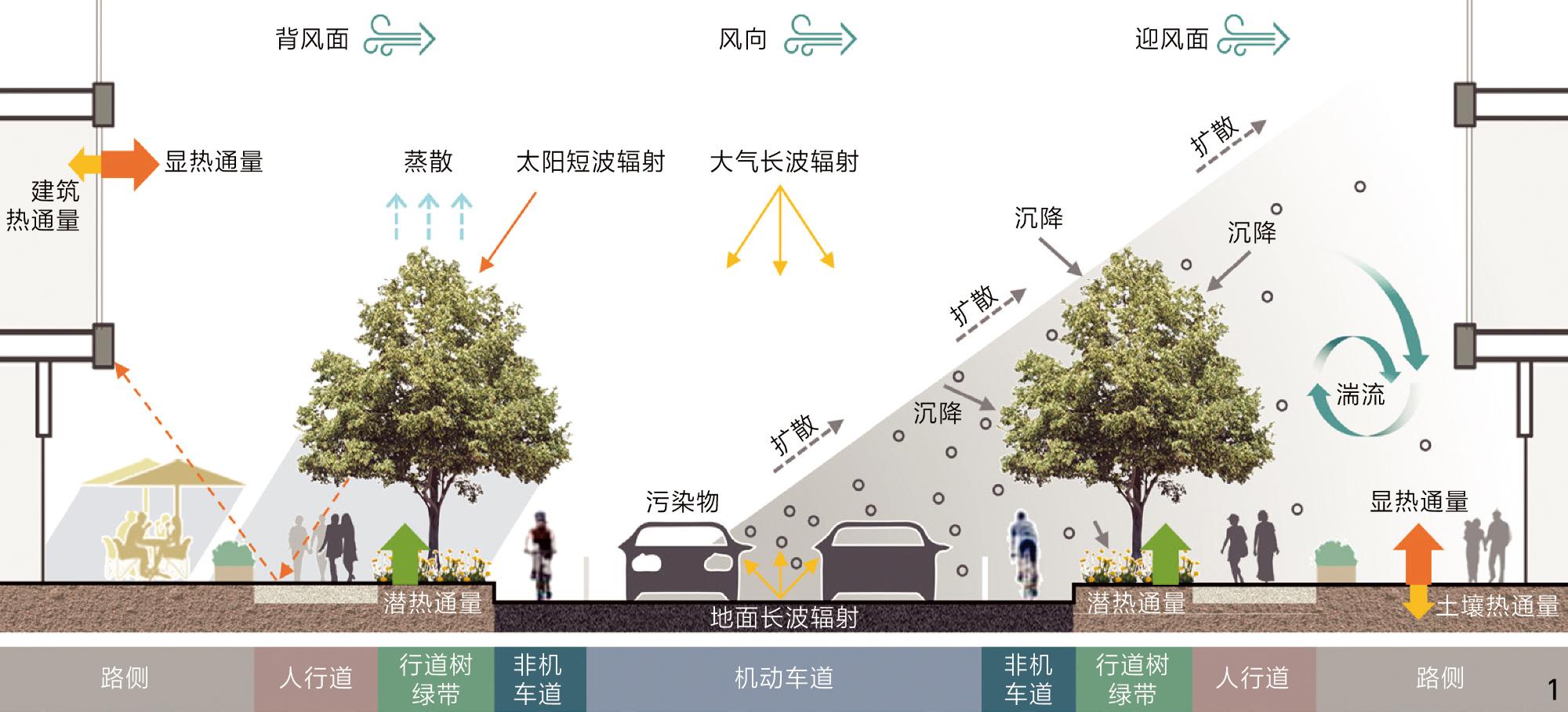


道路绿地植被对空气质量及热环境影响研究进展
|
张诚/男/南京林业大学风景园林学院在读博士研究生/研究方向为园林植物应用与生态功能 |
|
圣倩倩/女/博士/南京林业大学风景园林学院副教授/南京林业大学数字化创新设计研究中心副主任/国家林业和草原局“园林植物数字化应用与生态设计”国家级创新联盟副秘书长/研究方向为园林植物应用与生态功能 |
|
祝遵凌/男/博士/南京林业大学艺术设计学院院长、教授/南京林业大学数字化创新设计研究中心主任/国家林业和草原局“园林植物数字化应用与生态设计”国家级创新联盟理事长/研究方向为园林植物栽培与应用、植物景观规划设计 |
Copy editor: 刘昱霏
收稿日期: 2025-09-15
修回日期: 2025-11-20
网络出版日期: 2026-03-12
基金资助
国家自然科学基金“城市道路绿地植物叶际对交通NOx的吸收代谢机制及净化效应”(32471942)
版权
Research Progress on Road Greenspace Vegetation Effects on Air Quality and Thermal Environment
|
ZHANG Cheng is a Ph.D. candidate in the School of Landscape Architecture, Nanjing Forestry University. His research focuses on the application of landscape plants and their ecological functions |
|
SHENG Qianqian, Ph.D., is an associate professor in the School of Landscape Architecture, Nanjing Forestry University, and the deputy director of the Digital Innovation Design Research Center at Nanjing Forestry University. She is also the deputy secretary-general of the National Innovation Alliance for “Digital Application of Landscape Plants and Ecological Design” under the National Forestry and Grassland Administration. Her research focuses on the application of landscape plants and their ecological functions |
|
ZHU Zunling, Ph.D., is a professor and the dean of the School of Art and Design at Nanjing Forestry University, the director of the Digital Innovation Design Research Center at Nanjing Forestry University, the chairman of the National Innovation Alliance for “Digital Application of Landscape Plants and Ecological Design” under the National Forestry and Grassland Administration. His research focuses on the cultivation and application of landscape plants, and plant landscape planning and design |
Received date: 2025-09-15
Revised date: 2025-11-20
Online published: 2026-03-12
Copyright
在全球气候变化与快速城市化双重压力下,热岛效应和空气污染已成为突出的城市环境问题。道路绿地植被作为绿色基础设施的重要组成部分,在遮阴降温、污染物沉降及局地气候调节方面具有显著潜力。然而,道路绿地植被生态效益的发挥,具有多维度和多机制的复杂性,需权衡其间的关系。
本研究从植被个体特征、植物群落特征以及环境背景3个维度构建综合分析框架,阐明道路绿地植被在改善空气质量与调节热环境中的协同与拮抗机制。
研究表明:1)道路绿地植被对空气质量及热环境的影响具有多维度特征,其作用效果由叶片微观形态到冠层宏观结构,再到群落配置的多级特征的综合作用决定;2)道路绿地植被在空气质量改善与热环境调节两类生态功能上存在内在机制冲突,需依据道路污染水平、风热环境及盛行气象条件进行多目标权衡,并通过精细化调控植被三维结构,协同提升空气质量与行人热舒适性;3)街道高宽比、朝向和风环境等环境背景是植被发挥生态效益的制约因素,道路绿地植被设计须遵循“因地制宜”原则,依据具体背景环境特征进行差异化配置。
未来应探索道路绿地植被三维空间形态的量化体系,融合多源监测与模拟技术,揭示植被结构对热效应与污染物扩散的复合影响机制,为可持续、多目标和综合型道路景观设计与生态宜居城市构建提供理论支撑。
张诚 , 圣倩倩 , 祝遵凌 . 道路绿地植被对空气质量及热环境影响研究进展[J]. 风景园林, 2026 , 33(1) : 47 -55 . DOI: 10.3724/j.fjyl.LA20250562
Under the dual pressures of global climate change and rapid urbanization, urban heat island effects and air pollution have become prominent environmental problems, severely affect public health and significantly reduce residents' quality of life. In this context, it is essential to take various measures to improve urban road air quality and thermal environment, such as controlling traffic emissions to reduce source pollution, optimizing urban ventilation design to promote pollutant dispersion and alleviate heat accumulation, setting physical barriers to block pollutant transmission, and rationally configuring vegetation to promote pollutant deposition and provide shading and cooling. Among these, the rational configuration of vegetation has been considered one of the feasible measures to significantly improve road air quality and thermal environment in the short term. However, previous studies have mostly focused on analyzing single ecological benefits, failing to fully reveal the complex coupling relationships between road greenspace vegetation’s improvement of air quality and regulation of thermal environments, as well as the inherent synergistic and antagonistic mechanisms. In particular, there has been a lack of systematic reviews on balancing multiple benefits, evaluating the comprehensive impacts of different vegetation configuration patterns, and understanding the interaction among environmental background factors.
This study constructed a comprehensive analytical framework from three dimensions: vegetation individual traits, community characteristics, and environmental background. It elucidated the synergistic and antagonistic mechanisms of road greenspace vegetation in improving air quality and regulating thermal environments, providing a theoretical basis for road space greening design to promote urban public health and the construction of sustainable living environments.
This study demonstrated that road greenspace vegetation had significant multidimensional effects on road environments, with various trade-offs and synergies. 1) Road greenspace vegetation had significant multidimensional effects and trade-offs on road environments. The realization of ecological benefits from vegetation was influenced by the combined effects of micro-scale leaf characteristics (such as epidermal wax, stomatal density, and trichome structure), macro-scale canopy structure (canopy width, leaf area), and community characteristics (stratified structure, planting density). There were complex interactions between different dimensional characteristics: for example, a high leaf area could enhance pollutant deposition and shading effects but might reduce canopy permeability, obstructing pollutant diffusion and leading to increased local pollutant concentrations. Similarly, a lower branch height could expand shading coverage but might inhibit near-surface air circulation, affecting thermal comfort. This cross-dimensional trade-off mechanism indicated that optimal vegetation configuration must be systematically and collaboratively optimized based on specific ecological benefit goals. 2) Road greenspace vegetation exhibited both synergistic and antagonistic effects in improving air quality and regulating thermal environments. High leaf area and high canopy closure vegetation could provide ample shading and transpiration cooling effects, thereby reducing air temperature and mean radiant temperature; however, effective pollutant diffusion required vegetation with appropriate porosity to ensure ventilation efficiency at pedestrian height, avoiding pollutant accumulation. Under ideal conditions, a well-structured stratified community could simultaneously achieve efficient pollutant reduction and effective thermal environment regulation. However, the mechanisms by which road greenspace vegetation improves air quality and regulates thermal environments were fundamentally different: high-density vegetation, while enhancing thermal comfort, tends to obstruct air flow, increase local pollution risks; whereas sparse vegetation configurations, although beneficial for pollutant diffusion, may weaken shading effects and transpiration cooling efficiency. Therefore, the vegetation configuration of road green spaces needed to be optimized based on road pollution levels, local microclimate characteristics, and prevailing meteorological conditions. By fine-tuning the three-dimensional structure of vegetation, air quality and thermal comfort could be enhanced in a synergistic manner. 3) Environmental background factors were critical boundary conditions that determined the effectiveness of vegetation ecological functions. The street aspect ratio determined the flow-field pattern and directly affected pollutant dispersion path; street orientation dictated the distribution of solar radiation and was a major factor influencing the spatial variation of thermal environments; wind field conditions govern the interaction processes between vegetation and the atmosphere. Therefore, vegetation configuration should be designed based on the specific spatial characteristics of the street.
Current studies have mostly focused on the impact of two-dimensional vegetation parameters on single environmental effects. Future research should develop a comprehensive quantification system for vegetation’s three-dimensional spatial morphology. Using technologies such as 3D laser scanning and stereophotogrammetric measurements to obtain canopy volume, leaf area density, and other spatial parameters, combined with computational simulation, will help reveal the coupling mechanisms between the three-dimensional spatial structure of road greenspace vegetation, pollutant dispersion, and heat radiation transfer. This will contribute to the development of a road greenspace vegetation design model based on spatial integrity. Furthermore, existing research has paid little attention to the interactive regulation mechanisms between road greenspace vegetation, air quality, and thermal environments. Most studies isolate the analysis of single environmental factors and fail to fully elucidate the synergistic effects of vegetation on the combined processes of pollution and heat. Future research should focus on simultaneous monitoring of canopy microclimates and spatiotemporal dynamics of multiple air pollutants, quantitatively analyzing the coupling relationship between thermal environment and pollution distribution under vegetation structure control, and exploring the synergistic and trade-off mechanisms in improving air quality and regulating thermal environments. This will provide a scientific basis for the creation of healthy and comfortable road space.
表1 植被个体特征、植被群落特征及环境背景对空气质量和热环境的综合影响Tab. 1 The combined effects of individual vegetation characteristics, community characteristics, and environmental context on air quality and thermal environment |
| 维度特征 | 指标 | 对空气质量的影响 | 对热环境的影响 | |
|---|---|---|---|---|
| 大类 | 小类 | |||
| 注:+代表该指标对空气质量或热环境有正向影响;++代表该指标在同小类指标中对空气质量或热环境具有更高的正向效应;−代表该指标对空气质量或热环境具有负向影响;/代表该指标对空气质量或热环境的具体影响的效应不明确。 | ||||
| 植被个体特征 | 叶习性 | 常绿 | ++ | ++ |
| 落叶 | + | + | ||
| 叶片性状 | 阔叶 | ++ | ++ | |
| 针叶 | + | + | ||
| 植被高度 | 树高 | / | + | |
| 枝下高 | / | − | ||
| 树冠与叶量 | 树冠 | / | + | |
| 叶量 | / | + | ||
| 植被群落特征 | 群落结构 | 单层群落 | + | + |
| 复层群落 | ++ | ++ | ||
| 配置方式 | 单行种植 | / | + | |
| 双行种植 | / | ++ | ||
| 群落水平结构特征 | 植被覆盖率与郁闭度 | / | + | |
| 天空可视因子 | / | − | ||
| 群落立面结构特征 | 疏透度 | / | + | |
| 环境背景 | 街道形态 | 高宽比 | − | + |
| 街道朝向 | 东西向 | / | − | |
| 南北向 | / | + | ||
| 风 | 风速 | + | + | |
| 平行风 | ++ | ++ | ||
| 垂直风 | / | + | ||
文中图表均由作者绘制。
1、提出了一个涵盖植被个体特征、植被群落特征和环境背景的多维度综合分析框架,探讨了道路植被在改善空气质量和调节热环境中的复杂作用。该框架为理解道路绿地植被的多层次效益提供了理论依据。
2、分析了道路绿地植被在空气质量改善和热环境调节中的作用,提出通过优化植被三维结构(如冠层密度、叶面积等)来发挥更高的生态效益。特别是在平衡不同环境目标时,精细化的植被设计能够有效提升行人舒适度和区域空气质量。
3、强调了街道高宽比、朝向和风环境等背景要素对植被生态功能的影响,为道路绿地植被设计提供了更具针对性的理论依据。
| [1] |
REN Z B, FU Y, DONG Y L, et al. Rapid Urbanization and Climate Change Significantly Contribute to Worsening Urban Human Thermal Comfort: A National 183-City, 26-Year Study in China[J]. Urban Climate, 2022, 43: 101154.
|
| [2] |
World Health Organization. Ambient Air Pollution: A Global Assessment of Exposure and Burden of Disease[J]. Clean Air Journal, 2016, 26(2): 6.
|
| [3] |
KELLY F J, ZHU T. Transport Solutions for Cleaner Air[J]. Science, 2016, 352(6288): 934-936.
|
| [4] |
BOWLER D E, BUYUNG-ALI L, KNIGHT T M, et al. Urban Greening to Cool Towns and Cities: A Systematic Review of the Empirical Evidence[J]. Landscape and Urban Planning, 2010, 97(3): 147-155.
|
| [5] |
刘滨谊, 彭旭路. 城市街道小气候舒适性研究进展与启示[J]. 中国园林, 2019, 35(10): 57-62.
LIU B Y, PENG X L. The Progress and Enlightenment of Research on Microclimate Comfort in Urban Streets[J]. Chinese Landscape Architecture, 2019, 35(10): 57-62.
|
| [6] |
KOUSIS I, PISELLO A L. Evaluating the Performance of Cool Pavements for Urban Heat Island Mitigation Under Realistic Conditions: A Systematic Review and Meta-Analysis[J]. Urban Climate, 2023, 49: 101470.
|
| [7] |
YANG F, GAO Y W, ZHONG K, et al. Impacts of Cross-Ventilation on the Air Quality in Street Canyons with Different Building Arrangements[J]. Building and Environment, 2016, 104: 1-12.
|
| [8] |
VOORDECKERS D, LAURIKS T, BAETENS D, et al. Numerical Study on the Impact of Traffic Lane Adjustments and Low Boundary Walls on Pedestrian Exposure to NO2 in Street Canyons[J]. Landscape and Urban Planning, 2024, 243: 104974.
|
| [9] |
ZHENG S L, HE C W, GULDMANN J M, et al. Heat Mitigation Benefits of Urban Trees: A Review of Mechanisms, Modeling, Validation and Simulation[J]. Forests, 2023, 14(12): 2280.
|
| [10] |
MIRABI E, DAVIES P J. Mitigating Urban Heat Along Roadways; Systematic Review of Impact and Practicability[J]. Urban Climate, 2024, 58: 102207.
|
| [11] |
WU H T, JIN R, LIU M X, et al. Investigating the Potential of Street Trees in Mitigating Pedestrian Thermal Stress During Heatwaves Conditions: An Empirical Study in Guangzhou[J]. Building and Environment, 2024, 265: 111955.
|
| [12] |
LI Y Q, LIU X, CHESHMEHZANGI A, et al. Multidimensional Factors Affecting Tree-Induced Cooling Benefits: A Comprehensive Review[J]. Building and Environment, 2025, 282: 113242.
|
| [13] |
VOORDECKERS D, LAURIKS T, DENYS S, et al. Guidelines for Passive Control of Traffic-Related Air Pollution in Street Canyons: An Overview for Urban Planning[J]. Landscape and Urban Planning, 2021, 207: 103980.
|
| [14] |
WANG X S, TENG M J, HUANG C B, et al. Canopy Density Effects on Particulate Matter Attenuation Coefficients in Street Canyons During Summer in the Wuhan Metropolitan Area[J]. Atmospheric Environment, 2020, 240: 117739.
|
| [15] |
郭晓华, 戴菲, 殷利华. 基于ENVI-met的道路绿带规划设计对PM2.5消减作用的模拟研究[J]. 风景园林, 2018, 25(12): 75-80.
GUO X H, DAI F, YIN L H. A Simulation Study on the Effect of ENVI-met-Based Road Greenbelt Planning and Design on PM2.5 Reduction[J]. Landscape Architecture, 2018, 25(12): 75-80.
|
| [16] |
LI Z T, ZHANG H, JUAN Y H, et al. Effects of Urban Tree Planting on Thermal Comfort and Air Quality in the Street Canyon in a Subtropical Climate[J]. Sustainable Cities and Society, 2023, 91: 104334.
|
| [17] |
ABHIJITH K V, KUMAR P, GALLAGHER J, et al. Air Pollution Abatement Performances of Green Infrastructure in Open Road and Built-up Street Canyon Environments: A Review[J]. Atmospheric Environment, 2017, 162: 71-86.
|
| [18] |
RAHMAN M A, STRATOPOULOS L M F, MOSER-REISCHL A, et al. Traits of Trees for Cooling Urban Heat Islands: A Meta-Analysis[J]. Building and Environment, 2020, 170: 106606.
|
| [19] |
BALDAUF R. Roadside Vegetation Design Characteristics that Can Improve Local, Near-Road Air Quality[J]. Transportation Research Part D: Transport and Environment, 2017, 52: 354-361.
|
| [20] |
TIWARI A, KUMAR P, BALDAUF R, et al. Considerations for Evaluating Green Infrastructure Impacts in Microscale and Macroscale Air Pollution Dispersion Models[J]. Science of The Total Environment, 2019, 672: 410-426.
|
| [21] |
FERRINI F, FINI A, MORI J, et al. Role of Vegetation as a Mitigating Factor in the Urban Context[J]. Sustainability, 2020, 12(10): 4247.
|
| [22] |
胡杨, 马克明. 城市道路绿地对局地空气污染扩散的影响研究进展[J]. 应用生态学报, 2021, 32(1): 349-357.
HU Y, MA K M. Research Progress on the Effects of Urban Road Green Space on Dispersion of Local Air Pollutant[J]. Chinese Journal of Applied Ecology, 2021, 32(1): 349-357.
|
| [23] |
王占永, 陈昕, 胡喜生, 等. 植物屏障影响路边大气颗粒物分布机理及研究方法的进展[J]. 生态环境学报, 2022, 31(5): 1047-1058.
WANG Z Y, CHEN X, HU X S, et al. Mechanism and Research Methods of Roadside Green Barriers Affecting the Distribution of Atmospheric Particulate Matter: A Review[J]. Ecology and Environmental Sciences, 2022, 31(5): 1047-1058.
|
| [24] |
胡杨, 马克明. 城市街道绿化对空气质量及微气候影响的综合模拟研究[J]. 生态学报, 2021, 41(4): 1314-1331.
HU Y, MA K M. A Comprehensive Simulation Study on the Influence of Urban Street Greening on Air Quality and Microclimate[J]. Acta Ecologica Sinica, 2021, 41(4): 1314-1331.
|
| [25] |
THOENE B, RENNENBERG H, WEBER P. Absorption of Atmospheric NO2 by Spruce (Picea Abies) Trees[J]. New Phytologist, 1996, 134(2): 257-266.
|
| [26] |
SÆBØ A, POPEK R, NAWROT B, et al. Plant Species Differences in Particulate Matter Accumulation on Leaf Surfaces[J]. Science of the Total Environment, 2012, 427/428: 347-354.
|
| [27] |
VAL MARTIN M, HEALD C L, ARNOLD S R. Coupling Dry Deposition to Vegetation Phenology in the Community Earth System Model: Implications for the Simulation of Surface O3[J]. Geophysical Research Letters, 2014, 41(8): 2988-2996.
|
| [28] |
WU Z Y, WANG X M, CHEN F, et al. Evaluating the Calculated Dry Deposition Velocities of Reactive Nitrogen Oxides and Ozone from Two Community Models over a Temperate Deciduous Forest[J]. Atmospheric Environment, 2011, 45(16): 2663-2674.
|
| [29] |
ZHAO D, LEI Q, SHI Y, et al. Role of Species and Planting Configuration on Transpiration and Microclimate for Urban Trees[J]. Forests. 2020, 11(8):825.
|
| [30] |
ZHENG J, TARIN M W K, CHEN G, et al. The Characteristics of Plant Clusters Influence on the Cooling Effect: A Case Study in a Subtropical Island Park, China[J]. Global Ecology and Conservation, 2022, 34: e02055.
|
| [31] |
HUANG C W, LIN M Y, KHLYSTOV A, et al. The Effects of Leaf Size and Microroughness on the Branch-Scale Collection Efficiency of Ultrafine Particles[J]. Journal of Geophysical Research: Atmospheres, 2015, 120(8): 3370-3385.
|
| [32] |
YANG J, CHANG Y M, YAN P B. Ranking the Suitability of Common Urban Tree Species for Controlling PM2.5 Pollution[J]. Atmospheric Pollution Research, 2015, 6(2): 267-277.
|
| [33] |
WEERAKKODY U, DOVER J W, MITCHELL P, et al. Evaluating the Impact of Individual Leaf Traits on Atmospheric Particulate Matter Accumulation Using Natural and Synthetic Leaves[J]. Urban Forestry & Urban Greening, 2018, 30: 98-107.
|
| [34] |
ZHANG W K, WANG B, NIU X. Relationship Between Leaf Surface Characteristics and Particle Capturing Capacities of Different Tree Species in Beijing[J]. Forests, 2017, 8(3): 92.
|
| [35] |
ZHANG W K, ZHANG Z, MENG H, et al. How Does Leaf Surface Micromorphology of Different Trees Impact Their Ability to Capture Particulate Matter?[J]. Forests, 2018, 9(11): 681.
|
| [36] |
LIANG D, MA C, WANG Y Q, et al. Quantifying PM2.5 Capture Capability of Greening Trees Based on Leaf Factors Analyzing[J]. Environmental Science and Pollution Research, 2016, 23(21): 21176-21186.
|
| [37] |
HUANG J, KONG F H, YIN H W, et al. Transpirational Cooling and Physiological Responses of Trees to Heat[J]. Agricultural and Forest Meteorology, 2022, 320: 108940.
|
| [38] |
CHOI G Y, KIM H S, KIM H, et al. How Do Paving and Planting Strategies Affect Microclimate Conditions and Thermal Comfort in Apartment Complexes?[J]. International Journal of Climate Change Strategies and Management, 2021, 13(2): 97-119.
|
| [39] |
AL-DABBOUS A N, KUMAR P. The Influence of Roadside Vegetation Barriers on Airborne Nanoparticles and Pedestrians Exposure Under Varying Wind Conditions[J]. Atmospheric Environment, 2014, 90: 113-124.
|
| [40] |
TONG Z M, WHITLOW T H, MACRAE P F, et al. Quantifying the Effect of Vegetation on Near-Road Air Quality Using Brief Campaigns[J]. Environmental Pollution, 2015, 201: 141-149.
|
| [41] |
WANG C C, REN Z B, CHANG X Y, et al. Understanding the Cooling Capacity and Its Potential Drivers in Urban Forests at the Single Tree and Cluster Scales[J]. Sustainable Cities and Society, 2023, 93: 104531.
|
| [42] |
SPEAK A F, SALBITANO F. Summer Thermal Comfort of Pedestrians in Diverse Urban Settings: A Mobile Study[J]. Building and Environment, 2022, 208: 108600.
|
| [43] |
HARDIN P J, JENSEN R R. The Effect of Urban Leaf Area on Summertime Urban Surface Kinetic Temperatures: A Terre Haute Case Study[J]. Urban Forestry & Urban Greening, 2007, 6(2): 63-72.
|
| [44] |
SHENG Q Q, JI Y O, JIA C Y, et al. Differential Effects of Cooling and Humidification in Urban Green Spaces and Thresholds of Vegetation Community Structure Parameters: A Case Study of the Yangtze River Delta Region[J]. Cities, 2025, 159: 105765.
|
| [45] |
YAN J L, CHEN W Y, ZHANG Z X, et al. Mitigating PM2.5 Exposure with Vegetation Barrier and Building Designs in Urban Open-Road Environments Based on Numerical Simulations[J]. Landscape and Urban Planning, 2024, 241: 104918.
|
| [46] |
李新宇, 赵松婷, 李延明, 等. 北京市不同主干道绿地群落对大气PM2.5浓度消减作用的影响[J]. 生态环境学报, 2014, 23(4): 615-621.
LI X Y, ZHAO S T, LI Y M, et al. Subduction Effect of Urban Arteries Green Space on Atmospheric Concentration of PM2.5 in Beijing[J]. Ecology and Environmental Sciences, 2014, 23(4): 615-621.
|
| [47] |
范舒欣, 李坤, 张梦园, 等. 城市居住区绿地小微尺度下垫面构成对环境微气候的影响: 以北京地区为例[J]. 北京林业大学学报, 2021, 43(10): 100-109.
FAN S X, LI K, ZHANG M Y, et al. Effects of Micro Scale Underlying Surface Type and Pattern of Urban Residential Area on Microclimate: Taking Beijing as a Case Study[J]. Journal of Beijing Forestry University, 2021, 43(10): 100-109.
|
| [48] |
陶薪宇.北京城市绿地植物群落的热湿环境调节效应研究[D].北京: 北京林业大学, 2023.
TAO X Y. Study on the Effect of Heat and Humidity Regulation of Plant Community in Urban Green Space in Beijing[D]. Beijing: Beijing Forestry University, 2023.
|
| [49] |
CHEN X P, HAN M, HE J Y, et al. Integrated Effect of Aspect Ratio and Tree Spacing on Pedestrian Thermal Comfort of Street Canyon[J]. International Journal of Biometeorology, 2024, 68(10): 2115-2131.
|
| [50] |
CHEN T H, YANG H Y, CHEN G W, et al. Integrated Impacts of Tree Planting and Aspect Ratios on Thermal Environment in Street Canyons by Scaled Outdoor Experiments[J]. Science of The Total Environment, 2021, 764: 142920.
|
| [51] |
CAI Y, LI C, YE L, et al. Effect of the Roadside Tree Canopy Structure and the Surrounding on the Daytime Urban Air Temperature in Summer[J]. Agricultural and Forest Meteorology, 2022, 316: 108850.
|
| [52] |
SODOUDI S, ZHANG H W, CHI X L, et al. The Influence of Spatial Configuration of Green Areas on Microclimate and Thermal Comfort[J]. Urban Forestry & Urban Greening, 2018, 34: 85-96.
|
| [53] |
黄钰麟, 傅伟聪, 陈晶茹, 等. 植物群落特征对夏季公园林荫空间微气候的影响研究[J]. 中国园林, 2022, 38(3): 118-123.
HUANG Y L, FU W C, CHEN J R, et al. Study on the Influence of Plant Community Characteristics on the Summer Microclimate of the Tree-Shaded Space in Parks[J]. Chinese Landscape Architecture, 2022, 38(3): 118-123.
|
| [54] |
SHAHIDAN M F, JONES P J, GWILLIAM J, et al. An Evaluation of Outdoor and Building Environment Cooling Achieved Through Combination Modification of Trees with Ground Materials[J]. Building and Environment, 2012, 58: 245-257.
|
| [55] |
YAMASHITA S, SEKINE K, SHODA M, et al. On Relationships Between Heat Island and Sky View Factor in the Cities of Tama River Basin, Japan[J]. Atmospheric Environment (1967), 1986, 20(4): 681-686.
|
| [56] |
UNGER J. Intra-Urban Relationship Between Surface Geometry and Urban Heat Island: Review and New Approach[J]. Climate Research, 2004, 27: 253-264.
|
| [57] |
WANIA A, BRUSE M, BLOND N, et al. Analysing the Influence of Different Street Vegetation on Traffic-Induced Particle Dispersion Using Microscale Simulations[J]. Journal of Environmental Management, 2012, 94(1): 91-101.
|
| [58] |
HUSSAIN M, LEE B E. An Investigation of Wind Forces on Three Dimensional Roughness Elements in a Simulated Atmospheric Boundary Layer Flow[J]. Department of Building Science Faculty of Architectural Studies University of Sheffield, 1980.
|
| [59] |
JOHANSSON E. Influence of Urban Geometry on Outdoor Thermal Comfort in a Hot Dry Climate: A Study in Fez, Morocco[J]. Building and Environment, 2006, 41(10): 1326-1338.
|
| [60] |
EMMANUEL R, JOHANSSON E. Influence of Urban Morphology and Sea Breeze on Hot Humid Microclimate: The Case of Colombo, Sri Lanka[J]. Climate Research, 2006, 30(3): 189-200.
|
| [61] |
余洋, 蒋雨芊, 张琦瑀. 城市街道健康影响路径和空间要素研究[J]. 风景园林, 2021(2): 55-61.
YU Y, JIANG Y Q, ZHANG Q Y. Research on Health Impact Pathways and Spatial Elements of Urban Streets[J]. Landscape Architecture, 2021(2): 55-61.
|
| [62] |
CHATZIDIMITRIOU A, YANNAS S. Street Canyon Design and Improvement Potential for Urban Open Spaces; The Influence of Canyon Aspect Ratio and Orientation on Microclimate and Outdoor Comfort[J]. Sustainable Cities and Society, 2017, 33: 85-101.
|
| [63] |
ANDREOU E. Thermal Comfort in Outdoor Spaces and Urban Canyon Microclimate[J]. Renewable Energy, 2013, 55: 182-188.
|
| [64] |
YAHIA M W, JOHANSSON E. Influence of Urban Planning Regulations on the Microclimate in a Hot Dry Climate: The Example of Damascus, Syria[J]. Journal of Housing and the Built Environment, 2013, 28(1): 51-65.
|
| [65] |
JEANJEAN A P R, BUCCOLIERI R, EDDY J, et al. Air Quality Affected by Trees in Real Street Canyons: The Case of Marylebone Neighbourhood in Central London[J]. Urban Forestry & Urban Greening, 2017, 22: 41-53.
|
| [66] |
YASSIN M F. Numerical Modeling on Air Quality in an Urban Environment with Changes of the Aspect Ratio and Wind Direction[J]. Environmental Science and Pollution Research, 2013, 20(6): 3975-3988.
|
| [67] |
ZHANG H, XU T T, WANG Y X, et al. Study on the Influence of Meteorological Conditions and the Street Side Buildings on the Pollutant Dispersion in the Street Canyon[J]. Building Simulation, 2016, 9(6): 717-727.
|
| [68] |
HUANG Y D, HOU R W, LIU Z Y, et al. Effects of Wind Direction on the Airflow and Pollutant Dispersion Inside a Long Street Canyon[J]. Aerosol and Air Quality Research, 2019, 19(5): 1152-1171.
|
| [69] |
REN X Y, ZHANG G Y, CHEN Z G, et al. The Influence of Wind-Induced Response in Urban Trees on the Surrounding Flow Field[J]. Atmosphere, 2023, 14(6): 1010.
|
| [70] |
MORAKINYO T E, LAM Y F. Simulation Study on the Impact of Tree-Configuration, Planting Pattern and Wind Condition on Street-Canyon’s Micro-Climate and Thermal Comfort[J]. Building and Environment, 2016, 103: 262-275.
|
/
| 〈 |
|
〉 |