

风景园林学科视角下的“降碳、减污、扩绿、增长”协同增效综述
|
戴菲/女/博士/华中科技大学建筑与城市规划学院景观学系系主任、教授、博士生导师/湖北省城镇化工程技术研究中心成员/本刊编委/研究方向为规划学科研究方法、绿色基础设施、城市绿地系统 |
|
徐亚如/女/华中科技大学建筑与城市规划学院在读博士研究生/湖北省城镇化工程技术研究中心成员/研究方向为绿色基础设施、风景园林规划与设计 |
|
汪云/女/硕士/武汉市自然资源保护利用中心副主任、教授级高级规划师/研究方向为自然资源保护利用和城乡规划 |
|
王运达/男/博士/华中科技大学建筑与城市规划学院在站博士后/湖北省城镇化工程技术研究中心成员/研究方向为城市绿地系统规划与理论、风景园林规划设计、园林空间特征量化 |
Copy editor: 刘昱霏
收稿日期: 2025-09-15
修回日期: 2025-12-01
网络出版日期: 2026-03-12
基金资助
国家自然科学基金“城市绿色空间降碳—减污—增效测度及提升路径研究——以武汉市为例”(52578075)
国家自然科学基金“消减空气颗粒物的城市灰绿空间‘源-流-汇’耦合模拟研究”(52178041)
版权
A Review of the Synergistic Enhancement of “Carbon Reduction, Pollution Control, Green Expansion, and Growth” from the Perspective of Landscape Architecture
|
DAI Fei, Ph.D., is the director of the Department of Landscape Architecture, a professor and doctoral supervisor, in the School of Architecture and Urban Planning, Huazhong University of Science and Technology, member of Hubei Urbanization Engineering Technology Research Center, is an editorial board member of this journal. Her research focuses on planning discipline research methods, green infrastructure, urban green system |
|
XU Yaru is a Ph.D. candidate in the School of Architecture and Urban Planning, Huazhong University of Science and Technology, member of Hubei Urbanization Engineering Technology Research Center. Her research focuses on green infrastructure, landscape planning and design |
|
WANG Yun, Master, is the deputy director, a professorate senior urban planner of the Wuhan Natural Resources Conservation and Utilization Center. Her research focuses on natural resources conservation and utilization and urban-rural planning |
|
WANG Yunda, Ph.D., is a postdoctoral fellow in the School of Architecture and Urban Planning, Huazhong University of Science and Technology, member of Hubei Urbanization Engineering Technology Research Center. His research focuses on urban green space system planning and theory, landscape architecture design, and quantitative analysis of garden space characteristics |
Received date: 2025-09-15
Revised date: 2025-12-01
Online published: 2026-03-12
Copyright
在生态文明建设和全面绿色转型的背景下,“协同推进降碳、减污、扩绿、增长”是国家的核心战略,如何促进降碳、减污、扩绿、增长四者的协同增效成为中国各学科领域的重要课题。绿色空间是风景园林学科的主要研究对象,也是“扩绿”实施的重要载体,对“降碳”“减污”“增长”的同时促进有着独特的空间规划与设计落位视角。
梳理2005年以来与“降碳、减污、扩绿、增长”等领域相关的国家政策推进过程、内涵及关联机制、协同研究发文趋势及学科分布情况,系统剖析风景园林学科通过“扩绿”实现“降碳”“减污”“增长”协同增效的研究内容与发展趋势。
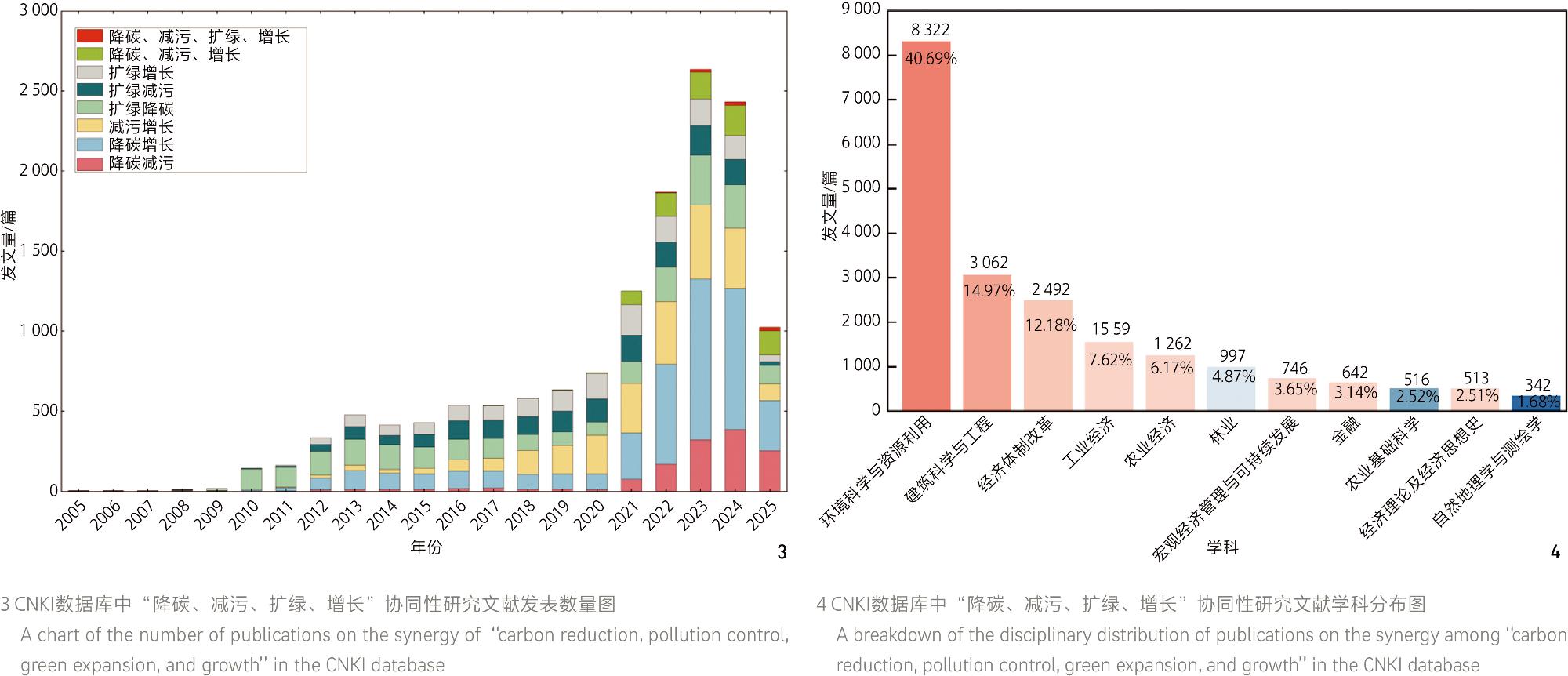
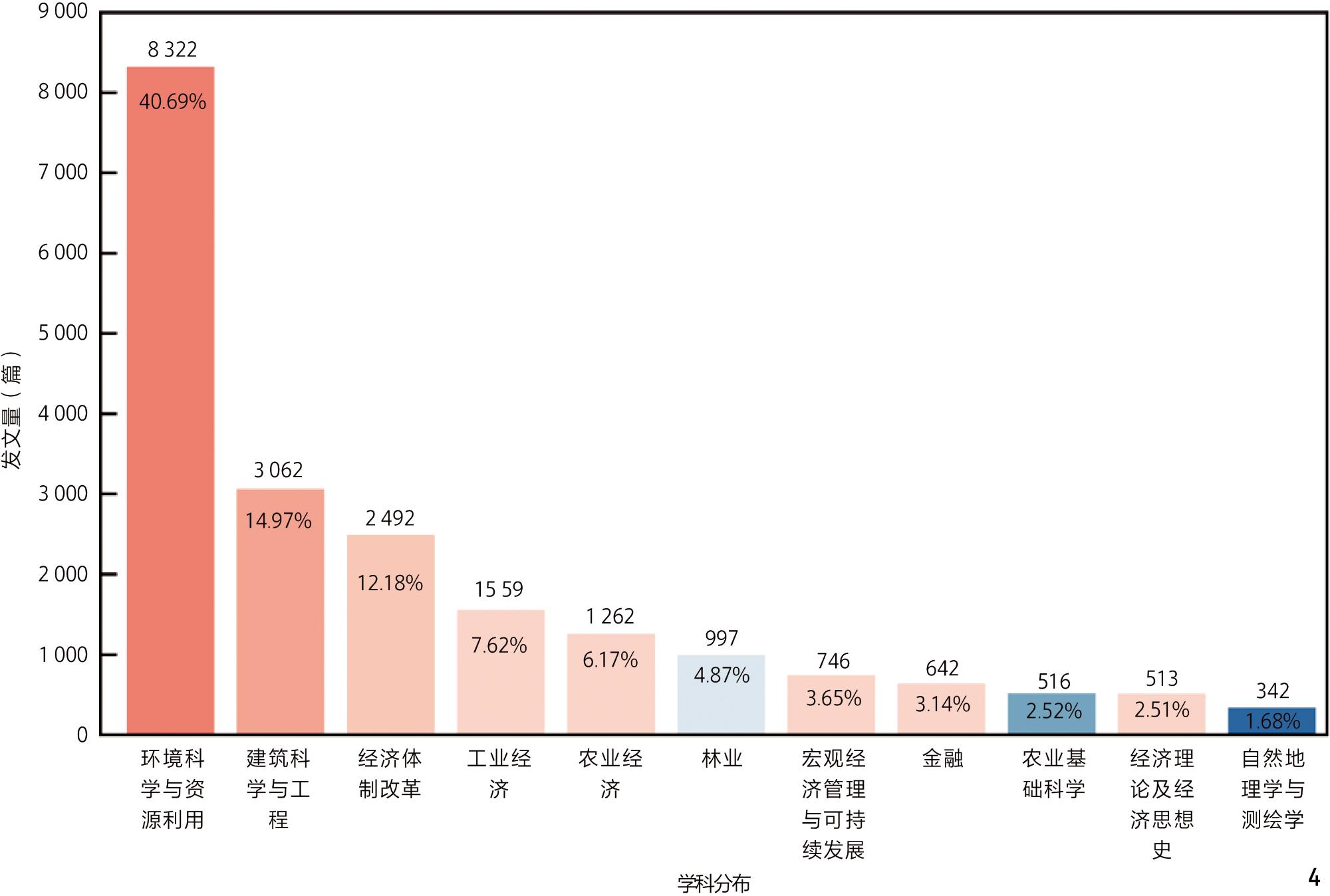
1)“降碳、减污、扩绿、增长”四者间的关系主要受政策影响,2022—2025年已处于政策协同深化期。2) 截至2025年6月30日,相关研究仍以降碳增长、减污增长、扩绿降碳、扩绿减污、扩绿增长、降碳减污等2项协同为主,且发文多集中在环境、经济等学科,研究以政策为导向展开,亟待人居环境学科开展以空间落位为导向的研究。3)风景园林学科视角下的研究主要关注“扩绿”的空间特征对“降碳”“减污”“增长”效果的影响,进而指导“扩绿”的规划设计与管理。且目前通过“扩绿”分别促进“降碳”“减污”“增长”效果的研究成果丰富。
未来应加强风景园林学科视角下以空间规划“扩绿”为引领的多维度协同增效研究,并与国土空间规划的多层级管控需求结合,以“降碳减污”“降碳、减污、增长”等协同增效为目标,提出覆盖“城乡—空间类型—地块”等多层级的绿色空间规划、设计与管理策略。
关键词: 风景园林; 绿色空间; “降碳、减污、扩绿、增长”; 协同增效
戴菲 , 徐亚如 , 汪云 , 王运达 . 风景园林学科视角下的“降碳、减污、扩绿、增长”协同增效综述[J]. 风景园林, 2026 , 33(1) : 12 -22 . DOI: 10.3724/j.fjyl.LA20250567
Against the backdrop of China’s ecological civilization construction and comprehensive green transition, the national strategy of “synergistic promotion of carbon reduction, pollution reduction, greening expansion, and growth” has become a core policy orientation. How to foster effective synergies among these four objectives—carbon reduction, pollution reduction, greening expansion, and growth—have consequently emerged as a key research agenda across multiple disciplines. As the primary research object of landscape architecture, green space constitutes a crucial spatial carrier for “greening expansion” and offers a distinctive spatial planning and design perspective for simultaneously advancing carbon reduction, pollution mitigation, and high-quality development. This study aims to clarify the policy evolution, disciplinary research patterns, and spatial mechanisms underlying such synergies, and to explore how landscape architecture can contribute more systematically to this national strategic framework.
The study first reviews major national policies issued since 2005 that relate to carbon reduction, pollution control, ecological conservation, greening expansion, and green growth. It outlines their advancement pathways, summarizes evolving objectives and conceptual connotations, and identifies linkage mechanisms among “carbon reduction, pollution reduction, greening expansion, and growth”. Second, based on literature statistics and disciplinary mapping, the study examines publication trends and disciplinary distribution of collaborative research focusing on different combinations of these four goals, thereby revealing the dominant paradigms and existing gaps. Third, from the standpoint of landscape architecture, it analyzes how different forms and configurations of “greening expansion” can be leveraged to achieve synergistic improvements across carbon reduction, pollution mitigation, and economic growth, with particular attention to spatial characteristics, ecological processes, socioeconomic feedbacks, and the translation of scientific findings into planning, design, and management strategies.
1) The relationships among carbon reduction, pollution reduction, greening expansion, and growth are strongly shaped by successive rounds of policy guidance. With the institutionalization of ecological civilization and the proposal of the “dual carbon” targets, policy documents have gradually shifted from sectoral management to integrated, cross-sectoral governance. During 2022−2025, China has entered a stage of deepening policy coordination, in where the four targets are no longer pursued in isolation but are embedded in systematic frameworks for territorial spatial planning, environmental management, and industrial restructuring. 2) As of 2025, the academic literature still focuses predominantly on pairwise synergies: carbon reduction−growth, pollution reduction−growth, greening expansion−carbon reduction, greening expansion−pollution reduction, greening expansion−growth, and carbon reduction−pollution reduction. Studies simultaneously addressing three or more objectives remain relatively scarce. Publications are heavily concentrated in environmental science and engineering, energy and climate studies, economics, and public policy. These works are largely driven by top-down policy agendas and oriented toward macro-level assessment, scenario simulation, and policy evaluation. In contrast, there is a clear deficiency of research within human settlement and built environment disciplines—including landscape architecture, urban and rural planning, and architecture—that take spatial localization, spatial configuration, and site-scale intervention as core entry points. 3) From the perspective of landscape architecture, existing studies primarily focus on how the spatial characteristics of green spaces—such as area and scale, type composition, landscape pattern, connectivity, configuration, and functional zoning—affect carbon sequestration, pollutant removal, microclimate regulation, and socio-economic benefits. These studies translate such relationships into principles that inform green space planning, design, and management. Current evidence demonstrates that “greening expansion” can effectively contribute to carbon reduction (e.g., through vegetation carbon sinks, reduced building energy consumption, and promotion of low-carbon mobility), pollution reduction (e.g., through air and water purification, noise mitigation, runoff regulation, and alleviation of urban heat islands), and growth (e.g., through enhancement of property values, attraction of investment, promotion of recreation and tourism, improvement of public health, and support for green industries and employment).
It is necessary to further strengthen multidimensional synergy research led by “greening expansion” under the disciplinary framework of landscape architecture, with spatial planning and design as a primary leverage. Future work should move beyond isolated pairwise relationships and pay greater attention to multi-objective coupling mechanisms that integrate carbon reduction, pollution control, ecosystem restoration, and high-quality development. Specifically, green space planning should be more closely aligned with the hierarchical management requirements of territorial spatial planning, coordinating national, regional, urban-rural, and site-specific scales. Taking synergistic carbon and pollution reduction, as well as integrated “carbon reduction-pollution reduction-growth” goals, as core targets, research should develop systematic strategies for green space planning, design, and management that cover multiple spatial levels, including “urban−rural systems, space types, plots”. This implies establishing quantitative indicators and spatial configuration guidelines for different categories of green space; embedding ecosystem service optimization, low-carbon transition objectives, and environmental health considerations into zoning, layout, and design codes; and strengthening adaptive management based on continuous monitoring, performance assessment, and feedback adjustment. By leveraging the spatial carrier function of green spaces and integrating ecological, social, and economic objectives coordinated, landscape architecture can play a pivotal role in realizing the synergy of carbon reduction, pollution mitigation, greening expansion, and sustainable growth, providing spatial solutions, design pathways, and technical support for national strategies on ecological civilization and comprehensive green transformation.
表1 国家关于协同推进“降碳、减污、扩绿、增长”的政策及相关要求[1-7]Tab. 1 National policies and requirements on “carbon reduction, pollution control, green expansion, and growth”[1-7] |
| 时间 | 会议/报告名称 | 主要内容和要求 |
|---|---|---|
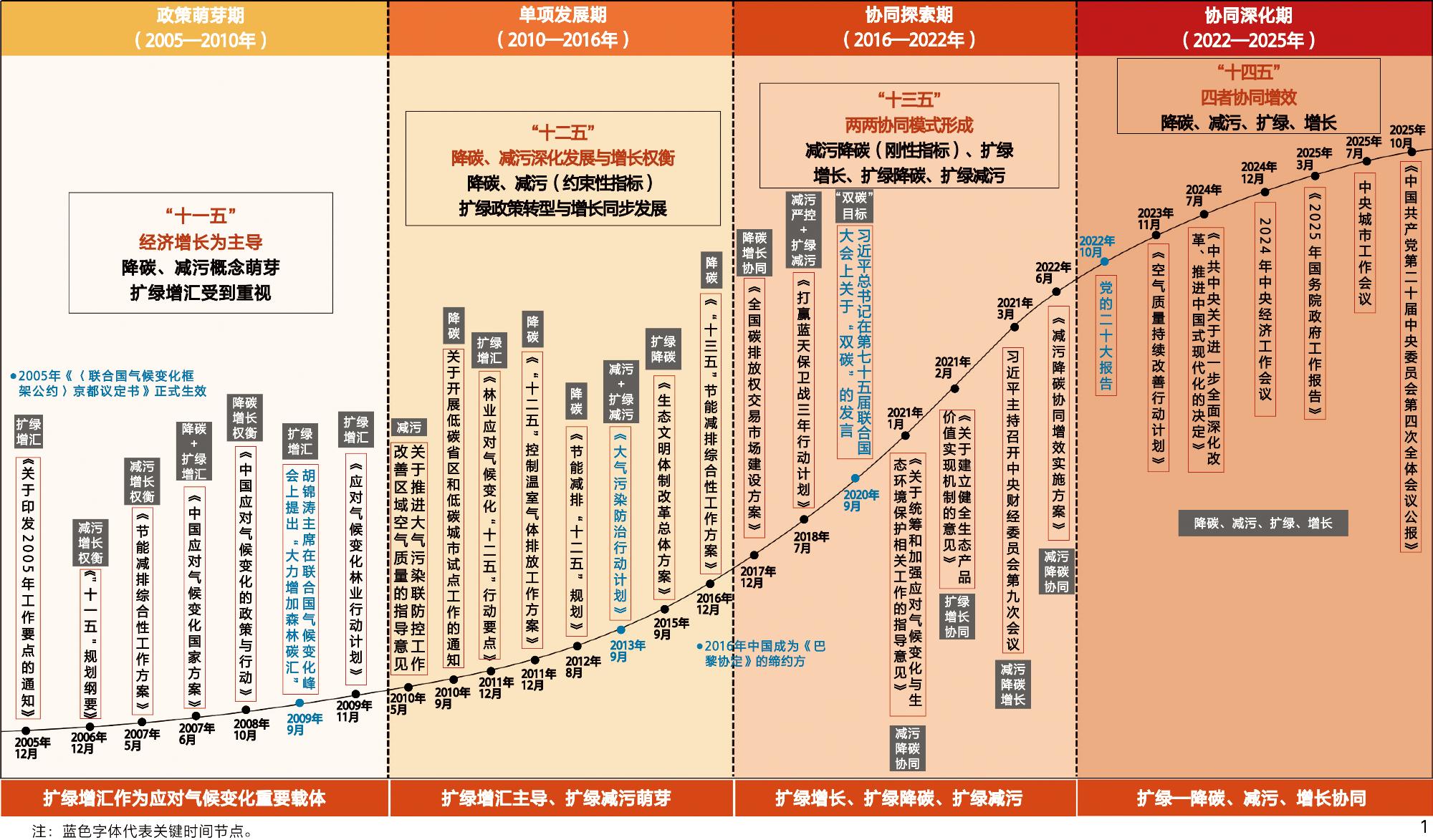
| 2022年10月 | 党的二十大报告 | “统筹产业结构调整、污染治理、生态保护、应对气候变化,协同推进降碳、减污、扩绿、增长”[1] |
| 2023年12月 | 国务院《空气质量持续改善行动计划》 | “协同推进降碳、减污、扩绿、增长,以改善空气质量为核心,以降低细颗粒物(PM2.5)浓度为主线,扎实推进产业、能源、交通绿色低碳转型,加快形成绿色低碳生产生活方式”[2] |
| 2024年7月 | 二十届三中全会《中共中央关于进一步全面深化改革、推进中国式现代化的决定》 | “协同推进降碳、减污、扩绿、增长,积极应对气候变化,加快完善落实绿水青山就是金山银山理念的体制机制”[3] |
| 2024年12月 | 2024年中央经济工作会议 | “协同推进降碳减污扩绿增长,加紧经济社会发展全面绿色转型”[4] |
| 2025年3月 | 《2025年国务院政府工作报告》 | “协同推进降碳减污扩绿增长,加快经济社会发展全面绿色转型。统筹产业结构调整、污染治理、生态保护、应对气候变化”[5] |
| 2025年7月 | 中央城市工作会议 | “推动减污降碳扩绿协同增效,提升城市生物多样性”[6] |
| 2025年10月 | 《中国共产党第二十届中央委员会第四次全体会议公报》 | “牢固树立和践行绿水青山就是金山银山的理念,以碳达峰碳中和为牵引,协同推进降碳、减污、扩绿、增长,筑牢生态安全屏障,增强绿色发展动能”[7] |
| 专题学术主持人 Guest Editor of the Special | ||||
| 戴菲 DAI Fei | ||||
| 华中科技大学建筑与城市规划学院教授Professor in the School of Architecture and Urban Planning, Huazhong University of Science and Technology | ||||
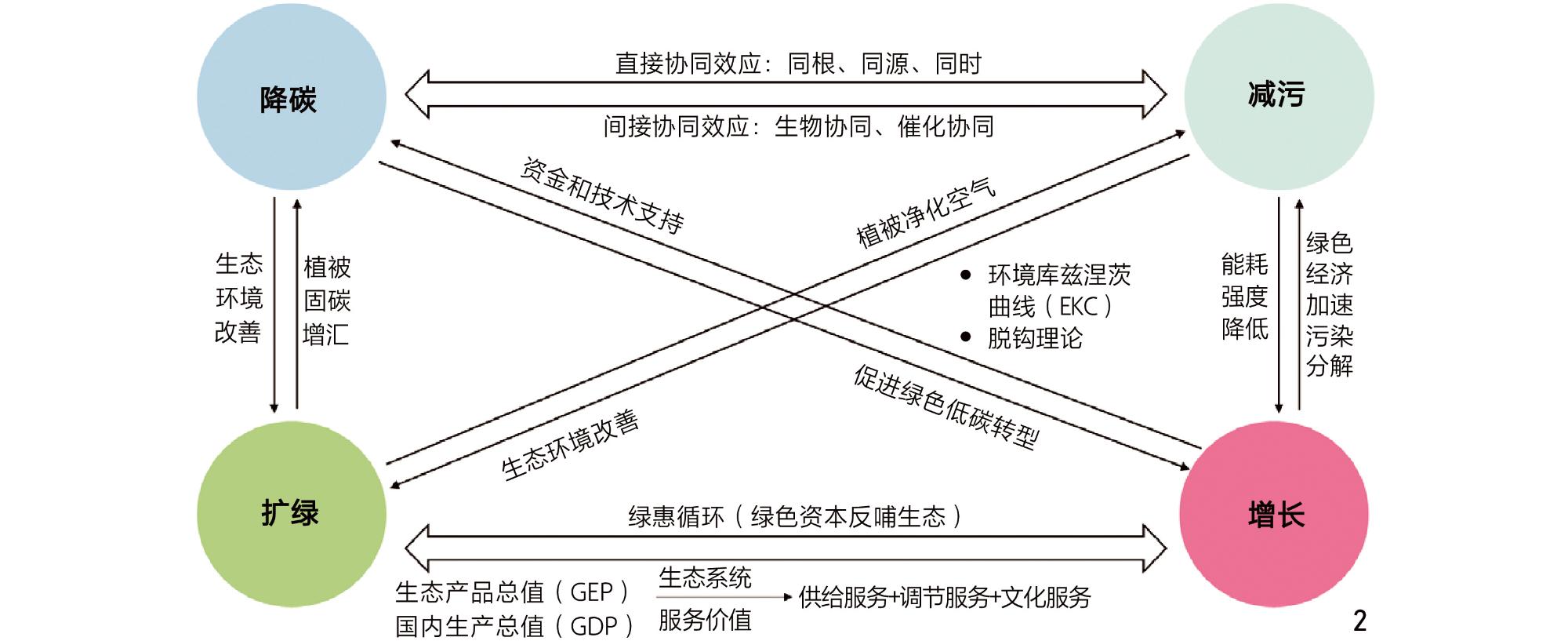
1、系统梳理2005—2025年“降碳、减污、扩绿、增长”国家政策演进及四者关联机制,揭示从单项治理到“四轮驱动”协同深化的阶段特征。
2、深入分析“降碳、减污、扩绿、增长”协同的发文趋势与学科版图,指出现有研究以环境、经济等学科为主、空间落位不足,急需风景园林学科从“扩绿”切入,推动“降碳、减污、扩绿、增长”协同增效的空间落位研究。
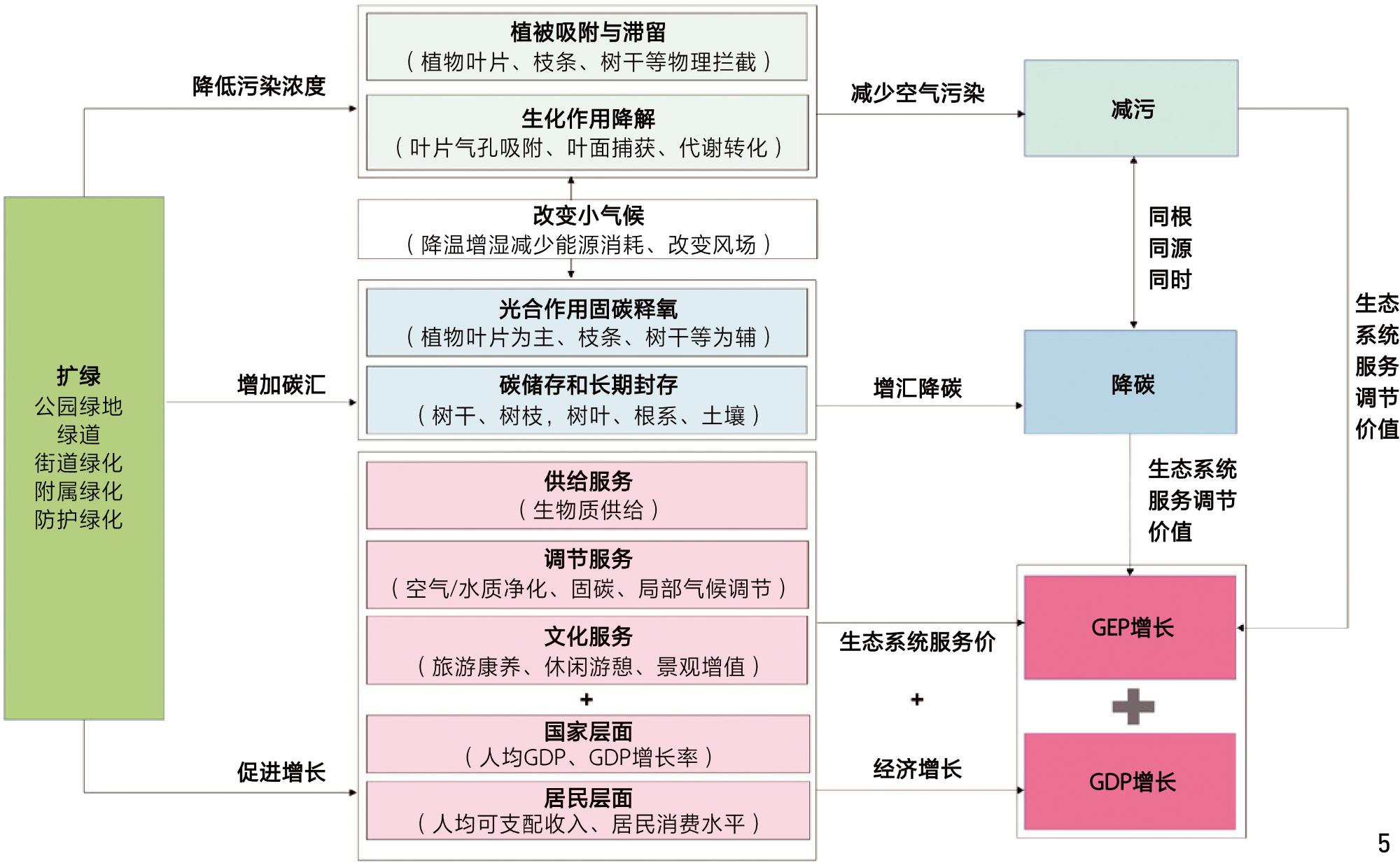
3、从风景园林学科视角构建以“扩绿”为引领的协同增效框架,系统总结绿色空间在“降碳”“减污”“增长”中的协同促进作用机理,并提出与国土空间规划多层级管控衔接的规划设计与管理方向。
| [1] |
习近平. 高举中国特色社会主义伟大旗帜 为全面建设社会主义现代化国家而团结奋斗: 在中国共产党第二十次全国代表大会上的报告[EB/OL]. (2022-10-25)[2025-09-24]. https://www.gov.cn/xinwen/2022-10/25/content_5721685.htm.
XI J P. Hold High the Great Banner of Socialism with Chinese Characteristics and Unite as One to Build a Modern Socialist Country in All Respects: Report to the 20th National Congress of the Communist Party of China[EB/OL]. (2022-10-25)[2025-09-24]. https://www.gov.cn/xinwen/2022-10/25/content_5721685.htm.
|
| [2] |
中华人民共和国国务院.关于印发《空气质量持续改善行动计划》的通知[EB/OL]. (2023-11-30)[2025-09-24]. https://www.gov.cn/gongbao/2023/issue_10886/202312/content_6921385.html.
The State Council of the People’s Republic of China. Notice on Issuing the Action Plan for Continuous Improvement of Air Quality[EB/OL].(2023-11-30)[2025-09-24]. https://www.gov.cn/gongbao/2023/issue_10886/202312/content_6921385.html.
|
| [3] |
中共中央关于进一步全面深化改革 推进中国式现代化的决定(2024年7月18日中国共产党第二十届中央委员会第三次全体会议通过)[EB/OL]. (2024-07-21)[2025-09-24]. http://www.scio.gov.cn/zdgz/jj/202407/t20240722_855895.html.
Decision of the Central Committee of the Communist Party of China on Further Comprehensively Deepening Reform and Advancing Chinese Modernization (Adopted at the Third Plenary Session of the 20th Central Committee of the Communist Party of China on July 18, 2024)[EB/OL]. (2024-07-21)[2025-09-24]. http://www.scio.gov.cn/zdgz/jj/202407/t20240722_855895.html.
|
| [4] |
坚定不移完成全年经济社会发展目标任务: 深入贯彻中央政治局会议精神做好2024年下半年经济工作[EB/OL]. (2024-07-31)[2025-09-24]. https://www.gov.cn/zhengce/202407/content_6965338.htm.
Resolutely Ensuring the Fulfillment of the Annual Economic and Social Development Goals and Tasks: Conscientiously Implementing the Spirit of the Meeting of the Political Bureau of the CPC Central Committee and Doing a Solid Job in Economic Work in the Second Half of 2024[EB/OL]. (2024-07-31)[2025-09-24]. https://www.gov.cn/zhengce/202407/content_6965338.htm.
|
| [5] |
李强.政府工作报告: 2025年3月5日在第十四届全国人民代表大会第三次会议上[EB/OL]. (2025-03-12)[2025-09-24]. https://www.gov.cn/yaowen/liebiao/202503/content_7013163.htm.
LI Q. Report on the Work of the Government: Delivered at the Third Session of the 14th National People’s Congress on March 5, 2025[EB/OL]. (2025-03-12)[2025-09-24]. https://www.gov.cn/yaowen/liebiao/202503/content_7013163.htm.
|
| [6] |
中央城市工作会议在北京举行 习近平发表重要讲话[EB/OL]. (2025-07-15)[2025-09-24]. https://www.gov.cn/yaowen/liebiao/202507/content_7032083.htm.
Central Urban Work Conference Held in Beijing; Xi Jinping Delivers an Important Address[EB/OL]. (2025-07-15)[2025-09-24]. https://www.gov.cn/yaowen/liebiao/202507/content_7032083.htm.
|
| [7] |
新华社. 中国共产党第二十届中央委员会第四次全体会议公报[EB/OL]. (2025-10-23)[2025-11-15].https://www.gov.cn/yaowen/liebiao/202510/content_7045444.htm.
Xinhua News Agency. Communiqué of the Fourth Plenary Session of the 20th Central Committee of the Communist Party of China[EB/OL]. (2025-10-23)[2025-11-15]. https://www.gov.cn/yaowen/liebiao/202510/content_7045444.htm.
|
| [8] |
UNESCO I. Charter for Landscape Architectural Education[EB/OL]. (2020-09-30)[2025-09-24]. https://www.eclas.org/wp-content/uploads.
|
| [9] |
国家环保总局. 环保总局国家统计局发布绿色国民经济核算研究成果[EB/OL]. (2006-09-07)[2025-09-25]. https://www.mee.gov.cn/gkml/sthjbgw/qt/200910/t20091023_180018.htm.
State Environmental Protection Administration. Research Findings on Green National Economic Accounting Released by SEPA and the National Bureau of Statistics[EB/OL]. (2006-09-07)[2025-09-25]. https://www.mee.gov.cn/gkml/sthjbgw/qt/200910/t20091023_180018.htm.
|
| [10] |
中华人民共和国国务院新闻办公室. 中国应对气候变化的政策与行动[EB/OL]. (2008-10-29)[2025-09-24]. https://www.gov.cn/zhengce/2008-10/29/content_2615768.htm.
The State Council Information Office of the People’s Republic of China. China’s Policies and Actions for Addressing Climate Change[EB/OL]. (2008-10-29)[2025-09-24]. https://www.gov.cn/zhengce/2008-10/29/content_2615768.htm.
|
| [11] |
中华人民共和国国务院. 国务院关于印发大气污染防治行动计划的通知[EB/OL]. (2013-09-10)[2025-09-24]. https://www.gov.cn/gongbao/content/2013/content_2496394.htm.
The State Council of the People’s Republic of China. Notice of the State Council on Issuing the Action Plan for the Prevention and Control of Air Pollution[EB/OL]. (2013-09-10)[2025-09-24]. https://www.gov.cn/gongbao/content/2013/content_2496394.htm.
|
| [12] |
中华人民共和国国务院. 中共中央国务院印发《生态文明体制改革总体方案》[EB/OL]. (2015-09-21)[2025-09-24]. https://www.gov.cn/gongbao/content/2015/content_2941157.htm.
The State Council of the People’s Republic of China. The CPC Central Committee and the State Council Issue the Overall Plan for the Reform of the Ecological Civilization System[EB/OL]. (2015-09-21)[2025-09-24]. https://www.gov.cn/gongbao/content/2015/content_2941157.htm.
|
| [13] |
中华人民共和国国务院. 国务院关于印发“十三五”节能减排综合工作方案的通知[EB/OL]. (2016-12-20)[2025-09-24].https://www.gov.cn/zhengce/content/2017-01/05/content_5156789.htm.
The State Council of the People’s Republic of China. Circular of the State Council on Printing and Distributing the Comprehensive Work Plan for Energy Conservation and Emission Reduction During the 13th Five-Year Plan Period[EB/OL]. (2016-12-20)[2025-09-24]. https://www.gov.cn/zhengce/content/2017-01/05/content_5156789.htm.
|
| [14] |
中华人民共和国国务院. 国务院印发《打赢蓝天保卫战三年行动计划》[EB/OL]. (2018-07-03)[2025-09-24]. https://www.gov.cn/xinwen/2018-07/03/content_5303212.htm.
The State Council of the People’s Republic of China. The State Council Issues the Three-Year Action Plan for Winning the Blue Sky Defense Battle[EB/OL]. (2018-07-03)[2025-09-24]. https://www.gov.cn/xinwen/2018-07/03/content_5303212.htm.
|
| [15] |
中华人民共和国生态环境部. 生态环境部印发《关于统筹和加强应对气候变化与生态环境保护相关工作的指导意见》[EB/OL]. (2021-01-11)[2025-09-24]. https://www.mee.gov.cn/xxgk2018/xxgk/xxgk03/202101/t20210113_817221.html.
Ministry of Ecology and Environment of the People’s Republic of China. The Ministry of Ecology and Environment Issues the Guiding Opinions on Coordinating and Strengthening Work Related to Climate Change Response and Ecological and Environmental Protection[EB/OL]. (2021-01-11)[2025-09-24]. https://www.mee.gov.cn/xxgk2018/xxgk/xxgk03/202101/t20210113_817221.html.
|
| [16] |
国家能源局生态环境部, 国家发展和改革委员会, 工业和信息化部, 住房和城乡建设部. 关于印发《减污降碳协同增效实施方案》的通知[EB/OL]. (2022-06-10)[2025-09-24]. https://www.gov.cn/zhengce/zhengceku/2022-06/17/content_5696364.htm.
National Energy Administration, Ministry of Ecology and Environment, National Development and Reform Commission, Ministry of Industry and Information Technology, and Ministry of Housing and Urban-Rural Development. Notice on Issuing the Implementation Plan for Synergistic Enhancement of Pollution Reduction and Carbon Reduction[EB/OL]. (2022-06-10)[2025-09-24]. https://www.gov.cn/zhengce/zhengceku/2022-06/17/content_5696364.htm.
|
| [17] |
胡剑波, 周宗康, 李潇潇. 中国降碳减污扩绿增长的时空分异及收敛性研究[J]. 长江流域资源与环境, 2025, 34(1): 166-180.
HU J B, ZHOU Z K, LI X X. Spatial-Temporal Differentiation and Convergence of Cutting Carbon Dioxide Emissions, Reducing Pollution, Expanding Green Development and Pursuing Economic Growth in China[J]. Resources and Environment in the Yangtze Basin, 2025, 34(1): 166-180.
|
| [18] |
欧阳志远, 史作廷, 石敏俊, 等. “碳达峰碳中和”: 挑战与对策[J]. 河北经贸大学学报, 2021, 42(5): 1-11.
OUYANG Z Y, SHI Z T, SHI M J, et al. Challenges and Countermeasures of “Carbon Peak and Carbon Neutrality”[J]. Journal of Hebei University of Economics and Business, 2021, 42(5): 1-11.
|
| [19] |
姜华, 阳平坚, 高健. 贯彻落实习近平总书记“四个一”部署要求构建减污降碳协同的制度体系[J]. 环境保护, 2021(17): 57-60.
JIANG H, YANG P J, GAO J. Implementing General Secretary Xi Jinping’s “Four Ones” Deployment Requirements and Building a Collaborative System of Pollution Reduction and Carbon Reduction[J]. Environmental Protection, 2021(17): 57-60.
|
| [20] |
庄贵阳, 王思博. 协同推进降碳减污扩绿增长: 内涵、挑战及应对[J]. 城市与环境研究, 2023(2): 45-55.
ZHUANG G Y, WANG S B. Achieving Synergy in Cutting Carbon Dioxide Emissions, Reducing Pollution, Expanding Green Development and Pursuing Economic Growth: The Connotation, Challenges and Response[J]. Urban and Environmental Studies, 2023(2): 45-55.
|
| [21] |
中国经济增长前沿课题组, 张鹏, 张平, 等. 绿色优先战略下的增长路径探索与治理实践[J]. 经济研究, 2022, 57(9): 27-45.
Research Group of China Economic Growth Frontier, ZHANG P, ZHANG P, et al. Exploration and Governance Practice of China’s Growth Path Under the Green-Development Strategy[J]. Economic Research Journal, 2022, 57(9): 27-45.
|
| [22] |
薛英岚, 曹东, 张静, 等.基于文献计量的降碳、减污、扩绿和增长协同发展研究进展与展望[J/OL].环境科学, 2025: 1-30.(2025-04-02)[2025-07-08].https://link.cnki.net/doi/10.13227/j.hjkx.202411296.
XUE Y L, CAO D, ZHANG J, et al. Research Progress and Prospect of Coordinated Development of Carbon Reduction, Pollution Reduction, Greening and Growth Based on Bibliometrics[J/OL]. Environmental Science, 2025: 1-30. (2025-04-02)[2025-07-08]. https://link.cnki.net/doi/10.13227/j.hjkx.202411296.
|
| [23] |
崔新蕾, 王冉冉. 中国降碳-减污-扩绿-增长协同发展空间关联网络特征及影响因素研究[J]. 环境科学研究, 2024, 37(7): 1446-1457.
CUI X L, WANG R R. Research on the Spatial Correlation Network Characteristics and Influencing Factors of Coordinated Development of Carbon Emission Reduction-Pollution Reduction-Green Expansion-Economic Growth in China[J]. Research of Environmental Sciences, 2024, 37(7): 1446-1457.
|
| [24] |
欧阳志云, 林亦晴, 宋昌素. 生态系统生产总值(GEP)核算研究: 以浙江省丽水市为例[J]. 环境与可持续发展, 2020, 45(6): 80-85.
OUYANG Z Y, LIN Y Q, SONG C S. Research on Gross Ecosystem Product (GEP): Case Study of Lishui City, Zhejiang Province[J]. Environment and Sustainable Development, 2020, 45(6): 80-85.
|
| [25] |
崔新蕾, 王艳融, 马艳茹. 黄河流域降碳-减污-扩绿-增长耦合协调的动态演进及其影响因素[J]. 水土保持研究, 2024, 31(4): 275-287.
CUI X L, WANG Y R, MA Y R. Dynamic Evolution of Carbon Reduction-Pollution Reduction-Green Expansion-Economic Growth Coupling Coordination and Its Influencing Factors in the Yellow River Basin[J]. Research of Soil and Water Conservation, 2024, 31(4): 275-287.
|
| [26] |
曾穗平, 王琦琦, 田健. 基于减污降碳协同增效的国土空间规划理论、技术体系与实践路径[J]. 西部人居环境学刊, 2025, 40(4): 16-22.
ZENG S P, WANG Q Q, TIAN J. Territorial Space Planning Based on Synergetic Control of Atmospheric Pollution and Carbon Emission: Planning Theory, Technical System and Implementation Path[J]. Journal of Human Settlements in West China, 2025, 40(4): 16-22.
|
| [27] |
刘世锦, 赵勇, 刘耕源. 降碳减污扩绿增长: “四位一体”评估框架及测度[J]. 生态文明研究, 2024, 11(3): 21-41.
LIU S J, ZHAO Y, LIU G Y. The Synergistic Effect of Carbon Reduction, Pollution Abatement, Green Expansion and Economic Growth: A New “Four in One” Evaluation Framework and Measurement Method[J]. Journal of Eco-Civilization Studies, 2024, 11(3): 21-41.
|
| [28] |
YI M, WANG Y Q, SHENG M Y, et al. Effects of Heterogeneous Technological Progress on Haze Pollution: Evidence from China[J]. Ecological Economics, 2020, 169: 106533.
|
| [29] |
周正柱, 王俊龙. 环境库兹涅茨曲线假说检验研究进展与展望[J]. 中国农业资源与区划, 2020, 41(1): 185-193.
ZHOU Z Z, WANG J L. Research Progress and Implication About Hypothesis Test of Environmental Kuznets Curve[J]. Chinese Journal of Agricultural Resources and Regional Planning, 2020, 41(1): 185-193.
|
| [30] |
司明倩, 穆艳. 基于GGE双标图的不同绿地植物固碳降温效益比较[J]. 应用生态学报, 2025, 36(3): 682-692.
SI M Q, MU Y. Comparison of Carbon Sequestration and Cooling Benefits of Plants in Different Landscaped Green Sites Based on GGE Biplot[J]. Chinese Journal of Applied Ecology, 2025, 36(3): 682-692.
|
| [31] |
王晶懋, 王一凡, 张涛, 等. 城市街区单元绿地空间格局与植物群落碳汇效益优化研究[J]. 风景园林, 2024, 31(6): 37-45.
WANG J M, WANG Y F, ZHANG T, et al. Research on Spatial Pattern of Green Space in Urban Block Units and Optimization of Carbon Sink Benefits of Plant Communities[J]. Landscape Architecture, 2024, 31(6): 37-45.
|
| [32] |
托马斯·A·克拉克. 山地森林的碳捕获潜力: 从全球角度看地方景观的韧性[J]. 风景园林, 2021, 28(7): 54-68.
CLARK T A. The Potential of Mountain Forests in Carbon Capture: A Global Perspective on Local Landscape Resilience[J]. Landscape Architecture, 2021, 28(7): 54-68.
|
| [33] |
JANHÄLL S. Review on Urban Vegetation and Particle Air Pollution: Deposition and Dispersion[J]. Atmospheric Environment, 2015, 105: 130-137.
|
| [34] |
国家统计局, 国家发展和改革委员会. 关于印发《生态产品总值核算规范(试行)》的通知发改基础[2022]481号[EB/OL]. (2022-10-21)[2025-09-25]. https://zglsxy.lsu.edu.cn/2022/1021/c2743a321837/page.htm.
National Bureau of Statistics, National Development and Reform Commission. Notice on Printing and Distributing the Norms for Gross Ecosystem Product (GEP) Accounting (Trial)[EB/OL] (2022-10-21)[2025-09-25]. https://zglsxy.lsu.edu.cn/2022/1021/c2743a321837/page.htm.
|
| [35] |
高等学校风景园林学科专业指导委员会编制.高等学校风景园林本科指导性专业规范: 2013年版[M].北京: 中国建筑工业出版社, 2013: 1-14.
Steering Committee of Landscape Architecture in Colleges and Universities. Guiding Professional Specification for Undergraduate Landscape Architecture in Colleges and Universities: 2013 Edition[M]. Beijing: China Architecture & Building Press, 2013.
|
| [36] |
戴菲, 李高钰, 汪云, 等. 国土空间生态修复规划与风景园林的角色担当[J]. 中国园林, 2025, 41(2): 6-14.
DAI F, LI G Y, WANG Y, et al. National Spatial Ecological Restoration Planning and the Role of Landscape Architecture[J]. Chinese Landscape Architecture, 2025, 41(2): 6-14.
|
| [37] |
李雪, 李文, 石淞. 不同网格尺度下哈尔滨市绿色空间碳储量和景观格局关联[J]. 环境科学, 2025, 46(11): 7094-7105.
LI X, LI W, SHI S. Correlation Between Green Space Carbon Storage and Landscape Pattern at Different Grid Scales in Harbin[J]. Environmental Science, 2025, 46(11): 7094-7105.
|
| [38] |
陈明, 戴菲, 傅凡, 等. 大气颗粒物污染视角下的城市街区健康规划策略[J]. 中国园林, 2019, 35(6): 34-38.
CHEN M, DAI F, FU F, et al. Health Planning of Urban Blocks from the Perspective of Particulate Matter Pollution[J]. Chinese Landscape Architecture, 2019, 35(6): 34-38.
|
| [39] |
姚晓洁, 杨思嘉, 陈璐. 宿州市城市绿地生态服务价值评价及动态变化特征分析[J]. 中北大学学报(自然科学版), 2023, 44(2): 146-153.
YAO X J, YANG S J, CHEN L. Evaluation of Urban Green Space Ecological Service Value and Analysis of Dynamic Change Characteristics in Suzhou City[J]. Journal of North University of China (Natural Science Edition), 2023, 44(2): 146-153.
|
| [40] |
TAO P Y, LIN Y, WANG X, et al. Optimization of Green Spaces in Plain Urban Areas to Enhance Carbon Sequestration[J]. Land, 2023, 12(6): 1218.
|
| [41] |
BI S B, CHEN M, DAI F. The Impact of Urban Green Space Morphology on PM2.5 Pollution in Wuhan, China: A Novel Multiscale Spatiotemporal Analytical Framework[J]. Building and Environment, 2022, 221: 109340.
|
| [42] |
苏芳, 郑亚萍, 阚立娜, 等. 基于CVM调查法评估城市公共绿地服务价值: 以西部省会城市为例[J]. 长江流域资源与环境, 2018, 27(11): 2434-2442.
SU F, ZHENG Y P, KAN L N, et al. Evaluation of Services Value of Public Green Space in Provincial Capitals of Urban Agglomeration in Western China[J]. Resources and Environment in the Yangtze Basin, 2018, 27(11): 2434-2442.
|
| [43] |
王宏达.北京市中心城区绿色空间碳汇功能时空演变及优化研究[D].北京: 北京林业大学, 2022.
WANG H D. Study on the Spatiotemporal Evolution and Optimization of Carbon Sink Function[D]. Beijing: Beijing Forestry University, 2022.
|
| [44] |
刘媛媛.基于雾霾影响下的城市空间重构研究: 以郑州市为例[D].长春: 吉林建筑大学, 2016.
LIU Y Y. The Research of Urban Space Reconstruction Based on the Influence of the Fog Haze: A Case Study of Zhengzhou[D]. Changchun: Jilin Jianzhu University, 2016.
|
| [45] |
潘远珍, 袁兴中, 刘红, 等. 重庆梁平区景观格局演变对生态系统服务价值的影响[J]. 园林, 2021, 38(4): 81-88.
PAN Y Z, YUAN X Z, LIU H, et al. Impact of Landscape Pattern Change on Ecosystem Service Value in Liangping, Chongqing[J]. Landscape Architecture, 2021, 38(4): 81-88.
|
| [46] |
武文婷, 夏国元, 包志毅. 杭州市城市绿地固碳释氧价值量评估[J]. 中国园林, 2016, 32(3): 117-121.
WU W T, XIA G Y, BAO Z Y. The Assessment of the Carbon Fixation and Oxygen Release Value of the Urban Green Space in Hangzhou[J]. Chinese Landscape Architecture, 2016, 32(3): 117-121.
|
| [47] |
戴菲, 邓瑛, 陈明, 等. 基于ENVI-met模拟的不同用地类型居住小区绿地布局对PM2.5的影响[J]. 风景园林, 2021, 28(12): 70-76.
DAI F, DENG Y, CHEN M, et al. Effects of Green Space Layout on PM2.5 in Different Types of Residential Areas Based on ENVI-met Simulation[J]. Landscape Architecture, 2021, 28(12): 70-76.
|
| [48] |
刘杰, 张浪, 余浩然. 社会-生态效益权衡下上海市中心城区绿地生态网络多情景模拟[J]. 中国园林, 2025, 41(5): 100-107.
LIU J, ZHANG L, YU H R. Multi-Scenario Simulation of Green Space Ecological Network in Downtown Shanghai Under Social-Ecological Benefit Trade-Offs[J]. Chinese Landscape Architecture, 2025, 41(5): 100-107.
|
| [49] |
TIMILSINA N, BECK J L, EAMES M S, et al. A Comparison of Local and General Models of Leaf Area and Biomass of Urban Trees in USA[J]. Urban Forestry & Urban Greening, 2017, 24: 157-163.
|
| [50] |
吴松泽.基于生态-社会功能的城市绿地质量及优化配置研究: 以长春市主城区为例[D].长春: 吉林大学, 2024.
WU S Z. Study on the Quality and Optimal Allocation of Urban Green Space Based on Ecological-Social Functions: A Case Study of the Main Urban Area of Changchun[D]. Changchun: Jilin University, 2024.
|
| [51] |
袁旸洋, 郭蔚, 汤思琪, 等. 城市蓝绿空间格局对碳固存的影响测度及关键指标[J]. 中国城市林业, 2023, 21(6): 6-16.
YUAN Y Y, GUO W, TANG S Q, et al. Assessing the Impact of Urban Blue-Green Space Pattern on Carbon Sequestration and Its Key Indicators[J]. Journal of Chinese Urban Forestry, 2023, 21(6): 6-16.
|
| [52] |
REN Z B, ZHENG H F, HE X Y, et al. Changes in Spatio-Temporal Patterns of Urban Forest and Its Above-Ground Carbon Storage: Implication for Urban CO2 Emissions Mitigation Under China’s Rapid Urban Expansion and Greening[J]. Environment International, 2019, 129: 438-450.
|
| [53] |
汤煜, 石铁矛, 卜英杰, 等. 城市绿地碳储量估算及空间分布特征[J]. 生态学杂志, 2020, 39(4): 1387-1398.
TANG Y, SHI T M, BU Y J, et al. Estimation and Spatial Distribution of Carbon Storage in Urban Greenspace[J]. Chinese Journal of Ecology, 2020, 39(4): 1387-1398.
|
| [54] |
HONG G, TAN C D, QIN L Y, et al. Identification of Priority Areas for UGI Optimisation Under Carbon Neutrality Targets: Perspectives from China[J]. Ecological Indicators, 2023, 148: 110045.
|
| [55] |
杨鑫, 高雯雯, 李莎, 等. 基于遥感影像估算的北京中心城区碳储量与气候环境关联性研究[J]. 风景园林, 2022(5): 31-37.
YANG X, GAO W W, LI S, et al. Research on Correlation Between Carbon Storage Estimation Based on Remote Sensing Image and Climate Environment in Central Urban Area of Beijing[J]. Landscape Architecture, 2022(5): 31-37.
|
| [56] |
LIN J, MA Q, JU Y, et al. Relationships Between Urbanization, Tree Morphology, and Carbon Density: An Integration of Remote Sensing, Allometric Models, and Field Survey[J]. Urban Forestry & Urban Greening, 2022, 76: 127725.
|
| [57] |
刘秀萍, 赵松婷, 李新宇, 等. 北京中心城区公园绿地固碳能力及驱动因素研究[J]. 风景园林, 2025, 32(1): 32-40.
LIU X P, ZHAO S T, LI X Y, et al. Research on Carbon Sequestration Capacity of Urban Park Green Space in the Central Urban Area of Beijing and Driving Factors Thereof[J]. Landscape Architecture, 2025, 32(1): 32-40.
|
| [58] |
王敏, 石乔莎. 城市高密度地区绿色碳汇效能评价指标体系及实证研究: 以上海市黄浦区为例[J]. 中国园林, 2016, 32(8): 18-24.
WANG M, SHI Q S. Evaluation Index System and Empirical Study on Green Carbon Sequestration Efficiency in Urban High Density Area: A Case Study of Shanghai Huangpu District[J]. Chinese Landscape Architecture, 2016, 32(8): 18-24.
|
| [59] |
张浪. 构建城市市域生态网络系统[J]. 园林, 2019, 36(6): 1.
ZHANG L. Constructing Urban Ecological Network System[J]. Landscape Architecture, 2019, 36(6): 1.
|
| [60] |
LIU Y, YANG Q S, DUAN L C. Adjusting the Structure Combinations of Plant Communities in Urban Greenspace Reduced the Maintenance Energy Consumption and GHG Emissions[J]. Journal of Environmental Engineering and Landscape Management, 2018, 26(4): 261-274.
|
| [61] |
王敏, 石乔莎. 城市绿色碳汇效能影响因素及优化研究[J]. 中国城市林业, 2015, 13(4): 1-5.
WANG M, SHI Q S. A Study of Influencing Factors to Urban Green Carbon Sequestration and Its Efficiency Optimization[J]. Journal of Chinese Urban Forestry, 2015, 13(4): 1-5.
|
| [62] |
BELAIRE J A, HIGGINS C, ZOLL D, et al. Fine-Scale Monitoring and Mapping of Biodiversity and Ecosystem Services Reveals Multiple Synergies and few Tradeoffs in Urban Green Space Management[J]. Science of the Total Environment, 2022, 849: 157801.
|
| [63] |
戴菲, 陈明, 朱晟伟, 等. 街区尺度不同绿化覆盖率对PM10、PM2.5的消减研究: 以武汉主城区为例[J]. 中国园林, 2018, 34(3): 105-110.
DAI F, CHEN M, ZHU S W, et al. Effects of Different Green Coverage in Block Scale on PM10 and PM2.5 Removal: A Case Study of the Main City of Wuhan[J]. Chinese Landscape Architecture, 2018, 34(3): 105-110.
|
| [64] |
陈明, 戴菲. 城市街区植物绿量及对PM2.5的调节效应: 以武汉市为例[C]//中国风景园林学会. 中国风景园林学会2018年会论文集. 北京: 建筑工业出版社, 2018: 340-345.
CHEN M, DAI F. Vegetation Quantity in Urban Blocks and Its Regulating Effects on PM2.5: A Case Study of Wuhan[C]// Chinese Society of Landscape Architecture. Proceedings of the 2018 Annual Conference of the Chinese Society of Landscape Architecture. Beijing: China Architecture & Building Press, 2018: 340-345.
|
| [65] |
CHEN M, REN Z Y, BI S B. Impact of Green Space Patterns on PM2.5 Levels: A Local Climate Zone Perspective[J]. Journal of Cleaner Production, 2024, 478: 143975.
|
| [66] |
雷雅凯, 段彦博, 马格, 等. 城市绿地景观格局对PM2.5、PM10分布的影响及尺度效应[J]. 中国园林, 2018, 34(7): 98-103.
LEI Y K, DUAN Y B, MA G, et al. Influence of Urban Green Landscape Pattern on the Concentration of PM2.5/PM10 and Scale Effect in Zhengzhou, China[J]. Chinese Landscape Architecture, 2018, 34(7): 98-103.
|
| [67] |
LI K M, LI C L, LIU M, et al. Multiscale Analysis of the Effects of Urban Green Infrastructure Landscape Patterns on PM2.5 Concentrations in an Area of Rapid Urbanization[J]. Journal of Cleaner Production, 2021, 325: 129324.
|
| [68] |
马西娜, 李金铭, 王梦媱, 等. 高密度城区绿地景观格局对PM2.5/O3的多尺度影响[J]. 西安建筑科技大学学报(自然科学版), 2024, 56(1): 120-130.
MA X N, LI J M, WANG M Y, et al. Multi-Scale Effects of High-Density Urban Green Space Landscape Pattern on PM2.5 and O3[J]. Journal of Xi’an University of Architecture & Technology (Natural Science Edition), 2024, 56(1): 120-130.
|
| [69] |
左长安, 邢丛丛, 董睿, 等.伦敦雾霾控制历程中的城市规划与环境立法[J].城市规划, 2014, 38(9): 51-56, 63.
ZUO C A, XING C C, DONG R, et al. Urban Planning and Environmental Legislation in the Process of London Haze Control[J]. City Planning Review, 2014, 38(9): 51-56, 63.
|
| [70] |
陈宇峰.基于气候特异性的北京城区楔形绿地体系构建[D].北京: 北京林业大学, 2015.
CHEN Y F. The Establishment of the Wedged Greenland System of the Urban Area of Beijing in View of Climatic Specificity[D]. Beijing: Beijing Forestry University, 2015.
|
| [71] |
江晨阳.韶山风环境及城市植被对PM2.5浓度影响的研究[D].长沙: 湖南大学, 2019.
JIANG C Y. Research on the Influence of Wind Environment and Urban Vegetation on PM2.5 Concentration in Shaoshan City[D]. Changsha: Hunan University, 2019.
|
| [72] |
徐阳洋, 李运远, 胡楠. 风环境视角下校园道路群落对PM10的滞尘效应及优化研究[J]. 城市建筑, 2024(9): 218-223.
XU Y Y, LI Y Y, HU N. Study on Dust Retention Effect and Optimization of Campus Road Verge Vegetation on PM10 in Wind Environment[J]. Urbanism and Architecture, 2024(9): 218-223.
|
| [73] |
LIN Y, YANG X Y, LI Y N, et al. The Effect of Forest on PM2.5 Concentrations: A Spatial Panel Approach[J]. Forest Policy and Economics, 2020, 118: 102261.
|
| [74] |
赵红斌, 刘晖. 盆地城市通风廊道营建方法研究: 以西安市为例[J]. 中国园林, 2014, 30(11): 32-35.
ZHAO H B, LIU H. Research on the Methods of Building Ventilation Corridors Among Basin Cities: Taking the City of Xi’an as the Example[J]. Chinese Landscape Architecture, 2014, 30(11): 32-35.
|
| [75] |
傅凡, 赵彩君, 孙玉红, 等. 园林绿地秋季温湿度与细颗粒物(PM2.5)浓度的关系研究: 以北京玉渊潭公园为例[J]. 中国园林, 2018, 34(4): 36-40.
FU F, ZHAO C J, SUN Y H, et al. Study on the Relationship Between Temperature, Humidity and Particular Matters in Green Spaces in Autumn: A Case Study of Yuyuantan Park, Beijing[J]. Chinese Landscape Architecture, 2018, 34(4): 36-40.
|
| [76] |
李江苏, 段良荣, 张天娇. 中国城市PM2.5和PM10时空分布特征和影响因素分析[J]. 环境科学, 2024, 45(4): 1938-1949.
LI J S, DUAN L R, ZHANG T J. Analysis of Spatio-temporal Distribution Characteristics and Influencing Factors of PM2.5 and PM10 in Chinese Cities[J]. Environmental Science, 2024, 45(4): 1938-1949.
|
| [77] |
徐安祺, 初步天, 肖湘东, 等. 基于PM2.5消减的街旁绿地植物空间配置模式研究: 以苏州工业园区为例[J]. 中国园林, 2023, 39(2): 90-95.
XU A Q, CHU B T, XIAO X D, et al. Spatial Pattern of Plants in Streetside Green Space Based on PM2.5 Reduction: A Case Study of Suzhou Industrial Park[J]. Chinese Landscape Architecture, 2023, 39(2): 90-95.
|
| [78] |
闫珊珊, 洪波. 公园绿地不同景观空间PM2.5分布特征及其影响因素研究[J]. 风景园林, 2019, 26(7): 101-106.
YAN S S, HONG B. PM2.5 Concentration Distribution Characteristics in Different Landscape Spaces and Influencing Factors in Urban Park[J]. Landscape Architecture, 2019, 26(7): 101-106.
|
| [79] |
MATOS P, VIEIRA J, ROCHA B, et al. Modeling the Provision of Air-Quality Regulation Ecosystem Service Provided by Urban Green Spaces Using Lichens as Ecological Indicators[J]. Science of the Total Environment, 2019, 665: 521-530.
|
| [80] |
张子墨, 赵丹, 加雨灵, 等. 基于多维效益的北京市国土空间生态修复规划实施评估[J]. 生态学报, 2025, 45(19): 9565-9576.
ZHANG Z M, ZHAO D, JIA Y L, et al. Implementation Evaluation of Spatial Ecological Restoration Plan Based on Multi-dimensional Benefits in Beijing[J]. Acta Ecologica Sinica, 2025, 45(19): 9565-9576.
|
| [81] |
黎佳君, 廖秋林, 沈守云, 等. 长株潭城市群绿心地区生态系统服务价值时空变化研究[J]. 中国园林, 2022, 38(1): 100-105.
LI J J, LIAO Q L, SHEN S Y, et al. Study on the Spatiotemporal Changes of Land Use and Ecosystem Services Value (ESV) of the Green Heart Area in the Changsha-Zhuzhou-Xiangtan (CZT) City Group[J]. Chinese Landscape Architecture, 2022, 38(1): 100-105.
|
| [82] |
马赫, 延相东. 呼和浩特市中心城区景观格局及生态系统服务价值研究[J]. 西南林业大学学报(自然科学), 2022, 42(3): 171-177.
MA H, YAN X D. Landscape Pattern and Ecosystem Service Value of Central Urban Area of Hohhot[J]. Journal of Southwest Forestry University (Natural Sciences), 2022, 42(3): 171-177.
|
| [83] |
康瑛, 赵文力, 胡佳, 等. 成都环城生态公园土地综合整治与生态修复对生态系统生产总值(GEP)的影响[J]. 现代城市研究, 2023, 38(1): 21-27.
KANG Y, ZHAO W L, HU J, et al. The Impact of Comprehensive Land Improvement and Ecological Restoration in Ecological Belt Surrounding the Chengdu City on the Gross Ecosystem Product (GEP)[J]. Modern Urban Research, 2023, 38(1): 21-27.
|
| [84] |
郑博福, 黄琼瑶, 陶林, 等. 赣南地区景观格局变化及其对生态系统服务价值的影响[J]. 生态学报, 2021, 41(15): 5940-5949.
ZHENG B F, HUANG Q Y, TAO L, et al. Landscape Pattern Change and Its Impacts on the Ecosystem Services Value in Southern Jiangxi Province[J]. Acta Ecologica Sinica, 2021, 41(15): 5940-5949.
|
| [85] |
邵大伟, 吴殿鸣. 景观破碎化对生态系统服务价值的影响作用分析: 以苏州为例[J]. 长江流域资源与环境, 2020, 29(11): 2436-2449.
SHAO D W, WU D M. Analysis on the Effect of Landscape Fragmentation on Ecosystem Service Value: A Case Study of Suzhou[J]. Resources and Environment in the Yangtze Basin, 2020, 29(11): 2436-2449.
|
| [86] |
杨早, 严文超, 侯艳, 等.基于生态−社会福祉的聚落型城市公园生态系统服务价值[J/OL].应用与环境生物学报, 2025: 1-15.(2025-05-14)[2025-08-01].https://link.cnki.net/doi/10.19675/j.cnki.1006-687x.2025.01012.
YANG Z, YAN W C, HOU Y, et al. Ecosystem Service Value of Urban Parks in Settlements Based on Ecological-Social Well-Being[J/OL]. Chinese Journal of Applied and Environmental Biology, 2025: 1-15. (2025-05-14)[2025-08-01]. https://link.cnki.net/doi/10.19675/j.cnki.1006-687x.2025.01012.
|
| [87] |
刘华斌, 古新仁. 城市小微湿地特征与价值研究: 以南昌中心城区为例[J]. 中国园林, 2022, 38(3): 101-105.
LIU H B, GU X R. Characteristics and Value of Urban Wetlands: Taking the Central Area of Nanchang as the Example[J]. Chinese Landscape Architecture, 2022, 38(3): 101-105.
|
| [88] |
JO B, RICHARDS M. Eco-Gentrification and Who Benefits from Urban Green Amenities: NYC’s High Line[J]. Landscape and Urban Planning, 2020, 204: 103900.
|
| [89] |
World Bank. Cities and Climate Change: An Urgent Agenda[EB/OL].(2014-03-25)[2025-07-08]. https://openknowledge.worldbank.org/handle/10986/17385.
|
| [90] |
WHO. UN Climate Action Summit 2019: WHO Calls for Placing Health at the Heart of Climate Commitments[EB/OL]. (2019-06-01)[2025-07-08]. https://www.who.int/news/item/21-09-2019-who-manifesto-for-a-healthy-recovery-from-covid-19.
|
| [91] |
IPCC. AR6 Synthesis Report: Climate Change 2023[EB/OL]. (2023-03-20)[2025-07-08]. https://www.ipcc.ch/report/sixth-assessment-report-cycle/.
|
/
| 〈 |
|
〉 |