

山地城市崖壁景观特征及保护利用策略——以重庆两江四岸区域为例
|
李波/男/博士/重庆大学建筑城规学院副教授/重庆大学煤矿灾害动力学与控制国家重点实验室成员/重庆大学山地城镇建设与新技术教育部重点实验室成员/研究方向为景观规划与生态修复 |
|
张钰姣/女/重庆大学建筑城规学院在读硕士研究生/研究方向为景观规划与生态修复 |
|
杜春兰/女/博士/重庆大学建筑城规学院教授/重庆大学山地城镇建设与新技术教育部重点实验室成员/本刊编委/研究方向为风景园林历史与理论、风景园林规划与设计 |
收稿日期: 2023-09-08
修回日期: 2024-06-20
网络出版日期: 2025-12-17
基金资助
国家自然科学基金面上项目“鸟类廊道视角下的山地城市立体生态网络功能连接及空间干预”(52078074)
国家自然科学基金重点项目“宜居城乡景观生态规划理论与方法——以西南山地为例”(52238003)
版权
Characteristics of and Protection and Utilization Strategies for Cliff Landscapes in Mountain Cities: A Case Study of the Two Rivers and Four Banks Area in Chongqing
|
LI Bo, Ph.D., is an associate professor in the School of Architecture and Urban Planning, Chongqing University, a member of the State Key Laboratory of Coal Mine Disaster Dynamics and Control, Chongqing University, and a member of the Key Laboratory of New Technology for Construction of Cities in Mountain Area, Ministry of Education, Chongqing University. His research focuses on landscape planning and ecological restoration |
|
ZHANG Yujiao is a master student in the School of Architecture and Urban Planning, Chongqing University. Her research focuses on landscape planning and ecological restoration |
|
DU Chunlan, Ph.D., is a professor in the School of Architecture and Urban Planning, Chongqing University, and a member of the Key Laboratory of New Technology for Construction of Cities in Mountain Area, Ministry of Education, Chongqing University, and an editorial board member of this journal. Her research focuses on history and theory of landscape architecture, and landscape planning and design |
Received date: 2023-09-08
Revised date: 2024-06-20
Online published: 2025-12-17
Copyright
崖壁作为山地城市重要的地域性景观之一,在城市意象、社会生活和相关城市职能中发挥着重要作用。新时代背景下,崖壁景观的地位和角色也逐渐发生变化。崖壁景观的可持续发展于城市及其本身都具有重要意义,然而目前关于崖壁景观的系统性认知比较匮乏。
以崖壁景观分布集中的重庆两江四岸区域为例,综合运用实地调查、史料梳理、ArcGIS空间分析等手段对山地城市崖壁景观特征及保护利用途径进行深入调查和讨论。
两江四岸区域崖壁景观在总体空间分布上呈现依附山形地势与滨江临水两大特征;在空间形态上可划分为自然崖壁、人工介入崖壁,人工崖壁3种类型,自然崖壁生境类型丰富多样,人工介入崖壁和人工崖壁则相对单一;崖壁景观提供了多元复合的功能空间,是重要的人文景观载体。
从崖壁空间功能转型、周边资源整合利用和自然生境保育3个方面提出崖壁景观的可持续发展策略,为山地城市崖壁景观的保护和开发利用提供参考。
李波 , 张钰姣 , 杜春兰 . 山地城市崖壁景观特征及保护利用策略——以重庆两江四岸区域为例[J]. 风景园林, 2024 , 31(8) : 114 -121 . DOI: 10.3724/j.fjyl.202309080407
As one of the important regional landscapes in mountain cities, cliffs play a significant role in urban imagery, social life, and related urban functions. In the new era, the status and role of cliff landscapes in cities have gradually changed. The sustainable development of cliff landscapes is of great significance to both mountain cities and cliffs themselves. However, there is a lack of systematic understanding of cliff landscapes within cities, and how to protect and utilize them is an urgent issue. Currently, research on cliff landscapes at home and abroad mainly focuses on the verification of their values, the utilization of their functions, and the exploration of engineering transformation techniques, while lacking an understanding of the overall distribution pattern of cliff landscapes and the interpretation of their spatial characteristics. Overall, the current research focuses more on cliff landscapes in special landforms than on those within the scope of urban construction in mountain cities. Therefore, conducting in-depth research on cliff landscapes in mountain cities will not only help gain a deeper understanding of the uniqueness of cliff landscapes in Chongqing, but also complement and improve the research on mountainous landscapes. It also has practical value for the future protection and utilization of cliff landscapes within cities.
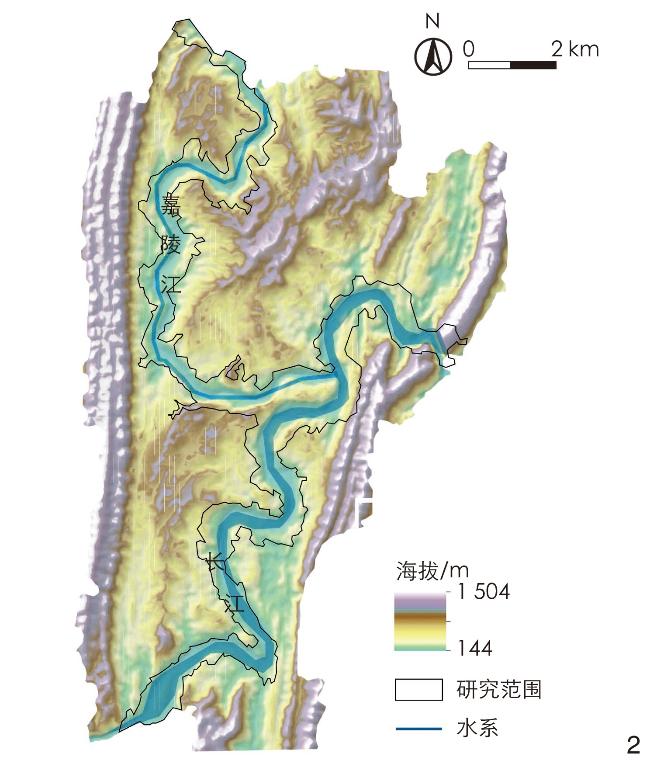
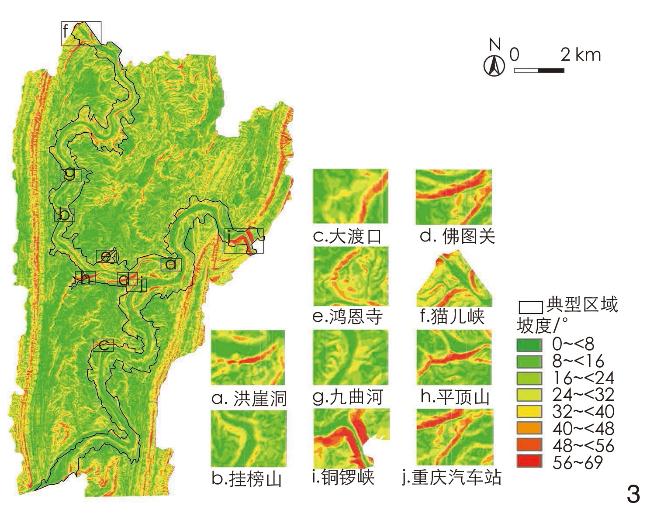
Takeing the Two Rivers and Four Banks area in Chongqing featuring the concentrated distribution of cliff landscapes as an example, this research mainly refers to relevant discussions of Zhang Genshou and Wang Xudong. It considers natural or artificial landforms with a slope greater than 60° and a height of more than 10 meters as cliffs, with steep slopes with a height greater than 10 meters being also considered part of the cliffs. Firstly, based on the slope extraction and contour analysis methods, a spatial database is established on the ArcGIS platform to identify cliff landscapes. Secondly, through literature review and field investigation, the current status of cliff landscapes in the Two Rivers and Four Banks area is deeply investigated and discussed, and key information on the types, distribution, element composition, and utilization status of cliffs in the Two Rivers and Four Banks area is summarized.
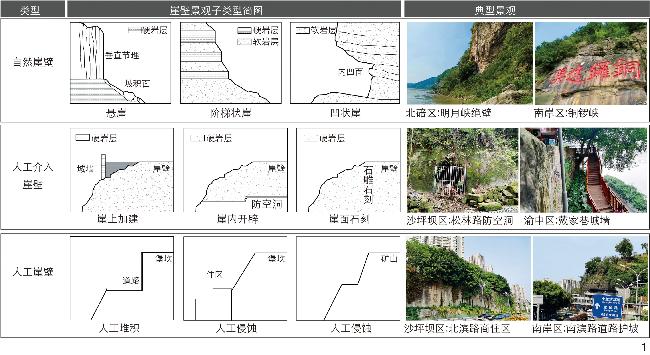
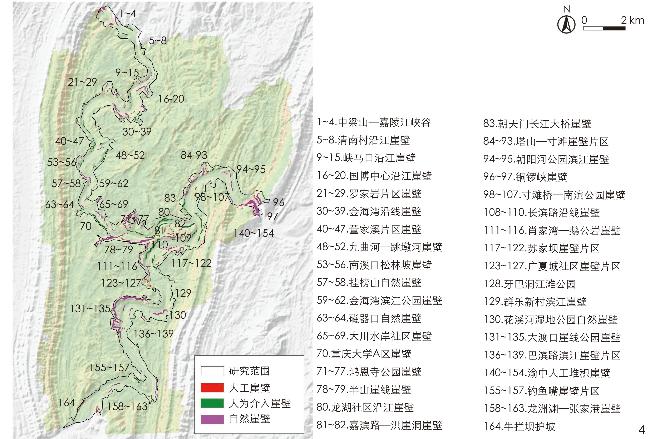
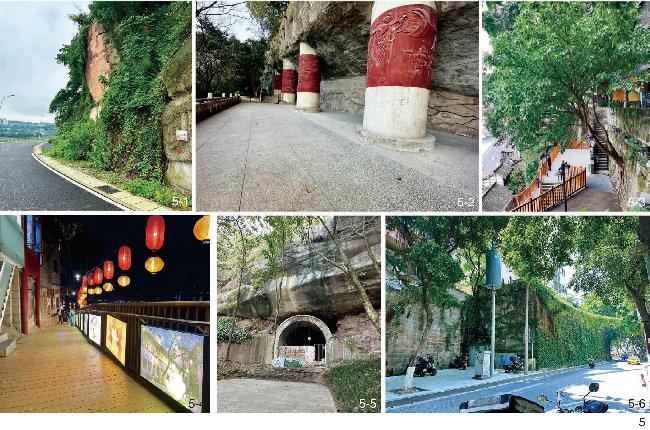
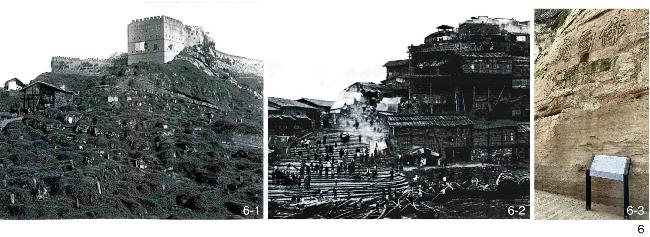
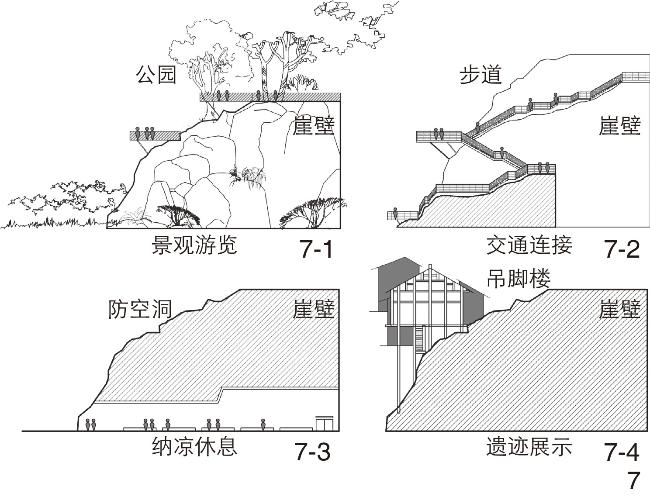
The research results indicate that the cliff landscapes in the Two Rivers and Four Banks area can be classified into three types based on their formation: natural cliffs, cliffs with human intervention, and artificial cliffs. Natural cliffs can be further divided into precipices, concave cliffs, and terraced cliffs based on their spatial forms. Cliffs with human intervention can be categorized into cliffs with construction thereon and cliffs with excavation therein. Artificial cliffs can be classified into artificially accumulated cliffs and artificially eroded cliffs. A total of 164 typical cliff landscape units are identified within the scope of the research, of which 88 ones are located on natural cliffs, 50 ones on cliffs with human intervention, and 26 ones on artificial cliffs. In terms of spatial distribution, they generally exhibit the two major characteristics of being located near mountains and water, and being adjacent to transportation routes. In terms of spatial function, they exhibit four utilization characteristics: Construction of urban defense systems based on the natural topography; construction of residential areas adapted to the mountainous terrain; development of a three-dimensional transportation system opened along the cliffs; development of various cliff lines for landscape exploration. The cultural value can be expressed from both spiritual and material perspectives. On one hand, steep cliffs are often regarded as a spiritual belief and emotional sustenance for people. On the other hand, the ancient buildings, inscriptions, and grottoes left on cliff landscape nodes demonstrate that cliff landscapes serve as an important carrier of cultural landscapes. As to habitat characteristics, natural cliffs have a rich variety of habitats, while the cliffs with human intervention and the artificial cliffs are relatively monotonous in terms of habitat type. Overall, cliff plants are dominated by spontaneous native plants, supplemented by artificially planted plants and alien invasive plants. In addition, the cliffs are of extremely high ecological value, and in different parts of the cliffs, due to differences in microhabitat conditions such as microclimate, water, light, heat, and substrate, the suitable plant species for growth also vary.
Based on the characteristics of cliff landscapes and the needs of urban development, this research identifies the protection and utilization elements of cliff landscapes, and initially puts forward three protection and utilization forms of cliff landscapes, which are mainly natural protection, cultural development and comprehensive utilization. The sustainable development strategy of cliff landscapes is proposed from three aspects: Transformation of cliff spatial functions, rational utilization of cliff resources, and management of cliff habitats. It is hoped that relevant results of this research can provide a strong scientific basis for the protection of cliff landscapes and the prevention of any further damage to such landscapes. And it is also hoped that these results can provide new perspectives and ideas for the development and utilization of cliff landscapes to maximize their economic, social and ecological benefits.
表1 “坡坎崖”概念比较Table 1 Contrast of the concepts of “steep slope, retaining wall and cliff” |
| 概念名称 | 形成方式 | 形态特征 | 坡度/° | 高度/m |
| 注:“—”表示目前没有明确的定量判断标准。 | ||||
| 坡 | 自然/人工 | 急剧升高的斜坡 | 25~35 | — |
| 坎 | 人工 | 硬质块状建筑材料砌筑的堡坎 | — | 0~15 |
| 崖 | 自然/人工 | 高而陡的岩壁 | 60~90 | >10 |
| 类别 | 朝代 | 著作 | 记载内容 |
| 方志 | 清代 | 《巴县志》[15] | “九宫庙临崖而筑……界道泉飞溜而澌,悬崖瀑布虹影垂” |
| 《乾隆·璧山县志》[17] | “挂榜山,辽望若屏” | ||
| 《重庆府志》[18] | “该峡悬崖临江下有圆石如铜锣状……统景峡两岸多石洞,遇寇警,可避兵” | ||
| 《重庆市江北区志》[19] | “渝城三面抱江,惟佛图关一线壁立万仞……两岸悬崖峭壁,俱合于温塘峡入太江” | ||
| 明代 | 《蜀中名胜记》[16] | “城西雉堞下有洞曰洪崖,覆以巨石,飞瀑时至,亦名滴水崖” | |
| 东晋 | 《华阳国志校注》[20] | “大禹挥开山斧劈之,山裂处记为铜锣峡……地势刚险,重屋垒居” | |
| 宋代 | 《舆地纪胜》[21] | “峡有关,冯当可葬其上,有圆石高悬” | |
| 图集 | 近现代 | 《老重庆影像志:老城门》[22]、《长江三峡历史地图集》[14] | 重庆城墙旧照、重庆吊脚楼旧照、长江三峡旧照 |
| 清代 | 《峡江图考》[23] | “第一部较为系统完整的三峡河道地图集” | |
| 宋代 | 《蜀川胜概图》[14] | “自岷江上游茂州至峡江掉石滩实景图绘” | |
| 书籍 | 近现代 | 《重庆通史》[2] | “鹅岭公园防空洞,位于公园正北山崖绝壁半山腰” |
| 《重庆大轰炸纪实》[24] | “1944年,重庆已有公私防空洞数千” |
| [1] |
许芗斌, 杜春兰, 赵娟. 明清时期重庆城池空间形态特征分析[J]. 中国园林, 2017, 33(4): 125-128.
XU X B, DU C L, ZHAO J. The Analysis of Spatial Morphology of Chongqing City Wall and Moat During Ming and Qing Dynasties[J]. Chinese Landscape Architecture, 2017, 33(4): 125-128.
|
| [2] |
周勇.重庆通史[M].重庆: 重庆出版社, 2002.
ZHOU Y. General History of Chongqing[M]. Chongqing Press, 2002.
|
| [3] |
刘晶晶.重庆吊脚楼建筑与文化研究[D].重庆: 重庆大学, 2015.
LIU J J. Study on Stilted Building and It’s Culture at Chongqing[D]. Chongqin: Chongqing University, 2015.
|
| [4] |
阎波, 李宗虎.山地滨水城市慢行系统设计探析: 以渝中半岛为例[J].中国园林, 2018, 34(4): 63-67.
YAN B, LI Z H. Study of Slow System Planning on Mountain City: Taking the Yuzhong Peninsula as an Example[J]. Chinese Landscape Architecture, 2018, 34(4): 63-67.
|
| [5] |
张根寿.现代地貌学[M].北京: 科学出版社, 2005.
ZHANG G S. Modern Geomorphology[M]. Beijing: Science Press, 2005.
|
| [6] |
BOGGESS L M, HARRISON G R, BISHOP G. Impacts of Rock Climbing on Cliff Vegetation: A Methods Review and Best Practices[J]. Applied Vegetation Science, 2021, 24(12): e12583
|
| [7] |
陈敏, 易峥, 冷炳荣, 等.山地城镇边角地功能优化: 以重庆市坡坎崖为例[C]//中国城市规划学会.面向高质量发展的空间治理: 2021中国城市规划年会论文集.北京: 中国建筑工业出版社, 2021.
CHEN M, YI Z, LENG B R, et al. Study on Optimization Model of Marginal Land Use Function in Mountain Towns: A Case Study of Pokan Cliff in Chongqing[C]//Urban Planning Society of China. Spatial Bovernance for High-Quality Development: 2021 Proceedings of Annual Conference on Urban Planning in China. Beijing: China Architecture & Building Press, 2021.
|
| [8] |
廖聪全, 罗评. 困难立地条件下的坡坎崖景观营建体系研究: 以重庆两江新区为例[J]. 园林, 2021, 38(6): 19-25.
LIAO C Q, LUO P. Research on “Slope Ridge Cliff” Landscape Construction System Under Challenging Site Conditions: A Case Study of Liangjiang New Area of Chongqing[J]. Landscape Architecture Academic Journal, 2021, 38(6): 19-25.
|
| [9] |
刘黎明, 冯善周, 许文年, 等. 植生水泥土植生性能试验研究[J]. 金属矿山, 2023(5): 296-305.
LIU L M, FENG S Z, XU W N, et al. Test Study on the Vegetation Performance of Vegetative Cement-Soil[J]. Metal Mine, 2023(5): 296-305.
|
| [10] |
YANG Y Y, WU H N, SHEN S L, et al. Environmental Impacts Caused by Phosphate Mining and Ecological Restoration: A Case History in Kunming, China[J]. Natural Hazards, 2014, 74(2): 755-770.
|
| [11] |
周成虎.地貌学辞典[M].北京: 中国水利水电出版社, 2007.
ZHOU C H. A Dictionary of Geomorphology[M]. Beijing: China Water & Power Press, 2007.
|
| [12] |
王旭东, 张虎元, 郭青林, 等. 敦煌莫高窟崖体风化特征及保护对策[J]. 岩石力学与工程学报, 2009, 28(5): 1055-1063.
WANG X D, ZHANG H Y, GUO Q L, et al. Weathering Characterization and Conservation Treatment of Cliff at Mogao Grottoes[J]. Chinese Journal of Rock Mechanics and Engineering, 2009, 28(5): 1055-1063.
|
| [13] |
穆桂春. 山城重庆城市地貌研究构思[J]. 西南师范大学学报(自然科学版), 1990, 15(4): 462-469.
MU G C. Thinking of the Urban Landform Stydies of the Mountain City Chongqing[J]. Journal of Southwest China Normal University(Natural Science Edition), 1990, 15(4): 462-469.
|
| [14] |
蓝勇, 姚杰.长江三峡历史地图集[M].北京: 星球地图出版社, 2015.
LAN Y, YAO J. Historical Atlas of the Three Gorges of the Yangtze River[M]. Beijing: Planet Map Publishing House, 2015.
|
| [15] |
四川省巴县志编纂委员会.巴县志[M].重庆: 重庆出版社, 1994.
Sichuan Province Ba County Compilation Committee. Chronicles of Ba County[M]. Chongqing: Chongqing Publishing House, 1994.
|
| [16] |
曹学佺.蜀中名胜记[M].重庆: 重庆出版社, 1984.
CAO X Q. Noted Scenery of the Shu Region[M]. Chongqing: Chongqing Publishing House, 1984.
|
| [17] |
四川省璧山县志编纂委员会.中国地方志: 璧山县志[M].成都: 四川人民出版社, 1996.
Sichuan Bishan County Compilation Committee. Chronicles of China: Chronicles of Bishan County[M]. Chengdu: Sichuan People’s Publishing House, 1996.
|
| [18] |
王梦庚.重庆府志: 一函十二册[M].清道光版.北京: 国家图书馆出版社, 2011.
WANG M G. Annals of Chongqing Government: Twelve Volumes in One Letter[M]. Daoguang Period in Qing Dynasty Edition. Beijing: National Library of China Publishing House, 2011.
|
| [19] |
重庆市江北区地方志编纂委员会.重庆市江北区志[M].成都: 巴蜀书社, 1993.
Jiangbei District Local Chronicles Compilation Committee of Chongqing. Chronicles of Jiangbei District, Chongqing[M]. Chengdu: Bashu Press, 1993.
|
| [20] |
常璩.华阳国志校注[M].成都: 巴蜀书社出版社, 1984.
CHANG Q. Notes on the Annals of Huayang[M]. Chengdu: Bashu Press, 1984.
|
| [21] |
王象之.舆地纪胜: 一卷[M].北京: 中华书局出版社, 1992.
WANG X Z. Geographical Records of Famous Scenery: Volume One[M]. Beijing: Zhonghua Book Company, 1992.
|
| [22] |
唐冶泽, 冯庆豪.老重庆影像志: 老城门[M].重庆: 重庆出版社, 2007.
TANG Y Z, FENG Q H. Image of Old Chongqing: Old City Gate[M]. Chongqing: Chongqing Publishing House, 2007.
|
| [23] |
周容伊.三峡地区寺庙园林空间特征及设计理法研究[D].重庆: 重庆大学, 2020: 33-34.
ZHOU R Y. Study on Spatial Feature and Design Methods of Temple Gardens in the Three Gorges Region[D]. Chongqing: Chongqing University, 2020: 33-34.
|
| [24] |
罗泰琪.重庆大轰炸纪实[M]. 呼和浩特: 内蒙古人民出版社, 1998.
LUO T Q. Chongqing Bombing Documentary[M]. Hohhot: Inner Mongolian People’s Publishing House, 1998.
|
| [25] |
重庆市文物局.重庆市第三次全国文物普查重要新发现[M].重庆: 重庆出版社, 2011.
Chongqing Cultural Relics Bureau. Important New Discoveries of the Third National Cultural Relics Survey in Chongqing[M]. Chongqing: Chongqing Publishing House, 2011.
|
| [26] |
项之圆, 米格尔, 孙俊桥. 基于“三个生态”的清代“巴渝十二景”分析[J]. 中国园林, 2019, 35(2): 120-124.
XIANG Z Y, MICAL T, SUN J Q. An Analysis of “Twelve Attractions in Bayu District” in Qing Dynasty Based on the Three Ecologies[J]. Chinese Landscape Architecture, 2019, 35(2): 120-124.
|
| [27] |
张霁.东汉巴蜀崖墓建筑研究[D].重庆: 重庆大学, 2016.
ZHANG J. Research on the Cliff Tombs of Eastern Han Dynasty in Bashu[D]. Chongqing: Chongqing University, 2016.
|
| [28] |
STRUMIA S, BUONANNO M, ARONNE G, et al. Monitoring of Plant Species and Communities on Coastal Cliffs: Is the Use of Unmanned Aerial Vehicles Suitable[J]. Diversity, 2020, 12(4): 149
|
| [29] |
陈春谛. 被遗忘的城市“生境”: 重庆市墙体自生植物调查分析[J]. 生态学报, 2020, 40(2): 473-483.
CHEN C D. Forgolten Urban Habitats: Analysis of Spontaneous Vegetation on the Urban Walls of Chongqing City[J]. Acta Eeologica Sinica, 2020, 40(2): 473-483.
|
| [30] |
吴昊.山地防空洞空间多使用功能义性利用研究[D].重庆: 重庆大学, 2013.
WU H. Mountainous Shelter Space Versatile Utilization Study[D]. Chongqing: Chongqing University, 2013.
|
/
| 〈 |
|
〉 |