

协调与偏好:山地城市公园聚集性空间青年人群视听感知
|
胡长涓/女/博士/重庆大学建筑城规学院助理研究员/研究方向为历史公园评价、历史街区复兴 |
|
宫聪/男/博士/重庆大学建筑城规学院副教授/研究方向为城市公共空间感知 |
|
龙灏/男/博士/重庆大学建筑城规学院教授、建筑系主任/研究方向为医疗建筑与疗愈环境 |
|
杨昕雨/女/重庆大学建筑城规学院在读硕士研究生/研究方向为城市公共空间感知 |
Copy editor:
收稿日期: 2024-01-20
修回日期: 2024-06-06
网络出版日期: 2025-12-17
基金资助
国家自然科学基金青年项目“基于‘活态-原真’关联协同的历史街区存量资源适应性再生研究”(52308008)
国家自然科学基金青年项目“等立视角下绿色基础设施与山地社区公共空间的多向耦合与互惠规划研究”(51908078)
国家自然科学基金面上项目“基于区域资源视角的协同效率机制下医养结合型养老社区医疗功能空间配置研究”(52078072)
中国博士后基金“活态原真价值引导下历史街区存量资源评价机制研究”(2023M730408)
国家重点研发计划“碳目标约束下的城区多系统耦合规划减碳关键技术研究”(2022YFE0208700)
版权
Coordination and Preference: Research on the Audio-Visual Perception of Young People of Gathering Space in Mountain City Parks
|
HU Changjuan, Ph.D., is an assistant research fellow in the Faculty of Architecture and Urban Planning, Chongqing University. Her research focuses on historic park evaluation, and historic district renewal |
|
GONG Cong, Ph.D., is an associate professor in the Faculty of Architecture and Urban Planning, Chongqing University. His research focuses on perception of urban public space |
|
LONG Hao, Ph.D., is a professor and director of the Department of Architecture in the Faculty of Architecture and Urban Planning, Chongqing University. His research focuses on healthcare architecture and healing environment |
|
YANG Xinyu is a master student in the Faculty of Architecture and Urban Planning, Chongqing University. Her research focuses on perception of urban public space |
Received date: 2024-01-20
Revised date: 2024-06-06
Online published: 2025-12-17
Copyright
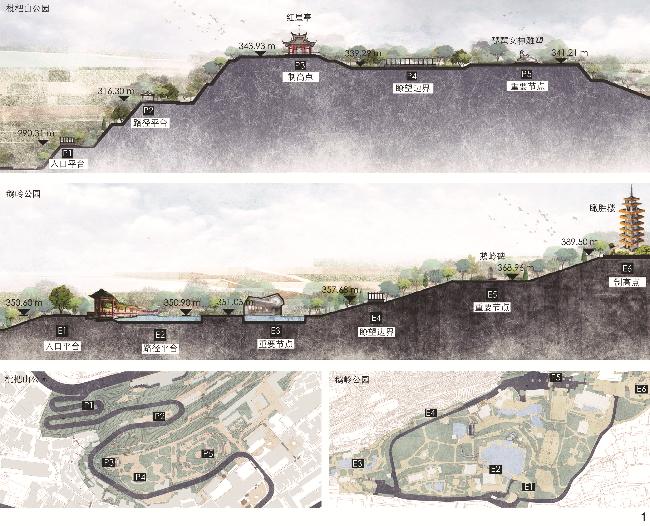
随着城市更新进入“品质提升”与“人本健康”阶段,基于视听感知评价的景观设计成为满足青年群体复杂需求的重要方法。山地城市公园中的聚集性空间承载着当地的人地关系,为满足青年群体的视听感知需求,探究其视景、声景偏好与空间要素,评价聚集性空间的视听感知协调度,以及视听感知与满意度相关性,对山地公园视景、声景营造与环境品质提升具有重要价值。
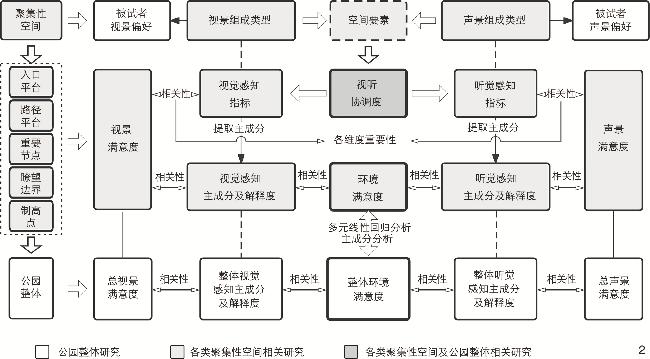
以重庆市渝中区枇杷山公园和鹅岭公园的5类聚集性空间作为研究对象,通过视声景调研与空间实测,选取12个视觉感知指标与10个听觉感知指标,形成问卷评价量表,采用主成分分析、Spearman相关性分析和多元线性回归分析,探索青年群体的视听感知协调度,以及各视听感知维度对视景、声景满意度,各类聚集性空间环境满意度与公园整体环境满意度的影响。
2个公园视景与声景总体协调,不同类型山地聚集性空间的视听感知评价结果具有较大差异,影响公园视景、声景,各类空间环境和公园整体环境满意度的指标各不相同。
在揭示山地城市公园环境感知与满意度评价主要影响因素的基础上,提出综合环境品质的提升策略:营造兼顾视听偏好的山地聚集性空间、构建视景与声景协调的山地场所序列、基于环境满意度进行因地制宜的设计。以期为山地城市公园的视景、声景营造和环境品质提升提供参考。
胡长涓 , 宫聪 , 龙灏 , 杨昕雨 . 协调与偏好:山地城市公园聚集性空间青年人群视听感知[J]. 风景园林, 2024 , 31(7) : 20 -29 . DOI: 10.3724/j.fjyl.202401200052
As urban renewal enters the stage of “quality improvement” and “human-centred health”, traditional park design strategies can no longer satisfy people’s requirements for environmental quality improvement of parks, and guiding landscape design through audio-visual perception evaluation has become an important method to meet the complex needs of young people. Mountain city parks are rich in sensory information, and the gathering space is the place where the human-land relationship in mountain city parks is concretely presented. However, in mountain city parks, how residents perceive different types of gathering spaces, the preference of residents for visual and acoustic spatial elements, and the correlation between the evaluation of audio-visual perception and the satisfaction with various types of gathering spaces need to be further studied. This research aims to, in combination with the audio-visual preference and audio-visual coordination of young people in gathering spaces of mountain city parks, the evaluation of the correlation between audio-visual perception and satisfaction (including the satisfaction with visual and acoustic landscape, satisfaction with the environment of gathering spaces, and overall satisfaction with park environment), and the integration between the preference of young people for visual and acoustic landscape and relevant spatial elements, guide the implementation of the strategy for comprehensive improvement of environmental quality, and explore how the complex relationship between acoustic landscape, visual landscape and environmental satisfaction can be addressed in mountain city parks.
Taking 5 types of gathering spaces in Pipa Mountain Park and Eling Park in Yuzhong District, Chongqing as the research object, this research, through combining audio-visual walk survey with spatial measurement, selects 22 audio-visual perception indicators, and establishes a questionnaire evaluation scale. Based on the investigation of the environmental characteristics and the semi-structural interviews of residents, the research selects and integrates the perception indicators widely applicable to landscape assessment and design to form 12 visual perception indicators adapted to mountain parks, among which naturalness, openness, diversity and accessibility are the four indicators with the most characteristic dimensions of mountain landscape. The selection of auditory perception indicators follows the standard dimensions, and the selected indicators are combined with the most mountainous dimensions (diversity and naturalness) to form 10 dimensions of auditory perception. The research presents data analysis and results through multi-level and multi-dimensional technical path. On the basis of reliability and validity test, frequency count analysis is used to explore audio-visual preference and audio-visual interaction. Principal component analysis, Spearman correlation analysis and multiple linear regression methods are used to explore the influence of each dimension on the audio-visual satisfaction, satisfaction with environment of gathering spaces, and overall satisfaction with park environment.
The evaluation statistics and audio-visual coordination analysis show that the audio-visual perception evaluation of different types of gathering spaces has its own characteristics, and the visual landscape and acoustic landscape of the two parks are general coordinated. The analysis of the correlation between audio-visual perception and the satisfaction with the environment of gathering spaces shows that the indicators affecting the satisfaction with various types of spatial environments are different. The most distinctive space in mountain parks involves 4 relevant perception dimensions. Specifically, important nodes and path platforms are significantly correlated with the accessibility dimension; important nodes and path platforms are significantly correlated with the naturalness and diversity dimensions in both parks; path platforms, boundaries and important nodes are all significantly correlated with the openness dimension. The analysis of the correlation between the overall audio-visual perception and the overall environmental satisfaction shows that the naturalness dimension has a certain influence on the overall environmental satisfaction and the satisfaction with visual and acoustic landscape.
On the basis of revealing the main influencing factors of environmental perception and satisfaction evaluation of mountain city parks, this research refines the focus of audio-visual environment creation in mountain city parks. Combined with the characteristics of mountainous terrain, the research proposes the optimization strategies for youth-friendly spatial elements. Moreover, the research proposes relevant strategies for construction of youth-friendly order in mountain spaces, with a view to creating an organized and logical mountain space order by incorporating multi-dimensional spatial characteristics, enhancing spatial guidance, and improving the memorability of the environment. The research also proposes local adaptation strategies, emphasizing that the advantages of mountain space should be reasonably utilized to create satisfactory audio-visual landscape, and the needs of young people should be taken into account and the acoustic and visual environment elements be optimized to evoke residents’ memory of local cultural lineage. These strategies can provide theoretical basis and practical ideas for construction of acoustic and visual landscape and comprehensive improvement of environmental quality of mountain city parks.
表1 山地城市公园视听感知评价体系[4, 23, 25-37]Table 1 Evaluation system for audio-visual perception of mountain city parks[4, 23, 25-37] |
| 维度 | 指标 | 释义 |
| 注:*为能够反映山地景观特色的指标。 | ||
| 视觉感知 | 自然性[25]* | 多高差环境视景中自然要素的占比 |
| 开阔度[25]* | 山地视环境能够营造开敞空间和瞭望空间的程度 | |
| 多样性[26]* | 山地视环境景观立体层次的丰富度 | |
| 庇护性[26] | 视环境具有步行安全性与人身安全性(安全度),树木郁闭度高或有建筑遮阴(郁闭度) | |
| 社交性[27] | 视环境能够促进人与人的社会活动 | |
| 文化性[28] | 景观环境包含文化建筑与构筑物,或含有历史信息与要素 | |
| 美观性[29] | 视环境具有一定的美感度 | |
| 舒适性[30] | 视环境整体具有一定的舒适性,利于舒缓压力 | |
| 秩序性[30] | 景观元素是有序的,而不是杂乱的 | |
| 可达性[31]* | 景观空间具有一定的视线可达性与步行可达性:与道路接口较多且可识别、距出入口近、到达该处高差较小 | |
| 可识别性[23, 32] | 景观环境具有一定的可识别性和记忆点,而不是毫无特征的 | |
| 功能性[4, 23] | 景观空间能够提供适用的娱乐健身设施、完善的休憩服务设施与基础服务设施 | |
| 听觉感知 | 愉悦性[33-34] | 声环境是使人心情愉悦的 |
| 恼人性[33] | 声环境是使人烦躁不安的 | |
| 静谧性[33] | 声环境是静谧宁静的 | |
| 无序性[26, 33] | 声环境是混乱无序的 | |
| 活力性[35] | 声环境是充满生机与活力的 | |
| 单调性[33] | 声环境是单调乏味的 | |
| 事件性[33, 36] | 声环境中有重要事件发生 | |
| 无事件性[33, 36] | 声环境中没有重要事件发生 | |
| 自然性[37]* | 多高差环境的声景中的自然声占比 | |
| 多样性[26]* | 立体声环境层次丰富多样,而不是单调或冗杂的 | |
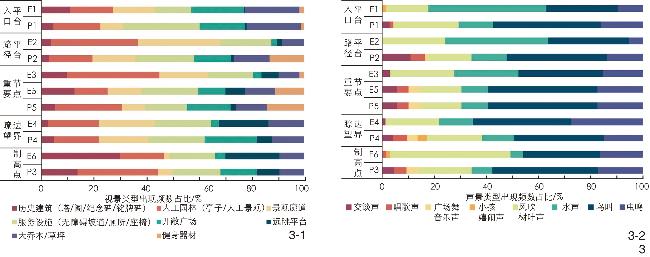
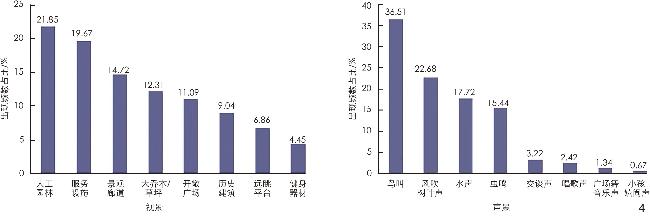
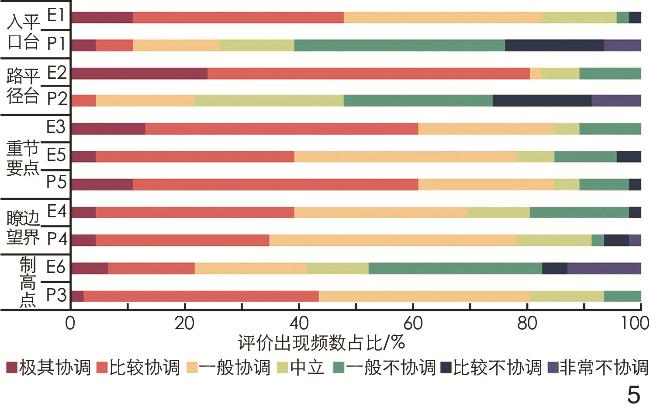
图3 5类聚集性空间中被试者的视景类型偏好(3-1)与声景类型偏好(3-2)Fig. 3 Types of visual landscape (3-1) and acoustic landscape (3-2) preferred by the subjects in five types of gathering spaces |
表2 视听觉感知与视声景满意度相关性计算结果Tab. 2 Results of correlation between audio-visual perception and visual landscape satisfaction |
| 维度 | 指标 | 入口平台 | 路径平台 | 重要节点 | 瞭望边界 | 制高点 | 均值 | 相关性排序 | |||||||||
| 均值 | 相关 系数 | 均值 | 相关 系数 | 均值 | 相关 系数 | 均值 | 相关 系数 | 均值 | 相关 系数 | ||||||||
| 注:*表示在0.05级别(双尾)相关性显著;**表示在0.01级别(双尾)相关性显著。 | |||||||||||||||||
| 视觉感知与视景满意度 | 舒适性 | 0.88 | 0.72** | 1.46 | 0.69** | 1.67 | 0.65** | 1.50 | 0.39** | 1.85 | 0.67** | 1.47 | 1 | ||||
| 多样性 | 0.76 | 0.59** | 1.36 | 0.55** | 1.52 | 0.37** | 1.41 | 0.46** | 1.79 | 0.42** | 1.37 | 2 | |||||
| 开阔度 | 1.46 | 0.14 | 1.39 | 0.13 | 1.17 | −0.02 | 1.40 | 0.00 | 1.25 | 0.08 | 1.33 | 3 | |||||
| 美观性 | 0.55 | 0.65** | 1.34 | 0.67** | 1.54 | 0.67** | 1.27 | 0.59** | 1.86 | 0.71** | 1.31 | 4 | |||||
| 庇护性 | 0.86 | 0.34** | 1.29 | 0.41** | 1.67 | 0.47** | 1.48 | 0.32** | 1.23 | 0.28** | 1.30 | 5 | |||||
| 社交性 | 0.68 | 0.53** | 1.42 | 0.46** | 1.40 | 0.36** | 1.38 | 0.29** | 1.25 | 0.41** | 1.22 | 6 | |||||
| 可识别性 | 0.00 | 0.44** | 1.38 | 0.50** | 1.41 | 0.43** | 1.22 | 0.42** | 1.93 | 0.37** | 1.19 | 7 | |||||
| 秩序性 | 0.74 | 0.42** | 1.32 | 0.43** | 1.44 | 0.43** | 1.09 | 0.31** | 1.20 | 0.35** | 1.08 | 8 | |||||
| 自然性 | 1.07 | 0.41** | 1.16 | 0.36** | 1.25 | 0.15 | 1.10 | 0.22* | 0.84 | 0.41** | 1.08 | 9 | |||||
| 可达性 | 1.19 | 0.00 | 0.65 | 0.35** | 0.52 | 0.10 | 1.07 | 0.00 | 1.52 | 0.06 | 0.99 | 10 | |||||
| 文化性 | −0.59 | 0.48** | 0.68 | 0.10 | 0.82 | 0.31** | 0.16 | 0.14 | 1.39 | 0.24** | 0.49 | 11 | |||||
| 功能性 | −0.13 | 0.30** | 0.89 | 0.02 | 0.60 | 0.25** | 0.58 | 0.14 | 0.25 | 0.26* | 0.44 | 12 | |||||
| 听觉感知与声景满意度 | 多样性 | 0.25 | 0.62** | 0.72 | 0.62** | 0.71 | 0.37** | 0.48 | 0.48** | 0.29 | 0.55** | 0.49 | 1 | ||||
| 愉悦性 | 0.10 | 0.87** | 0.38 | 0.82** | 1.02 | 0.72** | 0.59 | 0.68** | 0.22 | 0.82** | 0.46 | 2 | |||||
| 活力性 | 0.32 | 0.64** | 0.66 | 0.53** | 0.44 | 0.29** | 0.57 | 0.33** | 0.07 | 0.45** | 0.41 | 3 | |||||
| 无序性 | 0.24 | −0.66** | 0.28 | −0.63** | −0.71 | −0.47** | −0.02 | −0.32** | 0.12 | −0.49** | −0.02 | 4 | |||||
| 事件性 | −0.28 | 0.44** | 0.23 | 0.30** | 0.19 | 0.23** | 0.07 | 0.30** | −0.30 | 0.26** | −0.02 | 5 | |||||
| 无事件性 | 0.05 | −0.19 | −0.18 | -0.07 | −0.11 | −0.11 | −0.09 | −0.19 | 0.14 | −0.05 | −0.04 | 6 | |||||
| 恼人性 | 0.06 | −0.75** | −0.15 | −0.72** | −0.80 | −0.51** | −0.27 | −0.40** | −0.02 | −0.67** | −0.24 | 7 | |||||
| 单调性 | −0.33 | −0.60** | −0.40 | −0.23* | −0.35 | −0.26** | −0.35 | −0.19 | −0.16 | −0.20 | −0.32 | 8 | |||||
| 自然性 | −0.30 | 0.76** | 0.03 | 0.69** | −0.12 | 0.29** | −0.56 | 0.43** | −1.05 | 0.58** | −0.40 | 9 | |||||
| 静谧性 | −0.74 | 0.69** | −0.45 | 0.60** | 0.27 | 0.34** | −0.45 | 0.22* | −0.74 | 0.54** | −0.42 | 10 | |||||
文中图表均由作者绘制。
| [1] |
宫聪, 胡长涓. 基于绿色基础设施多种社会功能的社区公共空间规划[J]. 中国城市林业, 2021, 19(1): 12-18.
GONG C, HU C J. Community Public Space Planning Based on Multiple Social Functions of Green Infrastructures[J]. Journal of Chinese Urban Forestry, 2021, 19(1): 12-18.
|
| [2] |
叶林, 王傲, 王昕皓, 等. 青年友好视角下的北美城市公园评价方法研究进展[J]. 园林, 2023, 40(1): 42-51.
YE L, WANG A, WANG X H, et al. Research Progress on Urban Park Evaluation Tools of North America Based on the Youth-Friendly Perspective[J]. Landscape Architecture Academic Journal, 2023, 40(1): 42-51.
|
| [3] |
冯昕玥, 林敏慧. 城市公园游客属性、身体活动与场地条件关系研究[J]. 中国园林, 2023, 39(7): 89-95.
FENG X Y, LIN M H. Study on the Relationships Between Tourists’ Characteristics, Physical Activity Level and Site Conditions[J]. Chinese Landscape Architecture, 2023, 39(7): 89-95.
|
| [4] |
卢峰, 王振文, 陶陶. 分割与连接: 城市再生视野下的山地城市公共空间重塑, 以重庆主城区为例[J]. 世界建筑, 2021(6): 28-31.
LU F, WANG Z W, TAO T. Segmentation and Connection: Reconstruction of Public Space in Mountainous Cities from the Perspective of Urban Regeneration, a Case Study of Chongqing[J]. World Architecture, 2021(6): 28-31.
|
| [5] |
文安邦, 汤青, 欧阳朝军, 等. 中国山地保护与山区发展: 回顾与展望[J]. 中国科学院院刊, 2023, 38(3): 376-384.
WEN A B, TANG Q, OUYANG C J, et al. Mountain Protection and Mountain Development in China: Review and Prospect[J]. Bulletin of Chinese Academy of Sciences, 2023, 38(3): 376-384.
|
| [6] |
张万钦, 杜春兰, 胡俊琦. 知觉交互: 山地城市公园更新中的文化意象激活[J]. 中国园林, 2021, 37(11): 63-68.
ZHANG W Q, DU C L, HU J Q. Perceptual Interaction: The Cultural Image Activation of Park Renewal in Mountainous City[J]. Chinese Landscape Architecture, 2021, 37(11): 63-68.
|
| [7] |
徐千里. 山地城市的公共空间与生活日常[J]. 建筑技艺, 2018, 37(12): 16-21.
XU Q L. Daily Life and Public Space in Mountain Cities[J]. Architecture Technique, 2018, 37(12): 16-21.
|
| [8] |
LIU J, KANG J, BEHM H, et al. Effects of Landscape on Soundscape Perception: Soundwalks in City Parks[J]. Landscape & Urban Planning, 2014, 123(1): 30-40.
|
| [9] |
赵幸子, 毛颖, 胡昂. 浣花溪公园不同景观空间下的声景观特性[J]. 应用声学, 2022, 41(3): 359-372.
ZHAO X Z, MAO Y, HU A. The Characteristics of Acoustic Landscape in Different Landscape Spaces of Huanhuaxi Park[J]. Journal of Applied Acoustics, 2022, 41(3): 359-372.
|
| [10] |
刘江, 郁珊珊, 王亚军, 等. 城市公园景观与声景体验的交互作用研究[J]. 中国园林, 2017, 33(12): 86-90.
LIU J, YU S S, WANG Y J, et al. Research on the Interaction Effect Between Landscape and Soundscape Experience in City Parks[J]. Chinese Landscape Architecture, 2017, 33(12): 86-90.
|
| [11] |
刘江, 杨玲, 黄丽坤. 生态型城市公园声景体验的影响因素研究[J]. 风景园林, 2019, 26(5): 89-93.
LIU J, YANG L, HUANG L K. Research on the Influential Factors of Soundscape Experience in Urban Ecological Park[J]. Landscape Architecture, 2019, 26(5): 89-93.
|
| [12] |
JEON J Y, LEE P J, HONG J Y, et al. Non-auditory Factors Affecting Urban Soundscape Evaluation[J]. The Journal of the Acoustical Society of America, 2011, 130(6): 3761-3770.
|
| [13] |
沈钦炜, 魏凌伟, 熊慧锦, 等. 基于FAHP的梅岭国家森林公园景观视觉评价[J]. 中国城市林业, 2021, 19(1): 54-59.
SHEN Q W, WEI L W, XIONG H J, et al. Visual Evaluation of Meiling National Forest Park Landscape Based on FAHP[J]. Journal of Chinese Urban Forestry, 2021, 19(1): 54-59.
|
| [14] |
李鑫, 王子尧, 吴丹子, 等. 基于生理反馈的城市滨河步道对青年人压力缓解的研究[J]. 中国园林, 2022, 38(5): 86-91.
LI X, WANG Z Y, WU D Z, et al. Research on Pressure Relief of Young People by Urban Waterfront Trail Based on Physiological Feedback[J]. Chinese Landscape Architecture, 2022, 38(5): 86-91.
|
| [15] |
邵钰涵, 薛贞颖, 蒿奕颖, 等. 城市公园视听感知品质评价研究: 以成都环城生态区为例[J]. 风景园林, 2022, 29(9): 26-32.
SHAO Y H, XUE Z Y, HAO Y Y, et al. Research on Evaluation of Audio-Visual Perception Quality of Urban Parks: A Case Study of Chengdu Outer-Ring Ecological Zone[J]. Landscape Architecture, 2022, 29(9): 26-32.
|
| [16] |
翟宇佳, 吴承照. 城市公园总体满意度主要影响因素识别: 基于不同年龄组使用者的分析[J]. 风景园林, 2021, 28(5): 57-62.
ZHAI Y J, WU C Z. Identification of Main Influencing Factors on Urban Park Overall Satisfaction: Based on Analysis of Users of Different Age Groups[J]. Landscape Architecture, 2021, 28(5): 57-62.
|
| [17] |
李婧, 张晓婉. 城市修补理论在上海老公园改造中的应用[J]. 中国园林, 2019, 35(6): 61-71.
LI J, ZHANG X W. The Application of the Urban Repair Theory in the Reconstruction of Old Parks in Shanghai[J]. Chinese Landscape Architecture, 2019, 35(6): 61-71.
|
| [18] |
黄生钱, 秦华, 辛儒鸿. 山地滨水公园设计的地域性营造: 以重庆金海湾公园设计为例[J]. 规划师, 2015, 31(12): 78-82.
HUANG S Q, QIN H, XIN R H. Local Character Creation in Waterfront Park Design: Golden Bay Park Design, Chongqing[J]. Planners, 2015, 31(12): 78-82.
|
| [19] |
FANG X, GAO T, HEDBLOM M, et al. Soundscape Perceptions and Preferences for Different Groups of Users in Urban Recreational Forest Parks[J]. Forests, 2021, 12(4): 468.
|
| [20] |
JEON J Y, HONG J Y. Classification of Urban Park Soundscapes Through Perceptions of the Acoustical Environments[J]. Landscape & Urban Planning, 2015, 141: 100-111.
|
| [21] |
WANG R. A Good Sound in the Right Place: Exploring the Effects of Auditory-Visual Combinations on Aesthetic Preference[J]. Urban Forestry & Urban Greening, 2019, 43: 12356.
|
| [22] |
邵钰涵, 薛贞颖, 斯韦茨, 等. 人本视角下的公众参与式方法探索: 感知引导法[J]. 风景园林, 2020, 27(11): 116-122.
SHAO Y H, XUE Z Y, THWAITES K, et al. Exploration of Public Participation Method from the Humanistic Perspective: Perception Stimulation[J]. Landscape Architecture, 2020, 27(11): 116-122.
|
| [23] |
杜春兰.山地城市景观学研究[D].重庆: 重庆大学, 2005.
DU C L. Research of the Discipline of Mount Urban Landscape [D]. Chongqing: Chongqing University, 2005.
|
| [24] |
张汇雯, 邓宏, 冯琬清. 基于NLP定制模型的游客感知研究: 以重庆市鹅岭公园为例[J]. 园林, 2023, 40(12): 122-130.
ZHANG H W, DENG H, FENG W Q. A Study on Tourists’ Perception of Eling Park in Chongqing City Based on NLP Customized Model[J]. Landscape Architecture Academic Journal, 2023, 40(12): 122-130.
|
| [25] |
KYTTÄ M, KAHIL M. The Perceived Quality Factors of the Environment and Their Ecoefficient Accessibility[C]// GALLIS C. Proceedings from the 1st European COST E-39 Conference: Forests, Trees and Human Health and Well-Being. Thessalonica: Medical & Scientific Publishers, 2005: 337-351.
|
| [26] |
GRAHN P, STIGSDOTTER U K. The Relation Between Perceived Sensory Dimensions of Urban Green Space and Stress Restoration[J]. Landscape and Urban Planning, 2010, 94(3-4): 264-275.
|
| [27] |
GEHL J. Life Between Buildings[M]. New York: Van Nostrand Reinhold, 1987.
|
| [28] |
CASPERSEN O H, OLAFSSON A S. Experiencing Values in the Green Structure of Copenhagen[R]. Copenhagen: University of Copenhagen, 2006.
|
| [29] |
STOLTZ J, GRAHN P. Perceived Sensory Dimensions: An Evidence-Based Approach to Greenspace Aesthetics[J]. Urban Forestry & Urban Greening, 2021, 59(4): 126989.
|
| [30] |
ULRICH R S, SIMONS R F, LOSITO B D, et al. Stress Recovery During Exposure to Natural and Urban Environments[J]. Journal of Environmental Psychology, 1991, 11(3): 201-230.
|
| [31] |
杨丽娟, 杨培峰, 陈炼. 城市公园绿地供给的公平性定量评价: 以重庆市中心城区为例[J]. 中国园林, 2020, 36(1): 108-112.
YANG L J, YANG P F, CHEN L. Quantitative Evaluation on the Equity of Park Green Space Provision: A Case Study of Central District of Chongqing[J]. Chinese Landscape Architecture, 2020, 36(1): 108-112.
|
| [32] |
胡长涓, 宫聪, 汪瑞军. 基于双重对比分析的历史街区绿量生态效益[J]. 中国城市林业, 2023, 21(5): 103-113.
HU C J, GONG C, WANG R J. Ecological Benefits of Green Quantity in Historic Areas Based on Dual Comparative Analysis[J]. Journal of Chinese Urban Forestry, 2023, 21(5): 103-113.
|
| [33] |
INSTITUTION B S. Acoustics − Soundscape − Part 2: Data Collection and Reporting Requirements: ISO/TS 12913-2[S]. Geneva: BSI Standards Publication, 2018.
|
| [34] |
KANG J, ALETTA F, GJESTLAND T T, et al. Ten Questions on the Soundscapes of the Built Environment[J]. Building and Environment, 2016, 108: 284-294.
|
| [35] |
AXELSSON Ö, NILSSON M E, BERGLUND B. A Principal Components Model of Soundscape Perception[J]. The Journal of the Acoustical Society of America, 2010, 128(5): 2836-2846.
|
| [36] |
AXELSSON Ö. How to Measure Soundscape Quality[C]// DOE J. Proceedings of the Euronoise 2015 Conference. Maastricht: European Acoustics Association, 2015: 1477-1481.
|
| [37] |
GRAHN P. Landscapes in Our Minds: People’s Choice of Recreative Places in Towns[J]. Landscape Research, 1991, 16(1): 11-19.
|
| [38] |
LIU J, KANG J, BEHM H, et al. Effects of Landscape on Soundscape Perception: Soundwalks in City Parks[J]. Landscape and Urban Planning, 2014, 123: 30-40.
|
| [39] |
KANG J. Noise Management: Soundscape Approach[M]// NRIAGU J O. Encyclopedia of Environmental Health. Burlington: Elsevier, 2011: 174-184.
|
| [40] |
LIU J, WANG Y, ZIMMER C, et al. Factors Associated with Soundscape Experiences in Urban Green Spaces: A Case Study in Rostock, Germany[J]. Urban Forestry & Urban Greening, 2019(37): 135-146.
|
| [41] |
宫聪, 吴竑, 胡长涓. 基于绿色基础设施网络的城市公共空间生态功能优化策略: 以南京中心城区为例[J]. 新建筑, 2022(1): 49-54.
GONG C, WU H, HU C J. Ecological Function Optimization Strategy of Urban Public Open Space Based on Green Infrastructure Network: A Case Study of Central Nanjing[J]. New Architecture, 2022(1): 49-54.
|
/
| 〈 |
|
〉 |