

韧性乡村视角下农业景观布局理论框架
|
杨亚东/男/博士/中国农业科学院农业资源与农业区划研究所研究员/北方干旱半干旱耕地高效利用全国重点实验室成员/研究方向为农业区域布局、绿色发展 |
|
杜娅婷/女/中国农业科学院农业资源与农业区划研究所在读博士研究生/北方干旱半干旱耕地高效利用全国重点实验室成员/研究方向为农业区域发展 |
|
杜歆仪/女/中国农业科学院农业资源与农业区划研究所在读硕士研究生/北方干旱半干旱耕地高效利用全国重点实验室成员/研究方向为农业区域发展 |
|
张艺佳/女/中国农业科学院农业资源与农业区划研究所在读硕士研究生/北方干旱半干旱耕地高效利用全国重点实验室成员/研究方向为农村发展 |
Copy editor: 王一兰
收稿日期: 2024-02-21
修回日期: 2024-10-21
网络出版日期: 2025-12-16
版权
Theoretical Framework for Agricultural Landscape Layout from the Perspective of Resilient Rural Area
|
YANG Yadong, Ph.D., is a research fellow in the Institute of Agricultural Resources and Regional Planning, CAAS, and a member of the State Key Laboratory of Efficient Utilization of Arid and Semi-arid Arable Land in Northern China. His research focuses on agricultural regional layout and green development |
|
DU Yating is a Ph.D. candidate in the Institute of Agricultural Resources and Regional Planning, CAAS, and a member of the State Key Laboratory of Efficient Utilization of Arid and Semi-arid Arable Land in Northern China. Her research focuses on agricultural regional development |
|
DU Xinyi is a master student in the Institute of Agricultural Resources and Regional Planning, CAAS, and a member of the State Key Laboratory of Efficient Utilization of Arid and Semi-arid Arable Land in Northern China. Her research focuses on agricultural regional development |
|
ZHANG Yijia is a master student in the Institute of Agricultural Resources and Regional Planning, CAAS, and a member of the State Key Laboratory of Efficient Utilization of Arid and Semi-arid Arable Land in Northern China. Her research focuses on rural development |
Received date: 2024-02-21
Revised date: 2024-10-21
Online published: 2025-12-16
Copyright
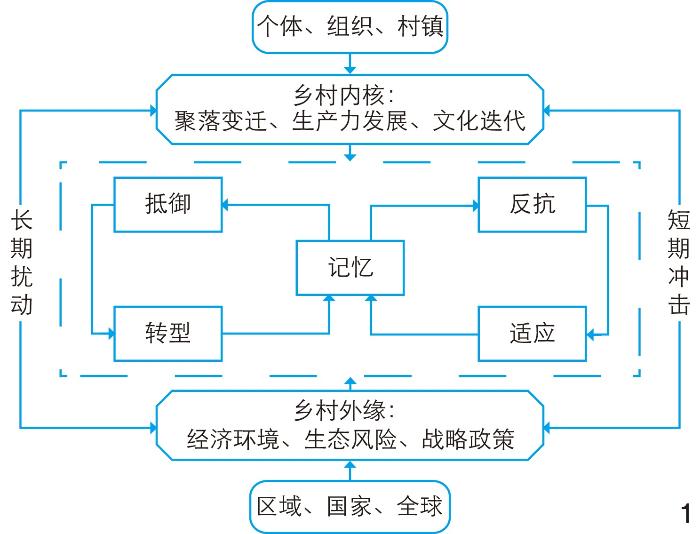
乡村发展抗逆响应持续受到社会各界关注,韧性乡村视角下农业景观如何布局成为亟待研究的问题。
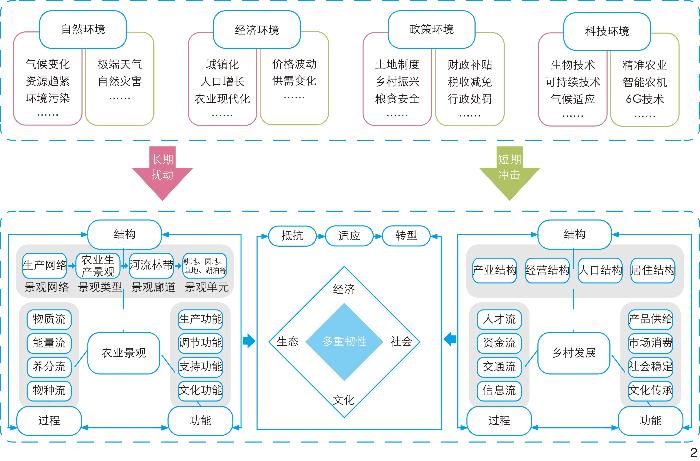
应用系统分析方法,以“结构—过程—功能”为分析框架,多角度分析农业景观对外部环境变化的时空响应,多维度解析农业景观系统韧性强化作用。
外部环境的长期干扰和短期冲击导致农业景观结构经历了整体性的重构,表现为结构功能级联化、斑块构造破碎化、要素组成同质化、视觉感知精准化以及时空演替多样化等多重特征。农业景观结构与乡村系统抵御、适应和转型能力等具有密切联系。据此提出以生物多样性、过程可持续、功能复合化、发展绿色化为指导的景观布局策略,以实现优化生态过程、改善景观功能、促进服务协同,将人类活动对景观演化的影响导入良性循环,持续服务乡村韧性提升。
杨亚东 , 杜娅婷 , 杜歆仪 , 张艺佳 . 韧性乡村视角下农业景观布局理论框架[J]. 风景园林, 2024 , 31(12) : 33 -39 . DOI: 10.3724/j.fjyl.202402210098
In the context of globalization, industrialization, informatization, and urbanization, rural areas worldwide are undergoing profound transformations. While developed countries have experienced urbanization and counter-urbanization, rural areas in developing countries face challenges such as population outmigration, inefficient land use, and environmental degradation. In view of this, it is essential to build resilient rural systems that can withstand external shocks. Agricultural landscapes, shaped by human-nature interactions, play a crucial role in supporting ecosystems, food security, and biodiversity. This research aims to develop an integrated framework for optimizing agricultural landscape layouts to enhance rural resilience, focusing on biodiversity conservation, process sustainability, functional integration, and green development. By addressing both environmental and socio-economic factors, the research offers actionable strategies for landscape planners, policymakers, and rural development practitioners.
A system analysis approach is applied. The research adopts a “structure – process – function” analytical framework to examine the temporal and spatial responses of agricultural landscapes to external environmental changes. Multi-dimensional aspects of landscape resilience are explored, including the landscape’s capability to resist, adapt to, and transform external pressures. The research also proposes landscape layout strategies to enhance system resilience.
The research finds that agricultural landscapes have undergone significant restructuring under both long-term disturbances and short-term shocks. Long-term pressures such as climate change, globalization, and urbanization result in the fragmentation and homogenization of agricultural landscapes, while short-term shocks, such as natural disasters or market fluctuations, lead to more immediate and sometimes irreversible changes. These structural shifts highlight the intricate connection between agricultural landscapes and the resilience of human – land coupling systems. Agricultural landscapes play a pivotal role in regulating the flow of materials, energy, nutrients, and species, all of which are essential for the long-term functioning of rural ecosystems. Therefore, optimizing agricultural landscape layout is key to improving system resilience. By adopting targeted strategies, landscapes can be better equipped to withstand external pressures while maintaining core functions such as food production, biodiversity conservation, and socio-cultural continuity. The research proposes four key strategies for enhancing resilience. 1) Biodiversity strategy: Prioritizes habitat restoration and protection by creating ecological corridors and promoting diversified farming systems, such as intercropping, crop rotation, and agroforestry. 2) Process sustainability strategy: Focus on improving the sustainability of nutrient flows, soil quality, and hydrological processes. The research suggests optimizing landscape layouts by incorporating elements such as wetlands, ecological islands, and buffer zones, which help regulate water flow and nutrient distribution. 3) Functional integration strategy: Recognize that modern agricultural landscapes must fulfill multiple roles, including food production, recreation, cultural preservation, and ecological conservation. The research advocates for the construction of multifunctional hubs and networks that integrate these functions within a single landscape. 4) Green development strategy: Integrate natural ecological processes with sustainable agricultural practices. This strategy focuses on reducing environmental costs and resource inputs by promoting green agricultural techniques such as organic farming, reduced fertilizer use, and water-saving irrigation methods. The strategy applies at multiple scales, from large-scale ecosystems involving mountains, rivers, forests, and farmlands, to small-scale sustainable intensification of agricultural fields.
表1 韧性乡村视角下农业景观布局策略Tab. 1 Strategies for agricultural landscape layout from the perspective of resilient rural area |
| 策略 | 核心理念 | 角度 | |
| 生物多样性 | 保护和营造 多元生境 | 生物过程 | 过程 |
| 过程可持续 | 景观连接度; 景观异质性; 非农生境营造 | 非生物过程 | |
| 功能复合化 | 枢纽构造; 廊道串联; 功能嵌入 | 功能空间叠合 | 功能 |
| 绿色发展 | 大尺度多元 景观要素; 小尺度绿色 基础设施 | 功能多尺度耦合 | |
| [1] |
张甜, 刘焱序, 王仰麟. 恢复力视角下的乡村空间演变与重构[J]. 生态学报, 2017, 37 (7): 2147-2157
ZHANG T, LIU Y X, WANG Y L. The Rural Spatial Evolution and Reconstruction on A Resilience View[J]. Acta Ecologica Sinica, 2017, 37 (7): 2147-2157.
|
| [2] |
LIU Y, LI Y. Revitalize the World’s Countryside[J]. Nature, 2017, 548 (7667): 275-277
|
| [3] |
罗必良, 耿鹏鹏. 乡村治理及其转型: 基于人情关系维度的考察[J]. 农业经济问题, 2022 (10): 6-18
LUO B L, GENG P P. Rural Governance and Its Transformation: An Investigation Based on the Dimension of Human Relations[J]. Issues in Agricultural Economy, 2022 (10): 6-18.
|
| [4] |
胡溢轩. 迈向韧性发展: 乡村适应性变迁的内在逻辑[J]. 社会发展研究, 2022, 9 (4): 189-205
HU Y X. Subjectivity and Tenacious Development: Adaptive Changes in Rural Revitalization[J]. Journal of Social Development, 2022, 9 (4): 189-205.
|
| [5] |
李红波. 韧性理论视角下乡村聚落研究启示[J]. 地理科学, 2020, 40 (4): 556-562
LI H B. Rural Settlements Research from the Perspective of Resilience Theory[J]. Scientia Geographica Sinica, 2020, 40 (4): 556-562.
|
| [6] |
王成, 任梅菁, 胡秋云, 等. 乡村生产空间系统韧性的科学认知及其研究域[J]. 地理科学进展, 2021, 40 (1): 85-94
WANG C, REN M J, HU Q Y, et al. Rural Production Space System Resilience and Its Research Domains[J]. Progress in Geography, 2021, 40 (1): 85-94
|
| [7] |
邱明丽, 刘殿锋, 刘耀林. 乡村韧性理论框架与测度体系[J]. 中国土地科学, 2021, 35 (8): 107-114
QIU M L, LIU D F, LIU Y L. Review on Theoretical Framework and Evaluation System of Rural Resilience[J]. China Land Science, 2021, 35 (8): 107-114.
|
| [8] |
张保华, 谷艳芳, 丁圣彦, 等. 农业景观格局演变及其生态效应研究进展[J]. 地理科学进展, 2007 (1): 114-122
ZHANG B H, GU Y F, DING S Y, et al. Research Development on Driving Factors and Ecological Effects of Agriculture Landscape Pattern Change[J]. Progress in Geography, 2007 (1): 114-122
|
| [9] |
CUMMING G S, BUERKERT A, HOFFMANN E M, et al. Implications of Agricultural Transitions and Urbanization for Ecosystem Services[J]. Nature, 2014, 515 (7525): 50-57
|
| [10] |
余慧容, 杜鹏飞. 农业景观保护路径历史回顾及启示[J]. 地理研究, 2021, 40 (1): 152-171
YU H R, DU P F. A Review of Agricultural Landscape Conservation Pathways and Its Implications[J]. Geographical Research, 2021, 40 (1): 152-171
|
| [11] |
DAY J M. Fostering Emergent Resilience: The Complex Adaptive Supply Network of Disaster Relief[J]. International Journal of Production Research, 2014, 52 (7): 1970-1988
|
| [12] |
HOLLING C S. Resilience and Stability of Ecological Systems[J]. Annual Review of Ecology and Systematics, 1973, 4: 1970-1988
|
| [13] |
GUNDERSON L H, HOLLING C S. Panarchy: Understanding Transformations in Human and Natural Systems[M]. Washington, D.C.: Island Press, 2002.
|
| [14] |
邵亦文, 徐江. 城市韧性: 基于国际文献综述的概念解析[J]. 国际城市规划, 2015, 30 (2): 48-54
SHAO Y W, XU J. Understanding Urban Resilience: A Conceptual Analysis Based on Integrated International Literature Review[J]. Urban Planning International, 2015, 30 (2): 48-54.
|
| [15] |
李泽, 吴博萌. 气候变化背景下乡村聚落生态韧性评价与空间分异研究[J]. 生态经济, 2023, 39 (11): 110-118
LI Z, WU B M. Evaluation and Spatial Differentiation of Ecological Resilience of Rural Settlements Under Climate Change[J]. Ecological Economy, 2023, 39 (11): 110-118.
|
| [16] |
王亚男, 吕晓, 张学波. 农户视角下乡村感知韧性的作用机制及提升路径: 以山东省曲阜市为例[J]. 地理学报, 2024, 79 (2): 321-336
WANG Y N, LYU X, ZHANG X B. The Mechanism and Improvement Path of Rural Perceived Resilience from the Perspective of Farmers: A Case Study of Qufu City, Shandong Province[J]. Acta Geographica Sinica, 2024, 79 (2): 321-336
|
| [17] |
任洪杰, 李辉尚.中国乡村生态韧性的时空演变特征及影响因素探究[J/OL].干旱区地理, 2024: 1-11(2024-08-29)[2024-10-22]. http://kns.cnki.net/kcms/detail/65.1103.X.20240328.1016.002.html.
REN H J, LI H S. Spatial and Temporal Evolution Characteristics and Influencing Factors of Rural Ecological Resilience in China[J/OL]. Arid Land Geography, 2024: 1-11(2024-08-29)[2024-10-22]. http://kns.cnki.net/kcms/detail/65.1103.X.20240328.1016.002.html.
|
| [18] |
唐欣, 谢诗蕾. 乡村经济韧性的时空分布及组态影响因素[J]. 深圳大学学报(人文社会科学版), 2023, 40 (5): 78-87
TANG X, XIE S L. Spatio-Temporal Distribution and Configuration Influencing Factors of Rural Economic Resilience[J]. Journal of Shenzhen University (Humanities & Social Sciences), 2023, 40 (5): 78-87
|
| [19] |
GILLER K E, DELAUNE T, SILVA J V, et al. The Future of Farming: Who Will Produce Our Food?[J]. Food Security, 2021, 13 (5): 1073-1099
|
| [20] |
LI H B, JIN X B, LIU J, et al. Analytical Framework for Integrating Resources, Morphology, and Function of Rural System Resilience: An Empirical Study of 386 Villages[J]. Journal of Cleaner Production, 2022, 365: 132738.
|
| [21] |
李玉恒, 黄惠倩, 王晟业. 乡村韧性研究的热点与趋势: 基于CiteSpace的知识图谱分析[J]. 地理科学, 2023, 43 (9): 1568-1575
LI Y H, HUANG H Q, WANG S Y. Hotspots and Trends of Rural Resilience Research: Knowledge Map Analysis Based on Citespace[J]. Scientia Geographica Sinica, 2023, 43 (9): 1568-1575.
|
| [22] |
胡最, 闵庆文, 刘沛林. 农业文化遗产的文化景观特征识别探索: 以紫鹊界、上堡和联合梯田系统为例[J]. 经济地理, 2018, 38 (2): 180-187
HU Z, MIN Q W, LIU P L. Identification on Cultural Landscape of Traditional Rice Terraces in the Southern Area of China[J]. Economic Geography, 2018, 38 (2): 180-187.
|
| [23] |
罗紫薇, 胡希军, 韦宝婧, 等. 基于多准则CA-Markov模型的城市景观格局演变与预测: 以上杭县城区为例[J]. 经济地理, 2020, 40 (10): 58-66
LUO Z W, HU X J, WEI B J, et al. Urban Landscape Pattern Evolution and Prediction Based on Multi-criteria CA-Markov Model: Take Shanghang County as an Example[J]. Economic Geography, 2020, 40 (10): 58-66.
|
| [24] |
田健, 宿荣, 曾穗平. 大运河天津段沿岸乡村“三生”脆弱性评价与韧性重构策略[J]. 规划师, 2022, 38 (10): 117-123
TIAN J, SU R, ZENG S P. Vulnerability Assessment and Resilience Reconstruction of Rural Production − Living − Ecological Areas Along the Grand Canal, Tianjin Section[J]. Planners, 2022, 38 (10): 117-123
|
| [25] |
ORTIZ A M D, OUTHWAITE C L, DALIN C, et al. A Review of the Interactions Between Biodiversity, Agriculture, Climate Change, and International Trade: Research and Policy Priorities[J]. One Earth, 2021, 4 (1): 88-101
|
| [26] |
杨亚东, 罗其友, 杜娅婷, 等. 乡村振兴背景下的“产—景—村”融合发展: 现状与对策[J]. 中国农业资源与区划, 2021, 42 (3): 232-239
YANG Y D, LUO Q Y, DU Y T, et al. “Industry − Scenery − Village” Integrated Development in the Context of Rural Revitalization: Current Status and Countermeasures[J]. Chinese Journal of Agricultural Resources and Regional Planning, 2021, 42 (3): 232-239.
|
| [27] |
MARTIN R, SUNLEY P. On the Notion of Regional Economic Resilience: Conceptualization and Explanation[J]. Journal of Economic Geography, 2015, 15 (1): 1-42
|
| [28] |
买欣, 陶伟, 刘望保. 国内外乡村韧性研究进展评述[J]. 人文地理, 2023, 38 (2): 28-34
MAI X, TAO W, LIU W B. Literature Review on the Research Progress of Rural Resilience[J]. Human Geography, 2023, 38 (2): 28-34.
|
| [29] |
LAMBIN E F, MEYFROIDT P. Global Land Use Change, Economic Globalization, and the Looming Land Scarcity[J]. Proceedings of the National Academy of Sciences, 2011, 108 (9): 3465-3472
|
| [30] |
REN C C, ZHOU X Y, WANG C, et al. Ageing Threatens Sustainability of Smallholder Farming in China[J]. Nature, 2023, 616 (7955): 96-103
|
| [31] |
ZHU Y Q, SUN L, LUO Q Y, et al. Spatial Optimization of Cotton Cultivation in Xinjiang: A Climate Change Perspective[J]. International Journal of Applied Earth Observation and Geoinformation, 2023, 124: 103523.
|
| [32] |
杨亚东, 李国景, 程长林. 马铃薯种植布局优化与定位重构: 社会嵌入理论的阐述[J]. 农村经济, 2023 (3): 48-57
YANG Y D, LI G J, CHENG C L. Optimization of Potato Planting Layout and Reconstruction of Positioning: An Explanation of Social Embedding Theory[J]. Rural Economy, 2023 (3): 48-57.
|
| [33] |
KOSMA M, LAITA A, DUFLOT R. No Net Loss of Connectivity: Conserving Habitat Networks in the Context of Urban Expansion[J]. Landscape and Urban Planning, 2023, 239: 104847.
|
| [34] |
TANG J J, ZHOU L, DANG X W, et al. Impacts and Predictions of Urban Expansion on Habitat Quality in the Densely Populated Areas: A Case Study of the Yellow River Basin, China[J]. Ecological Indicators, 2023, 151: 110320.
|
| [35] |
LUO M Y, WANG S P, SAAVEDRA S, et al. Multispecies Coexistence in Fragmented Landscapes[J]. Proceedings of the National Academy of Sciences, 2022, 119 (37): e2201503119.
|
| [36] |
ZHAO J, CHEN J, BEILLOUIN D, et al. Global Systematic Review with Meta-analysis Reveals Yield Advantage of Legume-Based Rotations and Its Drivers[J]. Nature Communications, 2022, 13 (1): 4926.
|
| [37] |
杨亚东, 段丁丁, 巨章宏, 等. 基于FAO-GAEZ模型的中国马铃薯县域种植空间布局优化[J]. 地理研究, 2022, 41 (12): 3352-3363
YANG Y D, DUAN D D, JU Z H, et al. Optimization Analysis of China’s Potato Spatial Layout at County Level Based on Fao-Gaez Model[J]. Geographical Research, 2022, 41 (12): 3352-3363
|
| [38] |
王磊, 席运官, 潘阳, 等. 生态空间格局优化与景观要素耦合视角下环水有机农业面源污染控制技术[J]. 农业资源与环境学报, 2021, 38 (2): 160-166
WANG L, XI Y G, PAN Y, et al. Agricultural Non-point Source Pollution Control Technology Based on Coupling Effects of Agricultural Spatial Pattern and Landscape Elements by Developing Organic Agriculture in Watershed Areas[J]. Journal of Agricultural Resources and Environment, 2021, 38 (2): 160-166.
|
| [39] |
CONG W F, ZHANG C, LI C, et al. Designing Diversified Cropping Systems in China: Theory, Approaches and Implementation[J]. Frontiers of Agricultural Science and Engineering, 2021, 8 (3): 362-372.
|
| [40] |
施卫明, 王远, 闵炬.中国农业面源污染防控研究进展与工程案例[J].土壤学报, 2023, 60(5): 1309-1323.
SHI W M, WANG Y, MIN J. Progress in Research and Engineering Application Cases of Agricultural Non-Point Source Pollution Control in China[J] Acta Pedologica Sinica, 2023, 60(5): 1309-1323.
|
| [41] |
贺缠生, 田杰, 张宝庆, 等.土壤水文属性及其对水文过程影响研究的进展、挑战与机遇[J].地球科学进展, 36(2): 113-124.
HE C S, TIAN J, ZHANG B Q, et al. A Review of Advances in Impacts of Soil Hydraulic Properties on Hydrological Processes, Challenges and Opportunities[J]. Advances in Earth Science, 36(2): 113-124.
|
| [42] |
王朗, 徐延达, 傅伯杰, 等.半干旱区景观格局与生态水文过程研究进展[J].地球科学进展, 2009, 24(11): 1238.
WANG L, XU Y D, FU B J, et al. Landscape Pattern and Eco-hydrological Process[J]. Advances in Earth Science, 36(2): 113-124.
|
| [43] |
梁发超, 胡其玉, 起晓星. 基于生命共同体的景观生态风险评价与管控策略: 以成渝城市群为例[J]. 经济地理, 2021, 41 (8): 152-159
LIANG F C, HU Q Y, QI X X. Risk Assessment of Landscape Ecology and Its Control Strategy Based on Life Community: A Case Study of Chengdu − Chongqing Urban Agglomeration[J]. Economic Geography, 2021, 41 (8): 152-159.
|
/
| 〈 |
|
〉 |