

儿童通学空间环境健康安全评估技术研究及实践——以杭州市为例
|
张克凡/男/浙江农林大学硕士/同创工程设计有限公司风景园林师/研究方向为园林与景观设计 |
|
吴晓华/女/博士/浙江农林大学风景园林与建筑学院、浙江农林大学生态文明研究院副教授/研究方向为儿童健康与福祉 |
|
陈楚文/男/硕士/浙江农林大学风景园林与建筑学院教授/研究方向为风景园林规划设计 |
|
丁黄昊/男/浙江农林大学硕士/研究方向为园林与景观设计 |
Copy editor: 刘昱霏
收稿日期: 2024-01-23
修回日期: 2024-09-23
网络出版日期: 2025-12-16
版权
Research and Practice of Techniques for Environmental Health and Safety Assessment of Children’s School Trip Space: A Case Study of Hangzhou City
|
ZHANG Kefan gained his Master degree in Zhejiang A&F University, and is a landscape architect in Tongchuang Engineering Desing Co., Ltd. His research focuses on landscape planning and design |
|
WU Xiaohua, Ph.D., is an associate professor in Institute of Ecological Civilization, and in the School of Landscape Architecture, Zhejiang A&F University. Her research focuses on children’s health and well-being |
|
CHEN Chuwen, Master, is a professor in the School of Landscape Architecture, Zhejiang A&F University. His research focuses on landscape architecture planning and design |
|
DING Huanghao gained his Master degree in Zhejiang A&F University. His research focuses on landscape planning and design |
Received date: 2024-01-23
Revised date: 2024-09-23
Online published: 2025-12-16
Copyright
健康安全的通学空间是儿童积极通学的前提条件,也是儿童自由互动和健康成长的人性化场所。构建以儿童友好为导向的通学空间是儿童友好型城市建设的关键。
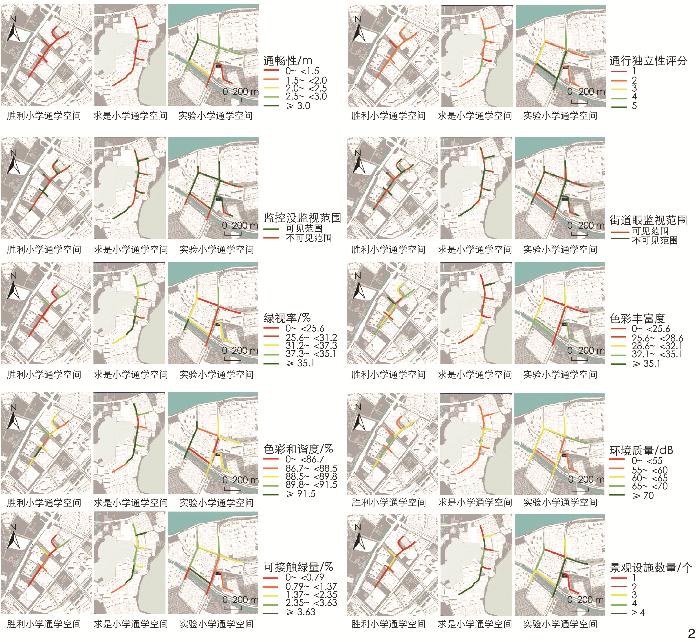
对相关理论和实证文献进行归纳与研究,总结儿童认知行为特征和影响儿童积极通学的因素,运用层次分析法,构建通学空间环境健康安全评价体系;结合开源数据挖掘、图像语义分割和GIS可见性分析等技术手段,对杭州市求是小学、胜利小学和钱塘实验小学现有通学空间进行健康安全评价。
评价结果表明,求是小学通学空间综合评分(3.27)>钱塘实验小学通学空间综合评分(3.10)>胜利小学通学空间综合评分(2.41),3所小学通学空间在交通基础设施、空间景观层次、活动空间营造以及社会监视体系方面仍有提升空间。
针对3所小学的现有通学空间提出4项改善策略,包括完善建设通学空间基础设施、创造通学空间多样活动空间、提升通学空间景观层次品质、建立通学空间社会监视体系,为构建儿童友好型城市提供了新的理论依据。
张克凡 , 吴晓华 , 陈楚文 , 丁黄昊 . 儿童通学空间环境健康安全评估技术研究及实践——以杭州市为例[J]. 风景园林, 2024 , 31(12) : 113 -120 . DOI: 10.3724/j.fjyl.202401230055
With the rapid development of urbanization and road motorization, problems such as air pollution, traffic safety and public health are becoming increasingly serious, which have caused inconvenience and even safety risks to children’s school trip, and profoundly affect children’s behaviors of school trip. A healthy and safe school trip space is a prerequisite for children’s active school trip and a humanized place to realize children’s free interaction and healthy growth. However, in China, there are currently problems such as narrow space, broken landscape and traffic accidents with respect to the school trip space for children, and existing evaluation tools have not fully formed a detailed theoretical framework while failing to effectively integrate with design work. Therefore, it is necessary to construct an environmental health and safety assessment system for school trip space.
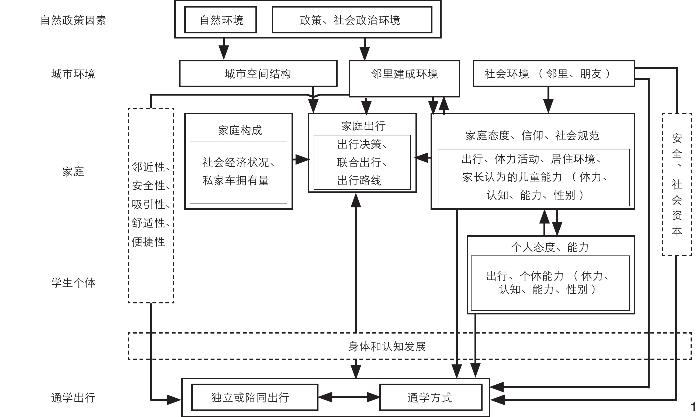
Based on the combing of literature regarding children’s cognitive and behavioral characteristics, the influencing factors of active school trip, and the behavioral characteristics of school-age children during their school trip, this research identifies the main needs of children during their school trip, namely walking safety and growth comfort needs, which include walking space safety, social environment safety, growth health comfort, and activity space diversity. Based on this, the research constructs an environmental health and safety assessment system for school trip space. In terms of data collection, the research collects data mainly through mining data on urban street and terrain, field shooting of streetscape pictures, field measurement and scoring, etc. Semantic segmentation of streetscape pictures, GIS visibility analysis, color entropy method, cosine law and other analysis methods are adopted.
In this research, 13 evaluation indicators are selected. These indicators include: Accessibility, safety of street crossing facilities, street crossing distance, school trip independence, crowd density, street eye surveillance coverage, monitor monitoring coverage, sound environment quality, green visibility, color richness, color harmony, accessible green biomass, and number of landscape facilities. According to the results of the hierarchical analysis method, walking safety has the highest weighting value of 0.35 and spatial diversity has the lowest weighting value of 0.13, which indicates that in the environmental health and safety assessment system for school trip space, the walking space safety is considered to be the primary factor influencing children’s active school trip, and the diversity of activity space has less influence.Through the stratified sampling method, the school trip spaces of Qiuyi Primary School, Qiantang Experimental Primary School and Shengli Primary School are screened out from the first batch of pilot elementary schools included in the “Comfortable Passage” program, with the health and safety assessment of the school trip space of such schools being conducted according to the environmental health and safety assessment system for school trip space. The results show that the average health and safety score of school trip space of the three schools above as a whole is 2.97 points, the average health and safety score of the school trip space of Qiushi Primary School is 3.27, higher than Qiantang Experimental Primary School (3.10) and Shengli Primary School (2.41). Through the interview survey, the access structure of the above three primary schools and parents’ attitude towards their children’s walking to school are obtained. The results show that the support degree of parents of students in Qiushi Primary School for their children’s walking to school is 63%, higher than Qiantang Experimental Primary School (50%) and Shengli Primary School (43%). In terms of the proportion of children walking to school, Qiushi Primary school (51.8%) is higher than Qiantang Experimental Primary School (47.3%) and Shengli Primary School (40%). The results of interview survey are consistent with the results of evaluation, indicating that the evaluation system has high accuracy.
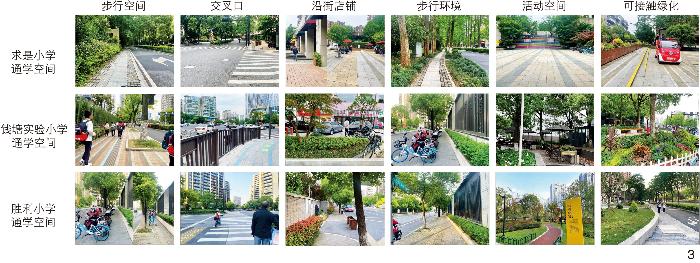
According to the evaluation results, the main problems in the school trip space of the three schools include the safety of walking, the insufficiency of space for rest and communication, the obstruction of social surveillance line of sight, and the lack of vegetation. Therefore, based on the current status and characteristics of regional construction, four targeted improvement strategies are proposed, including perfecting the infrastructure construction of school trip space, creating diverse activity spaces within school trip space, improving the landscape quality of school trip space, and establishing a social surveillance system for school trip space. The research results can provide guidance for the improvement of environment of school trip space and have important theoretical and practical significance for the construction of child-friendly cities. In addition, different from subjective evaluation and field survey, digital and parametric data analysis methods such as multi-source data, semantic segmentation and GIS visibility analysis are introduced into the environmental health and safety assessment system for school trip space to achieve objective and quantitative evaluation and analysis of the health and safety of school trip space, thus providing a scientific, standard and objective technical means for the evaluation of urban school trip space. Quantitative methods and optimization measures may also be applied to relevant urban research.
表1 儿童友好步行空间代表性评价工具[6-9]Tab. 1 Evaluation tools for child-friendly walking spaces[6-9] |
| 评价工具 | 发布年份 | 代表性指标 | 指标项数 | 指标测度方式 |
| 步行环境系统性评估(Systematic Pedestrian and Cycling Environmental Scan, SPACES)[6] | 2002 | 街道眼监视情况、过街基础设施类型、人行道与车道间的缓冲距离、交叉口有无、环境卫生情况;街道连续性、环境吸引性等 | 37 | 客观审计、 主观感知 |
| 儿童友好度(Kid Street Scan, KISS) | 2004 | 车道限速情况、步行畅通性、照明设施、街道环境的舒适度和整洁度、活动空间多样性等 | 47 | 主观感知 |
| 道路环境量表(The Path Environment Audit Tool, PEAT)[7] | 2005 | 步行空间独立性、地面平整度、人行道及信号灯、人行道与道路间的缓冲设施、商业设施、步行基础设施、声环境质量、街道和环境卫生情况(气味、粪便等) | 34 | 客观审计、 主观感知 |
| 青少年社区环境步行能力量表(Neighborhood Environment Walkability Scale for Youth, NEWS-Y)[8] | 2009 | 土地混合度、娱乐设施可用性、街道连通性、步行基础设施、街道环境情况、交通安全性、社会安全性、设施多样性、居住密度 | 8 | 主观感知 |
| 微观步行环境量表(Microscale Audit of Pedestrian Streetscapes, MAPS)[9] | 2015 | 人行道缓冲设施、商业设施密度、自然环境舒适性、社会秩序、人行道有无、照明设施有无、休憩设施有无、交叉口安全性等 | 77 | 客观审计 |
表2 通学空间健康安全评价体系Tab. 2 Evaluation system for health and safety of school trip space |
| 评价维度 | 评价指标 | 指标量化 | 数据来源 |
| 步行空间 安全性 | 畅通性 | 根据GA/T | 实地勘测 |
| 过街基础设施 安全性 | 过街基础设施安全性评分根据人车接触概率划分为1~5级:立体过街设施评分为5;有斑马线和红绿灯时,过街时间充裕评分为4,过街时间不充裕评分为3;有斑马线但无红绿灯评分为2;无斑马线无红绿灯评分为1 | 实地勘测 | |
| 过街距离 | 根据所跨越的道路的车道数量(含非机动车道)划分为5个等级。双向十车道及以上评分为1;八车道评分为2;六车道评分为3;四车道评分为4;两车道评分为5 | 实地勘测 | |
| 通行独立性 | 根据机动车、非机动车、行人(学生)之间的分隔类型划分为1~5级。当有连续围栏或绿化时,有机非隔离带评分为5;无机非隔离带评分为4;当人行道与非机动车道以树池隔离时,有机非隔离带评分为3;没有机非隔离带评分为2;人行道无隔离措施,评分为1 | 实地勘测 | |
| 社会环境 安全性 | 人群密度 | 百度热力图配准与矢量化后得出不同时段的人群密度。基于热力图颜色定义人群密度的5个等级:非常安全(>40人/100 m2)、较安全(>20~40 人/100 m2)、一般(>10~20人/100 m2)、较危险(>2~10人/100 m2)、非常危险(≤2 人/100 m2)。人群密度越高,评分越高[15] | 百度热力图 |
| 街道眼监视覆盖率 | 根据GIS可见性分析,计算通学空间街道眼监视覆盖率,每段街道的街道眼监视覆盖率的结果通过自然间断点法分为5个等级,街道眼监视覆盖率越高,评分越高 | 实地勘测、 GIS可见性分析 | |
| 监控设备监视覆盖率 | 根据GIS可见性分析,计算通学空间的监控设备监视覆盖率,每段街道的监控设备监视覆盖率的结果通过自然间断点法分为5个等级,监控设备监视覆盖率越高,评分越高 | 实地勘测、 GIS可见性分析 | |
| 成长健康 舒适性 | 声环境质量 | 根据GB 3096—2008《声环境质量标准》进行赋值统计,将检测到的环境噪声按55 dB、60 dB、65 dB、70 dB划分为1~5级,噪声数值越大,评分越低 | 实地勘测 |
| 绿视率 | 利用图像语义分割,计算街景图片中绿色植物的占比,结果通过自然间断点法分为5个等级,绿视率越高,评分越高 | 街景图片、图像语义分割 | |
| 色彩丰富度 | 基于街景图片,根据在视觉熵的基础上增加能反映区块色彩特征的表达,计算街景图片的色彩丰富度[32],结果通过自然间断点法分为5个等级,色彩丰富度数值越高,评分越高 | 街景图片、matlab | |
| 色彩和谐度 | 基于街景图片,通过余弦定理计算相邻街景图片中各种颜色出现频次的相似度,结果通过自然间断点法分为5个等级,色彩和谐度数值越高,评分越高 | 街景图片、matlab | |
| 活动空间 多样性 | 景观设施数量 | 统计各通学空间中促进身体活动的景观设施数量,包括雕塑小品、植物组团、休憩座椅等,景观设施数量越多,评分越高 | 实地勘测 |
| 可接触绿量 | 利用图像语义分割,提取街景图片中的可接触绿量,结果通过自然间断点法分为5个等级,可接触绿量越高,评分越高 | 街景图片、图像语义分割 |
表3 通学空间评估权重Tab. 3 Weights for school trip space assessment |
| 评估维度 | 权重 | 评价指标 | 权重 |
| 步行空间安全性 | 0.35 | 畅通性 | 0.16 |
| 过街基础设施安全性 | 0.33 | ||
| 过街距离 | 0.26 | ||
| 通行独立性 | 0.25 | ||
| 社会环境安全性 | 0.21 | 人群密度 | 0.14 |
| 街道眼监视覆盖率 | 0.35 | ||
| 监控设备监视覆盖率 | 0.51 | ||
| 成长健康舒适性 | 0.31 | 声环境质量 | 0.24 |
| 绿视率 | 0.39 | ||
| 色彩丰富度 | 0.16 | ||
| 色彩和谐度 | 0.21 | ||
| 活动空间多样性 | 0.13 | 景观设施数量 | 0.42 |
| 可接触绿量 | 0.58 |
表4 通学空间各指标评价结果Tab. 4 Evaluation results of various indicators of school trip space |
| 评价指标 | 评分 | ||
| 求是小学 通学空间 | 钱塘实验小学 通学空间 | 胜利小学 通学空间 | |
| 畅通性 | 1.89 | 3.55 | 1.09 |
| 过街基础设施安全性 | 2.66 | 3.63 | 2.50 |
| 过街距离 | 4.33 | 2.89 | 3.50 |
| 通行独立性 | 2.51 | 3.29 | 1.90 |
| 街道眼监视覆盖率 | 3.29 | 3.01 | 1.86 |
| 监控设备监视覆盖率 | 4.41 | 3.26 | 2.04 |
| 人群密度 | 1.96 | 3.68 | 2.45 |
| 绿视率 | 3.59 | 2.68 | 2.45 |
| 色彩丰富度 | 2.33 | 2.61 | 3.12 |
| 色彩和谐度 | 3.59 | 2.94 | 3.09 |
| 声环境质量 | 3.48 | 3.18 | 3.27 |
| 景观设施数量 | 2.96 | 3.44 | 0.95 |
| 可接触绿量 | 3.67 | 2.79 | 2.56 |
表5 通学空间家长访谈结果和综合评分对比Tab. 5 Comparison of parent interview results and composite scores of school trip space |
| 通学空间 | 综合评分 | 家长支持度/% | 积极通学比例/% |
| 求是小学 | 3.27 | 63.3 | 51.8 |
| 钱塘实验小学 | 3.10 | 50.0 | 47.3 |
| 胜利小学 | 2.41 | 43.3 | 40.0 |
| [1] |
刘铮.安全视角下校区附近儿童通学路径景观改造[D].西安: 西安建筑科技大学, 2021.
LIU Z. Landscape Renovation of Children’s School Commuting Path Near Schools from the Perspective of Safety: A Case Study of Kangle Road in Xi’an[D]. Xi’an: Xi’an University of Architecture and Technology, 2021
|
| [2] |
COOPER A R, PAGE A S, FOSTER L J, et al. Commuting to School: Are Children Who Walk More Physically Active?[J]. American Journal of Preventive Medicine 2003, 25(4): 273-276.
|
| [3] |
何玲玲, 林琳. 学校周边建成环境对学龄儿童上下学交通方式的影响: 以上海市为例[J]. 上海城市规划, 2017 (3): 30-36
HE L L, LIN L. The Impacts of School Neighborhood Built Environment on School-Age Children’s School Commuting: A Case Study of Shanghai[J]. Shanghai Urban Planning Review, 2017 (3): 30-36.
|
| [4] |
TEWAHADE S, LI K G, GOLDSTEIN B R, et al. Association Between the Built Environment and Active Transportation Among U.S. Adolescents[J]. Journal of Transport & Health, 2019, 15 (C): 100629
|
| [5] |
阳凯婧.儿童友好视角下的小学通学空间评价与优化策略研究[D].桂林: 桂林理工大学, 2023.
YANG K J. Study on Evaluation and Optimization Strategies of Primary School Communication Space from the Perspective of Child Friendliness: Take the Old City of Guilin as an Example[D]. Guilin: Guilin University of Technology, 2023.
|
| [6] |
PIKORA T, BULL F, JAMROZIK K, et al. Developing a Reliable Audit Instrument to Measure the Physical Environment for Physical Activity[J]. American Journal of Preventive Medicine, 2002, 23 (3): 187-194
|
| [7] |
TROPED P J, CROMLEY E K, FRAGALA M S, et al. Development and Reliability and Validity Testing of an Audit Tool for Trail/Path Characteristics: The Path Environment Audit Tool (PEAT)[J]. Journal of Physical Activity & Health, 2006, 3(S1): 158-175.
|
| [8] |
ROSENBERG D, DING D, SALLIS F J, et al. Neighborhood Environment Walkability Scale for Youth (NEWS-Y): Reliability and Relationship with Physical Activity[J]. Preventive Medicine, 2009, 49 (2-3): 213-218
|
| [9] |
SALLIS J F, CAIN K L, CONWAY T L, et al. Is Your Neighborhood Designed to Support Physical Activity? A Brief Streetscape Audit Tool[J]. Preventing Chronic Disease, 2015, 12 (9): 141
|
| [10] |
徐守珩, 庄惟敏. 影响儿童通学需求层次的街道空间质量标准探究[J]. 西部人居环境学刊, 2023, 38 (2): 45-51
XU S H, ZHUANG W M. Research on the Quality Criteria of Street Space Affecting Children’s Hierarchy of School Travel Needs[J]. Journal of Human Settlements in West China, 2023, 38 (2): 45-51.
|
| [11] |
ZHAO J, SU W, LUO J C, et al. Evaluation and Optimization of Walkability of Children’s School Travel Road for Accessibility and Safety Improvement[J]. International Journal of Environmental Research and Public Health, 2021, 19 (1): 71-90
|
| [12] |
尚珊珊.儿童友好导向下城市建成环境对通学出行的影响研究[D].苏州: 苏州科技大学, 2019.
SHANG S S. Effects of Urban Built Environment on Students’ Travel Behavior in the Perspective of Child-Friendly City: A Case Study of Typical Communities in Suzhou[D]. Suzhou: Suzhou University of Science and Technology, 2019.
|
| [13] |
黎俊仪, 林盈芳, 董建文, 等. 语义分割技术下的城市滨水绿地美景度评价研究: 以福州西湖公园、左海公园为例[J]. 中国园林, 2022, 38 (10): 92-97
LI J Y, LIN Y F, DONG J W, et al. Landscape Evaluation on Urban Waterfront Under Semantic Segmentation Technology: Taking Xihu Park and Zuohai Park in Fuzhou as Examples[J]. Chinese Landscape Architecture, 2022, 38 (10): 92-97.
|
| [14] |
王文欣, 孙超群, 周恺. 基于GIS视域分析的校园夜间出行安全性评价模型研究[J]. 现代城市研究, 2021 (4): 23-29
WANG W X, SHUN C Q, ZHOU K. Research on an Evaluation Model for Safe Night-Time Travel on Campus Using GIS Viewshed Analysis[J]. Modern Urban Research, 2021 (4): 23-29
|
| [15] |
秦志博, 龙良初, 冯丹, 等. 基于多源数据的旅游城市街道活力量化评价及提升策略: 以桂林历史城区为例[J]. 桂林理工大学学报, 2022, 42 (4): 820-829
QIN Z B, LONG L C, FENG D, et al. Quantitative Evaluation and Promotion Strategy of Street Vitality in Tourist Cities Based on Multi-source Data: A Case Study of Guilin Historic Urban Area[J]. Journal of Guilin University of Technology, 2022, 42 (4): 820-829
|
| [16] |
ZHANG R, YAO E J, LIU Z L. School Travel Mode Choice in Beijing, China[J]. Journal of Transport Geography, 2017, 62: 98-110
|
| [17] |
SCHEINER J, HUBER O, LOHMÜLLER S. Children’s Mode Choice for Trips to Primary School: A Case Study in German Suburbia[J]. Travel Behaviour and Society, 2019, 15: 15-27.
|
| [18] |
MCMILLAN T E. The Relative Influence of Urban form on a Child’s Travel Mode to School[J]. Transportation Research Part A, 2006, 41 (1): 69-79.
|
| [19] |
MITRA R. Independent Mobility and Mode Choice for School Transportation: A Review and Framework for Future Research[J]. Transport Reviews, 2013, 33 (1): 21-43
|
| [20] |
徐梦一, 沈瑶, 张潇, 等.环境行为学视角下建成环境与儿童出行影响机制研究[J].中国园林, 2022, 38(8): 54-59.
XU M Y, SHEN Y, ZHANG X, et al. Study on the Impact Mechanism of the Built Environment and Children’s Travel from the Perspective of Environmental Behavior[J]. Chinese Landscape Architecture, 2022, 38(8): 54-59.
|
| [21] |
唐敏, 谭敏, 成受明, 等. 成都市儿童独立通学的出行特征及其影响因素研究[J]. 住区, 2023 (5): 138-143
TANG M, TAN M, CHENG S M, et al. Study on the Characteristics and Influencing Factors of Children’s Independent School Commuting in Chengdu[J]. Design Community, 2023 (5): 138-143
|
| [22] |
邢慧楠, 黄晓燕, 夏伊凡. 社区和学校建成环境对儿童积极通学的影响: 基于交叉分类多层模型的西安实证[J]. 西北大学学报(自然科学版), 2023, 53 (5): 749-760
XING H N, HUANG X Y, XIA Y F. Associations of Neighborhood and School Built Environment with Active Commuting to School in Children: An Empirical Study of Xi’an City Based on Cross-Classified Multilevel Model[J]. Journal of Northwest University (Natural Science Edition), 2023, 53 (5): 749-760.
|
| [23] |
田玉慧.儿童友好视角下城市小学通学空间可步行性评价研究: 以哈尔滨南岗区为例[D].哈尔滨: 哈尔滨工业大学, 2021.
TIAN Y H. The Walkability Evaluation Research of Urban Primary Schools from the Perspective of Child Friendly: A Case Study of Nangang District of Harbin[D]. Harbin: Harbin Institute of Technology, 2021.
|
| [24] |
乔晓暄.基于色彩心理学的社区儿童活动空间设计研究: 以成都市“花花学园”儿童活动体验中心为例[J].色彩, 2024(2): 23-25.
QIAO X X. Research on the Design of Community Children’s Activity Space Based on Color Psychology: Taking the Children’s Activity Experience Center of “Huahua Academy” in Chengdu as an Example[J]. Color, 2024(2): 23-25.
|
| [25] |
潘建非, 陈凯怡. 基于色彩心理学的广州儿童公园硬质景观分析[J]. 广东园林, 2016, 38 (5): 9-15
PAN J F, CHEN K Y. Hard Landscape Analysis of Guangzhou Children’s Parks Based on Color Psychology[J]. Guangdong Landscape Architecture, 2016, 38 (5): 9-15
|
| [26] |
武凤文, 陈明远. 儿童健康安全视角下的步行通学道评测与优化策略[J]. 城市发展研究, 2020, 27 (7): 20-27
WU F W, CHEN M Y. The Evaluation and Improvement Strategy of the Way to Elementary School from the Perspective of Children[J]. Urban Development Studies, 2020, 27 (7): 20-27.
|
| [27] |
徐佳楠.儿童友好视角下的街道安全评价研究[D].大连: 大连理工大学, 2022.
XU J N. Research on the Evaluation of Safety Street Environment Based on the Child-Friendly View[D]. Dalian: Dalian University of Technology, 2022.
|
| [28] |
刘涟涟, 陈飞, 蔡军. 德国促进儿童独立上学的城市交通规划与教育[J]. 城市交通, 2020, 18 (2): 17-29
LIU L L, CHEN F, CAI J. Germany’s Urban Transportation Planning and Education for Promoting Children Going to School Independently[J]. Urban Transport of China, 2020, 18 (2): 17-29.
|
| [29] |
CAI L W. The Research on Safety Children's Travel Route on Child-Friendly City of Netherlands[J]. International Journal of Environmental Protection and Policy, 2017, 5(6): 94-98.
|
| [30] |
张秦英, 田靖雯, 赵琳瑄, 等. 高密度城区儿童亲自然属性评价研究[J]. 景观设计, 2023 (4): 22-25
ZHANG Q Y, TIAN J W, ZHAO L X, et al. Evaluation Research on Children’s Biophilic Attributes in High-Density Urban Areas[J]. Landscape Design, 2023 (4): 22-25
|
| [31] |
胡肖涵.深圳市红荔社区儿童独立性活动特征与环境支持体系研究[D].哈尔滨: 哈尔滨工业大学, 2018.
HU X H. Study on Characteristics and Environmental Support System of Children’s Independent Mobility in Hong Li Community of Shenzhen[D]. Harbin: Harbin Institute of Technology, 2018.
|
| [32] |
韩君伟, 董靓. 基于心理物理方法的街道景观视觉评价研究[J]. 中国园林, 2015, 31 (5): 116-119
HAN J W, DONG L. A Study of Visual Evaluation of Streetscape Based on the Psychophysical Method[J]. Chinese Landscape Architecture, 2015, 31 (5): 116-119
|
| [33] |
薛蕊.基于CPTED理论的高校校园户外空间环境安全评价研究[D].广州: 华南理工大学, 2020.
XUE R. Research on Safety Evaluation of Outdoor Space in Campus Based on Crime Prevention Through Environmental Design (CPTED) Theory[D]. Guangzhou: South China University of Technology, 2021
|
| [34] |
耿佳慧, 翟俊.数据驱动道路绿化: 基于街景的多维品质评估[J].中国园林, 2024, 40(9): 104-109.
GENG J H, ZHAI J. Data-Driven Urban Road Greening Planning: Multi-dimensional Quality Assessment and Optimization by Incorporating Street View Data[J]. Chinese Landscape Architecture, 2024, 40 (9): 104-109.
|
| [35] |
张珍, 张圆. 交通噪声对儿童影响的研究综述[J]. 声学技术, 2018, 37 (4): 354-361
ZHANG Z, ZHANG Y. The Effect of Traffic Noise on Children: A Review[J]. Technical Acoustics, 2018, 37 (4): 354-361.
|
/
| 〈 |
|
〉 |