

基于公众认知的上海城市荒野景观偏好研究
|
马靖/男/华东理工大学艺术设计与传媒学院在读硕士研究生/研究方向为风景园林规划与设计、城市荒野景观 |
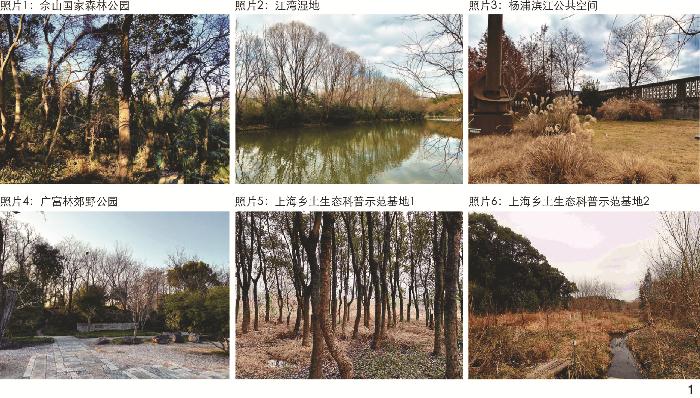
|
何彦/女/华东理工大学艺术设计与传媒学院在读硕士研究生/研究方向为风景园林规划与设计、城市荒野景观 |
|
冯璐/女/博士/华东理工大学艺术设计与传媒学院副教授/研究方向为风景园林规划与设计 |
|
郭陶然/男/上海天渊生态科技有限公司执行董事/研究方向为都市生物多样性保育与修复 |
Copy editor: 边紫琳
收稿日期: 2024-06-11
修回日期: 2024-09-18
网络出版日期: 2025-12-16
基金资助
上海市哲学社会科学规划项目“韧性城市下基于社会-生态视角的长三角绿色基础设施优化研究”(2021ECK002)
版权
Research on Preferences for Urban Wilderness Landscape in Shanghai Based on Public Cognition
|
MA Jing is a master student in the School of Art Design and Media, East China University of Science and Technology. His research focuses on landscape planning and design, and urban wilderness landscape |
|
HE Yan is a master student in the School of Art Design and Media, East China University of Science and Technology. Her research focuses on landscape planning and design, and urban wilderness landscape |
|
FENG Lu, Ph.D., is an associate professor in the School of Art Design and Media, East China University of Science and Technology. Her research focuses on landscape planning and design |
|
GUO Taoran is an executive director of Shanghai Tianyuan Ecological Technology Co., Ltd. His research focuses on urban biodiversity conservation and restoration |
Received date: 2024-06-11
Revised date: 2024-09-18
Online published: 2025-12-16
Copyright
分析上海城市居民对城市荒野的认知与景观偏好情况,探究荒野景观构成的积极因素与消极因素,为上海荒野景观的保护与发展提供参考和建议。
结合公众参与式地理信息系统(public participation geographic information system, PPGIS)和问卷调研,获取受访者人口统计学特征与景观偏好、价值认知、空间定位等数据信息,利用相关性分析和核密度分析等方法对采集到的数据进行分析比较。
1)公众对城市荒野概念的了解程度较低,但接受程度较高,并对城市中实际的荒野分布有大概的认知。2)公众对城市荒野景观感知偏中立态度,不同自然与人工要素会对公众偏好产生影响。3)公众居住与活动范围可能会对城市荒野接受度产生影响。
应优先对公众认知程度较高和交通便利的荒野区域进行转型更新,综合考量场地内自然与人工要素,分析不同人群的活动需求,保障场地可达性、可视性,使城市荒野景观成为城市生态景观的一部分,为城市荒野景观建设提供参考。
马靖 , 何彦 , 冯璐 , 郭陶然 . 基于公众认知的上海城市荒野景观偏好研究[J]. 风景园林, 2024 , 31(11) : 56 -64 . DOI: 10.3724/j.fjyl.202406110315
In the face of urban landscape habitat fragmentation and ecological deterioration under the background of high-speed urbanization, more and more urban residents are in urgent need of contact with more diversified and enriched natural elements and open spaces, so as to improve the quality of living environment and safeguard their physical and mental health. As one type of green space connecting cities, human and nature, urban wilderness landscape has its unique ecological function, aesthetic significance and economic value, and has broad research prospects. This research analyzes the value cognition and landscape preference of Shanghai residents for urban wilderness, explores the positive and negative perception effects of different landscape elements that constitute the wilderness landscape, and provides more targeted and localized references and suggestions for the construction and development of ecological landscape in Shanghai.
This research obtains landscape pictures of different kinds of sample plots through field visit, and designs Likert scale and other forms of questionnaires to collect data. The questionnaire survey is conducted simultaneously online and offline in combination with the public participation geographic information system (PPGIS), a self-developed WeChat mini program, which makes it more effective and convenient to collect information about the respondents’ demographic characteristics, landscape preferences, value cognition, spatial geographic positioning, etc. The collected data are further organized, compared and mapped using spatial analysis methods such as SPSS correlation analysis and ArcGIS kernel density.
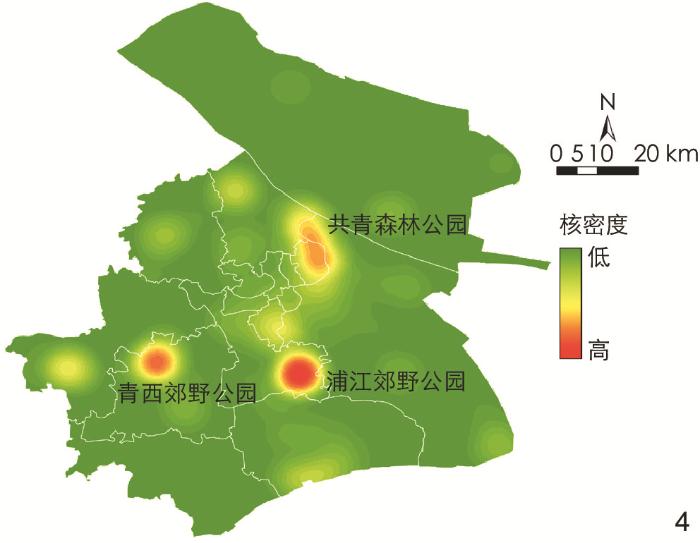
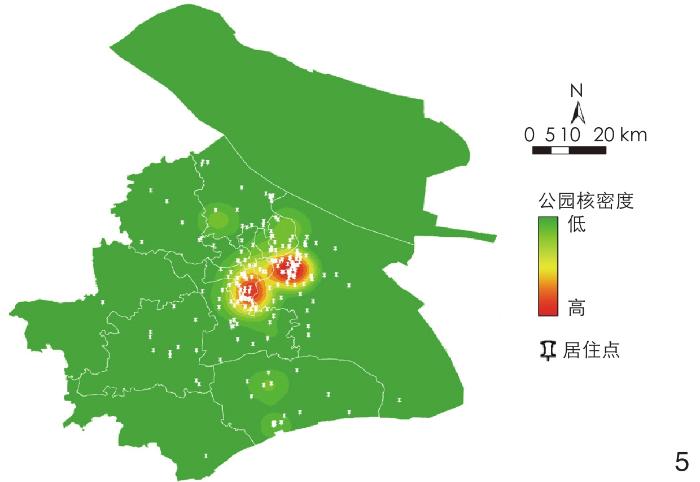
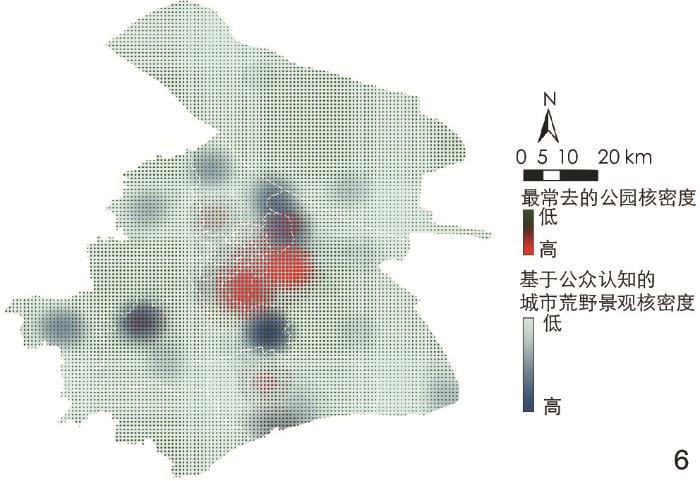
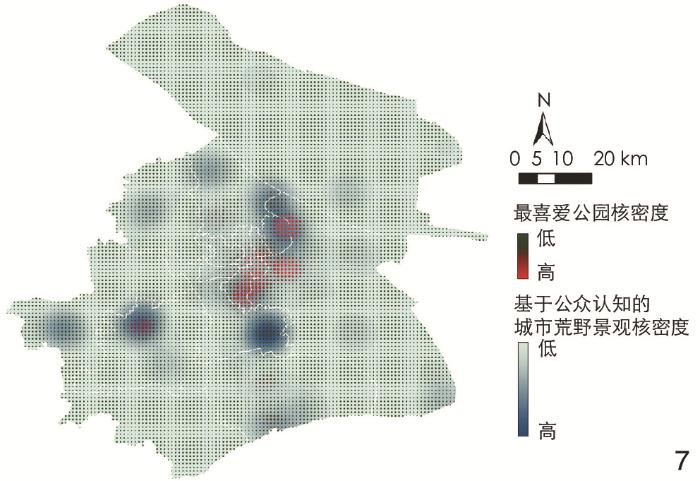
1) Most of the respondents have a low level of understanding of “urban wilderness”, but a high level of cognition and acceptance thereof. 2) Different groups of respondents have different preferences and concerns about wilderness landscape sites, but the public’s aesthetic preference for wilderness landscapes is generally neutral. Different natural landscape elements and artificial landscape elements in wilderness landscape sites, such as water bodies, plants, hardscapes, and facilities, have an impact on the public’s preference. 3) Respondents also have an approximate knowledge of the distribution of actual wilderness areas within Shanghai. Survey statistics show that, the distribution of wilderness sites familiar to the public is mainly concentrated in Minhang District, Qingpu District and the area outside the suburban ring. The openness and development of wilderness space may affect the cognitive impression of urban residents. 4) Respondents’ cognition of the distribution of wilderness landscapes is affected by the scope of activities, with the scope of daily recreation being highly overlapped with wilderness space. Some parks and green spaces with near-natural design are also regarded as wilderness sites and are widely praised. 5) Respondents’ acceptance of wilderness landscapes has a certain correlation with the urbanization level of the area they live in, for which there is typically a threshold value. Wilderness resources with high quality or convenient location generally have higher potential development value and are more likely to be accepted by the public.
1) Priority should be given to the renewal and transformation of wilderness space with a high degree of public cognition and convenient transportation, and the design and development of high-quality wilderness resources should be carried out by taking advantage of corresponding wilderness sites, such as well-designed country parks, or unused green spaces near residential areas. 2) When designing and optimizing specific urban wilderness landscapes, attention should be paid to the activity needs and recreational preferences of different groups of people, and relevant artificial landscape elements should be designed to enhance the interest and attractiveness of corresponding landscape sites, with such artificial landscape elements including artistic interactive devices for photo taking, plant and animal observation points, rest facilities, etc. 3) The maintenance and management of wilderness landscape entail paying more attention to water quality, garden paths and lines, as well as the natural growth of plants and the degree of wilderness, so as to ensure visibility and accessibility within a certain range while taking into account environmental wildness and safety. Zoning can be carried out to reduce human interference, and a sustainable nature-led ecological community can be constructed through the introduction of native species and pioneer plants. 4) It is supposed to increase the popularization and publicity of “urban wilderness”, especially with regard to ecological values, and cooperate with residential areas nearby to organize recreational activities, etc., so as to enhance the public’s connection with and understanding of the natural wilderness landscape, thus enabling the public to integrate into the natural wilderness landscape, which may help strengthen their sense of local identity and emotional connection. Based on this, the scope and influence of publicity can be expanded through the radiation effect of activities, and the concept of urban wilderness can be promoted to more urban residents. Designers and users are mutually reinforcing. A wider audience and demand for urban wilderness landscapes can, on the one hand, enrich the vitality and value of landscape, and on the other hand help designers and scholars in the field to better understand how wilderness landscapes are practically operated and optimized.
表1 受访者人口统计学特征Tab. 1 Demographic characteristics of respondents |
| 人口统计学 特征 | 分组 | 样本数 | 比例/% |
| 受教育程度 | 初中及以下 | 14 | 5.1 |
| 高中或中专 | 20 | 7.2 | |
| 大专 | 28 | 10.1 | |
| 本科 | 97 | 35.0 | |
| 研究生及以上 | 118 | 42.6 | |
| 职业 | 学生 | 104 | 37.5 |
| 公司职员 | 95 | 34.3 | |
| 公职人员 | 18 | 6.5 | |
| 个体经营户 | 9 | 3.2 | |
| 农民 | 2 | 0.7 | |
| 离退休职员 | 25 | 9.0 | |
| 其他 | 24 | 8.7 | |
| 从事/从事过 景观/园林等 相关工作 | 是 | 42 | 15.2 |
| 否 | 235 | 84.8 | |
| 年龄 | 18岁以下 | 15 | 5.4 |
| 18~40岁 | 206 | 74.4 | |
| 41~60岁 | 36 | 13.0 | |
| 60岁以上 | 20 | 7.2 | |
| 性别 | 男 | 120 | 43.3 |
| 女 | 157 | 56.7 | |
| 家庭情况 | 独居 | 57 | 20.6 |
| 单身,与父母同住 | 83 | 30.0 | |
| 已婚(或情侣同住),无子女 | 15 | 5.4 | |
| 已婚,与子女同住 | 66 | 23.8 | |
| 已婚,无子女,与父母同住 | 8 | 2.9 | |
| 已婚与父母子女同住 | 25 | 9.0 | |
| 已婚,子女独立 | 8 | 2.9 | |
| 其他 | 15 | 5.4 |
表2 人口统计学特征与城市荒野认知情况相关性分析Tab. 2 Analysis of the correlation between demographic characteristics and urban wilderness cognition |
| 变量 | 年龄 | 性别 | 工作类型 | 受教育程度 | 家庭情况 | 从事/从事过景观/ 园林等相关工作 |
| 注:**表示在0.01级别(双尾)相关性显著;*表示在0.05级别(双尾)相关性显著。 | ||||||
| 对概念的了解程度 | 0.056 | 0.090 | 0.062 | 0.141* | 0.041 | −0.444** |
| 参与科普活动的意愿程度 | 0.029 | 0.049 | 0.007 | 0.135* | 0.007 | −0.258** |
| 接受科普前后的印象变化 | −0.051 | −0.152* | −0.021 | 0.039 | 0.019 | 0.072 |
表3 城市荒野照片得分与感知词词频Tab. 3 Scores of urban wilderness photos and frequencies of perception words |
| 照片 编号 | 得分 均值 | 消极感知词词频/% | 积极感知词词频/% | |||||||||
| 蚊虫叮咬 | 枝叶划伤 | 难以进入 | 垃圾堆积 | 令人不安 | 自然风景 | 很有特色 | 适合放松 | 想要探索 | 物种丰富 | |||
| 1 | 2.81 | 41.2 | 50.2 | 60.3 | 12.3 | 23.1 | 36.8 | 10.1 | 7.6 | 15.5 | 14.4 | |
| 2 | 3.36 | 26.0 | 10.5 | 18.4 | 4.7 | 9.0 | 59.6 | 17.3 | 40.1 | 8.3 | 9.4 | |
| 3 | 3.35 | 15.9 | 8.3 | 8.7 | 9.0 | 11.6 | 38.3 | 35.0 | 30.0 | 22.0 | 6.1 | |
| 4 | 3.84 | 5.4 | 3.6 | 4.0 | 1.4 | 3.6 | 35.4 | 33.2 | 65.0 | 22.4 | 7.6 | |
| 5 | 3.00 | 31.0 | 26.7 | 29.2 | 11.9 | 17.3 | 42.2 | 19.1 | 14.8 | 19.1 | 7.6 | |
| 6 | 2.62 | 44.8 | 35.7 | 40.1 | 23.5 | 23.5 | 32.9 | 10.8 | 4.7 | 12.3 | 13.4 | |
表4 人口统计学特征与照片得分相关性分析Tab. 4 Analysis of the correlation between demographic characteristics and photo score |
| 照片编号 | 年龄 | 性别 | 工作类型 | 受教育程度 | 家庭情况 | 从事/从事过景观/ 园林等相关工作 |
| 注:**表示在0.01级别(双尾)相关性显著;*表示在0.05级别(双尾)相关性显著。 | ||||||
| 1 | 0.239** | −0.107 | 0.097 | −0.215** | −0.020 | 0.064 |
| 2 | 0.208** | −0.062 | 0.115 | −0.129* | 0.154* | 0.031 |
| 3 | 0.113 | 0.073 | 0.055 | −0.081 | -0.007 | −0.121* |
| 4 | 0.051 | 0.011 | 0.091 | −0.134* | 0.057 | −0.027 |
| 5 | 0.096 | −0.066 | 0.071 | −0.160** | 0.110 | −0.055 |
| 6 | 0.186** | −0.063 | 0.087 | −0.154* | 0.065 | −0.036 |
表5 人口统计学特征与场地探索意向相关性分析Tab. 5 Analysis of the correlation between demographic characteristics and site exploration intentions |
| 变量 | 年龄 | 性别 | 工作类型 | 受教育程度 | 家庭情况 | 从事/从事过景观/ 园林等相关工作 | |
| 注:**表示在0.01级别(双尾)相关性显著;*表示在0.05级别(双尾)相关性显著。 | |||||||
| 前往偏好 | 场地维护程度 | −0.100 | −0.028 | −0.169** | 0.185** | −0.058 | −0.073 |
| 场地区位 | −0.136* | 0.079 | −0.140* | 0.062 | −0.096 | −0.083 | |
| 场地安全性 | −0.148* | −0.152* | −0.053 | 0.222** | 0.010 | −0.030 | |
| 场地可进入性 | −0.081 | 0.031 | 0.010 | 0.078 | 0.043 | −0.158** | |
| 场地可活动性 | −0.009 | 0.097 | 0.023 | 0.085 | 0.107 | −0.146* | |
| 场地美观性 | 0.037 | 0.076 | 0.030 | −0.015 | −0.011 | 0.002 | |
| 活动偏好 | 观察动植物 | −0.011 | 0.146* | 0.028 | 0.028 | 0.152* | −0.116 |
| 拍照写生 | 0.039 | 0.017 | −0.101 | 0.181** | −0.002 | −0.127* | |
| 散步郊游 | 0.045 | −0.061 | −0.006 | 0.126* | −0.049 | 0.002 | |
| 休息停留 | −0.059 | 0.049 | −0.081 | 0.061 | −0.065 | −0.016 | |
| 健身锻炼 | 0.034 | −0.145* | 0.034 | −0.031 | 0.014 | 0.094 | |
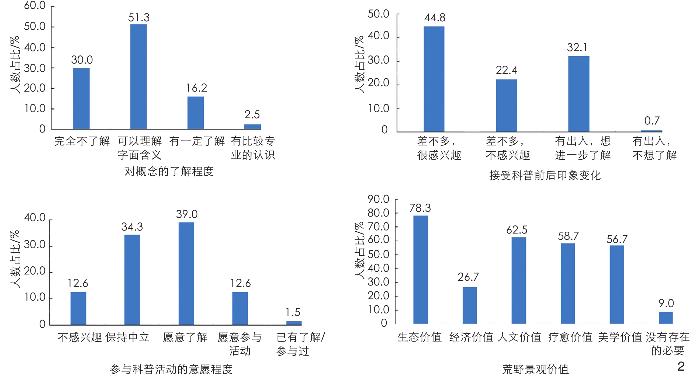
文中所有图表均由作者拍摄与绘制,其中行政边界信息来源于高德地图,审图号:GS京(2022)1061号。
| [1] |
MILLER J R. Biodiversity Conservation and the Extinction of Experience[J]. Trends in Ecology & Evolution, 2005, 20 (8): 430-434.
|
| [2] |
KOWARIK I. Urban Wilderness: Supply, Demand, and Access[J]. Urban Forestry & Urban Greening, 2018, 29: 336-347.
|
| [3] |
曹越, 杨锐. 中国荒野研究框架与关键课题[J]. 中国园林, 2017, 33 (6): 10-15
CAO Y, YANG R. The Research Framework and Key Issues of Chinese Wilderness Studies[J]. Chinese Landscape Architecture, 2017, 33 (6): 10-15.
|
| [4] |
JORGENSEN A, KEENAN R. Urban Wildscapes[M]. New York: Routledge, 2012.
|
| [5] |
王向荣. 城市荒野与城市生境[J]. 风景园林, 2019, 26 (1): 4-5
WANG X R. Urban Wilderness and Urban Habitat[J]. Landscape Architecture, 2019, 26 (1): 4-5.
|
| [6] |
ZEFFERMAN E P, MCKINNEY M L, CIANCIOLO T, et al. Knoxville’s Urban Wilderness: Moving Toward Sustainable Multifunctional Management[J]. Urban Forestry & Urban Greening, 2017, 29: 357-366.
|
| [7] |
CELINA A, JENS-CHRISTIAN S, GERMAN T, et al. Wildness and Habitat Quality Drive Spatial Patterns of Urban Biodiversity[J]. Landscape and Urban Planning, 2022, 228: 104570.
|
| [8] |
WEBER F, KOWARIK I, SÄUMEL I. A Walk on the Wild Side: Perceptions of Roadside Vegetation Beyond Trees[J]. Urban Forestry & Urban Greening, 2014, 13 (2): 205-212.
|
| [9] |
CHRISTOPHER R, KAYLA P, KERRY A, et al. Asset or Liability? Ecological and Sociological Tradeoffs of Urban Spontaneous Vegetation on Vacant Land in Shrinking Cities[J]. Sustainability, 2018, 10 (7): 2139.
|
| [10] |
PHILIPS D, LINDQUIST M. Just Weeds? Comparing Assessed and Perceived Biodiversity of Urban Spontaneous Vegetation in Informal Greenspaces in the Context of Two American Legacy Cities[J]. Urban Forestry & Urban Greening, 2021, 62: 127151
|
| [11] |
MANYANI C M, SHACKLETON M L. Cocks, Attitudes and Preferences Towards Elements of Formal and Informal Public Green Spaces in Two South African Towns, Landscape and Urban Planning, 2021, 214: 104147.
|
| [12] |
DE LA FUENTE DE VAL G. The Effect of Spontaneous Wild Vegetation on Landscape Preferences in Urban Green Spaces[J]. Urban Forestry & Urban Greening, 2023, 81: 127863
|
| [13] |
徐雁, 黄民生, 何国富, 等. 上海建设生态型城市的瓶颈问题及对策[J]. 现代城市研究, 2006, 21 (6): 59-64
XU Y, HUANG M S, HE G F, et al. Bottlenecks and Countermeasures for Building an Ecological City in Shanghai[J]. Modern Urban Research, 2006, 21 (6): 59-64.
|
| [14] |
张凯旋, 车生泉, 马少初, 等. 城市化进程中上海植被的多样性、空间格局和动态响应(Ⅵ): 上海外环林带群落多样性与结构特征[J]. 华东师范大学学报: 自然科学版, 2011 (4): 1-14
ZHANG K X, CHE S Q, MA S C, et al. Diversity, Spatial Pattern and Dynamic Response of Vegetation in Shanghai During Urbanization (Ⅵ): Diversity and Structural Characteristics of Communities in the Outer Ring Forest Belt of Shanghai[J]. Journal of East China Normal University (Natural Science Edition), 2011 (4): 1-14.
|
| [15] |
王晞月. 城市缝隙: 人居语境下荒野景观的存续与营造策略[J]. 城市发展研究, 2017, 24 (7): 11-16
WANG X Y. Urban Interstitial Space: Strategic Research on the Planning of Wildscape in the Context of Living Environment[J]. Urban Development Studies, 2017, 24 (7): 11-16.
|
| [16] |
李嘉宁, 王志勇, 吴珊珊, 等. 城市荒野的生态与文化价值研究进展[J]. 风景园林, 2024, 31 (1): 89-96
LI J N, WANG Z Y, WU S S, et al. Progress of Research on Ecological and Cultural Values of Urban Wilderness[J]. Landscape Architecture, 2024, 31 (1): 89-96
|
| [17] |
曹越, 马丁, 杨锐. 城市野境: 城市区域中野性自然的保护与营造[J]. 风景园林, 2019, 26 (8): 20-24
CAO Y, MARTIN V, YANG R. Urban Wilderness: Conservation and Creation of Wild Nature in Urban Areas[J]. Landscape Architecture, 2019, 26 (8): 20-24.
|
| [18] |
杨永川, 王娟, 达良俊. 城市化进程中上海植被的多样性、空间格局和动态响应(Ⅱ): 城市废弃地上海江湾机场的植物组成[J]. 华东师范大学学报(自然科学版), 2008 (4): 40-48
YANG Y C, WANG J, DA L J. Diversity, Spatial Pattern and Dynamics of Vegetation Under Urbanization in Shanghai (Ⅱ): Study on the Flora of Jiangwan Airport, an Abandoned Land, Shanghai[J]. Journal of East China Normal University (Natural Science), 2008 (4): 40-48.
|
| [19] |
郭陶然, 山冰沁. 城市荒野景观营造: 以上海乡土生态科普示范基地为例[J]. 景观设计学, 2021, 9 (1): 120-131
GUO T R, SHAN B Q. Urban Wilderness Construction: An Example of Shanghai Urban Biodiversity Education Base[J]. Landscape Architecture Frontiers, 2021, 9 (1): 120-131
|
| [20] |
同济大学建筑设计研究院(集团)有限公司. 上海杨浦滨江公共空间和综合环境工程(一至三期)[J]. 中国工程咨询, 2024, 25 (2): 3-4
Tongji Architecture Design (Group) Co., Ltd. Shanghai Yangpu Riverside Public Space and Integrated Environment Project (Phase I−III)[J]. China Engineering Consultants, 2024, 25 (2): 3-4.
|
| [21] |
席丹丹, 刘斯, 柳钰, 等. 公众认知下的成都城市荒野景观价值[J]. 风景园林, 2024, 31 (1): 97-102
XI D D, LIU S, LIU Y, et al. Values of Chengdu Urban Wilderness Landscape Under Public Cognition[J]. Landscape Architecture, 2024, 31 (1): 97-102
|
| [22] |
PHILIPS D, LINDQUIST M. Just Weeds? Comparing Assessed and Perceived Biodiversity of Urban Spontaneous Vegetation in Informal Greenspaces in the Context of Two American Legacy Cities[J]. Urban Forestry & Urban Greening, 2021, 62: 127151
|
| [23] |
魏方, 陈鲁, 昝鹏, 等. 机器与自然之间: 后工业景观再野化的公众感知研究[J]. 中国园林, 2022, 38 (8): 36-41
WEI F, CHEN L, ZAN P, et al. Between Industrial Remains and the Green: Research on Public Perception of Rewilded Postindustrial Landscape[J]. Chinese Landscape Architecture, 2022, 38 (8): 36-41.
|
| [24] |
LEHTO C, HEDBLOM M, FILYUSHKINA A, et al. Seeing Through Their Eyes: Revealing Recreationists’ Landscape Preferences Through Viewshed Analysis and Machine Learning[J]. Landscape and Urban Planning, 2024, 248: 105097.
|
| [25] |
戴代新, 谢民. 公众参与地理信息系统在风景园林规划中的应用[J]. 风景园林, 2016, 23 (7): 98-104
DAI D X, XIE M. The Application of Public Participation Geographic Information Systems in Landscape Architecture[J]. Landscape Architecture, 2016, 23 (7): 98-104.
|
| [26] |
刘阳, 赵振斌, 李小永. 基于PPGIS的乡村旅游社区景观价值变化研究: 以丽江束河古镇为例[J]. 地理科学, 2021, 41 (2): 328-339
LIU Y, ZHAO Z B, LI X Y. Research on the Change of Landscape Value of Rural Tourism Community Based on PPGIS: Taking Shuhe Ancient Town of Lijiang as an Example[J]. Geoscience, 2021, 41 (2): 328-339.
|
| [27] |
戴代新, 刘颂, 张桐恺. 基于公众参与地理信息系统的城市近代公园文化服务评估研究: 以上海复兴公园为例[J]. 风景园林, 2019, 26 (8): 95-100
DAI D X, LIU S, ZHANG T K. Research on the Assessment of Cultural Services in Modern Urban Parks Based on Public Participation Geographic Information System: Taking Shanghai Fuxing Park as an Example[J]. Landscape Architecture, 2019, 26 (8): 95-100.
|
| [28] |
赵晓龙, 汤奕子, 卞晴, 等. 基于公众参与地理信息系统的城市绿地体力活动与建成环境特征相关性研究: 以哈尔滨市为例[J]. 风景园林, 2021, 28 (3): 101-106
ZHAO X L, TANG Y Z, BIAN Q, et al. Identification of Correlation Between Physical Activity of Green Space and Built Environment Characteristics Based on PPGIS: A Case Study of Harbin[J]. Landscape Architecture, 2021, 28 (3): 101-106.
|
| [29] |
黄邓楷, 王国光, 陈芷筠. 基于公众参与地理信息系统的广州大学城环境安全感评价研究[J]. 风景园林, 2019, 26 (12): 97-102
HUANG D K, WANG G G, CHEN Z J. Research on Perceived Safety Evaluation of Guangzhou Higher Education Mega Center Environment Based on Public Participation Geographic Information System[J]. Landscape Architecture, 2019, 26 (12): 97-102.
|
| [30] |
邵钰涵, 刘滨谊. 乡村景观的视觉感知分析[J]. 中国园林, 2016, 32 (9): 5-10
SHAO Y H, LIU B Y. Visual Perception Analysis of Rural Landscape[J]. Chinese Landscape Architecture, 2016, 32 (9): 5-10.
|
| [31] |
罗涛, 徐婵娟, 蓝思琪, 等. 城市视觉景观公众偏好特征研究[J]. 中国园林, 2023, 39 (11): 15-21
LUO T, XU C J, LAN S Q, et al. Characterization of Public Preference for Urban Visual Landscape[J]. Chinese Landscape Architecture, 2023, 39 (11): 15-21.
|
| [32] |
张增可, 李曾燕, 杨柏钰, 等. 上海大金山岛常见木本植物功能性状对生长和死亡的影响[J]. 植物生态学报, 2023, 47 (10): 1398-1406
ZHANG Z K, LI Z Y, YANG B Y, et al. Effects of Functional Characteristics of Common Woody Plants on Growth and Death on Dajinshan Island, Shanghai[J]. Journal of Plant Ecology, 2023, 47 (10): 1398-1406.
|
| [33] |
葛振鸣, 王天厚, 施文彧, 等. 崇明东滩围垦堤内植被快速次生演替特征[J]. 应用生态学报, 2005, 16 (9): 1677-1681
GE Z M, WANG T H, SHI W Y, et al. Characteristics of Rapid Secondary Succession of Vegetation Within the Reclamation Embankment of Chongming Dongtan[J]. Journal of Applied Ecology, 2005, 16 (9): 1677-1681.
|
/
| 〈 |
|
〉 |