

夜跑友好视角下城市街道环境视觉感知评价
|
陈崇贤/男/博士/华南农业大学林学与风景园林学院副教授、博士生导师/本刊青年编委/研究方向为风景园林规划设计与理论 |
|
刘欣宜/女/华南农业大学林学与风景园林学院在读硕士研究生/研究方向为风景园林规划设计与理论 |
|
邱添 /女/华南农业大学林学与风景园林学院在读硕士研究生/研究方向为风景园林规划设计与理论 |
|
刘京一/男/博士/华南农业大学林学与风景园林学院副教授、硕士生导师/研究方向为风景园林规划设计与理论 |
收稿日期: 2023-10-16
网络出版日期: 2025-12-15
基金资助
国家自然科学基金资助项目“迈向健康城市环境:对后疫情时代城市公共空间规划、设计和管理的响应”(72111530208)
广州市科技计划项目“城市街道景观适老健康效益智能化评测及优化研究”(编号202201010046)
版权
Evaluation on Visual Perception of Urban Street Environment from the Perspective of Being Friendly to Nighttime Running
|
CHEN Chongxian, Ph.D., is an associate professor and doctoral supervisor in the College of Forestry and Landscape Architecture, South China Agricultural University, and a young editorial board member of this journal. His research focuses on landscape planning and design, and theory of landscape architecture |
|
LIU Xinyi is a master student in the College of Forestry and Landscape Architecture, South China Agricultural University. Her research focuses on landscape planning and design, and theory of landscape architecture |
|
QIU Tian is a master student in the College of Forestry and Landscape Architecture, South China Agricultural University. Her research focuses on landscape planning and design, and theory of landscape architecture |
|
LIU Jingyi, Ph.D., is a associate professor and master supervisor in the College of Forestry and Landscape Architecture, South China Agricultural University. His research focuses on landscape planning and design, and theory of landscape architecture |
Received date: 2023-10-16
Online published: 2025-12-15
Copyright
【目的】随着现代生活方式的转变,城市居民对夜跑活动的需求日益增加。已有跑步环境研究较多关注日间情景,城市街道夜间环境对跑者的影响还有待进一步探究。【方法】以广州越秀核心区为研究区域,利用计算机视觉和人机对抗评分平台评估不同类型街道对夜跑的安全感、恢复力、舒适度、吸引力及环境质量等方面视觉感知的影响,并运用空间自相关方法和地理加权回归模型研究各类街道环境要素与夜跑环境视觉感知之间的关系。【结果】研究发现,滨水街道和商业街可提升夜跑者的舒适度和恢复力,历史文化街道可增强夜跑的安全感和吸引力,而餐饮街和商住混合区街道较难激发正面跑步体验。不同街道环境要素对夜跑环境视觉感知的影响存在差异。【结论】考虑夜跑环境视觉感知评价对优化城市夜间跑步环境具有指导意义,未来可以通过区分街道类型,采取有针对性的规划设计措施来提升不同街道的夜跑体验质量。
陈崇贤 , 刘欣宜 , 邱添 , 刘京一 . 夜跑友好视角下城市街道环境视觉感知评价[J]. 风景园林, 2024 , 31(4) : 36 -43 . DOI: 10.3724/j.fjyl.202310160466
[Objective] As contemporary lifestyles continue to evolve, urban residents have witnessed a notable surge in the demand for nighttime running activities. However, it is imperative to acknowledge that the existing research on environmental perception predominantly focuses on daytime running scenario, leading to a constrained comprehension of how nighttime street environments influence the perceptions of runners. Given the distinctive disparities between daytime and nighttime running contexts, variables such as illumination, pedestrian density and accessibility of nighttime streetscape hold significant potential to shape runners’ perceptions of safety, comfort, resilience, etc. Therefore, there exists a compelling necessity for a more comprehensive investigation into how diverse categories of street environments during nighttime influence the perceptions of urban residents interested in nighttime running activities.
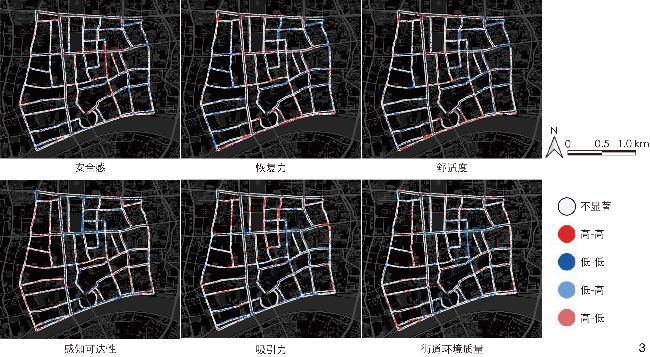
[Methods] This research aims to evaluate how nighttime street environments influence the visual perception of nighttime running environment by taking in account the six key indicators of safety, resilience, comfort, perceived accessibility, attractiveness, and quality of street environment. The research is conducted in the core area of Yuexiu District in Guangzhou. The computer vision technology is used to extract elements from nighttime street environments, and the visual perception of nighttime running environment is assessed using a combination of crowdsourced human-computer interaction evaluations and a residual neural network model, based on which a spatial autocorrelation analysis is performed. Furthermore, a geographically weighted regression model is applied to better understand the influence of various urban street environment factors on the visual perception of nighttime running environment.
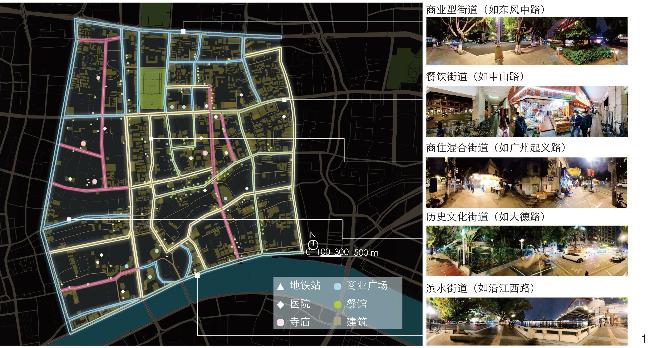
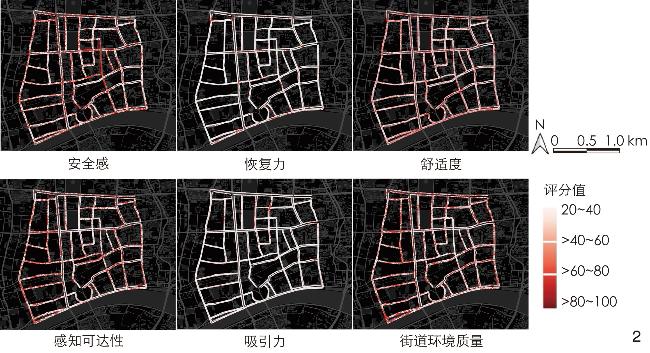
[Results] Different types of streets vary greatly in how nighttime runners perceive them. Waterfront streets and historical and cultural streets often display heightened levels of safety, resilience, and allure. This suggests that these locales typically provide a secure and comfortable environment for nighttime running, albeit at the expense of slightly diminished perceived accessibility. In contrast, single-purpose dining streets and those with limited functional diversity tend to score lower in terms of resilience, comfort, and environmental quality, likely due to factors such as heavy pedestrian traffic and vehicular congestion. Commercial streets, however, tend to garner higher ratings in resilience, attractiveness, and comfort. Moreover, various environmental aspects of nighttime streets, such as green visibility, sky visibility, degree of congestion, degree of enclosure, walkability, scenario diversity, color temperature, and brightness, demonstrate substantial variations in their associations with the visual perception of nighttime running environment across different types of streets. For instance, waterfront streets are more likely to be perceived as comfortable and accessible during nighttime running, and enhancing the brightness of street lighting and utilizing warm-toned illumination can enhance the convenience and perceived accessibility of nighttime running in such areas. Historical and cultural streets are particularly susceptible to the influences of nighttime environmental conditions. Increasing the green visibility, openness, brightness, and walkability can stimulate nighttime running by appealing to runners through the presence of lush green spaces, expansive views of the night sky, and broad sidewalks. In the case of comprehensive streets, reducing the perception of enclosure can heighten attractiveness, especially in well-appointed streets. However, such associations may decrease the sense of safety in bustling commercial and dining streets characterized by chaotic traffic. This implies that well-maintained comprehensive streets can attract night runners, whereas streets under poor management may diminish the perception of safety. Furthermore, in mixed-use areas, attractiveness and resilience are more readily influenced by nighttime street environment factors, and warm-toned lighting may detract from the beauty of streets.
[Conclusion] This research highlights the importance of targeted urban planning and design strategies tailored to the functional attributes of different types of streets in optimizing the urban environment for nighttime running. Specifically, the introduction of windbreak greenery and other landscaping elements in open waterfront areas can create a comfortable microclimate, thereby enhancing the overall comfort of nighttime running. In streets of historical and cultural significance, strategically placing uniform and soft lighting fixtures and incorporating decorative greenery can not only ensure safety but also foster a vibrant nighttime running ambiance. For mixed-use streets with diverse functions, enhancing the quality of roads and pedestrian infrastructure and integrating distinct rest areas or social spaces can enrich the nighttime running experience. In view of this, relevant authorities need to take into account the functional attributes and unique characteristics of local streets in future urban planning and design endeavors. Measures such as lighting upgrades, landscape enhancement, and site adaptation must be implemented to enhance the comfort, safety, and attractiveness of nighttime running environments. This, in turn, will contribute to the development of urban public spaces that better cater to the needs of night runners, encouraging residents to participate in nighttime running activities and ultimately fostering a more dynamic, inclusive, and health-oriented urban nighttime lifestyle. Such a transformative approach will guide cities toward creating a more accommodating environment for nighttime runners.
表1 城市街道夜跑环境视觉感知评估指标Tab. 1 Assessment indicators for visual perception of nighttime running in urban street environments |
| 感知指标 | 定义 | 问题 |
|---|---|---|
| 安全感 | 指对环境潜在风险的主观预测及应对时的可控性评估 | 在此环境中夜跑,能否让您感到安全? |
| 恢复力 | 指街道环境能够使夜跑者在精神和心理上得到调节和放松的特点 | 在此环境中夜跑,能否让您感到放松? |
| 舒适度 | 指对街道的整洁度、秩序感、人体尺度等要素的协调性感受 | 在此环境中夜跑,能否让您感到舒适? |
| 感知可达性 | 指对空间连通感和街道便捷性的认知判断 | 您认为这里的通达性如何? |
| 吸引力 | 指对街道环境的可识别性、美观性等认可而产生的愉悦情绪 | 您认为这里的吸引力如何? |
| 街道环境质量 | 指对夜间绿化环境、街道照明、基础设施等的整体性评判 | 您认为这里的环境质量如何? |
表2 城市夜间街道环境视觉要素Tab. 2 Visual elements of urban nighttime street environment |
| 环境要素 | 技术方法 | 定义 | 计算式[42] |
|---|---|---|---|
| 绿视率 | 语义分割 | 指人可见范围内植物覆盖的比例,能够增强夜跑者对于街景美学的体验,延长夜跑的时间,减轻心理压力 | $ {G}_{i}={V}_{i}/{n}_{i} $,$ \mathrm{式}\mathrm{中}{G}_{i} $表示第$ i $张图像中植被像素占总像素的比例,$ {V}_{i} $表示植被的像素数量,$ {n}_{i} $表示总像素数量 |
| 天空可视率 | 语义分割 | 指人视野中可见的天空比例,影响街景的空间质量和对夜跑活动的舒适程度 | $ {O}_{i}={S}_{i}/{n}_{i} $,$ {\mathrm{式}\mathrm{中}O}_{i} $表示第$ i $张图像中天空像素占总像素的比例,$ {S}_{i} $表示天空的像素数量 |
| 拥挤度 | 目标检测 | 反映夜跑街道的交通和行人流状况,与街道的自行车和行人数量有关 | $ {V}_{i}={p}_{i}+{b}_{i} $,$ {\mathrm{式}\mathrm{中}V}_{i} $是行人和自行车的总数,其中$ {p}_{i} $表示行人的数量,$ {b}_{i} $表示自行车数量 |
| 围合度 | 语义分割 | 指街道空间上由建筑物、墙体、树木等垂直元素所形成的视觉围合程度,与街景活力、夜跑的秩序和安全密切相关 | $ {E}_{i}=({V}_{i}+{T}_{i}+{BU}_{i}+{W}_{i}+{F}_{i}+{P}_{i}+)/{n}_{i} $,$ {\mathrm{式}\mathrm{中}E}_{i} $表示街道在视觉上被街道墙和相应的水平元素包围的程度,$ {V}_{i} $、$ {T}_{i} $、$ {BU}_{i} $、$ {W}_{i} $、$ {F}_{i} $、$ {P}_{i} $分别表示植被、地形、建筑、墙面、栅栏和杆的像素数量 |
| 视觉可步行性 | 语义分割 | 指街道对步行者的友好程度,考虑到人行道、交通车辆等,强调夜跑者的舒适和愉悦体验 | $ {W}_{i}={S}_{i}/({S}_{i}+{C}_{i}+{TU}_{i}+{B}_{i}+{R}_{i})\times {n}_{i} $,$ {\mathrm{式}\mathrm{中}S}_{i} $表示人行道像素的数量,$ {C}_{i} $、$ {TU}_{i} $、$ {B}_{i} $、$ {R}_{i} $分别表示汽车、卡车、公交车和道路像素的数量 |
| 场景多样性 | 目标检测 | 指街道元素的相对多样性,给予夜跑者不同的场景兴趣,增加了夜跑过程中丰富的视觉刺激和变化 | $ {R}_{i}={d}_{i}$,$ {\mathrm{式}\mathrm{中}R}_{i} $表示每张图片中街景元素的丰富程度,${d}_{i}$表示每张图片中街景元素类型的数量 |
| 亮度 | 机器学习 | 通常与光照强度相关,决定了夜跑者的视野范围与夜间街道的可见性[43] | $ {B}_{i}=\bar{v}_{i}$,若将亮度视为0~255的线性亮度值,则式中以$ \bar{v}_{i}$作为灯光强度的度量 |
| 色温 | 机器学习 | 指街道光源的颜色特性:中低的色温(约3 500~4 000 k)通常给人以温暖柔和的氛围感,对夜跑者起到放松、安抚的效果[44-45] | $ {T}_{i}={H}_{i} $,$ {\mathrm{式}\mathrm{中}T}_{i} $表示每张照片中灯光的色温信息,$ {H}_{i}$表示色调(Hue),即颜色的类型:{$ 0\leqslant {H}_{i} \leqslant 80 $}∪{$ 330\leqslant {H}_{i} \leqslant 360 $}属于暖光,其他区间为冷光 |
表3 夜跑环境视觉感知评分统计Tab. 3 Scoring statics of visual perception of nighttime running environment |
| 感知指标 | 均值 | 中位数 | 标准差 | 最大值 | 最小值 |
|---|---|---|---|---|---|
| 安全感 | 56.260 | 53.757 | 15.668 | 100 | 21.070 |
| 恢复力 | 42.210 | 39.993 | 11.336 | 100 | 22.277 |
| 舒适度 | 45.535 | 45.849 | 10.070 | 100 | 16.921 |
| 感知可达性 | 54.615 | 52.950 | 14.038 | 100 | 23.509 |
| 吸引力 | 43.207 | 42.325 | 9.092 | 100 | 20.095 |
| 街道环境质量 | 57.474 | 56.649 | 10.584 | 100 | 29.181 |
表4 OLS和GWR模型系数描述性统计Tab. 4 Descriptive statics of coefficients in OLS and GWR models |
| 环境要素 | 安全感 | 恢复力 | 舒适度 | |||||||||||||||||
|---|---|---|---|---|---|---|---|---|---|---|---|---|---|---|---|---|---|---|---|---|
| OLS | GWR | OLS | GWR | OLS | GWR | |||||||||||||||
| 概率 | Robust_Pr | VIF | 均值a) | 标准差b) | 概率 | Robust_Pr | VIF | 均值 | 标准差 | 概率 | Robust_Pr | VIF | 均值 | 标准差 | ||||||
| 注:*、**、***分别表示变量在90%、95%、99%置信水平上显著;“—”表示不存在显著性;a)GWR系数的正负号反映了它们对夜间跑步感知的潜在增强或抑制作用;b)GWR的标准差可以衡量不同变量对各区夜间跑步感知差异的影响程度,标准差越大,表示不同街区夜间跑步感知程度差异越大。 | ||||||||||||||||||||
| 绿视率 | 0*** | 0*** | 1.097 | 0.076 | 0.088 | 0*** | 0*** | 1.097 | 0.204 | 0.179 | 0*** | 0*** | 1.097 | 0.194 | 0.163 | |||||
| 天空可视率 | 0*** | 0*** | 1.029 | 0.088 | 0.097 | 0*** | 0*** | 1.027 | 0.111 | 0.114 | 0*** | 0*** | 1.028 | 0.157 | 0.142 | |||||
| 拥挤度 | 0*** | 0*** | 1.071 | 0.120 | 0.083 | 0.615 | 0.612 | 1.071 | — | — | 0*** | 0*** | 1.071 | 0.032 | 0.028 | |||||
| 围合度 | 0.947 | 0.947 | 1.220 | — | — | 0.547 | 0.540 | 1.220 | — | — | 0.233 | 0.228 | 1.220 | — | — | |||||
| 视觉可步行性 | 0*** | 0*** | 1.196 | 0.340 | 0.323 | 0*** | 0*** | 1.196 | 0.340 | 0.323 | 0*** | 0*** | 1.196 | −0.004 | −0.001 | |||||
| 场景多样性 | 0.988 | 0.988 | 1.218 | — | — | 0.752 | 0.744 | 1.218 | — | — | 0.239 | 0.242 | 1.218 | — | — | |||||
| 亮度 | 0*** | 0*** | 1.258 | 0.177 | 0.201 | 0*** | 0*** | 1.258 | 0.177 | 0.201 | 0*** | 0*** | 1.258 | 0.324 | −0.289 | |||||
| 色温(暖) | 0.001** | 0.003** | 1.046 | −0.164 | −0.179 | 0*** | 0*** | 1.046 | −0.164 | −0.179 | 0*** | 0*** | 1.046 | −0.159 | 0.434 | |||||
| 环境要素 | 感知可达性 | 吸引力 | 街道环境质量 | |||||||||||||||||
| OLS | GWR | OLS | GWR | OLS | GWR | |||||||||||||||
| 概率 | Robust_Pr | VIF | 均值 | 标准差 | 概率 | Robust_Pr | VIF | 均值 | 标准差 | 概率 | Robust_Pr | VIF | 均值 | 标准差 | ||||||
| 绿视率 | 0*** | 0*** | 1.097 | 0.073 | 0.095 | 0*** | 0*** | 1.097 | 0.145 | 0.140 | 0*** | 0*** | 1.097 | 0.162 | 0.158 | |||||
| 天空可视率 | 0*** | 0*** | 1.028 | −0.130 | −0.130 | 0*** | 0*** | 1.028 | 0.113 | 0.120 | 0*** | 0*** | 1.028 | 0.060 | 0.063 | |||||
| 拥挤度 | 0*** | 0*** | 1.071 | 0.107 | 0.068 | 0.500 | 0.405 | 1.071 | — | — | 0.276 | 0.268 | 1.071 | — | − | |||||
| 围合度 | 0*** | 0*** | 1.22 | 0.007 | 0.001 | 0.043* | 0.040* | 1.220 | 0.007 | 0.002 | 0.388 | 0.391 | 1.220 | — | — | |||||
| 视觉可步行性 | 0*** | 0*** | 1.196 | −0.016 | −0.029 | 0.376 | 0.365 | 1.196 | — | — | 0*** | 0*** | 1.196 | −0.835 | −0.828 | |||||
| 场景多样性 | 0.006** | 0.005** | 1.218 | −0.004 | −0.001 | 0.765 | 0.764 | 1.218 | — | — | 0.024* | 0.025* | 1.218 | −0.008 | −0.005 | |||||
| 亮度 | 0*** | 0*** | 1.258 | −0.295 | −0.289 | 0*** | 0*** | 1.258 | −0.310 | −0.301 | 0*** | 0*** | 1.258 | 0.069 | 0.064 | |||||
| 色温(暖) | 0*** | 0*** | 1.046 | 0.423 | 0.434 | 0*** | 0*** | 1.046 | 0.235 | 0.249 | 0*** | 0*** | 1.046 | 0.123 | 0.117 | |||||
文中图表均由作者绘制。
| [1] |
LIU Y, LI Y P, YANG W, et al. Exploring Nonlinear Effects of Built Environment on Jogging Behavior Using Random Forest[J]. Applied Geography, 2023, 156: 102990.
|
| [2] |
陈崇贤, 李海薇, 林晓玲, 等. 基于计算机视觉的夜间户外环境情绪感知特征研究[J]. 中国园林, 2023, 39 (2): 20-25.
CHEN C X, LI H W, LIN X L, et al. Measuring the Effect of Nightscapes on Emotion Perceptions Based on Computer Vision[J]. Chinese Landscape Architecture, 2023, 39 (2): 20-25.
|
| [3] |
黄丽蒂, 刘双双, 郑博丹, 等. 面向老龄社会的社区建成环境可步行性测度研究[J]. 南方建筑, 2024 (1): 107-114.
HUANG L D, LIU S S, ZHENG B D, et al. Measuring Walkability of the Built Environment in Communities for an Aging Society[J]. South Architecture, 2024 (1): 107-114.
|
| [4] |
贾敬涵, 王子尧, 李倞. 基于多源大数据与深度学习的道路视觉特征与骑行流量相关性研究[J]. 中国园林, 2023, 39 (4): 84-90.
JIA J H, WANG Z Y, LI L. Research on the Correlation Between Road Visual Features and Cyclinc Traffic Based on Multi-source Big Data and Deep Learning[J]. Chinese Landscape Architecture, 2023, 39 (4): 84-90.
|
| [5] |
黄邓楷, 袁磊. 跑步频率与街区环境特征关联研究: 基于街景图片和公众参与地理信息系统视角[J]. 南方建筑, 2023 (4): 69-78.
HUANG D K, YUAN L. The Correlation Between Running Frequency and Environmental Characteristics: A Case Study from the Perspective of Street View Images and Public Participation GlS[J]. South Architecture, 2023 (4): 69-78.
|
| [6] |
吕飞, 师鑫雨, 戴锏. 格林模式视角下社区休闲性体力活动影响因素研究: 以哈尔滨七个典型社区为例[J]. 西部人居环境学刊, 2022, 37 (6): 43-51.
LV F, SHI X Y, DAI J. Study on Influencing Factors of Community Leisure Physical Activity from the Perspective of PRECEDE-PROCEED Model: Taking Seven Typical Communities in Harbin as Examples[J]. Journal of Human Settlements in West China, 2022, 37 (6): 43-51.
|
| [7] |
WANG L, HAN X, HE J, et al. Measuring Residents’ Perceptions of City Streets to Inform Better Street Planning Through Deep Learning and Space Syntax[J]. ISPRS Journal of Photogrammetry and Remote Sensing, 2022, 190: 215-230.
|
| [8] |
KOOHSARI M J, YASUNAGA A, OKA K, et al. Place Attachment and Walking Behaviour: Mediation by Perceived Neighbourhood Walkability[J]. Landscape and Urban Planning, 2023, 235: 104767.
|
| [9] |
NAWRATH M, KOWARIK I, FISCHER L K. The Influence of Green Streets on Cycling Behavior in European Cities[J]. Landscape and Urban Planning, 2019, 190: 103598.
|
| [10] |
张旺. 健康城市规划路径与要素辨析[J]. 建筑工程技术与设计, 2017 (3): 698
ZHANG W. Exploration of Approaches and Factors of Healthy City Planning[J]. Architectural Engineering Technology and Design, 2017 (3): 698.
|
| [11] |
董慰, 刘岩, 董禹. 健康视角下城市居民对建成环境感知的测度方法研究进展[J]. 科技导报, 2020, 38 (7): 61-68.
DONG W, LIU Y, DONG Y. Measurement Methods of Urban Residents’ Perception of Built Environment from a Health Perspective: A Review[J]. Science & Technology Review, 2020, 38 (7): 61-68.
|
| [12] |
宋晗, 甄峰, 徐海贤. 基于身体活动及心理感知的城市空间环境设计研究[J]. 现代城市研究, 2023 12: 45-51.
SONG H, ZHEN F, XU H X. Research on the Design of Urban Space Environment Based on Physical Activity and Psychological Perception[J]. Modern Urban Research, 2023 12: 45-51.
|
| [13] |
梁晨, 曾坚. 基于重要性-绩效分析的历史文化街区步行环境优化研究: 以天津五大道地区为例[J]. 现代城市研究, 2019 (2): 54-59.
LIANG C, ZENG J. Research on Optimization of Walking Environment in Historical District Based on Importance-Performance Analysis: A Case Study of the Five Avenues, Tianjin[J]. Modern Urban Research, 2019 (2): 54-59.
|
| [14] |
郑凌予, 杨淑梅, 伍夏, 等. 基于空间感知的社区绿色暴露指数对活动行为影响研究[J]. 中国园林, 2023, 39 (1): 92-97.
ZHENG L Y, YANG S M, WU X, et al. Study on the Impact of Community Green Exposure Index on Activity Behavior Based on Spatial Perception[J]. Chinese Landscape Architecture, 2023, 39 (1): 92-97.
|
| [15] |
HUANG D K, TIAN M, YUAN L. Do Objective and Subjective Traffic-Related Pollution, Physical Activity and Nature Exposure Affect Mental Wellbeing? Evidence from Shenzhen, China[J]. Science of The Total Environment, 2023, 869: 161819.
|
| [16] |
ETTEMA D. Runnable Cities How Does the Running Environment Influence Perceived Attractiveness, Restorativeness, and Running Frequency?[J]. Environment & Behavior, 2015, 48 (9): 1127-1147.
|
| [17] |
朱萌, 王灿祥, 陈锦富. 街道步行环境夜间安全感关键影响因素识别: 基于可穿戴生理传感器的感知实验[J]. 中国园林, 2023, 39 (6): 64-69.
ZHU M, WANG C X, CHEN J F. Identification of Key Influences on the Perception of Safety at Night in Street Walking Environment: Walking Perception Experiments Based on Wearable Physiological Sensors[J]. Chinese Landscape Architecture, 2023, 39 (6): 64-69.
|
| [18] |
吴莞姝, 党煜婷, 赵凯. 基于多维感知的城市活力空间特征研究[J]. 地球信息科学学报, 2022, 24 (10): 1867-1882.
WU W S, DANG Y T, ZHAO K. Spatial Characteristics of Urban Vitality Based on Multi-dimensional Perception[J]. Journal of Geo-information Science, 2022, 24 (10): 1867-1882.
|
| [19] |
SONG H Y, PAN M M, CHEN Y Y. Nightlife and Public Spaces in Urban Villages: A Case Study of the Pearl River Delta in China[J]. Habitat International, 2016, 57: 187-204.
|
| [20] |
孙振帮, 闫治安, 王艺璇. 乡镇留守居民的绿色公共空间体力活动需求评价: 以山东省泰安市东疏镇为例[J]. 风景园林, 2023, 30 S2: 82-87.
SUN Z B, YAN Z A, WANG Y X. Research on Physical Activity Demand of Township Left-Behind Residents in Green Public Space: A Case Study of Dongshu Town Tai’an City[J]. Landscape Architecture, 2023, 30 S2: 82-87.
|
| [21] |
王青, 王琰, 李志民. 健康促进视角下中学生校园环境感知与体力活动关联性研究[J]. 西部人居环境学刊, 2023, 38 (4): 40-46.
WANG Q, WANG Y, LI Z M. A Study on the Correlation Between Environmental Perception and Physical Activity of Middle School Students from the Perspective of Health Promotion[J]. Journal of Human Settlements in West China, 2023, 38 (4): 40-46.
|
| [22] |
李心雨, 闫浩文, 王卓, 等. 街景图像与机器学习相结合的道路环境安全感知评价与影响因素分析[J]. 地球信息科学学报, 2023, 25 (4): 852-865.
LI X Y, YAN H W, WANG Z, et al. Evaluation of Road Environment Safety Perception and Analysis of Influencing Factors Combining Street View Imagery and Machine Learning[J]. Journal of Geo-information Science, 2023, 25 (4): 852-865.
|
| [23] |
袁琦, 陈泳. 包容性城市设计: 街道环境对认知衰退老年人休闲步行路径选择的影响研究[J]. 建筑学报, 2022 S1: 39-44.
YUAN Q, CHEN Y. Inclusive Urban Design: The Influence of Street Built Environment on the Leisure Walking Route Choice of the Cognitive Limpaired Older Adults[J]. Architectural Journal, 2022 S1: 39-44.
|
| [24] |
王厚雷, 张怡, 王竹影, 等. 城市社区建成环境对老年人户外体力活动与健康的影响[J]. 体育与科学, 2023, 44 (2): 81-89.
WANG H L, ZHANG Y, WANG Z Y, et al. Influence of Built Environment of Urban Community on Outdoor Physical Activity and Health of the Elderly[J]. Sports & Science, 2023, 44 (2): 81-89.
|
| [25] |
GAO Y J, ZHAO J Y, HAN L. Exploring the Spatial Heterogeneity of Urban Heat Island Effect and Its Relationship to Block Morphology with the Geographically Weighted Regression Model[J]. Sustainable Cities and Society, 2022, 76: 103431.
|
| [26] |
杨林川, 喻冰洁, 梁源, 等. 多源大数据支持下的共享单车出行与空间品质耦合研究[J]. 西部人居环境学刊, 2023, 38 (4): 47-57.
YANG L C, YU B J, LlANG Y, et al. The Coupling of Bike-Sharing Use and Cycling Space Quality: A Multi-Source Data-Supported Analysis[J]. Journal of Human Settlements in West China, 2023, 38 (4): 47-57.
|
| [27] |
LEE K H, DVORAK R G, SCHUETT M A, et al. Understanding Spatial Variation of Physical Inactivity Across the Continental United States[J]. Landscape And Urban Planning, 2017, 168: 61-71.
|
| [28] |
ÖZBIL T A, GÖÇER K, YEŞILTEPE D, et al. Understanding the Role of Urban Form in Explaining Transportation and Recreational Walking Among Children in a Logistic GWR Model: A Spatial Analysis in Istanbul, Turkey[J]. Journal of Transport Geography, 2020, 82: 102617.
|
| [29] |
广州市统计局. 2022年广州市人口规模及分布情况[EB/OL]. (2023-05-12)[2023-10-14]. http://tjj.gz.gov.cn/stats_newtjyw/tjsj/tjgb/qtgb/content/mpost_8910626.html.
Guang Zhou Statistics Bureau. The Population and Distribution of Guangzhou in 2022[EB/OL]. (2023-05-12)[2023-10-14]. http://tjj.gz.gov.cn/stats_newtjyw/tjsj/tjgb/qtgb/content/mpost_8910626.html.
|
| [30] |
GUO Q, LIN M Z, MENG J H, et al. The Development of Urban Night Tourism Based on the Nightscape Lighting Projects: A Case Study of Guangzhou[J]. Energy Procedia, 2011, 5: 477-481.
|
| [31] |
World Weather Online. Guangzhou Annual Weather Averages[EB/OL]. (2023-05-19)[2023-10-14]. https://www.worldweatheronline.com/guangzhou-weather/guangdong/cn.aspx.
|
| [32] |
人民网. 人民爱健身发布《2022国民健身趋势报告》[EB/OL]. (2022-08-02)[2023-10-14]. http://health.people.com.cn/n1/2022/0802/c14739-32491985.html.
People’s Daily Online. “People Love Fitness” Released 2022 National Fitness Trends Report[EB/OL]. (2022-08-02)[2023-10-14]. http://health.people.com.cn/n1/2022/0802/c14739-32491985.html.
|
| [33] |
DONG L, JIANG H C, LI W J, et al. Assessing Impacts of Street Environment on Running Route Choice Using Street View Data and Deep Learning: A Case Study of Boston[J]. Landscape and Urban Planning, 2022, 235: 104756.
|
| [34] |
齐子吟, 李君轶, 贺哲, 等. 基于街景图像的城市街道景观色彩对游客情感感知影响研究[J/OL].地球信息科学学报: 1-16[2023-10-25]. http://kns.cnki.net/kcms/detail/11.5809.P.20231023.0848.004.html.
QI Z Y, LI J Y, HE Z, et al. The Influence of Urban Streetscape Color on Tourists’ Emotional Perception Based on Streetscape Images[J/OL].地球信息科学学报: 1-16[2023-10-25]. http://kns.cnki.net/kcms/detail/11.5809.P.20231023.0848.004.html.
|
| [35] |
刘智谦, 吕建军, 姚尧, 等. 基于街景图像的可解释性城市感知模型研究方法[J]. 地球信息科学学报, 2022, 24 (10): 2045-2057.
LIU Z Q, LV J J, YAO Y, et al. Research Method of Interpretable Urban Perception Model Based on Street View Imagery[J]. Journal of Geo-information Science, 2022, 24 (10): 2045-2057.
|
| [36] |
胡峰. 广州市城市道路全要素设计手册[M]. 北京: 中国建筑工业出版社, 2018.
HU F. Guangzhou Complete Street Design Manual[M]. Beijing: China Architecture & Building Press, 2018.
|
| [37] |
YAO Y, LIANG Z T, YUAN Z H, et al. A Human-Machine Adversarial Scoring Framework for Urban Perception Assessment Using Street-View Images[J]. International Journal of Geographical Information Science, 2019, 33 (12): 2363-2384.
|
| [38] |
HO T K. Random Decision Forests[C]//IEEE. Proceedings of 3rd International Conference on Document Analysis and Recognition. Canada: IEEE, 2002.
|
| [39] |
YAO Y, WANG J L, HONG Y, et al. Discovering the Homogeneous Geographic Domain of Human Perceptions from Street View Images[J]. Landscape and Urban Planning, 2021, 212: 104125.
|
| [40] |
杨颋, 沈康, 周佛灵. 应用一种机器学习方法对新型剧场建筑进行视觉效果评价的实验[J]. 华中建筑, 2018, 36 (12): 55-62.
YANG T, SHEN K, ZHOU F L. An Experiment on Visual Evaluation for New Types of Theaters Based on a Machine Learning Method[J]. Huazhong Architecture, 2018, 36 (12): 55-62.
|
| [41] |
赵文晖, 伍昕忠, 徐斌, 等. 目标检测在链条标准件动态抓取中的应用研究[J]. 制造业自动化, 2023,45 (4): 213-216.
ZHAO W H, WU X Z, XU B, et al. Research on the Application of Target Detection in Dynamic Grasping of Chain Standard Parts[J]. Manufacturing Automation, 2023,45 (4): 213-216.
|
| [42] |
MA X Y, MA C Y, WU C, et al. Measuring Human Perceptions of Streetscapes to Better Inform Urban Renewal: A Perspective of Scene Semantic Parsing[J]. Cites, 2021, 110: 103086.
|
| [43] |
JOHANSSON M, ROSÉN M, KÜLLER R. Individual Factors Influencing the Assessment of the Outdoor Lighting of an Urban Footpath[J]. Lighting Research & Technology, 2011, 43 (1): 31-43.
|
| [44] |
中国建筑科学研究院. 城市道路照明设计标准: CJJ 45—2015[S]. 北京: 中国建筑工业出版社, 2016.
China Academy of Building Research. Standard for Lighting Design of Urban Road: CJJ 45−2015[S]. Beijing: China Architecture & Building Press, 2016.
|
| [45] |
袁景玉, 焦墨雪, 姚胜, 等. 居住区道路夜间光环境安全心理影响因素[J]. 科学技术与工程, 2021, 21 (27): 11681-11687.
YUAN J Y, JIAO M X, YAO S, et al. Influencing Factors of Safety Psychology in Night Light Environment of Residential Road[J]. Science Technology and Engineering, 2021, 21 (27): 11681-11687.
|
| [46] |
卢丹丹, 程维虎, 梅树江, 等. 时空统计在食源性疾病中的应用[J]. 数理统计与管理, 2018, 37 (1): 25-35.
LU D D, CHEN W H, MEI S J, et al. The Applications of Space-Time Statistical in the Field of Foodborne Disease[J]. Journal of Applied Statistics and Management, 2018, 37 (1): 25-35.
|
| [47] |
ANSELIN L. Local Indicators of Spatial Association: LISA[J]. Geographical Analysis, 1995, 27 (2): 93-115.
|
| [48] |
邢璐平, 方斌, 向梦杰. 基于GWR模型的江苏省耕地集约利用水平时空变化特征及影响因素[J]. 长江流域资源与环境, 2019, 28 (2): 376-386.
XING L P, FANG B, XIANG M J. Temporal and Spatial Variation of Cultivated Land Intensive Use Level and Its Influencing Factors in Jiangsu Province Based on GWR Model[J]. Resources and Environment in the Yangtze Basin, 2019, 28 (2): 376-386.
|
/
| 〈 |
|
〉 |