

“风景-遗存”对公众时空行为的影响机制研究——以首钢工业遗址公园为例
|
邱思嘉/女/北京林业大学园林学院在读硕士研究生/研究方向为风景园林规划与设计 |
|
宝力格/男/蒙古族/北京林业大学园林学院在读硕士研究生/研究方向为风景园林规划与设计 |
|
徐静/女/苗族/北京林业大学园林学院在读硕士研究生/研究方向为风景园林规划与设计 |
|
魏方/女/博士/北京林业大学园林学院副教授/研究方向为当代风景园林设计理论、景观感知、可持续更新 |
收稿日期: 2024-12-10
修回日期: 2025-01-19
网络出版日期: 2025-12-12
基金资助
北京市社会科学基金青年项目“基于公共价值提升的北京工业遗存分级保护与景观重构利用研究”(19YTC040)
版权
Research on the Influence Mechanism of “Scenery-Relics” Landscape on Public Spatio-Temporal Behavior and Perception Preference in Industrial Wasteland: A Case Study of Shougang Industrial Heritage Park
|
QIU Sijia is a master student in the School of Landscape Architecture, Beijing Forestry University. Her research focuses on landscape planning and design |
|
BAO Lige (Mongol) is a master student in the School of Landscape Architecture, Beijing Forestry University. His research focuses on landscape planning and design |
|
XU Jing (Miao) is a master student in the School of Landscape Architecture, Beijing Forestry University. Her research focuses on landscape planning and design |
|
WEI Fang, Ph.D., is an associate professor in the School of Landscape Architecture, Beijing Forestry University. Her research focuses on contemporary landscape design theory, landscape perception, and sustainable renewal |
Received date: 2024-12-10
Revised date: 2025-01-19
Online published: 2025-12-12
Copyright
后工业时期大量的城市工业废弃地减缓了城市化进程与经济发展,导致环境污染、生物多样性下降和城市空间碎片化,对居民生活质量和幸福感产生影响,城市工业废弃地逐渐变成被遗弃的空间。“风景-遗存”作为一种新兴的城市绿地类型展现出巨大的改造潜力,研究其对公众时空行为的影响机制,可为工业废弃地有机更新提供新的方向。
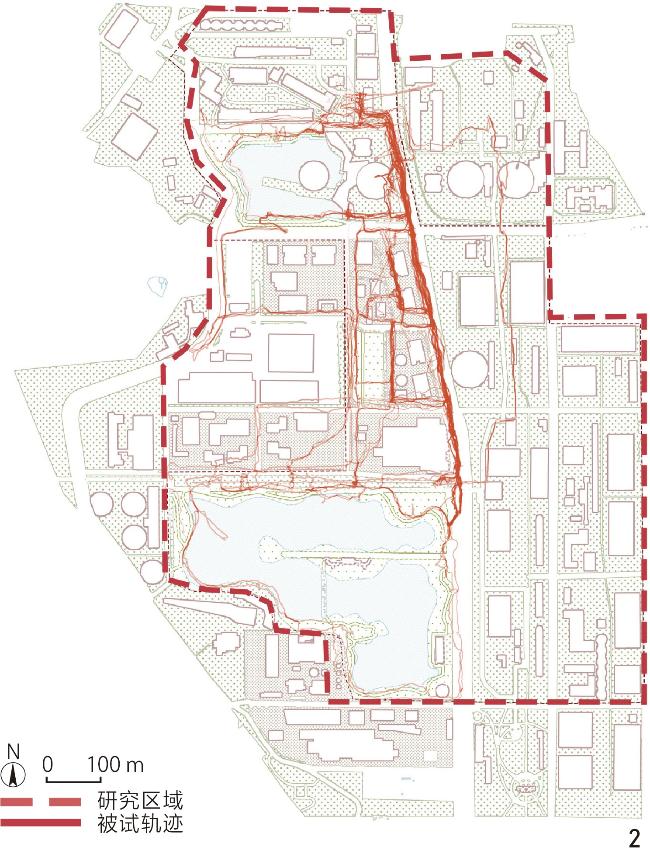
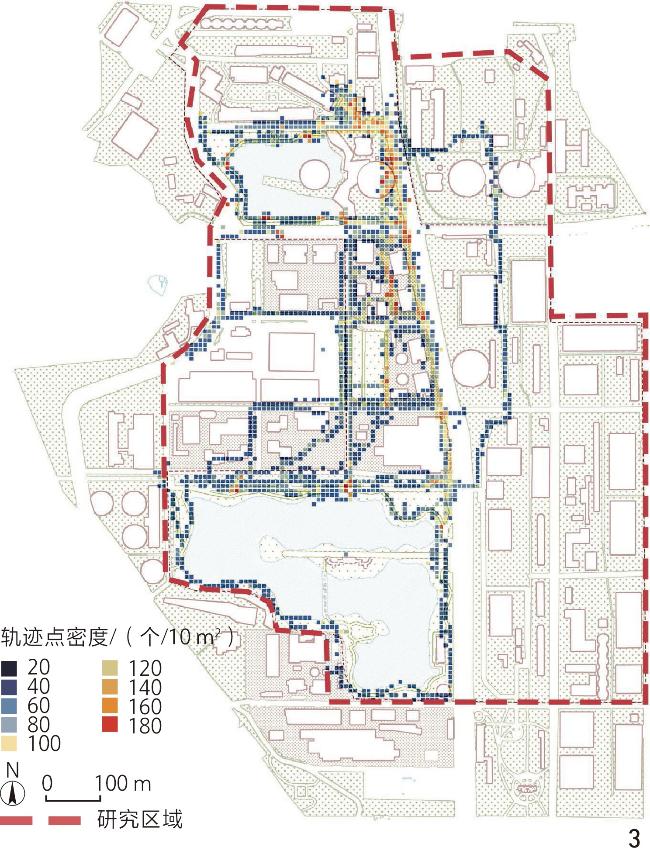
结合时空行为轨迹技术,通过计算空间指标度量样本空间的自然度,通过游客时空行为轨迹分布、轨迹点密度分布、轨迹点速度分布探究后工业景观中游客的行为模式。
对于客观指标,建筑面积占比与停留行为呈显著负相关,水体面积占比与通行行为呈极显著负相关;景观形状指数与漫步行为呈显著正相关,香农-威纳指数、辛普森指数与穿越行为呈现极显著正相关;自然要素与停留行为呈显著正相关。对于主观情感指标,除人工干预和管理程度与停留行为呈现显著正相关外,其余指标与时空行为无显著相关性。
从时空行为轨迹视角对后工业景观中游客行为模式进行研究,有助于了解后工业景观与游客行为模式之间的时空关系,可为后工业景观设计改造、城市绿地结构优化与工业废弃地有机更新提供理论参考。
邱思嘉 , 宝力格 , 徐静 , 魏方 . “风景-遗存”对公众时空行为的影响机制研究——以首钢工业遗址公园为例[J]. 风景园林, 2025 , 32(3) : 41 -48 . DOI: 10.3724/j.fjyl.LA20240107
During the de-industrialization period, large areas of urban industrial wastelands have slowed the process of urbanization and economic development. These sites, associated with environmental pollution, loss of biodiversity, and urban spatial fragmentation, have negatively influenced residents’ quality of life and well-being, eventually turning into abandoned spaces. The reclamation of industrial wastelands can effectively promote the development of these accounting components. Moreover, the “Scenery-Relics” concept, as a novel form of green space, has demonstrated significant potential for transformation, offering new directions for enhancing ecosystem cultural services.
The spatio-temporal behavioral trajectory technique provides an accurate and efficient method for the research on public behavioral preferences in post-industrial landscapes. Based on the aforesaid technique, to quantify the naturalness of sample spaces, spatial metrics are employed to measure their natural degree. By examining the trajectory patterns of tourists in post-industrial landscapes with varying degrees of naturalness, the number and density of trajectory points are used to investigate the behavioral patterns of tourists.
The results indicate a significant association mechanism between the spatio-temporal behavior trajectories of tourists and the “Scenery-Relics” of industrial land renewal. Various spatial elements and subjective emotional indicators within the naturalness of industrial landscapes exert certain influence on tourists’ spatio-temporal behavior. Overall, the proportion of buildings is inversely related to tourists’ stay time; the higher the proportion of buildings among all landscape elements, the shorter tourists’ stay. In terms of spatial indicators regarding the naturalness of industrial landscape, there is no significant correlation between behavior distribution and the proportions of paved areas, pedestrian pathways, vehicular roadways, or green spaces. However, the proportion of buildings shows a significant negative correlation with stay behavior distribution, while the proportion of water bodies exhibits a significant negative correlation with traffic behavior. The number of patches is not significantly related to behavior distribution, but the landscape shape index shows a significant positive correlation with strolling behavior. Shannon's Diversity Index and Simpson's Diversity Index demonstrate significant positive correlations with rapid traffic behavior. While naturalness and artificial elements are not significantly correlated with behavior distribution, natural elements show a significant positive correlation with stay behavior, and the number of plant layers is positively correlated with stay behavior. However, the data on subjective emotional indicator do not follow a normal distribution (p<0.05). Satisfaction, plant species, naturalness, and a sense of security show no significant relationship with behavior distribution. In contrast, artificial interventions and management are significantly positively correlated with stay behavior, indicating that tourists’ subjective perception of Shougang Industrial Heritage Park reveals a significant correlation between artificial interventions, management, and tourists’ behavior trajectories. Additionally, relevant research on the San Gaolu Xiuchi and Qunming Lake areas further confirms that within the natural elements of landscape spaces, the area of water bodies and the richness of plant spatial diversity are positively correlated with tourists’ stay time. Larger water body areas and more diverse plant landscapes can effectively attract tourists to stay.
Examining the behavior patterns of tourists in post-industrial landscapes from the perspective of spatio-temporal trajectory can help elucidate the spatio-temporal relationships between post-industrial landscapes and tourist behaviors. This approach provides a theoretical reference for the design and transformation of post-industrial landscapes, the optimization of urban green space structure, and the organic renewal of industrial wastelands.
表1 景观格局指数计算方法及意义Table 1 Calculation method and significance of landscape pattern index |
| 指标 | 计算式 | 式注 | 意义 |
| 景观形状指数 | ${\rm{ESI}} = {P^2}/A$ | ESI表示景观形状指数,P表示斑块的边缘长度,A表示斑块的面积 | 描述植被斑块的几何形状 |
| 斑块数量 | 描述景观破碎化程度 | ||
| 香农-威纳指数 | H ’$ = - \displaystyle\sum\nolimits_{i = 1}^S {{P_i} \times {\rm{ln}}{P_i}} $ | H’表示香农-威纳指数,S表示群落中物种的总数,P i 表示第i个物种的个体数占群落中总个体数的比例,ln表示自然对数。当群落中只有1个物种时,香农-威纳指数为0,即群落多样性为0。群落内物种数增加或物种相对多度越均衡,香农-威纳指数则随之上升;若不同物种相对多度差异增大,则香农-威纳指数降低 | 描述生态系统的物种多样性,评估生态系统的健康状况和稳定性 |
| 辛普森指数 | $D = 1 - \displaystyle\sum {P_i^2} $ | D为辛普森指数;P i 为第i个物种的个体数占群落中总个体数的比例 | 描述种群优势状况 |
表2 人工介入程度表征Table 2 Quantitative characterization of degree of manual intervention |
| 赋值 | 人工要素 | 自然要素 |
| 0 | 全面覆盖,有大型建筑或装饰性结构 | 完全没有自然要素 |
| 1 | 结构,无论是建造的雕像、喷泉,还是服务设施(酒吧、加油站)的面积占据场地总面积的90%~100%;存在大型建筑或装饰性结构 | 自然要素小于等于场地总面积的10% |
| 2 | 75%~90%或更多的面积被人工要素占据;存在大型建筑或装饰性结构 | 自然要素小于等于场地总面积的25% |
| 3 | 50%~75%的场地被人工要素占据 | 几种自然要素(草本植物、树木)的面积占据场地总面积的25%~50% |
| 4 | 人工要素存在且明显,但没有压倒自然要素;人工要素占据场地总面积的40%~50%,大型建筑或装饰性结构不存在或只占据场地的一小部分 | 多种不同的自然要素(草本、灌木、树木)的面积占场地总面积的50%~60% |
| 5 | 人工要素数量少,占据场地总面积不到40%~25%,没有突出的自然要素 | 自然要素面积占场地总面积的60%~75% |
| 6 | 人工要素少,其中一些人工要素突出;人工要素覆盖不到场地总面积的15%~25% | 原始自然生态系统,经过高度改造/改变,但保留了大量自然要素,自然要素面积占场地总面积的75%~85% |
| 7 | 人工要素少且不突出,覆盖不到场地总面积的10%~15% | 原始自然生态系统占场地总面积的85%~90% |
| 8 | 可能有0~10%的人工要素(不干扰自然要素的存在)用以促进娱乐和教育用途 | 原始自然生态系统的自然要素和多样化自然要素占场地总面积的90%~100% |
| 9 | 用于访问场地和教育所必需的人工要素占场地总面积的0~5%;只有一些可能以某种方式固定的人工要素 | 原始自然生态系统的自然要素占场地总面积95%~100% |
| 10 | 完全没有人工要素 | 所有原始场地的自然要素占场地总面积的100% |
表3 游客行为模式分类Table 3 Classification of tourist behavioral patterns |
| 行为模式 | 行走情况 | 速度区间 |
| 停留 | 站立 | 0~1.5 km/h |
| 漫步 | 低速行走 | >1.5~2.5 km/h |
| 通行 | 中速行走 | >2.5~4.0 km/h |
| 穿越 | 高速行走 | >4.0~6.0 km/h |
| 跑步/ | 高速通行 | >6.0 km/h |
表4 空间要素面积占比与行为模式的相关性Table 4 Correlation between area proportion of spatial elements and behavioral patterns |
| 行为模式 | 相关系数 | |||||
| 硬质铺装面积占比 | 车行道面积占比 | 人行道面积占比 | 建筑面积占比 | 水体面积占比 | 绿地面积占比 | |
| 注:*表示在0.05级别(双尾)相关性显著;**表示在0.01级别(双尾)相关性显著。 | ||||||
| 停留 | −0.144 | 0.135 | −0.159 | −0.433* | −0.500 | 0.307 |
| 漫步 | 0.205 | 0.279 | 0.274 | −0.017 | −0.500 | 0.211 |
| 通行 | 0.305 | 0.198 | 0.210 | 0.079 | −1.000** | 0.191 |
| 穿越 | 0.238 | 0.068 | −0.064 | −0.021 | | 0.080 |
表5 景观格局指数与行为模式的相关性Table 5 Correlation between landscape pattern index and behavioral patterns |
| 行为模式 | 景观格局指数 | |||
| 景观形状指数 | 斑块数量 | 香农-威纳指数 | 辛普森指数 | |
| 注:*表示在0.05级别(双尾)相关性显著;**表示在0.01级别(双尾)相关性显著。 | ||||
| 停留 | 0.217 | 0.081 | 0.355 | 0.403 |
| 漫步 | 0.436* | 0.050 | 0.200 | 0.264 |
| 通行 | 0.056 | −0.149 | 0.287 | 0.404 |
| 穿越 | −0.125 | −0.155 | 0.521** | 0.532** |
表6 人工介入程度与行为模式的相关性Table 6 Correlation between degree of manual intervention and behavioral patterns |
| 行为模式 | 相关系数 | ||
| 自然度 | 人工要素 | 自然要素 | |
| 注:*表示在0.05级别(双尾)相关性显著。 | |||
| 停留 | 0.319 | 0.241 | 0.407* |
| 漫步 | −0.024 | −0.216 | 0.231 |
| 通行 | −0.003 | −0.132 | 0.199 |
| 穿越 | 0.042 | −0.051 | 0.079 |
表7 主观情感指标与行为模式的相关性Table 7 Correlation between subjective emotion indicators and behavioral patterns |
| 行为模式 | 相关系数 | |||||||||
| 满意度 | 宁静程度 | 空间历史文化特征明显程度 | 人工干预和管理程度 | 植物种类丰富度 | 自然演替程度 | 安全感 | 平坦开敞程度 | 私密性 | 开展社交活动适宜性 | |
| 注:*表示在0.05级别(双尾)相关性显著。 | ||||||||||
| 停留 | −0.314 | −0.464 | 0.086 | 0.829* | −0.543 | −0.771 | −0.657 | 0.029 | −0.406 | 0.145 |
| 漫步 | 0.257 | −0.029 | −0.200 | −0.314 | −0.257 | −0.086 | −0.086 | −0.543 | −0.406 | −0.290 |
| 通行 | −0.371 | 0.319 | −0.257 | −0.486 | 0.543 | 0.371 | 0.371 | 0.086 | 0.580 | −0.667 |
| 穿越 | 0.257 | −0.464 | 0.086 | 0.600 | −0.429 | −0.200 | −0.200 | 0.029 | −0.638 | 0.725 |
文中图表均由作者绘制,其中
| [1] |
李梦一欣, 刘欣怡, 李荣庭, 等. 以价值为导向的城市工业废弃地再野化全球研究进展与挑战[J]. 风景园林, 2024, 31(11): 38-44.
LI M Y X, LIU X Y, LI R T, et al. Progress and Challenges in Global Research on Value-Oriented Rewilding of Urban Industrial Wastelands[J]. Landscape Architecture, 2024, 31(11): 38-44.
|
| [2] |
刘译环, 刘娇. 工业废弃地景观重塑研究: 以长春市莲花山大顶子废弃矿坑为例[J]. 美与时代(城市版), 2023(9): 53-55.
LIU Y H, LIU J. Research on Landscape Remodeling of Industrial Waste Land: The Case of Abandoned Mining Pit of Daitengzi, Lianhuashan, Changchun City[J]. Beauty & Times, 2023(9): 53-55.
|
| [3] |
苗明瑞, 冯律航, 吴尧, 等. 哈尔滨工业废弃地现存问题及活化路径研究[J]. 建筑与文化, 2024(7): 140-143.
MIAO M R, FENG L H, WU Y, et al. Research on Existing Problems and Activation Paths of Harbin Industrial Wasteland[J]. Architecture & Culture, 2024(7): 140-143.
|
| [4] |
包钰婷, 李晓鹏, 黄瑞. 成都四环路内工业废弃地自生植物生境及物种多样性[J]. 风景园林, 2024, 31(1): 103-111.
BAO Y T, LI X P, HUANG R. The Habitat and Diversity of Spontaneous Plants in Industrial Wasteland in the Fourth Ring Road of Chengdu[J]. Landscape Architecture, 2024, 31(1): 103-111.
|
| [5] |
金云峰, 方凌波, 沈洁. 工业森林视角下棕地景观再生的场所营建策略研究: 以德国鲁尔为例[J]. 中国园林, 2018, 34(6): 70-74.
JIN Y F, FANG L B, SHEN J. Place-Making Strategy of Brownfield Regeneration of Industrial Forests in Ruhr[J]. Chinese Landscape Architecture, 2018, 34(6): 70-74.
|
| [6] |
郑晓笛. 棕地再生的风景园林学探索: 以“棕色土方”联结污染治理与风景园林设计[J]. 中国园林, 2015, 31(4): 10-15.
ZHENG X D. Landscape Research on Brownfield Regeneration: “Brown Earth-Work” to Bridge Environmental Remediation and Landscape Design[J]. Chinese Landscape Architecture, 2015, 31(4): 10-15.
|
| [7] |
钟誉嘉, 吴丹子, 林箐. 城市垃圾填埋场景观再生策略探讨[J]. 工业建筑, 2019, 49(11): 33-37.
ZHONG Y J, WU D Z, LIN Q. Discussion on Landscape Recycling Strategy of Urban Landfill Site[J]. Industrial Construction, 2019, 49(11): 33-37.
|
| [8] |
常湘琦, 朱育帆. 碎片复写: 高强度再利用背景下的首钢北京冬奥组委总部景观设计营建[J]. 中国园林, 2020, 36(3): 21-26.
CHANG X Q, ZHU Y F. Fragment Palimpsest: 2022 Winter Olympic Organizing Committee Headquarters in Shougang Industrial Park in High-Intensity Development[J]. Chinese Landscape Architecture, 2020, 36(3): 21-26.
|
| [9] |
罗彼德, 简夏仪. 中国工业遗产与城市保护的融合[J]. 国际城市规划, 2013, 28(1): 56-62.
ROWE P G, KAN H Y. Accommodation of China’s Industrial Heritage in Urban Conservation Practices[J]. Urban Planning International, 2013, 28(1): 56-62.
|
| [10] |
陈跃中, 刘剑, 慕晓东. 废墟审美下的设计策略: 首钢园区冬训中心与五一剧场地块景观设计解析[J]. 中国园林, 2020, 36(3): 33-39.
CHEN Y Z, LIU J, MU X D. Design Strategies Under Ruins Aesthetics: An Analysis of Landscape Design of the Winter Training Center and May Day Theater in Shougang Industrial Park[J]. Chinese Landscape Architecture, 2020, 36(3): 33-39.
|
| [11] |
戴代新. 后工业景观设计语言: 上海宝山节能环保园核心区景观设计评议[J]. 中国园林, 2011, 27(8): 8-12.
DAI D X. Language of Post-Industrial Landscape: Analysis of the Core Area Landscape Design in the Energy-Saving & Environment-Friendly Park of Baoshan, Shanghai[J]. Chinese Landscape Architecture, 2011, 27(8): 8-12.
|
| [12] |
郭浩, 马源. 工业遗产廊道模式下的江河沿岸工业遗产保护与利用: 以广州珠江为例[J]. 工业建筑, 2022, 52(5): 9-15,76.
GUO H, MA Y. Protection and Utilization of Riverside Industrial Heritage Under the Mode of Industrial Heritage Corridor: Taking the Pearl River in Guangzhou as an Example[J]. Industrial Construction, 2022, 52(5): 9-15,76.
|
| [13] |
郑晓笛, 付泉川, 吴熙. 资源衰退型城市“城-棕-绿”空间格局研究: 以湖北省黄石市为例[J]. 风景园林, 2021, 28(2): 28-33.
ZHENG X D, FU Q C, WU X. Spatial Pattern of “City-Brown-Green” in Resource-Exhausted Cities: A Case Study of Huangshi City, Hubei Province[J]. Landscape Architecture, 2021, 28(2): 28-33.
|
| [14] |
OPPERT J M, CHARLES M A, CHARREIRE H, et al. Home and Work Physical Activity Environments: Associations with Cardiorespiratory Fitness and Physical Activity Level in French Women[J]. International Journal of Environmental Research and Public Health, 2016, 13(8): 824.
|
| [15] |
魏方, 徐静, 樊懋, 等. 可持续更新背景下后工业景观的连贯性与易读性感知研究[J]. 风景园林, 2023, 30(6): 27-34.
WEI F, XU J, FAN M, et al. Research on the Perceived Coherence and Legibility of Post-Industrial Landscape in the Context of Sustainable Renewal[J]. Landscape Architecture, 2023, 30(6): 27-34.
|
| [16] |
赵叶晴.从环境经验到审美经验: 伯林特环境美学思想研究[D].厦门: 厦门大学, 2022.
ZHAO Y Q. From Environmental Experience to Aesthetic Experience: A Research on the Environmental Aesthetic Thoughts of Arnold Berleant[D]. Xiamen: Xiamen University, 2022.
|
| [17] |
MITTERMEIER R A, MITTERMEIER C G, BROOKS T M, et al. Wilderness and Biodiversity Conservation[J]. Proceedings of the National Academy of Sciences of the United States of America, 2003, 100(18): 10309-10313.
|
| [18] |
袁嘉, 游奉溢, 侯春丽, 等. 基于植被再野化的城市荒野生境重建: 以野花草甸为例[J]. 景观设计学, 2021, 9(1): 26-39.
YUAN J, YOU F Y, HOU C L, et al. Reconstruction of Urban Wilderness Habitats Based on Vegetation Rewilding: Taking Wildflower Meadows as an Example[J]. Landscape Architecture Frontiers, 2021, 9(1): 26-39.
|
| [19] |
PIMM S L. Environment. Can We Defy Nature’s End?[J]. Science, 2001, 293(5538): 2207-2208.
|
| [20] |
YANG Y, GENG L, XIANG P, et al. Nature Connectedness: It’s Concept, Measurement, Function and Intervention[J]. Advances in Psychological Science, 2017, 25(8): 1360.
|
| [21] |
冯昕玥, 林敏慧. 城市公园游客属性、身体活动与场地条件关系研究[J]. 中国园林, 2023, 39(7): 89-95.
FENG X Y, LIN M H. Study on the Relationships Between Tourists' Characteristics, Physical Activity Level and Site Conditions[J]. Chinese Landscape Architecture, 2023, 39(7): 89-95.
|
| [22] |
陈亚, 阎景娟, 李宇. 城市后工业景观与空间记忆: 以金牛山生态修复为例[J]. 城市发展研究, 2024, 31(2): 30-34.
CHEN Y, YAN J J, LI Y. Post-Industrial Landscape and Spatial Memory: A Case Study of Ecological Restoration in Jinniu Mountain[J]. Urban Development Studies, 2024, 31(2): 30-34.
|
| [23] |
JIANG B, LI D, LARSEN L, et al. A Dose-Response Curve Describing the Relationship Between Urban Tree Cover Density and Self-Reported Stress Recovery[J]. Environment and Behavior, 2016, 48(4): 607-629.
|
| [24] |
RINK D. Wilderness: The Nature of Urban Shrinkage? The Debate on Urban Restructuring and Restoration in Eastern Germany[J]. Nature and Culture, 4(3): 275-292.
|
| [25] |
杨锐, 曹越. “再野化”: 山水林田湖草生态保护修复的新思路[J]. 生态学报, 2019, 39(23): 8763-8770.
YANG R, CAO Y. Rewilding: New Ideas for Ecological Protection and Restoration Projects of Mountains-Rivers-Forests-Farmlands-Lakes-Grasslands[J]. Acta Ecologica Sinica, 2019, 39(23): 8763-8770.
|
| [26] |
朱育帆. 历史对象与后工业景观[J]. 中国园林, 2020, 36(3): 6-14.
ZHU Y F. Historical Objects and Post-Industrial Landscape[J]. Chinese Landscape Architecture, 2020, 36(3): 6-14.
|
| [27] |
王哲, 朱捷. 探索景观触媒效应下城市后工业景观设计推动山地城市更新的途径[J]. 中国园林, 2024, 40(1): 86-92.
WANG Z, ZHU J. Exploring the Approaches for Urban Renewal in Mountainous City by Urban Post-Industrial Landscape Design Based on the Impact of Landscape Catalyst Effect[J]. Chinese Landscape Architecture, 2024, 40(1): 86-92.
|
| [28] |
FOO C H. Linking Forest Naturalness and Human Well-Being: A Study on Public’s Experiential Connection to Remnant Forests Within a Highly Urbanized Region in Malaysia[J]. Urban Forestry & Urban Greening, 2016, 16: 13-24.
|
| [29] |
SIKORSKA D, CIĘŻKOWSKI W, BABAŃCZYK P, et al. Intended Wilderness as a Nature-Based Solution: Status, Identification and Management of Urban Spontaneous Vegetation in Cities[J]. Urban Forestry & Urban Greening, 2021, 62: 127155.
|
| [30] |
TAN C, CHEN W Y, SU Y, et al. Wild or Neat? Personal Traits Affect Public Preference for Wildness of Urban Lakeshores in France and China[J]. Landscape and Urban Planning, 2024, 252: 105190.
|
| [31] |
RADFORD S L, SENN J, KIENAST F. Indicator-Based Assessment of Wilderness Quality in Mountain Landscapes[J]. Ecological Indicators, 2019, 97: 438-446.
|
| [32] |
MÜLLER A, BØCHER P K, FISCHER C, et al. ‘Wild’ in the City Context: Do Relative Wild Areas Offer Opportunities for Urban Biodiversity?[J]. Landscape and Urban Planning, 2018, 170: 256-265.
|
| [33] |
WEI F, HUANG C, CAO X, et al. “Restorative-Repressive” Perception on Post-Industrial Parks Based on Artificial and Natural Scenarios: Difference and Mediating Effect[J]. Urban Forestry & Urban Greening, 2023, 84: 127946.
|
| [34] |
魏方, 班馨月, 昝鹏. 时空的压缩与延展: 后工业景观中的废墟图景与历时表达[J]. 园林, 2024, 41(12): 25-31.
WEI F, BAN X Y, ZAN P. Compression and Extension of Space-Time: Images of Ruins in Postindustrial Landscapes[J]. Landscape Architecture Academic Journal, 2024, 41(12): 25-31.
|
| [35] |
任维, 李巧婷, 詹开元, 等. 基于机器学习的福建泉州世界文化遗产景观感知研究[J]. 风景园林, 2024, 31(11): 120-129.
REN W, LI Q T, ZHAN K Y, et al. Research on Landscape Perception of World Cultural Heritage in Quanzhou, Fujian Based on Machine Learning[J]. Landscape Architecture, 2024, 31(11): 120-129.
|
| [36] |
刘滨谊, 冯晶磊, 马淑菡, 等. 八景的景观多维感知机制研究[J]. 风景园林, 2024, 31(7): 12-19.
LIU B Y, FENG J L, MA S H, et al. Research on the Mechanism for Multidimensional Landscape Perception of “Eight Scenes”[J]. Landscape Architecture, 2024, 31(7): 12-19.
|
| [37] |
刘永峰, 潘诗雨, 李早, 等. 工业遗存改造型创意街区外部空间视觉量化分析: 以合肥市“长江180”与“合柴1972”为例[J]. 建筑与文化, 2021(11): 193-194.
LIU Y F, PAN S Y, LI Z, et al. Visual Quantitative Analysis of the External Space of Industrial Relics Reconstructed Creative Block: Taking Hefei “Changjiang 180” and “He Chai 1972” for Examples[J]. Architecture & Culture, 2021(11): 193-194.
|
| [38] |
王思宇. 基于空间属性分析的城市绿地设计研究[J]. 城市建筑, 2021, 18(23): 167-169.
WANG S Y. Research on Urban Green Space Design Based on Spatial Attributes[J]. Urbanism and Architecture, 2021, 18(23): 167-169.
|
| [39] |
李宾. 首钢工业景观格局变迁研究(1919—2019)[J]. 中国园林, 2020, 36(3): 15-20.
LI B. On the Patterns of Changes in Shougang Industrial Landscape (1919−2019)[J]. Chinese Landscape Architecture, 2020, 36(3): 15-20.
|
| [40] |
MASSONI E S, BARTON D N, RUSCH G M, et al. Bigger, More Diverse and Better? Mapping Structural Diversity and Its Recreational Value in Urban Green Spaces[J]. Ecosystem Services, 2018, 31: 502-516.
|
| [41] |
EKIM B, DONG Z, RASHKOVETSKY D, et al. The Naturalness Index for the Identification of Natural Areas on Regional Scale[J]. International Journal of Applied Earth Observation and Geoinformation, 2021, 105: 102622.
|
| [42] |
DZHAMBOV A M, LERCHER P, RÜDISSER J, et al. Allergic Symptoms in Association with Naturalness, Greenness, and Greyness: A Cross-Sectional Study in Schoolchildren in the Alps[J]. Environmental Research, 2021, 198: 110456.
|
| [43] |
HANNA E, BRUNO D, COMÍN F A. Evaluating Naturalness and Functioning of Urban Green Infrastructure[J]. Urban Forestry & Urban Greening, 2023, 80: 127825.
|
| [44] |
MACHADO A. An Index of Naturalness[J]. Journal for Nature Conservation, 2004, 12(2): 95-110.
|
| [45] |
SHAW S L, YU H, BOMBOM L S. A Space-Time GIS Approach to Exploring Large Individual-Based Spatiotemporal Datasets[J]. Transactions in GIS, 2008, 12(4): 425-441.
|
| [46] |
秦昆, 王玉龙, 赵鹏祥, 等. 行为轨迹时空聚类与分析[J]. 自然杂志, 2018, 40(3): 177-182.
QIN K, WANG Y L, ZHAO P X, et al. Spatiotemporal Clustering and Analysis of Behavior Trajectory[J]. Chinese Journal of Nature, 2018, 40(3): 177-182.
|
| [47] |
高强, 张凤荔, 王瑞锦, 等. 轨迹大数据: 数据处理关键技术研究综述[J]. 软件学报, 2017, 28(4): 959-992.
GAO Q, ZHANG F L, WANG R J, et al. Trajectory Big Data: A Review of Key Technologies in Data Processing[J]. Journal of Software, 2017, 28(4): 959-992.
|
| [48] |
梁锡燕.基于两步路平台的佛山市户外游憩行为和空间感知研究[D].广州: 华南理工大学, 2022.
LIANG X Y. Study on Outdoor Recreation Behavior and Spatial Perception Based on Two Steps Platform in Foshan[D]. Guangzhou: South China University of Technology, 2022.
|
| [49] |
PESCHARDT K K, STIGSDOTTER U K. Associations Between Park Characteristics and Perceived Restorativeness of Small Public Urban Green Spaces[J]. Landscape and Urban Planning, 2013, 112: 26-39.
|
| [50] |
BRONSTEIN I N, SEMENDJAJEW K A, MUSIOL G, et al. Taschenbuch der Mathematik[M]. Deutsch: Verlag Harri Deutsch, 2008.
|
| [51] |
DENG L, LUO H, MA J, et al. Effects of Integration Between Visual Stimuli and Auditory Stimuli on Restorative Potential and Aesthetic Preference in Urban Green Spaces[J]. Urban Forestry & Urban Greening, 2020, 53: 126702.
|
| [52] |
HARVEY C, AULTMAN-HALL L, HURLEY S E, et al. Effects of Skeletal Streetscape Design on Perceived Safety[J]. Landscape and Urban Planning, 2015, 142: 18-28.
|
| [53] |
KALTENBORN B P, BJERKE T. Associations Between Environmental Value Orientations and Landscape Preferences[J]. Landscape and Urban Planning, 2002, 59(1): 1-11.
|
| [54] |
吕回, 朱育帆. 后现代性想象: 首钢群明湖公园后工业景观设计研究[J]. 中国园林, 2020, 36(3): 27-32.
LÜ H, ZHU Y F. The Imagination in Post-Mordernism: Research of Post-Industry Landscape Design in the Case of Qunminghu Park in Shougang Group[J]. Chinese Landscape Architecture, 2020, 36(3): 27-32.
|
/
| 〈 |
|
〉 |