

基于多重证据的风景遗产时空演进及价值特征研究——以重庆涪陵北岩为例
|
刘琮杨/男/重庆大学建筑城规学院在读硕士研究生/研究方向为风景园林历史与理论 |
|
毛华松/男/博士/重庆大学建筑城规学院教授、博士生导师/山地城镇建设与新技术教育部重点实验室核心成员/研究方向为风景园林历史与理论、城市设计 |
|
程语/女/重庆大学建筑城规学院在读博士研究生/研究方向为风景园林历史与理论 |
收稿日期: 2024-05-17
修回日期: 2025-01-10
网络出版日期: 2025-12-12
基金资助
重庆市社会科学规划“学习贯彻党的二十大精神”重大专项基金“长江国家文化公园(重庆段)资源识别与在地化建设途径研究”(2023ZD08)
版权
Research on the Spatio-Temporal Evolution and Value Characteristics of Scenic Heritage Based on Multiple Evidence: A Case Study of Beiyan in Fuling, Chongqing
|
LIU Congyang is a master student in in the Faculty of Architecture and Urban Planning, Chongqing University. His research focuses on history and theory of landscape architecture |
|
MAO Huasong, Ph.D., is a professor and doctoral supervisor in the Faculty of Architecture and Urban Planning, Chongqing University, and a core member of the Key Laboratory of New Technology for Construction of Cities in Mountain Area, Ministry of Education. His research focuses on history and theory of landscape architecture, and urban design |
|
CHENG Yu is a Ph.D. candidate in the Faculty of Architecture and Urban Planning, Chongqing University. Her research focuses on history and theory of landscape architecture |
Received date: 2024-05-17
Revised date: 2025-01-10
Online published: 2025-12-12
Copyright
在空间“局部”与周边环境“整体”关联的宏大尺度、长期层积的背景下,风景遗产具有空间要素与价值内涵持续转变的巨时空特征。针对风景遗产的巨时空特征及空间环境与历史信息双重破碎化的紧迫性问题,构建认知风景遗产时空演进及价值特征的研究路径。
基于中国风景遗产留存文献类型多样、数量众多的优势,借鉴景观考古的理论方法,选择重庆涪陵北岩风景遗产作为研究对象,建构基于多重证据的涪陵北岩风景遗产时空演进及价值特征研究路径。在多重历史证据的比对互证、景观特征分析、时空演进分析等方法的基础上,复原遗产空间过程,解译其空间关联、空间要素以及文化价值的演进过程。
1)涪陵北岩风景遗产具有与自然融合的“山—江—村—园”整体性环境,呈现出锚固核心空间层积拓展的时空演进特征。2)涪陵北岩风景遗产承载着多元的社会文化价值,包括地方重要教化之地、地方风景标志和地方重要活动场所3个方面。
依据涪陵北岩风景遗产的时空演进及价值特征和现状问题提出针对性保护策略,为中国风景遗产保护实践提供借鉴。
刘琮杨 , 毛华松 , 程语 . 基于多重证据的风景遗产时空演进及价值特征研究——以重庆涪陵北岩为例[J]. 风景园林, 2025 , 32(3) : 127 -133 . DOI: 10.3724/j.fjyl.202405170271
As a special type of heritage, scenic heritage has long existed in China since ancient times, which is dominated by traditional “scenery”. Scenic heritage has a broad spatio-temporal span. Spatially, scenic heritage is formed under the macro landscape space system, and its humanistic and aesthetic values are associated with a wide range of space, which needs to be perceived from the perspective of “overall” landscape environment, rather than the perspective of “local” subject of heritage; temporally, scenic heritage is not a static historical section, but a result of long-term inter-generational inheritance, and its spatial elements, cognitive scope, and cultural values are constantly changing. The wide spatio-temporal span increases the difficulty of comprehensively identifying and recognizing the spatio-temporal characteristics of scenic heritage and its values. As a result, the continuously changing spatial elements and socio-cultural values of scenic heritage cannot be comprehensively identified, leading to a series of problems such as the static protection of heritage space, and the monotonous and fragmented interpretation of cultural values and historical information. In addition, the documents carrying multiple historical information are numerous and scattered, and it is difficult to carry out comprehensive and repeated archaeological excavation of scenic heritage as a living heritage, which further increases the difficulty of collecting and integrating historical information. Therefore, there is an urgent need to construct an appropriate path for research on the spatio-temporal and value characteristics of scenic heritage, so as to effectively deal with the dual fragmentation of spatial environment and historical information that scenic heritage is currently facing.
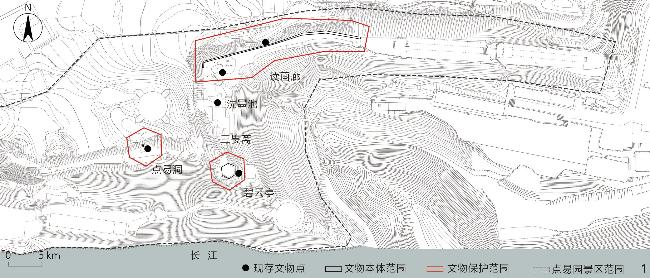
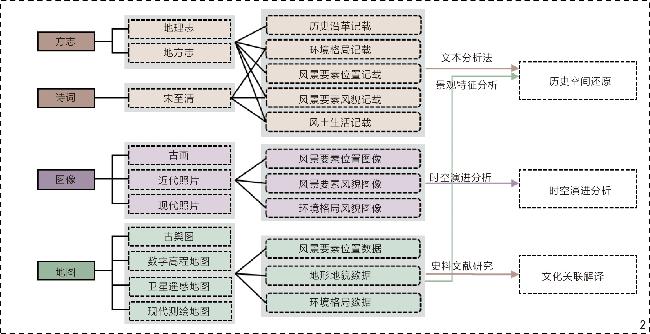
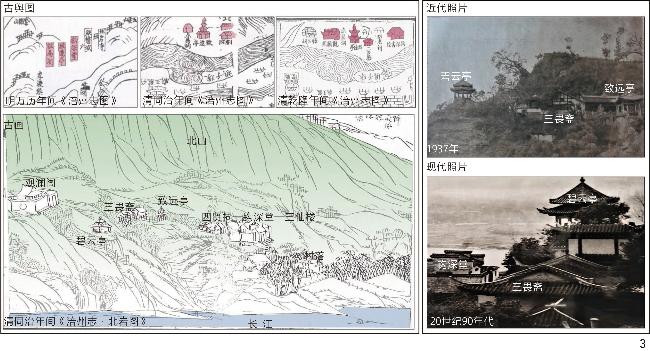
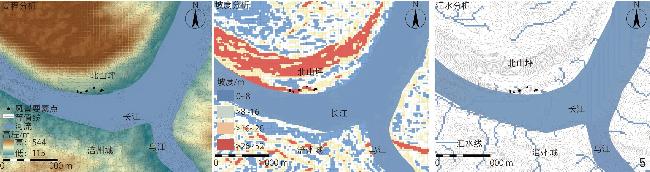
The research draws on the theoretical perspective of landscape archaeology, which focuses on the overall environment of heritage and explores the anchoring connection between space and culture, and adopts the multiple evidence method to, through the comparison and mutual verification of multiple historical evidence, construct a path for research on spatio-temporal and value characteristics of scenic heritage based on multiple evidence, in an effort to help resolve the problems of change of spatial environment and fragmentation of historical information faced by scenic heritage. At the same time, Fuling Beiyan Scenic Heritage is selected as a typical example for the empirical application of the constructed path. Beiyan Scenic Heritage in Fuling, Chongqing is located on the north bank of the Yangtze River, and has gradually become an important humanistic resort through local construction for generations due to its important value as the birthplace of “Yili” (a branch of Chinese philosophy). However, due to the lack of multi-temporal and multi-modal concepts and methods of scenic heritage cognition, the current scope of protection of Fuling Beiyan Scenic Heritage is limited to the cultural relics protection units for Beiyan Inscriptions and their nearby historical building areas, which has led to the aesthetic fragmentation between Fuling Beiyan Scenic Heritage and surrounding natural environment, as well as the loss of city − landscape relevance. In addition, the failure to fully understand the process of dynamic changes in Beiyan has also resulted in the problems of unclear historical stages of conservation, destruction of key spatial patterns, and monolithic interpretation of cultural values. The research aims to achieve the restoration of historical space, the analysis of spatio-temporal evolution, and the interpretation of cultural associations through the application of landscape archaeology methods such as comparing and contrasting multiple historical evidence regarding Fuling Beiyan Scenic Heritage, GIS landscape characterization, visual field analysis, and spatial evolution analysis. Firstly, in the step of historical spatial restoration, the historical information of Fuling Beiyan Scenic Heritage is verified based on the comparison and mutual verification of the four types of evidence, namely chronicles, poems, images, and maps; secondly, in the step of spatio-temporal evolution analysis, spatial evolution analysis is adopted to analyze the spatial pattern characteristics of Fuling Beiyan Scenic Heritage and the change law of landscape elements from the perspective of dynamics; and lastly, the cultural life characteristics associated with the spatial representations of Fuling Beiyan Scenic Heritage are summarized and interpreted based on the spatial analysis, so as to infer socio-cultural associations from the space.
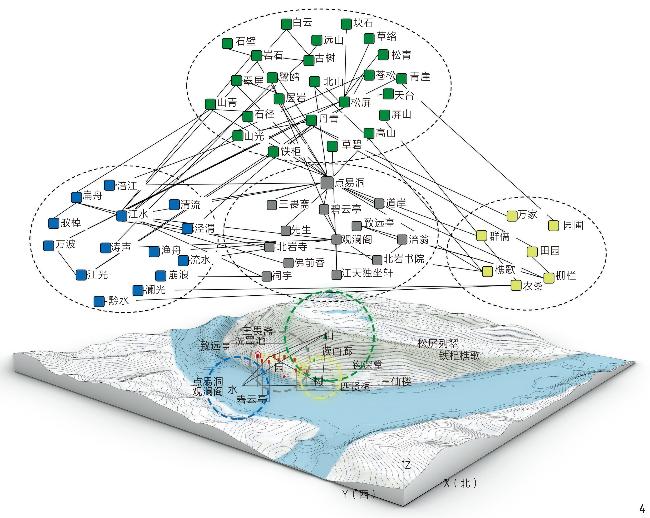
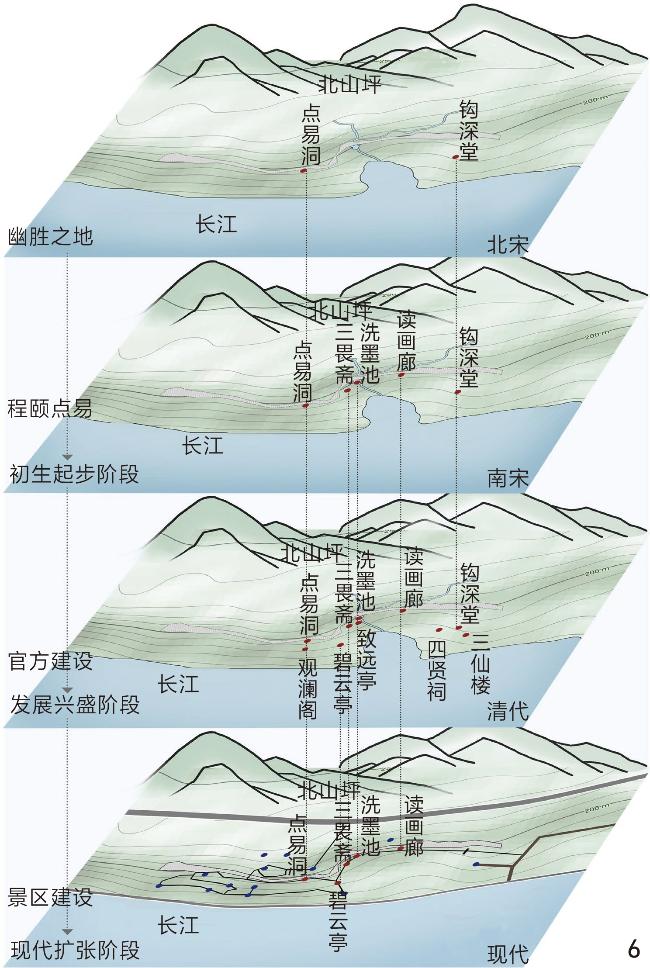
The spatio-temporal characteristics of the overall spatial association of Fuling Beiyan Scenic Heritage presented as “mountain − river − village − yard”, the inter-generational inheritance and expansion process of the key nodes of the core space, as well as the characteristics of the socio-cultural values of the important place of education, the local scenic landmarks, and the places of important local activities are identified.
The subsequent conservation of Fuling Beiyan Scenic Heritage should focus on reconstructing the overall structure of “mountain − river − village − yard”, resetting the internal elements and reshaping the value interpretation and dissemination system on the basis of full knowledge of its spatio-temporal and value characteristics, so as to better conserve and pass on the socio-cultural values of Fuling Beiyan Scenic Heritage, with a view to providing a reference for the practice of landscape heritage conservation in China.
图2 基于多重证据的涪陵北岩风景遗产时空演进及价值特征研究路径Fig. 2 A path for research on the spatio-temporal evolution and value characteristics of Fuling Beiyan Scenic Heritage based on multiple evidence |
表1 涪陵北岩风景遗产历史建设活动Table 1 Historical construction activities of Fuling Beiyan Scenic Heritage |
| 时间 | 建设活动 |
| 唐朝(618—907年) | 始建佛寺,成为参禅隐修的胜地 |
| 北宋初(960—1097年) | 建普净禅院 |
| 北宋绍圣四年(1097年) | 程颐谪涪,居普净院讲学,在涪数年凿洞注《易经》 |
| 南宋绍兴四年(1134年) | 程氏理学门人尹焞避难来涪,辟三畏斋 |
| 南宋绍兴五年(1135年) | 涪州知州李赡于普净院之上建成伊川先生祠堂 |
| 南宋嘉定元年(1208年) | 涪州知州范仲武建致远、碧云两亭和四贤祠、三仙楼 |
| 元朝(1279—1368年) | 点易洞前建观澜阁,建江天独坐轩 |
| 明朝(1368—1644年) | 重修钩深堂,移至宋址下,明末重修致远亭,更名为八卦亭 |
| 清乾隆九年(1740年) | 北岩书院改名钩深书院 |
| 清嘉庆(1796—1820) | 在三畏斋旁建桥(藏壑舫),重建致远亭,复原名 |
| 民国时期(1911— | 北岩十景多被损毁 |
| 1980年 | 北岩题刻设立县级文物保护单位,开始建设周易园景区 |
| 2016年 | 景区重修为点易园 |
文中图表均由作者绘制,
| [1] |
朱志荣.中国古代美学思想研究方法论[M].合肥: 安徽教育出版社, 2022.
ZHU Z R. Research Methodology of Ancient Chinese Aesthetic Thought[M]. Hefei: Anhui Education Press, 2022.
|
| [2] |
张杰.中国古代空间文化溯源[M].北京: 清华大学出版社, 2012.
ZHANG J. The Cultural Gene of Ancient Chinese Space[M]. Beijing: Tsinghua University Press, 2012.
|
| [3] |
刘滨谊, 赵彦. 中国“风景”观溯源[J]. 中国园林, 2018, 34(9): 46-52.
LIU B Y, ZHAO Y. Tracing on the Origin of the Concept of Chinese “Feng Jing”[J]. Chinese Landscape Architecture, 2018, 34(9): 46-52.
|
| [4] |
杨锐. “风景”释义[J]. 中国园林 2010 26(9): 1-3.
YANG R. Meanings of “Feng Jing”[J]. Chinese Landscape Architecture, 2010, 26(9): 1-3.
|
| [5] |
毛华松, 汤思琦, 程语. 基于地方志的中国风景遗产保护理论探索[J]. 风景园林, 2023, 30(12): 56-65.
MAO H S, TANG S Q, CHENG Y. Exploration of Protection Theory for Chinese Scenic Heritage Based on Local Chronicles[J]. Landscape Architecture, 2023, 30(12): 56-65.
|
| [6] |
吴良镛.吴良镛学术文化随笔[M].北京: 中国青年出版社, 2002.
WU L Y. Wu Liangyong Academic and Cultural Essays[M]. Beijing: China Youth Press, 2002.
|
| [7] |
石宪, 曹正伟, 毛华松. 浣花溪风景的历史变迁及其动力机制研究[J]. 中国园林, 2022, 38(2): 139-144.
SHI X, CAO Z W, MAO H S. Study on the Historical Changes and Dynamic Mechanism of Huanhuaxi Landscape[J]. Chinese Landscape Architecture, 2022, 38(2): 139-144.
|
| [8] |
高元, 武廷海. 中国古代山前寺院规画初探: 以隆中广德寺为例[J]. 城市规划, 2018, 42(6): 30-35.
GAO Y, WU T H. A Preliminary Exploration on the Plan of Guangde Zen Temple in Longzhong[J]. City Planning Review, 2018, 42(6): 30-35.
|
| [9] |
万敏, 潘莹紫, 姚佳其, 等. 数往知来、守正创新: 从江汉平原管窥中国城市八景的保护与更新[J]. 中国园林, 2024, 40(1): 54-60.
WAN M, PAN Y Z, YAO J Q, et al. Knowing the Future by Thinking of the Past, and Innovating on the Basis of What Has Worked in the Past: A View of the Protection and Renewal of Urban Eight Scenes in China from the Jianghan Plain[J]. Chinese Landscape Architecture, 2024, 40(1): 54-60.
|
| [10] |
赵烨, 赵怡钧, 刘心宇, 等. 时空完整性视野下山岳风景遗产的保护方法: 以泰山为例[J]. 风景园林, 2023, 30(12): 86-92.
ZHAO Y, ZHAO Y J, LIU X Y, et al. Conservation Approach for Mountain Landscape Heritage from the Perspective of Spatial and Temporal Integrity: A Case Study of Mount Tai[J]. Landscape Architecture, 2023, 30(12): 86-92.
|
| [11] |
王国维.古史新证: 王国维最后的讲义[M].北京: 清华大学出版社, 1994.
WANG G W. A New Evidence of Ancient History: Wang Guowei’s Last Lecture[M].Beijing: Tsinghua University Press, 1994.
|
| [12] |
陈寅恪.元白诗笺证稿[M].北京: 文学古籍刊行社, 1955.
CHEN Y K. Manuscript of the Investigation of Yuan Bai's Notes and Commentary on Poetry[M]. Beijing: Literature and Antiquities Publishing House, 1955.
|
| [13] |
张鑫, 李建平. 沈从文物质文化史研究与三重证据法的理论与实践[J]. 吉首大学学报(社会科学版), 2012, 33(6): 28-33.
ZHANG X, LI J P. The Theory and Practice of Shen Congwen’s Material Culture Research and the Triple Evidence Law[J]. Journal of Jishou University (Social Sciences Edition), 2012, 33(6): 28-33.
|
| [14] |
叶舒宪. 文学人类学的中国化过程与四重证据法: 学术史的回顾及展望[J]. 社会科学战线, 2010(6): 109-125.
YE S X. The Process of Chineseisation of Literary Anthropology and the Fourfold Method of Evidence: A Review and Prospect of Academic History[J]. Social Science Front, 2010(6): 109-125.
|
| [15] |
胡昭曦. 古史多重证据法与综合研究法: 纪念徐中舒先生诞辰120周年[J]. 中华文化论坛, 2018,7(11): 4-10.
HU Z X. The Methods of Multi Evidence and Comprehensive Research to Ancient History: In Commemoration of the 120th Anniversary of the Birth of Mr Xu Zhongshu[J]. Journal of Chinese Culture, 2018,7(11): 4-10.
|
| [16] |
杨静, 成玉宁. 遗址空间的完形表达与再现: 以南京石头城遗址公园为例[J]. 中国园林, 2022, 38(2): 26-30.
YANG J, CHENG Y N. The Integrity Expression and Reappearance of the Site Space: Taking Nanjing Stone City Heritage Park as an Example[J]. Chinese Landscape Architecture, 2022, 38(2): 26-30.
|
| [17] |
武廷海, 叶亚乐. 陕西黄帝陵的“九州之势”及其规画[J]. 西部人居环境学刊, 2020, 35(6): 115-120.
WU T H, YE Y L. The Jiuzhou Structure and Spatial Planning of the Huangdi Mausoleum in Shaanxi Province[J]. Journal of Human Settlements in West China, 2020, 35(6): 115-120.
|
| [18] |
刘珊珊, 黄晓. 寻找消失的遗产: 基于多重证据的湮废园林复原研究方法[J]. 风景园林, 2024, 31(3): 74-80.
LIU S S, HUANG X. Searching for the Lost Heritage: A Research Approach for Restoration of Perished Gardens Based on Multiple Evidence[J]. Landscape Architecture, 2024, 31(3): 74-80.
|
| [19] |
BRUNO D, JULIAN T. Handbook of Landscape Archaeology[M]. London: Routledge, 2016
|
| [20] |
ASTON M, ROWLEY T. Landscape Archaeology: An Introduction to Fieldwork Techniques on Post-Roman Landscapes[M]. London: David & Charles PLC, 1974.
|
| [21] |
MAY D E. The Development of Landscape Archaeology in Britain, Present Conflicts and Possible New Directions[J]. Landscape History, 2023, 44(2): 109-118.
|
| [22] |
FÖRSTER F, GROßMANN R , HINZ M, et al. Towards Mutual Understanding Within Interdisciplinary Palaeoenvironmental Research: An Exemplary Analysis of the Term Landscape[J]. Quaternary International, 2013, 312(1): 4-11.
|
| [23] |
赵忆, 周娉倩, 许超然, 等. 基于景观考古学的皇家祭天遗址探析: 以北魏坝顶圜丘为例[J]. 风景园林, 2021, 28(11): 33-38.
ZHAO Y, ZHOU P Q, XU C R, et al. Analysis of Royal Sacrificial Sites Based on Landscape Archaeology: A Case Study of Circular Mound at the Top of Onggon Dabaga of the Northern Wei Dynasty[J]. Landscape Architecture, 2021, 28(11): 33-38.
|
| [24] |
刘文卿, 刘大平. 景观考古学视野下的聚落空间组织信息阐释: 以三江平原汉魏聚落遗址为例[J]. 建筑学报, 2019(11): 83-90.
LIU W Q, LIU D P. Interpreting the Information of Spatial Organization and Distribution of Settlements from a Perspective of Landscape Archaeology: A Case Study on the Historic Sites of Settlements in Han and Wei Dynasties on Sanjiang Plain[J]. Architectural Journal, 2019(11): 83-90.
|
| [25] |
WILKINSON T J. The Archaeology of the Essex Coast, Volume I: The Hull Bridge Survey[M].Nottingham: Essex Country Council Archaeology Section, 1995: 197.
|
| [26] |
张海. 景观考古学: 理论、方法与实践[J]. 南方文物, 2010(4): 8-17.
ZHANG H. Landscape Archaeology: Theory, Method and Practice[J]. Cultural Relics in Southern China, 2010(4): 8-17.
|
| [27] |
陈野. 建构文化传统: 中国方志的深层功能[J]. 浙江学刊, 2021(1): 125-135.
CHEN Y. Constructing Cultural Tradition: The Deep Function of Chinese Chronicles[J]. Zhejiang Academic Journal, 2021(1): 125-135.
|
| [28] |
李源, 李险峰. 风景意象的“诗化”再现: 明代北京佛寺园林的景观认知[J]. 风景园林, 2022, 29(4): 128-133.
LI Y, LI X F. Poetic Representation of Landscape Images: Landscape Cognition of Buddhist Temple Gardens of the Ming Dynasty in Beijing[J]. Landscape Architecture, 2022, 29(4): 128-133.
|
| [29] |
王雪纯, 毛华松, 吴映华夏. 基于古诗词文本挖掘的唐宋三峡人文景观特征及审美认知研究[J]. 热带地理, 2023, 43(10): 2001-2011.
WANG X C, MAO H S, WU Y H X. Cultural Landscape in the Three Gorges Region Based on Ancient Poetry Text Mining from the Tang and Song Dynasties[J]. Tropical Geography, 2023, 43(10): 2001-2011.
|
| [30] |
吕绍衣.同治重修涪州志[M].成都: 巴蜀书社, 1992.
LÜ S Y. The Rewritten Chronicles of Fuzhou City in Tongzhi Period in Qing Dynasty[M]. Chengdu: Sichuan Ancient Books Publishing Press, 1992.
|
| [31] |
陈谷嘉, 邓洪波.中国书院史资料(上册)[M].杭州: 浙江教育出版社, 1998.
CHEN G J, DENG H B. Chinese Academy History Materials (the First Volume)[M]. Hangzhou: Zhejiang Education Press, 1998.
|
| [32] |
谭清宣, 叶凯. 涪陵北岩文化发展历程、内涵及影响初探[J]. 长江师范学院学报, 2011, 27(1): 14-20.
TAN Q X, YE K. An Exploration of the Evolution,Connotation and Influences of Fuling Northern Rock Culture[J]. Journal of Yangtze Normal University, 2011, 27(1): 14-20.
|
| [33] |
王象之.舆地纪胜·卷一七四[M].成都: 四川大学出版社, 2005.
WANG X Z. The Record of Scenic Spots Across the Country: Volume 174[M]. Chengdu: Sichuan University Press, 2005.
|
/
| 〈 |
|
〉 |