

基于恢复性感知的城市滨水绿地景观要素对公众健康行为影响
|
吴逸/女/华中农业大学园艺林学学院在读硕士研究生/研究方向为风景园林规划设计与理论 |
|
裘鸿菲/女/博士/华中农业大学园艺林学学院教授、博士生导师/农业农村部华中都市农业重点实验室成员/研究方向为风景园林规划设计与理论 |
|
罗心玥/女/华中农业大学园艺林学学院在读硕士研究生/研究方向为风景园林规划设计与理论 |
|
胡亚萍/女/华中农业大学园艺林学学院在读硕士研究生/研究方向为风景园林规划设计与理论 |
收稿日期: 2024-07-21
修回日期: 2024-12-30
网络出版日期: 2025-12-12
基金资助
中央高校基本科研业务费专项资助项目(2662018PY087)
版权
Impact of Urban Waterfront Green Space Landscape Elements on Public Health Behaviors Based on Restorative Perception
|
WU Yi is a master student in the College of Horticulture & Forestry Sciences of Huazhong Agricultural University. Her research focuses on landscape planning and design, and theory of landscape architecture |
|
QIU Hongfei, Ph.D, is a professor and doctoral supervisor in the College of Horticulture & Forestry Sciences of Huazhong Agricultural University, and a member of the Key Laboratory of Urban Agriculture in Central China, Ministry of Agriculture and Rural Affairs. Her research focuses on landscape planning and design, and theory of landscape architecture |
|
LUO Xingyue is a master student in the College of Horticulture & Forestry Sciences of Huazhong Agricultural University. Her research focuses on landscape planning and design, and theory of landscape architecture |
|
HU Yaping is a master student in the College of Horticulture & Forestry Sciences of Huazhong Agricultural University. Her research focuses on landscape planning and design, and theory of landscape architecture |
Received date: 2024-07-21
Revised date: 2024-12-30
Online published: 2025-12-12
Copyright
城市滨水绿地内部空间景观要素与健康行为之间的复杂关联亟待深入剖析,恢复性感知作为自然环境中影响个体行为决策的关键因素,为探究二者关系提供了新视角。
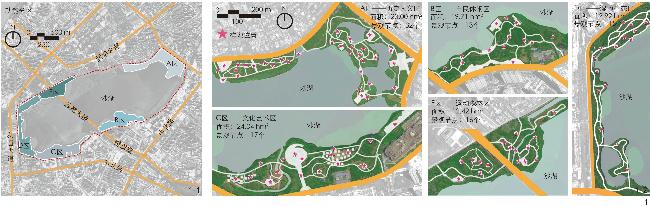
以武汉市沙湖公园93个景观节点为研究对象,结合计算机视觉技术、问卷调查和行为观测等方法,深入探究滨水绿地景观要素、恢复性感知对公众健康行为(恢复、体力及社交活动)的影响。
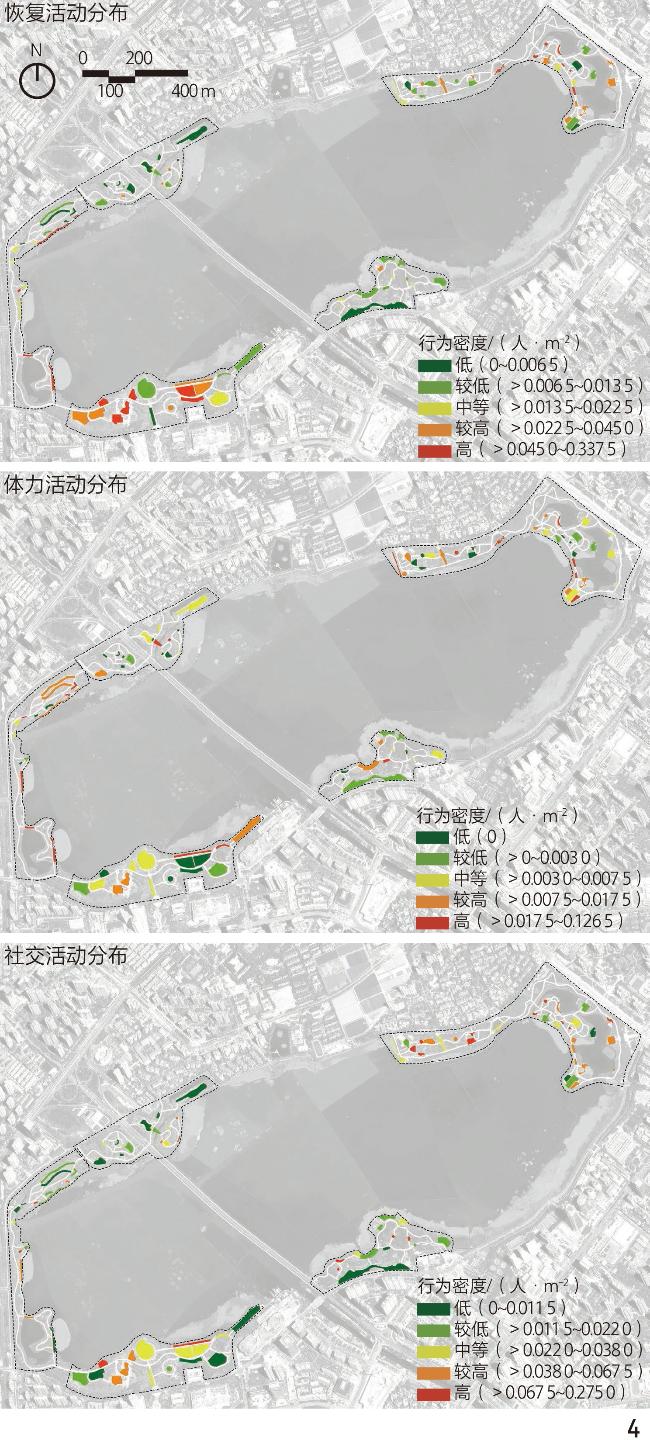
自然景观有助于提升公众的恢复性感知,而高比例的人工要素则产生相反效果;不同健康行为存在空间分布差异且显著影响要素各不相同;恢复性感知与恢复活动、社交活动呈显著正相关。
揭示了3类健康行为对节点景观要素的偏好差异,并证实了恢复性感知对促进健康行为的积极作用。未来可通过强化自然景观建设、合理规划空间色彩及实施节点差异化设计等措施,有效促进公众健康行为开展,进而提升滨水绿地健康效益。
吴逸 , 裘鸿菲 , 罗心玥 , 胡亚萍 . 基于恢复性感知的城市滨水绿地景观要素对公众健康行为影响[J]. 风景园林, 2025 , 32(3) : 119 -126 . DOI: 10.3724/j.fjyl.202407210396
Urban waterfront green spaces, as a typical representative of urban blue-green spaces, can serve as an important venue for the public to engage in various outdoor health-related activities. Although previous research has confirmed the close relationship between the diverse and complex landscape elements of waterfront green spaces and health behaviors, which mainly focuses on comparisons between overall waterfront green spaces, while seldom considering how landscape elements within these green spaces affect health behaviors. Meanwhile, restorative perception has been identified as a key factor influencing individual behavioral decisions in natural environments, which can provide a new perspective for exploring the relationship between the aforesaid landscape elements and health behaviors. Therefore, this research aims to delve into how landscape elements in urban waterfront green spaces influence public health behaviors from an internal spatial perspective, with restorative perception as a mediator.
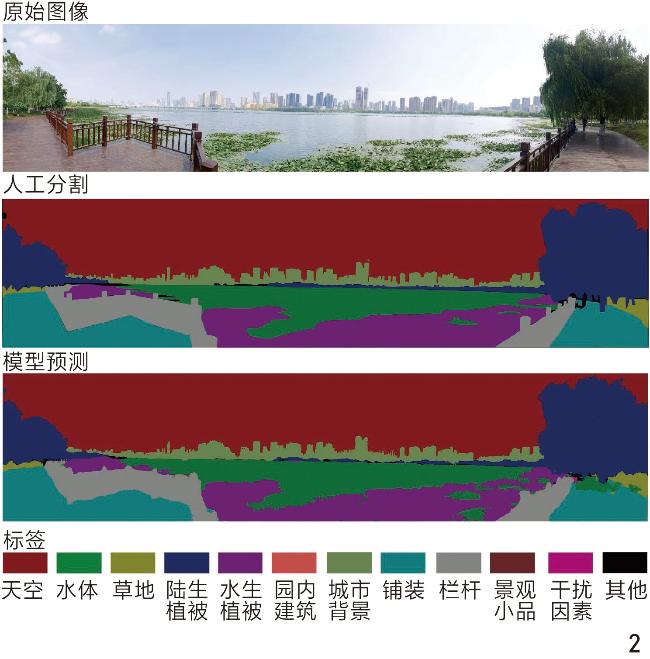
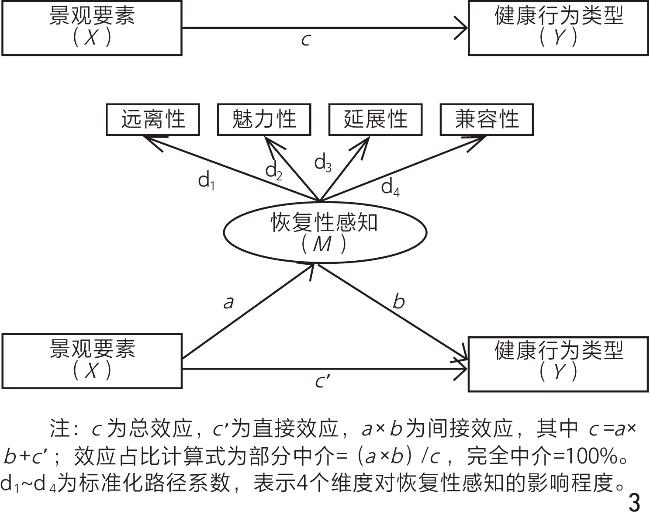
This research takes Wuhan Shahu Park as an example and selects 93 landscape nodes within the park as the research objects. Initially, a DeepLabv3+ semantic segmentation model tailored for landscapes in waterfront green spaces is developed through manual training. This is coupled with MATLAB-based color quantification and assignment statistical techniques to comprehensively and meticulously quantify landscape elements across six dimensions: Space, nature, artificiality, waterfront characteristic, color and entity. Subsequently, field surveys are conducted to gather public assessments of restorative perceptions (being away, fascination, extent and compatibility) at landscape nodes. Behavioral observations are also employed to document specific instances of public engagement in restorative, physical, and social activities within these sites. Ultimately, data analysis methods, including multiple regression analysis and mediation effect analysis, are applied to explore the interrelationships among landscape elements, restorative perceptions, and health behaviors.
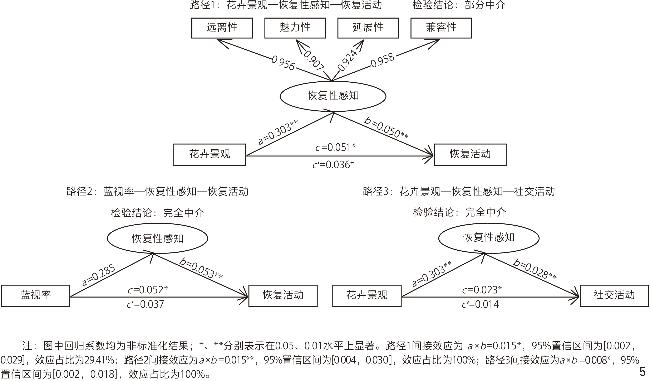
Research findings are summarized as follows. 1) Natural landscapes significantly enhance the public’s restorative perception, while a high proportion of artificial elements has the opposite effect. Specifically, flower landscapes, open and clear water bodies, and scenes with rich and bright colors or predominantly green hues can enhance positive perceptions. In contrast, bare soil, high proportions of paving/urban backgrounds, and scenes dominated by red/yellow hues have negative impacts. Especially when the proportion of pavement in the view exceeds 10%, that of the urban background exceeds 6%, and the total proportion of artificial elements exceeds 30%, the negative impacts are particularly evident. 2) Different types of health behaviors vary in spatial distribution and are significantly influenced by distinct elements. Restorative activities tend to occur in open waterfront spaces, and colorful and flower-filled landscapes; physical activities prefer linear waterfront spaces and rubberized surfaces; and social activities favor small landscape spaces with simple vegetation layers, rich colors, and harmonious building proportions. 3) Restorative perception plays a crucial role in promoting restorative and social activities, serving as a complete mediator in the relationships between “blue visibility and restorative activities”, and between “flower landscapes and social activities”, and as a partial mediator in the relationship between “flower landscapes and restorative activities”. However, for physical activities, the direct influence of restorative perception is relatively weak, possibly due to the greater dependence of physical activities on the specific functional attributes of activity sites.
This research clarifies the preference differences among three types of health behaviors toward nodal landscape elements and confirms the promotive effect of restorative perceptions on health behaviors, providing a scientific basis for the design and optimization of landscape nodes in waterfront green spaces. To further augment the health benefits of waterfront green spaces, the following initiatives may be taken in the future. Firstly, prioritize the development of natural landscapes while minimizing artificial elements, and leverage natural features to create inviting environments while ensuring their regular maintenance; secondly, strategically plan spatial colors to foster vibrant and diverse landscapes, with a focus on color harmony; and thirdly, implement tailored designs for landscape nodes to cater to diverse needs and establish functional spaces based on health behavior types, for which specific measures include promoting restorative activities through the integration of vibrant floral displays in open waterfront areas, providing physical activity infrastructure along watersides and on rubberized surfaces to satisfy public exercise requirements, and augmenting architectural spaces in aesthetically pleasing colorful venues to facilitate social interactions. Future research is recommended to introduce the time dimension, explore the influence mechanism among environment, perception, and behavior, and attempt to investigate the differences among different population groups.
表1 城市滨水绿地景观要素分解Table 1 Decomposition of landscape elements in urban waterfront green space |
| 类型 | 序号 | 景观要素 | 定义/计算方法 | 量化方法 |
| 注:Z3、Z4、Z5、R4、B2、B4的赋值统计首先由参与实地勘察的3名风景园林专业研究生分别进行,然后将统计结果汇总比较,有差异的部分商讨确定;T1通过章节2.3问卷调查的方式进行统计,选择人数最多的选项被视为最终结果。 | ||||
| 空间 | K1 | 天空开敞度 | 天空在图像中所占比例 | 语义分割 |
| K2 | 空间围合度 | 垂直要素(陆生植被、园内建筑、栏杆)在图像中所占比例 | 语义分割 | |
| K3 | 视觉复杂度 | 图像内容复杂程度 | MATLAB | |
| 自然 | Z1 | 绿视率 | 绿色植被(草坪、陆生植被、水生植被)在图像中所占比例 | 语义分割 |
| Z2 | 陆生植被比例 | 陆生植被在图像中所占比例 | 语义分割 | |
| Z3 | 植被层次 | 单层型(草、灌、乔)=0;双层型(乔-草、乔-灌、灌-草)=1;三层型(乔-灌-草)=2 | 赋值统计 | |
| Z4 | 花卉景观 | 无=0;有=1 | 赋值统计 | |
| Z5 | 土壤裸露程度 | 较低=0;一般=1;较高=2 | 赋值统计 | |
| 人工 | R1 | 城市背景比例 | 城市背景在图像中所占比例 | 语义分割 |
| R2 | 园内建筑比例 | 园内建筑在图像中所占比例 | 语义分割 | |
| R3 | 铺装比例 | 铺装在图像中所占比例 | 语义分割 | |
| R4 | 铺装形式 | 无=0(铺装比例<3%);砖石=1;木质=2;鹅卵石/碎石=3;塑胶=4 | 赋值统计 | |
| R5 | 景观小品比例 | 景观小品在图像中所占比例 | 语义分割 | |
| R6 | 干扰因素比例 | 景观视野内具有干扰效果的元素(垃圾桶、指示牌、路灯、车辆、杂物)所占比例 | 语义分割 | |
| 滨水 | B1 | 蓝视率 | 水体在图像中所占比例 | 语义分割 |
| B2 | 水体质量 | 无水体=0;清澈=1;浑浊=2 | 赋值统计 | |
| B3 | 水生植被比例 | 水生植被在图像中所占比例 | 语义分割 | |
| B4 | 驳岸形态 | 无驳岸=0;人工垂直型驳岸=1;自然生态型驳岸=2 | 赋值统计 | |
| 色彩 | S1 | 色彩数量 | 图像中除黑、白、灰三色外,像素量占比大于1%的色彩数量 | 色彩量化 |
| S2 | 色相指数 | 不同等级色相的像素量占比情况 | 色彩量化 | |
| S3 | 饱和度指数 | 不同等级饱和度的像素量占比情况 | 色彩量化 | |
| S4 | 明度指数 | 不同等级明度的像素量占比情况 | 色彩量化 | |
| S5 | 主色相占比 | 主色相的像素量在图像中所占比例 | 色彩量化 | |
| S6 | 色彩多样性指数 | 图像中色彩种类和数量的丰富程度 | 色彩量化 | |
| S7 | 色彩均匀度指数 | 图像中色彩分布的均匀程度 | 色彩量化 | |
| 实体 | T1 | 标志物 | 天空=0;水体=1;植被=2;建筑=3;景观小品=4;铺装=5 | 赋值统计 |
表3 景观要素与恢复性感知的多元逐步回归分析Table 3 Multiple stepwise regression analysis of landscape elements and restorative perception |
| 感知维度 | 模型参数 | 景观要素 | $\beta $值 | t 值 | 显著性 | VIF |
| 注:4个模型的残差分布均符合正态分布,且VIF值均小于5,F统计量的p值均小于0.001,表明模型不存在多重共线性且整体拟合效果显著。 | ||||||
| 远离性 | R 2=0.348、 | Z4(有) | 0.208 | 3.177 | 0.002 | 1.028 |
| Z5(较高) | −0.162 | −2.472 | 0.015 | 1.029 | ||
| R1 | −0.236 | −3.106 | 0.002 | 1.383 | ||
| R3 | −0.240 | −3.268 | 0.001 | 1.302 | ||
| B1 | 0.239 | 2.776 | 0.006 | 1.787 | ||
| B2(清澈) | 0.162 | 2.112 | 0.036 | 1.414 | ||
| S2 | 0.230 | 2.731 | 0.007 | 1.714 | ||
| S3 | 0.301 | 3.558 | 0.000 | 1.726 | ||
| 魅力性 | R 2=0.407、 | Z4(有) | 0.266 | 4.126 | 0.000 | 1.095 |
| Z5(较高) | −0.192 | −3.072 | 0.003 | 1.029 | ||
| R1 | −0.189 | −2.662 | 0.009 | 1.327 | ||
| R3 | −0.310 | −4.335 | 0.000 | 1.348 | ||
| R4(木质) | 0.145 | 2.229 | 0.027 | 1.111 | ||
| S2 | 0.329 | 0.000 | 0.033 | 1.717 | ||
| S3 | 0.321 | 4.020 | 0.000 | 1.679 | ||
| S5 | −0.150 | −2.305 | 0.022 | 1.117 | ||
| T1(植被) | −0.232 | −3.373 | 0.001 | 1.242 | ||
| 延展性 | R 2=0.161、 | Z4(有) | 0.235 | 3.252 | 0.001 | 1.009 |
| Z5(较高) | −0.191 | −2.638 | 0.009 | 1.012 | ||
| R4 | −0.299 | −4.140 | 0.000 | 1.006 | ||
| 兼容性 | R 2=0.341、 | Z4(有) | 0.218 | 3.305 | 0.001 | 1.029 |
| Z5(较高) | −0.193 | −2.914 | 0.004 | 1.037 | ||
| R1 | −0.268 | −3.512 | 0.001 | 1.379 | ||
| R3 | −0.188 | −2.430 | 0.016 | 1.425 | ||
| R4(砖石) | 0.163 | 2.080 | 0.039 | 1.452 | ||
| R4(木质) | 0.208 | 2.934 | 0.004 | 1.194 | ||
| B1 | 0.258 | 3.093 | 0.002 | 1.653 | ||
| S2 | 0.313 | 3.595 | 0.000 | 1.793 | ||
| S3 | 0.404 | 4.488 | 0.000 | 1.916 | ||
表4 景观要素与健康行为的多元逐步回归分析Table 4 Multiple stepwise regression analysis of landscape elements and health behaviors |
| 行为类型 | 模型参数 | 景观要素 | $\beta $值 | t 值 | 显著性 | VIF |
| 注:3个模型的残差分布均符合正态分布,且VIF值均小于5,F统计量的p值均小于0.001,表明模型不存在多重共线性且整体拟合效果显著。 | ||||||
| 恢复活动 | R 2=0.454、 | K1 | 0.630 | 6.544 | 0.000 | 2.684 |
| K2 | 0.663 | 6.392 | 0.000 | 3.090 | ||
| K3 | −0.170 | −2.102 | 0.037 | 1.882 | ||
| Z4 | 0.236 | 3.961 | 0.000 | 1.020 | ||
| B1 | 0.365 | 5.004 | 0.000 | 1.530 | ||
| B2(浑浊) | −0.148 | −2.300 | 0.023 | 1.192 | ||
| S3 | 0.274 | 3.118 | 0.002 | 2.213 | ||
| S6 | 0.207 | 3.069 | 0.003 | 1.302 | ||
| 体力活动 | R 2=0.269、 | R4(塑胶) | 0.136 | 2.026 | 0.044 | 1.005 |
| B1 | 0.315 | 4.049 | 0.000 | 1.339 | ||
| B2(清澈) | 0.273 | 3.481 | 0.001 | 1.333 | ||
| 社交活动 | R 2=0.261、 | Z3(三层型) | −0.227 | −2.959 | 0.004 | 1.265 |
| Z4 | 0.161 | 2.266 | 0.025 | 1.084 | ||
| R1 | −0.264 | −3.606 | 0.000 | 1.153 | ||
| R2 | 0.189 | 2.603 | 0.010 | 1.134 | ||
| R5 | −0.180 | −2.383 | 0.018 | 1.222 | ||
| S6 | 0.241 | 3.263 | 0.001 | 1.174 | ||
表5 恢复性感知与健康行为的皮尔逊相关性分析Table 5 Pearson correlation analysis of restorative perception and health behaviors |
| 恢复性感知 | 恢复活动 | 体力活动 | 社交活动 |
| 注:*、**分别表示在0.05、0.01水平上显著。 | |||
| 远离性 | 0.363** | 0.150 | 0.263* |
| 魅力性 | 0.452** | 0.127 | 0.340** |
| 延展性 | 0.362** | 0.107 | 0.282** |
| 兼容性 | 0.373** | 0.099 | 0.368** |
文中图表均由作者绘制,其中
| [1] |
健康中国行动推进委员会.健康中国行动(2019—2030年)[EB/OL].(2019-07-15)[2024-05-01].https://www.gov.cn/xinwen/2019-07/15/content_5409694.htm.
The Healthy China Action Promotion Committee. Healthy China Initiative (2019–2030)[EB/OL]. (2019-07-15)[2024-05-01]. https://www.gov.cn/xinwen/2019-07/15/content_5409694.htm.
|
| [2] |
MCEACHAN R, TAYLOR N, HARRISON R, et al. Meta-Analysis of the Reasoned Action Approach (RAA) to Understanding Health Behaviors[J]. Annals of Behavioral Medicine, 2016, 50(4): 592-612.
|
| [3] |
黄铎, 易芳蓉, 汪思哲, 等. 国土空间规划中蓝绿空间模式与指标体系研究[J]. 城市规划, 2022, 46(1): 18-31.
HUANG D, YI F R, WANG S Z, et al. Blue-Green Space Pattern and Indicator System in Territorial Planning[J]. City Planning Review, 2022, 46(1): 18-31.
|
| [4] |
袁青, 赵家璇, 冷红.冬季住区绿地活动行为对老年人心理健康的影响研究[J].中国园林, 2022, 38(3): 45-50.
YUAN Q, ZHAO J X, LENG H. Research on the Impact of Green Space Activity Behavior in Winter Residential Districts on the Mental Health of the Elderly[J]. Chinese Landscape Architecture, 2022, 38(3): 45-50.
|
| [5] |
HANSON S, JONES A. Is There Evidence that Walking Groups Have Health Benefits? A Systematic Review and Meta-Analysis[J]. British Journal of Sports Medicine, 2015, 49(11): 710-715.
|
| [6] |
MOLINA-GARCÍA J, MENESCARDI C, ESTEVAN I, et al. Associations Between Park and Playground Availability and Proximity and Children’s Physical Activity and Body Mass Index: The BEACH Study[J]. International Journal of Environmental Research and Public Health, 2021, 19(1): 250.
|
| [7] |
KLOMPMAKER J O, HOEK G, BLOEMSMA L D, et al. Associations of Combined Exposures to Surrounding Green, Air Pollution and Traffic Noise on Mental Health[J]. Environment International, 2019, 129: 525-537.
|
| [8] |
黄邓楷, 刘烨, 周佩玲. 自发地理信息支持下建成环境与移动型体力活动相关性荟萃分析[J]. 风景园林, 2024, 31(4): 12-20.
HUANG D K, LIU Y, ZHOU P L. Meta-Analysis on Associations Between the Built Environment and Mobile Physical Activity Using Volunteered Geographic Information[J]. Landscape Architecture, 2024, 31(4): 12-20.
|
| [9] |
董雯, 朱逊, 赵晓龙. 社区绿道建成环境特征与体力活动强度关联性研究: 以深圳市为例[J]. 风景园林, 2021, 28(12): 93-99.
DONG W, ZHU X, ZHAO X L. Research on Correlation Between Built Environment Characteristics of Community Greenway and Intensity of Physical Activities: A Case Study of Shenzhen[J]. Landscape Architecture, 2021, 28(12): 93-99.
|
| [10] |
翟宇佳, 黎东莹, 王德. 社区公园对老年使用者体力活动参与和情绪改善的促进作用: 以上海市15座社区公园为例[J]. 中国园林, 2021, 37(5): 74-79.
ZHAI Y J, LI D Y, WANG D. The Role of Urban Community Park in Promoting Seniors’ Physical Activity and Positive Emotion: A Case Study of 15 Shanghai Community Parks[J]. Chinese Landscape Architecture, 2021, 37(5): 74-79.
|
| [11] |
RIVERA E, TIMPERIO A, LOH V H Y, et al. Critical Factors Influencing Adolescents’ Active and Social Park Use: A Qualitative Study Using Walk-Along Interviews[J]. Urban Forestry & Urban Greening, 2021, 58: 126948.
|
| [12] |
刘滨谊, 常青, 张琳, 等. 城市公园绿地主客观植物多样性对居民健康行为的影响[J]. 中国园林, 2024, 40(11): 6-14.
LIU B Y, CHANG Q, ZHANG L, et al. The Influence of Measured and Perceived Biodiversity on Human Health Behavior in Urban Green Spaces[J]. Chinese Landscape Architecture, 2024, 40(11): 6-14.
|
| [13] |
VAN HECKE L, GHEKIERE A, VAN CAUWENBERG J, et al. Park Characteristics Preferred for Adolescent Park Visitation and Physical Activity: A Choice-Based Conjoint Analysis Using Manipulated Photographs[J]. Landscape and Urban Planning, 2018, 178: 144-155.
|
| [14] |
CHEN L C, PAPANDREOU G, KOKKINOS I, et al. DeepLab: Semantic Image Segmentation with Deep Convolutional Nets, Atrous Convolution, and Fully Connected CRFs[J]. IEEE Transactions on Pattern Analysis and Machine Intelligence, 2018, 40(4): 834-848.
|
| [15] |
张喆.基于公众响应评价的森林色彩特征及其影响研究: 以四川九寨沟秋季森林为例[D].北京: 中国林业科学研究院, 2017.
ZHANG Z. Public Response to Characteristics of Forest Color and Its Influence: A Case Study of Forest in Autumn of Jiuzhai Valley, Sichuan Province[D]. Beijing: Chinese Academy of Forestry Sciences, 2017.
|
| [16] |
DANIEL T C. Whither Scenic Beauty? Visual Landscape Quality Assessment in the 21st Century[J]. Landscape and Urban Planning, 2001, 54(1-4): 267-281.
|
| [17] |
JAHANI A, SAFFARIHA M. Aesthetic Preference and Mental Restoration Prediction in Urban Parks: An Application of Environmental Modeling Approach[J]. Urban Forestry & Urban Greening, 2020, 54: 126775.
|
| [18] |
郑涵青, 赖鹏程, 吴元晶, 等. 城市郊野公园景观旷奥视觉感知对游人行为意向的影响[J]. 风景园林, 2023, 30(5): 83-90.
ZHENG H Q, LAI P C, WU Y J, et al. Relationship Between Visual Perception of Landscape Kuang-Ao and Behavioral Intention of Tourists in Urban Country Parks[J]. Landscape Architecture, 2023, 30(5): 83-90.
|
| [19] |
黄杰, 黄安民, 杨飞飞, 等. 旅游者恢复性环境感知与游后行为意向: 影响机制和边界条件[J]. 旅游学刊, 2022, 37(2): 31-45.
HUANG J, HUANG A M, YANG F F, et al. Tourists’ Perceived Restorative Qualities and Post-Visit Behavioral Intention: The Mechanism and Boundary Condition[J]. Tourism Tribune, 2022, 37(2): 31-45.
|
| [20] |
WHITE M, SMITH A, HUMPHRYES K, et al. Blue Space: The Importance of Water for Preference, Affect, and Restorativeness Ratings of Natural and Built Scenes[J]. Journal of Environmental Psychology, 2010, 30(4): 482-493.
|
| [21] |
DANIEL T C, MEITNER M M. Representational Validity of Landscape Visualizations: The Effects of Graphical Realism on Perceived Scenic Beauty of Forest Vistas[J]. Journal of Environmental Psychology, 2001, 21(1): 61-72.
|
| [22] |
刘滨谊, 范榕. 景观空间视觉吸引要素及其机制研究[J]. 中国园林, 2013, 29(5): 5-10.
LIU B Y, FAN R. Research on Visual Attraction Elements and Mechanism of Landscape Space[J]. Chinese Landscape Architecture, 2013, 29(5): 5-10.
|
| [23] |
黎俊仪, 林盈芳, 董建文, 等. 语义分割技术下的城市滨水绿地美景度评价研究: 以福州西湖公园、左海公园为例[J]. 中国园林, 2022, 38(10): 92-97.
LI J Y, LIN Y F, DONG J W, et al. Landscape Evaluation on Urban Waterfront Under Semantic Segmentation Technology: Taking Xihu Park and Zuohai Park in Fuzhou as Examples[J]. Chinese Landscape Architecture, 2022, 38(10): 92-97.
|
| [24] |
LI X, WANG X R, JIANG X, et al. Prediction of Riverside Greenway Landscape Aesthetic Quality of Urban Canalized Rivers Using Environmental Modeling[J]. Journal of Cleaner Production, 2022, 367: 133066.
|
| [25] |
江浩波, 宋孟坤, 肖扬. 滨水空间视觉景观舒适度评价研究: 以上海市“一江一河”为例[J]. 风景园林, 2022, 29(10): 122-129.
JIANG H B, SONG M K, XIAO Y. Research on Visual Landscape Comfort Evaluation of Waterfront Space: A Case Study of Huangpu River and Suzhou Creek in Shanghai[J]. Landscape Architecture, 2022, 29(10): 122-129.
|
| [26] |
WANG Y A, CHANG Q, FAN P L, et al. From Urban Greenspace to Health Behaviors: An Ecosystem Services-Mediated Perspective[J]. Environmental Research, 2022, 213: 113664.
|
| [27] |
柴铁劬.康复医学[M].上海: 上海科学技术出版社, 2008.
CHAI T Q. Rehabilitation Medicine[M]. Shanghai: Shanghai Scientific & Technical Publishers, 2008.
|
| [28] |
World Health Organization. Global Action Plan on Physical Activity 2018−2030: More Active People for a Healthier World[M]. Geneva: World Health Organization, 2018.
|
| [29] |
OKUN M A, STOCK W A, HARING M J, et al. The Social Activity/Subjective Well-Being Relation: A Quantitative Synthesis[J]. Research on Aging, 1984, 6(1): 45-65.
|
| [30] |
NAGATA S, NAKAYA T, HANIBUCHI T, et al. Objective Scoring of Streetscape Walkability Related to Leisure Walking: Statistical Modeling Approach with Semantic Segmentation of Google Street View Images[J]. Health & Place, 2020, 66: 102428.
|
| [31] |
田玉敏, 林高全. 基于颜色特征的彩色图像检索方法[J]. 西安电子科技大学学报, 2002, 29(1): 43-46.
TIAN Y M, LIN G Q. Retrieval Technique of Color Image Based on Color Features[J]. Journal of Xidian University, 2002, 29(1): 43-46.
|
| [32] |
BERTO R. Exposure to Restorative Environments Helps Restore Attentional Capacity[J]. Journal of Environmental Psychology, 2005, 25(3): 249-259.
|
| [33] |
FAUL F, ERDFELDER E, LANG A G, et al. G*Power 3: A Flexible Statistical Power Analysis Program for the Social, Behavioral, and Biomedical Sciences[J]. Behavior Research Methods, 2007, 39(2): 175-191.
|
| [34] |
温忠麟, 叶宝娟. 中介效应分析: 方法和模型发展[J]. 心理科学进展, 2014, 22(5): 731-745.
WEN Z L, YE B J. Analyses of Mediating Effects: The Development of Methods and Models[J]. Advances in Psychological Science, 2014, 22(5): 731-745.
|
/
| 〈 |
|
〉 |