

城市综合公园全龄友好度评价
|
刘晓芳/女/博士/华侨大学建筑学院副教授/研究方向为城乡功能与形态、城市空间安全与健康 |
|
王怡然/女/华侨大学建筑学院在读硕士研究生/研究方向为东南地区民生空间健康效应及规划 |
|
肖琛宸/女/华侨大学建筑学院在读硕士研究生/研究方向为东南地区民生空间健康效应及规划 |
|
杨思声/男/博士/华侨大学建筑学院教授/研究方向为城乡规划与遗产保护 |
收稿日期: 2024-07-03
修回日期: 2025-01-14
网络出版日期: 2025-12-12
基金资助
国家建设高水平大学公派研究生项目(201904910427)
版权
Research on All-Age Friendliness Evaluation of Urban Comprehensive Parks
|
LIU Xiaofang, Ph.D., is an associate professor in the School of Architecture, Huaqiao University. Her research focuses on functions and forms of urban and rural areas, and safety and health of urban space |
|
WANG Yiran is a master student in the School of Architecture, Huaqiao University. Her research focuses on health effects and planning of people’s livelihood space in southeast China |
|
XIAO Chenchen is a master student in the School of Architecture, Huaqiao University. Her research focuses on health effects and planning of people’s livelihood space in southeast China |
|
YANG Sisheng, Ph.D., is a professor in the School of Architecture, Huaqiao University. His research focuses on urban and rural planning and heritage protection |
Received date: 2024-07-03
Revised date: 2025-01-14
Online published: 2025-12-12
Copyright
推进全龄友好城市的建设是践行高质量发展的重要举措。科学评价城市综合公园的全龄友好度,为城市综合公园的规划建设和管理提供科学依据和参考,有利于推动全龄友好城市建设的有效落实。
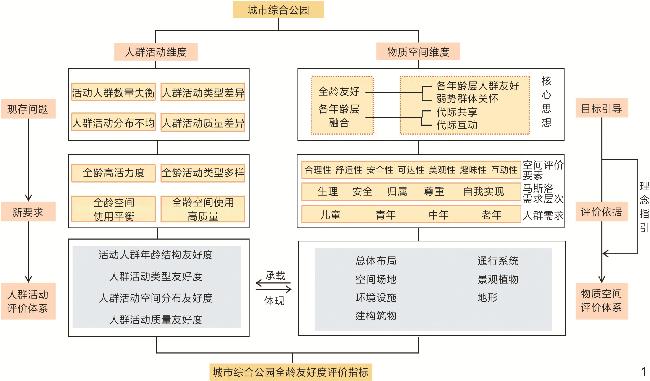
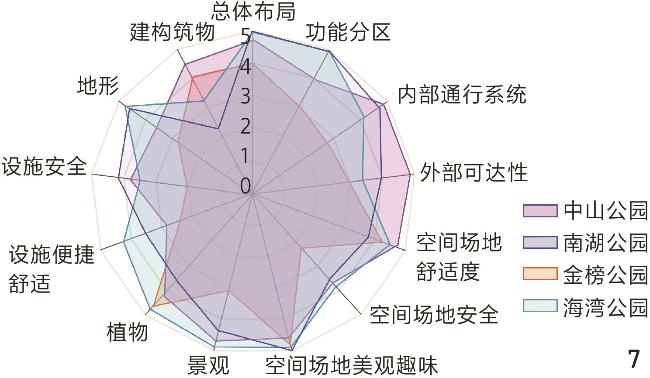
从人群活动、物质空间2个维度切入,构建城市综合公园全龄友好度的量化评价体系:1)构建包括活动人群年龄结构友好度、人群活动类型友好度、人群活动空间分布友好度、人群活动质量友好度指标在内的人群活动全龄友好度评价体系;2)建立包括7个一级指标、13个二级指标及47个三级指标在内的物质空间全龄友好度评价体系,并以厦门市4个类型的综合公园为例进行实证研究。
不同类型公园的全龄友好度不同:海湾公园全龄友好度最高但老年友好度不足;中山公园对老年、儿童群体友好,但中青年群体友好度欠佳;南湖公园活动比例失衡影响空间使用;金榜公园因地形复杂全龄友好度最低。不同公园对各年龄层群体的友好度也存在差异:对老年群体友好度最高,对儿童、中年、青年群体的友好度依次降低。
综合人群活动评价及物质空间评价的研究方法为城市综合公园全龄友好度的评价提供了新的思路。未来可以从功能布局、通行系统、空间布局、多元景感、评价机制方面优化城市综合公园规划,以建设高质量的全龄友好城市综合公园。
刘晓芳 , 王怡然 , 肖琛宸 , 杨思声 . 城市综合公园全龄友好度评价[J]. 风景园林, 2025 , 32(3) : 110 -118 . DOI: 10.3724/j.fjyl.202407030361
Promoting the construction of all-age-friendly cities is an important measure to practice high-quality development. Citizens can engage in long-term, numerous and diverse outdoor activities in urban comprehensive parks. Promoting all-age friendliness of urban comprehensive parks is an important aspect of effectively implementing the construction of all-age-friendly cities. The construction of all-age-friendly urban comprehensive parks can provide all-age people with open spaces which have comfortable and vibrant environments, and can also create intergenerational activities and promote the physical and mental health of all people. At present, the degree of all-age friendliness of urban comprehensive parks is relatively low. There still exist problems such as unbalanced distribution of activity quantity, activity type, and activity space among different age groups, as well as significant differences in activity quality. The purpose of this research is to provide a scientific basis for the construction of all-age-friendly urban comprehensive parks by exploring the evaluation method for all-age friendliness of urban comprehensive parks.
This research constructs a quantitative evaluation method for the all-age friendliness of comprehensive parks from the two dimensions of crowd activity and physical space. First of all, the evaluation model and method for all-age friendliness of crowd activities in comprehensive parks based on activity characterization are constructed. Next, the evaluation indicator system and method for all-age friendliness of physical space based on the relationship between the needs of all-age people and the elements of park planning and design are constructed. The evaluation system for all-age friendliness of crowd activities and that for all-age friendliness of physical space complement each other. As a result, a relatively complete evaluation method for all-age friendliness of comprehensive parks is constructed.
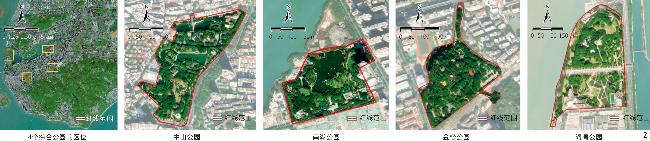
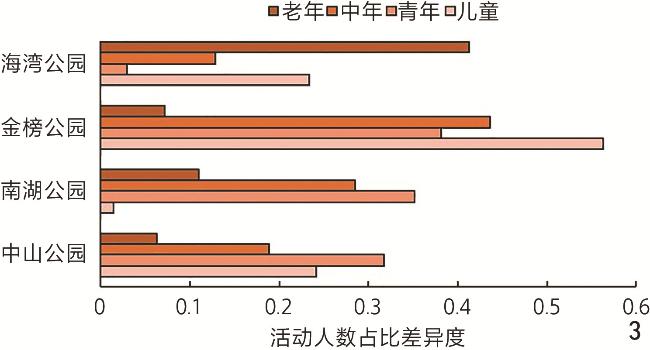
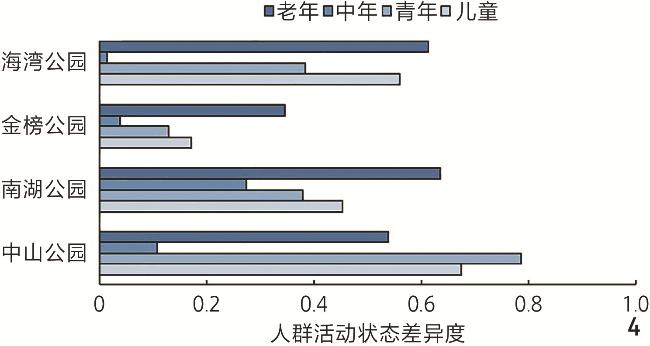
At the level of crowd activities, this research constructs the evaluation indicators and measurement methods. This research takes four representative comprehensive parks in Xiamen as examples for empirical research. Based on the evaluation of crowd activities in the four parks, it is found that there are differences in the all-age friendliness of different types of comprehensive parks: 1) Haiwan Park has the highest degree of all-age friendliness, but its elderly friendliness is relatively poor; 2) Zhongshan Park in the old urban area attracts more citizens, is more inclusive towards the elderly and children, and has a relatively high degree of all-age friendliness; 3) Nanhu Park has a relatively high degree of all-age friendliness, but the proportion of its activity types is imbalanced; 4) the complex terrain of Jinbang Park in mountainous areas limits the setting of activity venues, resulting in the lowest degree of all-age friendliness, manifested by the low degree of friendliness of age structure and activity space distribution of the activity crowd. In addition, there are also significant differences in activity friendliness among different age groups in the parks: 1) The parks have the highest degree of activity friendliness to the elderly group with the proportion of elderly people closest to the ideal value, the highest degree of friendliness of spatial distribution, and relatively high degree of friendliness of activity type and activity quality; 2) the parks have a relatively high degree of activity friendliness to the children group, which is marked by higher degree of friendliness of activity type and activity quality, but there is a large variation in other indicators among different parks; 3) the parks have a relatively low degree of activity friendliness to the middle-aged group, because there is a large difference between the proportion of the actual number and that of the ideal number of middle-aged people, and the degree of friendliness of activity space distribution and activity quality are both relatively low; 4) the parks have the lowest degree of activity friendliness to the youth group, as all indicators except for the activity type are at a relatively low level.
The research results on all-age friendliness of crowd activity and that of physical space are basically consistent. The indicators regarding crowd activity and those regarding physical space complement, couple with, and verify each other. The synergy of the two can effectively evaluate the all-age friendliness of comprehensive parks. This method provides a new approach for evaluating the all-age friendliness of urban public spaces and provides a scientific basis for the planning, construction, and management of urban comprehensive parks. The all-age friendliness evaluation of urban comprehensive parks should not only focus on external indicators such as the number, type and area of activities for different age groups, but also comprehensively consider internal indicators such as activity quality. It is suggested to optimize the planning of urban comprehensive parks in terms of functional layout, access system, spatial site, diverse land sense and evaluation mechanism in the future, apply the evaluation indicator system for all-age friendliness to implement the evaluation of planning and design schemes, built environment, etc., and coordinate innovative implementation mechanisms for urban renewal, quality improvement actions and other projects to effectively promote the construction of all-age-friendly parks and achieve high-quality urban development.
表1 物质空间全龄友好度评价指标体系Table 1 Evaluation indicator system for all-age friendliness of physical space |
| 一级指标 | 二级指标 | 三级指标 |
| 总体布局 | 总体布局 | 总体结构合理性 |
| 功能分区 | 功能布局合理性、动静分区适宜性 | |
| 通行系统 | 内部通行系统 | 路网结构合理性、全龄步行体验丰富度、全龄通行无障碍度、全龄活动路径协调度、道路的连续性 |
| 外部可达性 | 道路交通可达性 | |
| 空间场地 | 空间场地舒适 | 全龄活动空间功能适宜性、空间功能多龄复合性、全龄活动空间尺度舒适性、全龄活动空间氛围舒适性、空间场地代际社交促进性 |
| 空间场地安全 | 空间场地可监督性、空间是否有视觉死角、地面铺装安全性、空间开敞度 | |
| 空间场地美观趣味 | 空间层次丰富度、空间界面美观性、地面铺装美观性、地面铺装趣味性 | |
| 景观植物 | 景观 | 全龄景观偏好契合度、调动全龄感官的景观丰富度、景观小品丰富趣味性、景观小品特色性、绿色景观全龄适宜性 |
| 植物 | 植物层次结构丰富度、植物色彩丰富度、植物乔灌木结合配置丰富度、植物配置安全性、植物地域特色性 | |
| 环境设施 | 设施便捷舒适 | 满足全龄需求的公共服务设施丰富度、智能设施的老幼使用便捷度、全龄休憩设施完备度、游乐设施全龄适宜性、导视系统老幼使用便捷度、夜间照明系统完备度、设施全龄使用协同性、设施色彩美观度 |
| 设施安全 | 设施使用安全性 | |
| 地形 | 地形 | 地形设计对全龄活动的适宜性、地形安全性、地形趣味度 |
| 地形安全性 | ||
| 建构筑物 | 建构筑物 | 建构筑物全龄活动舒适性、建构筑物特色性 |
表2 各公园的活动人群年龄结构友好度评价结果Table 2 Evaluation results of age structure friendliness of the activity crowd in each park |
| 公园 | 活动人群年龄结 | 活动人数占比 | 活动人群年结 |
| 中山 | 0.035 | 0.811 | 0.268 |
| 南湖 | 0.020 | 0.761 | 0.363 |
| 金榜 | 0.102 | 1.453 | 0.126 |
| 海湾 | 0.046 | 0.805 | 0.243 |
表3 各公园的各年龄层人群活动种类Table 3 Activity types of different age groups in each park |
| 人群类型 | 活动种类 |
| 儿童 | 玩耍、休息、散步、观景、打羽毛球、跑步、骑行、聚会、观赏动物、打篮球、滑冰、拍照、游船 |
| 青年 | 玩耍、休息、散步、观景、打羽毛球、踢毽子、跑步、使用健身器材、跳广场舞、陪伴儿童、打篮球、聊天、看动物、棋牌、相亲、拍照、游船、唱歌 |
| 中年 | 静思、散步、观景、跑步、打羽毛球、陪伴儿童、踢毽子、跳广场舞、跑步、健身、聊天、棋牌、相亲、拍照、游船、看动物、室外游泳、唱歌 |
| 老年 | 散步、聊天、棋牌、陪伴儿童、健身、看动物、休息、打羽毛球、踢毽子、跳广场舞、拍照、打太极、唱歌 |
表4 各公园的人群活动类型友好度评价结果Table 4 Evaluation results of activity type friendliness in each park |
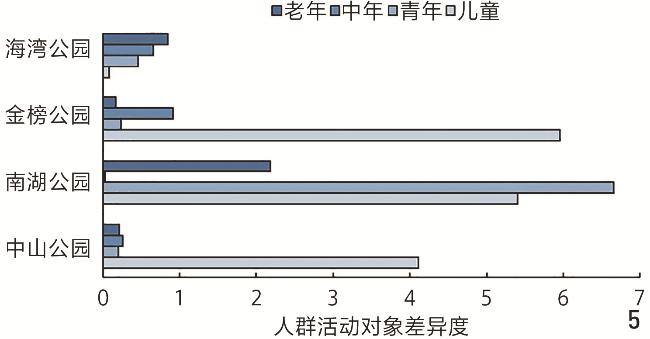
| 公园名称 | 人群活动 | 人群活动状 | 人群活动对 | 人群活动类 |
| 中山公园 | 43 | 1.460 | 5.234 | 0.238 |
| 南湖公园 | 46 | 1.427 | 14.400 | 0.194 |
| 金榜公园 | 42 | 1.341 | 6.671 | 0.213 |
| 海湾公园 | 44 | 1.794 | 1.916 | 0.355 |
表5 各公园的人群活动空间分布友好度评价结果Table 5 Evaluation results of activity space distribution friendliness in each park |
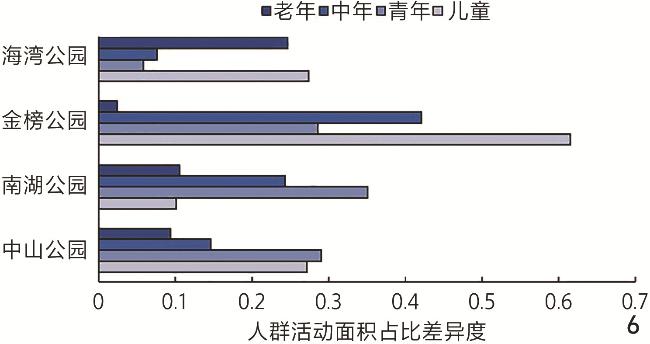
| 公园 | 人群活动面积占比 | 人群活动面积 | 人群活动空间 |
| 中山公园 | 0.034 | 0.834 | 0.280 |
| 南湖公园 | 0.042 | 0.840 | 0.254 |
| 金榜公园 | 0.094 | 1.439 | 0.134 |
| 海湾公园 | 0.031 | 0.661 | 0.332 |
表6 各公园人群活动质量友好度评价结果Table 6 Evaluation results of activity quality friendliness in each park |
| 公园名称 | 人群活动质量友好度 | ||||
| 儿童 | 青年 | 中年 | 老年 | 总计 | |
| 中山公园 | 1.00 | 0.73 | 0.74 | 0.76 | 3.23 |
| 南湖公园 | 1.00 | 0.87 | 0.96 | 0.99 | 3.82 |
| 金榜公园 | 1.00 | 0.95 | 1.00 | 1.00 | 3.95 |
| 海湾公园 | 1.00 | 0.87 | 0.79 | 0.87 | 3.53 |
表7 人群活动全龄友好度评价结果Table 7 Evaluation results of all-age friendliness of crowd activities |
| 公园名称 | 活动人群年龄 | 人群活动类型 | 人群活动空间 | 人群活动质量 | 人群活动全龄 |
| 中山公园 | 0.268 | 0.238 | 0.280 | 0.223 | 0.251 |
| 南湖公园 | 0.363 | 0.194 | 0.254 | 0.263 | 0.261 |
| 金榜公园 | 0.126 | 0.213 | 0.134 | 0.272 | 0.188 |
| 海湾公园 | 0.243 | 0.355 | 0.332 | 0.243 | 0.300 |
文中图表均为作者自绘,其中
| [1] |
盛卿.打造友好空间构筑幸福家园: 多地推进全龄友好社区建设侧记[N].中国建设报, 2023-04-19(2).
SHENG Q. Building a Friendly Space and Building a Happy Home: A Side Note on Promoting the Construction of All-Age Friendly Communities in Many Places[N]. China Construction News, 2023-04-19(2).
|
| [2] |
福建省图书馆.决策参考报告202301综述: 多方位着手, 推动全龄友好型城市建设[EB/OL].(2023-01-11)[2024-06-15]. https://www.fjlib.net/zt/fjstsgjcxx/zbzl/rdzt/202301/t20230111_471620.htm.
Fujian Library. Summary of Decision Reference Report 202301: Take a Multi-faceted Approach to Promote the Construction of Age-Friendly Cities[EB/OL]. (2023-01-11)[2024-06-15]. https://www.fjlib.net/zt/fjstsgjcxx/zbzl/rdzt/202301/t20230111_471620.htm.
|
| [3] |
王佳文, 胡继元, 王建龙, 等. 新时代城市公共社会福利设施规划标准研究: 走向全龄友好社会[J]. 城市规划, 2024, 48(2): 75-83.
WANG J W, HU J Y, WANG J L, et al. Research on Planning Standards for Urban Public Social Welfare Facilities in the New Era: Towards an Age-Friendly Society[J]. City Planning Review, 2024, 48(2): 75-83.
|
| [4] |
王泽夏, 张晓明, 廖顺意, 等. 全龄友好城市目标下广州市适老化交通对策[J]. 城市交通, 2022, 20(4): 18-27.
WANG Z X, ZHANG X M, LIAO S Y, et al. Senior-Friendly Transportation Strategies in Guangzhou Under the Goal of All-Age-Friendly City[J]. Urban Transport of China, 2022, 20(4): 18-27.
|
| [5] |
徐硕含, 琚瑞, 刘鹏, 等. 全龄友好型城市社区公共服务设施规划策略: 以衢州智慧新城为例[J]. 规划师, 2024, 40(8): 121-127.
XU S H, JU R, LIU P, et al. Planning Strategies for All-Friendly Urban Community Public Service Facilities: The Example of Quzhou Smart New City[J]. Planners, 2024, 40(8): 121-127.
|
| [6] |
芶皓, 郭自度. 从儿童友好到全龄友好: 复合空间视角下的佛山公园改造设计研究[J]. 广东园林, 2022, 44(4): 54-59.
GOU H, GUO Z D. From Child Friendliness to Age Friendliness: A Study on the Renovation Design of Foshan Park from the Perspective of Composite Space[J]. Guangdong Landscape Architecture, 2022, 44(4): 54-59.
|
| [7] |
张雍雍, 金建伟, 傅哲宁, 等. 全龄友好型城镇社区规划策略: 以温州市龙湾区为例[J]. 规划师, 2024, 40(8): 114-120.
ZHANG Y Y, JIN J W, FU Z N, et al. Planning Strategies for All-Age Friendly Urban Communities: Taking Longwan District of Wenzhou City as an Example[J]. Planners, 2024, 40(8): 114-120.
|
| [8] |
郑文晖. 全龄社区适老化更新的国际实践及其启示[J]. 建筑与文化, 2023(8): 126-128.
ZHENG W H. International Practice and Enlightenment of Renewal Suitable for Aging in Fullage Community[J]. Architecture & Culture, 2023(8): 126-128.
|
| [9] |
张德顺, 王丹, 姚鳗卿, 等. 全龄儿童友好型住区户外活动空间景观设计: 以长沙万科金域华府为例[J]. 华中建筑, 2022, 40(11): 81-84.
ZHANG D S, WANG D, YAO M Q, et al. Landscape Design of Outdoor Activity Space for All-Age Children Friendly Residential Area: A Case Study of Vanke Jinyu Huafu in Changsha[J]. Huazhong Architecture, 2022, 40(11): 81-84.
|
| [10] |
乔丹惠. 全龄友好理念下既有住区外部空间更新研究: 以天津体院北居住区为例[D].天津: 河北工业大学, 2022.
QIAO D H. Study on the Renewal of External Space of Existing Residential Areas Under the Concept of Age-Friendly: Take Tiyuanbei Residential Areas in Tianjin as an Example[D]. Tianjin: Hebei University of Technology, 2022.
|
| [11] |
LAWLER K, BERGER C. Building a Lifelong Community for All Ages[J]. Generations (San Francisco, Calif.), 2020, 44(2): 1-5.
|
| [12] |
姚之浩, 李昊昱. 全龄友好导向下居住型街区更新的研究框架与规划应对[J]. 规划师, 2024, 40(1): 34-41.
YAO Z H, LI H Y. The Research Framework and Planning Response for All-Age Friendly Neighborhood Renewal[J]. Planners, 2024, 40(1): 34-41.
|
| [13] |
SALVO G, LASHEWICZ B M, DOYLE-BAKER P K, et al. Neighbourhood Built Environment Influences on Physical Activity Among Adults: A Systematized Review of Qualitative Evidence[J]. International Journal of Environmental Research and Public Health, 2018, 15(5): 897.
|
| [14] |
COSTIGAN S A, VEITCH J, CRAWFORD D, et al. A Cross-Sectional Investigation of the Importance of Park Features for Promoting Regular Physical Activity in Parks[J]. International Journal of Environmental Research and Public Health, 2017, 14(11): 1335.
|
| [15] |
RIES A V, VOORHEES C C, ROCHE K M, et al. A Quantitative Examination of Park Characteristics Related to Park Use and Physical Activity Among Urban Youth[J]. Journal of Adolescent Health, 2009, 45(3): S64-S70.
|
| [16] |
黄瓴, 黄睿, 骆骏杭, 等. 山地城市老旧社区公共空间场景资产研究: 基于人—空间—活动的整体关联性分析[J]. 上海城市规划, 2023(1): 88-95.
HUANG L, HUANG R, LUO J H, et al. Research on Public Space Scene Assets of Old Communities in Mountainous Cities: A Holistic Correlation Analysis Based on Human-Space-Activity[J]. Shanghai Urban Planning Review, 2023(1): 88-95.
|
| [17] |
陶晓丽, 陈明星, 张文忠, 等. 城市公园的类型划分及其与功能的关系分析: 以北京市城市公园为例[J]. 地理研究, 2013, 32(10): 1964-1976.
TAO X L, CHEN M X, ZHANG W Z, et al. Classification and Its Relationship with the Functional Analysis of Urban Parks: Taking Beijing as an Example[J]. Geographical Research, 2013, 32(10): 1964-1976.
|
| [18] |
高文秀, 范香, 郑芬, 等.综合公园及其有效服务范围的空间布局分析[J].城市规划, 2017, 41(11): 97-101, 110.
GAO W X, FAN X, ZHENG F, et al. Spatial Distribution of Comprehensive Parks and Their Effective Service Scope[J]. City Planning Review, 2017, 41 (11): 97-101, 110.
|
| [19] |
中华人民共和国住房和城乡建设部.公园设计规范: GB 51192-2016[S].北京: 中国建筑工业出版社, 2017.
Ministry of Housing and Urban-Rural Development of the People’s Republic of China. Code for the Design of Public Park: GB 51192-2016[S]. Beijing: China Architecture & Building Press, 2017.
|
| [20] |
焦健, 王德, 程英. 上海市时间贫困人群的日常活动模式与特征[J]. 城市规划, 2023, 47(4): 31-44.
JIAO J, WANG D, CHENG Y. Daily Activity Patterns and Characteristics of the Time-Poverty People in Shanghai[J]. City Planning Review, 2023, 47(4): 31-44.
|
| [21] |
吴良镛. 人居环境科学的探索[J]. 规划师, 2001, 17(6): 5-8.
WU L Y. Search for the Theory of Science of Human Settlement[J]. Planners, 2001, 17(6): 5-8.
|
| [22] |
LIN T, GRIMM N B. Comparative Study of Urban Ecology Development in the U.S. and China: Opportunity and Challenge[J]. Urban Ecosystems, 2015, 18(2): 599-611.
|
| [23] |
史宜, 戴运来, 张珣, 等. 基于精细时空行为测度的街道空间人群数字画像构建与分异[J]. 风景园林, 2024, 31(9): 24-33.
SHI Y, DAI Y L, ZHANG X, et al. Research on the Construction and Differentiation Mechanism of Digital Portraits of Crowds in Street Space Based on Fine Spatiotemporal Behavior Measurement[J]. Landscape Architecture, 2024, 31(9): 24-33.
|
| [24] |
刘宇舒, 林芳, 王振宇, 等. 公共健康视角下城市社区绿道空间挖掘与规划选线研究: 以苏州市中心城区为例[J]. 西部人居环境学刊, 2024, 39(3): 58-64.
LIU Y S, LIN F, WANG Z Y, et al. Research on Spatial Excavation and Route Selection Method of Urban Community Greenway in Public Health Perspective: A Case Study of Central District of Suzhou[J]. Journal of Human Settlements in West China, 2024, 39(3): 58-64.
|
| [25] |
刘晓芳, 吝涛, 吴昕怡. 城市公园景观文化服务实现度定量化评价[J]. 华侨大学学报(自然科学版), 2022, 43(2): 206-215.
LIU X F, LIN T, WU X Y. Quantitative Evaluation on Realization Degree of Urban Parks Landscape Cultural Services[J]. Journal of Huaqiao University (Natural Science), 2022, 43(2): 206-215.
|
| [26] |
CLARE C M, CAROLYN F, TANG S S, et al. People Places: Design Guidelines for Urban Open Space, 2nd Edition[M]. New York: John Wiley and Sons, 1997.
|
| [27] |
韩涵, 于冰沁. “一米高度看城市”: 儿童友好视角下的综合公园趣味性评价[J]. 南方建筑, 2023(5): 99-107.
HAN H, YU B Q. “Seeing the City from a Meter Height”: Evaluation of Enjoyment of Comprehensive Parks from a Child-Friendly Perspective[J]. South Architecture, 2023(5): 99-107.
|
| [28] |
姚苏城, 龙岳林. 基于马斯洛需求理论的公园使用评价体系模型构建理论需求: 以湖南烈士公园为例[J]. 住宅与房地产, 2017(6): 110.
YAO S C, LONG Y L. The Theoretical Demand for the Construction of Park Use Evaluation System Model Based on Maslow’s Demand Theory: Taking Hunan Martyrs Park as an Example[J]. Housing and Real Estate, 2017(6): 110.
|
| [29] |
邓付东, 刘润, 周晓芳, 等.中心城区城市公园的儿童友好性分析及其规划应对: 以武汉市沙湖公园为例[J].湖北大学学报(自然科学版): 1-9.
DENG F D, LIU R, ZHOU X F, et al. Child Friendly Analysis and Planning Response of Urban Parks in Central Urban Areas: Take Wuhan Shahu Park as An Example[J]. Journal of Hubei University (Natural Science): 1-9.
|
| [30] |
RISHI P, MOGHE S, UPADHYAY B K. Analysis of Hierarchy of Needs and Motivational Strategies for Eco-development Planning in Two National Parks of India[J]. Resources, Conservation and Recycling, 2008, 52(5): 707-718.
|
| [31] |
张菁, 李海涛, 付冬楠, 等. 我国全龄友好城市的内涵与建设策略研究[J]. 城市规划, 2024, 48(S1): 144-152.
ZHANG J, LI H T, FU D N, et al. Research on the Connotation and Construction Strategies of All-Age Friendly City in China[J]. City Planning Review, 2024, 48(S1): 144-152.
|
| [32] |
贺慧, 荣升, 张彤. 全龄友好的城市环境研究进展及未来趋向[J]. 新建筑, 2024(4): 103-109.
HE H, RONG S, ZHANG T. All-Age-Friendly Urban Environment Research Progress and Future Trends[J]. New Architecture, 2024(4): 103-109.
|
| [33] |
朱荟. 构建全龄友好社会的重点与关键[J]. 人民论坛, 2024(23): 78-82.
ZHU H. Key Points and Keys of Building a Age-Friendly Society[J]. People’s Tribune, 2024(23): 78-82.
|
| [34] |
AHMAD O B, BOSCHI P C, LOPEZ A D, et al. Age Standardization of Rates: A New WHO Standard[C]. Geneva: World Health Organization, 2001.
|
| [35] |
ZHAO J Z, LIU X, DONG R C, et al. Landsenses Ecology and Ecological Planning Toward Sustainable Development[J]. International Journal of Sustainable Development & World Ecology, 2016, 23(4): 293-297.
|
| [36] |
ZHAO J, YAN Y, DENG H, et al. Remarks About Landsenses Ecology and Ecosystem Services[J]. International Journal of Sustainable Development & World Ecology, 2020, 27(3): 196-201.
|
/
| 〈 |
|
〉 |