

从《沈阳百咏》探析光绪初年盛京城人居文化景观
|
谢淼伊娜/女/沈阳建筑大学建筑与规划学院在读博士研究生/辽宁省区域建筑学与寒地人居科学重点实验室成员/研究方向为建筑历史与理论 |
|
王飒/男/博士/沈阳建筑大学建筑与规划学院教授、博士生导师/辽宁省区域建筑学与寒地人居科学重点实验室成员/研究方向为东北聚落的历史与文化、城乡建筑遗产保护与环境行为、视觉环境与人居空间感知 |
收稿日期: 2023-09-18
修回日期: 2024-03-30
网络出版日期: 2025-12-12
基金资助
国家自然科学基金“东北‘女真-满族’聚落变迁及其演进机制研究”(52278028)
辽宁省社科规划基金“辽宁古代城镇地方志史料挖掘及其明清时期变迁研究”(L22BTQ005)
版权
Cultural Landscape of Human Settlements in Shengjing City in the Early Guangxu Period Based on Shenyang Baiyong
|
XIE Miaoyina is a Ph.D. candidate in the School of Architecture and Planning, Shenyang Jianzhu University, and a member of the Key Laboratory of Regional Architecture and Human Settlements Science of Cold Areas in Liaoning Province. Her research focuses on history and theory of architecture |
|
WANG Sa, Ph.D., is a professor and doctoral supervisor in the School of Architecture and Planning, Shenyang Jianzhu University, and a member of the Key Laboratory of Regional Architecture and Human Settlements Science of Cold Areas in Liaoning Province. His research focuses on history and culture of settlements in northeast China, urban and rural architectural heritage protection and environmental behavior, and visual environment and living space perception |
Received date: 2023-09-18
Revised date: 2024-03-30
Online published: 2025-12-12
Copyright
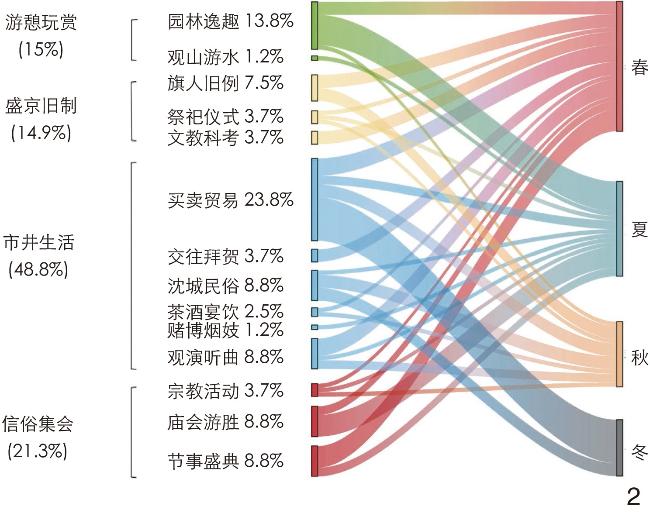
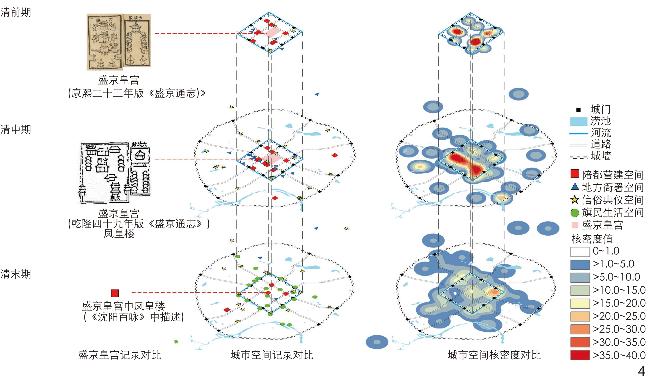
【目的】从人居环境学的角度,探究在清末外部变化影响下仍是帝国陪都的盛京城内文化景观和城市空间变化,以填补盛京城清末文化景观研究的不足。【方法】以《沈阳百咏》为依据,运用文本挖掘语义分析、时间地理学分析、历史地理空间分析量化光绪初年盛京城人居文化景观类型和时空信息,探讨文化景观的分布规律,并通过对比清朝前、中、末期城市空间,总结光绪初年盛京城的风貌特点。【结果】将盛京城人居文化景观归纳为“游憩玩赏”“盛京旧制”“市井生活”“信俗集会”4个一级分类及15个二级分类,发现文化景观类型与季节农时有强关联,不同文化景观在地理空间分布上有显著差异,整体上集中于关厢地带,城北景观密度高于城南。通过将《沈阳百咏》中城市空间与清前、中期城市空间对比发现,光绪初年盛京城已成为有满族特色的地方中心性城市。【结论】对《沈阳百咏》的深入挖掘填补了清末盛京城文化景观研究的缺环,为清代盛京城研究提供新思路,同时也为后续通过诗文分析盛京城文化景观格局提供了参考。
谢淼伊娜 , 王飒 . 从《沈阳百咏》探析光绪初年盛京城人居文化景观[J]. 风景园林, 2024 , 31(6) : 133 -139 . DOI: 10.3724/j.fjyl.202309180429
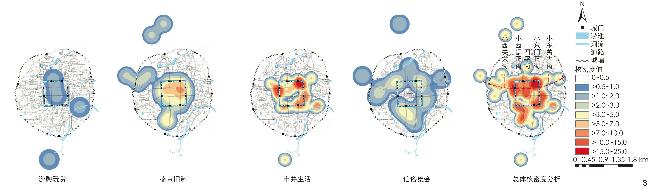
【Objective】The current research on Shengjing City (today’s Shenyang City, Liaoning Province, China) mainly focuses on fields such as architecture, urban history, planning history, landscape science and folklore, and the issues of interest include urban spatial patterns, morphological changes, landscape construction, influence of multi-ethnic integration on urban development, etc. However, there is scant research on the cultural landscape in historical periods from the perspective of the science of human settlement. Moreover, due to the lack of official historical materials on Shengjing City in the late Qing Dynasty, the research on Shengjing City seldom involves this historical period. The early Guangxu period marked the final stage of the feudal monarchy. As the secondary capital then, Shengjing was on the eve of the collapse of the old order. The book Shenyang Baiyong written in the fourth year of the Guangxu period can serve as a historical snapshot. It explores the cultural landscapes and the urban spatial changes of Shengjing City, which remained an imperial secondary capital under the external changes of the late Qing Dynasty, from the perspective of the science of human settlement, and is of great significance for filling the gap in the research on the cultural landscape in Shengjing City in the late Qing Dynasty.【Methods】This research uses methods such as text mining analysis, spatial-temporal geographical analysis, and historical geospatial analysis to quantitatively analyze the types of cultural landscapes described by Miao Runfu in Shenyang Baiyong, as well as the spatio-temporal information of these cultural landscapes, and to explore their distribution patterns. Specifically, the research firstly uses the ROST CM6 content mining system to extract high-frequency characters from the poems in Shenyang Baiyong through text mining analysis, and categorizes these high-frequency characters based on the nature of activities in cultural landscapes, spatial locations of these landscapes, and historical and cultural characteristics of Shengjing City. Then, based on the theory of spatio-temporal geography, the research analyzes the cultural landscapes depicted in Shenyang Baiyong on an annual basis, and presents the distribution patterns of cultural landscapes in Shengjing City over time in the form of Sankey diagram. Moreover, a geospatial analysis is conducted using ArcGIS software, and a kernel density analysis is conducted on different types of cultural landscapes in Shengjing City to explore their spatial distribution patterns. Additionally, by comparing the urban spaces described in Shenyang Baiyong with those recorded in the official documents from the early and middle Qing Dynasty, the research illustrates the characteristics of urban landscapes in Shengjing City during Guangxu period.【Results】The cultural landscapes in Shengjing City are classified into 4 primary types and 15 secondary types. A visual analysis of the temporal distribution characteristics of cultural landscapes conducted using Sankey diagrams reveals that the cultural landscapes in Shengjing City follow the overall pattern of seasonal agricultural cycles, and are influenced by festival folklore. A kernel density analysis conducted using ArcGIS reveals significant differences in the spatial distribution of different types of cultural landscapes, which are generally concentrated in the area between the outer city wall and the inner city wall. The density of landscapes in the north of the city is higher than that in the south, and activities are distributed along the line from Xiaoxiguan Street to Xiaodongguan Street in the northern part of the city, suggesting that this east-west road traversing Shengjing City was an important space for activities of residents during Guangxu period. Changes in the level of attention to the four types of urban spaces, namely, spaces for capital construction, spaces for local government offices, spaces for religious customs and living spaces for the Banner people and commoners, and changes in the distribution kernel density of the city indicate that the official power spaces in Shengjing City had faded out of the lives of local residents by that time, while the civil spaces continued to develop, with the population constantly expanding, the commerce thriving, and the beliefs diversifying. However, due to the special status of the Banner people in Qing Dynasty, the nobles and aristocrats lived in the inner city, while the Banner people lived in the outer city. The Shengjing society depicted by Miao Runfu still consisted mainly of the banner people with prosperous and diversified living spaces. It is found that by the early Guangxu period, the influence of the royal family had gradually weakened, with Shengjing City transitioning from a capital city to a secondary capital, and then to an awkward situation at the end of Qing Dynasty when the Qing government was preoccupied with internal and external troubles, accompanied by the declining political status of Shengjing City. However, from an urban perspective, the population, economy, and culture of Shengjing City continued to grow richer, making it gradually develop into a local center city with Manchu characteristics.【Conclusion】Due to the lack of official historical records, the research on the cultural landscapes in Shengjing City in the late Qing Dynasty has long been in a state of blank. Shenyang Baiyong to some extent compensates for the insufficiency of historical materials, providing a basis for analyzing the cultural landscapes in Shengjing City in the early Guangxu period. The in-depth exploration of Shenyang Baiyong fills the gap in the research on the cultural landscapes in Shengjing City in the late Qing Dynasty, which can provide new insights for the research on Shengjing City and a reference for subsequent analysis of the cultural landscape pattern of Shengjing City through poetry.
表1 盛京城文化景观词频统计Tab. 1 Statistics of word frequency regarding cultural landscapes in Shengjing City |
| 活动要素 | 词频 | 活动要素 | 词频 | 活动要素 | 词频 | 活动要素 | 词频 | |||
| 鼓乐 | 33 | 皇寺 | 6 | 塔影 | 4 | 操演 | 2 | |||
| 婚嫁 | 16 | 货郎 | 6 | 跳跶 | 4 | 出行 | 2 | |||
| 饮酒 | 16 | 立春 | 6 | 舞狮 | 4 | 供三官 | 2 | |||
| 听曲 | 15 | 商人 | 6 | 拜贺 | 3 | 观莲 | 2 | |||
| 吃茶 | 14 | 超度 | 5 | 抽大烟 | 3 | 观舞 | 2 | |||
| 踏青 | 13 | 买卖 | 5 | 吹城 | 3 | 还愿 | 2 | |||
| 烧香 | 11 | 僧侣 | 5 | 祠庙 | 3 | 教场 | 2 | |||
| 行市 | 11 | 宿娼 | 5 | 蹴鞠 | 3 | 接佛 | 2 | |||
| 宴请 | 11 | 跳神 | 5 | 登阁 | 3 | 商业街 | 2 | |||
| 观演 | 9 | 学校 | 5 | 风筝 | 3 | 武童 | 2 | |||
| 庙会 | 9 | 占卜 | 5 | 宫观 | 3 | 闲谈 | 2 | |||
| 乘凉 | 8 | 观灯 | 4 | 叫卖 | 3 | 远眺 | 2 | |||
| 佛寺 | 8 | 观农 | 4 | 骑马 | 3 | 渍菜 | 2 | |||
| 聚赌 | 8 | 糊窗 | 4 | 石刻 | 3 | 辞灶 | 2 | |||
| 烧炕 | 8 | 货车 | 4 | 挽弓 | 3 | 长亭 | 2 | |||
| 出丧 | 7 | 教堂 | 4 | 八旗 | 2 | 园林 | 2 | |||
| 游水 | 7 | 礼拜 | 4 | 兵丁 | 2 |
表2 盛京城文化景观类型Tab. 2 Types of cultural landscapes in Shengjing City |
| 一级景观类型 (词频) | 二级景观类型 | 景观相关词条 |
| 游憩玩赏(61) | 访古探幽 | 塔影、石刻、长亭等 |
| 园林逸趣 | 乘凉、踏青、园林等 | |
| 观山游水 | 登阁、远眺、观莲等 | |
| 盛京旧制(33) | 旗人旧例 | 八旗、吹城、教场等 |
| 祭祀仪式 | 跳跶、皇寺、接佛等 | |
| 文教科考 | 学校、武童、挽弓等 | |
| 市井生活(195) | 买卖贸易 | 货郎、行市、商人等 |
| 交往拜贺 | 闲谈、拜贺等 | |
| 沈城民俗 | 糊窗、烧炕、烧炕等 | |
| 茶酒宴饮 | 吃茶、宴请、饮酒等 | |
| 赌博烟妓 | 聚赌、宿娼、抽大烟等 | |
| 观演听曲 | 鼓乐、听曲、观演等 | |
| 信俗集会(82) | 宗教活动 | 烧香、超度、占卜等 |
| 庙会游胜 | 庙会、皇寺、观灯等 | |
| 节事盛典 | 立春、供三官、辞灶等 |
文中图表均由作者绘制,其中
| [1] |
黄昕珮, 李琳. 对“文化景观”概念及其范畴的探讨[J]. 风景园林, 2015, 22(3): 54-58.
HUANG X P, LI L. Discussion on Concept and Category of “Cultural Landscape”[J]. Landscape Architecture, 2015, 22(3): 54-58.
|
| [2] |
王茂生.清代沈阳城市发展与空间形态研究[D].广州: 华南理工大学, 2010.
WANG M S. Study on the City Evolution & Space Morphology of Shenyang in Qing Dynasty[D]. Guangzhou: South China University of Technology, 2010.
|
| [3] |
王飒.中国传统聚落空间层次结构解析[D].天津: 天津大学, 2012.
WANG S. The Analysis of the Space Level Structure of Chinese Traditional Settlements[D]. Tianjin: Tianjin University, 2012.
|
| [4] |
张健, 李萌, 李竟翔. 清末沈阳的城市与园林建设情况[J]. 华中建筑, 2017, 35(3): 90-94.
ZHANG J, LI M, LI J X. The Construction of Shenyang City and Gardens During the Late Qing Dynasty[J]. Huazhong Architecture, 2017, 35(3): 90-94.
|
| [5] |
陈伯超. 地域性融合文化对盛京城空间格局的影响[J]. 城市建筑, 2006 (8): 16-19.
CHEN B C. The Function of Regional Syncretic Culture in the Formation for Space Structure of Shengjing[J]. Urbanism and Architecture, 2006 (8): 16-19.
|
| [6] |
李春玲, 李绪刚, 赵炜. 基于古诗词语义解析的乡村景观认知: 以成都平原为例[J]. 中国园林, 2020, 36(5): 76-81.
LI C L, LI X G, ZHAO W. On the Optimization of Rural Settlement Space Planning Method Based on Semantic Analysis of Ancient Poetry: A Case Study of the Chengdu Plain[J]. Chinese Landscape Architecture, 2020, 36(5): 76-81.
|
| [7] |
傅俊杰, 唐孝祥. 明清珠江三角洲桑园围地区人文景观类型与文化内涵[J]. 风景园林, 2020, 27(6): 115-120.
FU J J, TANG X X. Human Landscape Types and Cultural Connotations of Sangyuan Wei Area of Pearl River Delta in Ming and Qing Dynasties[J]. Landscape Architecture, 2020, 27(6): 115-120.
|
| [8] |
王长松, 邹文卉. 想象的城市: 南京诗词景观的塑造与网络结构[J]. 风景园林, 2022, 29(1): 129-134.
WANG C S, ZOU W H. Imagined City: The Shaping and Network Structure of Nanjing Poetic Landscape[J]. Landscape Architecture, 2022, 29(1): 129-134.
|
| [9] |
张建立, 李仁杰, 傅学庆, 等. 古诗词文本的空间信息解析与可视化分析[J]. 地球信息科学学报, 2014, 16(6): 890-897.
ZHANG J L, LI R J, FU X Q, et al. Spatial Information Analysis and Visualization Analysis of the Ancient Poetry[J]. Journal of Geo-information Science, 2014, 16(6): 890-897.
|
| [10] |
唐晓岚, 贾奥恒, 崔华桢.基于北宋山水文章的文人游山观景研究[J].园林, 2022, 39(10): 104-111.
TANG X L, JIA A H, CUI H Z, A Study of Scholars’ Sightseeing on Mountains Based on Mountain and Water Articles in Northern Song Dynasty[J]. Landscape Architecture Academic Journal, 2022, 39 (10): 104-111.
|
| [11] |
肖遥, 邵明, 马源. 基于古文献语义分析的清代北京城人居环境游憩活动及空间研究[J]. 风景园林, 2022, 29(2): 134-139.
XIAO Y, SHAO M, MA Y. Research on Recreational Activities and Space of Human Settlements of Beijing in Qing Dynasty Based on Semantic Analysis of Ancient Literature[J]. Landscape Architecture, 2022, 29(2): 134-139.
|
| [12] |
王云才, 李烨, 盛硕. 基于诗词文本的历史文化景观服务评估与分区管控: 以富春江历史性河流廊道为例[J]. 风景园林, 2022, 29(10): 12-19.
WANG Y C, LI Y, SHENG S. Historic Cultural Landscape Service Evaluation and Zoning Management Strategy Based on Poetry Text: A Case Study of Fuchunjiang Historic River Corridor[J]. Landscape Architecture, 2022, 29(10): 12-19.
|
| [13] |
刘桂海. 公元1049年成都游娱时空研究: 以田况《成都遨乐诗》为中心[J]. 城市史研究, 2021 (1): 185-199.
LIU G H. In 1049, The Research of Chengdu Amusement Space-Time in 1049: Focusing on Tian Kuang[J]. Urban History Research, 2021 (1): 185-199.
|
| [14] |
张晓虹, 牟振宇, 陈琍, 等. 南宋临安节日活动的时空结构研究[J]. 中国历史地理论丛, 2008 (4): 5-22.
ZHANG X H, MOU Z Y, CHEN L, et al. The Study on the Spatial and Timing Structure of Festival Activities in Lin’an City During the Southern Song Period[J]. Journal of Chinese Historical Geography, 2008 (4): 5-22.
|
| [15] |
缪润绂.沈阳百咏[M].沈阳: 沈阳出版社, 2009.
MIAO R F. Shenyang Baiyong[M]. Shenyang: Shenyang Press, 2009.
|
| [16] |
修文强.清代东北竹枝词研究[D].长春: 东北师范大学, 2016.
XIU W Q. The Qing Dynasty Northeast Zhuzhici Research[D]. Changchun: Northeast Normal University, 2016.
|
| [17] |
吴博.东北竹枝词研究[D].广州: 广州大学, 2010.
WU B. A Study About Zhu Zhi in the Northeast of China[D]. Guangzhou: Guangzhou University, 2010.
|
| [18] |
王妍. 从竹枝词探析清代沈阳地区庙会文化[J]. 山西青年, 2020 (3): 189
WANG Y. Exploring the Temple Fair Culture in Shenyang of Qing Dynasty from Bamboo Branches[J]. Shanxi Youth, 2020 (3): 189
|
| [19] |
寒冬虹.趣味盎然的《沈阳百咏》[J].北京图书馆馆刊, 1995(Z2): 133-135, 148.
HAN D H. The Interesting Shenyang Baiyong[J]. Journal of the National Library of China, 1995(Z2): 133-135, 148.
|
| [20] |
缪润绂.陪京杂述[M].沈阳: 沈阳出版社, 2009.
MIAO R F. Peijing Zashu[M]. Shenyang: Shenyang Press, 2009.
|
| [21] |
董秉忠.盛京通志: 三十二卷[M].沈阳: [出版者不详], 1684(清康熙二十三年).
DONG B Z. Shengjing Tongzhi: Volume 32[M]. Shenyang: [s. n.], 1684 (The 23th Year of Kangxi, Qing Dynasty).
|
| [22] |
阿桂, 刘谨之, 程维岳.钦定盛京通志: 一百三十卷首一卷[M].乾隆四十九年武英殿刻本.沈阳: 辽海出版社, 1997.
A G, LIU J Z, CHENG W Y. Qinding Shengjing Tongzhi: First of Volume 130[M]. Block-printed edition of Hall of Military Prowess, The 49th Year of Qianlong, Qing Dynasty. Shenyang: Liaohai Press, 1997.
|
| [23] |
陈伯超.盛京宫殿建筑[M].北京: 中国建筑工业出版社, 2007.
CHEN B C. The Shengjing Palace Building[M]. Beijing: China Architecture & Building Press, 2007.
|
| [24] |
函可.千山诗集[M].哈尔滨: 北方文艺出版社, 2005.
HAN K. Qianshan Poetry Collection[M]. Harbin: North Literature and Art Press, 2005.
|
| [25] |
汤妍.沈阳地区寺庙景观环境研究[D].沈阳: 沈阳建筑大学, 2017.
TANG Y. Temple Gardens Environment Research in Shenyang[D]. Shenyang: Shenyang Jianzhu University, 2017.
|
| [26] |
缪润绂.陪都纪略[M].沈阳: 沈阳出版社, 2009.
MIAO R F. Peidu Jilue[M]. Shenyang: Shenyang Press, 2009.
|
/
| 〈 |
|
〉 |