

基于视线关联的古代泉州山水人文空间格局识别与解析
|
刘淑虎/男/博士/福州大学建筑与城乡规划学院副教授/福州市城乡空间规划行业技术创新中心主任/研究方向为传统村落空间设计智慧 |
|
黄静馨/女/福州大学建筑与城乡规划学院在读硕士研究生/古建筑保护福建省高校工程研究中心成员/研究方向为传统城市空间设计智慧 |
|
黄龙英/女/福州大学建筑与城乡规划学院在读硕士研究生/古建筑保护福建省高校工程研究中心成员/研究方向为传统城市空间设计智慧 |
|
王文奎/男/硕士/福建省工程勘察设计大师/福州大学建筑与城乡规划学院教授级高级工程师/福建省国土空间分析与模拟数字技术重点实验室学术委员会委员/研究方向为风景园林规划与设计、国土空间生态保护修复等 |
收稿日期: 2023-07-05
修回日期: 2024-03-26
网络出版日期: 2025-12-12
基金资助
国家自然科学基金“闽江流域传统村落空间设计智慧图解与当代应用研究”(51778145)
福建省社科基金“保护与传承闽江流域人文精神的区域‘遗产空间网络’构建”(FJ2024B214)
福建省自然科学基金“基于GIS的福建传统村落空间形态演化机制及保护区划管控研究”(2022J01936)
福建省社科基金“朱子学对韩国儒林人居文化影响及其意义研究”(FJ2021C035)
版权
Identification and Analysis of the Pattern of Landscape and Humanity Space in Ancient Quanzhou City Based on Line-of-Sight Correlation
|
LIU Shuhu, Ph.D., is an associate professor in the School of Architecture and Urban-Rural Planning, Fuzhou University, and director of Fuzhou Urban and Rural Spatial Planning Industry Technology Innovation Center. His research focuses on wisdom of traditional village space deign |
|
HUANG Jingxin is a master student in the School of Architecture and Urban-Rural Planning, Fuzhou University, and a member of Fujian University Engineeing Research Center for the Protection of Ancient Buildings. Her research focuses on wisdom of traditional urban space design |
|
HUANG Longying is a master student in the School of Architecture and Urban-Rural Planning, Fuzhou University, and a member of Fujian University Engineering Research Center for the Protection of Ancient Buildings. Her research focuses on wisdom of traditional urban space design |
|
WANG Wenkui, Master, is Fujian Engineering Survey and Design Master, a professorate senior engineer in the School of Architecture and Urban-Rural Planning, Fuzhou University, and a member of the Academic Committee of the Key Laboratory of Digital Technology for Territorial Spatial Analysis and Simulation in Fujian Province. His research focuses on landscape planning and design, and territorial spatial ecological protection and restoration |
Received date: 2023-07-05
Revised date: 2024-03-26
Online published: 2025-12-12
Copyright
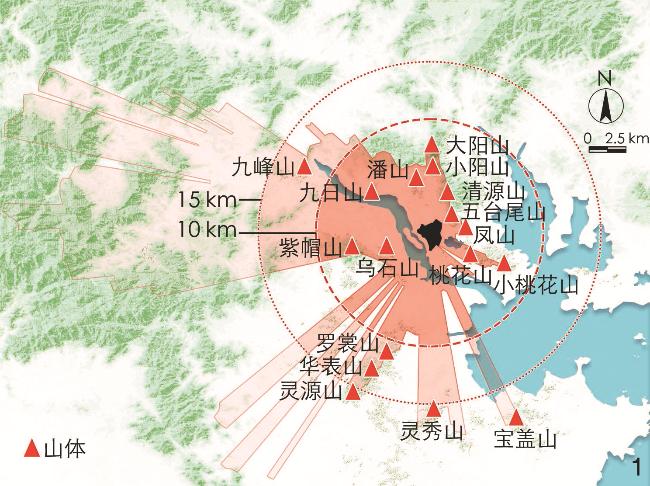
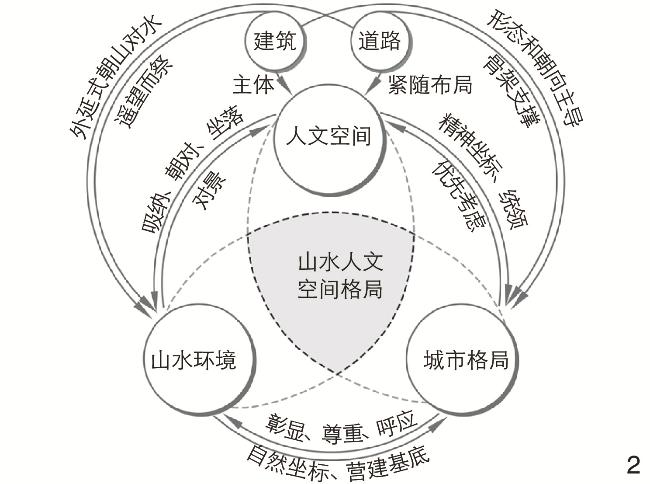
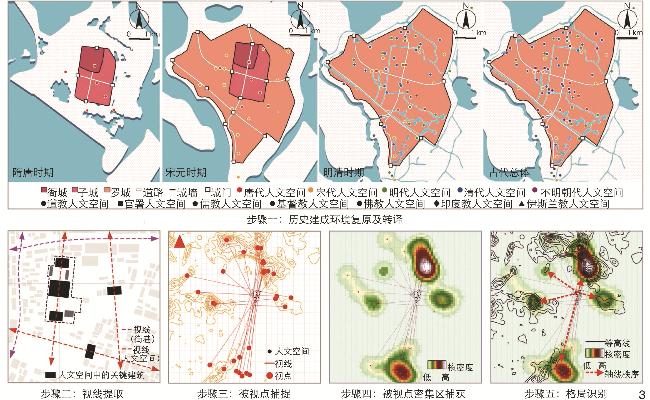
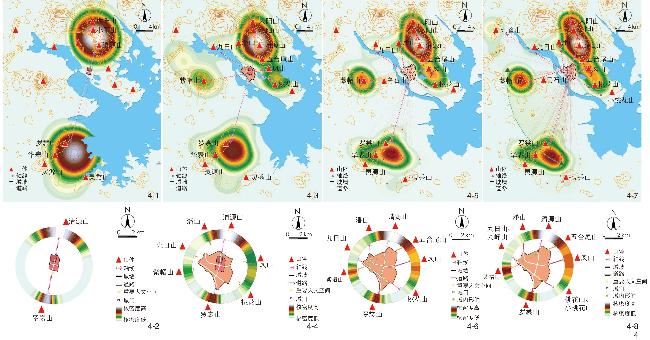
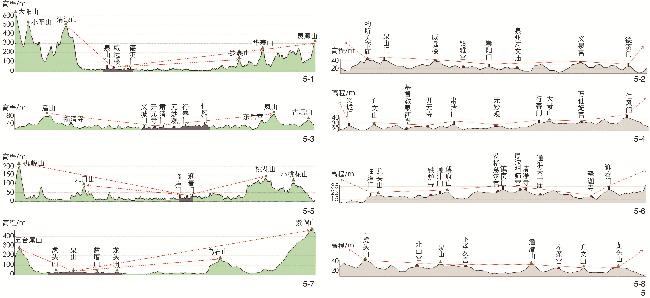
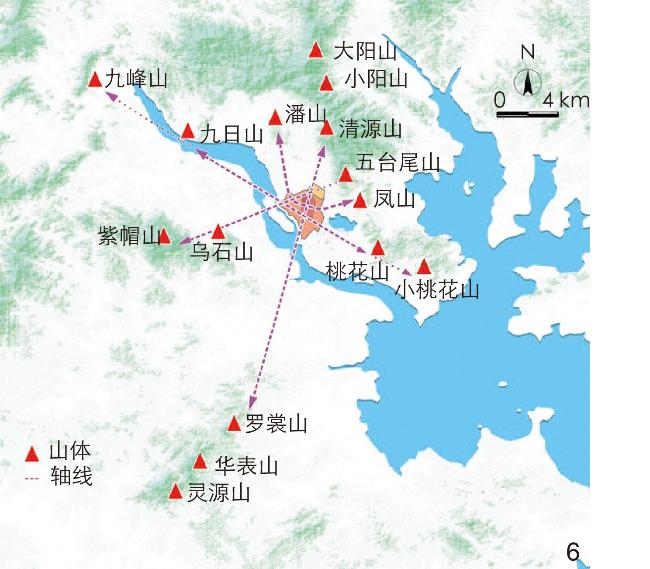
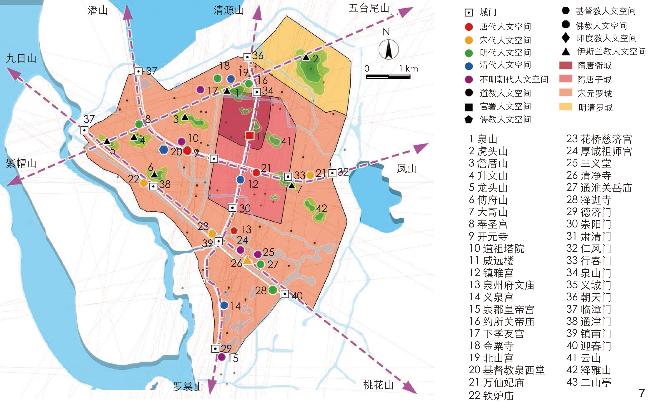
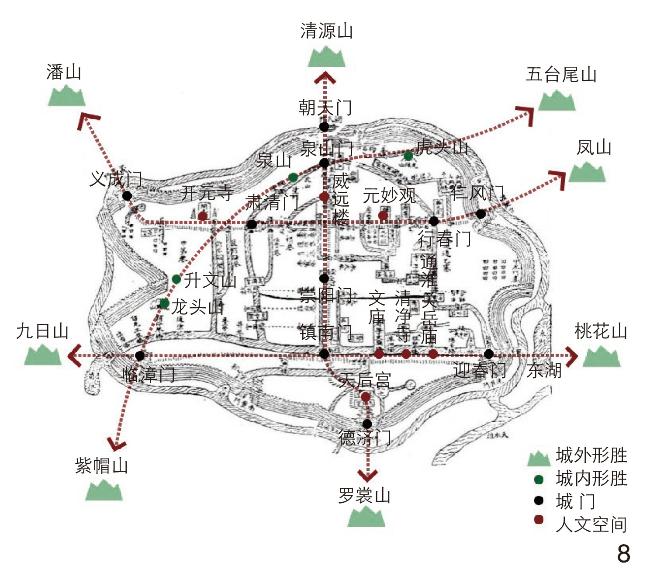
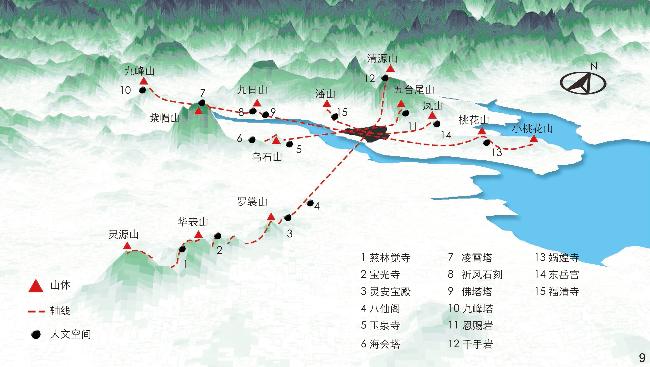
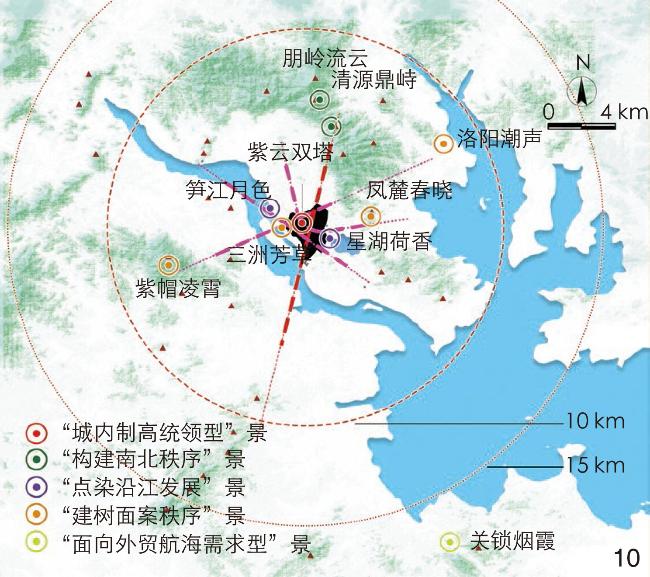
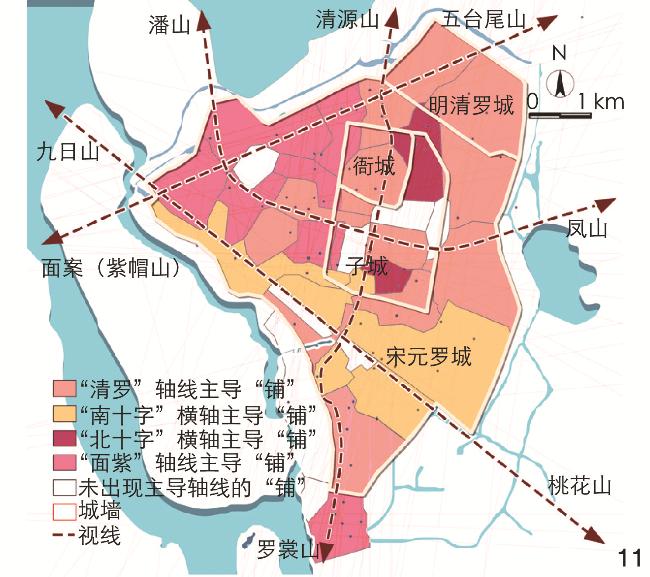
【目的】识别山水人文空间格局有助于格局发展策略的提出和识别技术体系的构建,是发掘中国传统城市营建智慧的重要前提。【方法】以“人文空间视线关联山水”的营建原则为方法构建基础,借助ArcGIS软件中创建要素、交点捕捉、核密度分析等工具,构建“历史建成环境复原及转译—视线提取—被视点捕捉—被视点密集区捕获—格局识别”的方法路径。【结果】古代泉州历经隋唐“倚恃清罗,独轴定址”—宋元“望山引序,七峰夹持”—明清“两横一纵,朝案昭彰”的格局演化历程,形成四轴所构的“牛”字形总体山水人文空间格局,具有在空间秩序上“双十率东,面紫立西”、在景致风物上“山城一体,层景立境”和在文化内涵上“景情交融,文蕴立域”的特征。【结论】泉州山水人文空间格局蕴含着空间秩序永续延展、景致风物层叠可得、自然人文互动互促的格局营建智慧;未来研究可在研究对象方面扩充山水城市案例,在研究方法方面进行智能化革新提升,在研究实践方面指导空间格局修复和发展策略制定,从而实现全面认知和保护历史城市山水人文空间格局的目标。
刘淑虎 , 黄静馨 , 黄龙英 , 王文奎 . 基于视线关联的古代泉州山水人文空间格局识别与解析[J]. 风景园林, 2024 , 31(6) : 115 -124 . DOI: 10.3724/j.fjyl.202307050300
【Objective】As an important prerequisite for exploring the wisdom of traditional construction, the identification of pattern of landscape and humanity space is conducive to the proposal of pattern development strategy and the construction of identification technology, and can help solve the problem that a large number of urban spatial patterns need to be identified and protected.【Methods】Following the space construction principle of “establishing line-of-sight correlation between humanity space and landscape”, this research constructs an identification approach for spatial pattern that includes five steps: “restoration and translation of historical built environment”, “extraction of line of sight”, “capture of viewed points”, “capture of densely viewed areas” and “identification of spatial pattern”, in order to open up a new perspective for the identification, protection and development of urban spatial patterns. Specifically, the “extraction of line of sight” means using the create features tool of ArcGIS to extract the orientation of humanity spaces and streets to simulate the line of sight; the “capture of viewed points” means using the Intersection Snapping Tool of ArcGIS to capture the intersection of the light of sight and the maximum value of the contour line to simulate the viewed point; the “capture of densely viewed areas” means using the kernel density analysis tool of ArcGIS to analyze the kernel density of viewed points and obtain densely viewed areas; the “identification of spatial pattern” means determining the cultural order within the city and identifying the pattern of landscape and humanity space by comparing the consistency between the densely viewed areas and visible mountain peaks at a macro scale, and analyzing the correlation between the orientation of highly consistent streets, humanity spaces and mountain peaks at the urban scale.【Results】The research results show that in Sui and Tang dynasties, when the ritual order dominated urban construction, the pattern of landscape and humanity space in Quanzhou City was mainly distributed along the north-south direction, forming a north-south single axis connecting Qingyuan Mountain and Luochang Mountain, and laying a solid foundation for the long-term development of the spatial pattern of Quanzhou. During Song and Yuan dynasties featuring economic prosperity and development, Quanzhou, under the dual influence of foreign and local cultures, presented a trend of diversified and personalized urban construction to meet multiple needs such as economic, religious and cultural needs, forming a central divergent spatial pattern overlooking seven mountains. During Ming and Qing dynasties when urban construction was dominated by folk religion, relying on the street framework and driven by the “Pujing” (“mirror laying”) systempattern, Quanzhou actively built humanity space with a specific orientation to enhance the line-of-sight correlation, and created a spatial pattern emphasizing two horizontal axes and one vertical axis and clarifying the two mountains of Chao Mountain and An Mountain. In summary, Quanzhou continued and strengthened the “牛” (“Niu”)-shaped pattern led by the four axes through the coordinated construction of humanity spaces based on line-of-sight correlation. This evolutionary process exhibits the characteristics of enriched belief, personalized orientation, and scientific concept. The analysis of the aforesaid spatial pattern reveals that in terms of spatial order, Quanzhou seeks the ingenuity of nature and constructs humanity spaces with artistic conception, thus forming a spacial pattern featuring inheritance and leadership, with the “Double Ten” axis determining the spatial pattern of the eastern urban area, while the axis facing Zimao Mountain determining the spatial pattern of the western urban area. In terms of landscape construction, through the development and supplementation of humanity spaces, Quanzhou establishes a landscape system featuring city − mountain integration with a strong sense of charm; in terms of cultural connotation, mountains are related to urban culture and life, thus consolidating urban cohesion and centrality.【Conclusion】Upon review and analysis, this research concludes that the pattern of landscape and humanity space in ancient Quanzhou City contains three types of construction wisdom: Construction essence of extension and sustainability of spatial order; design techniques for the hierarchy and accessibility of landscape organization; application wisdom of interaction and mutual promotion between nature and culture. Future research may expand the case studies of landscape cities in terms of research object, carry out intelligent innovation and improvement in research method, and guide the formulation of spatial pattern restoration and development strategy in practice, thus achieving the goal of comprehensive understanding and protection of the historical pattern of landscape and humanity space.
| [1] |
王树声. 中国城市规划传统的现代意义[J]. 城市规划, 2019, 43(1): 50-57.
WANG S S. Modern Significance of Chinese Urban Planning Traditions[J]. City Planning Review, 2019, 43(1): 50-57.
|
| [2] |
王树声, 高元, 李小龙. 中国城市山水人文空间格局研究[J]. 城市规划学刊, 2019 (1): 27-32.
WANG S S, GAO Y, LI X L. A Study on the Spatial Structure of Chinese Landscaping and Cultural Cities[J]. Urban Planning Forum, 2019 (1): 27-32.
|
| [3] |
孙诗萌.自然与道德: 古代永州地区城市规划设计研究[M].北京: 中国建筑工业出版社, 2019: 87-88, 257-268.
SUN S M. Nature and Morality: The Planning and Design of Cities in Historic Yongzhou Region[M]. Beijing: China Architecture & Building Press, 2019: 87-88, 257-268.
|
| [4] |
李小龙, 王茜, 赵子良, 等. 关中聚落空间格局的山水人文营建经验研究[J]. 南方建筑, 2022, 211(5): 27-34.
LI X L, WANG Q, ZHAO Z L, et al. Empirical Study on Landscape and Cultural Construction of Spatial Patterns in Guanzhong Settlement[J]. South Architecture, 2022, 211(5): 27-34.
|
| [5] |
毛华松, 程语. 辨方正位, 体国经野: 《周礼》营国制度中的山水风景意象及其历史影响研究[J]. 中国园林, 2020, 36(4): 16-21.
MAO H S, CHENG Y. Identifying the Region and Rectifying the Order, and Shaping the Cities and Countryside: Study on Landscape Imagery and Historical Influence of Capital Construction System in Rites of the Zhou[J]. Chinese Landscape Architecture, 2020, 36(4): 16-21.
|
| [6] |
沈旸, 周小棣, 梁勇. 镇山与镇庙: 古代山川崇拜中的建筑与景观呈现[J]. 中国园林, 2015, 31(7): 92-96.
SHEN Y, ZHOU X D, LIANG Y. Five Sacred Mountains & Temple: The Ancient Worship of Mountains and Rivers in the Landscape[J]. Chinese Landscape Architecture, 2015, 31(7): 92-96.
|
| [7] |
谢恬子, 傅凡, 郑德昊, 等.基于诗词文本的北京西山文化景观格局研究[J].风景园林, 2024, 31(2): 129-136.
XIE T Z, FU F, ZHENG D H, et al. Research on the Pattern of Cultural Landscape in the West Mountain of Beijing Based on Poetry Texts[J]. Landscape Architecture, 2024, 31(2): 129-136.
|
| [8] |
种岚妮. 西安古村落山水人文空间格局及其保护传承策略研究[D].西安: 西安建筑科技大学, 2021.
ZHONG L N. Study on the Cultural Spatial Pattern of Ancient Villages in Xi’an and Its Protection and Inheritance Strategies[D]. Xi’an: Xi’an University of Architecture and Technology, 2021.
|
| [9] |
贾媛. 榆林沿黄地区典型传统村落山水人文空间格局解析及传承策略[D].西安: 西安建筑科技大学, 2021.
JIA Y. The Typical Traditional Villages Landscape Cultural Space Structure Analysis and Inheritance Strategy Along the Yellow River in Yulin[D]. Xi’an: Xi’an University of Architecture and Technology, 2021.
|
| [10] |
刘梦. 富平城市山水人文空间格局及其保护研究[D].西安: 西安建筑科技大学, 2020.
LIU M. A Study on the Protection of Structure of Landscaping and Cultural Space in Fuping County[D]. Xi’an: Xi’an University of Architecture And Technology, 2020.
|
| [11] |
张杰.中国古代空间文化溯源[M].北京: 清华大学出版社, 2012.
ZHANG J. The Cultural Gene of Ancient Chinese Space[M]. Beijing: Tsinghua University Press, 2012.
|
| [12] |
王贵祥. 中国古代建筑方位问题探讨[J]. 建筑史, 2009 (2): 108-126.
WANG G X. A Research on the Orientation of Ancient Chinese Architecture[J]. Journal of Architecture History, 2009 (2): 108-126.
|
| [13] |
武廷海. 从形势论看宇文恺对隋大兴城的“规画”[J]. 城市规划, 2009, 265(12): 39-47.
WU T H. On Plan for Capital City of Daxing in Sui Dynasty Led by Yu Wenkai in the View of Xingshi Theory[J]. City Planning Review, 2009, 265(12): 39-47.
|
| [14] |
武廷海. 画圆以正方: 中国古代都邑规画图式与规画术研究[J]. 城市规划, 2021, 45(1): 80-93.
WU T H. City Planning with Compass: An Inquiry into the Pattern and Method of Ancient Chinese City Planning[J]. City Planning Review, 2021, 45(1): 80-93.
|
| [15] |
田梦瑶, 郑文俊, 艾烨, 等. 桂林山水城市历史景观“锚固-层积”时空过程解译[J]. 中国园林, 2022, 38(3): 26-31.
TIAN M Y, ZHENG W J, AI Y, et al. The Interpretation of the Spatial-Temporal Process of “Anchoring-Layering” Structure of Guilin Landscape City Historical Urban Landscape[J]. Chinese Landscape Architecture, 2022, 38(3): 26-31.
|
| [16] |
张杨, 何依.“破立之间”: 历史城区街巷空间的开放性研究: 以平遥古城书院街区为例[J].现代城市研究, 2020(10): 110-115.
ZHANG Y, HE Y. “Between Breaking and Building”: An Open Study of the Space of Historic Cities: A Case Study of Shuyuan Block in the Ancient City of Pingyao[J], Modern Urban Research, 2020(10): 110-115.
|
| [17] |
王树声, 李小龙, 严少飞. 结合大尺度山水环境的中国传统规划设计方法[J]. 科学通报, 2016, 61(33): 3564-3571.
WANG S S, LI X L, YAN S F. Research on the Design Method of China’s Traditional Urban Planning Based on Large-Scale Landscape Environment[J]. Chinese Science Bulletin, 2016, 61(33): 3564-3571.
|
| [18] |
毛华松, 汤思琦, 傅俊杰. 中国古代“城-山”风景的文化意象、空间秩序与景致营建研究[J]. 中国园林, 2022, 38(1): 26-31.
MAO H S, TANG S Q, FU J J. Research on the Cultural Image, Spatial Order and Landscape Construction of Ancient Chinese “City-Mountain” Landscape[J]. Chinese Landscape Architecture, 2022, 38(1): 26-31.
|
| [19] |
李建, 董卫.古代城市地图转译的历史空间整合方法: 以杭州市古代城市地图为例[J].城市规划学刊, 2008(2): 93-98.
LI J, DONG W. An Integrated Research Approach on City Map Decoding Based on Reshaping Decoding of Ancient Map of Hangzhou City[J], Urban Planning Forum, 2008(2): 93-98.
|
| [20] |
泉州历史文化中心.泉州古建筑[M].天津: 天津科学技术出版社, 1991.
Quanzhou Historical and Cultural Center. Quanzhou Ancient Architecture[M]. Tianjin: Tianjin Science and Technology Press, 1991.
|
| [21] |
吴幼雄, 黄伟民, 陈桂炳.泉州史迹研究[M].厦门: 厦门大学出版社, 1998.
WU Y X, HUANG W M, CHEN G B. Research on Quanzhou Historical Sites[M]. Xiamen: Xiamen University Press, 1998.
|
| [22] |
杨园章. 张廷芳家族的礼仪实践: 明初泉州儒学的社会史考察[J]. 民俗研究, 2023 (1): 100-110.
YANG Y Z. The Etiquette Practice of Zhang Tingfang’s Family: A Social History Study of Quanzhou Confucianism in the Early Ming Dynasty[J]. Folklore Studies, 2023 (1): 100-110.
|
| [23] |
周焜民.泉州古城踏勘[M].厦门: 厦门大学出版社, 2007.
ZHOU K M. Reconnaissance of Quanzhou Ancient City[M]. Xiamen: Xiamen University Press, 2007.
|
| [24] |
吴丹丹, 吴杨, 马仁锋, 等. 浙江美丽乡村空间格局及可持续发展模式研究[J]. 世界地理研究, 2022, 31(2): 363-375.
WU D D, WU Y, MA R F, et al. Study on the Spatial Differentiation Pattern and Sustainable Development Model of Beautiful Villages in Zhejiang Province[J]. World Regional Studies, 2022, 31(2): 363-375.
|
| [25] |
李佳丽, 邓蜀阳. 从城市“图—底”关系看城市空间秩序[J]. 规划师, 2014, 30(8): 127-131.
LI J L, DENG S Y. Urban Spatial Order from the Perspective of the Relationship Between “Figure-Bottom” in Cities[J]. Planners, 2014, 30(8): 127-131.
|
| [26] |
孙希旦.礼记集解[M].北京: 中华书局, 1998.
SUN X D. Collection and Interpretation of Rites[M]. Beijing: Zhonghua Book Company, 1998.
|
| [27] |
怀荫布.泉州府志[M].台北: 成文出版社, 1970.
HUAI Y B. Quanzhou Prefecture Annals[M]. Taipei: Chengwen Press, 1970.
|
| [28] |
张阁. 古代泉州城市景观体系研究[D].北京: 北京林业大学, 2020.
ZHANG G. Research on Landscape System of Ancient Quanzhou City[D]. Beijing: Beijing Forestry University, 2020.
|
| [29] |
郑巧芬. 唐宋闽南岁时诗研究[D].泉州: 华侨大学, 2015.
ZHENG Q F. A Study of Suishi Poetry in Southern Fujian During the Tang and Song Dynasties[D]. Quanzhou: Huaqiao University, 2015.
|
| [30] |
刘天怡, 钟书林. 遗民泪难禁, 谁慰飘蓬意: 林朝崧与乙未前后的台湾诗坛[J]. 台湾研究集刊, 2018 (5): 77-87.
LIU T Y, ZHONG S L. Lin Chaosong and the Taiwan Poetry Around Yi Wei Period[J]. Taiwan Research Journal, 2018 (5): 77-87.
|
| [31] |
杨思然, 王树声, 李小龙, 等. 文轴: 一种构建城市人文空间格局的秩序基线[J]. 城市规划, 2019, 43(7): 67-68.
YANG S R, WANG S S, LI X L, et al. The Axis of Culture: An Order Baseline for Constructing the Spatial Pattern of Urban Culture[J]. City Planning Review, 2019, 43(7): 67-68.
|
| [32] |
王树声, 石璐, 朱玲.三形: 结合自然山水规划的三个层次[J].城市规划, 2017, 41(1): 中插1-中插2.
WANG S S, SHI L, ZHU L. Three Levels: Combining the Three Levels of Natural Landscape Planning[J]. City Planning Review, 2017, 41(1): Insert1-Insert 2.
|
| [33] |
张琳捷, 王树声, 李小龙, 等. 文镇: 一种提振地脉而凝铸人心的规划方法[J]. 城市规划, 2019, 43(9): 61-62.
ZHANG L J, WANG S S, LI X L, et al. Wenzhen: A Planning Method for Revitalizing the Veins and Solidifying Minds[J]. City Planning Review, 2019, 43(9): 61-62.
|
| [34] |
赵春喜. 泉州多元文化与泉州十景[D].泉州: 华侨大学, 2007.
ZHAO C X. Multicultural Culture of Quanzhou and the Ten Views of Quanzhou[J]. Quanzhou: Huaqiao University, 2007.
|
/
| 〈 |
|
〉 |