

城市荒野的生态与文化价值研究进展
|
李嘉宁/男/北京大学城市与环境学院在读博士研究生/水利部水生态保护和水利遗产重点实验室成员/研究方向为设计生态学、乡村振兴研究与实践 |
|
王志勇/男/博士/中国环境科学研究院助理研究员/研究方向为生态保护修复监管理论与方法、区域生态文明战略 |
|
吴珊珊/女/博士/北京大学建筑与景观设计学院讲师/水利部水生态保护和水利遗产重点实验室成员/研究方向为生态修复、景观服务与绩效评估 |
|
谢梦云/女/博士/武汉大学城市设计学院讲师/研究方向为景观美学、乡村振兴研究与实践 |
Copy editor: 边紫琳
收稿日期: 2023-06-01
修回日期: 2023-11-11
网络出版日期: 2025-12-11
基金资助
国家社会科学基金后期资助一般项目“《东京梦华录》中的城市空间意象研究”(23FYSB047)
国家重点研发计划“城市水生态修复技术与功能评价”(2016YFC0401105)
国家自然科学基金面上项目“城市水适应性景观的水文调控机制及绩效评估”(51678002)
版权
Progress of Research on Ecological and Cultural Values of Urban Wilderness
|
LI Jianing is a Ph.D. candidate in the College of Urban and Environmental Sciences, Peking University, and a member of Ministry of Water Resources Key Laboratory for Hydro-ecology and Hydraulic Heritage. His research focuses on design ecology, and rural revitalization research and practice |
|
WANG Zhiyong, Ph.D., is an assistant research fellow in the Chinese Research Academy of Environmental Sciences. His research focuses on theory and approach in ecosystem protection, restoration, and supervision, and strategy on regional ecological civilization |
|
WU Shanshan, Ph.D., is a lecturer in the College of Architecture and Landscape, Peking University, and a member of Ministry of Water Resources Key Laboratory for Hydro-ecology and Hydraulic Heritage. Her research focuses on ecological restoration, and landscape service and performance assessment |
|
XIE Mengyun, Ph.D., is a lecturer in the School of Urban Design, Wuhan University. Her research focuses on landscape aesthetics, and rural revitalization research and practice |
Received date: 2023-06-01
Revised date: 2023-11-11
Online published: 2025-12-11
Copyright
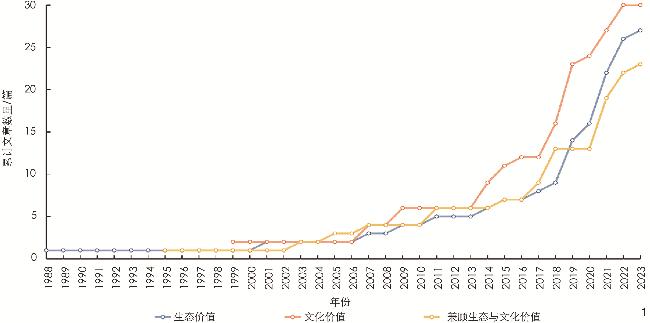
【目的】在当前中国生态文明建设的背景下,城市荒野的生态价值和文化价值日益凸显。理解城市荒野的综合价值可以为城市规划和管理提供重要参考,进而引导城市荒野的保护和恢复工作,促进社区参与和公众教育,提升居民的生活质量和福祉。【方法】在解析城市荒野概念内涵的基础上,聚焦其生态价值与文化价值,对30年来国内外研究进展进行梳理,总结共识,探讨未来可深入推进的方向。【结果】发现学界对城市荒野的理解可归纳为3种倾向:注重特定地点生态特性的城市荒野地、强调居民野性感知的野性体验点、结合生态与体验的城市荒野景观及城市野境。从生态视角来看,不同类型的城市荒野对应着保持或恢复自然主导作用的不同历程,其高度的自我调节能力形成的野性自然为城市提供了多种生态系统服务;从文化视角来看,居民的自然形象、景观偏好和景观体验与城市荒野的意象、评价、求趣与寄情相关联。【结论】基于对城市荒野生态价值与文化价值的辨析,总结出3个方面的联系以供后续研究探讨:1)城市荒野的动态演变是促进荒野感知的关键特征;2)城市荒野以自然过程为主导的特征对文化感知具有双重作用;3)生态与文化视角的融合共同影响着城市荒野生态系统的稳定性和发展前景。可为风景园林领域的从业者和研究者提出建议。
李嘉宁 , 王志勇 , 吴珊珊 , 谢梦云 . 城市荒野的生态与文化价值研究进展[J]. 风景园林, 2024 , 31(1) : 89 -96 . DOI: 10.3724/j.fjyl.202306010255
[Objective] In the context of enhanced construction of ecological civilization in China, the concept of urban green development and urban organic renewal continue to advance, the nature-based technology for rewilding of urban ecological space is rapidly developing, and the public’s awareness of ecological protection has increased, making the ecological and cultural values of urban wilderness increasingly prominent. The protection, restoration, and development of urban wilderness play an important role in increasing urban biodiversity, promoting the sustainability of urban ecosystem, enriching the cultural connotation of urban landscape, improving residents’ quality of life, and promoting cultural identity and community cohesion. [Methods] This research analyzes the concept and connotation of urban wilderness with a focus on the ecological and cultural values of urban wilderness. With “urban” and “wilderness or wildness or wildscape” as theme search terms, the research reviews the progress of relevant researches at home and abroad over the past 30 years through the China National Knowledge Infrastructure (CNKI) core journals, CSSCI, CSCD, and “Web of Science” databases. Moreover, the research summarizes the existing research consensus, and discusses future research directions to be further explored. [Results] The research shows that there are three tendencies in the academic understanding of urban wilderness, including “urban wilderness areas” that focus on the ecological characteristics of specific locations, “wildness experience points” that emphasize the wildness experience of urban residents, and “urban wildscape” and “urban wildness” that combine ecological characteristics of specific locations with resident experience. Different types of urban wilderness correspond to different processes of maintaining or restoring natural dominance. The wild nature formed by the high self-regulation capability of urban wilderness can provide ecological support services, provisioning services, regulating services, and cultural services to the city. These services play an important role in promoting urban sustainable development, improving residents’ quality of life, and promoting harmonious coexistence between human and the natural environment. However, compared to the support services and cultural services, regulating services and provisioning services still lack empirical research. Subsequent research may focus on performance evaluation of urban wilderness practice projects centering around the regulating services and provisioning services to comprehensively reveal the ecological value of urban wilderness. The research from the cultural perspective of urban wilderness mainly emphasizes residents’ subjective perception and experience at the spiritual level, involving residents’ natural image, landscape preference, and landscape experience of urban wilderness. Residents’ natural image of urban wilderness corresponds to residents’ perception of urban wilderness. On the one hand, the nature-dominated characteristics of urban wilderness may evoke contradictory perceptions. On the other hand, personal growth environment, frequency of contact with urban wilderness, values, and cultural backgrounds may also influence residents’ understanding and cognition of the natural image of urban wilderness. Residents’ landscape preference for urban wilderness reflects their specific evaluations of wildness. The spatial structure, management level and accessibility of urban wilderness, as well as residents’ age, gender, education level, cultural background, etc., may all influence their preferences for urban wilderness. Therefore, it is helpful to increase the public’s understanding, appreciation, and awareness of the ecological, economic, and cultural values of wilderness landscape through multimedia science popularization activities. Residents’ experience in urban wilderness is related to their pursuit of interest and emotional attachment to the wilderness. There is a consensus among scholars on endowing wilderness spaces with a core meaning of “experience”. Urban residents can experience wilderness by combining sensory experience and imagination. Urban wilderness also helps urban residents form attachment to places, thereby enhancing their self-esteem and personal identity. Therefore, designers may create private spaces for solitude and contemplation, set up viewing platforms to experience seasonal changes, and provide various recreational facilities to enrich residents’ experiences in urban wilderness. [Conclusion] Based on the analysis of the ecological and cultural values of urban wilderness, this research summarizes three aspects of the connection between the ecological and cultural characteristics and values of urban wilderness for future exploration: the dynamic evolution of urban wilderness is a key feature that promotes wilderness perception; the nature-dominated characteristics of urban wilderness have a dual effect on cultural perception; the integration of ecological and cultural perspectives jointly influences the stability and development prospects of urban wilderness ecosystems. Finally, the research proposes several development suggestions for practitioners and researchers in landscape planning and design, including the formulation of technical indicators related to urban wilderness, the systematic identification and evaluation of urban wilderness areas that need protection and restoration, the determination of corresponding conservation and management requirements, the enhancement of publicity and education to promote public participation, and the promotion of multi-sector cooperation to form a multi-participation work pattern.
| [1] |
SHANAHAN D F, LIN B B, BUSH R, et al. Toward Improved Public Health Outcomes from Urban Nature[J]. American Journal of Public Health, 2015, 105(3): 470-477.
|
| [2] |
DIEMER M, HELD M, HOFMEISTER S. Urban Wilderness in Central Europe[J]. International Journal of Wilderness, 2003, 9(3): 7-11.
|
| [3] |
俞孔坚. 城市荒野: 另一种文明[J]. 景观设计学, 2021, 9(1): 5-9.
YU K J. Urban Wildness as Another Civilization[J]. Landscape Architecture Frontiers, 2021, 9(1): 5-9.
|
| [4] |
CASSON S A, MARTIN V G, WATSON A, et al. Wildness Protected Areas: Management Guidelines for IUCN Category 1b Protected Areas[M]. Gland: IUCN, 2016.
|
| [5] |
CRONON W. The Trouble with Wildness: Or, Getting Back to the Wrong Nature[J]. Environmental History, 1996, 1(1): 7-28.
|
| [6] |
曹越, 马丁, 杨锐. 城市野境: 城市区域中野性自然的保护与营造[J]. 风景园林, 2019, 26(8): 20-24.
CAO Y, MARTIN V G, YANG R. Urban Wildness: Protection and Creation of Wild Nature in Urban Areas[J]. Landscape Architecture, 2019, 26(8): 20-24.
|
| [7] |
马丁, 希尔. 城市野境: 比“城市荒野”更准确的措辞[J]. 景观设计学, 2021, 9(1): 80-91.
MARTIN G V, HILL M. Urban Wildness: A More Correct Term Than “Urban Wilderness”[J]. Landscape Architecture Frontiers, 2021, 9(1): 80-91.
|
| [8] |
袁嘉. 城市荒野: 夹缝中的自然与机遇[J]. 景观设计学, 2021, 9(1): 10-13.
YUAN J. Urban Wilderness: Nature and the Potential in the Urban Cracks[J]. Landscape Architecture Frontiers, 2021, 9(1): 10-13.
|
| [9] |
钱蕾西, 王晞月, 王向荣. 城市自然的再认知: 典型城市荒野空间的识别特征及应对策略[J]. 中国园林, 2022, 38(8): 16-23.
QIAN L X, WANG X Y, WANG X R. Recognition of Urban Nature: Identification Features and Coping Strategies of Typical Urban Wilderness Spaces[J]. Chinese Landscape Architecture, 2022, 38(8): 16-23.
|
| [10] |
王晞月, 王向荣. 风景园林视野下的城市中的荒野[J]. 中国园林, 2017, 33(8): 40-47.
WANG X Y, WANG X R. Urban Wilderness Based on the View of Landscape Architecture[J]. Chinese Landscape Architecture, 2017, 33(8): 40-47.
|
| [11] |
邵钰涵, 徐欣瑜, 袁嘉. 城市荒野景观: 内涵与价值审视[J]. 景观设计学, 2021, 9(1): 14-25.
SHAO Y H, XU X Y, YUAN J. The Intension and Values of Urban Wildscapes[J]. Landscape Architecture Frontiers, 2021, 9(1): 14-25.
|
| [12] |
KOWARIK I. Urban Wilderness: Supply, Demand, and Access[J]. Urban Forestry & Urban Greening, 2018, 29: 336-347.
|
| [13] |
KOWARIK I. Wild Urban Woodlands: Towards a Conceptual Framework[M]//KOWARIK I, KÖRNER S. Wild Urban Woodlands: New Perspectives for Urban Forestry. Berlin: Springer Berlin Heidelberg, 2005: 1-32.
|
| [14] |
DUFFNER F, WATHERN P. Building an Urban Wilderness[J]. Environment, 1988, 30(2): 12-34.
|
| [15] |
RUST S P. The Urban Wilderness Park: An Oxymoron?[R]. Albany: USDA Forest Service, 1995.
|
| [16] |
王向荣. 城市荒野与城市生境[J]. 风景园林, 2019, 26(1): 4-5.
WANG X R. Urban Wilderness and Urban Habitat[J]. Landscape Architecture, 2019, 26(1): 4-5.
|
| [17] |
袁嘉, 欧桦杰, 金晓东, 等. 城市荒野生态研究概述[J]. 生态学报, 2023, 43(4): 1703-1713.
YUAN J, OU H J, JIN X D, et al. An Overview of Urban Wildness Ecological Research[J]. Acta Ecologica Sinica, 2023, 43(4): 1703-1713.
|
| [18] |
RINK D. Wildness: The Nature of Urban Shrinkage? The Debate on Urban Restructuring and Restoration in Eastern Germany[J]. Nature and Culture, 2009, 4(3): 275-292.
|
| [19] |
BUNTING B S. An Alternative Wildness: How Urban Exploration Brings Wildness to the City[J]. Interdisciplinary Studies in Literature and Environment, 2015, 22(3): 602-622.
|
| [20] |
JORGENSEN A, KEENAN R. Urban Wildscapes[M]. London: Rouledge, 2012: 1-2.
|
| [21] |
科瓦里克. 与荒野共生: 城市绿地的发展前景[J]. 景观设计学, 2021, 9(1): 92-103.
KOWARIK I. Working with Wilderness: A Promising Direction for Urban Green Spaces[J]. Landscape Architecture Frontiers, 2021, 9(1): 92-103.
|
| [22] |
KONIJNENDIJK C C. New Perspectives for Urban Forests: Introducing Wild Woodlands[M]//KOWARIK I, KÖRNER S. Wild Urban Woodlands: New Perspectives for Urban Forestry. Berlin: Springer Berlin Heidelberg, 2005: 33-45.
|
| [23] |
WESTERMANN J R, VON DER LIPPE M, KOWARIK I. Seed Traits, Landscape and Environmental Parameters as Predictors of Species Occurrence in Fragmented Urban Railway Habitats[J]. Basic and Applied Ecology, 2011, 12(1): 29-37.
|
| [24] |
BURKHOLDER S. The New Ecology of Vacancy: Rethinking Land Use in Shrinking Cities[J]. Sustainability, 2012, 4(6): 1154-1172.
|
| [25] |
王晞月. 城市缝隙: 人居语境下荒野景观的存续与营造策略[J]. 城市发展研究, 2017, 24(7): 11-16.
WANG X Y. Urban Interstitial Space: Strategic Research on the Planning of Wildscape in the Context of Living Environment[J]. Urban Development Studies, 2017, 24(7): 11-16.
|
| [26] |
杨锐, 曹越. “再野化”: 山水林田湖草生态保护修复的新思路[J]. 生态学报, 2019, 39(23): 8763-8770.
YANG R, CAO Y. Rewilding: New Ideas for Ecological Protection and Restoration Projects of Mountains-Rivers-Forests-Farmlands-Lakes-Grasslands[J]. Acta Ecologica Sinica, 2019, 39(23): 8763-8770.
|
| [27] |
RUPPRECHT C D D, BYRNE J A, GARDEN J G, et al. Informal Urban Green Space: A Trilingual Systematic Review of Its Role for Biodiversity and Trends in the Literature[J]. Urban Forestry & Urban Greening, 2015, 14: 883-908.
|
| [28] |
AZNAREZ C, SVENNING J C, TAVEIRA G, et al. Wildness and Habitat Quality Drive Spatial Patterns of Urban Biodiversity[J]. Landscape and Urban Planning, 2022, 228: 104570
|
| [29] |
JORGENSEN A, TYLECOTE M. Ambivalent Landscapes-Wilderness in the Urban Interstices[J]. Landscape Research, 2007, 32(4): 443-462.
|
| [30] |
ZEFFERMAN E P, MCKINNEY M L, CIANCIOLO T, et al. Knoxville’s Urban Wilderness: Moving Toward Sustainable Multifunctional Management[J]. Urban Forestry and Urban Greening, 2018, 29: 357-366.
|
| [31] |
BONTHOUX S, BRUN M, DI PIETRO F, et al. How Can Wastelands Promote Biodiversity in Cities? A Review[J]. Landscape and Urban Planning, 2014, 132: 79-88.
|
| [32] |
KOWARIK I, HILLER A, PLANCHUELO G, et al. Emerging Urban Forests: Opportunities for Promoting the Wild Side of the Urban Green Infrastructure[J]. Sustainability, 2019, 11(22): 6318
|
| [33] |
郭陶然, 山冰沁. 城市荒野景观营造: 以上海乡土生态科普示范基地为例[J]. 景观设计学, 2021, 9(1): 120-131.
GUO T R, SHAN B Q. Urban Wilderness Construction: An Example of Shanghai Urban Biodiversity Education Base[J]. Landscape Architecture Frontiers, 2021, 9(1): 120-131.
|
| [34] |
袁嘉, 游奉溢, 侯春丽, 等. 基于植被再野化的城市荒野生境重建: 以野花草甸为例[J]. 景观设计学, 2021, 9(1): 26-39.
YUAN J, YOU F Y, HOU C L, et al. Reconstruction of Urban Wilderness Habitats Based on Vegetation Rewilding: Taking Wildflower Meadows as an Example[J]. Landscape Architecture Frontiers, 2021, 9(1): 26-39.
|
| [35] |
BAINES C. Foreword: The Wild Side of Town[M]//JORGENSEN A, KEENAN R. Urban Wildscapes. New York: Rouledge, 2012: xii-xv.
|
| [36] |
KITHIIA J, LYTH A. Urban Wildscapes and Green Spaces in Mombasa and Their Potential Contribution to Climate Change Adaptation and Mitigation[J]. Environment and Urbanization, 2011, 23(1): 251-265.
|
| [37] |
HWANG Y H, JONATHAL Z E Y. Intended Wildness: Utilizing Spontaneous Growth for Biodiverse Green Spaces in a Tropical City[J]. Journal of Landscape Architecture, 2019, 14(1): 54-63.
|
| [38] |
全璨璨, 胡玲玲, 范丽琨. 城市生态湿地公园的保护与利用: 以江洋畈生态公园为例[J]. 安徽农业科学, 2022, 50(8): 109-112.
QUAN C C, HU L L, FAN L K. Protection and Utilization of City Ecological Wetland Park: Taking Jiangyangfan Park as the Example[J]. Journal of Anhui Agricultural Sciences, 2022, 50(8): 109-112.
|
| [39] |
俞孔坚. 建筑与水涝共生: 哈尔滨群力雨洪公园[J]. 建筑学报, 2012(10): 68-69.
YU K J. Architecture and Waterlogging Symbiosis: Harbin Qunli Rainwater Park[J]. Architectural Journal, 2012(10): 68-69.
|
| [40] |
ASGARIAN A, AMIRI B J, SAKIEH Y. Assessing the Effect of Green Cover Spatial Patterns on Urban Land Surface Temperature Using Landscape Metrics Approach[J]. Urban Ecosystems, 2015, 18(1): 209-222.
|
| [41] |
MOLLEE E, POULIOT M, MCDONALD M A. Into the Urban Wild: Collection of Wild Urban Plants for Food and Medicine in Kampala, Uganda[J]. Land Use Policy, 2017, 63: 67-77.
|
| [42] |
GAREKAE H, SHACKLETON C M. Foraging Wild Food in Urban Spaces: The Contribution of Wild Foods to Urban Dietary Diversity in South Africa[J]. Sustainability, 2020, 12(2): 678
|
| [43] |
谢梦云. 当代中国城市对荒野审美的呼唤[J]. 风景园林, 2019, 26(8): 35-38.
XIE M Y. Pursuing Wilderness Aesthetics in Contemporary Chinese Cities[J]. Landscape Architecture, 2019, 26(8): 35-38.
|
| [44] |
KIRCHHOFF T, VICENZOTTI V. A Historical and Systematic Survey of European Perceptions of Wildness[J]. Environmental Values, 2014, 23(4): 443-464.
|
| [45] |
KEULARTZ J, VAN DER WINDT H, SWART J. Concepts of Nature as Communicative Devices: The Case of Dutch Nature Policy[J]. Environmental Values, 2004, 13(1): 81-99.
|
| [46] |
COLLEY K, CRAIG T. Natural Places: Perceptions of Wildness and Attachment to Local Greenspace[J]. Journal of Environmental Psychology, 2019, 61: 71-78.
|
| [47] |
SONTI N F. Ambivalence in the Woods: Baltimore Resident Perceptions of Local Forest Patches[J]. Society and Natural Resources, 2020, 33(7): 823-841.
|
| [48] |
CHEN C D, LU Y, JIA J S, et al. Urban Spontaneous Vegetation Helps Create Unique Landsenses[J]. International Journal of Sustainable Development and World Ecology, 2021, 28(7): 593-601.
|
| [49] |
LUTZ A R, SIMPSON-HOUSLEY P, DE MAN A F. Wildness Rural and Urban Attitudes and Perceptions[J]. Environment and Behavior, 1999, 31(2): 259-266.
|
| [50] |
BUIJS A E, ELANDS B H M, LANGERS F. No Wilderness for Immigrants: Cultural Differences in Images of Nature and Landscape Preferences[J]. Landscape and Urban Planning, 2009, 91(3): 113-123.
|
| [51] |
VAN DEN BERG A E. Individual Differences in the Aesthetic Evaluation of Natural Landscapes[D]. Groningen: Groningen University, 1999.
|
| [52] |
BRUN M, DI PIETRO F, BONTHOUX S. Residents’ Perceptions and Valuations of Urban Wastelands are Influenced by Vegetation Structure[J]. Urban Forestry & Urban Greening, 2018, 29: 393-403.
|
| [53] |
LAMPINEN J, TUOMI M, FISCHER L K, et al. Acceptance of Near-Natural Greenspace Management Relates to Ecological and Socio-Cultural Assigned Values among European Urbanites[J]. Basic and Applied Ecology, 2021, 50: 119-131.
|
| [54] |
RUPPRECHT C D D, BYRNE J A. Informal Urban Greenspace: A Typology and Trilingual Systematic Review of Its Role for Urban Residents and Trends in the Literature[J]. Urban Forestry & Urban Greening, 2014, 13(4): 597-611.
|
| [55] |
KIM M, RUPPRECHT C D D, FURUYA K. Residents’ Perception of Informal Green Space: A Case Study of Ichikawa City, Japan[J]. Land, 2018, 7(3): 102
|
| [56] |
HWANG Y H, YUE Z E J, LING S K, et al. It’s Ok to Be Wilder: Preference for Natural Growth in Urban Green Spaces in a Tropical City[J]. Urban Forestry & Urban Greening, 2019, 38: 165-176.
|
| [57] |
GOLD R J, REVILL G. Exploring Landscapes of Fear: Marginality, Spectacle and Surveillance[J]. Capital & Class, 2003, 27(2): 27-50.
|
| [58] |
STAVRIDES S. Heterotopias and the Experience of Porous Urban Space[M]//FRANCK K A, STEVENS Q. Loose Space: Possibility and Diversity in Urban Life. London: Routledge, 2007: 174-192.
|
| [59] |
THOMPSON C W. Urban Open Space in the 21st Century[J]. Landscape and Urban Planning, 2002, 60(2): 59-72.
|
| [60] |
KAPLAN R, KAPLAN S. Experience of Nature: A Psychological Perspective[M]. Cambridge: Cambridge University Press, 1989.
|
| [61] |
APPLETON J. The Experience of Landscape[M]. New York: John Wiley & Sons, 1975.
|
| [62] |
THOMSEN J M, POWELL R B, MONZ C. A Systematic Review of the Physical and Mental Health Benefits of Wildland Recreation[J]. Journal of Park and Recreation Administration, 2018, 36(1): 123-148.
|
| [63] |
LEV E, KAHN P H, CHEN H, et al. Relatively Wild Urban Parks Can Promote Human Resilience and Flourishing: A Case Study of Discovery Park, Seattle, Washington[J]. Frontiers in Sustainable Cities, 2020, 2: 2
|
| [64] |
SCANNELL L, GIFFORD R. Comparing the Theories of Interpersonal and Place Attachment[M]//MANZO L C, DEVINE-WRIGHT P. Place Attachment: Advances in Theory, Methods and Applications. London: Routledge, 2014: 23-36.
|
| [65] |
VON LINDERN E. Setting-Dependent Constraints on Human Restoration While Visiting a Wilderness Park[J]. Journal of Outdoor Recreation and Tourism, 2015, 10: 29-37.
|
| [66] |
FULLER R A, IRVINE K N, DEVINE-WRIGHT P, et al. Psychological Benefits of Greenspace Increase with Biodiversity[J]. Biology Letters, 2007, 3(4): 390-394.
|
| [67] |
THRELFALL C G, KENDAL D. The Distinct Ecological and Social Roles that Wild Spaces Play in Urban Ecosystems[J]. Urban Forestry & Urban Greening, 2018, 29: 348-356.
|
| [68] |
ASHLEY P. Toward an Understanding and Definition of Wilderness Spirituality[J]. Australian Geographer, 2007, 38(1): 53-69.
|
| [69] |
陈望衡. 城市审美如何容纳荒野?[J]. 郑州大学学报(哲学社会科学版), 2019, 52(4): 5-8.
CHEN W H. How does Urban Aesthetics Accommodate Wilderness?[J]. Journal of Zhengzhou University (Philosophy and Social Sciences Edition), 2019, 52(4): 5-8.
|
| [70] |
PERINO A, PEREIRA H M, NAVARRO L M, et al. Rewilding Complex Ecosystems[J]. Science, 2019, 364(6438): eaav5570
|
/
| 〈 |
|
〉 |